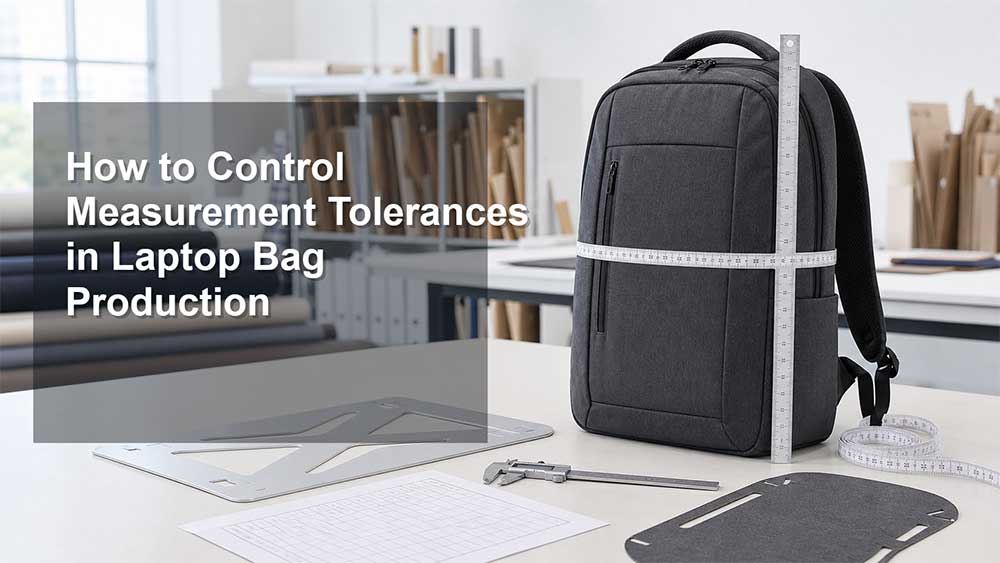
How to Control Measurement Tolerances in Laptop Bag Production
A laptop bag may match the approved appearance and still fail in use. The laptop compartment may be slightly too narrow, the zipper opening may restrict access, or two shoulder straps may finish at visibly different lengths.
These problems often come from one basic weakness: the product has target dimensions, but no reliable system for defining, measuring, and controlling dimensional variation.
Laptop bags are soft sewn products. Fabric can move during cutting, foam adds thickness, binding changes an edge, and sewing tension can affect the finished shape. Expecting every bag to be mathematically identical is unrealistic. Accepting any variation, however, creates problems with laptop fit, component alignment, appearance, packing, and batch consistency.
The practical objective is to establish tolerances that production teams can achieve, inspectors can measure consistently, and buyers can validate against the product’s intended use.
In practice, laptop bag measurement tolerances are controlled through six steps:
Define every point of measurement and its measuring condition.
Set tolerances according to functional, assembly, and visual risk.
Confirm usable laptop fit after the padded compartment is fully assembled.
Freeze the approved pattern, specification, and sample versions.
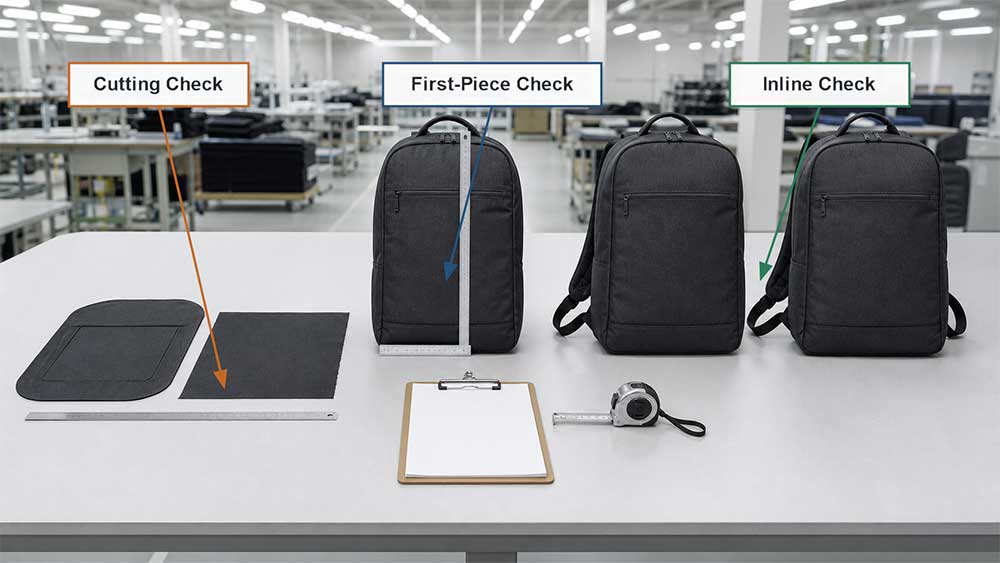
Measure during cutting, first-piece production, inline inspection, and final inspection.
Record actual results and investigate any systematic shift or out-of-tolerance measurement.
The rest of this guide explains how to apply these steps to a real laptop bag project.
What Is a Measurement Tolerance?
A measurement specification normally contains two elements:
Target measurement: the intended dimension
Tolerance: the permitted variation above or below that target
For example:
Finished bag width: 420 mm ±5 mm
This means that an individual bag measuring from 415 mm to 425 mm conforms to that specification, provided it was measured using the agreed method.
The tolerance does not mean that production should aim randomly anywhere within this range. The production target remains 420 mm. The tolerance defines the boundary between acceptable normal variation and a nonconforming result.
Why Laptop Bags Need Product-Specific Tolerances
There is no universal dimensional tolerance that works for every laptop bag, material, structure, or point of measurement.
A tolerance that is reasonable for the overall width may be too loose for a logo position and too tight for a softly filled exterior pocket. The correct range depends on:
The function of the measurement
The materials and construction
The size of the component
The measuring method
The visual effect of variation
The production process
The consequences of being too large or too small
Applying ±5 mm to every measurement may look simple on a specification sheet, but it rarely reflects how the product actually works.
Start With a Clear Point of Measurement
A point of measurement, commonly shortened to POM, defines exactly where and how a dimension is taken.
A useful POM should include:
A unique POM number
A clear measurement name
A diagram showing the start and end points
The target value
Positive and negative tolerances
The product condition during measurement
Any special instruction concerning foam, elastic, curves, or adjustable components
“Measure the laptop compartment” is not a complete instruction. It does not explain whether the inspector should measure:
The finished internal usable width
The lining panel from seam to seam
The foam cavity before binding
The opening through which the laptop enters
The external width of the compartment
These values can be different even when they describe the same area of the bag.
Define the Measuring Condition
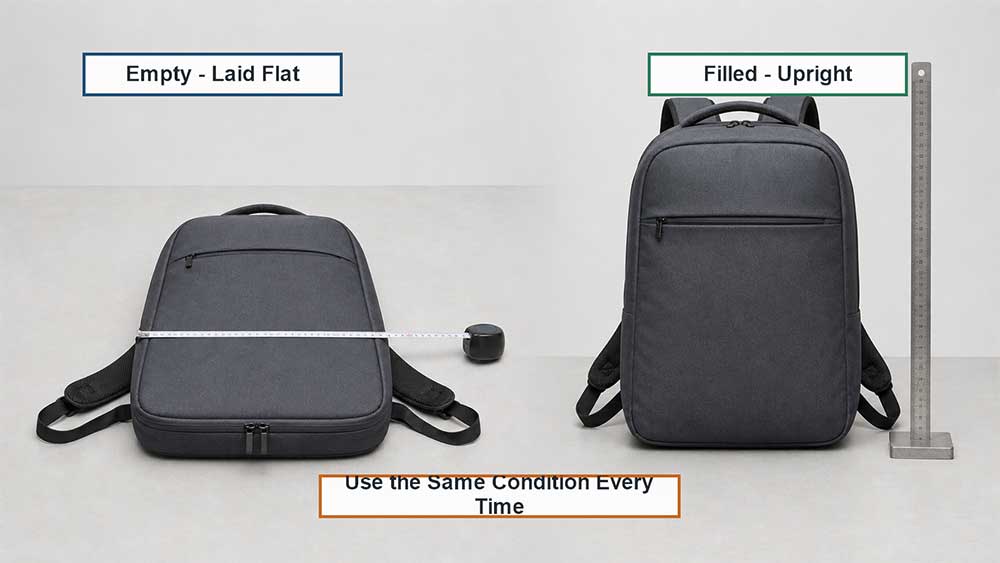
Soft bags can produce different results depending on how they are positioned and handled. A measurement method should therefore define the product condition.
Questions to settle include:
Is the bag laid flat or held upright?
Is it empty or filled with a specified load?
Are zippers open or closed?
Should foam be compressed?
Should fabric wrinkles be smoothed without stretching?
Are adjustable straps measured at their shortest, longest, or specified position?
Is elastic measured relaxed or extended?
Is a curved edge measured in a straight line or along the curve?
The measuring surface also matters. A flat table, calibrated tape or ruler, approved fitting device, and consistent handling pressure all improve repeatability.
This is especially important when the permitted tolerance is narrow. If two trained inspectors cannot reproduce reasonably similar results, the method needs to be clarified before the tolerance can be enforced.
The principles behind controlled measuring equipment and reliable measurement results are also addressed in ISO 10012:2026.
Classify Measurements by Risk
Not every POM deserves the same level of control. A practical approach is to classify dimensions according to what happens when they vary.
Functional measurements
These affect whether the product performs as intended.
Examples include:
Laptop compartment usable width and height
Effective zipper opening
Sleeve depth
Trolley sleeve width
Shoulder strap adjustment range
Handle clearance
Accessory pocket fit
Functional measurements usually require the most careful validation because an in-tolerance appearance cannot compensate for a laptop that does not fit.
Assembly measurements
These affect whether separate components fit or align during production.
Examples include:
Zipper and opening lengths
Gusset and body-panel matching
Webbing attachment positions
Foam and lining dimensions
Binding lengths
Buckle and strap compatibility
Assembly tolerances should account for the way several parts interact. A small deviation on each component can combine into a larger finished-product problem.
Visual measurements
These mainly affect symmetry and appearance.
Examples include:
Logo placement
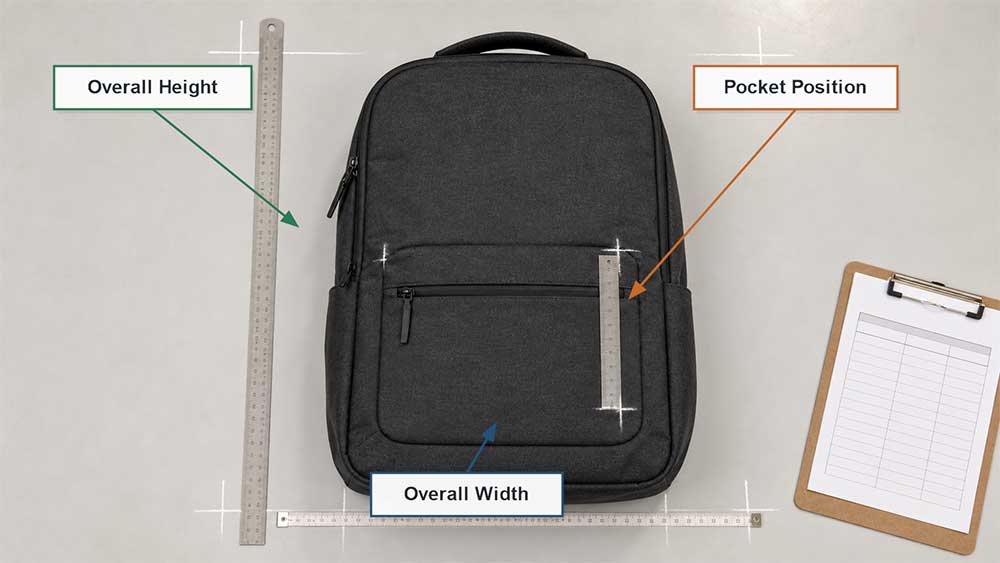
Pocket position
Stitching distance from an edge
Handle centering
Shoulder strap symmetry
Label placement
A small offset may not change function but can still make the product look inconsistent, particularly on clean business-bag designs with simple front panels.
General measurements
These describe overall product size without directly controlling a critical function.
Examples include:
Overall width
Overall height
Overall depth
Exterior pocket dimensions
They still matter for published specifications, packaging and visual consistency, but they may allow more variation than a critical device-fit measurement.
Laptop Fit Must Be Verified on the Finished Structure
Laptop size labels such as 13-inch, 15.6-inch, and 17-inch describe screen diagonals, not the complete device dimensions. Two laptops with the same advertised screen size may have different body widths, depths and thicknesses.
For that reason, laptop fit should not be approved from the size label alone. Buyers can first establish the target device dimensions using a consistent laptop measurement method, then validate fit using one or more of the following:
The actual target laptop
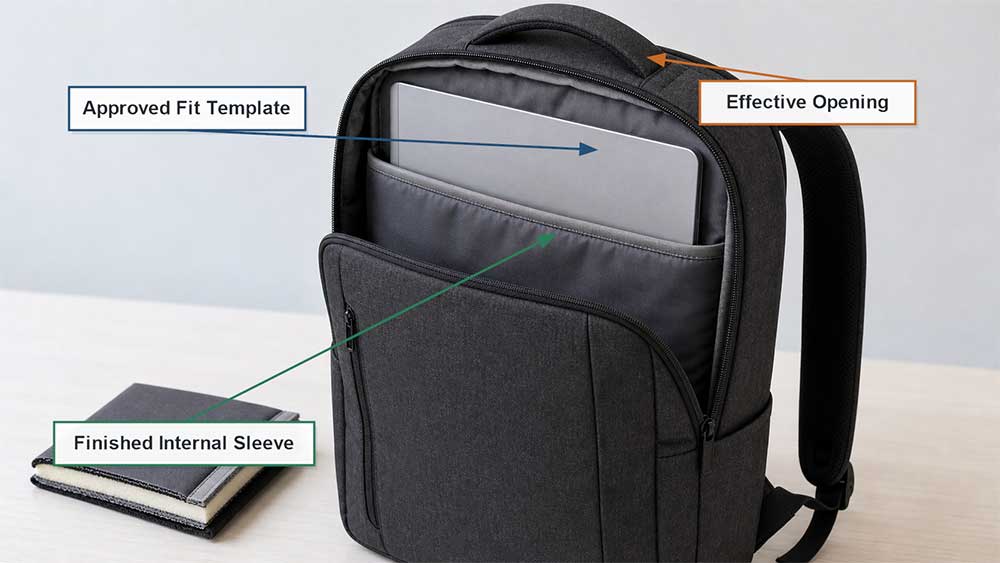
An approved rigid fitting template
A dummy device matching the maximum permitted dimensions
A documented device envelope covering the intended product range
Fit testing should take place after the compartment has been fully assembled with its lining, foam, binding, seams, closure and any suspension structure.
A flat cut panel may appear large enough before sewing. Once foam thickness, seam allowance and edge binding are added, the available internal space can become noticeably smaller.
Internal Size, Opening Size, and External Size Are Different
These three measurements are often confused:
External size: the outside dimensions of the finished bag or compartment
Internal usable size: the space available inside the assembled padded structure
Effective opening: the usable clearance through which the laptop must pass
A compartment can have sufficient internal width but still fail because the zipper opening is too short. It can also meet the external target while providing less internal space than expected because of thick foam or construction details.
For a laptop compartment, the specification may therefore need separate POMs for:
Usable internal width
Usable internal height
Effective opening length
Maximum device thickness
Top or side clearance
Bottom foam or suspension allowance
The required amount of space should be based on fit trials rather than on an untested theoretical formula.
Use Asymmetric Tolerances When Necessary
Not every measurement should use an equal plus-and-minus tolerance.
Suppose the minimum usable opening is 370 mm. Making it 3 mm wider may not cause a problem, but making it 3 mm narrower could prevent the target device from entering.
A specification might therefore use:
Effective laptop opening: 370 mm +5/-0 mm
Asymmetric tolerances are useful when one direction creates substantially more risk than the other.
They may apply to:
Minimum laptop compartment dimensions
Effective opening length
Minimum strap adjustment range
Maximum packed size
Logo clearance from a seam
Components that must fit inside another component
The tolerance should still be validated against appearance, structure and production capability. More space is not automatically better if it makes the laptop unstable inside the compartment.
Consider Tolerance Accumulation
A finished measurement is often influenced by several components.
For example, laptop-compartment capacity may depend on:
Main body-panel dimensions
Gusset width
Foam thickness
Lining dimensions
Seam allowance
Binding width
Zipper construction
Assembly position
Each component may individually fall within its permitted range, yet their combined variation can make the compartment too small.
This is tolerance accumulation, sometimes called tolerance stack-up.
When a finished function depends on several interacting parts, the safest approach is to validate the complete assembled structure. Component-level tolerances should support the finished functional requirement rather than replace it.
Example of a Laptop Bag Measurement Specification
The table below illustrates how a measurement specification can be structured. It is not a universal tolerance standard for every laptop bag.
POM
Measurement
Target
Tolerance
Measuring condition
A01
Finished bag width
420 mm
±5 mm
Bag empty, zipped and laid flat
A02
Finished bag height
310 mm
±5 mm
Bottom and top edges naturally aligned
A03
Finished bag depth
120 mm
±8 mm
Gusset opened without stretching
B01
Laptop compartment usable width
375 mm
+5/-0 mm
Measured inside finished padded compartment
B02
Laptop compartment usable height
265 mm
+5/-0 mm
From finished bottom to usable top limit
B03
Effective zipper opening
370 mm
+5/-0 mm
Zipper fully open; usable clearance measured
C01
Logo center position
As artwork
±3 mm
From defined centerline and top reference
D01
Shoulder strap attachment symmetry
Equal
Maximum 4 mm difference
Bag laid flat without pulling straps
D02
Adjustable strap length
450–850 mm
±10 mm
Hardware fitted; webbing measured along length
The target values and tolerances need to be confirmed for each project according to the device range, bag structure, materials, appearance requirements and factory capability.
Freeze the Pattern, Specification, and Approved Sample Together
Dimensional control becomes unreliable when production uses different document versions.
Before bulk production, the following should refer to the same approved revision:
Pattern files
Cutting templates
Measurement specification
Tech pack
Bill of materials
Artwork and logo-position documents
Approved pre-production sample
Written sample comments
Production instructions
Inspection checklist
A change made in an email or chat message is not enough if the pattern maker, production line and inspector are working from older documents.
Each controlled file should show a revision number or date. When a dimension changes, related patterns, drawings, sample comments and inspection documents need to be updated together.
Control Dimensions Before Final Inspection
Waiting until finished-goods inspection is expensive. A systematic error may already have affected most of the order.
The most effective checkpoints are spread across development and production.
Pattern and sample stage
During development, confirm:
POM definitions
Measuring conditions
Laptop fitting method
Relationship between pattern dimensions and finished measurements
Material and foam thickness
Effective openings
Logo and component positions
Approved tolerances
The pre-production sample is especially important because it combines the intended materials, construction and dimensions before bulk production starts.
Cutting stage
Check selected critical cut panels against the approved pattern or template.
This can reveal:
Incorrect pattern versions
Printing or scaling errors
Fabric movement
Wrong cutting orientation
Distortion during spreading
Incorrect foam or lining dimensions
Cut panels should not automatically use the same measurements as the finished bag. Sewing, turning, binding and padding change the final result.
First-piece production
The first completed units from the bulk-production line should receive a full measurement review.
This confirms whether:
The production pattern matches the approved version
Seam allowances are being followed
Folders, guides and sewing aids are set correctly
Foam and lining are positioned correctly
Operators understand the measuring and construction requirements
Finished laptop fit remains valid
A first-piece check is one of the best opportunities to stop a systematic error before it spreads.
Inline inspection
Measurements should continue during production, particularly for critical POMs.
Inline checks help detect:
Gradual process drift
Operator-to-operator variation
Changes between production lines
Incorrect replacement templates
Material behavior that differs from the approved sample
Repeated construction errors
Inspection frequency depends on order size, process stability, product risk and the buyer’s quality plan. Critical measurements may need more frequent checks than general exterior dimensions.
Final inspection
Final inspection verifies the completed lot using the agreed measurement specification and sampling plan.
Inspectors should record actual results rather than only writing “pass.” Actual data makes trends and systematic shifts easier to identify.
A separate laptop bag quality inspection process can also cover workmanship, materials, hardware, branding, packaging and functional checks beyond dimensional control.
Dimensional Tolerance Is Not the Same as AQL
Dimensional tolerances and AQL-based sampling plans answer two different questions:
Dimensional tolerance: What measurement range makes an individual product conforming or nonconforming?
AQL-based sampling plan: How many units should be inspected, and what acceptance or rejection rule applies to the lot?
For example, a specification may state that a laptop-compartment width below 375 mm is nonconforming. The sampling plan then determines how many bags are checked and how the detected nonconformities affect the decision on the lot.
An AQL value does not tell the factory how many millimetres of dimensional variation are acceptable. That limit must come from the approved product specification.
ISO 2859-1:2026 covers sampling procedures for inspection by attributes indexed by AQL. The ANSI/ASQ Z1.4 and Z1.9 resources provide additional information about attribute and variable sampling approaches.
The buyer and supplier should also agree on how dimensional failures are classified. A measurement that prevents the intended laptop from fitting may deserve more serious treatment than a small deviation in a low-risk exterior pocket.
Record Actual Measurement Data
A useful measurement report records the actual value for each inspected unit.
Instead of:
Laptop compartment width: Pass
Record:
Unit 01: 378 mm Unit 02: 376 mm Unit 03: 374 mm Unit 04: 379 mm
This immediately shows that Unit 03 is below a 375 mm minimum and may also reveal whether the process is moving toward the lower limit.
Actual data helps teams:
Identify systematic shifts
Compare production lines or time periods
Verify corrective actions
Review buyer concessions
Improve future tolerance decisions
Separate isolated variation from a recurring process problem
An average should never be used to hide individual failures. If half the bags measure 410 mm and the other half measure 430 mm, the average is 420 mm, but every unit may still be outside a 420 mm ±5 mm requirement.
What to Do When a Measurement Is Out of Tolerance
An out-of-tolerance result does not automatically explain the cause. A structured investigation avoids unnecessary rework and prevents the same problem from continuing.
Confirm the measuring method
First verify:
The correct POM was used
The inspector followed the approved method
The product was in the defined condition
The correct unit was used
The measuring tool was suitable
The latest specification revision was available
If the result remains outside tolerance after correct remeasurement, treat it as a genuine nonconformity.
Isolate affected products
Separate the identified units and any related production bundle, time period or cartons. Do not return them to conforming inventory until a disposition has been approved.
Determine whether the shift is isolated or systematic
Take additional measurements from different cartons, lines, operators or production periods.
A few scattered results may indicate local sewing variation. A repeated shift in the same direction may come from:
An incorrect pattern revision
A cutting-scale error
Fabric movement
Incorrect seam allowance
A wrongly adjusted folder or sewing guide
A repeated operator method
A construction change that was not added to the specification
A failed number does not fully explain the severity of the problem. Determine whether the deviation affects:
Laptop compatibility
Device protection
Opening and access
Carrying comfort
Component alignment
Packaging
Product appearance
Published product specifications
The reverse also matters. If a measurement technically remains within tolerance but the approved target laptop does not fit, the product has not met the functional requirement. Function takes priority over a superficially passing number.
Decide the disposition
Depending on the cause and effect, the available actions may include:
Remeasurement using the correct method
100% inspection and sorting
Rework or repair
Component replacement
Reproduction
Written buyer approval of a limited deviation
Rejection of affected products or the lot
Any concession should document the POM, actual measurement range, affected quantity, functional assessment and approving party.
The specification should not be quietly changed after production simply to make nonconforming goods appear acceptable.
Correct the root cause
Repairing completed bags does not prevent recurrence. The relevant pattern, cutting template, sewing guide, work instruction, measuring method or inspection frequency may also need correction.
When a dimensional issue is found during sampling, feedback should identify the POM, target measurement, actual result and required adjustment. Comments such as “the bag is too small” or “the pocket is in the wrong place” are not precise enough. A clearer method is explained in this guide to giving useful feedback on a laptop bag sample.
Common Mistakes in Tolerance Control
Using ±5 mm for every measurement
A single tolerance may work for some overall dimensions, but not for a laptop opening, logo position or strap adjustment range.
Listing only length, width and height
Three overall dimensions cannot control internal fit, opening clearance, pocket position, strap symmetry or component alignment.
Judging internal space before assembly
Flat pattern or cut-panel dimensions do not accurately represent usable space after foam, lining, binding and zippers are installed.
Using the approved sample instead of a specification
The approved sample is important, but it does not reveal every hidden dimension or tell inspectors exactly how to measure it. The sample and written specification should support each other.
Checking dimensions only before shipment
By final inspection, a systematic error may already affect the entire order. Pattern, cutting, first-piece and inline checks reduce this risk earlier.
Failing to update every controlled document
A dimension changed only in an email may never reach the pattern maker, production team or inspector. All relevant controlled files need the same revision.
Using averages to hide individual failures
An acceptable average does not prove that every inspected product conforms.
Ignoring measurement-system variation
If the tolerance is narrower than the method can measure repeatably, pass-or-fail decisions become unreliable. This is especially relevant to padded, curved and flexible structures.
Pre-Production Tolerance Checklist
Before bulk production begins, confirm that:
Every important measurement has a unique POM number.
POM diagrams clearly show the start and end points.
The product condition during measurement is defined.
Foam, elastic and adjustable parts have specific instructions.
One primary unit of measurement has been established.
Functional, assembly, visual and general measurements are distinguished.
Positive and negative tolerances are separated where necessary.
Laptop fit has been tested with an approved device or fitting template.
Pattern, specification and approved-sample revisions match.
Critical cut panels will be checked before production.
First bulk-production units will receive a full measurement review.
Inline measurement frequency has been agreed.
Inspectors will record actual data.
Responsibility for out-of-tolerance products has been established.
Any concession requires documented buyer approval.
For buyers developing a new style, Vancharli Outdoor’s custom laptop bag development and production capabilities can support specification review, pattern development, sampling and dimensional control through bulk production. These requirements are best agreed before the pre-production sample is approved, while changes can still be made without disrupting the order.
Conclusion
Laptop bag tolerance control does not require every soft bag to be mathematically identical. It requires the approved product to remain functional, visually consistent and measurable through a method that different trained inspectors can reproduce.
When POMs, measuring conditions, pattern versions, functional fit tests and production checkpoints are agreed before bulk production, dimensional variation becomes easier to detect and correct before it affects an entire order.
Frequently Asked Questions
Can every finished laptop bag exactly match the approved sample?
No. Fabric, foam, binding, webbing and sewn components create small dimensional variations. The objective is to keep these changes within a validated range while maintaining function, appearance and batch consistency.
Should internal and external dimensions use the same tolerance?
Not necessarily. Internal measurements may directly affect device fit, while some exterior dimensions mainly affect appearance. Tolerances should reflect the functional and visual risk of each POM.
Is a measurement chart still needed after a sample is approved?
Yes. The approved sample shows the intended product, but it does not define every POM, measuring condition or permitted range. A controlled measurement specification is still required for repeatable production and inspection.
How many laptop bags should be measured during bulk inspection?
The sample size depends on the order quantity, inspection level, defect classification, buyer requirements and agreed sampling plan. Critical functional dimensions may also need more frequent inline checks or additional sampling.
Does AQL determine the permitted dimensional error?
No. The approved product specification defines the target measurements and tolerances. An AQL-based sampling plan supports sample-size selection and lot-acceptance decisions after individual inspected units have been classified as conforming or nonconforming.
What if the dimensions pass but the target laptop does not fit?
The product has failed the agreed functional requirement. Recheck the POM, measuring method, actual device dimensions, effective opening, foam condition and tolerance accumulation. A passing number cannot replace validated device compatibility.










Comments are closed