How to Plan a Realistic Custom Bag Production Timeline
A realistic custom bag production timeline should be planned backward from the date the finished goods need to reach your warehouse—not forward from the day you contact a factory.
The complete schedule may include design clarification, material sourcing, sample development, revisions, pre-production approval, bulk manufacturing, inspection, packing, export preparation, and transportation. Some activities can run at the same time, while others cannot begin until a previous decision is complete.
That is why a factory’s statement that “production takes a certain number of days” is not enough to confirm whether your launch date is achievable.
This guide explains how brands, importers, wholesalers, and procurement teams can build a practical timeline for a custom bag project without relying on an unrealistic fixed lead time.
A workable production plan follows five basic steps:
Step
What to do
1. Set the delivery target
Confirm when the goods must reach your warehouse or distribution center
2. Define the release conditions
List everything that must be approved before bulk production can start
3. Identify dependencies
Find the materials, samples, approvals, and bookings that control the schedule
4. Add working time and buffers
Include factory time, buyer response time, inspection, correction, and logistics buffers
5. Track milestone evidence
Update the schedule using actual approvals, material status, and production progress
The goal is not to create a date that looks precise. It is to create a schedule that explains what each date depends on.
Start With the Date That Actually Matters
Before discussing lead time with a supplier, define the date you are trying to protect.
Common timeline dates include:
Product launch date
Retail delivery date
Warehouse arrival date
Port arrival date
Estimated departure date
Cargo-ready date
Bulk production completion date
Production start date
These dates are not interchangeable.
If your launch requires products to be available in a European warehouse on September 1, for example, September 1 is the planning target. The factory completion date must be calculated by working backward through inland delivery, customs clearance, international transportation, origin handling, inspection, packing, and production.
Starting with the factory’s production date can hide important time outside the sewing line.
The sales terms also affect which party controls transportation, insurance, export procedures, and delivery risk. Buyers can review the official Incoterms® 2020 information from the International Chamber of Commerce, but the selected term should also be written clearly in the purchase agreement.
Clarify What “Lead Time” Means
The phrase “lead time” can refer to very different periods.
A supplier may use it to mean:
Time from deposit to production
Time from material arrival to cutting
Time from approved sample to finished goods
Time from production release to cargo-ready date
The complete period from order confirmation to delivery
Ask the factory to define both the start and end of the quoted lead time.
A useful statement would be:
Bulk production requires the agreed number of working days after the final specifications, pre-production sample, materials, packaging details, purchase order, and payment conditions have been approved.
This is more useful than:
Production takes 35 days.
The second statement provides a duration but does not explain when the clock starts, whether it uses working or calendar days, or what happens if one approval is still missing.
Build the Timeline Backward From Warehouse Delivery
Once the warehouse delivery date is confirmed, move backward through the project.
A complete custom bag schedule may include:
Warehouse receiving
Customs clearance and inland delivery
International transportation
Export handling and shipment departure
Final inspection, correction, and packing
Bulk production
Material procurement and incoming inspection
Pre-production sample approval
Sample revisions
Initial prototype development
Technical and commercial confirmation
Not every order needs every stage. A repeat order using approved materials may move directly into material confirmation and production planning. A new bag with custom fabric, molded hardware, or retail packaging will normally require more development work.
The important point is to include every stage that applies to the actual order rather than copying a generic timeline from another project.
Define the Conditions for Releasing Bulk Production
Bulk production should not begin simply because a deposit has been paid.
Before authorizing production, the buyer and factory should confirm the agreed release conditions. Depending on the project, these may include:
Final product specifications
Approved pre-production sample
Confirmed measurements and tolerances
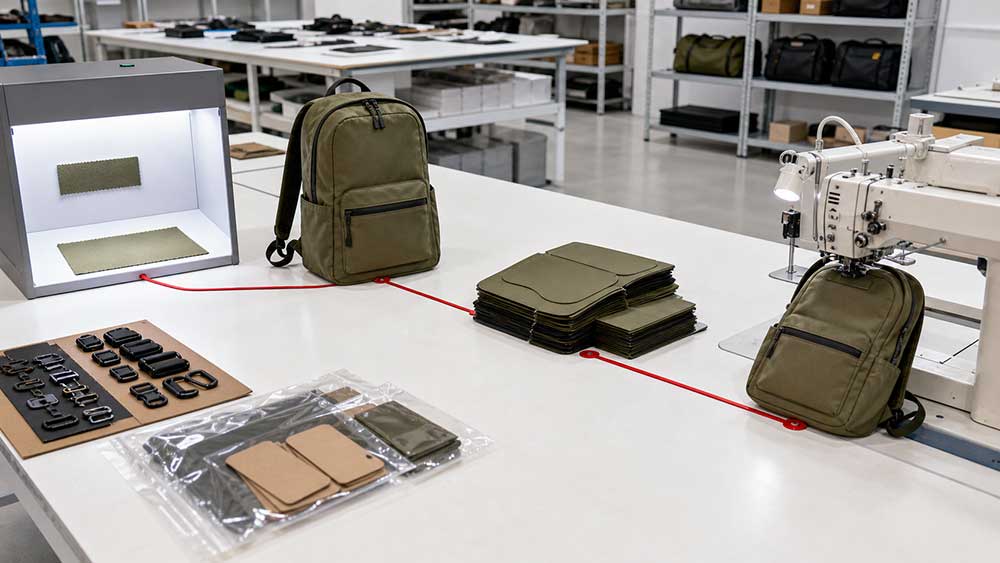
Approved fabric, lining, foam, webbing, zippers, and hardware
Approved color references
Final logo artwork and placement
Labels, hangtags, barcodes, and packaging
Testing or compliance requirements
Order quantity and size or color breakdown
Inspection criteria
Shipping marks
Purchase order and payment conditions
If one of these items is still open, the factory should identify whether production can safely proceed or whether the missing decision affects materials, cutting, assembly, branding, or packing.
For a more detailed look at how product decisions are confirmed before bulk manufacturing, see our guide to the laptop bag sampling process.
Identify the Project’s Critical Path
The critical path is the sequence of dependent activities that determines the earliest possible completion date.
It is not always the sewing stage.
For one project, the critical item may be a custom-dyed outer fabric. For another, it may be a molded buckle, a revised pattern, laboratory testing, or late approval of retail packaging.
Consider a simplified example:
The outer fabric cannot be ordered until the color is approved.
The pre-production sample requires the final outer fabric.
Bulk cutting cannot begin until the sample is approved.
Sewing cannot begin until cutting is complete.
In this situation, color approval affects several later stages. Treating it as a minor cosmetic decision would create a misleading schedule.
Ask the factory which item currently controls the planned completion date. The answer may change as the project progresses.
Separate Parallel Work From Dependent Work
Some activities can run at the same time.
For example:
Carton dimensions may be estimated while the sample is being revised.
Label artwork may be prepared while standard materials are being sourced.
A preliminary shipping plan may be discussed before bulk production starts.
Inspection requirements may be agreed while the sample is under review.
Other activities should remain dependent:
Final packaging dimensions may depend on the finished folded bag.
Custom fabric production may depend on color approval.
Bulk cutting should depend on the approved specification.
Final inspection should depend on an agreed acceptance standard.
Shipment booking should use a credible cargo-ready date.
Running suitable activities in parallel can shorten the project. Starting dependent work too early only transfers risk to a later stage.
Allow More Time for First Orders Than Repeat Orders
A first order and a repeat order should not automatically use the same timeline.
A first order may require:
Pattern development
Material evaluation
Prototype construction
One or more revision rounds
Logo and packaging development
Performance testing
Production method confirmation
A repeat order can be faster when the design, approved sample, material references, suppliers, packaging, and production documents remain unchanged.
However, a repeat order is not automatically identical. Before confirming a shorter schedule, check:
Whether the original material is still available
Whether the material lot or color needs approval
Whether any component supplier has changed
Whether the approved sample is still available
Whether specifications have been revised
Whether packaging or labeling has changed
Whether the previous production line and process are still suitable
A reorder with material substitutions or design changes may behave more like a new project than a true repeat order.
Plan Material Procurement as a Separate Workstream
Material sourcing is often hidden inside the factory’s quoted production time, even though it may control the schedule.
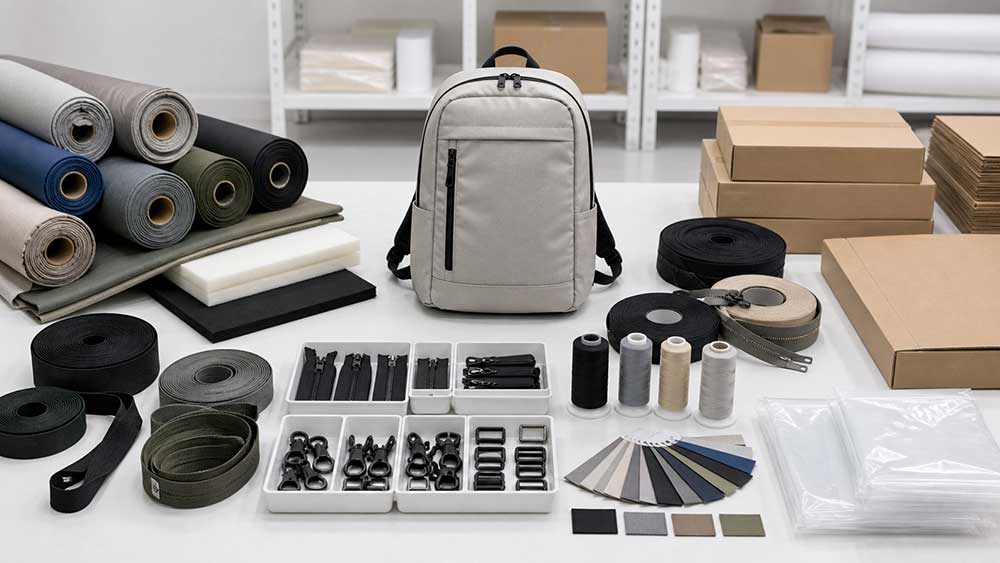
Custom bag materials can include:
Outer fabric and lining
Foam and reinforcement
Webbing and binding
Zippers and sliders
Buckles and metal hardware
Thread
Logo patches and labels
Hangtags, polybags, inserts, and cartons
The schedule should distinguish among:
Stock materials
Standard materials that require replenishment
Made-to-order materials
Custom-colored materials
Custom-molded components
Buyer-nominated materials
Ask when each critical material will be ordered, when it is expected to arrive, and what incoming checks must be completed before it can be released to production.
Custom colors, coatings, recycled content, branded hardware, and special finishes may introduce supplier minimums, additional approvals, or longer procurement periods. Buyers who are still defining the material direction can review Vancharli Outdoor’s custom bag fabric options before finalizing the schedule.
Include Buyer Approval Time
Buyer response time is part of the production timeline.
If a sample arrives on Friday but the review is not completed for eight working days, the project has not experienced an eight-day factory delay. The approval stage took eight working days.
Create a response target for each decision:
Approval item
Target response time
Design clarification
Agreed number of working days
Material or color approval
Agreed number of working days
Sample feedback
Agreed number of working days
Pre-production approval
Agreed number of working days
Packaging artwork
Agreed number of working days
Shipping document review
Agreed number of working days
Assign one decision owner on the buyer’s side whenever possible. Feedback collected from design, purchasing, quality, marketing, and management should be consolidated before it is sent to the factory.
Conflicting comments usually cost more time than a long but well-organized revision list.
Freeze Changes Before Bulk Production
A timeline becomes unreliable when the product keeps changing after approval.
Late changes can affect:
Material orders
Patterns and cutting dies
Sewing construction
Logo tooling
Packaging dimensions
Product cost
Testing
Inspection criteria
The reserved production slot
Create a clear specification-freeze point. After that point, any requested change should trigger a written review covering:
Which approved documents must change
Whether materials can still be used
Whether the sample must be revised
Whether cost is affected
Whether the cargo-ready date must move
A small-looking change is not always a small scheduling change. Moving a zipper, changing foam thickness, or replacing a buckle can affect several connected parts of the bag.
Include Inspection, Correction, and Packing Time
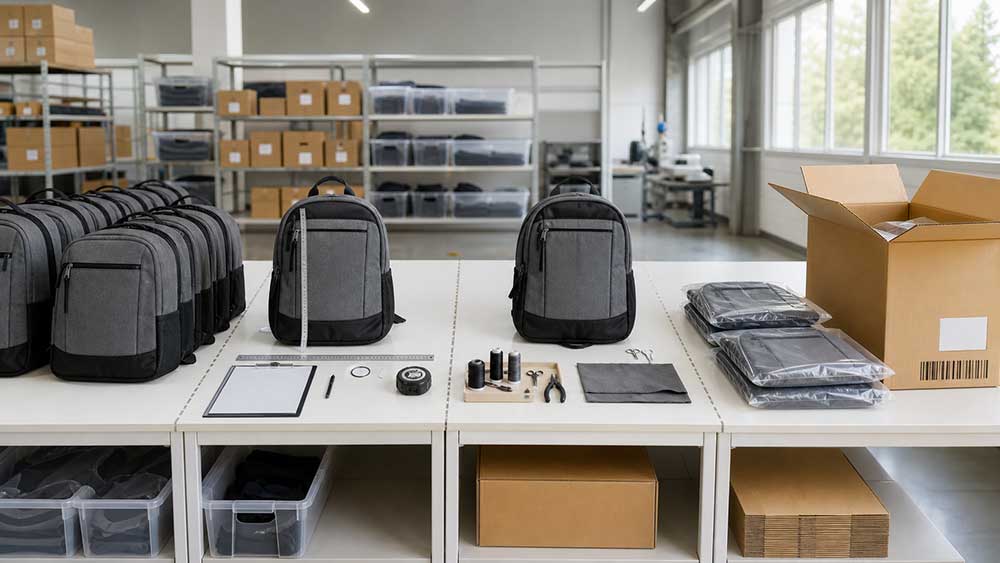
Bulk completion does not always mean the goods are ready to ship.
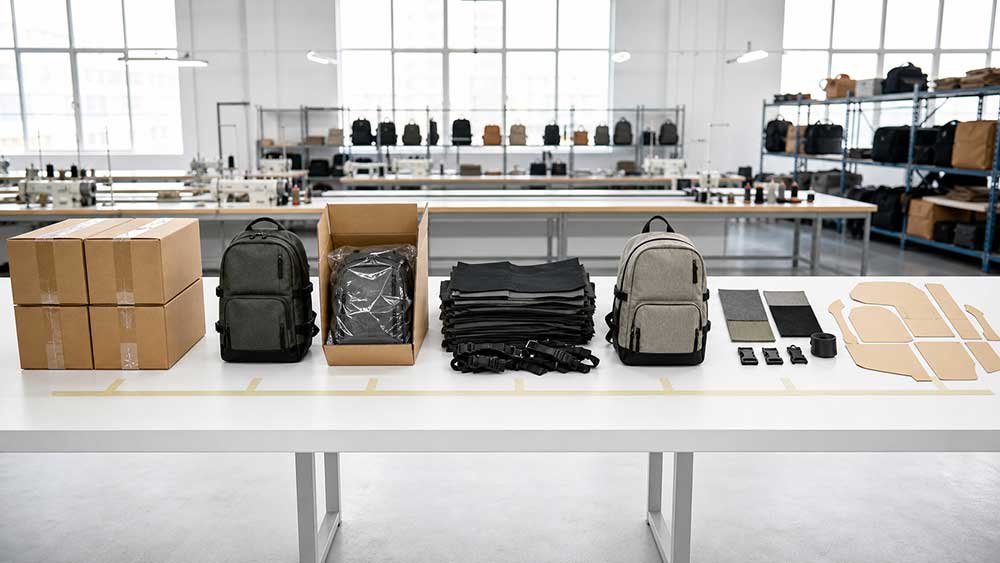
After sewing and assembly, the order may still require:
Thread trimming and cleaning
Measurement checks
Functional checks
Metal or needle detection, where required
Final inspection
Defect sorting or correction
Folding and packing
Barcode and label verification
Carton sealing and marking
Final carton count and measurements
Do not schedule the shipment departure for the same day that production is expected to finish.
If an inspection identifies a correctable issue, the factory needs time to sort, repair, recheck, and repack the affected goods. A realistic plan provides room for this work without immediately missing the shipment.
Add Buffers Where Risk Actually Exists
Adding the same number of buffer days to every stage is not an effective risk plan.
Place buffers around the parts of the project that contain real uncertainty, such as:
First-time pattern development
Custom material production
Color matching
Sample delivery and approval
Testing
Peak-season production
Final inspection and possible correction
Vessel or flight availability
Customs clearance
Public holidays
The size of each buffer should depend on the consequence of a delay and the available alternatives.
A project with a fixed retail launch, customized materials, and ocean freight requires more schedule protection than a repeat order using available materials and flexible air transportation.
Factory holidays and supplier holidays also need separate attention. Even when the assembly factory is working, fabric mills, zipper suppliers, packaging vendors, testing laboratories, ports, or logistics providers may be operating at reduced capacity.
Manage the Schedule With Evidence-Based Milestones
A useful timeline should contain more than estimated start and finish dates.
Track milestones using evidence:
Milestone
Evidence to request
Specifications confirmed
Final document version and approval record
Material approved
Approved swatch, sample, or reference code
Materials ordered
Purchase status and expected arrival
Materials received
Incoming inspection status and any exceptions
PP sample approved
Dated approval and approved reference sample
Production started
Line-start confirmation
Production progressing
Quantity completed and current status
Final inspection completed
Inspection result and corrective status
Goods packed
Packing list, carton count, and photos
Cargo ready
Confirmed dimensions, weight, and pickup date
“Production is ongoing” is not a useful milestone. A meaningful update should explain what has been completed, what remains, and whether the critical path has changed.
Questions to Ask the Factory Before Approving the Timeline
Before accepting the schedule, ask:
What event starts the quoted production lead time?
Is the schedule stated in working days or calendar days?
Which approvals are still outstanding?
Which material or component currently controls the schedule?
Are the materials in stock, replenished to order, or custom-made?
Has a production slot been reserved?
Which activities can run in parallel?
What happens if sample or color approval is late?
How much time is allowed for final inspection and correction?
Which holidays or peak-season constraints affect the plan?
What evidence will be provided at each milestone?
At what point must the shipment booking be confirmed?
A reliable factory should be able to explain the assumptions behind the dates. If a schedule only shows one production duration and one shipping date, it is probably incomplete.
A Simple Custom Bag Timeline Template
Use the following structure for a new project:
Stage
Planned date
Owner
Dependency
Current status
Technical brief confirmed
Buyer and factory
Product requirements
First sample completed
Factory
Brief and available materials
Sample feedback issued
Buyer
Sample received and reviewed
PP sample approved
Buyer and factory
Revisions completed
Critical materials ordered
Factory
Specifications and color approval
Materials released
Factory
Arrival and incoming inspection
Bulk production started
Factory
All release conditions met
Final inspection completed
Factory, buyer, or inspector
Production and packing status
Cargo ready
Factory
Inspection and correction completed
Shipment departed
Logistics party
Booking and export documents
Warehouse delivery
Buyer or logistics party
Clearance and inland transport
For each delayed milestone, update the dependent dates rather than leaving the original completion date unchanged.
What to Do When the Timeline Slips
A delayed milestone does not always mean the final delivery date must move. The effect depends on whether the delayed activity is on the critical path and whether safe recovery options exist.
When a delay occurs, ask:
What caused it?
Which later activities depend on it?
Can another activity proceed in parallel?
Can an available material or approved method be used without changing the product standard?
Can buyer approval be accelerated?
Can inspection or booking preparation begin earlier?
Does the cargo-ready date or warehouse delivery date need to change?
Avoid solving a delay by silently removing inspection time, rushing unapproved materials, or starting bulk production with unresolved specifications. These actions may preserve a date on paper while increasing quality and commercial risk.
Final Thoughts
A realistic custom bag production timeline is not a promise based on one number. It is a chain of connected decisions, approvals, materials, manufacturing activities, inspections, and logistics milestones.
The most dependable plans:
Work backward from warehouse delivery
Define exactly when lead time starts
Identify the critical path
Include buyer response time
Separate parallel work from dependent work
Freeze specifications before production
Protect inspection and correction time
Update dates using actual milestone evidence
If the assumptions change, the timeline should change with them. Early visibility is far more useful than a completion date that remains unchanged until the order is already late.
Vancharli Outdoor supports OEM and ODM bag projects from material selection and sample development through bulk production, inspection, packing, and shipment coordination. Buyers can share their product brief, target quantity, customization requirements, and required delivery window so that the project team can evaluate the timeline based on the actual design and supply conditions.
FAQ
How long does custom bag production usually take?
There is no responsible universal lead time. The schedule depends on design complexity, sample revisions, material availability, order quantity, production capacity, testing, packaging, and shipping method. Ask the factory for a stage-based timeline rather than one total number.
Does production lead time start when the deposit is paid?
Not always. Many factories start counting production time only after payment conditions, final specifications, materials, colors, packaging, and the pre-production sample have been approved. The starting condition should be written into the purchase order or production plan.
Can bulk production begin before the PP sample is approved?
It may be possible to prepare certain materials or reserve capacity, but starting irreversible bulk work before approval increases risk. Cutting, logo application, and final assembly should normally follow the agreed production-release conditions.
Should shipping time be included in the production timeline?
It should be included in the overall delivery plan but shown separately from manufacturing. This makes it easier to see whether a delay comes from production, export handling, international transportation, customs clearance, or inland delivery.
Are repeat orders always faster?
They are often faster when the design, materials, suppliers, packaging, and production documents remain unchanged. Material discontinuation, color changes, new packaging, or revised specifications can make a reorder require additional development and approval.
How should public holidays be handled?
Confirm the holiday schedules of the factory, material suppliers, testing providers, and logistics partners. Place orders and approvals early enough to avoid relying on normal capacity immediately before or after a major holiday.
How much buffer should a buyer add?
There is no fixed percentage that works for every order. Add buffers around high-risk dependencies such as custom materials, sample approval, testing, final inspection, peak-season capacity, and ocean freight. The buffer should reflect the commercial consequence of missing the delivery date.
What is the safest way to shorten a custom bag timeline?
Finalize the brief early, use available materials where suitable, consolidate feedback, approve samples promptly, run independent tasks in parallel, and reserve production and freight capacity early. Do not shorten the schedule by skipping necessary approvals or quality checks.









Comments are closed