




Can You Put a Hydration Bladder in Any Backpack?
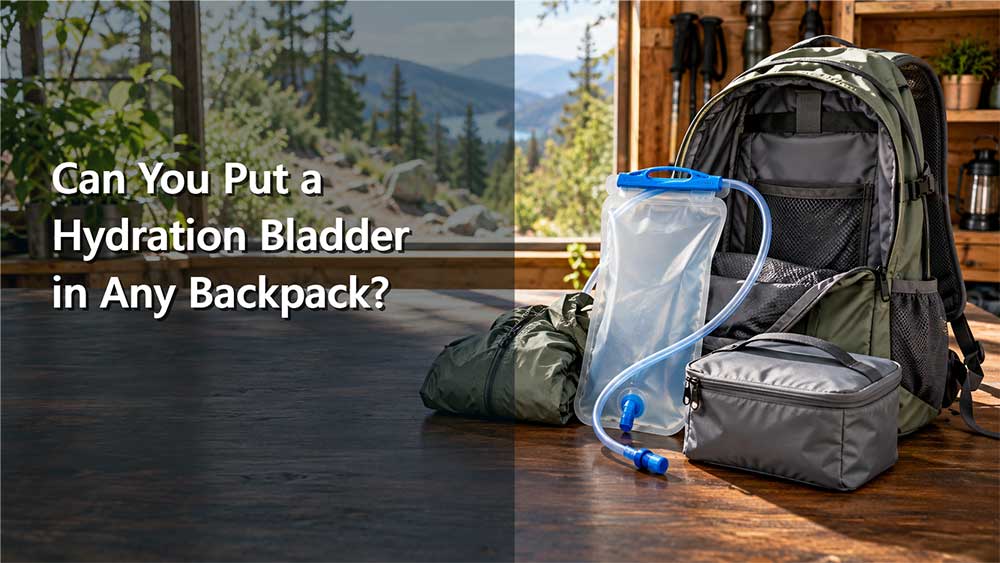
You can put a hydration bladder in many backpacks, but not every backpack is suitable. The filled reservoir needs enough room, reliable support, and a hose route that does not pinch the tube. A backpack with a compatible hydration sleeve and hose port is usually easier to use, but some ordinary backpacks can also work after a careful fit check.
A hydration bladder, also called a reservoir, is the flexible water container—not the backpack itself. Adding one may let you drink through a tube without removing your bag. To see whether your backpack will work, check it with the bladder filled and your usual gear packed.
What Makes a Backpack Hydration-Compatible?
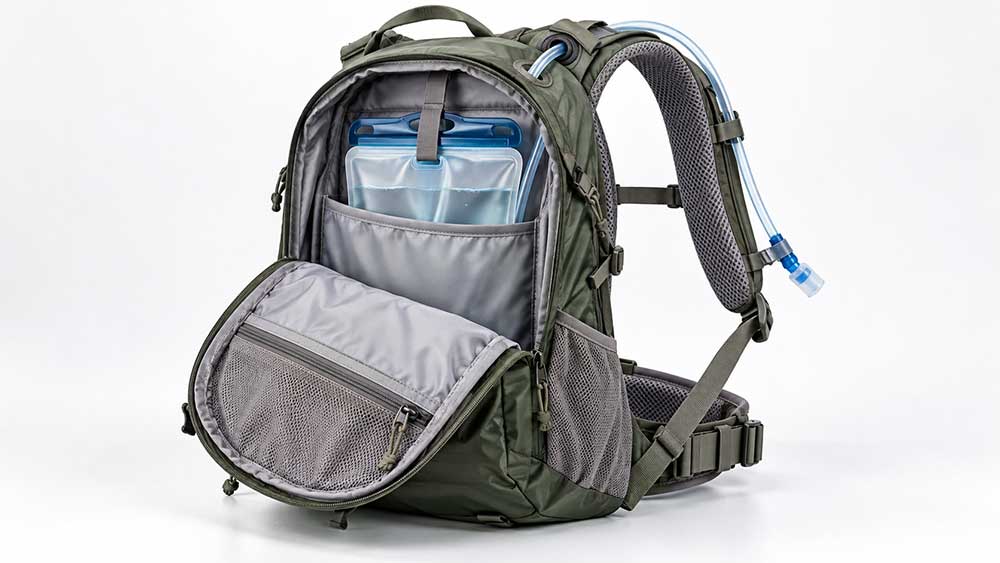
Start by checking your backpack’s product description or instructions. “Hydration-compatible” generally means it has features intended to accommodate a reservoir, although the supported size and attachment system vary.
REI’s hydration pack selection guide describes reservoir sleeves, hose ports, and shoulder-strap clips used in these systems.
If the description does not give a clear answer, inspect the bag yourself.
| What to check | What you want to find | Why it matters |
|---|---|---|
| Space for the filled reservoir | Enough height, width, and depth, including its closure | An empty bladder can fit where a filled one cannot |
| Support and retention | A suitable sleeve, compatible hanger, or another secure arrangement | The reservoir should not slide or bunch up during use |
| Hose exit | A dedicated port or an existing opening that leaves the tube unobstructed | A pinched or sharply bent tube can interrupt drinking |
| Hose retention | Clips, loops, or compatible removable retainers | The tube should remain accessible without swinging freely |
| Gear separation | Space away from sharp items and moisture-sensitive equipment | The reservoir needs protection, and other contents need protection from possible leaks |
| Loaded comfort | A pack that carries the combined water and gear weight comfortably | Physical fit alone does not establish practical suitability |
You do not need every feature found on a dedicated hydration pack. The bladder should stay in place, and you should be able to reach the mouthpiece and drink easily.
Check the Filled Reservoir, Not Just Its Capacity
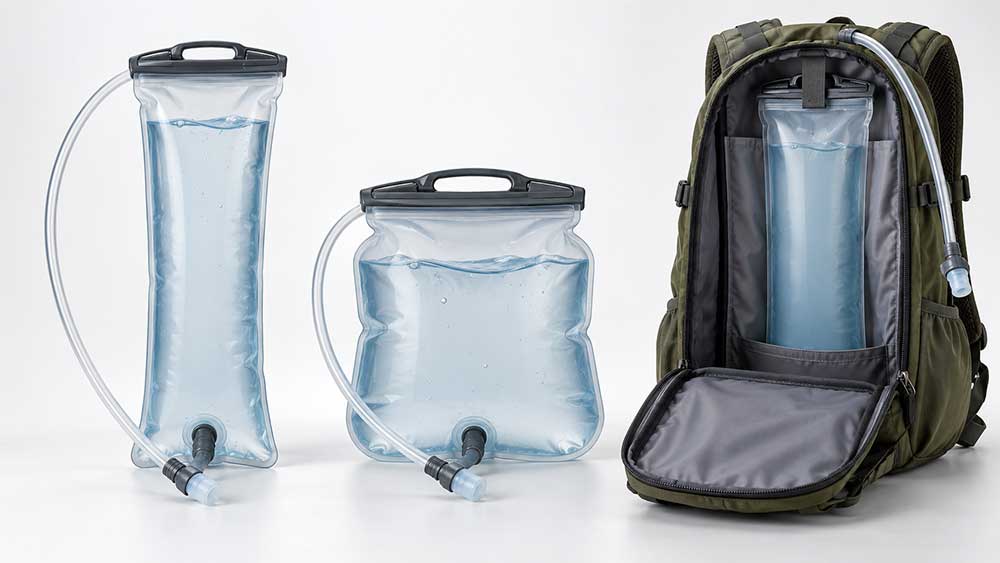
A “2L” label tells you how much water a reservoir holds. It does not tell you whether its shape matches your backpack.
Reservoirs with the same capacity can differ in height, width, filled thickness, closure shape, and hose connection position. Check the manufacturer’s dimensions and measure the available compartment. If you already own both items, test them together with water inside.
Include the rest of your equipment in that test. A reservoir that fits in an empty bag may become difficult to insert once you add lunch and clothing.
Water also adds a noticeable load:
| Water carried | Approximate water weight |
|---|---|
| 1 liter | 1 kilogram / 2.2 pounds |
| 2 liters | 2 kilograms / 4.4 pounds |
| 3 liters | 3 kilograms / 6.6 pounds |
These figures exclude the reservoir, backpack, and equipment.
Choose water capacity around your route and refill opportunities, then check whether your pack can carry that amount comfortably. Our day-hike hydration pack size guide explains how to assess water capacity separately from gear space.
Can You Use a Backpack Without a Hydration Sleeve?
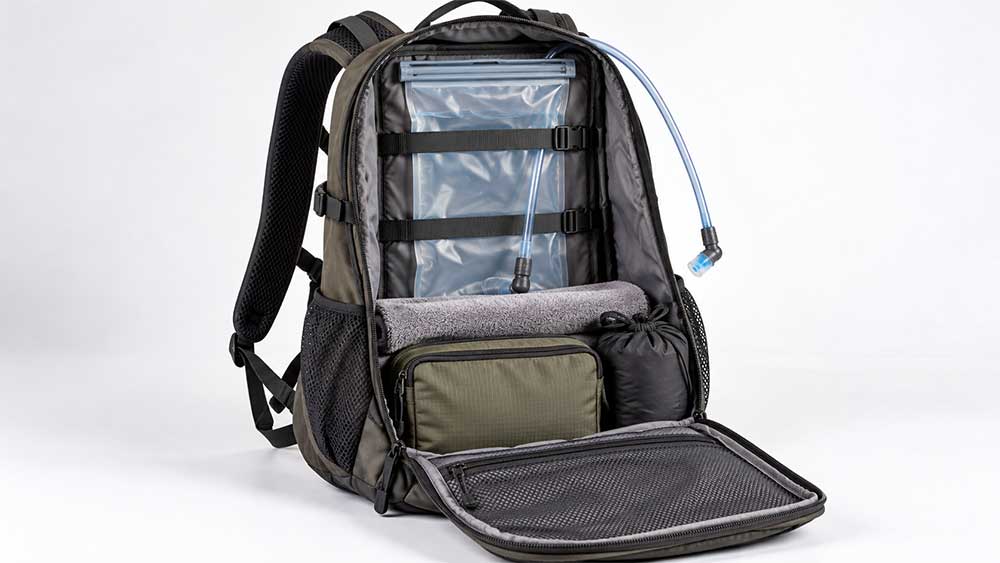
Sometimes. A dedicated sleeve makes positioning easier, but the absence of one does not automatically rule out a reservoir.
Look for a suitable compartment near the back panel or a compatible removable sleeve that can be supported by the pack’s existing attachment points. Check the accessory’s fit and attachment requirements before buying it.
The reservoir should stay in place as you move and as you drink. Keep it away from sharp equipment, and make sure other gear does not press hard against the closure or bend the hose connector.
A hanger is useful when the system is designed for one, but not every reservoir requires the same hanging arrangement. Some setups use a fitted compartment or retaining straps instead. Follow the instructions for your particular combination.
If your only option is to place the bladder in the main compartment, check whether it stays secure without being squeezed or damaged by surrounding gear. If it repeatedly shifts, folds around the connector, or becomes difficult to drink from, use a different arrangement.
What If the Backpack Has No Hose Port?
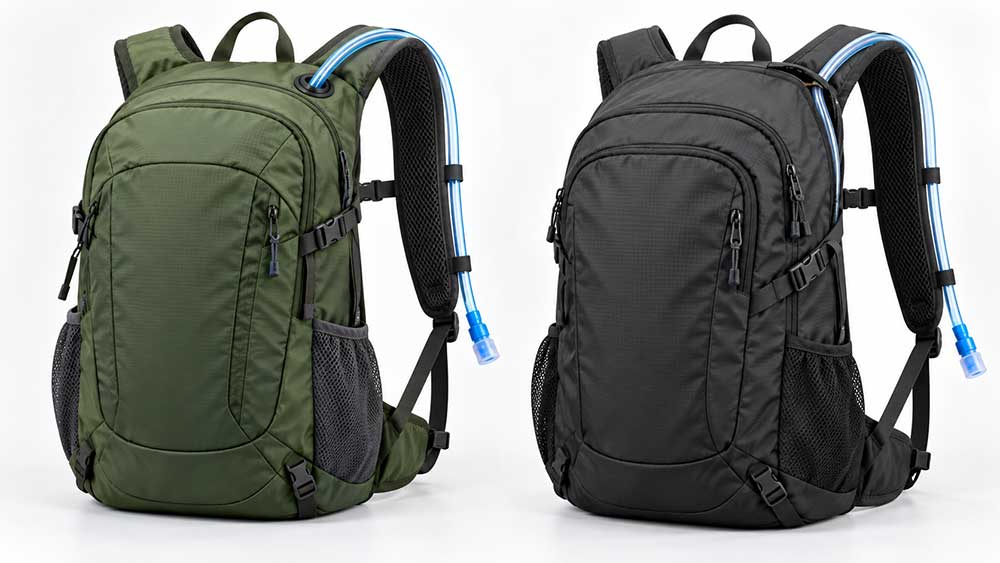
A dedicated hose port lets the tube leave the bag while the main compartment stays closed. Without one, you need to check whether an existing opening can provide a workable route.
On some zippered backpacks, the tube can pass through a small gap near the top. This is only practical if:
- The zipper does not pinch or scrape the tube.
- The opening stays small enough to retain your equipment.
- The hose reaches your mouth without pulling on the reservoir.
- You accept that the opening may let in rain or dust.
Do not force the zipper closed around the hose. After packing the bag, check water flow again—equipment can change the tube’s position.
A roll-top or sealed waterproof backpack may be a poor candidate if routing the hose prevents the closure from working as intended. Its waterproof performance should not be assumed with the closure left open or altered.
Before cutting a new hole, ask the pack maker about approved options. A cut can damage the fabric or interfere with weather protection. For occasional use, carrying a bottle may be easier than modifying the bag.
Can a Laptop Sleeve Hold a Hydration Bladder?
Some can, but a laptop sleeve is not automatically a hydration sleeve.
Check whether the manufacturer identifies it as suitable for both uses. If not, assess the filled reservoir’s fit, support, and hose route rather than relying on the compartment’s appearance.
A padded computer compartment might accommodate a flat reservoir, but it may lack retention points or make the closure difficult to reach. Padding can also become wet if the reservoir leaks.
Do not place the bladder and a laptop together in the same sleeve. Keep electronics protected from possible leaks and condensation. An insulated reservoir cover may reduce condensation, but it should not be treated as a leakproof barrier.
If you regularly carry a computer and want to drink through a reservoir, a bag with separate, purpose-designed compartments is a more straightforward choice.
If you already own a hydration pack and want to carry everyday items in it, see our guide to using a hydration pack as a regular backpack.
Test the Setup Before Taking It Outdoors
Check compatibility with the load you actually intend to carry.
- Fill and inspect the reservoir. Close it according to its instructions, connect the hose, and check the closure and connection for leaks.
- Position and support it. Use the intended sleeve, hanger, or retaining system. Make sure the connector is not forced into a tight bend.
- Pack your equipment. Keep sharp objects separated and confirm that you can close the bag without forcing it.
- Route and secure the hose. Leave enough length to drink comfortably, with no large dangling loop.
- Put the pack on and take a drink. Open any valve lock and check that water flows normally.
- Walk with it, then inspect it again. Check for movement, pressure against your back, dampness, and changes in hose position.
If you plan to run, include an easy jog on familiar ground. Being able to fit a bladder inside a backpack does not make its harness suitable for running. Our hydration backpack bounce guide helps you check movement without simply tightening every strap.
Also consider refilling. If removing the reservoir requires unpacking most of the bag, the setup may be usable but inconvenient for frequent refills.
When a Bottle or Dedicated Hydration Pack Makes More Sense
Use your existing backpack if the reservoir fits securely, the hose route works, and the loaded bag feels comfortable. A pack sold without a reservoir may already have everything needed to accommodate one.
A bottle is a practical alternative when there is no clear hose route, when you need to keep electronics separate, or when reservoir access makes refilling cumbersome.
A dedicated hydration pack becomes worth considering when your regular backpack cannot control the load or when you want integrated reservoir storage and hose management for frequent use.
If the filled bladder stays secure, the hose runs freely, and the pack feels comfortable, your existing backpack may be all you need.
Developing a backpack with reservoir storage for your outdoor brand? Explore custom hydration pack options from Vancharli Outdoor.
FAQ
Do you need a dedicated hydration backpack to use a bladder?
No. A compatible hiking or everyday backpack can work if it provides enough room, secure support, and suitable hose routing. A dedicated hydration backpack is convenient, but it is not the only option.
Can you use a hydration bladder in a school backpack?
Possibly, depending on the bag’s compartments, support, and openings. Test it with water and your usual load. If the bag also carries books or electronics, account for possible leaks and keep moisture-sensitive items protected.
Can a 3L bladder fit in a backpack designed for a 2L reservoir?
Do not assume it will. Check the backpack’s stated compatibility and compare the reservoir’s dimensions and attachment system. A larger bladder may be too tall or wide, even if you do not fill it completely.
Does the bladder need to be the same brand as the backpack?
Not necessarily. What matters is the reservoir’s fit, attachment compatibility, and hose route. Check both manufacturers’ guidance, particularly where the pack uses a specific hanger or connector.
Can you put the bladder in an external pocket?
Only if the pocket can hold it securely and protect it adequately. An exposed reservoir is more vulnerable to snagging or contact with rough surfaces. Check hose reach and retention as well as the pocket’s dimensions.
Does adding a reservoir sleeve make a backpack fully hydration-compatible?
Not by itself. A sleeve can help with positioning, but you still need suitable attachment points, a workable hose exit, and enough room for the filled reservoir and equipment.
Does the backpack need to be waterproof?
No. Waterproof fabric is not a requirement for reservoir compatibility, and an externally waterproof bag does not necessarily protect its contents from a leak inside. Check the reservoir’s condition and protect moisture-sensitive equipment separately.




Comments are closed