




How to Build a Business Bag Product Line for Retail Brands
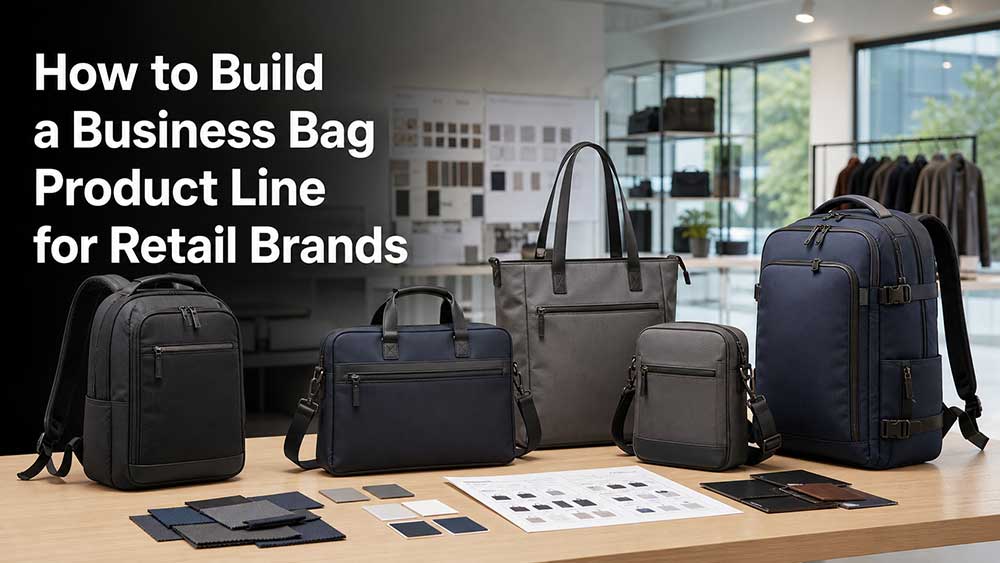
Building a business bag product line is not about producing as many backpacks, briefcases, messenger bags, totes, and sleeves as the budget allows.
The real task is to decide which customer needs the collection should cover, which products deserve a place in the first assortment, and how many colors, sizes, materials, and price points the brand can realistically develop, stock, and replenish.
For most retail brands, a practical starting point is a focused assortment built around one primary daily-carry product, one clearly differentiated alternative, and one lower-priced add-on. The range can then expand when sales performance, channel feedback, and customer requests reveal a genuine gap.
A focused collection might begin with only three or four products. A poorly controlled collection can turn the same number of basic concepts into dozens of SKUs before packaging, channel versions, or regional requirements are counted.
The most useful planning sequence is:
- Map the customer’s work and carrying situations.
- Identify the product formats that cover those situations.
- Remove products that solve the same problem.
- Build a manageable assortment by channel.
- Model SKU growth before design approval.
- Coordinate price, sourcing cost, materials, and construction.
- Confirm MOQ and the total assortment commitment.
- Move the collection through clear development gates.
- Launch the collection in controlled phases.
- Expand only when post-launch evidence reveals a genuine gap.
This guide explains how retail brands can use that process to build a coherent, commercially realistic business bag range.
A Product Line Is Not the Same as a Retail Assortment
A business bag product line is the broader family of products a brand develops for work, commuting, meetings, hybrid work, corporate programs, and business travel.
It may include:
- Business backpacks
- Laptop backpacks
- Laptop briefcases
- Messenger bags
- Laptop totes
- Laptop sleeves
- Rolling laptop bags
- Document cases
- Tech organizers
- Small work accessories
A retail assortment is the specific mix of products, colors, sizes, and price points offered through a particular channel, market, account, or season.
A brand may develop six products but offer:
- Four through its own website
- Three to wholesale retailers
- Two through a corporate program
- One premium travel style through a specialist retailer
Oracle’s assortment-planning framework treats product mix, option counts, attributes, locations, and channels as connected retail decisions. That distinction matters because a brand does not need to place every developed product in every sales channel.
Before building the range, the team should also agree on what belongs in the business bag category. A business bag may include laptop protection, but its purpose is wider than carrying a computer alone.
Step 1: Map Customer Jobs and Carrying Occasions
Do not begin by deciding how many backpack styles to create.
Begin with the work the customer needs the bag to perform.
A product line for client-facing consultants will require a different balance from one designed for hybrid workers commuting by train. A corporate employee program will have different priorities from a premium direct-to-consumer collection.
Useful customer jobs may include:
- Carrying a laptop and daily work equipment
- Arriving at a formal meeting with a restrained bag
- Moving through public transport with both hands free
- Accessing documents or devices quickly
- Carrying a light work setup over short distances
- Combining office use with business travel
- Protecting a laptop inside another bag
- Organizing chargers, cables, and adapters
- Transporting heavier equipment through airports or trade shows
The product team should map each job against the actual carrying situation.
| Customer Job | Typical Environment | Carrying Need | Likely Product Direction |
|---|---|---|---|
| Full daily commute | Train, bus, cycling, walking | Hands-free carry and balanced weight | Business laptop backpack |
| Formal client meetings | Office, conference room, hotel | Slim profile and structured presentation | Laptop briefcase |
| Light mobile work | Coworking, short commute, sales visits | Fast crossbody access | Laptop messenger bag |
| Flexible office and personal use | Hybrid work, cafés, daily errands | Wide opening and adaptable styling | Laptop tote |
| Device-only protection | Office, home, travel | Precise laptop fit with low bulk | Laptop sleeve |
| Frequent business travel | Airport, hotel, trade show | Larger capacity and luggage compatibility | Travel backpack or rolling laptop bag |
| Cable and accessory organization | All environments | Compact organization inside another bag | Tech organizer |
This is a planning map, not a required product list.
A brand should not develop every product shown in the table. It should identify the jobs that matter most to its own customer and select the smallest assortment that covers them well.
Step 2: Build a Product Coverage Matrix
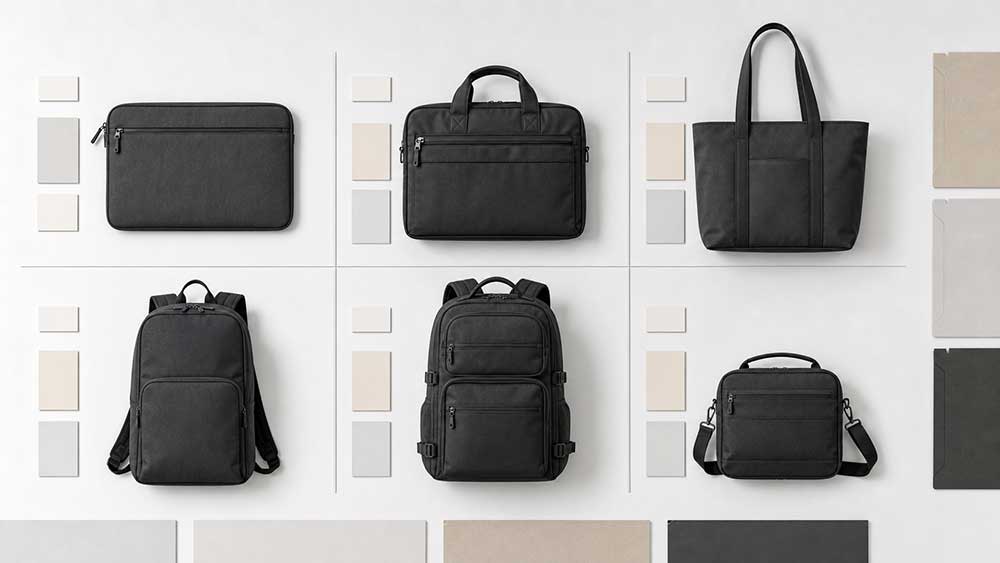
Once the customer jobs are clear, create a matrix that connects use case, carrying format, device range, channel, price role, and launch priority.
An illustrative matrix might look like this:
| Proposed Product | Main Customer Job | Carrying Format | Laptop Requirement | Best-Fit Channel | Price Role | Launch Priority |
|---|---|---|---|---|---|---|
| Commuter laptop backpack | Full daily commute | Two-shoulder | Broad daily laptop range | DTC, wholesale, marketplace | Core | Phase 1 |
| Structured briefcase | Formal work and meetings | Hand and shoulder | Slimmer device range | DTC, department store, wholesale | Core or premium | Phase 1 |
| Laptop sleeve | Device protection | Hand carry or inside another bag | Precise fit | All channels | Entry | Phase 1 |
| Laptop tote | Flexible office use | Hand and shoulder | Medium device range | DTC, fashion retail | Core | Phase 2 |
| Messenger bag | Light mobile work | Crossbody | Light laptop setup | DTC, specialty retail | Entry or core | Phase 2 |
| Travel laptop backpack | Business travel | Two-shoulder and luggage compatible | Larger device and accessory load | DTC, travel retail | Premium | Phase 2 |
| Rolling laptop bag | Heavy business travel | Wheeled | Larger device and document load | Travel specialist, B2B | Premium | Phase 3 |
The matrix exposes problems that are difficult to see when each design is reviewed separately.
For example:
- Two products may serve the same customer job at the same price.
- A proposed style may not fit any important sales channel.
- The collection may contain several commuter products but no formal option.
- Every product may be concentrated in the core price tier.
- The brand may be planning too many laptop-size variations for the expected demand.
This is where assortment strategy becomes more useful than simply listing product ideas.
Step 3: Check for Gaps and Cannibalization
A new silhouette does not automatically create a new market opportunity.
A backpack and messenger bag may look different, but if they carry the same load, fit the same laptop, serve the same commute, use the same material, and sell at nearly the same price, they may compete for the same customer.
Before approving a product, ask:
- Which customer would choose this instead of another product in the line?
- What carrying situation does it handle better?
- Does it introduce a new price point, channel, or use case?
- Is its capacity or device fit meaningfully different?
- Can the difference be explained clearly on a product page or by a retail salesperson?
If the only answer is “it uses a different strap,” the role may not be strong enough.
A useful comparison test is:
| Comparison Area | Product A | Product B | Meaningful Difference? |
|---|---|---|---|
| Main customer job | |||
| Carrying format | |||
| Capacity | |||
| Laptop range | |||
| Access method | |||
| Formality level | |||
| Price role | |||
| Channel |
The purpose is not to eliminate all overlap. Some customers genuinely prefer different carrying formats.
The goal is to ensure that each product has a clear merchandising story rather than relying only on a different shape.
Step 4: Create a Minimum Viable Assortment
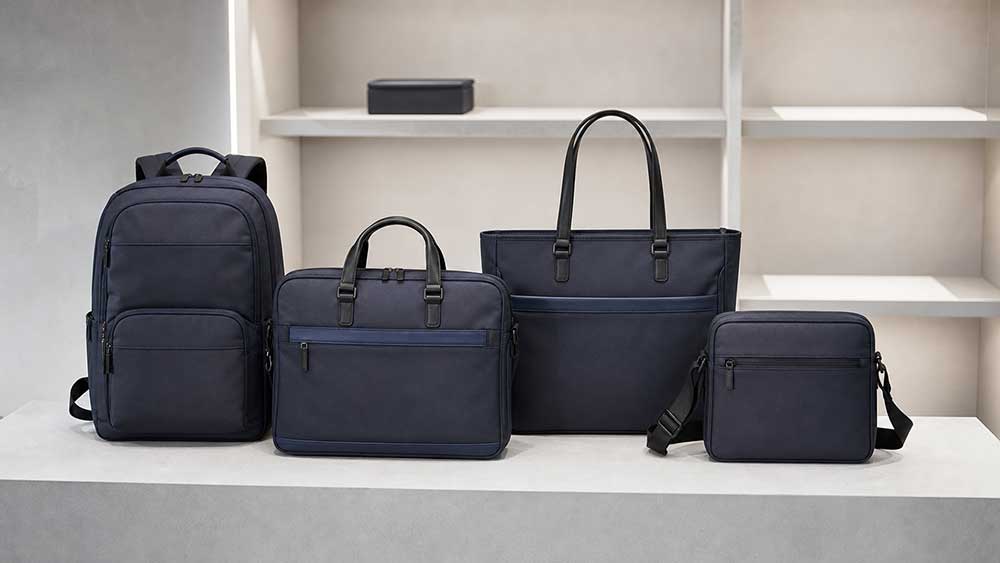
A first collection does not need to cover every possible business-bag category.
It needs enough range to test the brand’s core customer, price position, and design direction without creating unnecessary development and inventory complexity.
A practical minimum viable assortment may contain:
- One primary daily-carry product
- One alternative format for a different work situation
- One lower-priced add-on or entry product
For a commuter-focused brand, that could be:
- Business laptop backpack
- Structured laptop briefcase
- Laptop sleeve
For a more fashion-led office collection, it could be:
- Laptop tote
- Slim commuter backpack
- Tech organizer
For a business-travel collection, it could be:
- Travel laptop backpack
- Compact briefcase
- Laptop sleeve or organizer
The exact combination matters less than the coverage.
Together, the first products should answer:
- What is the brand’s main business-bag use case?
- Which product is most likely to attract the first customer?
- Is there an alternative carrying format?
- Is there an accessible entry product?
- Can the products be presented as one collection?
- Can the brand afford to sample, stock, photograph, and market every SKU?
A smaller assortment is not automatically conservative. It can give the brand cleaner sales data because each product has a clearer role.
Step 5: Model Assortment Breadth, Depth, and SKU Growth
Assortment breadth refers to the number of product types in the range.
Assortment depth refers to the number of variations within each product type, such as:
- Colors
- Sizes
- Materials
- Hardware finishes
- Feature packages
- Packaging versions
SKU growth becomes easy to underestimate.
For example:
4 styles × 3 colors × 2 laptop sizes = 24 SKUs
Add two material versions:
4 styles × 3 colors × 2 sizes × 2 materials = 48 SKUs
If one channel also requires different packaging, the operational workload grows again.
Each variation can create additional work involving:
- Product records
- Photography
- Product-page content
- Barcodes or retail identifiers
- Packaging labels
- Carton planning
- Inventory forecasts
- Replenishment
- Warehouse locations
- Sample approvals
- MOQ allocation
GS1 defines a GTIN as an identification key used to uniquely identify trade items that may be priced, ordered, or invoiced. A brand’s internal SKU system and retail identifiers are not always the same, but both require the assortment to be structured clearly.
Before design approval, calculate:
Styles × Colors × Sizes × Material Versions × Channel Variants
Then ask whether the expected sales volume justifies the resulting complexity.
A More Controlled Color Plan
Instead of offering every color across the entire line, a first assortment might use:
- One core neutral across all products
- One secondary color on selected products
- One test colorway on one or two styles
For example:
- Black across the full collection
- Navy on the backpack, briefcase, and tote
- Olive only on the commuter backpack
This gives customers a choice without multiplying every possible combination.
Step 6: Build a Laptop-Size Architecture
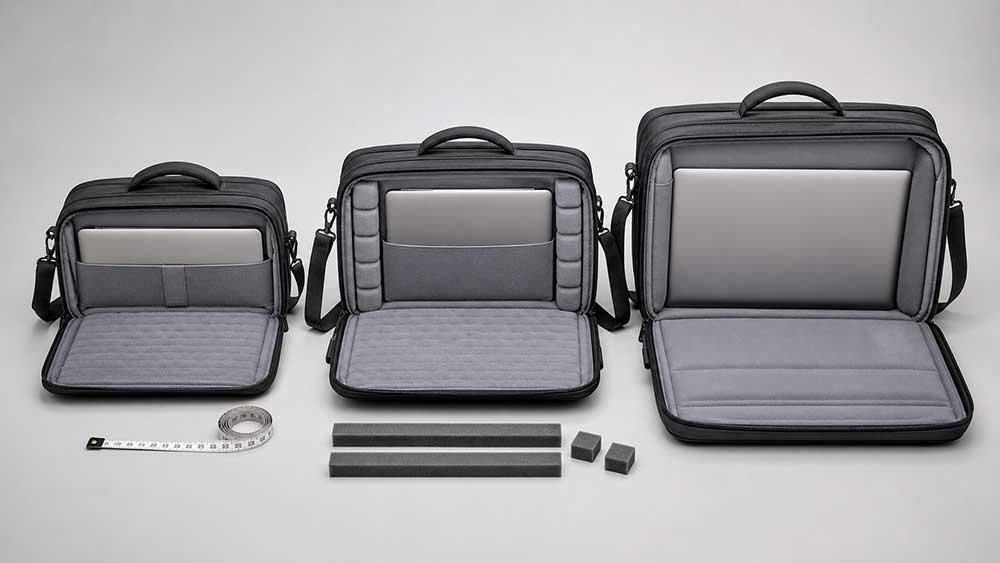
Laptop sizing can create unnecessary product depth when the brand relies only on screen-size labels.
Two laptops marketed as 15.6-inch models may have different body dimensions. A backpack with a flexible padded compartment may accommodate a broader range than a fitted laptop sleeve.
The product line should define:
- Maximum device width
- Maximum device height
- Maximum device thickness
- Required fitting clearance
- Compartment-opening dimensions
- Whether a protective shell may be used
- Whether the product requires precise or flexible fit
- Whether increasing device size changes the whole bag proportion
Different products may use different sizing strategies.
Flexible-Fit Products
A business backpack or travel backpack may use one compartment designed around a practical range of device dimensions.
Controlled-Fit Products
A briefcase may need tighter proportions to retain a professional silhouette.
Precise-Fit Products
A laptop sleeve usually needs more exact internal dimensions.
Brands should not create separate 13-inch, 14-inch, 15.6-inch, 16-inch, and 17-inch versions of every product unless the sales channel and expected volume can support them.
For technical measurement guidance, refer to the guide on how to measure a laptop for a bag.
Step 7: Build the Price and Margin Architecture
Price planning should happen before the assortment is locked.
A business bag collection may use three broad roles:
| Price Role | Purpose | Possible Products |
|---|---|---|
| Entry | Lower-priced introduction or add-on | Laptop sleeve, tech organizer, simple messenger bag |
| Core | Main customer need and main brand expression | Business backpack, laptop tote, standard briefcase |
| Premium | Higher structure, materials, travel function, or presentation | Executive briefcase, travel backpack, rolling laptop bag |
The price difference should reflect meaningful value.
A premium product may offer:
- More demanding construction
- Higher-grade exterior material
- More refined hardware
- Better device protection
- Improved carrying comfort
- More complex organization
- Travel functionality
- Custom lining
- Stronger retail presentation
It should not rely on a different logo plate alone.
The target retail price and target sourcing cost also need to work together.
For each style, define:
- Target retail price
- Target wholesale price, where relevant
- Target sourcing cost
- Expected landed-cost factors
- Required margin structure
- Essential features
- Brand-defining features
- Optional upgrades
- Acceptable material or hardware alternatives
This prevents the design team from completing a visually attractive collection that cannot support the intended channel economics.
The relationship between design, material, structure, and target cost is also discussed in the guide to designing a professional-looking business backpack.
Step 8: Create Channel-Specific Assortments
The complete product line does not need to appear in every channel.
Direct-to-Consumer Website
A brand website can usually support:
- The widest style range
- Detailed product comparisons
- More color choice
- Add-on accessories
- Early testing of new products
Wholesale Retailers
Wholesale buyers may prefer:
- A narrower range
- Clear price steps
- Proven colors
- Reliable delivery
- Products with obvious differences
- Enough margin for the retailer
Marketplaces
Marketplace listings often depend on:
- Clear specifications
- Device dimensions
- Feature comparison
- Customer reviews
- Competitive pricing
- Simple variation structures
Too many poorly differentiated options can make the listing harder to understand.
Department Stores and Specialty Retailers
These channels may require:
- Stronger visual presentation
- A coherent price ladder
- Clear product segmentation
- Colors suited to the retailer’s customer
- Packaging and labeling that match the account
Corporate Programs
Corporate programs may prioritize:
- Consistent logo application
- Controlled colors
- Laptop compatibility
- Packaging
- Delivery timing
- Repeatability
- Order quantity
- Cost control
The brand may use the same core product platform while reducing colors, simplifying hardware, or changing packaging for corporate customers.
Step 9: Build a Shared Product Platform
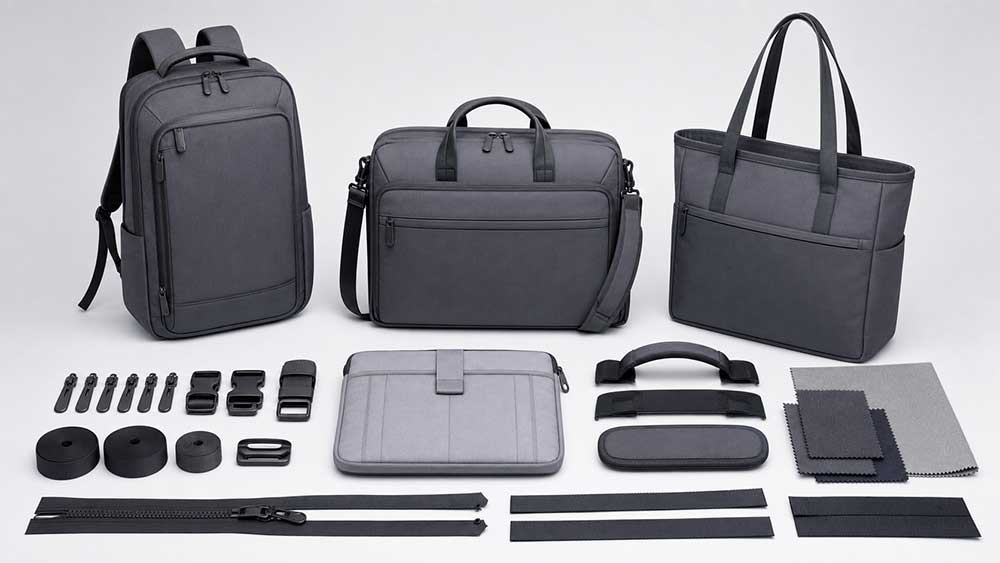
A product line should feel connected, but every product should not be forced into the same pattern or construction.
Shared elements may include:
- Main material family
- Lining color
- Zipper family
- Hardware finish
- Puller shape
- Logo treatment
- Webbing
- Binding
- Interior labels
- Packaging language
- Laptop-protection principles
- Color palette
These shared elements can improve visual consistency and simplify sourcing and approval.
However, product-specific construction still matters.
A sleeve requires precise fit and clean edge control. A backpack needs shoulder-strap comfort and load distribution. A briefcase places more stress on its handles and structured panels. A rolling bag introduces wheels, a telescopic handle, a reinforced base, and additional travel-related failure points.
A useful platform strategy is:
Share the components that support brand consistency, but customize the structure that supports product performance.
When the prototypes are reviewed together, the design team should check:
- Do the products feel like part of the same collection?
- Is the logo scale consistent?
- Do the hardware finishes belong together?
- Does one material behave poorly on a particular format?
- Does one product look substantially cheaper than the others?
- Are the shared components proportionate across all sizes?
- Does each bag still have its own clear purpose?
A zipper puller that looks balanced on a 24-liter backpack may appear oversized on a slim sleeve. A structured fabric that works well for a briefcase may feel unnecessarily rigid on a commuter backpack.
These relationships are easier to judge when the collection is reviewed side by side.
For material and component planning, the existing guides to business bag materials and business bag hardware provide more detailed comparisons.
Step 10: Coordinate MOQ With the Full Assortment
MOQ should be assessed at collection level before the design and sampling plan is finalized.
A minimum that appears manageable for one product can become a much larger commitment after multiplying:
- Styles
- Colors
- Sizes
- Materials
- Hardware versions
- Packaging formats
Before finalizing the range, clarify:
- Is the MOQ calculated per style or per color?
- Can one material order support several products?
- Can the same color be shared across the collection?
- Do custom zippers, pullers, buckles, or logos have separate minimums?
- Can one packaging format serve multiple styles?
- Which products can use stock materials?
- Which styles justify custom-dyed materials?
- Can the first assortment use fewer colorways?
The development team should calculate the combined commitment rather than treating each quotation as an isolated order.
This review may change the assortment before sampling begins. A product with a clear customer role may still need to move to a later phase if its material, color, or component minimum creates too much initial inventory exposure.
Step 11: Use Development Gates
A product line becomes difficult to control when every style progresses at a different speed without clear approval points.
Development gates give the design, merchandising, sourcing, and manufacturing teams a shared decision process.
Gate 1: Assortment Approval
Confirm:
- Target customer
- Main use cases
- Product coverage matrix
- Channel role
- Price role
- Launch priority
- Estimated SKU count
- Initial MOQ commitment
A product that has no distinct customer job should not move forward simply because the sketch looks attractive.
Gate 2: Design and Cost Feasibility
Review:
- Silhouette
- Dimensions
- Laptop fit
- Material direction
- Hardware
- Logo method
- Construction complexity
- Target sourcing cost
- MOQ implications
This is the right point to simplify expensive details or remove overlapping products.
Gate 3: Prototype Review
Review the samples individually and as a collection.
Check:
- Empty and loaded shape
- Device fit
- Access and organization
- Carrying comfort
- Shared design language
- Material behavior
- Hardware proportions
- Cost changes
- Manufacturing difficulty
The full process for developing an individual product is covered in the laptop bag sampling process. A product-line review adds the cross-product comparison that a single-style review cannot provide.
Gate 4: Retail Readiness
Before pre-production approval, confirm:
- Final specifications
- Color approvals
- Packaging
- Labels
- Product identifiers
- Product photography requirements
- Quality criteria
- Channel allocation
- Order quantities
- Assortment packing
Quality standards should include both shared requirements and product-specific checks. The laptop bag quality inspection checklist can support the inspection plan without replacing style-specific criteria.
Step 12: Launch in Controlled Phases
A phased launch allows the brand to test product roles before committing to a deeper assortment.
Phase 1: Validate the Core Customer
Launch the smallest assortment that covers the main customer jobs.
For example:
- Commuter backpack
- Formal briefcase
- Laptop sleeve
The purpose of Phase 1 is to test whether the core use cases, product roles, price relationships, and visual direction are understood by customers and retail partners.
Phase 2: Fill a Proven Gap
Possible additions may include:
- Laptop tote
- Messenger bag
- Travel backpack
- Tech organizer
- A new laptop fit
- A proven secondary color
A Phase 2 product should respond to a specific gap rather than simply make the collection look larger.
Phase 3: Add Depth or Specialist Products
Later extensions may include:
- Premium material editions
- Seasonal colorways
- Rolling laptop bag
- Corporate versions
- Smaller or larger formats
- Related travel accessories
A strong-selling commuter backpack does not necessarily justify five more backpacks. The better opportunity may be a matching sleeve, a formal briefcase, or a travel extension.
Step 13: Review Post-Launch Performance
After launch, the team should return to the original customer-job and coverage matrices.
Review:
- Sell-through by style
- Sell-through by color
- Returns
- Customer reviews
- Warranty issues
- Stockouts
- Slow-moving SKUs
- Add-on purchases
- Channel feedback
- Corporate inquiries
- Requests for other laptop sizes
- Requests for missing carrying formats
The next product should fill a proven gap rather than simply increase the number of styles.
For example:
- Customers may want a matching sleeve rather than another backpack.
- Wholesale buyers may need a lower-priced messenger bag.
- Business travelers may request a larger version.
- Corporate clients may need simplified colors and branding.
- Tote customers may request a zippered top.
- Returns may show that the laptop compartment needs clearer dimensions.
Post-launch review may also justify removing a weak SKU, reducing a color range, consolidating sizes, or moving a product to a different channel.
Expansion is only one possible response. Simplification can be equally valuable.
How Vancharli Outdoor Reviews a Multi-Style Business Bag Program
Developing several related business bags requires more than preparing separate quotations for separate styles.
The collection needs coordinated decisions across:
- Customer use cases
- Product roles
- Silhouettes
- Laptop dimensions
- Materials
- Hardware
- Colors
- Branding
- Target costs
- Pattern development
- Sampling
- Quality standards
Vancharli Outdoor has professional designers who can support brands from early collection planning through visual development, pattern-making, prototype sampling, revisions, and bulk-production preparation.
In a multi-style program, the design team can review products side by side before shared materials and components are finalized.
This helps identify issues such as:
- Two products serving the same customer need
- A hardware component that is too large for a smaller style
- A material that suits one structure but performs poorly on another
- Inconsistent logo scale
- Color combinations that do not work across the full range
- Laptop compartments that create unnecessary size variations
- Features that push one product beyond its target sourcing cost
The objective is not to make every bag identical. It is to create a recognizable collection in which each style has a separate commercial role and a workable production structure.
Brands planning custom business bag collections can discuss the intended customer, price architecture, product mix, materials, design direction, MOQ, and development sequence before the assortment is locked.
When evaluating a long-term manufacturing partner, the brand should also consider whether the supplier can support design refinement, pattern-making, material sourcing, multi-style sampling, quality control, and coordinated bulk production. These criteria are covered in more detail in the guide to choosing a laptop bag manufacturer.
Common Assortment-Planning Mistakes
Beginning With Too Many Bag Types
More products do not automatically create better market coverage. They can create overlapping roles and dilute initial order quantities.
Treating Every Color as Mandatory
A color that works for a tote may not be necessary for a rolling bag. Color should be planned by product and channel.
Using Screen Size as the Only Laptop Standard
Laptop body dimensions differ. The product should be developed around usable internal dimensions and fitting clearance.
Finalizing Design Before Reviewing Cost and MOQ
Late cost reduction often removes quality from the wrong parts of the product. Cost and minimum-order implications should be reviewed before patterns and samples become difficult to change.
Making Every Product Look Identical
A shared visual language is useful. Reusing the same structure across a backpack, sleeve, briefcase, and tote is not.
Expanding Without Identifying a Gap
A new product should add a new customer job, price role, channel, carrying format, or device requirement.
Treating Expansion as the Only Solution
Weak sales may indicate unclear positioning, excessive SKU depth, poor sizing, inappropriate pricing, or the wrong channel. Adding more products may increase the problem.
Business Bag Assortment Planning Worksheet
Before sampling begins, confirm the following:
Customer Coverage
- Who is the primary customer?
- Which work situations matter most?
- Which carrying formats do those situations require?
- Which laptop dimensions must be supported?
- Which customer needs are intentionally not covered in Phase 1?
Assortment Structure
- What products are included?
- What separate role does each product perform?
- Which products may cannibalize one another?
- What is the first-launch SKU count?
- Which products are reserved for later phases?
Channel and Pricing
- Which products belong in each channel?
- What are the entry, core, and premium roles?
- What retail and wholesale prices must be supported?
- What target sourcing cost applies to each style?
- Which optional features can be adjusted?
Shared Platform
- Which materials are shared?
- Which components are shared?
- Which colors extend across the collection?
- Which construction details must remain product-specific?
- Is the branding consistent without becoming repetitive?
MOQ and Development
- How does MOQ multiply across styles, colors, and sizes?
- Which components have separate minimums?
- What are the approval gates?
- Which prototype is developed first?
- When will the complete collection be reviewed together?
- Which quality standards are shared?
- Which checks are unique to each product?
Launch and Review
- Which products belong in Phase 1?
- What evidence will justify Phase 2?
- Which performance indicators will be reviewed?
- Which slow-moving SKUs may be removed?
- Which customer requests represent a real assortment gap?
Final Thoughts
A successful business bag product line is not defined by the number of products it contains.
It is defined by how clearly those products cover real customer needs.
Start with work situations, carrying requirements, laptop dimensions, channels, and price roles. Use a coverage matrix to identify missing needs and overlapping products before committing to development.
Then calculate how styles, colors, sizes, materials, and packaging multiply into SKUs. Review MOQ at the full-assortment level, not only one product at a time.
Shared materials, hardware, colors, and branding can make the line feel coherent, but each product still needs a structure appropriate to its own function.
Move the collection through defined approval gates, launch in controlled phases, and use post-launch evidence to decide whether the next step should be expansion, adjustment, consolidation, or SKU reduction.
The strongest assortment is not the one with the most choices. It is the one in which customers can understand why each product exists, retailers can merchandise the range clearly, and the brand can develop, produce, stock, and expand it with control.
FAQ
What is the difference between a product line and a retail assortment?
The product line is the broader family a brand develops. The retail assortment is the specific selection of styles, colors, sizes, and price points offered through a particular channel or market.
How many products should be included in the first launch?
There is no universal number. One practical starting point is a primary daily-carry product, an alternative carrying format, and a lower-priced add-on. The final number depends on customer coverage, budget, MOQ, channel, and inventory capacity.
How can a brand tell whether two products overlap too much?
Compare their customer job, carrying format, capacity, laptop range, formality, price role, and channel. If most of these are the same, the products may compete for the same purchase.
Does every bag need several laptop-size versions?
No. Backpacks can often accommodate a broader range of device dimensions, while fitted sleeves require more precise sizing. Separate size SKUs should be supported by demand and channel requirements.
How should a brand reduce SKU complexity?
Limit the first launch to essential products, use fewer colorways, avoid unnecessary size versions, share selected materials and components, and create different assortments for different channels.
Should MOQ be reviewed per product or for the full collection?
Both matter, but the full-collection calculation is essential. Style, color, material, hardware, and packaging minimums can combine into a much larger commitment than the MOQ for one product suggests.
Can the same product line serve both retail and corporate customers?
Yes, but the assortment may change. Retail channels may carry more colors and formats, while corporate programs may use fewer styles with controlled branding, packaging, delivery, and pricing.
When should the collection be expanded?
Expand when sales performance, customer requests, channel feedback, returns, or stockout patterns reveal a clear unmet need. New products should fill a gap rather than repeat an existing role.

Comments are closed