



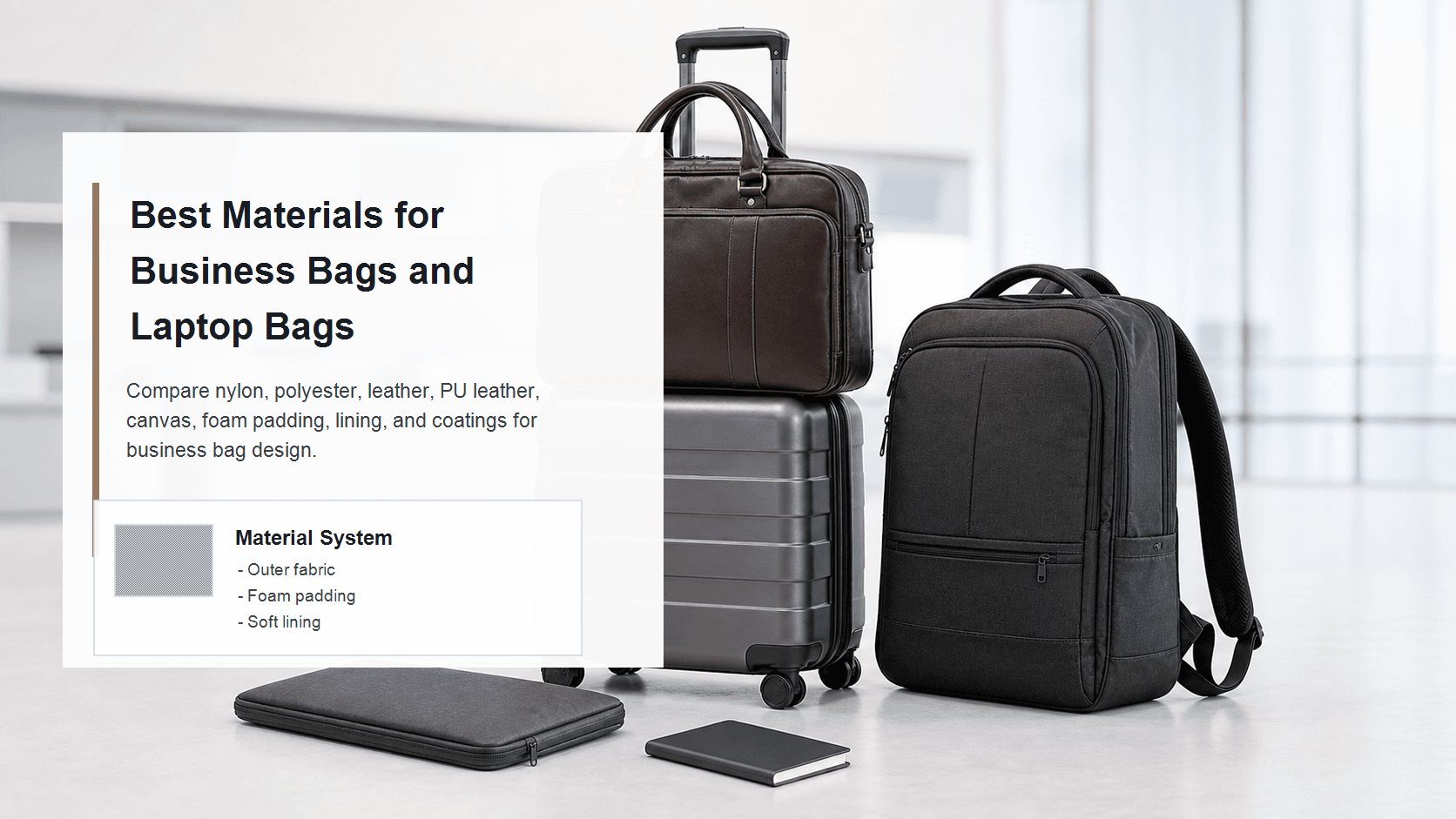
Best Materials for Business Bags and Laptop Bags
The best material for a business bag or laptop bag depends on how the bag will be used. A daily commuter backpack, a premium leather briefcase, a lightweight laptop sleeve, and a corporate work bag should not always use the same material.
For everyday commuting and travel, nylon and high-denier polyester are usually practical choices because they can be made lightweight, abrasion-resistant, and water-resistant through denier selection, weave structure, coating, and backing. For premium executive bags, full-grain or top-grain leather offers a more professional appearance. PU leather and microfiber leather can create a polished business look at a lower price point. Canvas works well for casual business bags, creative work bags, and heritage-style laptop messenger bags.
For laptop bags, the outer material is only one part of protection. Foam padding, soft lining, bottom structure, zipper quality, hardware, and compartment design all affect how safe and practical the bag feels in daily use.
What Makes a Material Good for Business Bags and Laptop Bags?
A good business bag material should do more than look professional. It needs to match the user’s daily routine, the bag style, the target price, and the level of protection required.
For business bags and laptop bags, the most important material factors are:
- Professional appearance
- Abrasion resistance
- Water resistance
- Weight
- Shape retention
- Ease of cleaning
- Laptop protection compatibility
- Logo and branding compatibility
- Cost and production stability
- Compliance for target markets
A business bag used for daily office commuting needs to look clean and hold its shape. A laptop backpack needs to protect electronics while staying comfortable. A laptop sleeve needs soft touch and scratch protection. A rolling laptop bag needs stronger bottom structure and abrasion-resistant outer fabric.
This is why there is no single “best” material for every business bag or laptop bag. The better approach is to choose materials based on the product type, target user, carrying weight, weather exposure, and expected retail price.
Nylon: Suitable for Durable and Lightweight Laptop Backpacks
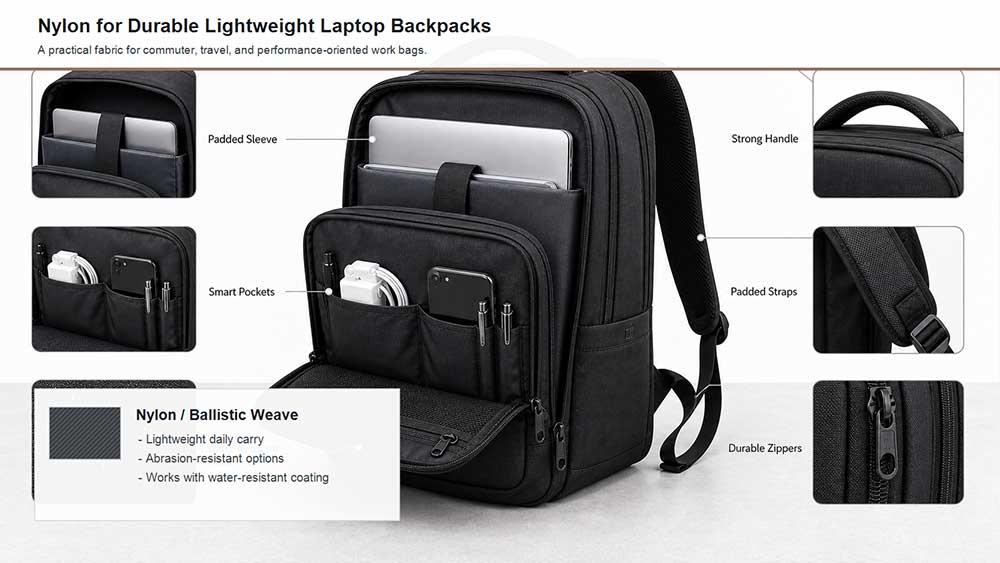
Nylon is one of the most practical materials for laptop backpacks, travel business bags, commuter backpacks, and performance-oriented work bags. It is lightweight, flexible, and can be made highly abrasion-resistant depending on the yarn, denier, weave, coating, and backing.
For business and laptop bags, nylon is commonly used in:
- Laptop backpacks
- Travel laptop bags
- Commuter backpacks
- Business backpacks
- Messenger bags
- Rolling laptop bags
- Tech organizer bags
High-denier nylon, ballistic nylon, ripstop nylon, and CORDURA-style performance fabrics are often chosen when the bag needs stronger abrasion resistance. CORDURA describes its advanced fabrics as being used in products such as backpacks, work boots, and outdoor gear where comfort, durability, and reliability matter, which makes it a useful reference point for performance bag materials: CORDURA Advanced Fabrics.
Nylon is especially useful for laptop backpacks because it can provide durability without making the bag too heavy. It also works well with PU coating, water-resistant finishes, laminated backing, and structured foam panels.
However, nylon is not always the right choice for every business bag. Some nylon fabrics look sporty or technical, which may not suit a formal executive briefcase. If the bag needs a more polished office appearance, the fabric texture, finish, color, hardware, and zipper style should be selected carefully.
Common suitable bag types for nylon:
| Bag Type | Why Nylon Works |
|---|---|
| Laptop backpack | Lightweight, durable, easy to carry daily |
| Travel laptop bag | Good abrasion resistance and water-resistant options |
| Business backpack | Practical for office and commute use |
| Rolling laptop bag | Works well with reinforced base structures |
| Tech organizer | Flexible, lightweight, easy to sew |
Nylon is a strong choice when the product needs to feel durable, modern, and practical rather than formal or luxury.
Polyester: Suitable for Cost-Effective Business and Laptop Bags
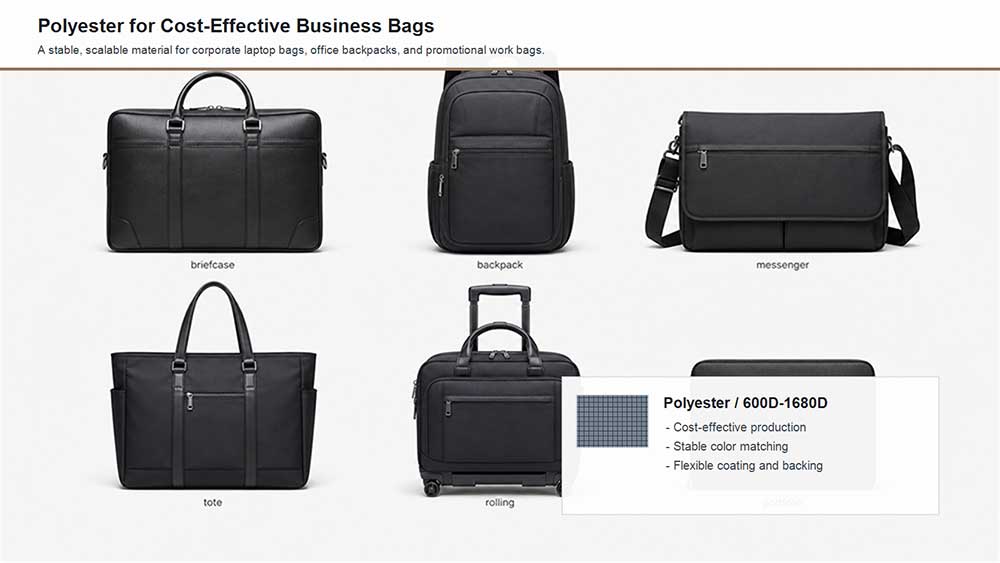
Polyester is widely used in business bags and laptop bags because it is cost-effective, stable in color, and suitable for large-scale production. It can be made in many deniers, textures, finishes, and coatings, making it flexible for different product levels.
Common polyester options include:
- 300D polyester
- 600D polyester
- 900D polyester
- 1200D polyester
- 1680D polyester
- Recycled polyester
- PU-coated polyester
- PVC-backed polyester
Polyester is often used for corporate laptop bags, promotional business bags, entry-level laptop backpacks, school laptop bags, and work bags where cost, color consistency, and production stability matter.
One advantage of polyester is color performance. It is often easier to control color consistency across large production runs, which matters for corporate programs, private label collections, and branded business bag lines.
Polyester should not automatically be seen as low-end. A high-denier polyester with proper coating, backing, stitching, lining, and hardware can perform well for everyday business use. The real difference comes from denier, yarn quality, coating, backing, lining, stitching density, zipper quality, and whether stress points are reinforced.
Common suitable bag types for polyester:
| Bag Type | Why Polyester Works |
|---|---|
| Corporate laptop bag | Cost-effective and easy to brand |
| Entry-level business backpack | Good balance of price and function |
| Promotional work bag | Stable color and scalable production |
| Laptop tote | Can be coated or textured for different looks |
| School or office laptop bag | Practical for everyday use |
Polyester is a good choice when the product needs reliable performance, stable pricing, and flexible customization.
Leather: Suitable for Premium Business Bags
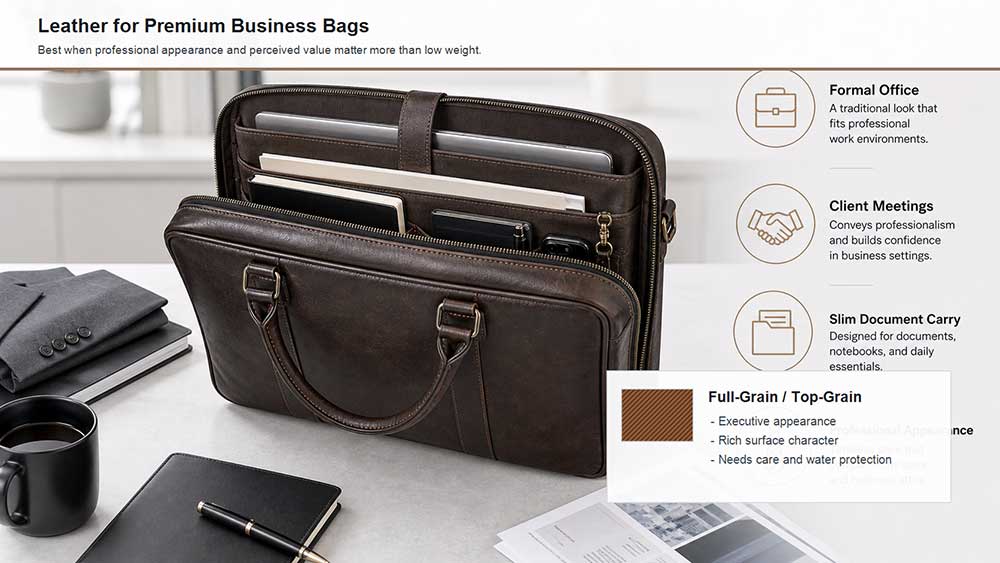
Leather is one of the most traditional materials for premium business bags. It is commonly used for executive briefcases, leather laptop bags, business totes, portfolio bags, and high-end messenger bags.
The main advantage of leather is appearance. Full-grain and top-grain leather can look refined, professional, and long-lasting. Leather also develops character over time, which makes it attractive for premium business users.
Common leather options include:
- Full-grain leather
- Top-grain leather
- Split leather
- Corrected-grain leather
- Suede
- Nubuck
Full-grain leather is often used for premium business bags because it retains the natural grain surface and can develop a richer appearance over time when properly cared for. Top-grain leather is also widely used in business bags because it offers a cleaner surface and refined appearance. Split leather and corrected-grain leather can be more cost-effective, but they may not offer the same long-term character as higher-grade leather.
Leather is not perfect for every laptop bag. It is heavier than most synthetic fabrics, more expensive, and requires more care. It can also be sensitive to water, scratches, and humidity if not treated properly.
For brands developing premium leather business bags, sourcing and responsibility also matter. The Leather Working Group’s audit standard is designed to assess facilities processing leather and covers areas such as operating permits, production data, and incoming material traceability: Leather Working Group Leather Manufacturer Standard.
Common suitable bag types for leather:
| Bag Type | Why Leather Works |
|---|---|
| Executive briefcase | Premium and professional appearance |
| Leather laptop bag | Strong business image |
| Business tote | Refined style for office use |
| Portfolio bag | Sleek and formal |
| Premium messenger bag | Heritage and professional look |
Leather is best when appearance, perceived value, and premium positioning are more important than lightweight carry or low cost.
PU Leather and Microfiber Leather: Suitable for a Polished Look at Lower Cost
PU leather and microfiber leather are often used when brands want a clean business look without the cost, weight, or maintenance requirements of genuine leather.
These materials are commonly used in:
- Budget business bags
- Laptop sleeves
- Business totes
- Corporate gift bags
- Entry-level briefcases
- Fashion business backpacks
PU leather can create a smooth, polished appearance and is usually easy to clean. It is also available in many colors and textures, which makes it useful for brand collections. Microfiber leather is generally more durable and more refined than basic PU leather, depending on the specification.
The main weakness is long-term durability. Lower-quality PU leather can peel, crack, or become sticky over time, especially under heat, humidity, repeated bending, or poor storage conditions. For B2B buyers, the surface layer, base fabric, thickness, flex resistance, odor, and chemical compliance should be checked before production.
PU leather and microfiber leather are suitable when the product needs:
- A business-friendly appearance
- Lower cost than genuine leather
- Easy cleaning
- Consistent color
- Smooth logo application
- Lightweight structure
They are not ideal when the product must last for many years under heavy daily use, unless the material grade is carefully selected and tested.
Canvas: Suitable for Casual Business and Heritage Style
Canvas is a strong woven fabric often used in casual business bags, laptop totes, messenger bags, and heritage-style work bags. It gives a natural, textured look that feels less formal than leather but more classic than many synthetic fabrics.
Canvas works well for:
- Casual office bags
- Creative work bags
- Canvas laptop totes
- Laptop messenger bags
- Heritage business bags
- Weekend work bags
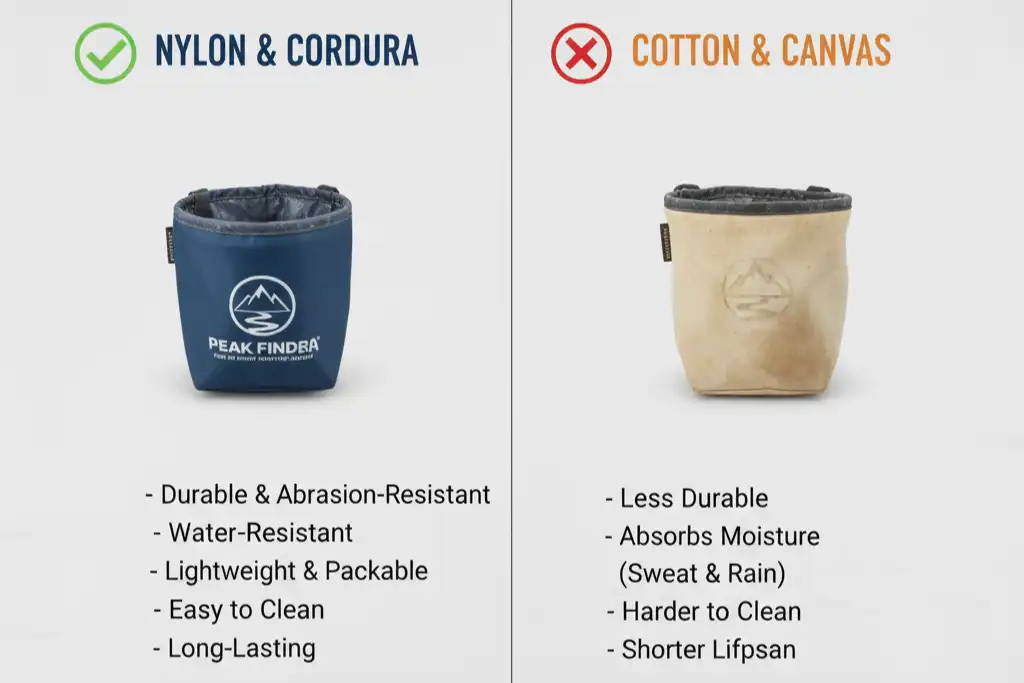
Heavy cotton canvas can be durable, but it is also heavier than many synthetic fabrics. Untreated canvas does not resist water as well as coated nylon or polyester. For laptop bags, this matters because moisture protection is important.
Waxed canvas or coated canvas can improve water resistance and structure. However, waxed canvas may need more care and can develop marks over time. Some users like that aged look, while others may prefer a cleaner business appearance.
Canvas is best when the bag needs a casual, natural, and slightly rugged style. It may not be the best choice for formal executive bags or lightweight travel laptop backpacks.
Recycled Polyester and Eco Fabrics: Suitable for Sustainable Collections
Recycled polyester, often called RPET, is increasingly used in business bags and laptop bags for brands that want a more sustainable product story. It is commonly made from recycled plastic bottles or recycled polyester sources, depending on the supply chain.
RPET can be used for:
- Corporate laptop bags
- Eco-conscious business backpacks
- Promotional bags
- Work totes
- Laptop sleeves
- Retail private label collections
However, brands should be careful with vague sustainability claims. A material should not be described as eco-friendly only because it sounds greener. Buyers should check recycled content documentation, supplier traceability, color performance, coating, strength, and production consistency.
For business buyers, recycled content claims should be supported by supplier documentation, transaction certificates where applicable, and consistent material records across sampling and bulk production. This helps avoid greenwashing and makes the material story easier to support in retail, corporate, and wholesale channels.
For textile safety and responsible material selection, OEKO-TEX STANDARD 100 is a useful reference because it is a label for textiles tested for harmful substances from yarn to finished product: OEKO-TEX STANDARD 100.
Recycled polyester is a good choice when a brand wants to support sustainability goals while keeping the practical benefits of polyester, such as color stability, scalable production, and flexible bag construction.
EVA, PE, and EPE Foam: The Hidden Materials That Protect Laptops
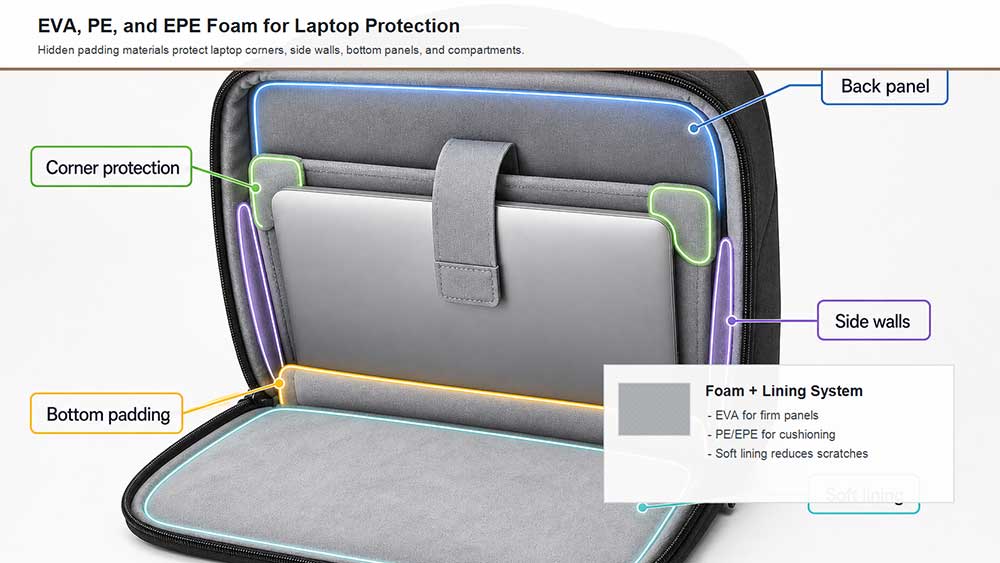
For laptop bags, the outer fabric is not the only important material. The hidden materials inside the bag often decide how well the laptop is protected.
Foam padding is used in laptop compartments, back panels, bottom panels, and sleeve structures. It helps absorb bumps, reduce pressure, and keep the device separated from hard surfaces.
Common laptop bag padding materials include:
- EVA foam
- PE foam
- EPE foam
- PU foam
- Sponge foam
- Neoprene
- Layered foam structures
EVA foam is firmer and more structured, making it useful for panels, bases, and protective compartments. PE and EPE foam are lightweight and cost-effective, often used in everyday laptop bags and sleeves. PU foam feels softer but may compress more easily depending on density. Neoprene is commonly used for slim laptop sleeves because it is flexible and close-fitting.
For laptop protection, thickness is not the only factor. Foam density, placement, recovery, bottom protection, and compartment fit all matter. A bag with moderate dense foam and a raised laptop sleeve can protect better than a bag with thick but soft padding.
For a deeper explanation, see our guide on how much padding a laptop bag needs.
Lining Materials: Small Detail, Big Difference
The lining material inside a business bag or laptop bag affects touch, scratch resistance, user experience, and perceived quality.
Common lining materials include:
- Polyester lining
- Brushed tricot
- Microfiber lining
- Fleece-like lining
- Nylon lining
- Smooth woven lining
For laptop compartments, soft lining is especially important. It helps prevent scratches on the laptop surface and creates a more premium feel when users insert or remove the device.
However, lining should not be confused with impact protection. A soft lining can prevent scratches, but it cannot replace foam padding or a structured laptop compartment.
A good laptop compartment should not have rough seams, exposed zipper tape, sharp hardware, or hard internal edges touching the laptop. For premium business bags, the lining should also match the outer material and market positioning. A high-end leather briefcase with poor lining will feel unfinished, even if the outer leather is good.
Water-Resistant Coatings and Backing Materials
For business bags and laptop bags, water resistance often depends on coatings, backing materials, zipper design, and construction details.
Common water-resistant treatments include:
- PU coating
- PVC backing
- TPU film
- DWR finish
- Laminated backing
- Coated canvas
- Waterproof zipper tape
PU coating is common in nylon and polyester bags because it helps improve water resistance and structure. PVC backing can add stiffness and cost-effective water resistance, but it may not suit every market or compliance requirement. TPU film is often used in higher-performance waterproof or water-resistant products.
It is important to understand the difference between water-resistant and waterproof. A water-resistant business bag can handle light rain or short exposure, but it may not protect a laptop in heavy rain, long exposure, or full submersion. Water can also enter through zippers, seams, stitching holes, and openings.
For laptop bags, the safest design combines:
- Water-resistant outer fabric
- Protected zipper construction
- Proper seam design
- Laptop compartment away from bottle storage
- Internal lining that does not trap excessive moisture
- External water bottle pockets
A good laptop bag should not rely only on fabric coating. The full construction should reduce water risk.
Material Comparison Table
| Material | Commonly Suitable For | Strengths | Weaknesses |
|---|---|---|---|
| Nylon | Laptop backpacks, travel bags, commuter bags | Lightweight, durable, abrasion-resistant options | Can look too sporty if texture is not selected well |
| Polyester | Corporate bags, entry-level laptop bags, work bags | Cost-effective, color stable, scalable | Lower-end versions may be less durable |
| Leather | Executive briefcases, premium business bags | Professional, premium, long-lasting | Heavy, expensive, needs care |
| PU leather | Budget business bags, laptop sleeves, totes | Polished look, easy to clean, lower cost | May crack or peel if quality is poor |
| Microfiber leather | Mid-range business bags | More refined than basic PU, consistent surface | Still not the same as premium genuine leather |
| Canvas | Casual business bags, messenger bags | Natural look, durable, heritage style | Heavier, needs treatment for water resistance |
| RPET | Sustainable collections, corporate programs | Supports recycled material story | Needs documentation and certification |
| EVA foam | Laptop compartments, structured panels | Firm, protective, shape-retaining | Hidden material, adds cost and structure |
| PE/EPE foam | Laptop sleeves, everyday laptop bags | Lightweight, cost-effective cushioning | Protection depends on density and placement |
| Microfiber lining | Laptop compartments | Soft touch, scratch protection | Not impact protection alone |
Best Material by Bag Type
Different bag types need different material combinations. A material that works well for a laptop backpack may not be the best choice for a formal business briefcase.
Business Backpack
A business backpack usually works best with nylon, high-denier polyester, or coated polyester. These materials keep the bag practical for commuting while allowing a clean, professional look.
For a business bag collection, the outer fabric should balance office appearance, durability, water resistance, and daily comfort.
Laptop Backpack
A laptop backpack should use durable outer fabric, dense foam padding, soft lining, and a stable laptop compartment. Nylon and polyester are common choices because they are practical for daily commuting and travel.
A padded laptop backpack should not depend on fabric alone. The laptop sleeve, bottom protection, back panel, and organizer layout are just as important.
Laptop Briefcase
A laptop briefcase often uses leather, PU leather, microfiber leather, nylon, or high-density polyester. Leather works well for premium executive styles, while nylon or polyester can make the bag lighter and easier to maintain.
The best material depends on whether the briefcase is designed for formal office use, daily commuting, or travel.
Laptop Messenger Bag
A laptop messenger bag can work well in leather, canvas, nylon, or polyester. Leather gives a more professional look, canvas creates a casual work style, and nylon or polyester makes the bag lighter and more weather-resistant.
Because messenger bags are carried on one shoulder, material weight matters. A heavy leather messenger bag may look premium but can feel uncomfortable when fully loaded.
Laptop Sleeve
A protective laptop sleeve usually uses neoprene, PU leather, polyester, felt, microfiber lining, or foam-padded structures. The material should protect against scratches, light bumps, and daily handling.
For sleeves, fit is especially important. Even good material cannot protect well if the laptop moves too much inside the sleeve.
Laptop Tote Bag
Laptop tote bags often use leather, PU leather, coated canvas, nylon, or polyester. Because tote bags may have softer outer bodies, a padded internal laptop sleeve is important.
For business users, the material should look polished while still supporting daily laptop carry.
Rolling Laptop Bag
Rolling laptop bags need high-denier polyester, nylon, reinforced corners, strong base panels, and abrasion-resistant bottom materials. The laptop compartment must be protected from the wheel structure, handle system, and heavier travel items.
What Brands Should Consider When Choosing Materials
For brands, wholesalers, and product development teams, material selection should happen early in the product design process. It affects cost, appearance, performance, compliance, MOQ, lead time, branding, and customer satisfaction.
Before choosing a material, brands should consider:
- Target user
- Bag type
- Retail price range
- Daily use scenario
- Laptop size
- Required protection level
- Water resistance requirement
- Logo method
- Color consistency
- Hardware quality
- Lining quality
- Padding structure
- Testing requirements
- Market compliance
- Packaging and private label needs
For example, a premium leather briefcase may need full-grain or top-grain leather, refined hardware, and a clean lining. A commuter laptop backpack may need nylon or polyester, dense padding, water-resistant coating, and a suspended laptop compartment. A corporate laptop bag may need stable polyester, consistent color, easy logo application, and cost-effective production.
For OEM and ODM projects, Vancharli Outdoor usually reviews outer fabric, lining, padding, hardware, logo method, and compliance requirements together, because material choice affects not only appearance but also sampling, cost control, bulk consistency, and user experience. The goal is not simply to choose a popular material, but to build a product that fits the user, price point, and sales channel.
Final Answer: What Is the Best Material?
There is no single best material for every business bag or laptop bag.
For lightweight commuting, nylon and high-denier polyester are usually practical choices. For premium executive business bags, full-grain or top-grain leather is often the stronger option for appearance and perceived value. For polished but cost-friendly products, PU leather and microfiber leather can work well. For casual business styles, canvas offers a natural and heritage look. For sustainable collections, recycled polyester can be a strong option when supported by proper documentation.
For laptop bags, the best material system includes more than the outer shell. A good laptop bag should combine durable fabric, proper coating, dense foam padding, soft lining, secure laptop fit, and reinforced bottom structure.
In short, the best material is the one that matches the bag’s real use case: how often it is carried, how formal it needs to look, how much weight it must hold, how much weather exposure it faces, and what protection level the laptop compartment needs.
FAQ
What is the best material for a business bag?
The best material depends on the style and target user. Leather is best for premium executive bags, nylon and polyester are practical for daily commuting, PU leather works for polished lower-cost business bags, and canvas suits casual or heritage-style work bags.
What is the best material for a laptop bag?
A good laptop bag usually combines durable outer fabric with foam padding and soft lining. Nylon and polyester are common outer materials, while EVA, PE, or EPE foam helps protect the laptop compartment.
Is nylon or polyester better for laptop bags?
Nylon is often stronger and more abrasion-resistant, while polyester is usually more cost-effective and color-stable. For high-end commuter laptop backpacks, nylon can be a strong choice. For corporate or entry-level laptop bags, polyester can be very practical.
Is leather good for laptop bags?
Leather is good for premium laptop briefcases, executive bags, and business totes. It looks professional and can last a long time with proper care. However, it is heavier, more expensive, and needs more maintenance than nylon or polyester.
Is PU leather good for business bags?
PU leather can be good for business bags when the goal is a polished appearance at a lower cost. However, low-quality PU can crack or peel over time, so brands should check material grade, flex resistance, odor, and compliance before production.
Is canvas good for laptop bags?
Canvas can be good for casual laptop bags, messenger bags, and work totes. It has a natural and durable look, but untreated canvas is not very water-resistant. For laptop use, coated or waxed canvas with a padded laptop sleeve is safer.
What material protects a laptop best?
The best laptop protection comes from a full material system, not one material alone. Durable outer fabric, EVA or PE foam, soft lining, a raised laptop sleeve, reinforced bottom, and secure fit all work together to protect the device.
Should business bags be waterproof?
Most business bags do not need to be fully waterproof, but water resistance is useful. A business laptop bag should handle light rain and daily spills, but heavy rain protection requires better zipper design, coated fabric, seam construction, or a rain cover.
What material is best for a lightweight laptop backpack?
Nylon and polyester are usually the best choices for lightweight laptop backpacks. They are lighter than leather and can be coated for water resistance. The best option depends on denier, weave, coating, lining, and padding structure.
What should brands check before choosing bag materials?
Brands should check durability, weight, appearance, water resistance, color consistency, logo method, padding compatibility, chemical compliance, MOQ, cost, and production stability. The best material should match the product’s target user and price point.



Comments are closed