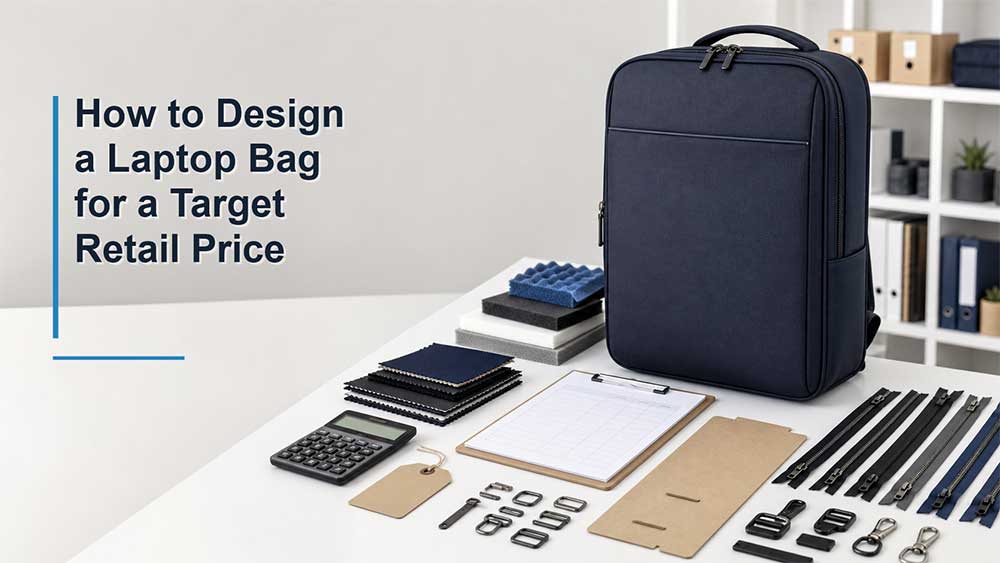
How to Design a Laptop Bag for a Target Retail Price
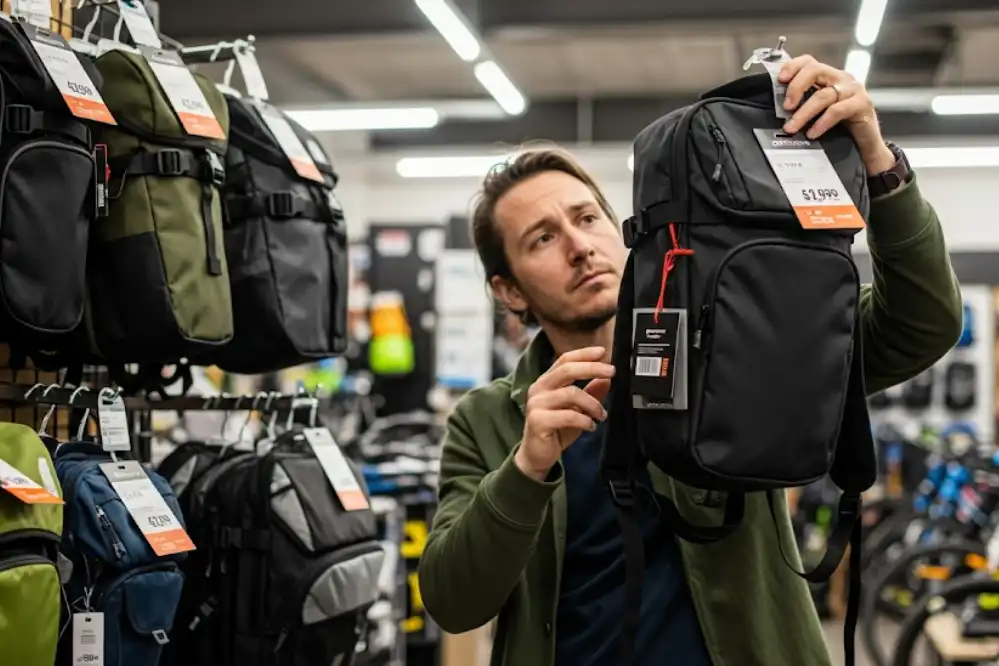
A target retail price should shape a laptop bag before the first pattern is made—not after a feature-heavy sample has already exceeded the budget.
The basic calculation works backward:
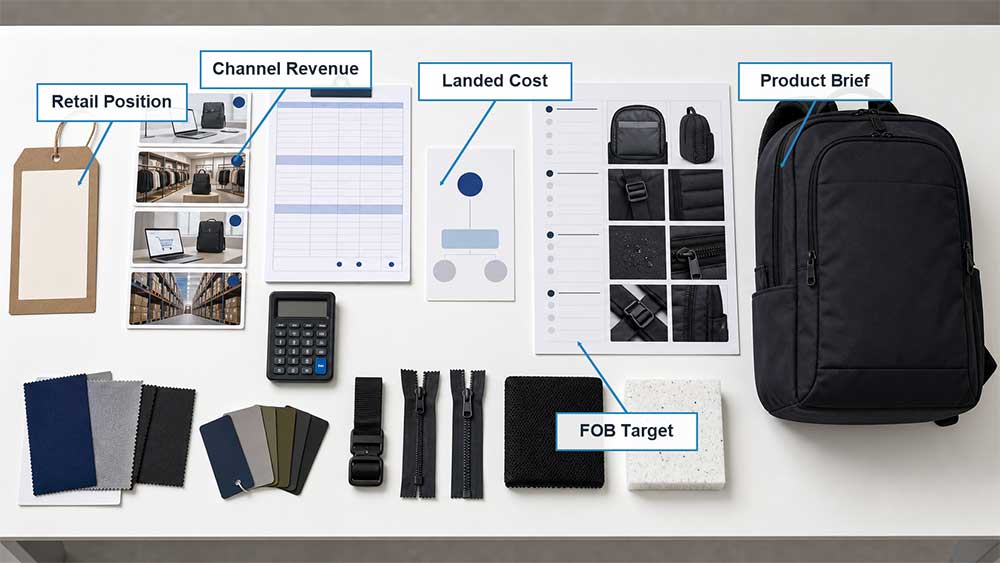
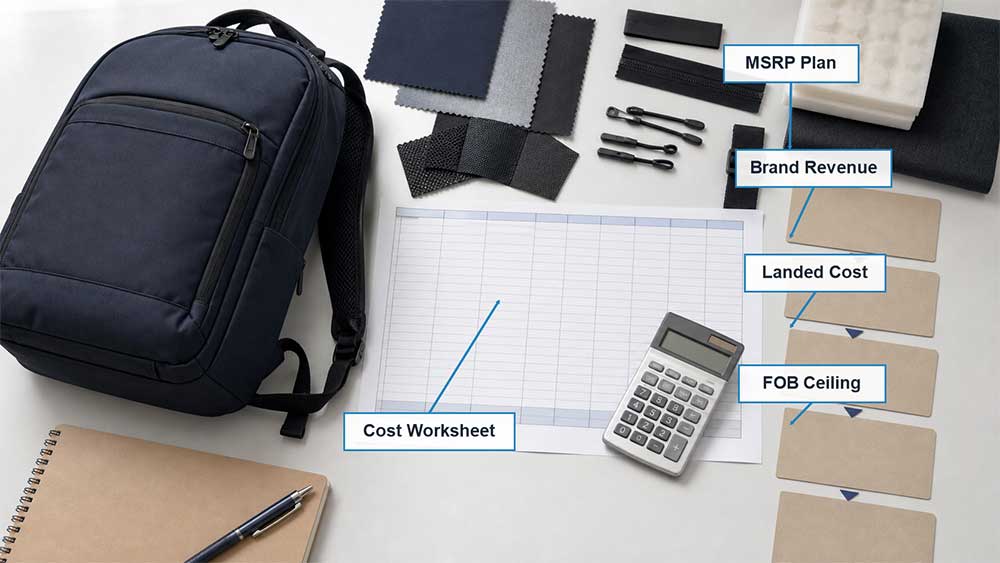
Target retail price → expected sales revenue → maximum landed cost → target FOB price → materials and construction budget
The goal is not to make every component cheaper. It is to protect the features customers value, simplify details they are unlikely to notice and ensure the final product can be manufactured consistently at a commercially viable cost.
Estimate how much revenue the brand will actually receive from each sale.
Apply the required gross margin to calculate the maximum landed cost.
Deduct estimated freight, duty and inbound expenses to establish a target FOB range.
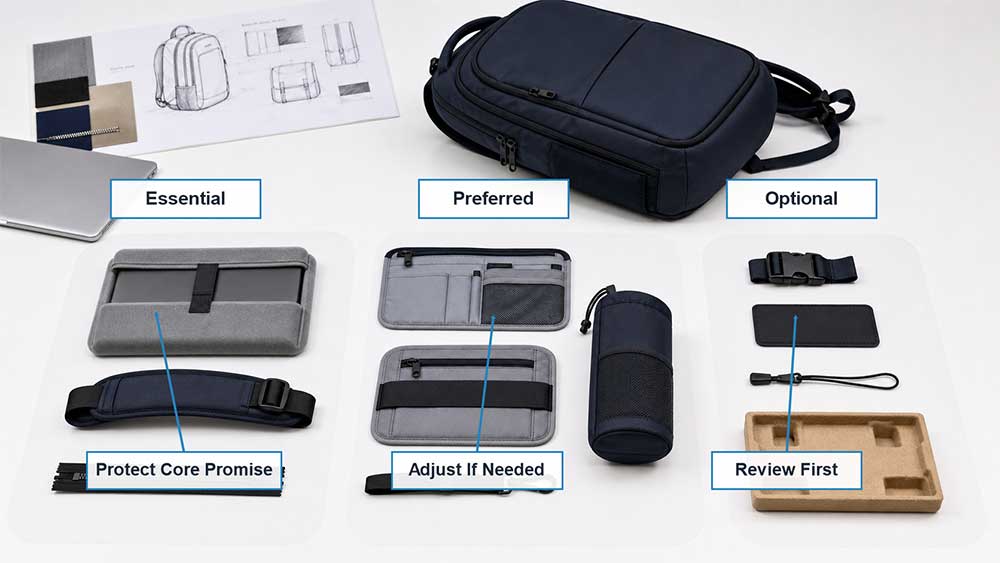
Divide product features into essential, preferred and optional groups.
Compare costed design options and confirm the final structure through sampling.
At the end of this process, the buyer should have a workable FOB target and a prioritized product brief—not just a suggested retail price.
Start With the Sales Channel
A laptop backpack with a $90 suggested retail price may support very different production costs depending on how it is sold.
A direct-to-consumer brand may receive the full selling price but still needs to account for discounts, payment fees, fulfillment, returns and marketing. A wholesale brand sells to retailers below MSRP and must leave enough margin for both the brand and the retailer. Marketplace sellers may also face commissions, advertising costs and fulfillment fees.
Before asking a manufacturer for a quotation, establish:
Target MSRP
Primary sales channel
Expected average selling price
Average discount rate
Wholesale price, if applicable
Required gross margin
Estimated freight, duty and inbound costs
Allowances for returns, promotions and channel fees
The MSRP alone does not tell a manufacturer how much of the price is available for product development and production.
Calculate the Maximum Landed Cost
For a direct-to-consumer product, a simplified starting point is:
These are planning formulas, not universal industry rules. Each company should use its own channel costs, accounting method and profitability target.
Landed cost is also different from the supplier’s FOB quotation. According to the U.S. International Trade Administration, the total cost of an imported product may include the product price, insurance, freight, duties, taxes and other charges.
A more complete planning formula is:
Estimated FOB ceiling = maximum landed cost − freight − duty and tax allowance − customs and brokerage − inland delivery − allocated inspection costs
Duty is normally estimated using the destination country, tariff classification, customs value and current duty rate. It should not be treated as an arbitrary fixed amount.
Confirm which expenses are already included in the quotation before deducting them. The selected Incoterm changes how costs and responsibilities are divided between buyer and seller; the ITA’s Incoterms overview provides a useful introduction.
A Hypothetical Laptop Bag Cost Example
Suppose a brand is planning a laptop backpack with a $90 MSRP.
The figures below are illustrative only:
Item
DTC example
Wholesale example
MSRP
$90.00
$90.00
Expected brand revenue
$81.00 after a 10% discount
$45.00 wholesale price
Target gross margin
65%
45%
Maximum landed cost
$28.35
$24.75
Freight, duty and inbound allowance
$6.35
$5.75
Approximate FOB ceiling
$22.00
$19.00
The same MSRP produces two different FOB ceilings because the channels have different revenue and margin structures.
Payment fees, returns, marketplace commissions and marketing expenses may not all be classified as landed product cost, but they still affect profitability. Brands should therefore review contribution margin as well as product gross margin before approving the design budget.
Turn the FOB Target Into a Product Brief
“Design a premium laptop backpack for no more than $22 FOB” is still too vague for accurate development.
The manufacturer also needs to understand what the bag must do:
Who is the intended user?
What laptop size must it accommodate?
Is it for commuting, business travel or corporate gifting?
What are the target dimensions, capacity and weight?
Which features influence the customer’s buying decision?
What visual details support the intended retail positioning?
For example, an urban commuter backpack may need a clean silhouette, a padded 15.6-inch laptop compartment, comfortable shoulder straps and an accessible front pocket. It may not need a separate shoe compartment, a molded back panel, several internal organizers and multiple metal buckles.
A cost target becomes useful only when it is connected to clear product priorities.
Divide Features Into Three Groups
Essential requirements
These protect the product’s main promise, usability or safety:
Correct laptop-compartment dimensions
Adequate foam around the device
Reinforced shoulder-strap attachment points
A reliable main-compartment closure
A comfortable carrying system
Required labels and compliance information
The primary visual element that identifies the brand
If removing a feature would undermine the main reason customers buy the product, it should not be the first place to cut cost.
Preferred features
These improve the user experience but can be adjusted if necessary:
Internal organizer pockets
Luggage pass-through
Water-bottle pockets
Key leash
Hidden security pocket
Additional lining or foam details
Optional features
These are usually reviewed first when the quotation exceeds the target:
Decorative webbing or buckles
Logos in several locations
Custom zipper pullers
Molded decorative components
Complicated hidden compartments
Contrasting materials used only for appearance
Elaborate individual retail packaging
This ranking gives the designer and manufacturer room to control cost without guessing which functions the brand considers essential.
Focus on the Cost Drivers That Affect the Design
Material, construction, hardware, branding and packaging can all change the quotation. Our guide to what affects the cost of a custom laptop bag explains those variables in more detail.
For target-price development, buyers should pay particular attention to four areas.
Construction complexity
Every additional panel, curved seam, bound edge and small pocket can add cutting, positioning and sewing time. A bag that looks minimal from the outside may still be expensive if its interior requires many separate operations.
Simplifying the pattern can sometimes save more than reducing a visible material specification.
Laptop protection
Foam thickness, foam type, lining, edge protection and the distance between the laptop sleeve and the bottom of the bag work together as a protection system.
Reducing foam everywhere may save little while weakening both protection and shape retention. A better approach is to preserve protection around the laptop and remove unnecessary padding from less critical areas.
Hardware and branding
Zipper specifications, the number of openings, double zipper pullers, metal fittings and custom components can quickly affect unit cost.
A woven label or printed logo has a different cost structure from a metal badge, molded patch or embroidery in several locations. The logo method, size, color and position should therefore be identified before sampling.
Buyers who need to define these components can use our business bag hardware guide as a specification reference.
Colors, packaging and shipping volume
Ordering 300 units in each of three colors is not necessarily equivalent to ordering 900 units in one color. Each color may require separate fabric, lining, webbing, thread and hardware purchasing.
Too many launch colors can create higher material minimums, more leftover material and less purchasing efficiency per SKU.
Packaging also needs to fit the retail strategy. Custom boxes, elaborate inserts and rigid packing methods consume budget and increase carton volume. A bag can meet its FOB target and still miss its landed-cost target if it cannot be packed efficiently.
Use a Logical Cost-Reduction Order
When the first quotation is too high, asking the manufacturer to reduce the price by a fixed percentage—while leaving every specification unchanged—rarely produces a useful solution.
A more practical sequence is:
Remove decorative components with limited customer value.
Eliminate duplicated pockets or unnecessary zipper openings.
Replace custom hardware with reliable standard components.
Consolidate materials and colors.
Simplify panels, seams and internal construction.
Review the logo method and packaging.
Consider alternative fabric or lining specifications that still meet the required performance.
Reassess the order quantity and color allocation.
Shoulder-strap reinforcement, critical laptop protection and proven closure components should not be the first targets. A saving that creates failures, complaints or returns is not a genuine cost reduction.
In our development work, the most productive cost discussions begin with a ranked feature list. This allows the design, pattern, material and costing teams to review the same priorities before the first sample is made, instead of removing features without understanding the product promise.
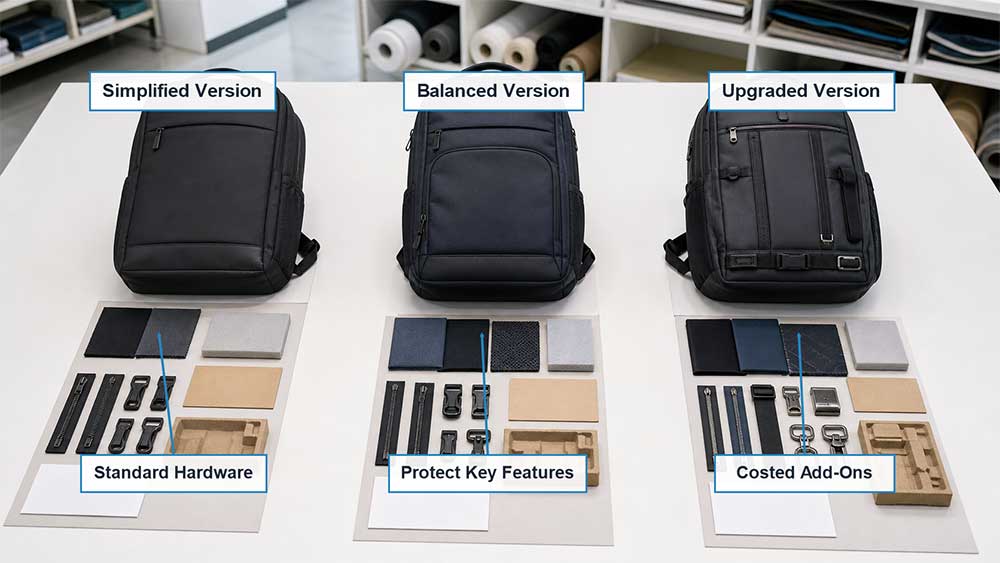
Ask for Costed Design Options
Rather than requesting one design and one price, ask the manufacturer to compare several clearly defined versions:
Option
Purpose
Core version
Meets the target FOB range while retaining all essential requirements
Preferred version
Adds the features with the strongest customer value
Premium version
Shows the cost impact of upgraded materials or components
The comparison may show, for example, how much a custom zipper puller, additional pocket or upgraded main fabric adds to the unit price.
This makes the trade-offs visible and prevents product development from becoming a series of disconnected revisions.
Provide Enough Information for a Reliable Quotation
A useful development brief should include:
Target market and use case
MSRP and sales channel
Target FOB or landed-cost range
Expected order quantity
Quantity per color
Bag dimensions and capacity
Laptop-compartment dimensions
Main fabric and lining requirements
Foam and support requirements
Pocket layout
Zipper and hardware grade
Logo method and placement
Packaging requirements
Reference images or design files
Destination country and requested Incoterm
If a finished tech pack is not yet available, annotated images and a prioritized feature list can still improve the first quotation. Brands preparing their first project can review what to prepare before private-label laptop bag production.
Use Sampling to Validate Cost and Construction
A quotation based on a drawing is still an estimate. Sampling reveals whether the proposed construction is practical and whether the cost assumptions work in a physical product.
During the sample review, check:
Laptop fit and clearance above the bottom
Shoulder-strap attachment strength
Bag shape when empty and loaded
Pocket accessibility
Zipper movement around corners
Seam thickness and binding quality
Material appearance in normal use
Final product weight
Packing method and carton efficiency
Updated bulk-production price
The price may change after the sample because material consumption, sewing difficulty, reinforcement, hardware or packaging becomes clearer during construction.
When a cost-saving change affects the structure or a critical component, approve it only after reviewing a revised sample or the relevant sample section. Once production begins, a defined laptop bag quality inspection checklist helps verify that materials, measurements and workmanship remain consistent with the approved sample.
Common Pricing-to-Design Mistakes
Applying a fixed retail-price multiplier
Dividing MSRP by four may be useful as an early filter, but it does not account for the brand’s actual discounts, retail terms, freight, duties or returns.
Giving the manufacturer only the MSRP
The factory cannot see the brand’s full commercial structure. A target FOB range is more actionable than the retail price alone.
Adding features without priorities
A long feature list can produce an impressive sample that does not meet the business target. Each pocket, zipper and decorative component should support a real user need or positioning objective.
Comparing quotations based on different specifications
Prices cannot be compared fairly if suppliers quote different fabrics, foam, zippers, reinforcements, packaging or Incoterms.
Choosing the lowest unit price without reviewing total cost
A design that generates quality claims, takes up excessive shipping volume or receives poor customer feedback is not a low-cost product in commercial terms.
Questions Buyers Often Ask
Should I tell the manufacturer the target retail price?
Yes. It helps explain the intended market position, but it should be accompanied by the sales channel, quantity and target FOB or landed-cost range. Retail price alone does not show how much is available for production.
What gross margin should I use?
There is no universal percentage. Use the company’s real channel economics, expected discounting, returns, operating model and profitability target. If the launch assumptions are uncertain, test several scenarios.
Is FOB price the same as landed cost?
No. FOB and landed cost cover different cost boundaries. Landed cost normally includes additional expenses incurred in bringing the goods to the buyer’s destination. Confirm the Incoterm and included charges before comparing quotations.
Can a manufacturer develop a design from a target cost?
Yes, but the buyer must also provide the use case, dimensions, essential functions, quality expectations and quantity. A cost number alone does not identify which features must be protected.
What if every quotation exceeds the target?
First confirm that all suppliers quoted the same specifications. Then identify the largest cost drivers and request priced alternatives. If the essential product still cannot meet the cost ceiling, the brand may need to change the retail price, channel structure, quantity or product concept.
Does a higher MOQ always reduce the price?
Not always. Larger quantities can improve purchasing and production efficiency, but the result depends on the construction, color allocation, material minimums and production setup. Dividing a larger order among many colors may provide limited savings.
How accurate is a quotation before sampling?
It depends on the completeness of the specifications. A detailed tech pack and confirmed materials make the estimate more reliable. The quotation should still be updated after the construction, components and packaging have been verified through sampling.
From Retail Positioning to a Production-Ready Bag
A commercially viable laptop bag does not begin with a long feature list followed by last-minute cost cutting. It begins with a clear financial boundary and a clear promise to the customer. Work backward from the revenue the brand expects to receive, establish a realistic FOB range and protect the features that define the product. Simplify complexity customers are unlikely to value, compare costed options and use sampling to verify the final decisions. That is how a target retail price becomes a laptop bag that can be produced consistently and sold with a sustainable margin. Vancharli Outdoor supports laptop bag brands with product design, material selection, pattern making, sampling and OEM/ODM production. A typical MOQ starts from 300 pieces, depending on the construction, materials, colors, logo, hardware and packaging requirements.









Comments are closed