



How to Approve Custom Bag Materials and Colors Remotely
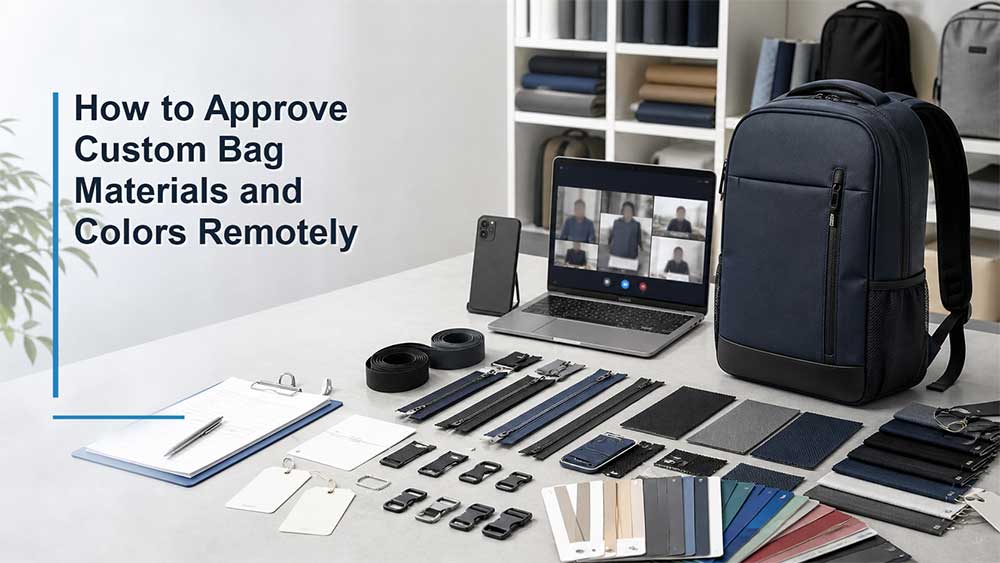
Most custom bag materials and colors can be reviewed remotely, but not every decision should be finalized from photos or a video call.
Digital files, labeled photos, and videos are useful for screening options and confirming specifications. When color, texture, hand feel, finish, structure, or performance matters to the final product, buyers should approve a clearly identified physical sample or use a properly controlled digital color system.
A reliable remote approval process answers three questions:
- What exactly is being approved?
- Which sample or specification becomes the controlling standard?
- How will that standard be used during bulk production and inspection?
In practice, the process should combine a written bill of materials, traceable sample numbers, physical swatches, lab dips or strike-offs where needed, a pre-production sample, and documented approval decisions.
The Remote Approval Process at a Glance
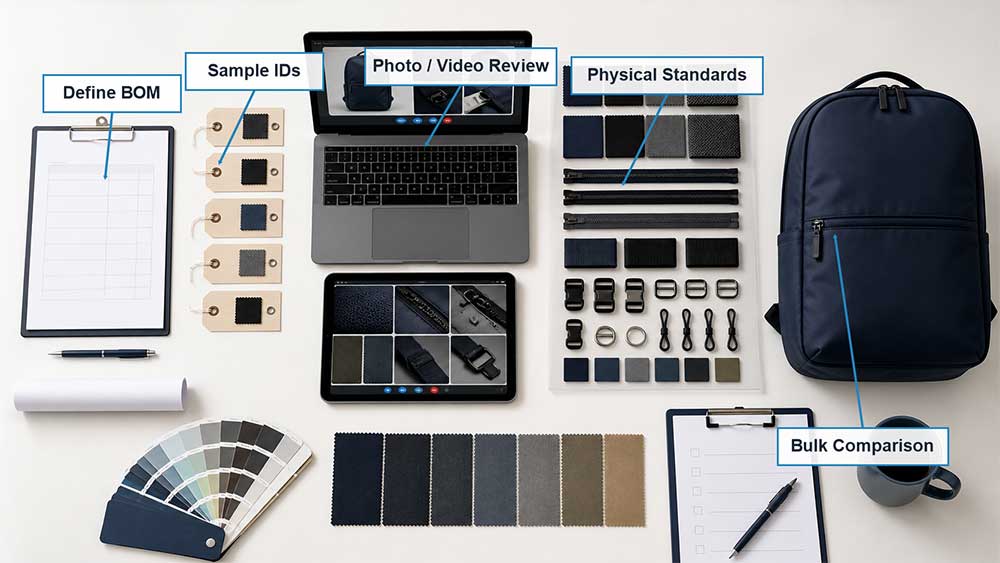
For buyers who need a quick answer, follow these five steps:
- Define every material and component in the bill of materials.
- Give each submitted swatch, color, and trim a unique reference number.
- Use photos and videos to screen options and confirm written details.
- Physically review materials that affect appearance, hand feel, structure, or performance.
- Compare bulk materials and the finished bag against the approved standards.
The right approval method depends on the risk of the component.
| Approval item | Digital review may be sufficient for | Physical review is usually needed when |
|---|---|---|
| Material identity | Supplier code, composition, and written specification | The material cannot be reliably identified from documents |
| General color direction | Early color screening | Final color is important to the brand or retail program |
| Texture and hand feel | Initial visual comparison | Softness, stiffness, grain, or finish affects product quality |
| Weight and thickness | Test reports or measurement videos | Structure, protection, or sewing performance may be affected |
| Printed artwork | Layout, dimensions, and general color direction | Final color, registration, repeat, clarity, or hand feel matters |
| Logo placement | Size and position on a marked sample | The technique involves embroidery, patches, or metal plates |
| Standard trims | Previously approved supplier and component codes | Custom colors, finishes, or visible trims are involved |
| Complete material combination | Initial review through labeled photos | Final approval of how all visible materials work together |
Digital review is often enough to eliminate unsuitable choices. It is less reliable as the only standard for a color- or appearance-critical production decision.
1. Define Exactly What Is Being Approved
Before reviewing any swatches, clarify the scope of each submission.
A buyer may approve the color of a fabric without approving its weight, coating, hand feel, water resistance, or abrasion performance. A prototype made from substitute fabric may be suitable for checking dimensions and construction, but it cannot approve the final production material.
Every submission should identify:
- Product name and style number
- Component being reviewed
- Supplier or material code
- Color reference
- Submission number and date
- Whether the review covers appearance, performance, or both
- Whether the decision applies only to sampling or also to bulk production
- Which changes require resubmission
Important decisions should not be scattered across unmarked photos, instant messages, and meeting notes. A separate approval form or clearly structured digital record makes it easier to see which version is current.
2. Build a Written Specification for Every Component
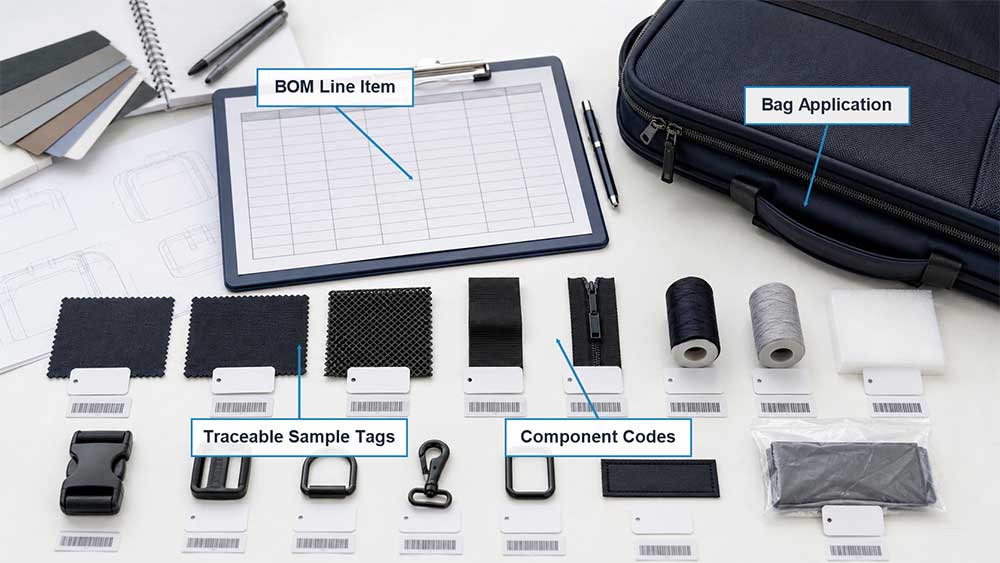
“Black nylon” is not a production-ready material specification.
Two black nylon fabrics can differ in yarn size, weave, weight, coating, gloss, stiffness, water resistance, and abrasion performance. They may look similar in a small photograph but create very different results in the finished bag.
The bill of materials should identify all relevant components, including:
- Main and secondary fabrics
- Lining and mesh
- Webbing and binding tape
- Zipper tape, teeth, and sliders
- Sewing thread
- Foam and structural reinforcement
- Plastic buckles
- Metal hardware
- Logo materials
- Labels and packaging
Record the information that matters to the function of each material.
| Specification field | What to record |
|---|---|
| Application | Shell, lining, webbing, zipper tape, or another component |
| Supplier reference | Supplier name, material code, or internal reference |
| Composition | Nylon, polyester, PU, mesh, or webbing |
| Construction | Weave, denier, yarn structure, or laminate construction |
| Weight or thickness | Unit and test method where relevant |
| Finish | PU coating, water-repellent treatment, matte finish, or brushing |
| Color standard | Pantone reference, approved master, or approved lab dip |
| Performance | Abrasion, colorfastness, water resistance, or strength |
| Approved version | Submission number and date |
| Status | Approved, rejected, or resubmit with comments |
Written specifications should remain connected to identifiable physical samples. A spreadsheet can organize the information, but each line still needs to point to the correct material.
Buyers who are still selecting the shell fabric can compare available custom bag fabric options and review how common backpack materials differ in performance before establishing the final approval standard.
3. Establish the Controlling Color Standard
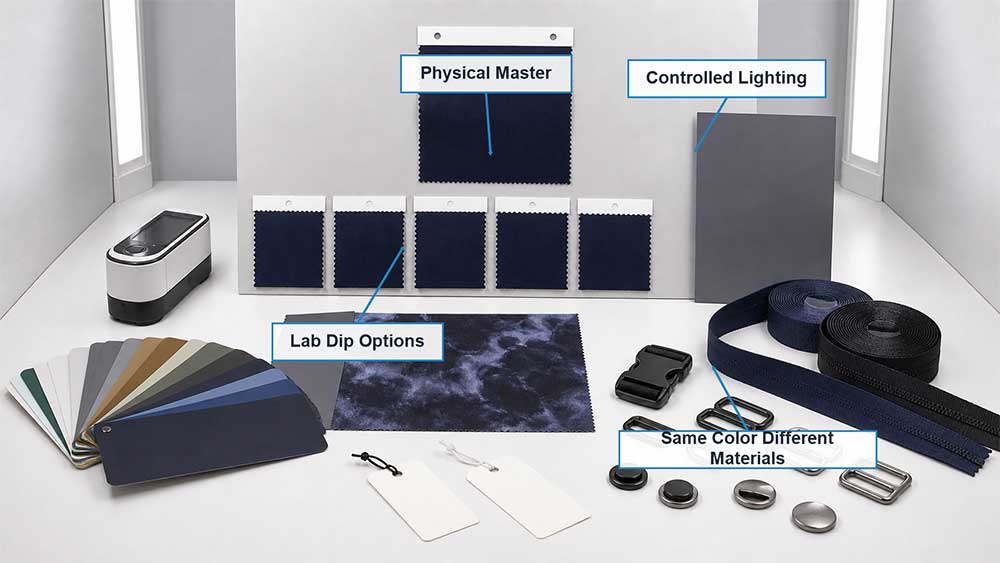
Names such as navy, charcoal, sand, or olive are too subjective to serve as production standards.
A Pantone reference can communicate the intended direction, but the color number alone is incomplete. Specify the exact Pantone system and suffix being used. Pantone maintains different systems for graphics, textiles, coatings, plastics, and other applications, as explained in its official overview of Pantone color systems.
A color selected from a coated-paper guide may not be the most suitable production standard for nylon fabric, webbing, plastic buckles, or coated metal hardware. Even when several components target the same nominal color, differences in substrate, texture, dyeing method, gloss, and finish can change how they appear.
Depending on the project, the controlling standard may be:
- An approved physical fabric or finished-product sample
- A clearly labeled and current color master
- An approved lab dip made on the intended substrate
- An approved strike-off for printed material
- A digital color standard supported by compatible measurement equipment and agreed procedures
Physical masters should be dated, identified, and protected from strong light, moisture, dirt, and unnecessary handling. Both the buyer and manufacturer should know which sample is the final controlling standard.
Digital color communication can shorten approval time, but it requires compatible instruments, consistent sample preparation, aligned measurement settings, and defined tolerances. Datacolor’s guidance on reliable digital color communication explains why digital data is only dependable when the entire measurement process is controlled.
It is not the same as approving color from an ordinary phone photograph.
4. Request a Complete Material Approval Package
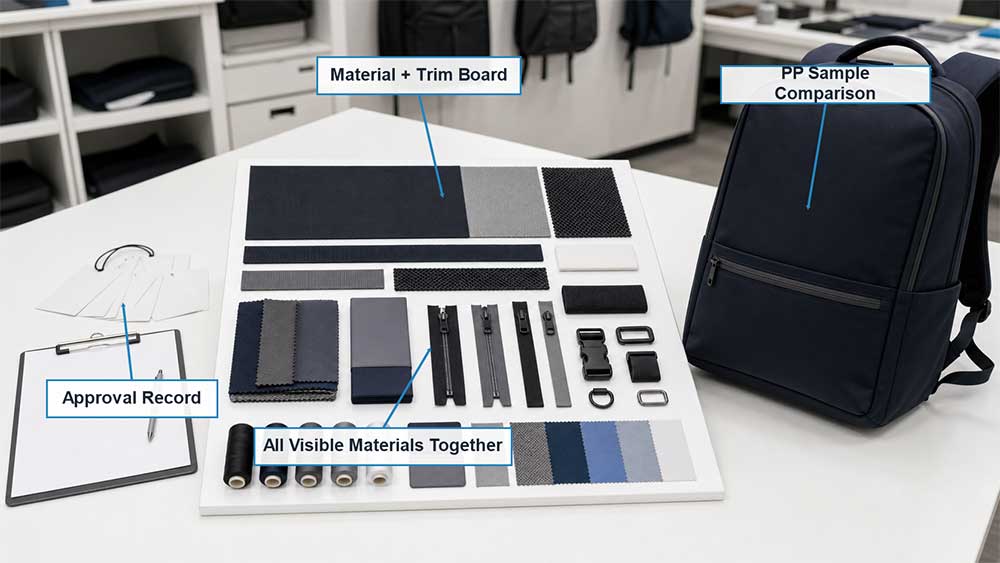
Approving materials through separate, unrelated messages makes it difficult to judge how the finished bag will look and perform.
Ask the manufacturer to prepare a clearly labeled approval package containing the relevant items:
- Main fabric
- Lining and mesh
- Webbing and binding
- Zipper tape, teeth, and sliders
- Sewing thread
- Foam and reinforcement materials
- Buckles and metal hardware
- Logo execution sample
- Labels
- Lab dips or strike-offs
- A combined material and trim board
Each item should show the style number, component name, material code, color reference, submission version, date, and intended location on the bag.
If availability, lead time, or minimum order quantity could influence production, record that information at the same time. There is little value in approving a material that cannot be obtained in the required quantity or within the planned schedule.
The combined material board is particularly useful. A main fabric, webbing, and zipper tape may all be described as black, yet appear blue-black, warm black, and neutral black when placed together. Reviewing them as a group allows the buyer to choose between a close match, a coordinated tonal effect, or an intentional contrast.
5. Use Photos and Video for Efficient Screening
Well-prepared visual evidence makes remote review faster, even when a physical sample will still be required for final approval.
Ask for:
- An overall photograph of the complete submission
- Close-ups showing weave, coating, grain, and surface finish
- Photographs that include both the sample and its reference label
- Side-by-side comparisons with the controlling standard
- Front and back views of the material
- Short videos showing bending, folding, stretching, or recovery
- Videos showing thickness or critical dimensions being measured
- Photographs of all visible materials placed together
- Color-critical comparisons under an agreed light source
Avoid approving color from heavily edited images or samples photographed against a strongly colored background. Camera white balance, exposure, image compression, ambient light, and monitor settings can all change what the buyer sees.
Materials may also match under one light source and appear different under another, a problem known as metamerism. For important color decisions, both parties should evaluate samples under agreed lighting conditions. X-Rite’s guidance on standardized light booths explains how controlled illumination supports more consistent visual evaluation.
Photos and videos are valuable evidence. They should support the controlling standard, not quietly replace it.
6. Approve the Correct Type of Physical Sample
Different submissions answer different questions. Buyers should know what each one can—and cannot—approve.
Material Swatch
A material swatch allows the buyer to examine the actual fabric, PU, mesh, or webbing.
Depending on its intended use, check:
- Color
- Weave and texture
- Weight and thickness
- Hand feel and stiffness
- Surface gloss
- Coating appearance
- Stretch and recovery
- Suitability for the planned bag structure
The approval record should state which characteristics have been accepted. Approval of color does not automatically approve performance.
Lab Dip
A lab dip is a small dyed sample made on the specified material before bulk dyeing.
Compare it with the controlling color standard under the agreed viewing conditions. Record the substrate, color reference, submission number, and selected option.
A color approved on one fabric should not automatically approve the same nominal color on a different substrate.
Strike-Off
A strike-off is used to review printed material before bulk printing. Check:
- Print color
- Pattern scale and repeat
- Registration
- Clarity and direction
- Appearance on the intended base fabric
- Hand feel after printing
Approval of the digital artwork confirms the design file. It does not confirm the final physical printing result.
Trim or Logo Execution Sample
Embroidery, screen printing, heat transfers, rubber patches, metal plates, and custom zipper pulls should be submitted using the intended production method whenever possible.
Artwork can confirm dimensions and positioning, but it cannot fully show embroidery density, patch texture, plating quality, edge definition, or how the logo interacts with the selected fabric. The same traceable controls used to prevent logo placement errors on custom bags should be applied during logo approval.
7. Review All Materials as One System
A common problem occurs when every component looks acceptable on its own but the finished combination does not feel coordinated.
Before comparing components, decide what visual relationship the product requires:
- The closest practical color match across different materials
- A coordinated tonal combination
- An intentional contrast
- Neutral hardware that works across several colorways
- A lighter or brighter lining for better interior visibility
Review the shell, lining, webbing, zipper, thread, plastic parts, metal hardware, and logo together. Pay particular attention to:
- Black or navy components sourced from different suppliers
- Matte fabric paired with glossy zipper tape
- Coated fabric combined with uncoated webbing
- Metal plating placed beside printed or embroidered logos
- Light linings that may show dirt or color transfer
- Bright colors that appear different on nylon, polyester, and plastic
- Fabrics whose appearance changes after foam or backing is added
The preferred result depends on the product. A business backpack may need a restrained tonal appearance. A tactical bag may require closer coordination among webbing, buckles, and reinforcement fabric. A sports or travel bag may intentionally use a bright lining or contrasting zipper pull.
Color coordination is a product design decision, not simply an instruction to “match the Pantone.”
8. Record Approval Decisions Without Ambiguity
Every submission should receive one clear status.
Approved
The identified sample is approved for the stated purpose. A later change to the supplier, specification, finish, or color must follow the agreed change-control procedure.
Rejected
The sample cannot be used. Feedback should explain what needs to change and may also identify which characteristics are already acceptable.
Resubmit With Comments
The sample must be corrected and submitted again before approval. If a material or color change is required, this status is safer than “approved with comments,” which can be interpreted differently by different teams.
A useful approval record includes:
- Style number and component
- Material and supplier reference
- Color reference
- Submission number
- Date received
- Approval status
- Buyer comments
- Name of the authorized approver
- Approval date
- Photograph of the submitted sample
- Location of the retained physical standard
Feedback should be specific. Instead of writing “the gray is wrong,” explain whether it is warmer, cooler, darker, lighter, less saturated, or more saturated than the controlling standard.
Annotated photographs can identify the sample and the area being discussed. Do not alter the color of a photograph to communicate the requested correction.
9. Confirm the Complete Bag on a Pre-Production Sample
After individual materials are approved, check how they perform together on a pre-production sample (PP sample).
Whenever practical, the PP sample should use the intended bulk materials, colors, trims, logo method, and construction.
Check:
- Overall color balance
- Coordination among the shell, lining, and trims
- Foam, reinforcement, and protective padding
- Shape when empty and loaded
- Surface wrinkles or coating marks
- Base color showing through stressed seams
- Zipper and binding performance
- Hardware finish
- Final logo appearance
- Material behavior around curves and corners
- Labels and packaging
For laptop backpacks, examine the foam and lining inside the device compartment. Travel, tactical, and sports bags may require more attention to bottom reinforcement, load-bearing webbing, equipment organization, or moisture-separated compartments.
If the sample still contains substitute materials, identify them clearly. Approval of the bag’s dimensions and construction does not approve unconfirmed substitute materials.
10. Carry the Approved Standards Into Bulk Production
Remote approval only works when the approved standards reach purchasing, incoming inspection, the production floor, and final quality control.
Before cutting begins, confirm that:
- Bulk materials come from the approved supplier and specification
- Incoming rolls or batches have been compared with the retained standard
- Shade variation between rolls has been reviewed
- Approved and unapproved materials are stored separately
- Material substitutions require written authorization
- Production teams use the correct BOM and approval file revision
- The factory retains the correct comparison samples
- Significant differences are reported before cutting
An approved lab dip does not guarantee that every meter of bulk fabric will be identical. Scaling from a laboratory sample to a production dye lot can introduce variation, so incoming bulk material still needs to be compared with the approved standard.
Buyer and manufacturer should also agree in advance on what qualifies as an acceptable minor variation. There is no universal Delta E limit suitable for every material, color, product, instrument setting, and brand.
As explained in Datacolor’s Delta E tolerance guidance, a meaningful tolerance must define the formula, instrument conditions, sample preparation, color family, product requirements, and visual acceptability. A numerical result should support—not replace—an agreed visual and commercial standard.
During final inspection, the approved PP sample, material board, written specifications, and approval records should be used together. These controls should form part of the brand’s wider custom bag production process.
Common Remote Approval Mistakes
Avoid these problems:
- Approving color from one phone photo: Photos are useful for screening but are not reliable color masters.
- Providing only a Pantone number: Specify the system and confirm the result on the intended substrate.
- Reviewing components separately: Materials that work individually may look inconsistent when assembled.
- Using unclear version descriptions: “The second black fabric” is not traceable; use a unique submission number.
- Treating construction approval as material approval: A substitute-fabric prototype cannot approve the final fabric.
- Allowing unapproved substitutions: Similar-looking stock materials may have different coatings, weights, stiffness, or shades.
- Copying a generic Delta E tolerance: Color tolerances must reflect the material, method, application, and buyer’s requirements.
Remote Material Approval Checklist
Before issuing final approval, confirm that:
- Every material has an identifiable code and written specification.
- The controlling color standard is clearly defined.
- The Pantone system and suffix are recorded where applicable.
- Appearance- or performance-critical materials have been physically reviewed.
- Lab dips and strike-offs use the intended substrate.
- Visible materials and trims have been compared together.
- Logos and hardware have been reviewed in the intended process and finish.
- Approval decisions and revision comments are unambiguous.
- The authorized approver and approval date are recorded.
- The PP sample uses approved production materials.
- Buyer and manufacturer retain matching reference standards.
- Material substitutions require written approval.
- Incoming and finished-product inspections use the same standards.
Build a Traceable Approval Process
The goal of remote approval is not to eliminate every physical sample. It is to use each approval method where it is most reliable.
Photos, videos, and digital files can accelerate screening and communication. Clearly labeled physical samples remain important when color, texture, hand feel, finish, structure, or performance affects the commercial result.
Every decision should be traceable from the written specification to the approved material, PP sample, incoming inspection, and finished-product standard. This reduces subjective instructions, unauthorized substitutions, and material problems discovered after bulk production has already started.
Work With an Experienced Custom Bag Manufacturer
Vancharli Outdoor supports overseas brands with material selection, custom color development, physical sample submissions, AI-assisted design drafts, pattern making, pre-production samples, and OEM/ODM bag production.
Typical MOQs for most fully custom bag projects start from 300 pieces. Some existing styles or material programs may start lower. The final MOQ depends on the product design, materials, colors, logo method, hardware, structure, and packaging requirements.
Frequently Asked Questions
Can custom bag colors be approved entirely by video call?
A video call is useful for initial review and for identifying obvious differences. If exact color, texture, gloss, or hand feel is commercially important, final approval should use an identified physical standard or a controlled digital color system.
Is a Pantone number enough to approve fabric color?
Usually not. The buyer should specify the Pantone system and suffix, then review a lab dip or actual material swatch on the intended substrate. Dyeing method, coating, texture, and viewing light can all affect the result.
Does every component require a physical sample?
No. Standard, low-risk components may be approved digitally when their specifications and supplier codes are clear. New shell fabrics, custom colors, important finishes, logo executions, and protective materials usually deserve physical review.
What if the same color looks different on several materials?
First decide whether an exact match is necessary. Compare the materials together under agreed lighting and approve their overall relationship. A coordinated tonal effect may be more realistic than forcing dissimilar substrates to appear identical.
Can a material be approved with a small correction?
If the correction must be completed before production, record the decision as “resubmit with comments.” Final approval should point to the corrected sample or updated written specification.
What happens if bulk material differs slightly from the approved sample?
Compare it with the retained standard under the agreed conditions and apply the project’s visual and numerical tolerances. Minor variation may be acceptable, but the manufacturer should not independently approve a difference that falls outside the agreed standard.
Who should keep the approved material samples?
Both buyer and manufacturer should retain matching, clearly labeled reference samples. They can then be used during incoming inspection, bulk production, repeat orders, and dispute resolution.




Comments are closed