Is Your Hydration Bladder Safe? BPA, PFAS, and Food-Contact Materials Explained
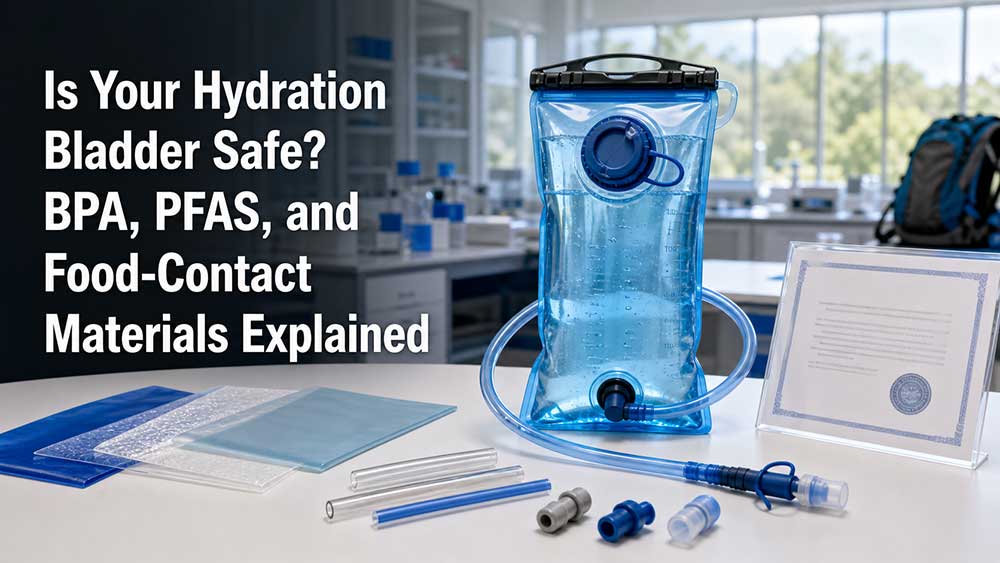
A hydration bladder may hold drinking water for hours while being exposed to movement, body heat, and changing outdoor temperatures. It is reasonable to ask what the reservoir, hose, bite valve, and connectors are made from—and whether those materials are suitable for repeated contact with drinking water.
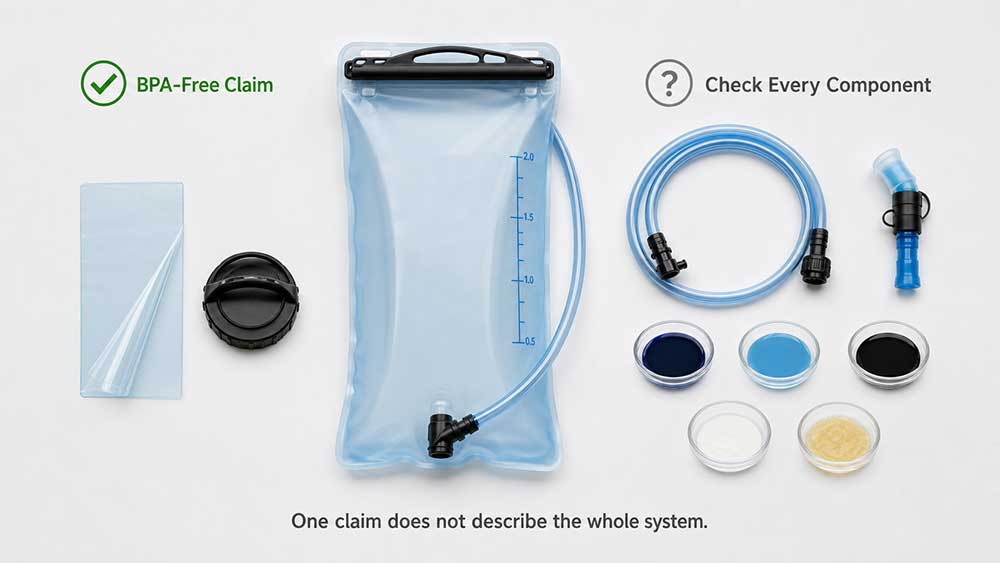
The short answer is that a hydration bladder cannot be judged by a single phrase such as “BPA-free” or “food-grade.”
BPA-free is useful information, but it does not automatically confirm that every water-contact component has been evaluated for its intended use and sales market. A PFAS-free claim also needs context: Does it cover the reservoir film, the complete drinking system, or the water-repellent finish on the backpack carrying it?
This guide first explains what these claims mean for users, then shows brand buyers what to verify before approving materials and production.
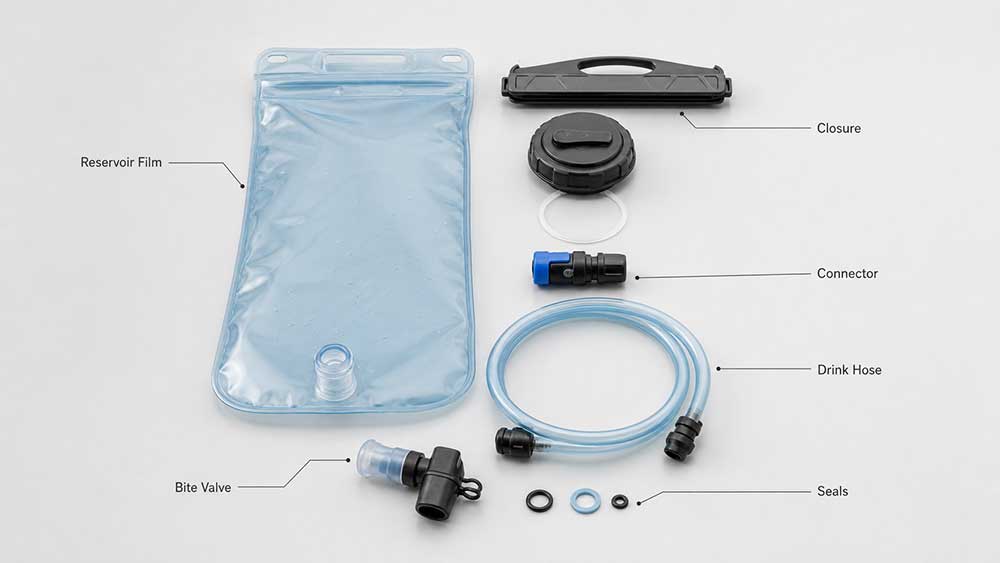
The flexible reservoir body is only one part of a hydration system. Depending on the design, drinking water may also contact:
The inner surface of the reservoir film
Welded seams
The filling opening and closure
Slide bars or screw caps
Quick-release connectors
The drinking hose
Elbows and fittings
The bite valve
Internal seals and O-rings
Printed markings on a water-contact surface, if present
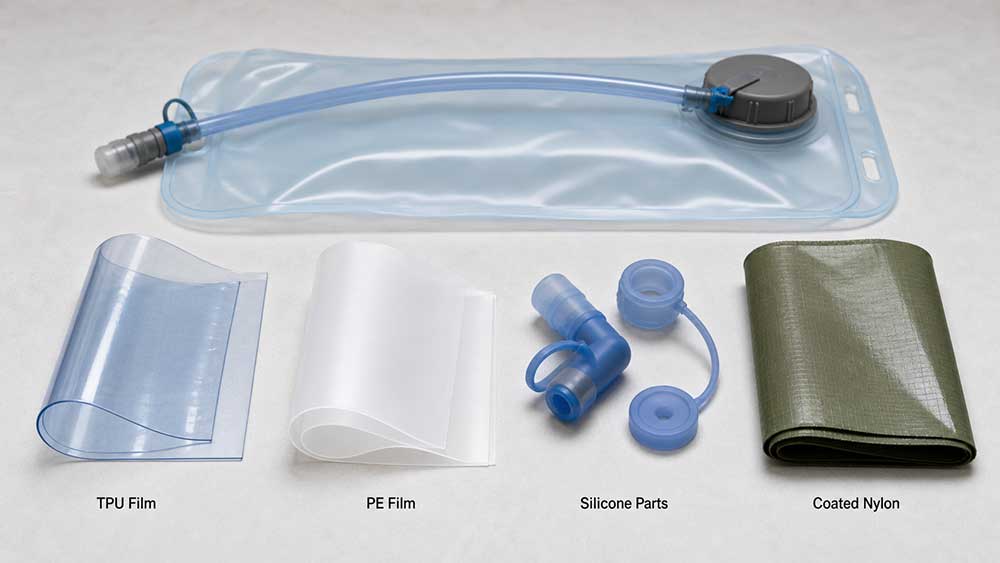
These parts may use different materials. A reservoir could combine a TPU film, polypropylene closure, silicone bite valve, polyethylene tube, and seals made from another elastomer.
A report covering only the main film may therefore be insufficient to support a claim about the complete hydration system. Check the film, hose, bite valve, closures, intended beverage, and permitted temperature—not only the material name shown on the product page.
What BPA-Free Does—and Does Not—Tell You
BPA stands for bisphenol A, a chemical historically used in certain polycarbonate plastics, epoxy resins, and other food-contact applications.
When a hydration bladder is described as BPA-free, the claim generally means that BPA was not intentionally used in the specified material or that the material or product met an agreed testing requirement. The exact meaning depends on the supplier’s declaration, test method, reporting limit, and components evaluated.
BPA-free does not automatically mean:
The complete hydration system meets every applicable food-contact requirement
The product is free from all related bisphenols
The material contains no other substances of concern
The reservoir is suitable for every beverage or temperature
Every color, thickness, or material variation is covered by the same report
The product will remain hygienic without correct cleaning and drying
Buyers should confirm whether the statement covers only the reservoir film or also the hose, bite valve, connectors, seals, and closure.
What about BPS and BPF?
Bisphenol S and bisphenol F have been used as alternatives to BPA in some material applications. A label that mentions only BPA does not necessarily make a statement about BPS or BPF.
HydraPak states that, in addition to being BPA-free, its products are also BPS- and BPF-free. The company explains that the TPU used in most of its products does not require BPA, BPS, or BPF for synthesis. HydraPak’s material explanation
This is a useful example of a manufacturer defining the scope of its material claim. It should not be expanded into a conclusion that every TPU formulation or every finished TPU hydration system is automatically compliant.
For an OEM or private-label order, request:
A material composition declaration
A statement covering BPA, BPS, and BPF where relevant
Applicable test reports
A list of the components covered
Confirmation that the tested material matches bulk production
Make sure the tested material is the same film, color, thickness, and supplier used for the order. A report for clear film may not automatically cover a colored version or a substitute from another material supplier.
BPA Rules Differ Between the United States and Europe
BPA requirements are not identical in every market.
The European Commission adopted a broad ban on BPA in food-contact materials in December 2024. Regulation (EU) 2024/3190 covers BPA and certain other hazardous bisphenols and bisphenol derivatives in relevant food-contact applications, with transitional arrangements for some products.
The EU explains that the measure includes products that come into contact with food or beverages, such as reusable plastic drink bottles and water-distribution equipment. European Commission
The FDA’s published position in the United States remains different. Based on its current assessment, the FDA states that available information continues to support the safety of BPA for currently approved uses in food containers and packaging. U.S. Food and Drug Administration
This difference matters for brands selling internationally. A general statement such as “FDA compliant” should not be treated as proof that the same product meets all EU requirements.
By 2026, buyers should define the intended sales markets before approving the materials and test program. The United States, European Union, United Kingdom, and other destinations may require different documentation.
What a PFAS-Free Claim Needs to Explain
PFAS are a large group of synthetic fluorinated chemicals. Certain PFAS have been used in industrial and consumer products because they can provide resistance to water, grease, stains, chemicals, or heat.
The U.S. Environmental Protection Agency describes PFAS as widely used, long-lasting chemicals that break down very slowly. Their persistence and widespread presence have led to increasing public and regulatory attention.
Three separate questions are often confused:
Is PFAS present in the source drinking water?
Is PFAS intentionally added to the reservoir or another water-contact component?
Is PFAS used in the water-repellent finish on the outer hydration pack?
These are not the same issue.
A hydration reservoir should not be assumed to contain PFAS simply because it is made from TPU. At the same time, the name “TPU” alone cannot prove that the complete product is PFAS-free.
The outer pack may use a durable water-repellent treatment on its textile surface. This treatment is separate from the reservoir film but may still matter to brands with policies restricting intentionally added PFAS.
A meaningful PFAS statement should identify:
Which components it covers
Whether it refers to intentionally added PFAS
Whether it is based on supplier declarations, testing, or both
Which PFAS or analytical method the test covers
The reporting or detection limit
Whether the outer pack fabric and its finish are included
“No intentionally added PFAS” is not the same as “zero PFAS”
A statement that no PFAS was intentionally added describes the formulation or manufacturing intent. It does not necessarily mean laboratory testing would report zero fluorinated substances under every method.
The phrase PFAS-free can also be ambiguous. PFAS includes thousands of substances, while a laboratory may test only a specified list or use a broader screening method, such as total organic fluorine.
The claim may still be useful, but buyers need to know whether it is based on formulation records, laboratory testing, or both.
Before publishing a PFAS-related claim, confirm:
The definition of PFAS being used
The materials and components covered
The test or declaration supporting the claim
The analyte list and reporting limit
Whether the reservoir and carrying pack are treated separately
Whether the wording meets target-market and retailer requirements
When laboratory testing is required, the buyer and an appropriately accredited laboratory should agree in advance on the product scope, test method, analyte list, and reporting limit.
Common Hydration Bladder Materials
Material names are useful starting points, but they cannot prove that a finished hydration system is safe or compliant. The exact formulation, additives, colorants, intended conditions, and supporting documents still matter.
Material
Common use
What buyers should verify
TPU
Flexible reservoir film and some soft components
Exact grade, film thickness, migration requirements, odor, weld strength, hydrolysis resistance, and temperature limits
PEVA or EVA-based materials
Flexible reservoir film
Formulation, additives, odor, low-temperature flexibility, seam strength, and food-contact documents
PE and PP
Closures, caps, slide bars, tubes, and connectors
Resin grade, colorants, intended contact conditions, fit, and durability
Silicone or TPE
Bite valves, seals, and flexible mouth-contact components
Food-contact suitability, hardness, tear resistance, valve recovery, odor, and temperature range
Flexible PVC
Some reservoirs or drinking hoses
Plasticizers, phthalates, other restricted substances, and target-market requirements
TPU is widely used because suitable grades can combine flexibility, relatively low weight, abrasion resistance, and heat-weldable seams. However, TPU is a material family rather than one fixed formula.
PEVA is also a broad commercial term that may cover different formulations. Buyers should not assume all PEVA reservoirs have identical performance or documentation.
Flexible PVC requires attention to the complete formulation, especially plasticizers and other additives. It is inaccurate to say that every PVC product is automatically unsafe, but some brands avoid PVC to simplify their phthalate policies or meet retailer requirements.
The same principle applies to silicone, TPE, PE, and PP. The material name is only the beginning of the evaluation.
Is “Food-Grade” Enough?
“Food-grade” is widely used in product descriptions, but it is not a complete compliance document.
A useful supplier response should identify:
The specific material
The manufacturer or source
The intended contact use
The applicable market
The regulation or requirement being referenced
The test conditions
The tested material or product
The report date and laboratory
Any temperature, time, or beverage limitations
In the European Union, food-contact materials must meet the general requirements of Regulation (EC) No 1935/2004. The European Commission explains that material constituents must not transfer into food at levels that could endanger health or unacceptably affect composition, taste, or odor. Additional requirements, including measures for plastic materials, may also apply. European Commission food-contact materials guidance
For the United States, the substances used should be authorized for their intended food-contact conditions under applicable FDA regulations or effective Food Contact Notifications.
A report for one TPU raw material may not automatically cover:
A finished multilayer reservoir
Printed measurement markings
The drinking hose
The bite valve
Colored closures
Adhesives or coatings
Replacement materials from another supplier
For B2B procurement, review the component list and supporting-document list together.
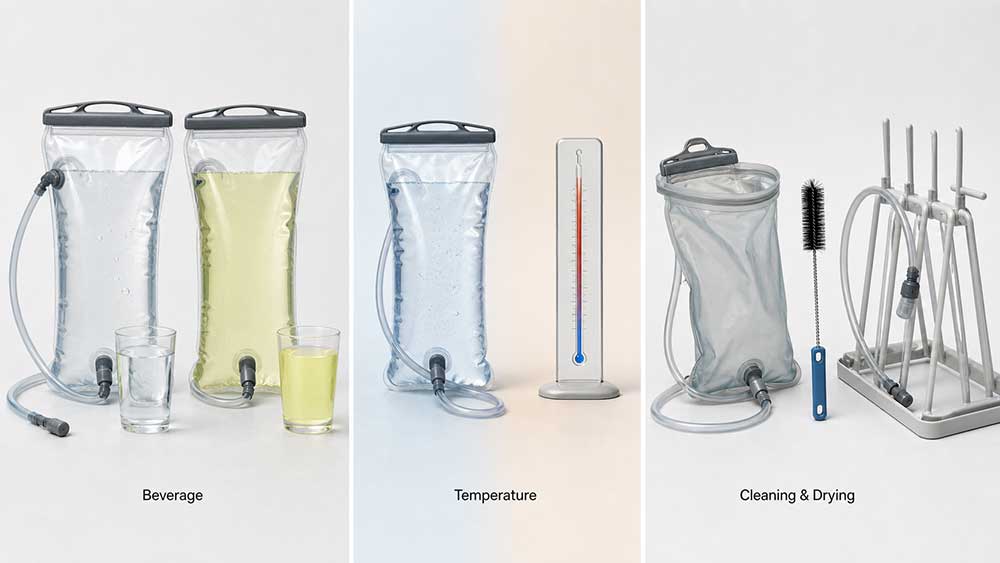
Taste, Temperature, and Cleaning Still Matter
Material declarations are important, but they do not answer every practical safety question.
Does plastic taste prove the reservoir is unsafe?
No. Taste and odor matter, but they are not reliable substitutes for chemical documentation or migration testing.
A new reservoir may have a noticeable smell because of:
The material formulation
Processing conditions
Packaging
Storage
Residual moisture
Printed or assembled components
A noticeable odor does not automatically prove that the product is hazardous. Likewise, a product with no smell is not automatically safe or compliant.
Follow the manufacturer’s rinsing and cleaning instructions before first use. If a strong taste or odor remains after correct cleaning, stop using the reservoir and contact the seller or supplier.
During product development, odor and taste should be evaluated at the sample stage, but the result should be treated as a user-experience check rather than the only safety test.
Do beverages and temperature change the requirements?
A hydration bladder designed for cool drinking water may not be suitable for boiling water, alcohol, milk, acidic beverages, or long-term liquid storage.
Confirm:
Maximum and minimum operating temperatures
Whether the reservoir is intended only for water
Whether sports drinks are permitted
Whether hot liquids are prohibited
Recommended contact time
Freezing guidance
Cleaning-agent limitations
Storage instructions
Heat can increase migration from some materials and may deform closures, weaken seams, or change valve performance. Do not use hot water unless the manufacturer specifically permits it.
Sports drinks may be compatible with the reservoir material, but sugar and electrolyte residue can remain in the hose, valve, and seams.
Can BPA-free material still develop mold?
Yes. Material claims do not prevent microbial growth.
A BPA-free, BPS-free, or PFAS-related claim cannot prevent:
Biofilm
Mold
Bacterial growth
Odor from trapped moisture
Residue inside the hose
Contamination on a dirty bite valve
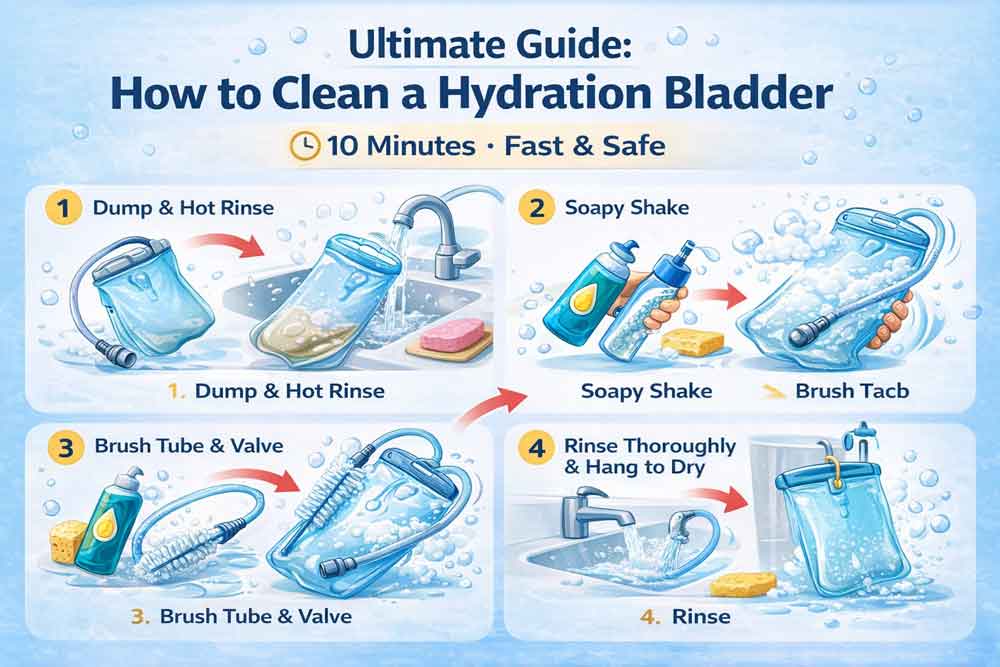
After use, clean the system according to the manufacturer’s instructions and allow it to dry fully. Sugary drinks require particular attention.
Suitable materials and proper hygiene are two separate parts of safe use. Neither can replace the other.
What Consumers Should Check Before Buying
Consumers rarely have access to a complete technical file, but a responsible brand should still provide useful information.
Look for:
A clearly identified reservoir material
An explanation of whether the claim covers BPA only or also BPS and BPF
Information about PVC or phthalates where relevant
Permitted beverages
Temperature limitations
Cleaning and storage instructions
Replacement-part availability
The intended market or relevant food-contact requirements
Clear PFAS wording that distinguishes the reservoir from the outer pack
Be cautious with claims such as:
“100% chemical-free”
“Completely non-toxic”
“FDA approved material”
“The safest hydration bladder”
“All TPU is naturally food-safe”
“No plastic taste proves it is safe”
The phrase “FDA approved” is often used too loosely. The more accurate question is whether the substances and their intended conditions of use comply with applicable FDA food-contact requirements.
What Brand Buyers Should Request
Brand buyers, importers, and product developers need more information than appears on a consumer label.
A hydration bladder specification should identify:
Reservoir film composition and supplier
Film thickness and layer structure
Hose material
Bite-valve material
Closure and connector materials
Seal materials
Colorants and printed markings
Intended beverages
Operating-temperature range
Target sales markets
Restricted-substance requirements
Required physical and chemical tests
The supporting package may include:
Material declarations
A bill of materials
Supplier compliance statements
Applicable migration or extraction test reports
BPA, BPS, and BPF statements
Phthalate documentation where relevant
PFAS declarations or test reports where required
REACH or retailer restricted-substance documentation
Production-lot traceability
Confirmation that bulk materials match the approved sample
Do not accept a report only because it contains the phrase “food-grade.” Check the product description, material, color, thickness, laboratory, test method, date, and whether the sample matches the order.
Why Production Material Must Match the Approved Sample
A compliant development sample provides little protection if the production material is later changed without review.
Substitution may occur because of:
Material availability
Price changes
Minimum order quantities
Color matching
Production scheduling
A change of supplier
Two films may look and feel similar while using different formulations and documentation.
The purchase specification should state that material substitutions require written approval. Production checks should confirm:
Film appearance and thickness
Material codes where applicable
Closures, connectors, hoses, and valves
Odor
Weld quality
Printing
Packaging claims
Batch or supplier details where required
Chemical documentation also cannot replace functional testing. A hydration bladder must resist leakage, pressure, repeated opening, hose movement, valve operation, and real carrying conditions.
How Vancharli Outdoor Approaches Hydration Bladder Projects
For custom hydration bladder projects, Vancharli Outdoor can review the reservoir film, hose, bite valve, closure, connectors, seals, and other water-contact components against the buyer’s specification and target-market requirements.
Claims such as BPA-free, BPS-free, phthalate-free, PVC-free, or PFAS-related should be connected to the specific materials, component scope, and supporting documents used for the order. They should not be added to a product page simply because another product with a similarly named material carries the same claim.
Before sampling, buyers should define:
Sales markets
Intended users
Intended beverages
Capacity
Operating-temperature range
Material preferences
Restricted-substance policies
Required documents
Leak and pressure tests
Permitted packaging claims
This allows material suitability, performance, cost, and marketing language to be reviewed together before production.
Why This Question Matters in 2026
The important change is not that one global rule has suddenly made all older hydration bladders unsafe.
Instead:
The EU has introduced broader restrictions on BPA and certain related bisphenols in food-contact materials.
The FDA’s published position on currently approved BPA uses remains different from the EU approach.
PFAS restrictions and reporting obligations continue to develop across jurisdictions and product categories.
Retailers and brands may set chemical policies that go beyond minimum legal requirements.
Buyers increasingly need component-specific declarations instead of broad statements about a finished product.
BPA-free and PFAS-free marketing claims are receiving closer scrutiny.
For an internationally sold hydration bladder, compliance should be treated as a target-market question rather than a universal badge.
A well-supported product combines suitable materials, accurate claims, component-level documentation, reliable construction, and proper cleaning. No single label can replace all five.
Frequently Asked Questions
Can an older hydration bladder develop more odor or taste?
Yes. Repeated use, poor drying, beverage residue, material aging, and storage conditions can affect taste and odor. Replace the reservoir if persistent odor remains after correct cleaning or if the film becomes sticky, cracked, or delaminated.
Can you put hot water in a hydration bladder?
Only if the manufacturer provides a suitable maximum-temperature rating. Hot water can increase migration from some materials and may deform closures, weaken seams, or affect valve performance.
Are sports drinks safe to store in a hydration bladder?
They may be, provided the manufacturer permits them. Sports drinks can leave sugar and electrolyte residue in the reservoir, hose, and bite valve, so the system should be cleaned promptly after use.
Does a BPA-free label cover the hose and bite valve?
Not necessarily. The claim may apply only to the main reservoir film. Ask whether it covers all components that contact the drinking water.
Should a PFAS-free statement include the outer hydration pack?
That depends on the wording. A claim about the reservoir may not cover the outer textile or its water-repellent treatment. Brands should define these scopes separately.
When should a hydration bladder be replaced?
Replace it when the film, seams, hose, bite valve, or connectors are damaged; when surfaces become sticky or delaminated; or when persistent mold, taste, or odor cannot be removed through correct cleaning.







Comments are closed