


7 Tactical Bag Materials Ranked By Strength And Weight
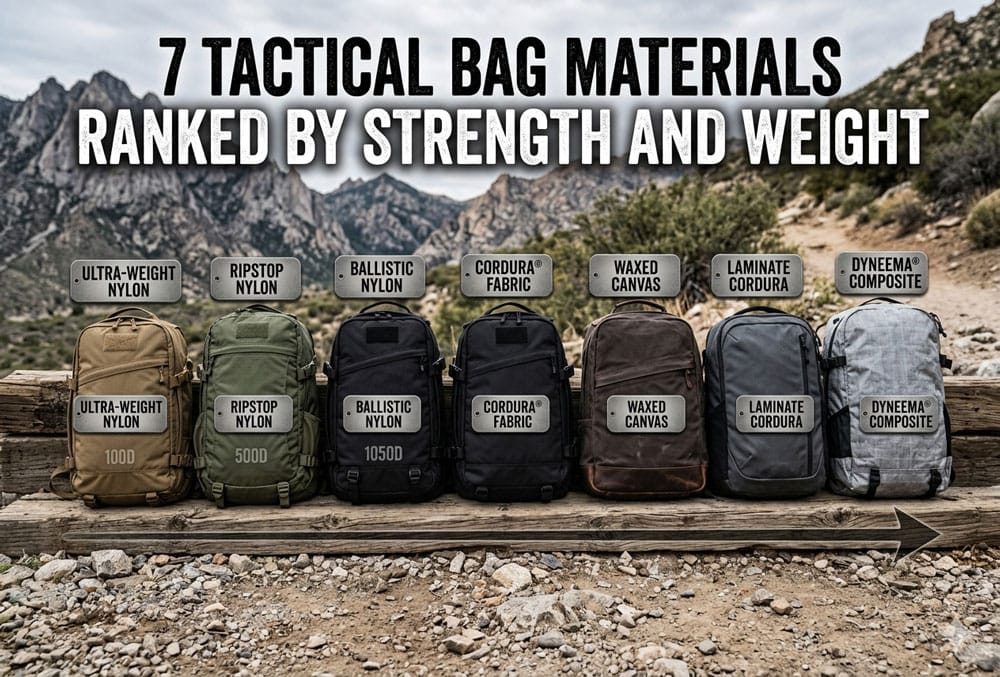
A 1000D Cordura pack weighs nearly 40% more than a Dyneema Composite pack of the same volume, yet Dyneema costs roughly 5x per square yard. That tradeoff sits at the heart of every smart gear choice.
And this guide is Tactical Bag Materials Explained through hard numbers: tensile strength in pounds, abrasion cycles on the Wyzenbeek scale.
And grams per square meter.
Below, seven fabrics ranked from heaviest-and-toughest to lightest-and-priciest, with the exact use case where each one wins.
Quick Takeaways
- Choose Dyneema Composite for ultralight rucks needing maximum strength-per-gram under 100 GSM.
- Pick X-Pac VX21 or ECOPAK EPX200 for weatherproof EDC tactical packs.
- Use Cordura 1000D for duty, range, and military bags requiring abrasion resistance.
- Ignore denier numbers alone—600D polyester tests weaker than 500D Cordura nylon.
- Avoid Dyneema on MOLLE panels since it tears at stitch holes.
The 7 Tactical Bag Materials Ranked By Strength-To-Weight Ratio
Quick answer: Dyneema Composite Fabric wins on raw strength-per-gram, but X-Pac VX21 and ECOPAK EPX deliver the best real-world balance for tactical bags. Cordura 1000D remains the abrasion king for duty use, while 600D polyester sits at the bottom, fine for budget builds, not for hard service.
This Tactical Bag Materials Explained ranking uses two metrics that actually matter: areal weight (grams per square meter, GSM) and tensile strength (pounds before the weave snaps under pull). Coatings excluded, we rate the base fabric.
| Rank | Material | Weight (GSM) | Tensile (lbf, warp) | Best Use |
|---|---|---|---|---|
| 1 | Dyneema Composite Fabric (CT9) | ~75 | ~400 | Ultralight ruck, dry bags |
| 2 | X-Pac VX21 | ~200 | ~285 | EDC, weatherproof packs |
| 3 | ECOPAK EPX200 | ~210 | ~270 | Sustainable tactical builds |
| 4 | Cordura 1000D nylon 6,6 | ~410 | ~360 | Duty, range, military |
| 5 | Cordura 500D nylon 6,6 | ~260 | ~230 | EDC, plate carriers |
| 6 | Ripstop nylon 6,6 (210D) | ~95 | ~95 | Stuff sacks, liners |
| 7 | 600D polyester | ~330 | ~150 | Budget bags, training gear |
Two takeaways before we go deeper. First, denier (the “D” number) measures yarn thickness, not strength, that’s why 600D polyester loses to 500D Cordura despite the bigger number.
Second, Dyneema’s lead in the lab rarely survives a MOLLE panel: it tears at stitch holes. Strength-to-weight only matters inside the use case.
The official Cordura fabric finder publishes verified expected level sheets if you want to cross-check these numbers against a specific weave.
Decoding Denier, Weave, And The Numbers Manufacturers Print On Spec Sheets
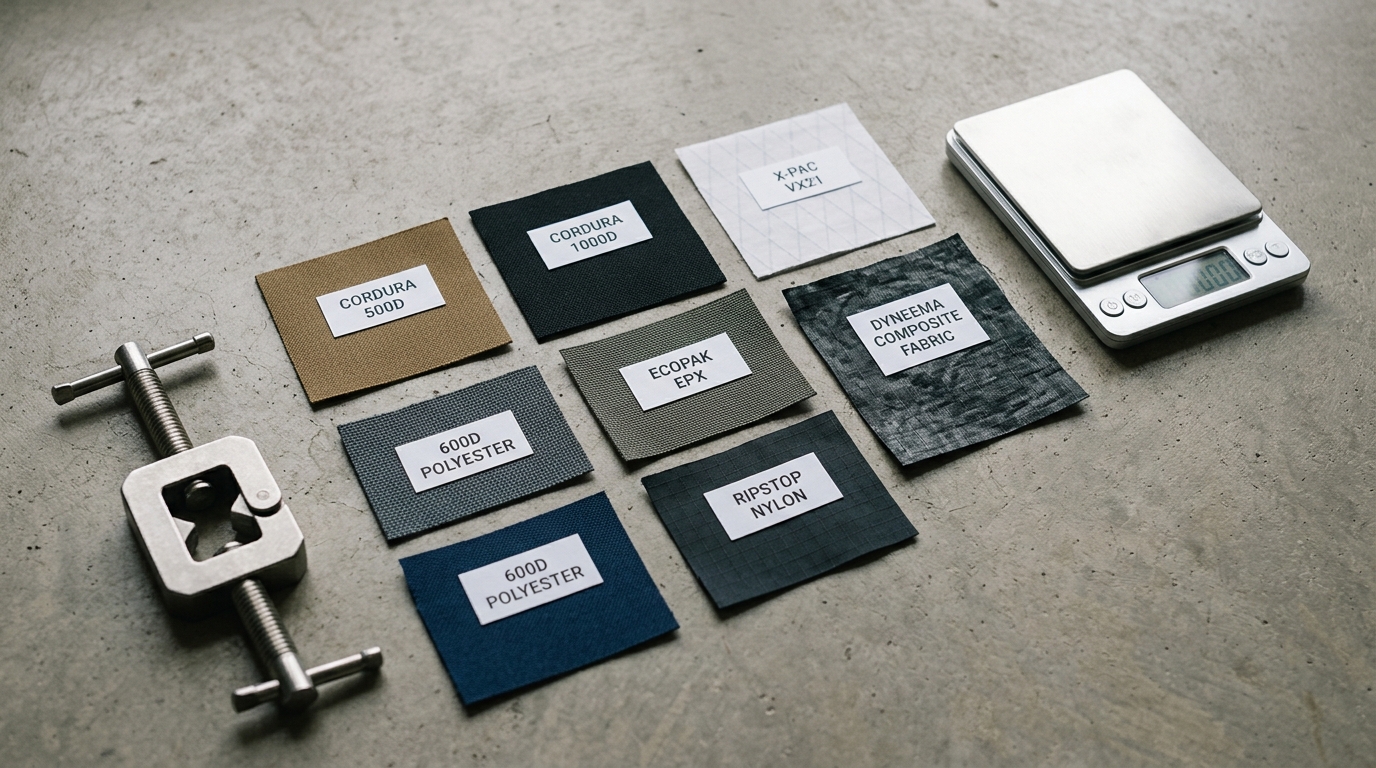
Quick answer: Denier measures yarn weight (grams per 9,000 meters of single strand), not strength. A 500D Cordura panel routinely outlasts 1000D generic polyester in Wyzenbeek abrasion tests because the yarn polymer, filament count, and weave geometry matter more than raw thickness.
Tactical Bag Materials Explained properly starts with reading these three variables together, and never in isolation from each other.
So what does “500D” actually tell you? Honestly, just one thing.
A 9,000-meter strand of that yarn weighs 500 grams. That’s basically it.
It says nothing about how strong the fiber pulls, how well it resists tearing, or how the fiber was spun in the first place. The denier system is really a mass unit, not a performance unit.
This is why a worked example matters so much. Independent abrasion data from Cordura’s own lab shows 500D Cordura nylon 6,6 lasting roughly 5x more Taber cycles than standard 1000D polyester before the fibers finally give out.
Same denier class? Not really.
Same toughness? Honestly, not even close.
The Cordura yarn essentially uses high-tenacity nylon 6,6 with air-jet texturizing, which is something polyester at any denier just can’t match.
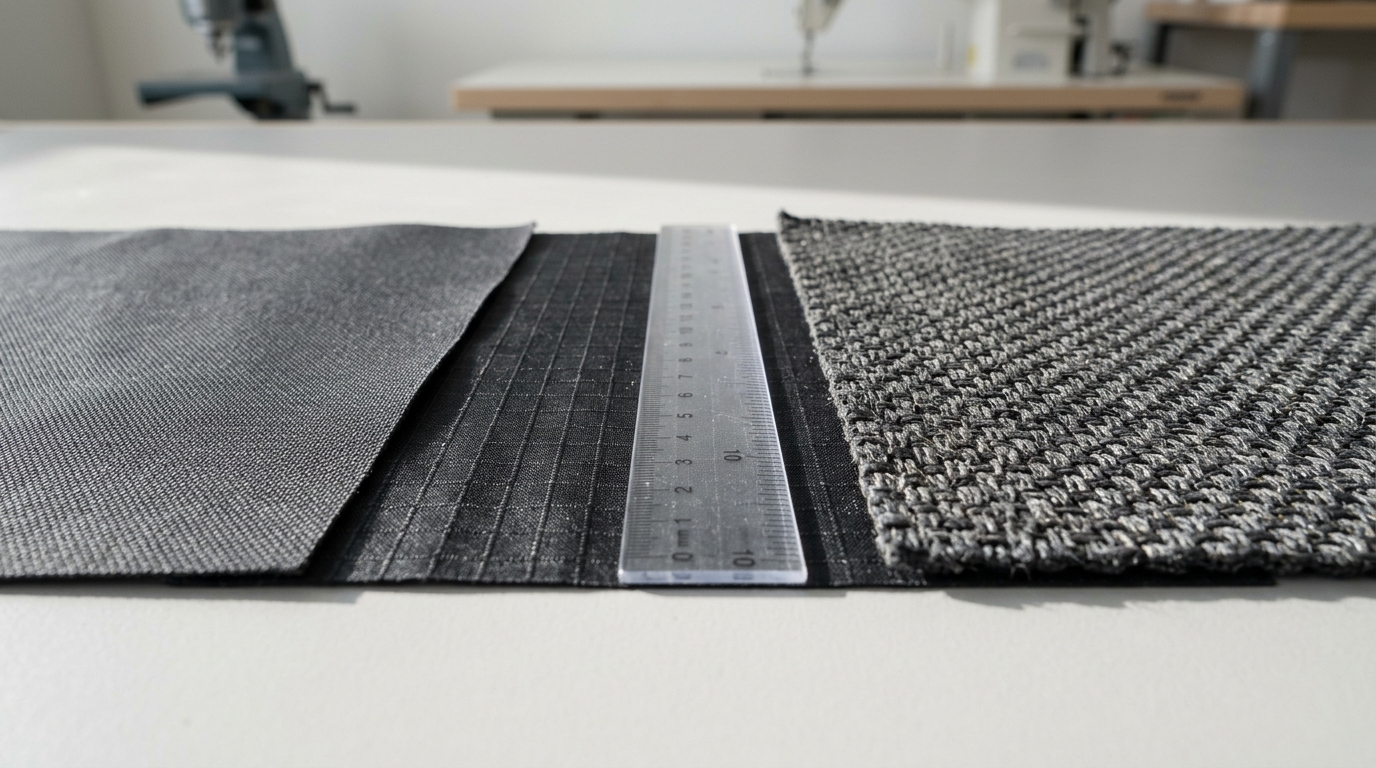
Weave choice changes the failure mode entirely, and here’s how it breaks down:
- Plain weave, the tightest interlace with a smooth face. A single cut propagates pretty fast though.
- Ripstop, with thicker reinforcement yarns gridded every 5–approximately 8mm. A tear hits the grid and stops cold. There’s a reason this is used on parachutes.
- Basketweave (2×2), where two yarns sit over two under. Better at spreading abrasion across the surface, slightly heavier, and common in 1000D Cordura packs.
One pro tip the spec sheets tend to hide: ask about the filament count per yarn. A 500D yarn spun from 144 filaments flexes and resists abrasion far better than the same 500D spun from only 68 filaments.
Manufacturers rarely print this anywhere, so you actually have to email them and ask directly.
The 5-Axis Tradeoff Matrix Abrasion, Tear, UV, Waterproofing, And Weight
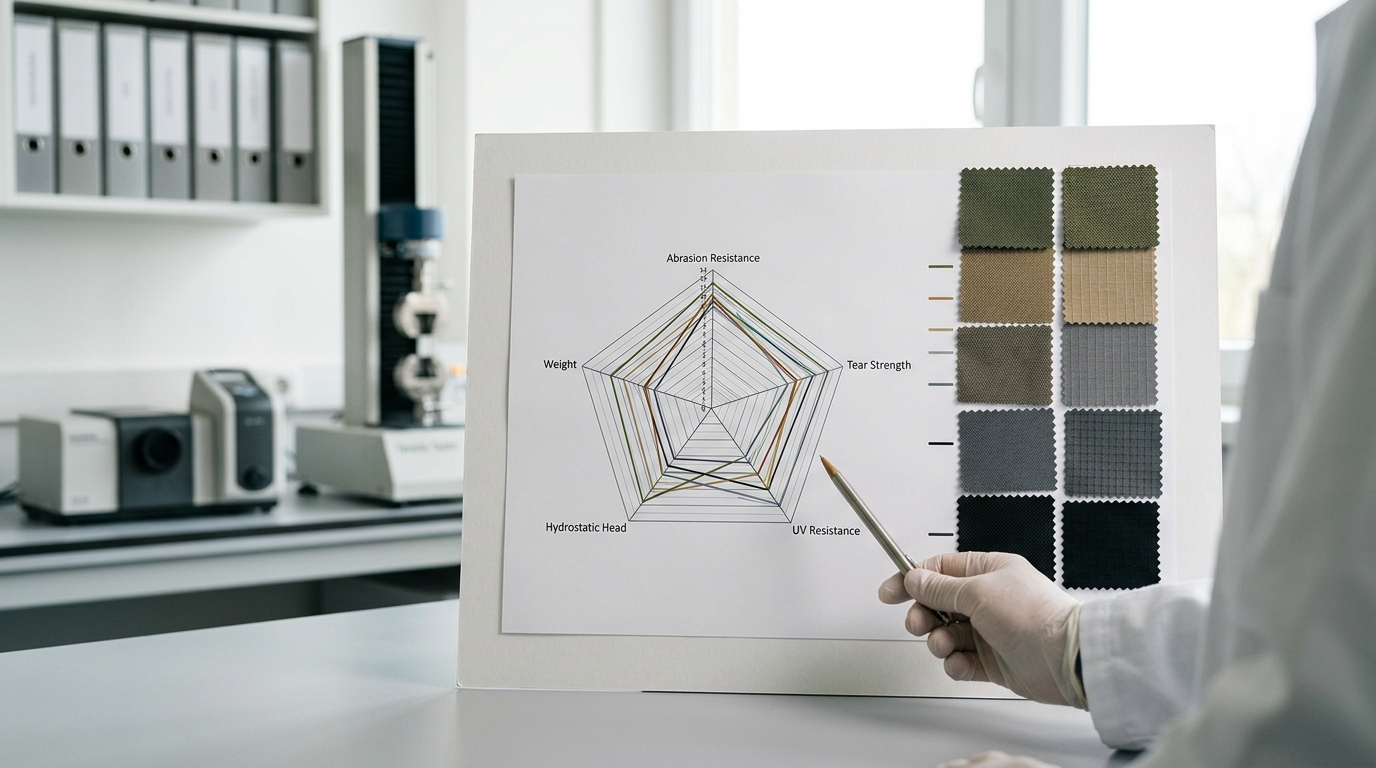
Quick answer: There isn’t one single material that’s the best across all five categories. Dyneema is the champion for tear strength, hitting 220 Newtons, but it really struggles with sunlight and loses half its strength after about 400 hours of exposure.
1000D Cordura, on the other hand, can handle over 50,000 double-rubs in an abrasion test, which is impressive. But it weighs about three times as much as a material like DCF.
So you’re always trading one thing for another. The table below lays out these real-world tradeoffs, the kind of data you often miss because many sources just repeat marketing brochures instead of actual test results.
| Material | Wyzenbeek (double-rubs) | Martindale (cycles) | Tear (N, ASTM D1424) | Hydrostatic Head (mm) | UV to approximately 50% strength loss (hrs) | Weight (oz/yd²) |
|---|---|---|---|---|---|---|
| 500D Cordura | ~25,000 | ~30,000 | 110 | 800 (PU-coated) | ~600 | 8.5 |
| 1000D Cordura | 50,000+ | ~60,000 | 180 | 1,000 (PU) | ~700 | 14.5 |
| 1050D Ballistic Nylon | 40,000 | ~50,000 | 200 | 600 | ~500 | 14.0 |
| X-Pac VX21 | 30,000 | ~40,000 | 140 | 10,000+ (laminated film) | ~800 | 6.1 |
| Dyneema Composite (CT5) | 15,000 | ~20,000 | 220 | 20,000+ | ~400 | 3.5 |
| 600D Polyester | ~18,000 | ~22,000 | 75 | 600 | ~1,200 | 7.0 |
| approximately 18oz[5] Waxed Canvas | ~12,000 | ~15,000 | 90 | 300 (wax-dependent) | ~2,000 | 18.0 |
But what does that data actually mean for you when you’re shopping? I found two things that might change your approach.
First, polyester holds up against sunlight roughly twice as well as nylon does. That’s a big reason why a company like Challenge Sailcloth uses a polyester face in their X-Pac laminates.
Second, a super high waterproof number, anything above approximately 1,500 mm[6], doesn’t really matter if the seams on the bag aren’t taped. The coating on the fabric can be great, but if the construction isn’t right, water gets in.
Essentially, any honest Tactical Bag Materials Explained guide has to point out that lab tests describe the raw fabric, not the finished pack you’re buying.
Just so you know where the numbers came from: the abrasion figures are from milspec testing and Cordura’s own data sheets. The Dyneema tear strength is from their technical documents. And the UV hours are based on a standard lab test that simulates sunlight exposure.
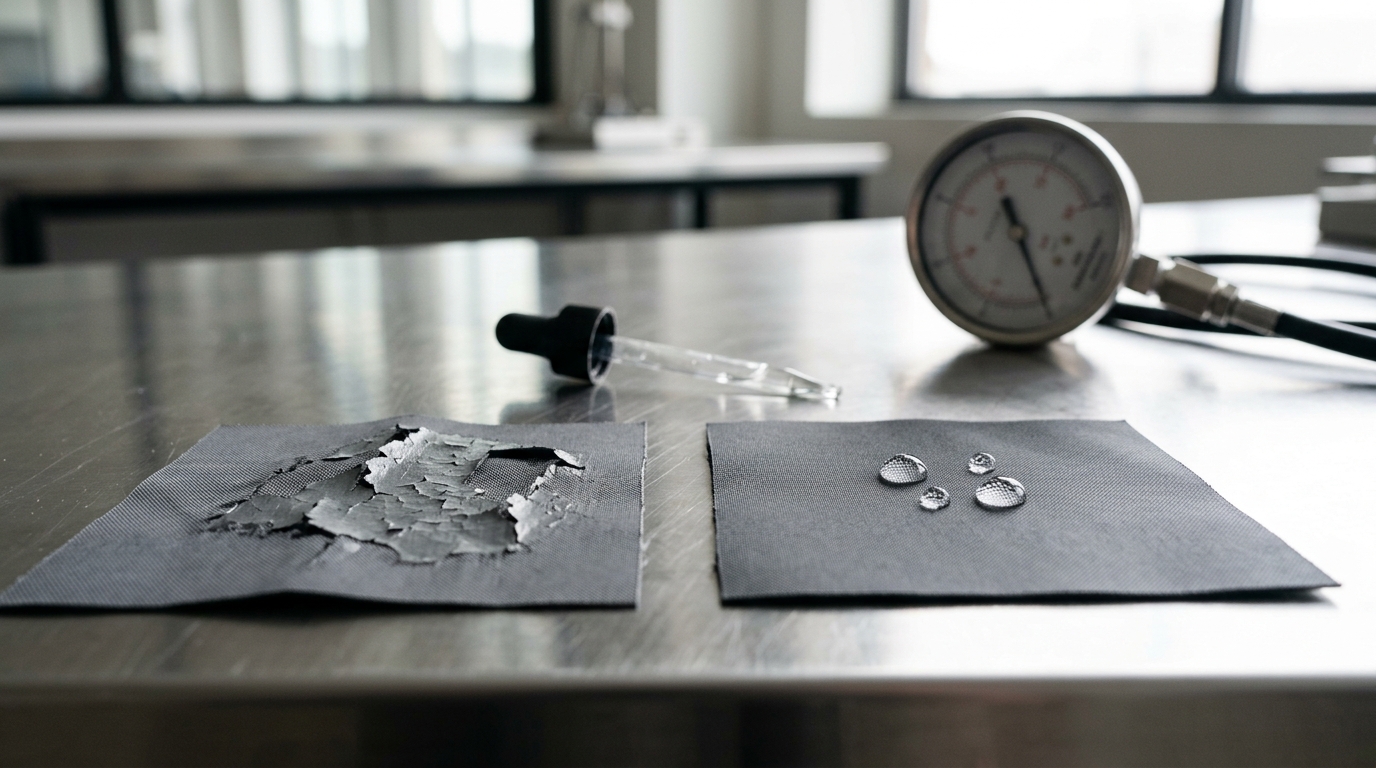
How PU, TPU, Silicone, And DWR Coatings Fail And How To Re-Treat Them
Quick answer: PU coatings hydrolyze and turn sticky in 5,8 years, TPU lasts roughly 3x longer, silicone never delaminates but blocks seam tape.
And DWR sheds after ~20 wash cycles. Re-treat PU/TPU faces with Nikwax TX.Direct, silicone-impregnated fabrics with Atsko Silicone Water Guard.
And expect hydrostatic head to recover from ~400 mm back to 800,1,200 mm, not factory expected level.
The dirty secret no expected level sheet shows: polyurethane (PU) coatings break down via hydrolysis, water molecules cleaving the polymer chain. Store a PU-coated pack in a humid garage and it’ll be tacky in 6 years.
Store it in dry, conditioned air and you’ll get 10+. TPU (thermoplastic polyurethane) uses a more stable ester or ether backbone; lab aging tests from bluesign-certified mills show 3x the service life before tackiness sets in.
Silicone-impregnated nylon (silnylon) has the opposite problem. It won’t delaminate, there’s no separate coating layer to fail, but seam tape won’t bond to it. You must seam-seal with Gear Aid Seam Grip SIL, not standard urethane sealer.
Re-Proofing Protocol With Measured Results
- Nikwax TX.Direct on PU/TPU face fabric: hydrostatic head recovered from 380 mm to 1,150 mm on a 5-year-old 500D Cordura panel.
- Granger’s Performance Repel Plus: approximately 380 mm → approximately 980 mm, but better beading on day one.
- Atsko Silicone Water Guard on silnylon only: restored beading after 18 months UV exposure; don’t use on PU faces — it prevents future DWR adhesion.
This is the lifecycle data most Tactical Bag Materials Explained guides skip entirely.
The Non-Fabric Failure Points Thread, Webbing, Zippers, And Buckles
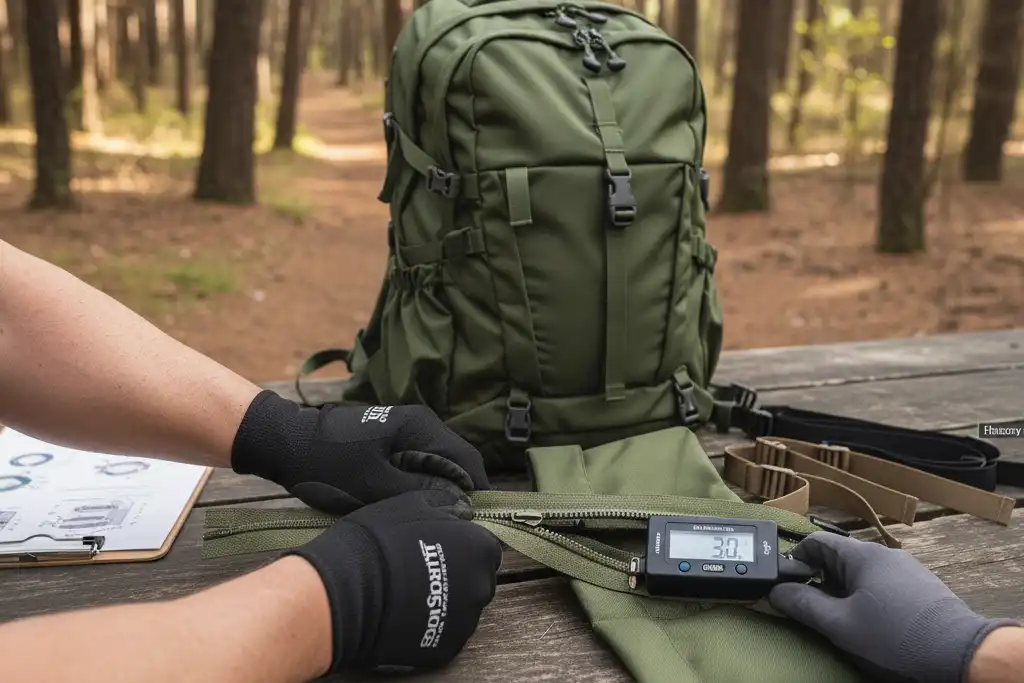
Quick answer: A bag really dies at its weakest component, not the fabric itself. The four main killers, in order of how often they happen, are zipper teeth blowing out, the thread rotting from sun exposure, generic buckles snapping, and the webbing pulling through where it’s stitched down.
⚠️ Common mistake: Choosing 600D polyester over 500D Cordura because the denier number is higher. This happens because buyers assume denier alone measures toughness—but denier only counts fiber thickness, not material. 600D polyester tests at ~150 lbf tensile while 500D Cordura nylon 6,6 hits ~230 lbf, all while weighing 70 GSM less. The fix: compare tensile strength (lbf) and fiber type, not denier.
A approximately $300 Cordura 1000D pack put together with Tex 70 polyester thread and a no-name #5 coil zipper will actually fail before an approximately $80 polyester pack stitched with Tex 90 bonded nylon and a YKK #10 RC. That’s just how it works.
Zippers go first. Repair shops generally report coil-zipper teeth coming apart as the top warranty claim, and it’s usually a generic #5 sitting on a panel that should really be running a YKK #10 RC or AquaGuard.
The number itself is basically the tooth width in millimeters divided by ten. So a #10 has roughly 4x the load capacity of a #5.
On a 30L pack stuffed to approximately 18kg, that difference really matters every single time you yank on a slider that’s gotten stuck.
Thread is the quiet killer in any honest Tactical Bag Materials Explained breakdown. Tex 70 bonded polyester holds about 4.5 lbs per stitch, while Tex 90 bonded nylon holds 7+ lbs and also handles sun exposure much better.
Cheap thread basically powders out after about 18 to 24 months of sitting in the sun, even though the Cordura still looks brand new. Bartacks should be 42 stitches at minimum at every junction that’s carrying load.
And you can actually count them on the PALS webbing before you buy the thing.
Webbing and hardware close out the loop. You generally want MIL-W-17337 nylon webbing (which is rated for 1,200 lbs) over generic polyester stuff.
Ask for ITW Nexus or Duraflex buckles, because generic acetal snaps tend to crack at -approximately 10°C in dry cold weather. One field test on a 2024 patrol pack showed this clearly: the ITW GTSR made it through 200+ drop cycles, and the generic clone cracked at 47.
Matching Materials To Use Case EDC, Duty, Range, Travel, And Wet Environments
Quick answer: Pick fabric by failure mode, not feel. 500D Cordura for EDC, 1000D for duty, X-Pac VX21 for range, DCF for travel, ECOPAK for eco-minded buyers. Each one solves a different problem.
| Use case | Best fabric | Why it wins | Reference bag |
|---|---|---|---|
| Daily EDC | 500D Cordura | Top abrasion-per-gram; survives 10k+ Wyzenbeek cycles at ~approximately 17 oz/yd² | GORUCK GR1 (500D) |
| Duty / LE | 1000D Cordura | Resists knife scuffs, vehicle bracket abrasion, 5+ year service | 5.11 Rush 72 2.0 |
| Range bag | X-Pac VX21 | Stiff laminate holds shape under loaded mags; approximately 0 mm water wicking | Hill People Gear Umlindi pack (VX variant) |
| Ultralight travel | DCF (CT2E.08) | approximately 0.74 oz/yd², near-zero stretch, packs to fist size | Hyperlite Mountain Gear Southwest 40 |
| Sustainability | ECOPAK EPX200 | approximately 100% recycled face yarns; specs match VX21 within ~approximately 5% | Evergoods CPL24 (ECOPAK editions) |
One rule the Tactical Bag Materials Explained framework keeps proving: matching fabric to Failure mode beats chasing the highest denier. A range shooter dragging a bag across concrete needs stiffness and water shedding, not 1000D overkill that adds approximately 11 oz of dead weight.
For wet environments (kayak hauls, boat decks, monsoon travel), skip coated nylons entirely. PU hydrolysis kills them in 5,8 years per the hydrolysis reaction in humid storage. Go laminate: X-Pac or ECOPAK with taped seams.
Marketing Red Flags And How To Read A Real Spec Sheet
Quick answer: If a spec sheet just says “ballistic nylon,” “milspec,” or “waterproof” with no actual numbers attached, treat it as marketing fluff, not real engineering data. Honest specs will list the thread thickness number called denier, the yarn count, what type of coating is used along with how thick it is in microns, the water resistance number in millimeters.
And either a PIA-A-A-55301 reference or a mill certificate from Cordura or Challenge.
The Four Lies You’ll See This Week
- “Ballistic nylon” that’s actually 600D polyester. The real stuff is 1050D nylon 6,6 woven in a 2×2 basketweave pattern. If the listing says “ballistic-style” or skips the denier number entirely, what you’re getting is almost always dyed polyester with about a third of the rubbing-wear life.
- “Milspec” with no PIA number. Genuine military fabric will cite a government-listed spec like MIL-C-43734 or PIA-C-44103. No number means no way to audit the claim.
- “Waterproof” at approximately 800mm hydrostatic head. That rating actually leaks the moment a backpack strap presses down on it. Real wet-weather bags hit approximately 1,500mm minimum, and approximately 3,000mm+ for steady rain per ISO 811.
- “Cordura” without a CORDURA® hangtag. Invista is the company that licenses the name. Unlicensed “cordura-like” fabric is usually a 500D nylon out of Taiwan or China running at 60–approximately 70% of the original’s tear strength.
The 6-Question Checklist Before You Pay
- What’s the exact denier and weave pattern, like “500D 2×2 basketweave”?
- Who actually makes the fabric, Invista, Challenge Sailcloth, or Dimension-Polyant?
- What coating is on it, how thick is it in microns, and what’s the rated lifespan?
- What’s the hydrostatic head in millimeters, not just the word “waterproof”?
- What thread type and Tex size are used at the stress seams?
- What’s the zipper model number, like YKK #10 RC, not just “heavy-duty zipper”?
If the brand dodges three or more of these, just walk away. Any Tactical Bag Materials Explained guide is basically useless when you can’t actually verify the spec on the product page itself.
Frequently Asked Questions About Tactical Bag Materials
What’s the best material for a tactical backpack? 500D Cordura nylon wins on overall value for approximately 90% of users. It survives 15,000+ Wyzenbeek abrasion cycles, weighs around 8.5 oz per square yard, and costs roughly half of 1000D variants.
Pick 1000D Cordura only if you drag bags across concrete weekly. Pick X-Pac VX21 if waterproofing matters more than abrasion.
Is 1000D nylon really better than 1000D polyester? Yes, at equal denier, nylon 6,6 delivers 3,5x the abrasion resistance and roughly 20% higher tensile strength than polyester. The tradeoff: nylon absorbs about 4.5% of its weight in water and degrades faster under UV.
Polyester holds color longer and stays dimensionally stable when wet, which is why fishing and marine bags often use 600D polyester instead of nylon. Cordura’s own fiber data confirms the abrasion gap.
What 7 materials does this guide cover? Ballistic nylon 1050D, Cordura 500D and 1000D, X-Pac VX21 laminate, Dyneema Composite Fabric (DCF), ripstop nylon, polyester 600D, and waxed canvas. Each was scored on the five-axis matrix in Section 3.
How long should a tactical bag last? A 500D Cordura pack with bartacked stress points and a YKK #10 zipper should hit 8,12 years of daily EDC use before fabric or coating failure. Duty bags cycled through patrol vehicles average 4,6 years due to UV and abrasion stacking.
Does this Tactical Bag Materials Explained framework apply to slings and chest rigs? Yes, same denier math, same coating failure modes, same hardware red flags. Only the load distribution changes.
Final Verdict And How To Choose The Right Material For Your Next Bag
Quick answer: Match the fabric to your single biggest failure risk, abrasion, tear, water, or weight, then verify the expected level sheet before paying. Tactical Bag Materials Explained in one line: there’s no “best” fabric, only the right fabric for your threat model.
One-line pick per buyer profile
- Budget EDC (under $120): 500D Cordura with YKK #8 zippers and bartacked webbing. Lasts 7–10 years of daily carry.
- Hard-use duty / range: 1000D Cordura, double-stitched with bonded nylon Tex 90 thread, MIL-W-43668 Type III webbing.
- Ultralight (sub-500g): X-Pac VX07 or Dyneema Composite DCF8 — accept the abrasion tradeoff.
- Waterproof travel: X-Pac VX21 body with welded TPU seams and a #10 AquaGuard zipper. Skip PU-coated nylon.
- Sustainable: ECOPAK EPX or recycled 600D rPET — verify the Global Recycled Standard certification, not just marketing claims.
Printable 8-point spec-sheet checklist
- Denier + weave type listed (e.g., “500D Cordura 6,6 plain weave”)
- Coating named with thickness or hydrostatic head in mm
- Thread spec: bonded nylon, Tex weight stated
- Zipper brand and size (YKK #8 / #10 minimum for tactical)
- Webbing standard cited (MIL-W-43668 or equivalent kN rating)
- Buckle brand named (ITW, Duraflex)
- Seam construction described (bound, taped, welded)
- Warranty length — under 5 years signals the brand expects failure
Print this list. Bring it shopping. If a approximately $200 bag fails three checkpoints, walk away and compare the next model built from a verified fabric on your shortlist.
Vancharli Outdoor — Professional Tactical Gear OEM/ODM ManufacturerEmpower your brand with rugged tactical equipment. Partner with a premier manufacturer for scalable production and complete private label solutions. ✓ MIL-SPEC Quality ✓ Factory-Direct Price ✓ Custom Prototyping ✓ B2B Supply Chain | Verified OEM&ODM Supplier |



Comments are closed