



GRS, RCS, and Materials Matter: What Recycled Bag Buyers Need to Know
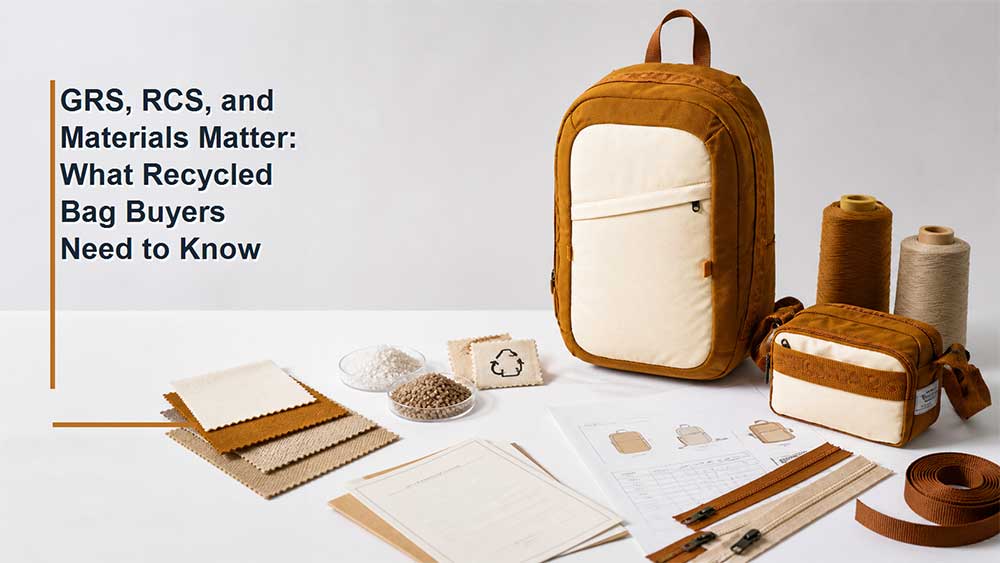
A supplier may show you a valid GRS or RCS certificate and still be unable to provide a certified shipment for your bag order. That is one of the most important distinctions recycled-material buyers need to understand.
GRS, RCS, and Materials Matter are certification systems—not fabric names or automatic proof that an entire bag is sustainable.
In practical terms:
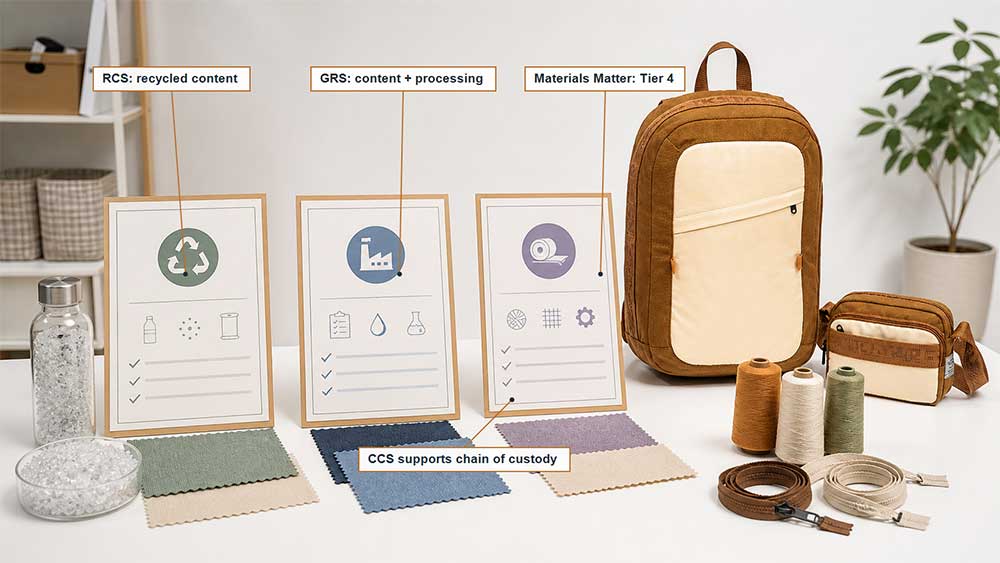
- RCS verifies recycled content and chain of custody.
- GRS verifies recycled content and chain of custody while adding social, environmental, and processing-chemical requirements.
- Materials Matter will replace GRS and RCS certification requirements at Tier 4, covering raw material production and primary processing. Downstream chain of custody will continue through the Content Claim Standard.
As of August 2026, GRS and RCS remain relevant for current sourcing programs. However, buyers planning products, packaging, or reorders beyond 2026 should also prepare for the Materials Matter transition.
Last reviewed: August 2026. Information checked against GRS 5.0, RCS 3.0, the Materials Matter Standard, and the Materials Matter Transition Policy.
GRS vs RCS vs Materials Matter at a Glance
| Comparison | RCS | GRS | Materials Matter |
|---|---|---|---|
| Main purpose | Verify recycled content and chain of custody | Verify recycled content and chain of custody with additional processing requirements | Create a unified standard for raw material production and primary processing |
| Current minimum recycled content | 5% for certification | 20% for certification and B2B use | Eligibility depends on the material, supply-chain tier, and applicable scope rules |
| Consumer-facing product label | Subject to current claims and logo rules | Normally requires at least 50% recycled content | Generally requires 30% combined Materials Matter Certified content |
| Social and environmental processing criteria | Not included as a separate RCS module module | Included | Incorporated for materials and activities within scope |
| Processing-chemical requirements | No separate RCS chemical module | Included for GRS product processing | Included within the new raw material and primary-processing framework |
| Chain of custody | Content Claim Standard | Content Claim Standard | Content Claim Standard continues to support downstream traceability |
| Typical buyer use | Lower recycled-content products or projects focused on content verification | Products requiring broader processing requirements or GRS documentation | Future certification, claims, and labeling programs |
These percentages serve different purposes. The minimum content required for certification is not necessarily the same as the minimum required for a consumer-facing product label.
GRS vs RCS: Which Standard Should a Bag Buyer Choose?
Choose the standard based on the product specification, customer requirement, intended claim, and supply chain—not simply on which logo appears more marketable.
RCS may be suitable when:
- The product contains a relatively low percentage of recycled material.
- The main goal is third-party verification of recycled content.
- The customer does not require the additional GRS social, environmental, and chemical-processing criteria.
- The proposed claim is permitted under current RCS rules.
GRS may be more suitable when:
- The product contains at least 20% recycled material.
- The customer or retailer specifically requires GRS documentation.
- Broader social, environmental, and processing-chemical requirements are part of the sourcing brief.
- The certified composition and chain of custody can support the intended product claim.
Prepare for Materials Matter when:
- The product or reorder program will continue beyond 2026–2027.
- Packaging, hangtags, catalogs, or product pages may remain in use through 2029.
- Recyclers and primary processors in the supply chain need a transition plan.
- The brand wants to avoid redesigning claims after packaging has already been printed.
A buyer can still source under GRS or RCS in 2026. The practical approach is to verify the current order under the applicable standard while asking suppliers how their certified supply chain will transition.
What Does RCS Verify?
The Recycled Claim Standard applies to products containing at least 5% recycled material. It verifies the presence and amount of recycled input and tracks that material through a certified chain of custody.
RCS can be appropriate for blended materials, products with lower recycled percentages, or sourcing programs primarily concerned with recycled-content verification.
It does not add the broader social, environmental, wastewater, emissions, or processing-chemical requirements found in GRS. It also does not prove that a bag is durable, waterproof, recyclable at the end of its life, or compliant with every regulation in its destination market.
The current Recycled Claim Standard 3.0 became effective on July 1, 2026 and may be used immediately. It becomes mandatory for audits on December 31, 2026.
What Additional Requirements Does GRS Include?
The Global Recycled Standard applies to products containing at least 20% recycled material. In addition to recycled-content verification and chain of custody, it includes requirements related to:
- Social practices
- Environmental management
- Wastewater and emissions
- Waste management
- Chemicals used when processing GRS products
Under the current system, a product generally needs at least 50% recycled content to qualify for a product-specific GRS label.
This means a bag containing 20%–49% recycled material may be eligible for GRS certification and B2B documentation but may not qualify for a consumer-facing GRS product label.
The Global Recycled Standard 5.0 also clarifies an important limitation: its chemical requirements address chemicals used during the processing of GRS products. They do not establish the complete chemical composition of reclaimed inputs or the finished bag.
Destination-market compliance reviews and finished-product testing may therefore still be necessary.
GRS 5.0 became effective on July 1, 2026 and may be used immediately. It becomes mandatory for audits on December 31, 2026.
How Will Materials Matter Change Recycled-Material Certification?
The Materials Matter Standard focuses on the earliest stages of the supply chain, including raw material production, recycling, and primary processing.
At Tier 4, recyclers and primary processors currently covered by GRS or RCS will transition to Materials Matter. Downstream organizations will continue using the Content Claim Standard to support chain of custody and product claims.
The official Materials Matter transition timeline is:
| Date | Change |
|---|---|
| December 12, 2025 | Final Materials Matter Standard and Claims and Labeling Policy published |
| December 31, 2026 | Standard becomes effective; eligible organizations may begin transitioning |
| December 31, 2027 | Materials Matter becomes mandatory for applicable Tier 4 audits |
| June 30, 2029 | All claims and labels must transition to the Materials Matter system |
From December 31, 2027 onward, Tier 4 audits must be conducted against Materials Matter. For downstream Tiers 1–3, organizations previously certified to both GRS and CCS will transition to CCS-only chain-of-custody certification by March 31, 2029, unless other applicable scopes or modules are added.
An Important Difference Between GRS and RCS During the Transition
The Materials Matter Transition Policy treats GRS and RCS inputs differently:
- Eligible GRS-certified inputs may be accepted in Materials Matter Certified products under the transition-claim rules.
- RCS-certified materials are not eligible as inputs into Materials Matter Certified products.
- RCS inventory must remain separate from Materials Matter Certified materials.
This distinction matters when buyers are planning long-term reorders or combining material stocks sourced under different standards.
Future Consumer-Facing Label Thresholds
Under the new Materials Matter Claims and Labeling Policy, the general minimum for a final-product consumer claim is 30% combined Materials Matter Certified content.
A temporary 20% exception applies to qualifying recycled cotton and recycled manmade cellulosic fibers.
These thresholds apply to consumer-facing final-product or component claims. They do not automatically determine eligibility for unfinished B2B products or Transaction Certificates.
Claims previously approved and printed or attached before the mandatory transition date may, subject to the transition policy, continue to be used until that inventory is exhausted. Online and newly submitted claims will need to follow the Materials Matter system after June 30, 2029.
Why a Scope Certificate Does Not Certify Your Order
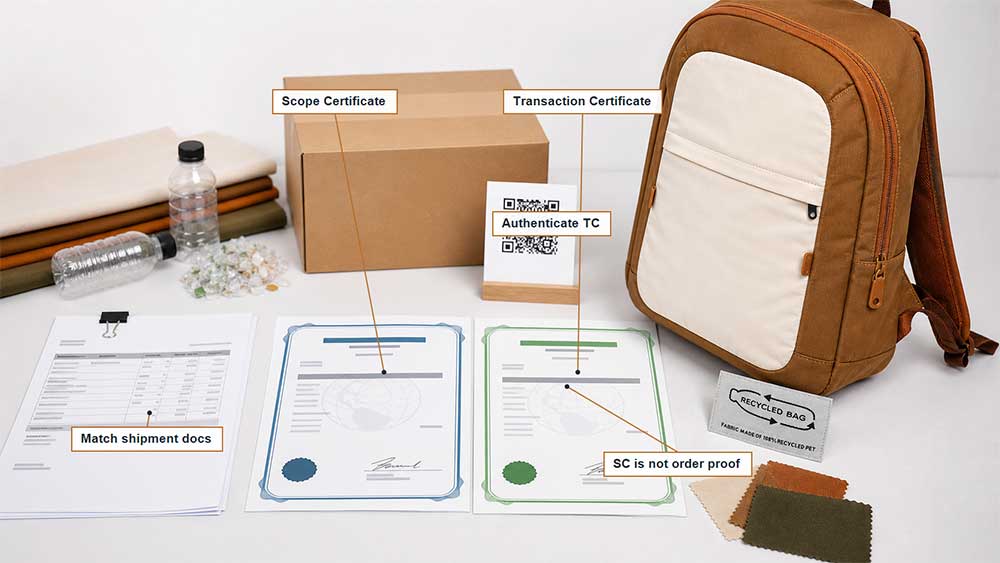
Recycled bag buyers commonly encounter two documents: the Scope Certificate and the Transaction Certificate. They serve different purposes.
Scope Certificate
A Scope Certificate shows that an organization has been audited and is certified for specified standards, sites, product categories, materials, and processing activities during the certificate’s validity period.
Buyers should check:
- Legal company name
- Certified facility address
- Validity dates
- Applicable standard and version
- Product and material categories
- Certified processing activities
- Issuing certification body
A valid Scope Certificate confirms what the supplier is authorized to handle. It does not prove that certified material was used in your specific order, that sufficient certified stock is available, or that the shipment has been certified.
Suppliers can be checked through Textile Exchange’s Find a Certified Company database.
Transaction Certificate
A Transaction Certificate connects certified products to a specific sale or shipment. Details should match the actual transaction, including:
- Seller and buyer
- Product description
- Certified material and composition
- Quantity
- Invoice references
- Shipment information
A shipment should not be treated as certified merely because the supplier has a valid Scope Certificate. The applicable transaction should be supported by a valid TC.
Buyers can verify certificates through Textile Exchange’s Authenticate a Transaction database. If the certificate cannot be found or the returned details do not match, contact the issuing certification body.
Why Certified Fabric Does Not Automatically Mean a Certified Bag
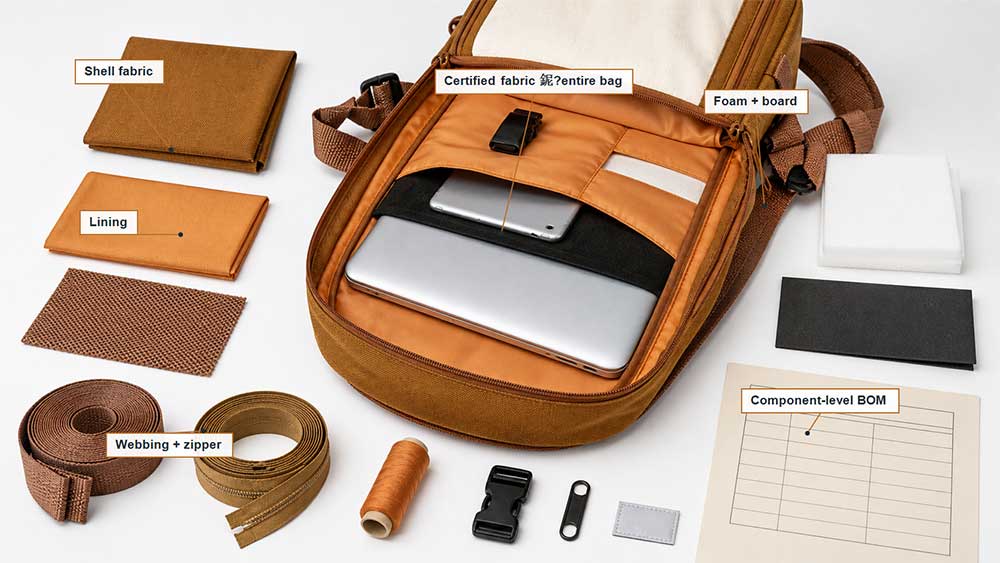
A backpack or travel bag rarely consists of only one material. A typical bill of materials may include:
- Shell fabric
- Lining
- Mesh
- Webbing and binding
- Zipper tape
- Sewing thread
- Foam and structural panels
- Coatings or laminated films
- Labels and logo patches
- Metal and plastic hardware
If only the shell is made from recycled polyester, the entire product should not automatically be marketed as a “100% recycled backpack.”
A more accurate claim might be:
The outer fabric is made with 100% post-consumer recycled polyester.
The correct wording depends on the certified composition, calculation method, chain-of-custody records, and approved claims policy.
Ask the supplier for a component-level BOM that identifies:
- Fiber or polymer type
- Virgin and recycled percentages
- Pre-consumer or post-consumer source
- Applicable certification
- Certified material supplier
- Whether the component and finished product can appear on the TC
- Component weight where a finished-product percentage must be calculated
Do not average percentages from separate fabric data sheets and use the result as a marketing claim. The finished composition must be supported through the certified chain and reviewed under the applicable claims rules.
Which Recycled Materials Are Commonly Used for Bags?
Certification verifies a material claim, but it does not determine whether that material is suitable for the product.
A lightweight promotional tote, structured laptop backpack, and RF-welded dry bag require different materials and performance standards.
| Recycled material | Common applications | Potential advantages | What buyers should verify |
|---|---|---|---|
| Recycled polyester or rPET | Backpacks, totes, travel bags, linings | Broad availability, many weights and finishes, established pricing | Abrasion, colorfastness, coating adhesion, hydrostatic resistance, recycled-source category |
| Recycled nylon | Technical backpacks, lightweight travel bags, premium outdoor bags | Potentially high strength-to-weight ratio and premium hand feel | Cost, MOQ, supply stability, tear strength, coating compatibility, batch variation |
| Recycled cotton | Totes, casual bags, pouches, fashion accessories | Natural appearance and softer feel | Tensile and tear strength, shrinkage, blend ratio, color variation, surface pilling |
| Recycled polypropylene | Nonwoven shopping bags, promotional bags, some woven utility bags | Lightweight and economical for simple constructions | Fabric density, seam strength, handle strength, printability, expected service life |
When choosing between recycled nylon and polyester, begin with performance, construction, and target cost. This nylon vs polyester bag material comparison explains their practical differences, while this guide to durable bag materials covers fabric construction and denier.
Coatings also matter. A recycled polyester shell may use a virgin PU coating, TPU film, or another laminate to achieve water resistance or welding performance. These additions affect certified composition, durability, repairability, and end-of-life recycling.
“Made with recycled fabric” and “recyclable as a finished product” are two different claims.
What GRS and RCS Do Not Prove
GRS or RCS documentation alone does not prove that a finished bag:
- Is made entirely from recycled materials
- Uses post-consumer rather than pre-consumer inputs
- Contains ocean-bound or ocean-recovered plastic
- Has a lower carbon footprint than every virgin-material alternative
- Can be recycled through the customer’s local system
- Is waterproof or suitable for prolonged outdoor exposure
- Meets the buyer’s abrasion, tear, colorfastness, or load requirements
- Meets every chemical and labeling rule in its destination market
- Will have identical color and hand feel across every reorder
These requirements should be addressed through the approved BOM, supplier declarations, performance testing, market-specific compliance checks, samples, and inspection criteria.
Material approval is only one stage in the custom bag production process. Sampling and testing remain necessary even when every relevant supplier holds a valid certificate.
Recycled Bag Buyer Checklist: From RFQ to Shipment

Before Requesting a Quote
- State whether the project requires RCS, GRS, or Materials Matter transition planning.
- Define the minimum recycled percentage.
- Clarify whether the percentage applies to one component or the complete product.
- Specify pre-consumer, post-consumer, or either.
- Identify the proposed customer-facing claim and logo.
- List physical performance and destination-market compliance requirements separately.
During Material and Sample Approval
- Check the current Scope Certificates of the factory, trader, and relevant material suppliers.
- Match company names, sites, products, materials, processes, and validity dates.
- Approve a component-level BOM.
- Confirm whether coatings, linings, webbing, and trims are virgin or recycled.
- Test fabric and finished-bag performance.
- Obtain approval for claims and artwork before printing labels or packaging.
In the Purchase Order
- State the applicable standard and certified composition.
- Require the shipment to be eligible for a Transaction Certificate.
- Assign responsibility for TC fees, documents, and application timing.
- Prohibit unapproved substitution of mills, traders, materials, or recycled-source categories.
- Require written approval for any change affecting the certified BOM or claim.
Before and After Shipment
- Confirm that bulk materials match the approved sample and BOM.
- Review inspection and test results.
- Match invoices, packing lists, quantities, and shipment data to the TC application.
- Authenticate the final Transaction Certificate.
- Archive certificates, claim approvals, artwork, test reports, and purchase documents together.
Better Recycled Claims Begin With Better Specifications
Certification planning should happen alongside material selection, construction, testing, target price, and labeling—not just before shipment.
Waiting until production is almost complete may reveal that the supplier’s Scope Certificate does not cover the required activity, an uncertified trader has interrupted the chain of custody, or the proposed marketing claim exceeds the product’s certified composition.
Vancharli Outdoor can help brand buyers review component-level BOMs, material specifications, testing requirements, certificate responsibilities, and claim wording before sampling and bulk production. If you are developing a recycled backpack, travel bag, tote, or outdoor bag, working with an experienced bags manufacturer can help align the physical product with its certification and documentation plan from the beginning.
Frequently Asked Questions
Is a supplier’s Scope Certificate enough to call my bags certified?
No. A Scope Certificate shows the supplier’s certified scope but does not prove that your specific order used certified inputs. The shipment should be supported by an authentic Transaction Certificate that matches the commercial documents.
Can a bag qualify for GRS if only its outer fabric is recycled?
Possibly, provided the finished composition meets the applicable minimum content, certification, and chain-of-custody requirements. However, the claim must accurately describe what is certified. A recycled shell does not make every component recycled.
Must recycled bag material come from post-consumer waste?
No. GRS and RCS can cover both pre-consumer and post-consumer recycled inputs when the materials meet the standard definitions and documentation requirements. A post-consumer claim should only be made when the certified records support it.
Does GRS mean a bag is free from harmful chemicals?
Not as an absolute guarantee. GRS places requirements on chemicals used to process certified products, but it does not establish every substance that may be present in reclaimed inputs or the finished bag. Legal compliance checks and product testing may still be required.
Can a non-certified buyer receive a Transaction Certificate?
A buyer does not necessarily need certification simply to purchase certified products and receive a TC. However, continuing the certified chain for onward B2B sales or making product-related claims may require certification and formal claim approval.
When will Materials Matter replace GRS and RCS?
Materials Matter becomes effective on December 31, 2026 and mandatory for applicable Tier 4 audits on December 31, 2027. All claims and labels must transition to the Materials Matter system by June 30, 2029.
Can we print the GRS logo after purchasing certified fabric?
Not automatically. Product claims and logo use must meet finished-product content, chain-of-custody, trademark, and approval requirements. Submit the claim and artwork to the responsible certification body before printing packaging or labels.
Is a bag made with recycled material automatically recyclable?
No. Recycled content describes the source of material inputs. Recyclability depends on the complete construction, including fiber blends, coatings, foam, adhesives, trims, hardware, and the recycling systems available where the product is discarded.



Comments are closed