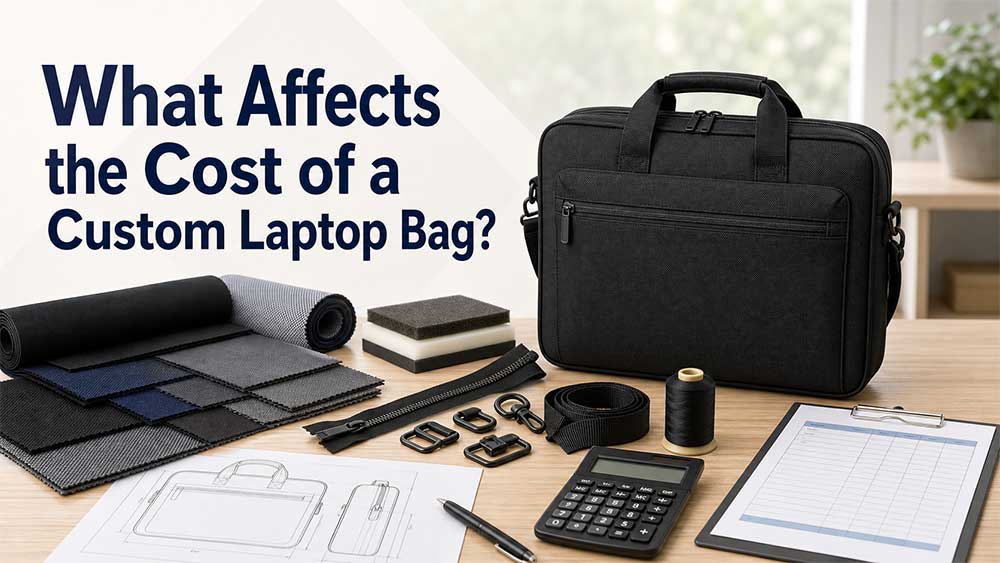
Two laptop bags may look similar in a product photo but receive very different factory quotations. The difference is rarely caused by one material or feature. It usually comes from the complete specification: fabric construction, laptop protection, internal organization, hardware, branding, order breakdown, development work, packaging, testing, and delivery terms.
A reliable unit price cannot be calculated until the product specification, quantity by color, packaging requirements, and quotation terms have been defined.
The main cost categories can be summarized as follows:
The first question is not simply, “How big is the bag?” It is, “What does the bag need to do?”
A basic laptop sleeve, a commuter backpack, a structured executive briefcase, and a wheeled laptop bag have different material requirements and production processes.
For example, a daily commuter backpack may require:
A padded laptop compartment
Comfortable shoulder straps
A breathable back panel
Internal organization
A water bottle pocket
Reinforced load-bearing points
A business briefcase may place more emphasis on:
Shape retention
Clean exterior panels
A structured handle
Detachable shoulder strap hardware
Document organization
Consistent topstitching
Clarifying the intended user, carrying load, sales channel, and target retail position helps the supplier recommend an appropriate construction instead of quoting based only on a reference image.
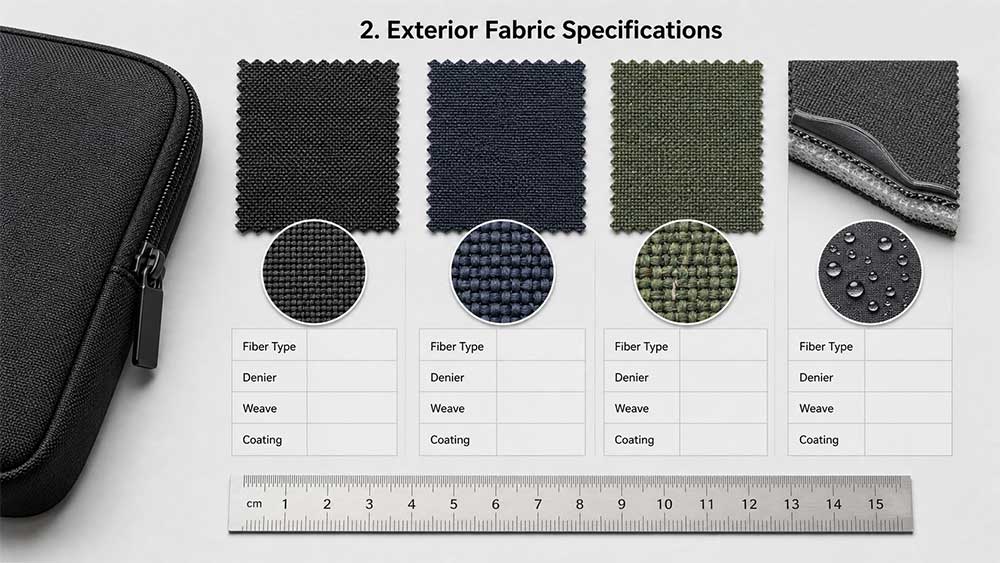
2. Exterior Fabric Specifications
“Polyester” or “nylon” is not a complete material specification. Fabrics with the same generic name can differ considerably in cost and performance.
Important variables include:
Fiber type
Yarn denier
Fabric construction
Weight
Weave density
Backing or lamination
Water-resistant treatment
Abrasion requirements
Color availability
Minimum order quantity
Recycled-content certification
Custom dyeing or finishing
A high-density polyester with a specialized coating may cost more than a basic nylon. Likewise, a stock black fabric is generally easier to source than a custom-dyed material that requires color development and a separate material MOQ.
The quotation should state the exact approved material or include enough detail to prevent one supplier from assuming a basic fabric while another prices a higher specification.
3. Lining, Foam, and Reinforcement
Materials inside the bag also contribute to cost, even though they may not be obvious in product photographs.
These can include:
Main lining
Pocket lining
Laptop-compartment lining
PE, EVA, EPE, or PU foam
Structural boards
Reinforcement fabric
Binding tape
Back-panel mesh
Adhesive or laminated layers
Foam should not be evaluated by thickness alone. Density, recovery, coverage, and placement also affect protection and shape.
A thin, higher-density foam may perform better than a thicker material that compresses easily. A structured business bag may also need reinforcement panels to maintain its shape, while a lightweight sleeve may use a much simpler construction.
Adding padding everywhere is not always better. It increases material consumption, sewing difficulty, weight, and shipping volume. Protection should be concentrated around the laptop compartment, bag base, back panel, handles, and other load-bearing areas.
4. Laptop Compartment Construction
The laptop compartment is one of the most important cost differences between a general backpack and a purpose-built laptop bag.
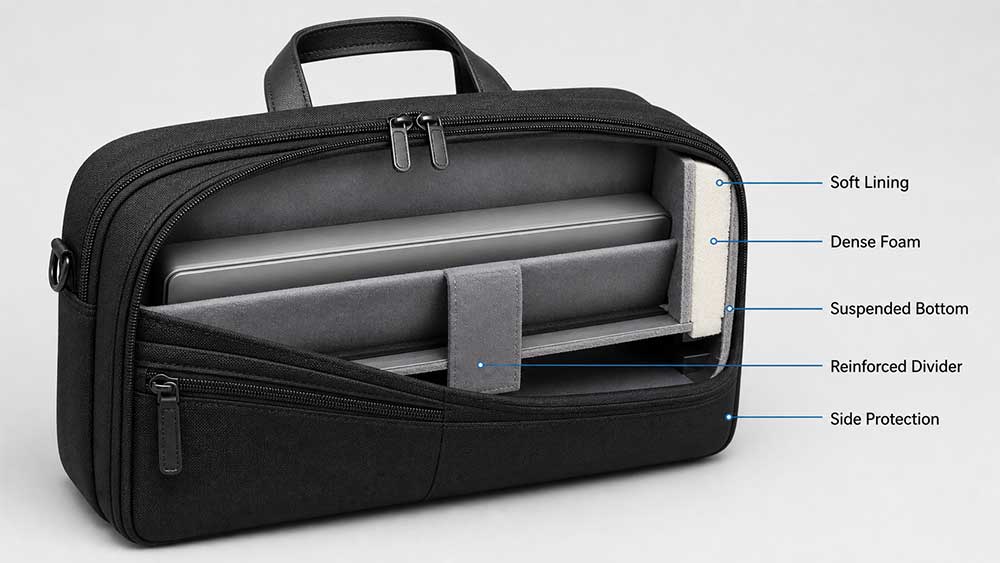
A basic version may use a padded sleeve sewn against the back panel. A more protective design may include:
A suspended compartment raised above the bag base
Separate front and back padding
Side protection
Corner protection
A soft device-facing lining
A closure strap or zipper
A separate tablet sleeve
Reinforcement around the compartment opening
These structures require additional materials, pattern pieces, sewing operations, and assembly control.
The required internal dimensions must also be confirmed. Laptop screen size does not equal the device’s external dimensions, and two 15.6-inch laptops can have different body measurements. Buyers should provide the actual device dimensions or follow a consistent method for measuring a laptop for a bag.
Protection should be assessed as a complete system. Foam thickness, density, coverage, bottom clearance, closure, and bag structure work together. The practical considerations are explained further in this guide to laptop bag padding and protection.
5. Bag Size and Capacity
A larger bag normally consumes more exterior fabric, lining, foam, webbing, and reinforcement. However, external dimensions alone do not explain the full difference.
Cost can also change because of:
Gusset depth
Number of compartments
Expansion panels
Extra-long zipper openings
Larger reinforcement pieces
Heavier carrying requirements
Oversized packaging
Lower carton loading efficiency
Unnecessary capacity can increase material use, product weight, and shipping volume without improving the user experience. Capacity should reflect the intended load rather than an assumption that a larger bag always offers better value.
6. Pattern Pieces and Sewing Complexity
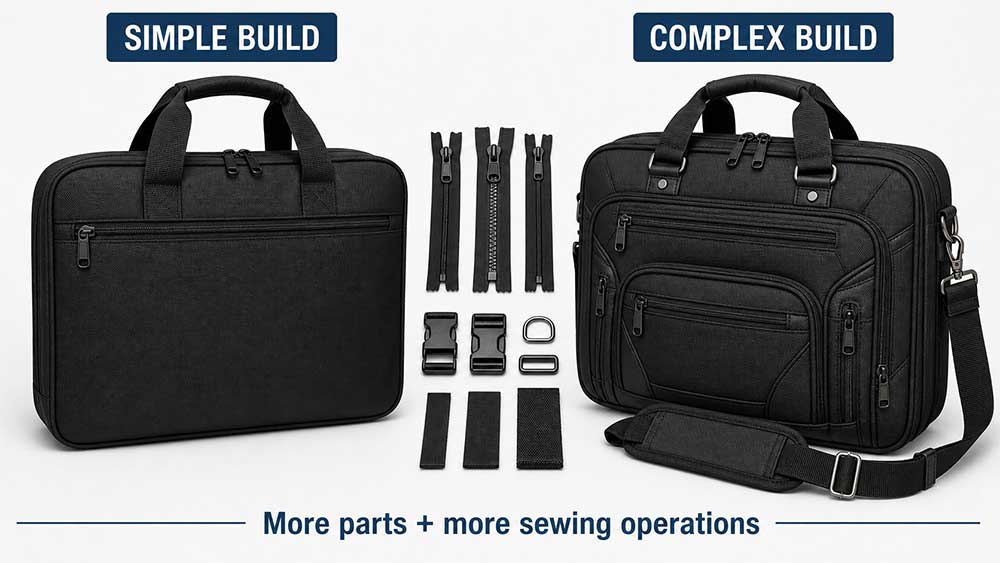
Every additional pattern piece must be prepared, cut, positioned, sewn, and inspected. Some pieces also require binding, reinforcement, lamination, or careful alignment.
Features that can increase labor include:
Multiple front pockets
Hidden security pockets
Curved zipper openings
Expansion compartments
Complex internal organizers
Bottle pockets
Luggage pass-through straps
Cable openings
Decorative overlays
Piping and binding
Box-and-cross stitching
Bar tacks at stress points
Tight dimensional tolerances
A pocket is not merely an extra piece of fabric. It may require a zipper, lining, binding, reinforcement, another pattern, and several sewing operations.
A visually simple business bag is not necessarily inexpensive. Minimalist designs often require accurate panel alignment, clean edges, stable topstitching, and materials that hold their shape without visible distortion.
7. Zippers, Buckles, Webbing, and Hardware
A laptop bag may contain several zippers, sliders, pulls, adjusters, rings, buckles, and reinforcement components. A small difference in the cost of each item can become significant across the full bag and the total order.
Zipper cost can vary according to:
Brand and quality grade
Coil, molded, or metal construction
Zipper size
Standard or reverse installation
Water-resistant treatment
Single or double sliders
Custom pulls
Tape color
Strength or cycle-test requirements
Other relevant components include webbing, adjustment hardware, D-rings, hook-and-loop fasteners, handle reinforcement, shoulder-strap hardware, and metal finishes.
Custom metal pulls or buckles may require tooling and a separate component MOQ. Existing sizes, proven components, and standard finishes usually make cost control easier.
“Add our logo” does not provide enough information for an accurate quotation.
Logo cost depends on:
Application method
Finished size
Number of colors
Position
Number of logos per bag
Printed coverage
Embroidery stitch count
Patch or badge material
Tooling and setup requirements
Order quantity
Common options include screen printing, heat transfer, embroidery, woven labels, rubber patches, silicone patches, embossed synthetic leather, and custom metal badges.
A small one-color print usually requires less setup than dense embroidery, a molded patch, or custom metal branding. Some methods may also involve artwork confirmation, molds, pre-production samples, or component MOQs.
Private-label requirements can extend beyond the main logo to include care labels, model labels, hangtags, barcodes, warranty cards, branded zipper pulls, and printed packaging. These details should be stated during the RFQ stage rather than added after the unit price has been agreed.
9. Order Quantity and Color Breakdown
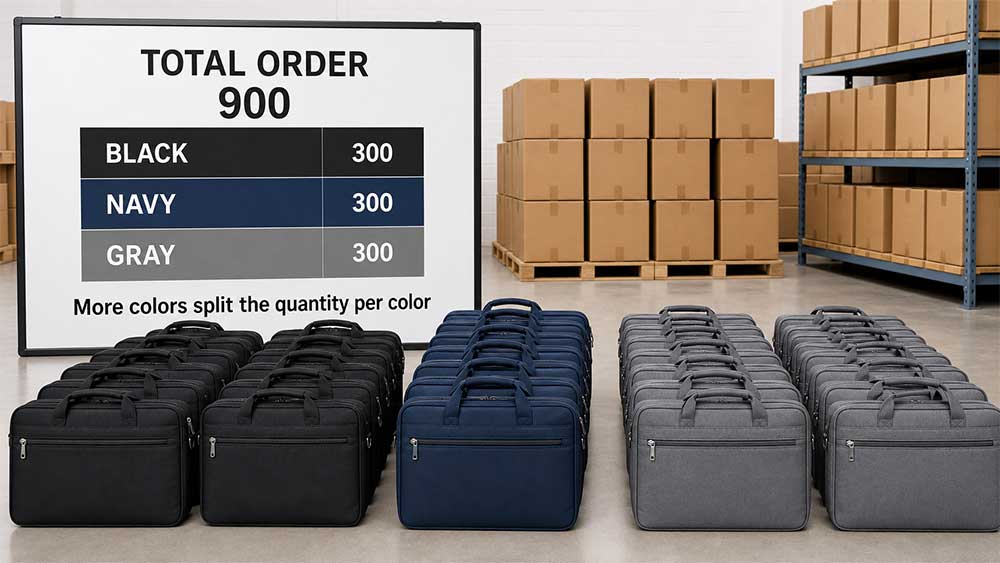
Quantity discounts are not based on the total number alone. A factory also needs to know how that quantity is divided.
MOQ and production efficiency may be calculated by:
Style
Size
Color
Logo version
Custom fabric
Custom component
Packaging version
An order of 1,200 identical black laptop bags is generally more efficient than 1,200 bags divided among six colors. Each color may require separate material purchasing, cutting, thread matching, labeling, production setup, and packing control.
A clear order breakdown might look like this:
Style
Color
Quantity
Laptop Backpack A
Black
600
Laptop Backpack A
Navy
300
Laptop Backpack A
Gray
300
Total
1,200
This is an illustrative order, not a quoted customer project.
Without the color allocation, a request for “the price of 1,200 pieces” may lead to a quotation based on assumptions that later prove incorrect.
10. Modifying an Existing Style or Developing a New Bag
Adding branding to an existing bag and developing a completely new product have different cost structures.
A semi-custom project may involve:
Selecting an existing construction
Choosing available colors
Adding a logo
Replacing labels
Adjusting standard packaging
A fully custom project may require:
Product design
Technical drawings
Pattern making
Sample construction
Material sourcing
Custom component development
Several revision rounds
Fit checks and load testing
New packaging development
Full development gives the brand control over dimensions, structure, materials, organization, and branding. It also adds pattern-making work, sourcing decisions, sample revisions, and approval time.
Clear Adobe Illustrator files, a detailed tech pack, BOM, dimension drawings, logo files, quantity plan, and—when available—a physical reference sample can reduce misunderstanding. Brands preparing their first RFQ can use this private-label laptop bag preparation guide as a checklist.
11. Sample Development and Revisions
A development sample usually costs more per piece than bulk production because a sample room cannot benefit from production-line efficiency.
Sample development may involve:
Pattern making
Sourcing materials in sample quantities
Individual cutting
Machine setup
Preparing custom components
Skilled sample makers
Technical review
Sample revisions or remaking
A first development sample is not always the final approved product, especially when dimensions, materials, hardware, or compartment construction still need adjustment.
Before development begins, buyers should confirm:
How many sample rounds are included?
Which revisions require additional payment?
Can the sample fee be credited after a bulk order?
Are molds and setup charges quoted separately?
Who pays the courier cost?
Will substitute materials be used in the first sample?
Changing the overall product direction after each sample increases both development cost and lead time. Feedback is easier to manage when required corrections are separated from optional new ideas.
12. Packaging Requirements
Packaging affects more than presentation. It can change labor requirements, carton capacity, shipping volume, and the condition of the bag on arrival.
Options may include:
Individual polybags
Bags containing recycled material
Tissue paper
Internal paper supports
Desiccants
Hangtags
Barcode labels
Printed inserts
Retail boxes
E-commerce shipping packaging
Custom export cartons
A structured laptop bag may need internal paper support to maintain its shape. A retail box can improve shelf presentation but may also increase packaging cost and freight volume substantially.
Packaging should match the sales channel. A bag shipped directly to an e-commerce customer may require different protection from a product unpacked and displayed by a retailer.
13. Testing, Inspection, and Compliance
Testing requirements depend on the destination market, retailer, material, intended use, and any performance or marketing claims.
Requirements may include:
Colorfastness testing
Abrasion testing
Seam-strength testing
Handle or shoulder-strap load testing
Zipper performance testing
Restricted-substance testing
Recycled-material documentation
Third-party pre-shipment inspection
Products sold in the European Union may need to consider applicable chemical restrictions under the EU REACH Regulation. Requirements in the United States can vary according to the materials, state regulations, retailer standards, and claims made about the product.
Testing is not automatically included in every factory quotation. The RFQ should define the test method, laboratory, sample quantity, acceptance criteria, and responsibility for retesting costs.
Inspection adds cost, but defects found after shipment can lead to rework, replacement, claims, repacking, or inventory that cannot be sold.
14. Production Location and Quotation Scope
Labor, material availability, component supply chains, energy costs, factory specialization, and efficient order sizes can vary by production location.
The lowest factory unit price does not necessarily produce the lowest landed cost. Buyers may also need to consider:
Inland transportation
Export handling
International freight
Insurance
Duties and taxes
Customs clearance
Destination charges
Local delivery
The quotation should state the applicable Incoterms® rule, named place or port, and version—for example, “FOB Xiamen, Incoterms® 2020.”
Buyers should not compare quotations until recurring unit costs, one-time charges, testing, packaging, and delivery terms have been separated.
Recurring unit costs
Exterior materials
Lining, foam, and reinforcement
Zippers, hardware, and other components
Cutting and sewing
Logo application
Standard packaging
In-line and final quality inspection
One-time or project-level costs
Pattern development
Sample development
Printing screens
Embroidery setup
Molds and tooling
Custom color development
Laboratory testing
Packaging design or cutting dies
One-time charges can be allocated across the expected order quantity when calculating the effective unit cost.
For example:
USD 360 tooling cost ÷ 1,200 bags = USD 0.30 per bag
This is a hypothetical cost allocation, not an actual quotation. If the same tooling can be used for repeat orders, its effect on the long-term unit cost will decrease.
A Specification Comparison Without Misleading Price Ranges
Consider three hypothetical specifications for the same 15.6-inch business laptop backpack:
Cost factor
Basic version
Balanced version
Premium version
Exterior
Stock polyester
High-density polyester with specified coating
Premium nylon or certified recycled fabric
Laptop protection
Basic padded sleeve
Suspended padded compartment
Suspended compartment with side and corner protection
Organization
Main compartment and front pocket
Business organizer and tablet sleeve
Multi-layer organization and device protection
Zippers
Standard zippers
Specified quality grade
Premium or water-resistant zippers
Hardware
Standard plastic parts
Upgraded standard components
Custom finish or branded hardware
Logo
One-color print
Embroidery or woven label
Molded patch or custom metal badge
Packaging
Individual polybag
Polybag, hangtag, and paper support
Branded retail packaging
Development
Existing style modification
Moderate pattern changes
Full custom development
The premium version costs more because several specifications change at the same time. The full difference should not be attributed to the exterior fabric alone.
The appropriate version depends on the target retail price, expected service life, brand position, user needs, and acceptable landed cost.
How to Reduce Cost Without Making the Bag Feel Cheap
Effective cost reduction removes complexity that users do not value. It should not begin by weakening laptop protection or load-bearing areas.
Simplify decorative panels
Decorative overlays, small contrast pieces, and unnecessary seams add cutting and sewing time. A cleaner panel layout can reduce labor while creating a more professional business appearance.
Protect the critical areas
Keep appropriate padding and reinforcement around the laptop compartment, bag base, handle connections, and shoulder straps. Reduce materials only where performance will not be compromised.
Use established components
Existing zipper sizes, buckles, adjusters, and standard finishes usually have lower MOQ and tooling requirements than fully customized hardware.
Limit the first color range
Concentrating the first order in one or two commercial colors can improve material-purchasing and production efficiency.
Remove low-value pockets
Every pocket should solve a real carrying or organization problem. Several pockets serving almost the same purpose may add cost without improving usability.
Modify a proven structure
An existing construction can reduce pattern-making work and repeated sample revisions while still allowing changes to materials, organization, color, and branding.
Share materials across a collection
Using the same exterior fabric, lining, webbing, zippers, and hardware across several products can improve purchasing efficiency and color consistency.
Design around a target cost
Brands should communicate their target retail position and target purchase cost early. The supplier can then recommend suitable trade-offs before a sample is completed, rather than removing important specifications later.
What Information Is Needed for an Accurate Quotation?
A useful RFQ should include:
Product type and intended use
Latest tech pack or dimension drawing
Finished dimensions and internal laptop-compartment dimensions
Exterior, lining, foam, and reinforcement specifications
Zipper, buckle, and hardware requirements
Logo method, size, color, and position
Quantity by style and color
Labeling and packaging requirements
Testing and compliance requirements
Target timing for samples and production
Required Incoterms® rule and named place
Target cost or retail positioning
If a specification has not been decided, mark it as “to be confirmed.” This prevents different suppliers from filling the gap with different assumptions.
Final Takeaway
The cost of a custom laptop bag comes from the complete product specification, not its appearance or size alone.
Exterior fabric matters, but so do lining, foam density, laptop-compartment construction, pattern complexity, sewing operations, zippers, hardware, branding, quantity allocation, development work, packaging, testing, and quotation terms.
Good cost planning does not begin by asking a factory to “make it cheaper.” It begins by identifying which features create value for the user, which structures protect the device or carry the load, and which complex details add cost without delivering enough practical benefit.
A capable custom laptop bag supplier should identify which approved specifications are driving the quotation, separate one-time charges from recurring costs, and document any proposed material or construction change before repricing the product.
Frequently Asked Questions
What usually has the greatest effect on custom laptop bag cost?
There is no single factor for every product. Exterior materials may be important, but complex construction, multiple pockets, protective padding, premium hardware, custom components, and low order quantities can have an equally significant effect.
Does a larger order always reduce the unit price?
Not always. Higher quantities usually improve production efficiency and spread setup costs across more units. However, splitting the order among many colors, materials, logos, or packaging versions can reduce those savings.
Is nylon always more expensive than polyester?
No. Price depends on fabric construction, weight, coating, finish, availability, supplier, and performance requirements. A high-specification polyester can cost more than a basic nylon.
Is modifying an existing laptop bag cheaper?
Usually, yes. Starting from an existing structure can reduce pattern-making work, sample revisions, and development risk. Major changes to dimensions, compartments, or the carrying system may still turn it into a full development project.
Why does a sample cost more than one bulk-production unit?
A sample requires small-quantity material sourcing, individual pattern making and cutting, machine setup, skilled sample work, and technical review. These costs cannot be spread across hundreds or thousands of units.
Can laptop-compartment padding be reduced to lower cost?
It can be optimized, but thickness should not be the only consideration. Density, coverage, suspended construction, bottom clearance, and intended use must also be evaluated. Removing protection from critical areas may create a false saving.
Do custom colors increase cost?
They can. Custom dyeing or color matching may involve material MOQ, development fees, approval rounds, testing, and longer lead times. Stock colors are generally easier to source.
Should tooling costs be included in the unit price?
They may be included or quoted separately. Buyers should confirm the amount, payment terms, tooling ownership, expected service life, and whether any charge can be credited after an order.










Comments are closed