How to Verify Recycled Fabric Claims in Custom Bags
A supplier sends you a GRS or RCS certificate and says the fabric is recycled. Does that prove the bags in your order contain the claimed material?
Not yet.
A valid certificate may confirm that a company is qualified to handle certain certified products. It does not, by itself, prove that the approved fabric entered your production order, that the finished bags contain the claimed percentage, or that your brand can use a certification logo.
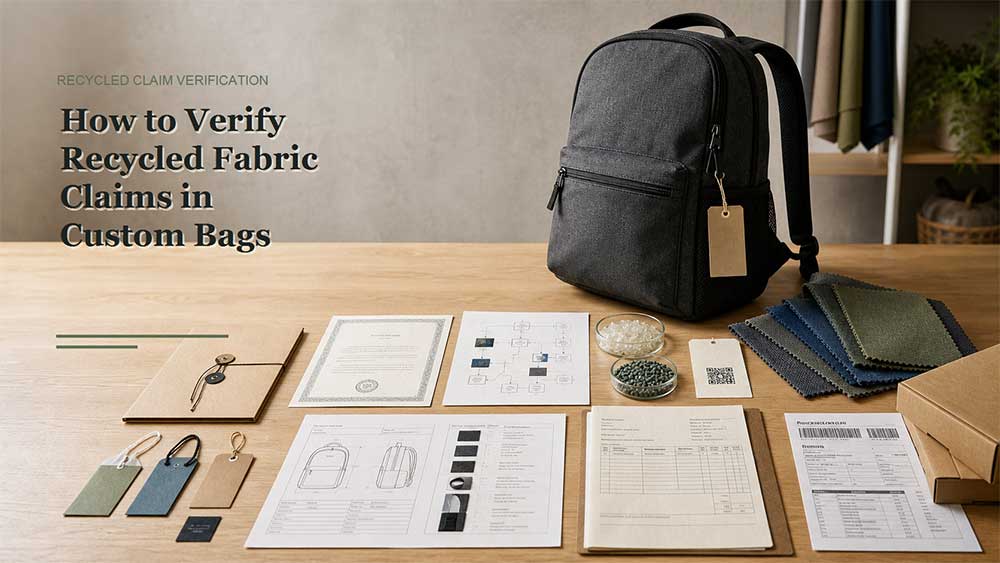
For a reliable claim, the evidence must connect the certificate, material code, approved sample, purchase order, production records, finished quantity, shipment documents, and final marketing language.
This guide explains how brand buyers, importers, and sourcing teams can build that evidence chain for custom bags.
Standards and regulatory references were last checked in August 2026. This article provides general sourcing and compliance information, not legal or certification advice.
To verify a recycled fabric claim in a custom bag order:
Confirm that the Scope Certificate is current and covers the required company, site, material, product category, and activity.
Use the same supplier material code in the BOM, quotation, approved sample, and purchase order.
Match certified-material purchasing and warehouse records with cutting records, production use, normal loss, and finished quantity.
Authenticate the shipment-level Transaction Certificate and compare it with the invoice and shipping documents.
Publish only the component, percentage, certification, and source claims supported by the complete record.
No single certificate, fabric swatch, supplier declaration, or laboratory test can prove the entire claim on its own.
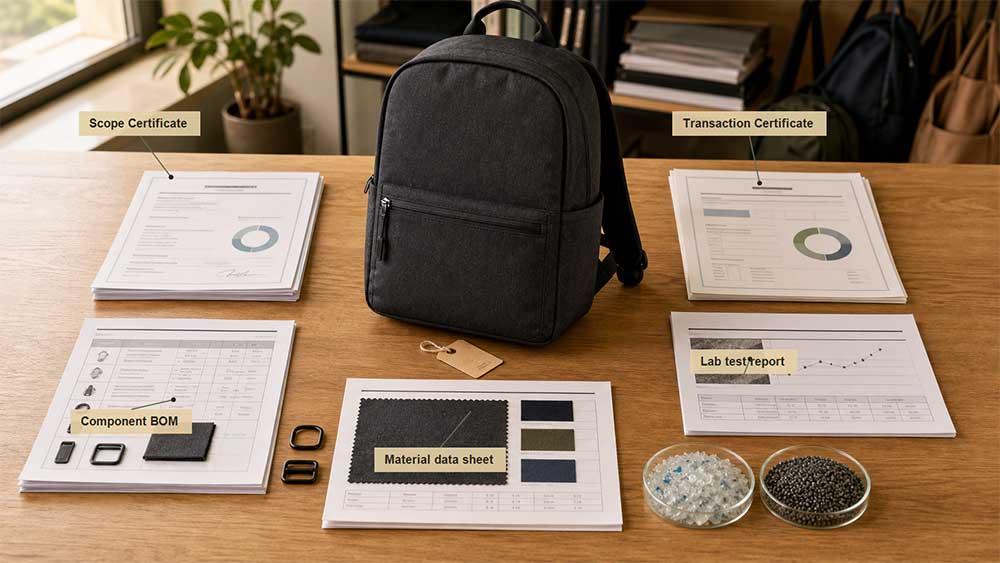
The Five Documents Buyers Should Not Confuse
Document or record
What it can show
What it cannot prove by itself
Scope Certificate (SC)
A company is certified for listed sites, products, materials, and activities
That your specific order used certified material
Material specification or data sheet
Fiber content, construction, coating, weight, and supplier claims
That the delivered material is certified or entered your production
Bill of Materials (BOM)
Which material is assigned to each bag component
That the listed materials were actually purchased and used
Transaction Certificate (TC)
Certified products are linked to a specific transaction
That every consumer-facing statement or logo is approved
Laboratory test report
Fiber composition or selected physical and chemical properties
The complete ownership history or certification chain
The strength of the claim comes from agreement between these records, not from one document viewed in isolation.
Step 1: Define Exactly What You Plan to Claim
Verification should begin before requesting samples or prices. Start by writing down the exact claim the brand wants to make.
These statements do not mean the same thing:
The shell fabric contains recycled polyester.
The shell fabric contains 100% recycled polyester.
The shell fabric contains 100% post-consumer recycled polyester.
The finished bag contains 45% recycled polyester by weight.
The bag contains certified recycled material.
The bag is GRS certified.
The product uses the GRS logo.
Each statement requires a different level of evidence and may be subject to different certification, labeling, or legal requirements.
A bag can contain certified recycled shell fabric while its lining, foam, sewing thread, coatings, labels, webbing, zippers, and hardware remain virgin materials. In that situation, “100% recycled bag” would normally overstate what has been verified.
Before sourcing begins, decide:
Which components will contain recycled material?
What recycled percentage is required for each component?
Is the source pre-consumer, post-consumer, or unspecified?
Is a component-level statement sufficient?
Does the brand need a certified finished-product claim?
Will a certification name or logo appear on the bag, packaging, website, or advertising?
Which markets will receive the product?
If those questions remain unresolved until production or packaging approval, the available evidence may no longer support the intended claim.
Step 2: Build a Component-Level BOM
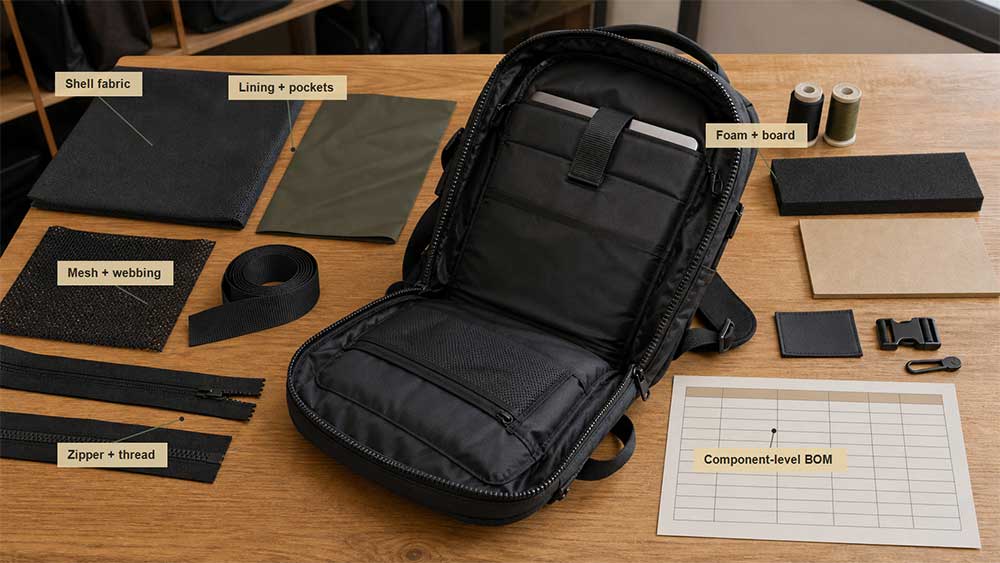
A bag should not be treated as one material. Its recycled-content plan needs to be documented by component.
At minimum, the BOM should record:
Component
Information to record
Shell and reinforcement fabrics
Supplier, material code, fiber composition, recycled percentage, source category, coating or membrane, and certification
Lining and pocket fabric
Material, weight, color, recycled percentage, and certification status
Mesh, webbing, and binding
Fiber or polymer, recycled percentage, supplier, and certificate coverage
Zippers and sewing thread
Tape or thread composition, claimed percentage, supplier, and supporting documents
Foam and structural sheets
Material type, virgin or recycled status, component weight, and thickness
Labels, logo patches, and packaging
Which item carries the claim and whether it refers to the product or packaging
Hardware
Material, finish, weight, and whether it is included in the finished-product calculation
For internal planning, buyers can estimate the finished product’s recycled content by weight:
This estimate can reveal whether a whole-product claim is realistic. It does not replace the official calculation method, permitted exclusions, chain-of-custody requirements, or claim approval process under the applicable certification or market rules.
Do not simply average the percentages shown on different fabric data sheets. A lightweight lining and a heavy shell should not contribute equally to a finished-product claim.
Step 3: Match the Scope Certificate to the Supply Chain
A Scope Certificate shows that an organization has been assessed for defined sites, products, materials, and activities. Textile Exchange explains that an SC means the company is eligible to process listed certified products; it does not automatically mean that the product you are ordering is certified.
Check:
Legal company name
Certified site address
Certificate or license number
Issue and expiry dates
Applicable standard
Product categories
Certified materials
Processing or trading activities
Certification body
Buyers can use Textile Exchange’s Find a Certified Company database to check current certification information. If the scope is unclear, the details conflict, or the certificate cannot be authenticated, contact the issuing certification body.
The company names shown on the quotation, invoice, Scope Certificate, bank information, and export documents may differ. A fabric mill, trader, bag factory, and export company can all have separate legal roles.
Different names do not automatically invalidate a claim. However, the supplier should explain the role of every company and show that the certified supply-chain path remains continuous.
Ask:
Who produces the recycled fiber or yarn?
Who weaves or knits the fabric?
Who dyes, prints, coats, or laminates it?
Is a trader involved?
Which factory cuts and sews the bags?
Which legal entity sells the finished bags?
Which party will apply for the shipment TC?
Textile Exchange’s chain-of-custody system distinguishes between an SC, which confirms an organization’s certification scope, and a TC, which links certified products to a particular transaction.
Do not assume certified fabric will retain its certified transaction status after passing through a trader or processor that is outside the required certification path. Unusual ownership or processing arrangements should be confirmed with the responsible certification body.
Can a Fabric Certificate Be Traced Directly to a Bag Order?
Not through the Scope Certificate alone.
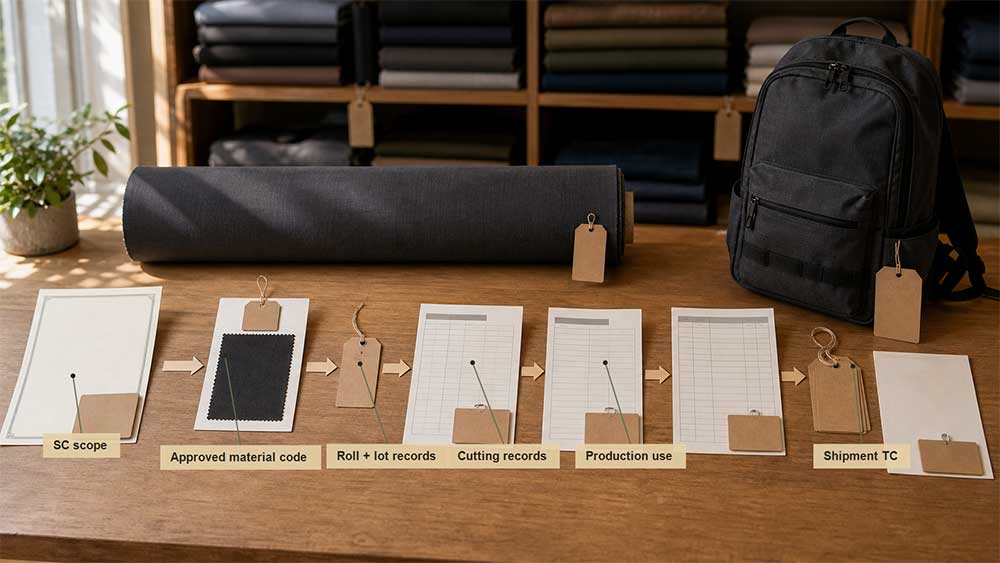
To connect a certified material to an actual order, trace:
Approved supplier material code
Fabric supplier and processors
Purchase orders and invoices
Incoming lot and roll numbers
Warehouse receipt and issue records
Cutting and production records
Finished-product quantity
Seller, buyer, and shipment documents
Applicable shipment TC
A certificate may be genuine while the claim for a specific order remains unverified because these records do not connect.
Step 4: Lock the Documented Material Into the Sample and PO
Many projects lose control at this point. The supplier may hold a valid certificate, but the sample may use a different fabric code with a similar appearance.
The material approval record should include:
Fabric mill or supplier
Supplier material code
Fiber composition and recycled percentage
Pre-consumer or post-consumer source, where applicable
Weave, denier, and weight
Coating or laminated membrane
Color standard and approved lab dip
Certification reference
Approval date
Required performance tests
Permitted tolerances
Approved alternatives
Use the same material code in the BOM, quotation, sample report, cost sheet, and PO. A clear custom bag material and color approval process reduces the risk of approving a visually similar fabric that does not carry the same documentation.
Where practical, retain a signed swatch or sealed reference sample. Appearance cannot prove recycled origin, but it can help identify an unapproved change in weave, coating, color, weight, or hand feel.
The PO or attached specification should also state:
Components covered by the recycled claim
Approved material codes
Required recycled percentages
Required source category, where applicable
Applicable certification and standard version
Required certified supply-chain path
Whether the shipment must be eligible for a TC
Who pays the TC fee and supplies the application records
TC submission deadline
Responsibility for claim and artwork approval
Material or supplier changes requiring written approval
Record-retention or audit rights where commercially appropriate
Certification requirements should be managed separately from physical performance and restricted-substance requirements. Recycled-content certification does not replace testing for abrasion, tear strength, colorfastness, coating adhesion, water resistance, or regulated chemicals.
Step 5: Reconcile Bulk-Material and Production Records
Sample approval does not guarantee that the same material will enter bulk production. Price changes, MOQ limitations, color availability, lead times, and coating problems can all lead to substitution requests.
During production, check the records connecting the approved material to the finished quantity:
Fabric purchase orders and supplier invoices
Incoming delivery notes
Roll labels and lot numbers
Warehouse receipt and inventory records
Segregation of certified and non-certified materials
Cutting or material-issue records
Actual consumption and production loss
Written approval for substitutions
In-line and final inspection results
Finished and rejected quantities
The purchased quantity, expected consumption, normal loss, finished quantity, and remaining inventory should be commercially and technically consistent.
If a factory claims that a large production run used a particular certified fabric but cannot show material input broadly consistent with the finished quantity, the buyer should request an explanation and supporting records.
The level of review does not need to be identical for every order. It can be adjusted according to the value of the claim, order size, supply-chain complexity, and substitution risk.
Recycled-material control should form part of the normal custom bag production process, alongside incoming inspection, material approval, in-line inspection, final inspection, and shipment-document review.
Step 6: Match the Transaction Certificate to the Shipment
A Transaction Certificate connects certified products with a specific transaction. It should be checked against the actual commercial documents, not simply filed away.
Compare:
Seller and buyer
Certified organization and site
Certification standard
Product description
Material and composition
Pre-consumer or post-consumer category, where stated
Quantity and unit
Invoice number and date
Shipment information
Certification body
Certificate number
Textile Exchange’s Authenticate a Transaction system provides a single source for checking valid TCs issued by active certification bodies from October 2022. If the certificate cannot be found or the returned information does not match, contact the responsible certification body.
An upstream fabric TC should not automatically be treated as proof that the finished-bag shipment is certified. The applicable certified path needs to cover the relevant trading, processing, bag manufacturing, and selling stages.
The TC should also correspond to the approved material and order. Authentication confirms whether the certificate is valid; order reconciliation confirms whether that certificate actually belongs to the relevant product and shipment.
What If the TC Is Still Pending When the Goods Ship?
Before issuing the PO, agree on:
Which party will apply
Documents each party must provide
Application deadline
Expected delivery date for the TC
Responsibility for corrections or missing information
Agreed remedy if the TC is delayed or rejected
Whether a buyer accepts the physical goods and whether the brand can publish a certification claim are separate decisions.
Until the final shipment TC has been issued and verified, the brand should not publish a consumer-facing certification claim based only on a supplier’s promise that the document will arrive later.
Plan for the Materials Matter Transition
As of August 2026, GRS and RCS remain in use. However, buyers planning future collections should account for Textile Exchange’s transition to Materials Matter.
The Materials Matter Standard becomes effective on December 31, 2026.
It becomes mandatory for applicable Tier 4 audits from December 31, 2027.
All claims and labels must transition to Materials Matter by June 30, 2029.
The first version includes recycled materials currently covered by GRS and RCS. Textile Exchange’s Content Claim Standard will continue to support chain of custody and product claims.
Products, packaging, and online claims that will remain in the market during the transition may require different planning from short-lived orders. Confirm the appropriate certification and labeling route with the responsible certification body before approving materials or printing packaging.
Use Laboratory Testing for the Questions It Can Answer
Testing and certification solve different problems.
Standard fiber-composition testing can identify polyester, nylon, cotton, or blends. Physical testing can measure fabric weight, tear strength, abrasion resistance, colorfastness, coating adhesion, and water resistance.
These tests are important for quality control, but routine composition testing usually cannot determine whether polyester came from recycled or virgin feedstock.
Some specialized methods can provide supplementary evidence for specific materials. For example, Intertek’s rPET Verification is designed to identify recycled polyester fiber made from used PET plastic bottles in yarns, fabrics, and products.
Before arranging specialized testing, ask the laboratory:
Which polymer and recycled source can the method identify?
Is the result qualitative or quantitative?
Can coatings, blends, dyes, or additives affect the result?
What samples and reference information are required?
Can the result substantiate the exact claim you intend to make?
Unless the applicable legal or certification framework recognizes the method as a prescribed form of verification, the report should be treated as supplementary evidence.
Testing cannot reconstruct missing ownership records, prove that every supply-chain stage was certified, or repair a broken chain of custody.
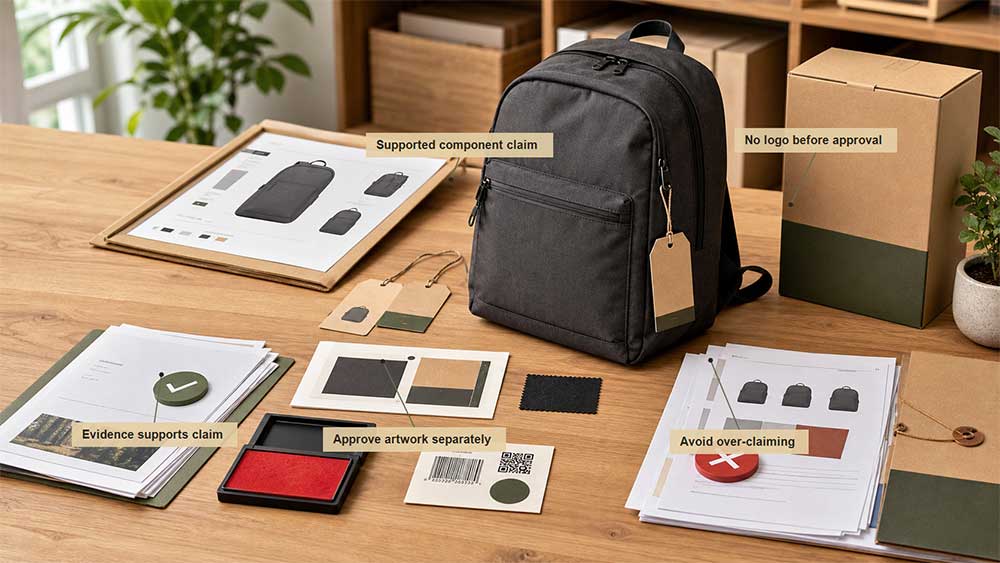
Approve the Final Product Claim Separately
Consumer-facing language should never go beyond the available evidence.
Available evidence
More accurate wording
Wording to avoid
Only the shell fabric is documented as containing 100% post-consumer recycled polyester
“The shell fabric contains 100% post-consumer recycled polyester.”
“100% recycled backpack”
A verified finished-product calculation supports a specific percentage
“This bag contains X% certified recycled polyester by weight.”
“Made entirely from recycled materials”
Recycled origin is supported, but post-consumer origin is not
Use the word “certified” only when the product, transaction, claim maker, and approval path satisfy the applicable certification requirements.
Textile Exchange Claims and Logo Approval
Receiving a TC does not automatically give a brand or retailer permission to use a Textile Exchange certification mark or publish any wording it chooses.
Claims and artwork referring to GRS, RCS, Materials Matter, or another Textile Exchange standard must follow the applicable claims and labeling policy and approval process.
Certification decisions and TC issuance remain with the responsible certification body. The brand or other claim maker remains responsible for legal compliance, while Textile Exchange standard claims and certification marks must follow the applicable eligibility, licensing, and approval requirements.
Confirm these requirements before printing labels, hangtags, packaging, or product inserts.
Recycled-Content Claims in the United States
Under 16 CFR §260.13, a company should not directly or indirectly misrepresent the recycled content of a product or package.
An unqualified recycled-content claim is appropriate only when the entire product or package, excluding minor incidental components, is made from recycled material. If recycled material represents only part of the product, the claim should clearly state the amount or percentage by weight.
For a bag where only the shell fabric is supported by evidence, a specific component claim is generally more defensible than wording that implies the entire bag is recycled.
Environmental Claims in the European Union
For products marketed to EU consumers, buyers should also review the national rules implementing Directive (EU) 2024/825 on empowering consumers for the green transition.
Member States had until March 27, 2026 to transpose the Directive, and the new requirements apply from September 27, 2026. The rules strengthen consumer protection against vague or misleading environmental claims and non-compliant sustainability labels. The European Commission provides an official FAQ on the Directive.
Products and marketing materials prepared before the application date should not be ignored. Existing EU rules against misleading commercial practices still apply, and authorities have issued guidance for proportionate handling of old-stock situations.
Specific component, material, source, and percentage statements are usually easier to substantiate than broad terms such as “green,” “eco-friendly,” or “sustainable.” Final wording should still be reviewed for each sales market.
Warning Signs When Reviewing Recycled-Material Claims
Pause and investigate further if a supplier:
Provides only a logo, screenshot, or fabric data sheet
Provides an expired Scope Certificate
Uses a certificate belonging to another company or site without explaining the relationship
Provides an SC that does not cover the required material, product, or activity
Says the certificate is traceable but cannot connect it to the order
Documents only one fabric but describes the entire bag as recycled
Uses “post-consumer recycled” without evidence of the source category
Will not identify the mill, trader, processor, or bag factory in the certification path
Promises a TC but cannot identify the party responsible for applying
Changes the approved material code without written approval
Cannot reconcile certified-material input with finished quantity
Treats routine fiber testing as complete proof of recycled origin
Prints a certification logo before the claim and artwork are approved
A warning sign does not automatically prove misconduct. Different legal entities, certified stock, combined shipments, and certificate-processing times may have reasonable explanations.
Those explanations should still be documented and independently verifiable.
Using Recycled Materials in Custom Bag Production
Vancharli Outdoor develops custom backpacks, business bags, travel bags, and outdoor bags using recycled polyester, recycled nylon, and other available recycled-material options.
Depending on the project and available supply chain, we can help buyers:
Build a component-level BOM
Source recycled fabrics and confirm material codes
Develop samples using specified recycled materials
Map the required certified supply-chain path
Organize certificate and production records
Trace material purchasing through production
Coordinate physical-performance and restricted-substance testing
Prepare supporting documents needed for a TC application
Where certification bodies, material suppliers, or independent laboratories are involved, we coordinate with the responsible parties rather than acting as the certifier or test laboratory.
The certification route should be confirmed before material, sample, price, and PO approval. Using recycled fabric does not automatically make the finished bag eligible for a certification logo or whole-product recycled claim.
Working with an experienced custom bag manufacturer from the beginning makes it easier to keep approved materials, samples, production records, shipment documents, and final marketing claims aligned.
Frequently Asked Questions
Can a recycled fabric certificate be traced to an actual order?
Not through the Scope Certificate alone. Buyers need to connect the approved material code with purchasing records, incoming lots, warehouse and production records, finished quantity, commercial documents, and the applicable TC.
Does a valid certificate prove that bulk production used certified fabric?
No. The certificate may be valid but linked to a different material or order. Check the approved material code against purchasing, warehouse, cutting, consumption, and finished-product records.
Can a supplier declaration replace a Transaction Certificate?
Not when the claim depends on a certified transaction. A supplier declaration can record a commitment, but it does not replace shipment-level certification or independently verifiable chain-of-custody evidence.
What should a buyer do if the TC is still pending?
Confirm that the responsible seller has submitted a complete application and agree on a submission deadline and contractual remedy. Do not publish the certification claim until the TC has been issued and verified.
What if the material code changes after approval?
Pause the substitution. Compare the new material’s composition, recycled percentage, source category, certification coverage, supply-chain path, coating, color, weight, performance, and cost. Update the BOM, approved sample, PO, test plan, and certification records only after written approval.
Can one TC cover several shipments?
Do not assume that it can. The arrangement depends on the applicable issuance requirements and structure of the commercial documents. Confirm it with the certification body and check that all relevant invoices, products, quantities, and shipments are correctly listed.
Can laboratory testing prove that polyester is recycled?
Routine fiber-composition testing normally cannot distinguish recycled polyester from virgin polyester. Specialized rPET methods may provide additional evidence for certain sources, but they do not automatically replace certification and traceability records.
Can a brand use a certification logo after receiving the TC?
Not automatically. Logo use and consumer-facing certification claims are subject to separate eligibility, licensing, artwork, and approval requirements.
How can a buyer verify a post-consumer recycled claim?
Request records that specifically identify the post-consumer source and retain that classification through the applicable chain of custody. If the evidence supports only general recycled content, the claim should not be expanded to “post-consumer recycled.”
When should verification begin?
Start during the inquiry stage—before approving materials, samples, prices, the PO, packaging, or product-page wording. A traceability gap is much easier to correct before bulk production begins.









Comments are closed