



Water-Resistant Laptop Bags: What Buyers Should Know
A water-resistant laptop bag can help protect a laptop from light rain, short exposure, and daily splashes, but it is not the same as a waterproof bag. For buyers, the most important thing to understand is that water resistance is not created by one fabric label alone. It depends on the outer material, coating, zipper design, seam construction, laptop compartment placement, bottom protection, and how the bag separates liquids from electronics.
For daily commuting, office use, school, business travel, and short outdoor exposure, a well-designed water-resistant laptop bag is usually enough. Most business laptop bags are made to handle everyday splashes and light rain, not full waterproof conditions. Fully waterproof construction is more common in outdoor dry bags, cycling bags, roll-top waterproof backpacks, and field-use bags, but those designs can feel too technical, stiff, bulky, or outdoor-focused for everyday business use.
The safest choice is not simply the bag that says “water-resistant” on the product page. The safer choice is the bag with the right construction behind that claim.
The Direct Answer: Water-Resistant Is Useful, but Not Waterproof
A water-resistant laptop bag is designed to resist water to a limited degree. It can usually handle light rain, brief splashes, and normal commuting conditions. It is not designed for soaking, heavy rain for long periods, or submersion.
A waterproof laptop bag needs stronger construction. That may include waterproof laminated fabric, sealed or welded seams, waterproof zippers, roll-top closures, or special closure systems. Most business laptop bags are designed to be water-resistant, not fully waterproof, because they also need to look clean, open easily, carry comfortably, and fit office or travel use.
Fully waterproof construction is more common in outdoor dry bags, cycling bags, roll-top waterproof backpacks, or field-use bags. These structures are useful in harsh wet environments, but they are often too technical, stiff, or bulky for everyday business bags. For most business laptop bags, the practical goal is reliable splash and light-rain resistance, not dry-bag-level waterproofing.
The difference matters because laptops are electronic devices. A few drops on the outside of the bag may not be a problem. Water entering through the zipper, seam, bottom panel, or bottle pocket can be much more serious.
The IEC explains that IP ratings are used to grade how well an enclosure resists dust and liquid intrusion through the IP code system. For laptop bags, this is a useful reminder: unless a bag has been tested under a specific standard or method, buyers should be careful with strong claims such as “IPX waterproof” or “fully waterproof.” A general water-resistant laptop bag should not be marketed as if it were a tested waterproof enclosure: IEC IP ratings.
Tip: If a laptop bag only says “water-resistant material” but does not mention zippers, seams, or construction, treat the claim as limited protection.
Where Water Usually Enters a Laptop Bag
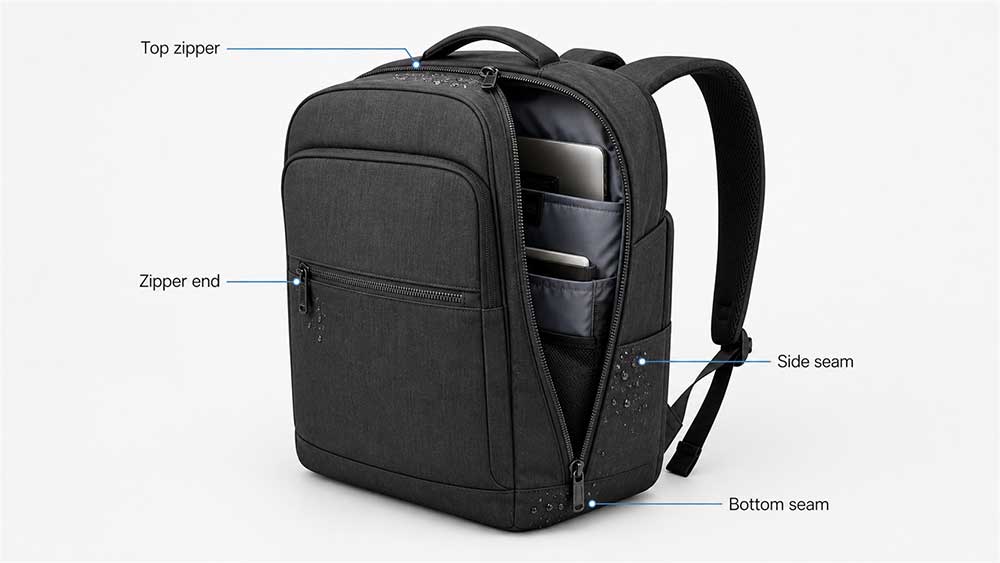
Many buyers focus only on the outer fabric, but water often enters through weak points in the construction. A fabric may resist water well, but the bag can still leak if the zipper, seams, or openings are not protected.
Common water entry points include:
- Top zipper openings
- Front pocket zippers
- Stitching holes
- Seams and binding edges
- Bottom panels
- Side pockets
- Bottle pocket areas
- Gaps around zipper ends
- Wet umbrellas placed inside the main compartment
- Leaking bottles or coffee tumblers
For laptop bags, internal liquid risk is just as important as rain. A leaking water bottle inside the main compartment can be more dangerous than light rain outside the bag. This is why laptop bags should place water bottles outside the main laptop area whenever possible.
A good water-resistant laptop bag should guide water away from the laptop compartment. It should not place the laptop sleeve directly beside an internal bottle pocket, wet umbrella section, or open-top liquid storage area.
Tip: When checking a sample, do not only spray the front fabric. Spray the zipper area, bottom seam, and pocket openings. These areas often reveal the real water resistance level.
Outer Fabric: Nylon, Polyester, PU Leather, and Coated Materials
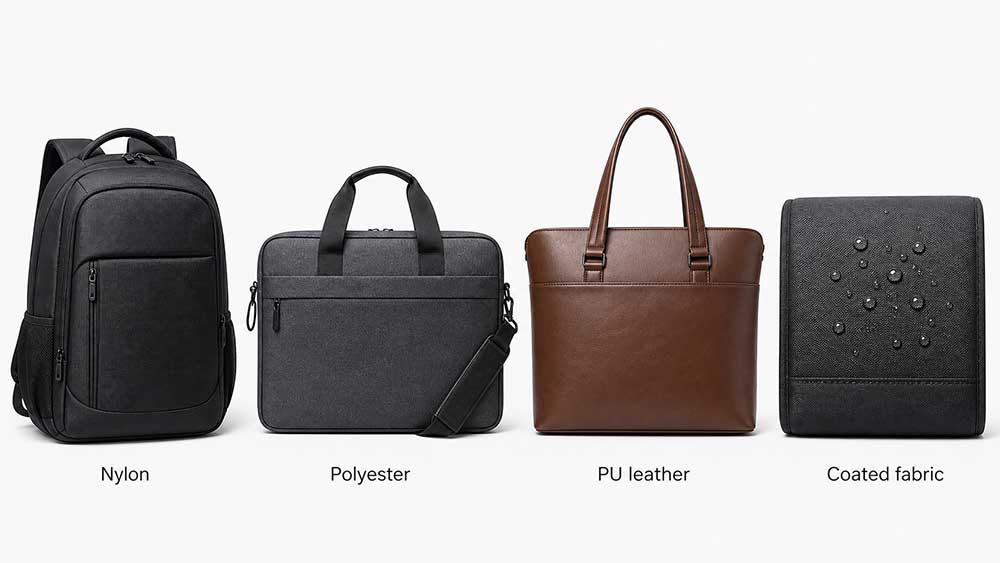
The outer fabric is the first layer of protection, but it is not the whole system. Nylon, polyester, PU leather, and coated materials can all be used for water-resistant laptop bags if the specification and construction are suitable.
Nylon is commonly used for laptop backpacks, commuter bags, and travel work bags because it can be lightweight, flexible, and durable. With PU coating, DWR finish, TPU film, or laminated backing, nylon can offer stronger water resistance.
Polyester is also common in business laptop bags and corporate work bags. It is often cost-effective, color-stable, and suitable for large-scale production. High-denier polyester with proper coating can work well for everyday laptop carry.
PU leather has a smooth surface that is easy to wipe clean. It can be useful for formal business totes, laptop sleeves, and briefcase-style bags. However, PU leather surface resistance does not make the entire bag waterproof. Water can still enter through seams, stitching, zippers, and openings.
Canvas can be used for casual business laptop bags, but untreated canvas is usually weaker against moisture. Waxed canvas or coated canvas offers better water resistance, but the look and maintenance requirements are different from nylon or polyester.
For buyers comparing features that make a good laptop bag, fabric should be judged together with padding, zipper protection, internal layout, and bottom structure.
Coatings and Backings: What Buyers Should Check
Water resistance often comes from coatings, films, or backing materials applied to the fabric. These layers help reduce water penetration and can also improve structure.
Common options include:
- PU coating
- PVC backing
- TPU film
- DWR finish
- Laminated fabric
- Coated canvas
- Waterproof or water-resistant backing layers
PU coating is common in nylon and polyester laptop bags. It can improve water resistance and give the fabric more body. PVC backing may provide structure and water resistance, but buyers should check market requirements and material compliance. TPU film is often used in higher-performance waterproof or water-resistant products.
DWR finish helps water bead on the surface, but it may reduce over time with wear, washing, abrasion, or long-term use. Laminated fabric can provide stronger protection, but it may also affect softness, breathability, folding, cost, and sewing difficulty.
Buyers should ask:
- Is the fabric coated or only tightly woven?
- What coating is used?
- Is the coating on the back side or surface?
- Does the coating affect smell or hand feel?
- Will the coating crack, peel, or become sticky?
- Is the fabric tested for water penetration?
- Will water resistance remain stable after bending or abrasion?
A water-resistant laptop bag should not rely on a vague fabric name. “Nylon” or “polyester” alone does not explain water resistance. The coating, backing, weave, denier, and construction all matter.
Tip: For B2B orders, ask for the exact fabric specification, not just the material name. “600D polyester with PU coating” is more useful than “water-resistant fabric.”
Zippers Matter More Than Many Buyers Think
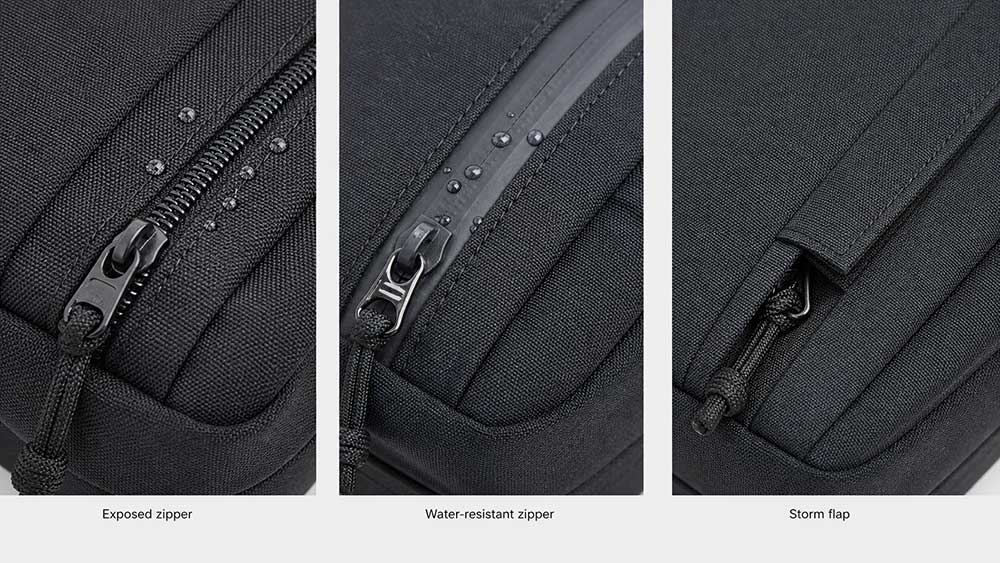
Zippers are one of the most common weak points in laptop bags. Even if the fabric is water-resistant, rain can enter through zipper teeth, zipper tape, slider gaps, and zipper ends.
For better water resistance, laptop bags may use:
- Covered zippers
- Storm flaps
- Reverse coil zippers
- Water-resistant zippers
- PU-laminated zipper tape
- Zipper garages
- Protected top openings
YKK describes AquaGuard zippers as water-resistant or water-repellent zipper options using polyurethane lamination, and also notes that these zippers are not waterproof or watertight: YKK AquaGuard zipper guidance. This distinction is important. A water-resistant zipper can improve protection around openings, but it should not be treated as a fully waterproof closure in all conditions.
Zipper placement also matters. A zipper on the top of the laptop compartment faces more direct rain than a zipper hidden under a flap. A front pocket zipper may collect water if the bag is tilted forward. A zipper that curves around corners can be harder to protect than a straight zipper under a cover.
A laptop bag does not always need the most expensive zipper. But the zipper should match the product claim. If a bag is marketed as water-resistant for commuting, the zipper area should not be completely exposed without any protection.
Seams, Stitching, and Construction
Stitched seams create needle holes. These holes may allow water to pass through, especially during long exposure or pressure from rain. This is one reason why a water-resistant fabric does not automatically make a water-resistant bag.
Common construction levels include:
- Basic stitched seams
- Reinforced stitched seams
- Bound seams
- Covered seams
- Taped seams
- Welded seams
- Seamless or molded construction in special products
Most business laptop bags use stitched construction because it allows cleaner shapes, organized compartments, padded panels, and office-friendly styling. Fully waterproof bags may use welded seams or roll-top closures, but that construction can look more outdoor-oriented and may not suit all business bag designs.
AATCC TM127 measures fabric resistance to water penetration under hydrostatic pressure, but its results should not be treated as the same as rain or water spray resistance: AATCC TM127 Water Resistance: Hydrostatic Pressure. This is important for buyers because a fabric test does not automatically prove the entire laptop bag is waterproof.
For a laptop bag, seam construction should match the intended use. A daily office bag may only need light rain resistance. A cycling commuter bag or field work laptop bag may need more serious seam protection.
Tip: If the buyer needs heavy rain protection, ask whether the whole bag or only the fabric was tested. These are not the same thing.
Laptop Compartment Design: The Real Protection Zone
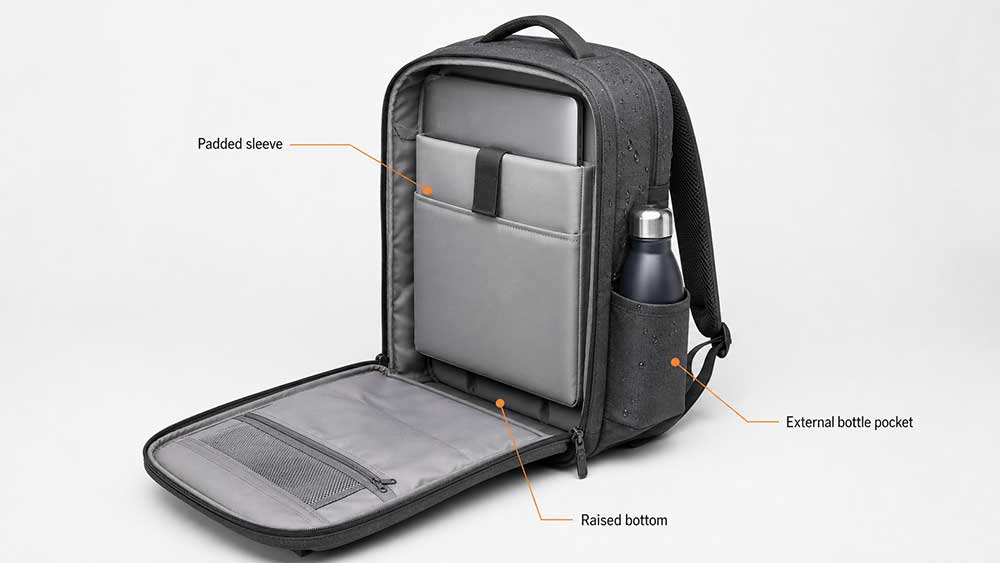
The laptop compartment is the most important area in a water-resistant laptop bag. Even if the outer shell becomes wet, the laptop should stay separated from water entry points and liquid items.
A safer laptop compartment should include:
- Padded laptop sleeve
- Raised or suspended bottom
- Compartment away from bottle pockets
- Protected laptop zipper
- Soft lining
- Water-resistant divider fabric
- Bottom protection
- Internal separation from wet items
- Enough fit control to reduce laptop movement
For daily use, water resistance and impact protection should work together. A laptop bag that resists light rain but has poor padding can still be risky. A bag with strong padding but poor zipper protection can also be risky.
When buyers think about laptop bag padding, they should also consider moisture protection. Foam can absorb or trap moisture if water enters the compartment. A well-designed laptop sleeve should keep the laptop stable, elevated from the bottom, and separated from wet zones.
The same logic applies when protecting a laptop inside a backpack. The laptop should not sit loose in the main compartment with bottles, umbrellas, chargers, and hard accessories.
Tip: A laptop compartment placed directly against an internal bottle pocket is a warning sign. Even if the fabric is water-resistant, liquid storage should be kept away from electronics.
Water-Resistant vs Waterproof Laptop Bags
Buyers often use water-resistant and waterproof as if they mean the same thing, but they are different.
| Feature | Water-Resistant Laptop Bag | Waterproof Laptop Bag |
|---|---|---|
| Best for | Light rain, office, daily commute | Heavy rain, outdoor use, cycling, wet travel |
| Fabric | Coated nylon, coated polyester, PU leather, treated fabric | Waterproof laminated fabric or stronger barrier material |
| Zippers | Covered, reversed, or water-resistant zippers | Waterproof or sealed closure systems |
| Seams | Stitched, reinforced, sometimes covered | Sealed, taped, welded, or specially constructed |
| Laptop safety | Good for short exposure if well designed | Better for harsh wet conditions |
| Look | More business-friendly options | Often more technical or outdoor-oriented |
| Opening style | Usually easier and faster to access | May use roll-top or sealed closures |
| Limit | Not for soaking or long exposure | Still depends on closure and construction |
| Buyer focus | Daily protection, business appearance, and convenience | Stronger water protection and testing |
A water-resistant laptop bag is usually enough for office workers, students, and business commuters who face light rain or daily splashes. A waterproof laptop bag is better for cycling commuters, outdoor professionals, field workers, or travelers who may face heavy rain.
For laptop backpacks used for daily commuting, water resistance is useful, but it should be combined with comfort, laptop fit, bottom protection, and internal organization.
What Buyers Should Check Before Buying or Ordering
Before buying or ordering water-resistant laptop bags, buyers should look beyond the product description. The real question is whether the construction supports the claim.
Use this checklist:
| Buyer Check | Why It Matters |
|---|---|
| Outer fabric specification | Shows whether water resistance comes from material, coating, or finish |
| Coating or backing type | Affects water resistance, structure, cost, and durability |
| Zipper protection | Zippers are common water entry points |
| Seam construction | Stitching holes can allow water to pass through |
| Laptop compartment location | Keeps electronics away from wet zones |
| Raised laptop sleeve | Reduces bottom moisture and impact risk |
| External bottle pocket | Keeps liquids away from the main compartment |
| Bottom panel material | Bottom areas touch wet floors and surfaces |
| Lining material | Should not trap excessive moisture near the laptop |
| Claim wording | Water-resistant and waterproof should not be mixed |
| Testing method | Fabric testing and whole-bag testing are different |
| Rain cover option | Useful for heavy rain or travel |
| Bulk consistency | Water resistance should remain stable in production |
A good buyer check should include both appearance and function. A laptop bag may look professional, but if the top zipper is exposed and the laptop compartment sits beside a bottle pocket, water risk may still be high.
Common Mistakes Buyers Make
Mistake 1: Thinking coated fabric means the whole bag is waterproof
Coated fabric helps, but water can still enter through zippers, seams, and openings.
Mistake 2: Ignoring the laptop compartment
A water-resistant outer shell is not enough if the laptop sits near a bottle pocket or directly at the bottom of the bag.
Mistake 3: Confusing water-resistant with waterproof
Water-resistant bags are usually made for light rain and short exposure. Waterproof bags need stronger construction and more careful testing.
Mistake 4: Forgetting about internal liquid risk
A leaking water bottle inside the bag can be more dangerous than rain outside the bag.
Mistake 5: Using strong marketing claims without testing
If the bag has not been tested for a specific waterproof or IP rating claim, the wording should stay accurate and conservative.
Mistake 6: Choosing outdoor waterproof construction for a formal business bag without checking usability
A fully waterproof outdoor-style bag may protect well in heavy rain, but it may feel too bulky, technical, or inconvenient for daily office use. Business buyers should balance water protection with access, appearance, weight, and comfort.
What Brands Should Consider for OEM and ODM Projects
For brands, wholesalers, and product development teams, water resistance should be planned at the product design stage. It affects material selection, zipper choice, seam structure, lining, laptop compartment placement, quality control, claim wording, and cost.
Before sampling, brands should confirm:
- Target use scenario
- Expected rain exposure
- Fabric type and coating
- Zipper type
- Seam structure
- Laptop compartment position
- Bottle pocket placement
- Bottom panel design
- Lining material
- Padding structure
- Logo method
- Testing requirements
- Compliance requirements
- Claim wording
- Bulk production consistency
For OEM and ODM laptop bag projects, Vancharli Outdoor usually reviews fabric coating, zipper construction, seam design, laptop compartment placement, lining, padding, and claim wording together before sampling. A water-resistant claim should match the actual construction of the bag, not just the fabric supplier’s description.
For buyers developing custom laptop bags, it is also important to decide whether the product is meant for office commuting, school use, business travel, cycling, or outdoor work. Different use cases need different levels of water resistance.
Tip: In B2B development, confirm the marketing claim before bulk production. A business laptop bag is usually better positioned as water-resistant for daily use, while fully waterproof claims should be reserved for products with the construction and testing to support them.
Final Answer: What Should Buyers Know?
A water-resistant laptop bag is useful for daily office commuting, school use, short walks in light rain, business travel, and normal everyday splashes. It can help reduce risk from brief wet conditions, but it should not be treated as a fully waterproof bag.
Most business laptop bags are meant to be water-resistant, not completely waterproof. This is usually the more practical choice for office and travel use because the bag still needs to look professional, open easily, carry comfortably, and avoid an overly technical outdoor appearance.
Buyers should check more than the outer fabric. The real protection comes from the full system: coated material, protected zippers, seam construction, laptop compartment placement, raised bottom design, external bottle storage, lining, and accurate claim wording.
For daily office commuting, school use, and short walks in light rain, a well-designed water-resistant laptop bag is usually enough. For heavy rain, cycling, outdoor work, or long wet exposure, buyers should consider stronger waterproof construction, sealed seams, waterproof closures, or a rain cover.
The best water-resistant laptop bag is not the one with the strongest claim. It is the one whose material, construction, and testing match the way the bag will actually be used.
FAQ
Are water-resistant laptop bags waterproof?
No. Water-resistant laptop bags can handle light rain, splashes, and short exposure, but they are not designed for soaking, long heavy rain, or submersion unless specifically built and tested for waterproof performance.
Are most business laptop bags fully waterproof?
No. Most business laptop bags are water-resistant rather than fully waterproof. Fully waterproof construction is more common in outdoor dry bags, cycling bags, roll-top waterproof backpacks, and field-use bags.
Is a water-resistant laptop bag enough for daily commuting?
Yes, it is usually enough for daily commuting if the bag has coated fabric, protected zippers, a safe laptop compartment, and good internal separation from bottles or wet items.
What is the difference between water-resistant and waterproof laptop bags?
A water-resistant laptop bag resists water to a limited degree. A waterproof laptop bag needs stronger construction, such as waterproof fabric, sealed seams, waterproof closures, or special testing.
Can rain damage a laptop inside a laptop bag?
Yes. Rain can damage a laptop if water enters through zippers, seams, openings, bottle pockets, or the laptop compartment. The risk is higher during heavy rain or long exposure.
What material is best for water-resistant laptop bags?
Coated nylon and coated polyester are common choices for water-resistant laptop bags. PU leather can also resist light surface moisture, but whole-bag protection still depends on zippers, seams, and construction.
Are water-resistant zippers necessary?
They are useful, especially around laptop compartments and top openings. However, water-resistant zippers are not the same as fully waterproof closures, and the zipper position and seam design still matter.
Should a water-resistant laptop bag have an external bottle pocket?
Yes. External bottle pockets help keep liquid away from the laptop compartment. Internal bottle storage near the laptop sleeve increases risk if the bottle leaks.
Do water-resistant coatings wear out?
Some coatings and finishes can weaken over time because of abrasion, bending, cleaning, heat, or long-term use. Buyers should check material quality and intended use before ordering.
Can a business laptop bag be both professional and water-resistant?
Yes. Many business laptop bags use coated nylon, coated polyester, PU leather, protected zippers, and clean construction to balance office appearance with daily water resistance.
What should brands test before producing water-resistant laptop bags?
Brands should check fabric coating, zipper protection, seam structure, laptop compartment placement, bottle pocket position, bottom panel design, color fastness, odor, abrasion, water resistance, and whether the product claim matches actual performance.



Comments are closed