



How to Reduce Laptop Bag Carton Volume and Freight Costs
Freight can represent a significant part of the landed cost of a bulk laptop bag order, especially when the products are structured, heavily padded, or shipped in quantities that do not fill a container efficiently. In many cases, the problem is not the actual weight of the bags but the amount of space they occupy after packing.
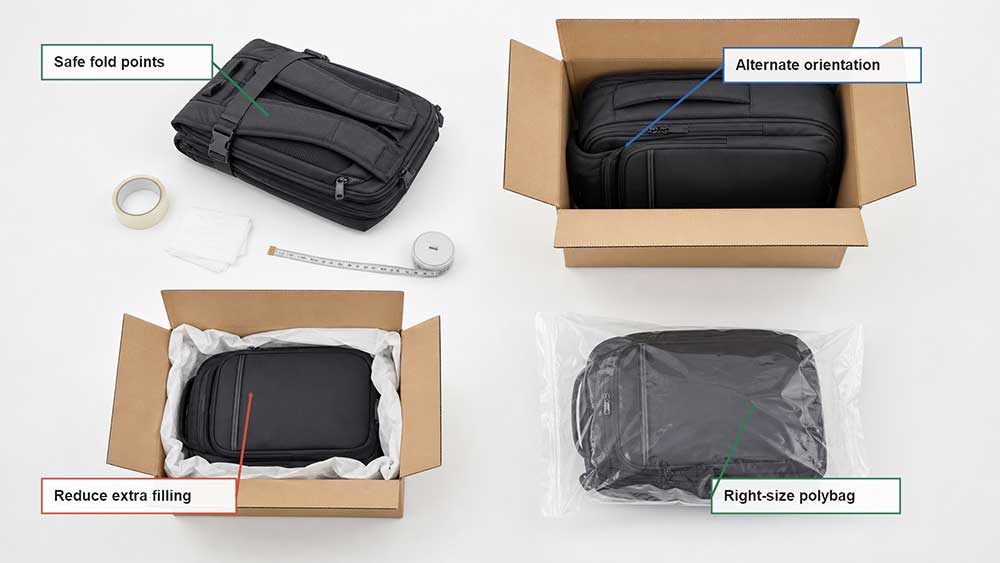
The most practical ways to reduce carton volume are to control how each bag is folded, alternate the orientation of bags inside the carton, remove unnecessary filling, right-size the individual polybag, and compare several carton quantities through physical packing trials.
Before approving any change, calculate the total shipment CBM and inspect whether the bags recover properly after unpacking. A smaller carton is worthwhile only if it lowers the final freight quotation without damaging the bag’s shape, padding, hardware, or retail presentation.
The Main Packing Changes to Evaluate
| Optimization Method | Possible Benefit | Main Risk |
|---|---|---|
| Adjust the folding method | Reduces the packed thickness of each bag | Creased foam or reinforcement |
| Alternate bag orientation | Prevents thick areas from accumulating | Hardware pressing against adjacent bags |
| Reduce unnecessary filling | Lowers individual packed volume | Collapsed panels or permanent creases |
| Right-size the polybag | Reduces trapped air and excess material | Slower or more difficult packing |
| Compare carton quantities | May reduce carton count or total CBM | Excessive compression or carton weight |
| Simplify retail packaging | Can significantly reduce shipping volume | Failure to meet sales-channel requirements |
| Improve packability during development | Reduces volume at the structural level | Additional sampling or design changes |
These methods should not be approved independently. The complete proposal must be evaluated against freight cost, packing labor, carton strength, product recovery, and the condition required at the destination.
A Five-Step Process for Reducing Freight Costs
A practical approval process can be organized into five steps:
- Confirm how the shipment will be charged.
- Obtain accurate packing dimensions, weights, carton counts, and CBM.
- Test two or three folding and carton configurations.
- inspect the bags after compression, storage, unpacking, and recovery.
- Compare the final forwarder quotations and approve the best complete proposal.
This sequence prevents buyers from accepting a smaller carton that looks efficient on paper but creates product damage or fails to reduce the actual freight charge.
Why Laptop Bags Can Be Expensive to Ship
Laptop bags are often relatively light compared with the space they occupy. Several common features can increase their packed volume:
- Thick laptop-compartment padding
- Padded shoulder straps and back panels
- Reinforced bases
- Three-dimensional front pockets
- Molded EVA panels
- Wide piping
- Fixed handles
- Rigid internal boards
- Individual retail packaging
- Filling paper used to maintain the bag’s shape
A soft laptop sleeve may lie almost completely flat. A structured business backpack or laptop briefcase may retain considerable depth even when empty.
This difference matters because carriers do not always charge according to actual weight alone.
Step 1: Understand How the Shipment Is Charged
Before changing the packaging, ask the selected carrier or freight forwarder how the planned service will be charged.
Ocean Freight
For less-than-container-load ocean freight, charges may be based on weight or measurement. The carrier or forwarder compares the cargo weight and shipment volume according to the applicable terms.
For a full-container shipment, the main concern is how effectively the cartons use the available container space. Carton dimensions, loading orientation, unused gaps, weight restrictions, and total carton count can all affect utilization.
Air Freight and International Express
Airfreight and courier services commonly compare actual gross weight with dimensional weight and may charge using the higher figure.
A common dimensional-weight formula is:
Dimensional weight = Length × Width × Height ÷ Dimensional factor
The required units, rounding method, and dimensional factor depend on the carrier and service. Buyers should confirm the current rules for their route and shipping account instead of relying entirely on a generic online calculator.
The explanations from DHL Global Forwarding and UPS show why a change in packaging dimensions can affect chargeable weight even when the products themselves weigh the same.
Calculate Carton CBM Correctly
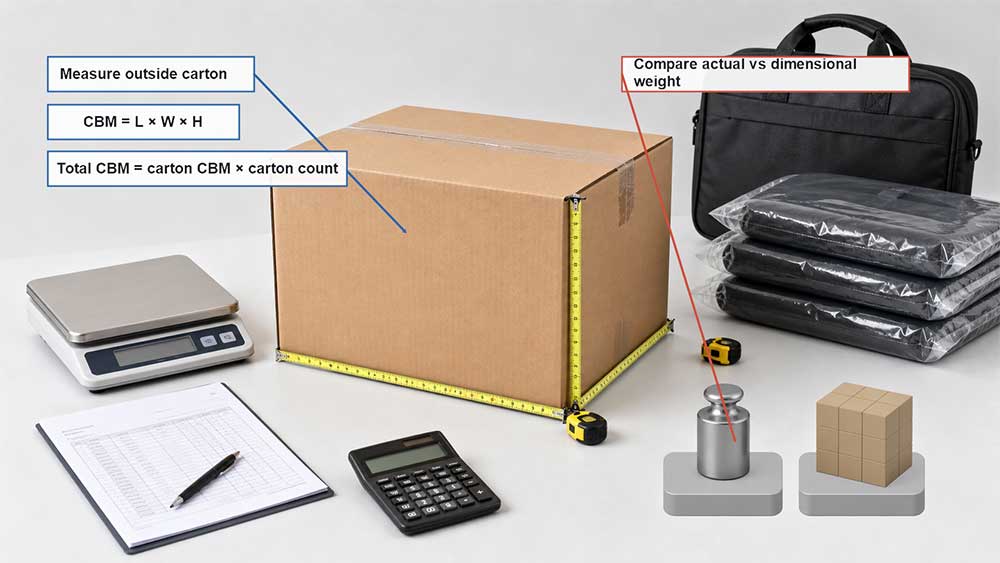
When carton dimensions are measured in meters:
CBM per carton = Length × Width × Height
When dimensions are measured in centimeters:
CBM per carton = Length × Width × Height ÷ 1,000,000
For example, a sealed carton measuring 60 × 50 × 40 cm has a volume of:
60 × 50 × 40 ÷ 1,000,000 = 0.12 CBM
The shipment volume is:
Total CBM = CBM per carton × Total number of cartons
Always use the maximum external dimensions of a fully packed and sealed carton. If the carton bulges, the dimensions recorded by the carrier may be larger than those stated in the original packing specification.
CBM is widely understood by importers and freight forwarders in Europe and the United States. Domestic US freight may also use cubic feet or cubic inches, but the underlying calculation is the same.
Step 2: Collect Complete Packing Data
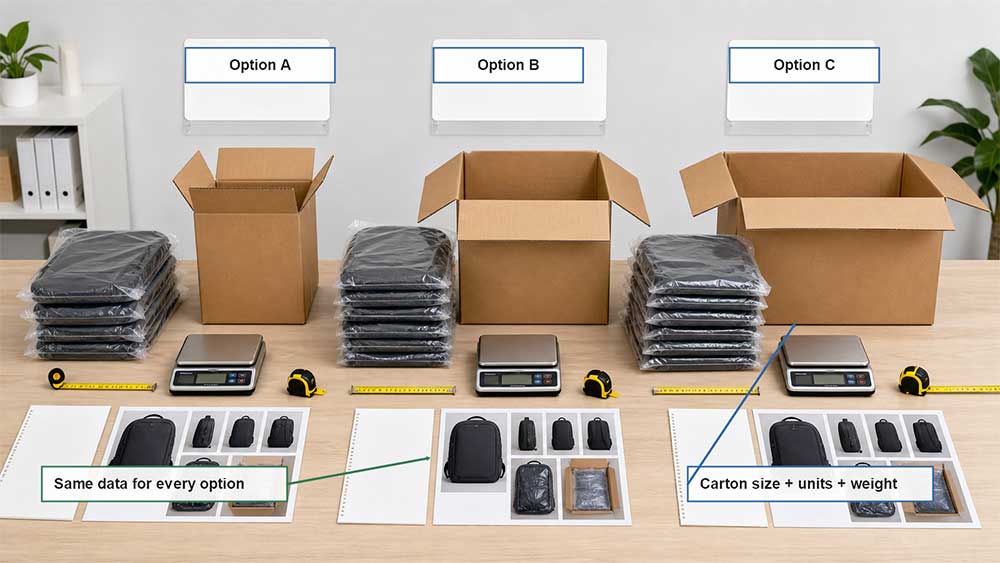
A quotation that states only “20 pieces per carton” does not provide enough information to determine whether the packing has been optimized.
Ask the supplier to provide:
- Product dimensions in its natural condition
- Folded product dimensions
- Net weight per unit
- Individually packed dimensions
- Individual packaging materials
- Units per carton
- External carton length, width, and height
- Net and gross weight per carton
- CBM per carton
- Total carton count
- Total shipment CBM
- Packing photographs
- A packing video for an unfamiliar or complicated folding method
Carton dimensions should come from a finished carton that has been fully packed and sealed—not an empty carton, internal measurements, or an early estimate.
When comparing proposals, require the same data for every option. Otherwise, an apparently smaller carton may conceal a higher total carton count, more packing labor, or an impractical gross weight.
Step 3: Test Practical Ways to Reduce Carton Volume
Develop a Controlled Folding Method
Laptop bags should not be folded according to whatever method happens to fit the first trial carton. The folding points must correspond with the construction of the product.
Depending on the design, the packing method may include:
- Laying shoulder straps flat against the back panel
- Tucking loose adjustment webbing into a pocket or securing it with a keeper
- Folding a soft gusset inward along a natural seam
- Laying handles flat without creating a sharp crease in the handle core
- Placing detachable shoulder straps inside the main compartment
- Removing a detachable base board and laying it flat inside the bag
- Nesting front pockets when the construction allows it
- Alternating the orientation of adjacent bags
- Protecting exposed buckles, zipper pulls, and metal hardware
Do not place folding lines across rigid boards, molded EVA, thick piping, laptop compartments, or printed logos that could develop permanent creases.
A thin laptop sleeve, soft messenger bag, structured briefcase, and molded laptop backpack should not automatically use the same folding method.
Alternate the Orientation of the Bags
Laptop backpacks rarely have uniform thickness from top to bottom. Shoulder straps and back padding create thickness in one area, while a three-dimensional front pocket adds volume elsewhere.
If every bag is packed in the same direction, the thickest sections can accumulate in one part of the carton. Alternating their orientation may create a more even stack.
Possible arrangements include:
- One bag face up and the next face down
- One top facing left and the next facing right
- Aligning a thick shoulder-strap area with the thinner front panel of the adjacent bag
- Alternating left and right side pockets when the design allows it
This method is not suitable for every product. Exposed hardware must not press directly into another bag’s fabric, padding, or logo. A thin separator or different arrangement may be necessary.
The final layout must be verified through a physical packing trial rather than judged only from drawings.
Reduce Unnecessary Internal Filling
Internal filling helps maintain the product’s shape, but completely filling every compartment often creates unnecessary shipping volume.
Instead of removing all filling, identify the areas that genuinely require support:
- Upper corners that collapse easily under pressure
- Large front panels without internal reinforcement
- Three-dimensional pockets with a fixed presentation requirement
- Padded handles that may become flattened
- Molded parts that cannot be folded
- Retail display areas that must remain smooth
Possible alternatives include localized tissue paper, lightweight formed-paper supports, recyclable air cushions, or a smaller amount of filling placed only in critical areas.
Removing every internal support may reduce carton size but increase creasing, recovery time, destination labor, and customer complaints. The objective is to use the minimum reasonable amount of filling while maintaining an acceptable arrival condition.
Right-Size the Individual Polybag
An oversized polybag can trap air, create excess folds, and prevent the products from forming a stable stack.
Review whether:
- The polybag matches the dimensions of the folded product
- Excess material can be reduced without making packing difficult
- Air can escape before sealing
- Warning-label and ventilation-hole requirements are met
- Adhesive strips or seals could contact the product
- Moisture-control materials are required
- Printed packaging is genuinely necessary for the sales channel
Vacuum packing may appear efficient, but it is unsuitable for many structured laptop bags. Sustained vacuum pressure can compress foam, create strong folding lines, distort molded panels, and press hardware into surface fabrics.
Any vacuum or compression-packing proposal should be tested using production-equivalent materials and a storage period that reflects the expected shipping cycle.
Decide Whether Individual Retail Packaging Is Necessary
Retail presentation and freight efficiency do not always lead to the same packaging decision.
Individual boxes may be necessary for premium retail, corporate gifts, e-commerce fulfillment, or customer-specified programs. For wholesale distribution, however, a polybag, hangtag, and export carton may be sufficient.
Review whether:
- Every unit needs an individual box
- An oversized color box can be reduced
- Instructions can be placed flat inside the bag
- Detachable accessories can be secured in an internal compartment
- Hangtags can be protected without a separate insert
- Packaging dimensions suit retail shelves or fulfillment systems
- E-commerce packaging requires separate distribution testing
Do not remove packaging that the sales channel genuinely needs merely to improve the factory’s carton figures. The packing specification must still support the buyer’s retail, warehouse, and distribution requirements.
Step 4: Compare and Test Several Packing Proposals
Compare Several Carton Quantities
One packing trial does not prove that a carton has been optimized. Instead of increasing the quantity until the carton can barely close, test several realistic options.
| Packing Plan | Units per Carton | Carton Dimensions | CBM per Carton | Total Cartons | Total CBM | Recovery Risk |
|---|---|---|---|---|---|---|
| A | 10 | Record after trial | Calculate | Calculate | Calculate | Low |
| B | 12 | Record after trial | Calculate | Calculate | Calculate | Requires testing |
| C | 15 | Record after trial | Calculate | Calculate | Calculate | Potentially high |
The smallest carton is not automatically the lowest-cost solution. Compare:
- Total shipment CBM
- Chargeable weight
- Carton material cost
- Packing labor
- Gross weight per carton
- Pallet or container utilization
- Product recovery after unpacking
- Risk of carton deformation
- Destination labor needed to restore the products
A higher quantity per carton may reduce the number of cartons but require a taller or stronger carton. It may also increase compression and manual-handling risk.
Use Verified Calculations
The following is a calculation example, not a claimed project result.
Suppose a buyer wants to compare two packing proposals:
| Item | Plan A | Plan B |
|---|---|---|
| Order Quantity | 1,000 units | 1,000 units |
| Units per Carton | 10 | 12 |
| Carton Dimensions | 60 × 50 × 50 cm | 60 × 50 × 45 cm |
| CBM per Carton | 0.150 | 0.135 |
| Required Cartons | 100 | 84 |
| Calculated Total CBM | 15.000 | 11.340 |
Because 1,000 is not evenly divisible by 12, Plan B requires 84 cartons, with the final carton only partially filled. Its actual dimensions and freight treatment would need to be confirmed separately.
The calculation suggests that Plan B occupies less space, but it does not prove that the proposal is workable.
Before approval, confirm:
- Whether 12 bags fit without forced compression
- Whether the sealed carton remains within 60 × 50 × 45 cm
- Whether the carton is strong enough
- Whether the bags recover after realistic storage and transport
- Whether the carton gross weight is practical for handling
- Whether the new dimensions reduce the forwarder’s final quotation
Any claimed saving should be based on verified packing data and the final freight quotation, not a predetermined percentage.
Do Not Reduce Carton Strength Blindly
A smaller carton does not automatically justify lighter or weaker corrugated board. The export carton still needs to withstand handling, stacking, humidity, and the expected distribution cycle.
When changing the carton, review:
- Gross weight per carton
- Carton dimensions and proportions
- Corrugated board specification
- Joint construction
- Sealing method
- Stacking height
- Warehouse conditions
- Expected transport duration
- Palletized or floor-loaded shipping
- Destination distribution conditions
Overpacking can cause the carton to bulge, increasing its measured dimensions and reducing stacking stability. It can also create concentrated pressure on the products inside.
For larger programs or demanding distribution environments, carton compression testing or an appropriate packaged-product test may be useful. The International Safe Transit Association provides recognized packaged-product testing frameworks, but the selected protocol should reflect the product, route, handling method, distribution cycle, and customer requirements.
Run a Packing and Compression Trial
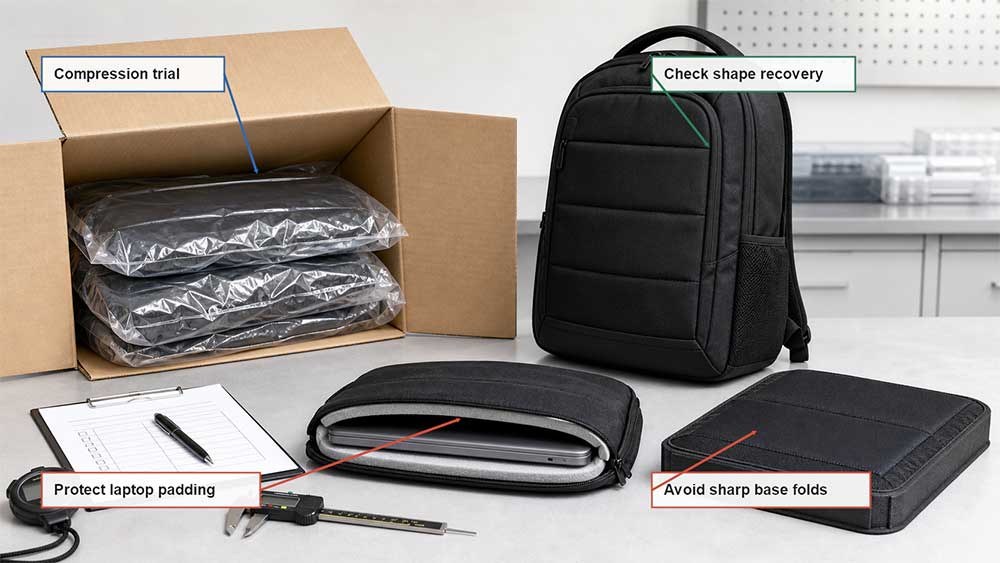
Use the approved final sample or samples made with production-equivalent materials and construction.
A practical trial can follow these steps:
- Fold and pack the bags using the proposed method.
- Record individual packed dimensions and sealed carton dimensions.
- Weigh the complete carton.
- Photograph each packing step.
- Keep the products packed for an agreed period.
- Apply controlled stacking or pressure conditions when relevant.
- Inspect the products immediately after unpacking.
- Allow a defined period for natural recovery.
- Inspect them again under consistent lighting.
- Record permanent creases, distortion, pressure marks, and changes in foam thickness.
Pay particular attention to:
- Laptop-compartment padding
- Front-panel and back-panel shape
- Base reinforcement
- Shoulder straps and handles
- Piping and zipper alignment
- Molded foam
- Buckles and metal hardware
- Printed or embroidered logos
- Surface pressure marks
- Odor or trapped moisture
- Recovery after the load is removed
If the products require extensive reshaping at the destination before they can be sold, the apparent freight saving may simply transfer cost to the destination warehouse.
This issue is closely related to why business backpacks lose their shape. Foam density, reinforcement materials, panel proportions, folding lines, packing pressure, and storage duration can all affect recovery.
Protect Laptop Padding and Reinforcement Areas
Laptop protection is one of the product’s primary functions. The protective layer should not become the most severely compressed area in the carton.
Avoid:
- Folding directly across the laptop compartment
- Allowing a buckle to press into laptop-compartment foam
- Creating a crease in the bottom protection area
- Compressing thick foam beyond a verified level
- Allowing a rigid board to create a concentrated pressure point
- Placing one bag’s hardware directly against another bag
More foam does not automatically provide better long-term protection. Thickness, density, coverage, positioning, attachment, and compression recovery should all be considered when deciding how much padding a laptop bag needs.
Step 5: Approve the Complete Cost and Quality Result
Consider Freight Efficiency During Product Development
By the time a pre-production sample is approved, most decisions that determine shipping volume have already been fixed. Packability should therefore be discussed while the pattern, foam, reinforcement, pockets, and hardware positions can still be adjusted.
Possible design considerations include:
- Using a removable base board
- Allowing the gusset to fold along a natural seam
- Keeping reinforcement away from the intended folding line
- Selecting foam with suitable compression recovery
- Designing detachable accessories to fit inside the bag
- Avoiding unnecessary transport depth in front pockets
- Reducing unnecessary overlap between multiple foam layers
- Allowing handles to lie flat without damage
- Positioning hardware so adjacent bags can be packed safely
- Adjusting product proportions to suit practical carton or pallet sizes
These changes should not sacrifice laptop protection, carrying comfort, usable capacity, appearance, or durability merely to reduce carton size.
Structural changes can also affect material consumption, sewing operations, tooling, sampling cost, and production consistency. Shipping requirements are best discussed before the pre-production sample is approved.
Ask the Supplier for Comparable Proposals
“Please make the carton smaller” is not a complete packaging instruction. It may encourage compression without defining what product condition is acceptable afterward.
A more useful request is:
Please provide two or three packing proposals showing the folding method, units per carton, sealed external carton dimensions, gross weight, total carton count, total CBM, packing photographs, and the product condition after unpacking and recovery.
This gives the buyer enough information to compare the complete result.
In a custom project, an experienced laptop bag manufacturer should also explain how each option may affect the bag shape, laptop compartment, hardware protection, carton strength, packing labor, and production consistency.
The approved method should be documented in the final packaging specification rather than left only in email or chat records.
Laptop Bag Packing Approval Checklist
Before approving bulk packing, confirm that:
- The shipping method has been selected
- The forwarder has confirmed the charging method
- Carton dimensions come from a physical packing trial
- External dimensions were measured after sealing
- Net weight, gross weight, carton count, and total CBM are recorded
- At least two carton quantities have been compared
- Folding lines avoid padded and reinforced areas
- Straps, webbing, and hardware are secured
- Unnecessary internal filling has been reduced
- Required retail packaging has been retained
- The carton closes without excessive bulging
- Products have remained packed for a realistic test period
- Products were inspected immediately after unpacking
- Products were inspected again after a defined recovery period
- The final method is documented with photographs
- An approved packing reference sample is retained for bulk-production comparison
Final Thoughts
The goal is not to force the highest possible number of laptop bags into the smallest carton. It is to remove unnecessary volume without creating larger quality problems or destination handling costs.
The most reliable process is to obtain complete packing data, confirm the carrier’s charging method, compare several folding and carton configurations, test product recovery, and then use the forwarder’s quotation to confirm whether the change produces a real saving.
There is no universal packing ratio or guaranteed saving percentage. The result depends on product construction, order quantity, carton dimensions, shipping method, route, carrier rules, and the condition the buyer expects after unpacking.
Packing is genuinely optimized only when the shipment uses space efficiently and the laptop bags still arrive ready to sell.
FAQ
How is carton CBM calculated for laptop bags?
Multiply the sealed carton’s maximum external length, width, and height in meters. Multiply the CBM per carton by the total number of cartons to calculate the shipment volume.
Are structured laptop backpacks suitable for vacuum packing?
Many are not. Vacuum pressure can permanently compress foam, crease reinforcement, distort molded panels, and cause hardware pressure marks. Any proposal should be tested using production-equivalent materials and a realistic storage period.
Does increasing the number of bags per carton always reduce freight cost?
No. It may reduce the carton count while increasing carton dimensions, gross weight, compression, handling difficulty, or damage risk. Compare total CBM, chargeable weight, packaging cost, labor, and arrival condition.
Should all internal filling paper be removed?
Not automatically. Some panels, corners, handles, or molded parts may still require localized support. Use the minimum reasonable amount needed to maintain an acceptable arrival condition.
Which carton dimensions should be sent to the freight forwarder?
Provide the maximum external dimensions of the fully packed and sealed carton, together with the carton count and gross weight per carton. If the carton bulges, report the actual maximum dimensions.
When should the final packing method be approved?
Approve it before bulk packing begins and preferably before final pre-production sample approval. Document the folding method, quantity per carton, carton dimensions, protective materials, and recovery standard.




Comments are closed