




Laptop Bag Reorder Planning: When and How Much Should You Order?

A laptop bag reorder should be placed before inventory becomes visibly low. For imported custom bags, the right time to reorder depends on how quickly each SKU sells, how long the complete replenishment process takes, how much usable and incoming inventory remains, and how much safety stock the business needs.
A practical starting point is:
Reorder Point = Average Daily Sales × Complete Replenishment Lead Time + Safety Stock
This tells you when purchasing action is required. It does not automatically tell you how many bags to order.
The final reorder quantity must also consider forecast demand, reliable inbound inventory, supplier and material minimum order quantities, budget, warehouse capacity, product lifecycle, and any planned design or packaging changes.
For many unchanged custom laptop bag reorders shipped by sea, planning three to four months before the expected stockout date may be reasonable. Orders involving custom materials, packaging changes, peak-season capacity, or unstable logistics may require four to six months or longer.
These are practical planning ranges, not fixed industry standards or guaranteed delivery schedules. Each order should be confirmed according to current material availability, production capacity, order quantity, inspection requirements, shipping method, and destination.
Start With Inventory Position, Not Warehouse Stock
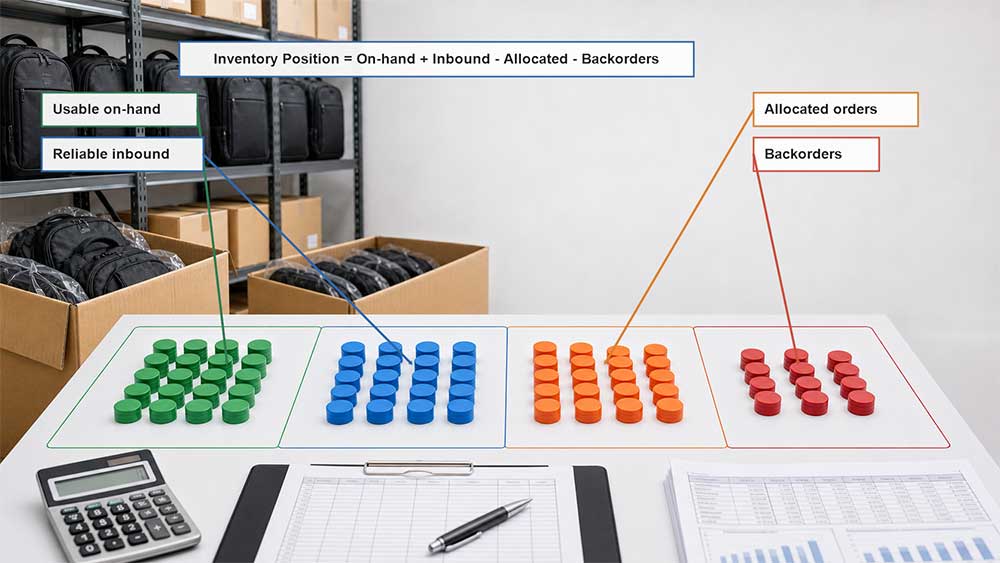
The number physically sitting in a warehouse does not show the complete inventory situation.
A more useful calculation is:
Inventory Position = Usable On-Hand Inventory + Reliable Inbound Inventory − Allocated Inventory − Backorders
Suppose a laptop backpack SKU has:
- 1,200 units physically in stock
- 300 units already allocated to confirmed customer orders
- 500 units in production with a dependable delivery schedule
- 100 units on backorder
Its inventory position is:
1,200 + 500 − 300 − 100 = 1,300 units
Without this calculation, the purchasing team may assume that it has 1,700 units available. In reality, only 1,300 units are positioned to meet future demand.
What Counts as Usable Inventory?
Usable on-hand inventory normally excludes:
- Damaged or defective products
- Stock under quality quarantine
- Customer returns that have not been inspected
- Samples and display products
- Inventory reserved for contracts or promotions
- Products waiting for rework
- Obsolete packaging or discontinued configurations
Reliable inbound inventory should only include quantities with a realistic chance of arriving as scheduled. An unconfirmed purchase order or a production lot that has failed inspection should not be treated in the same way as approved goods already in transit.
The team should also avoid counting customer demand twice. If confirmed orders have already been deducted as allocations or backorders, the same quantities should not be added again to the forecast without a clear reason.
Calculate the Complete Replenishment Lead Time
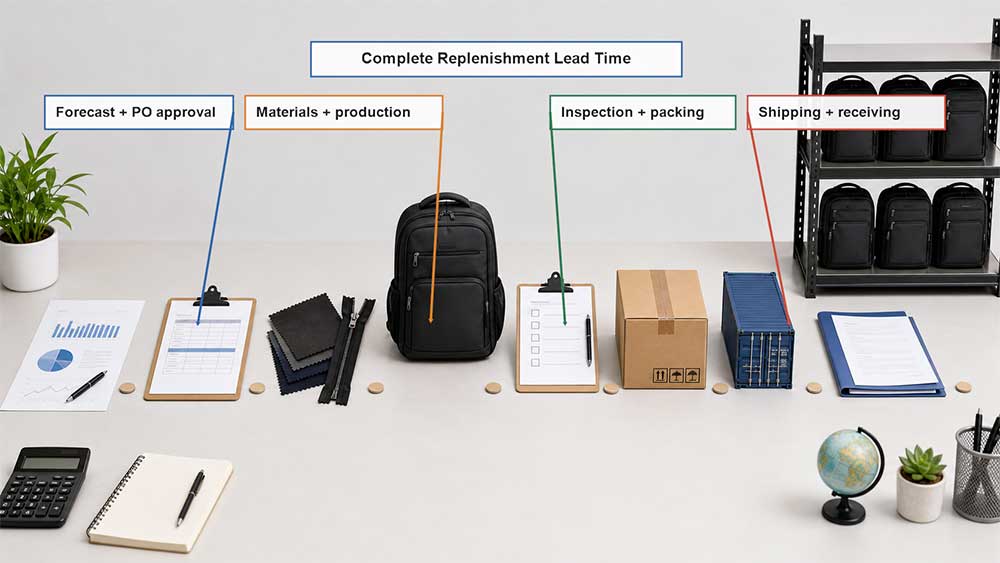
One of the most common reorder mistakes is treating factory production time as the complete replenishment lead time.
For imported custom laptop bags, the full process may include:
- Sales and inventory review
- Internal quantity and budget approval
- Price and purchase order confirmation
- Deposit arrangement
- Fabric and component sourcing
- Pre-production confirmation
- Cutting, sewing, assembly, and packing
- Final inspection and possible corrective work
- Export booking and origin transportation
- Air or ocean freight
- Import customs clearance
- Delivery to the destination warehouse
- Warehouse receiving and inventory-system entry
The lead time ends when the bags are received and available for sale—not when the factory finishes packing them.
Practical Planning Ranges for Repeat Orders
Based on the production and shipping stages commonly involved in custom bag projects, buyers can use the following ranges for initial planning:
| Reorder situation | Practical planning range |
|---|---|
| Unchanged product, available materials, air freight | About 6–10 weeks |
| Unchanged product shipped by ocean | About 3–4 months |
| Custom materials, packaging updates, or minor product changes | About 4–5 months |
| Peak season, long-lead materials, major revisions, or unstable logistics | About 4–6 months or longer |
Actual timing must be reconfirmed for every purchase order. A repeat order may avoid part of the development process, but it can still be delayed by material availability, supplier capacity, inspection findings, public holidays, or transportation conditions.
Internal Approval Time Still Counts
Lead-time planning should not begin only when the supplier receives the purchase order.
Before that happens, a business may need to:
- Review the sales forecast
- Approve quantities by SKU
- Confirm the purchasing budget
- Negotiate updated pricing
- Issue the purchase order
- Arrange the deposit
- Approve changes to packaging or labels
If these activities normally take two weeks, those two weeks belong in the complete planning timeline.
This is also why preparation should begin before inventory reaches the formal reorder point. Supplier quotations, material checks, forecasts, and approvals can be prepared early, while the purchase order is released when the trigger is reached.
Material and Component Lead Times
A repeat order does not mean every material is still available.
The supplier may need to source or reproduce:
- Custom-dyed outer fabric
- Matching lining
- Specific zipper colors
- Branded zipper pullers
- Custom buckles or metal hardware
- Foam with a specified density
- Color-matched webbing
- Printed labels or woven labels
- Retail packaging
- Rubber logo patches or metal badges
Some of these items have their own MOQ and production schedule. If an original component has been discontinued, the buyer may also need to test and approve a substitute.
Even when the sewing line is available, one missing zipper color or branded component can prevent production from starting on time.
Production, Inspection, and Corrective Work
Production time varies according to order volume, construction complexity, material supply, factory capacity, public holidays, and seasonal demand.
Inspection also needs its own place in the schedule. If a shipment requires rework, sorting, component replacement, or partial reproduction, a plan with no time buffer can quickly turn into an expensive air-freight problem.
Before production begins, buyers should reconfirm the applicable quality inspection requirements for bulk laptop bag orders. Adding new standards only when the shipment is nearly complete creates avoidable disputes and delays.
A repeat order should also carry forward corrective actions from the previous batch. If the last production run had uneven stitching, insufficient handle reinforcement, zipper failures, incorrect labels, or damaged cartons, the updated requirements should appear in the purchase order, specification sheet, approved sample, and inspection criteria.
International Shipping, Customs, and Warehouse Receiving
Factory completion does not mean the bags are ready to sell.
The logistics stage may still include export booking, origin transport, port handling, ocean or air freight, transshipment, customs clearance, destination release, final delivery, warehouse inspection, and inventory-system entry.
US importers can review the official import guidance from US Customs and Border Protection. The selected Incoterm also affects how transportation, documents, insurance, costs, and risk are divided between buyer and seller; the International Trade Administration’s explanation of Incoterms provides a useful overview.
A freight forwarder’s port-to-port transit estimate is not the same as the full factory-to-available inventory timeline. Use current forwarder estimates together with the company’s own shipping and receiving history.
Set an Appropriate Safety Stock
Safety stock is additional inventory held to absorb forecast error, unexpected demand, production delays, inspection problems, or logistics disruption. The ASCM explanation of safety stock similarly describes it as protection against supply and demand uncertainty.
Different laptop bag SKUs should not automatically receive the same safety-stock quantity.
A Simple Days-of-Cover Method
Businesses with limited historical data can begin with:
Safety Stock = Average Daily Sales × Safety Stock Days
For an SKU selling 10 units per day:
- 14 days of safety stock = 140 units
- 30 days of safety stock = 300 units
- 45 days of safety stock = 450 units
This method is easy to use, but it is an experience-based buffer. It does not directly measure variations in demand or delivery time.
A Historical Maximum Method
Businesses with reasonably consistent sales and delivery records may use a historical maximum method as a practical estimate:
Safety Stock = (Maximum Daily Sales × Maximum Lead Time) − (Average Daily Sales × Average Lead Time)
Consider a hypothetical laptop backpack SKU with:
- Maximum daily sales: 15 units
- Maximum lead time: 125 days
- Average daily sales: 10 units
- Average lead time: 105 days
The result is:
(15 × 125) − (10 × 105) = 825 units
This method is straightforward, but it can produce a conservative result because it combines maximum demand with maximum lead time even when those events did not occur together.
Larger inventory programs may prefer a service-level model based on demand variability, lead-time variability, and forecast error. The appropriate method depends on data quality and on the relative cost of a stockout versus excess inventory.
More safety stock may be justified when:
- Sales fluctuate significantly
- A major promotion is approaching
- Supplier lead time has been unreliable
- Materials require custom production
- The sales season is short and important
- A stockout would affect key customers
- No similar substitute SKU is available
- Shipping or customs timing is uncertain
The buffer can usually be lower when demand is stable, supply is reliable, replenishment is faster, or customers can accept a substitute product.
Colors, sizes, and configurations should be reviewed separately. A fast-selling black laptop backpack and a slow-selling seasonal color do not need the same buffer.
Calculate the Reorder Point
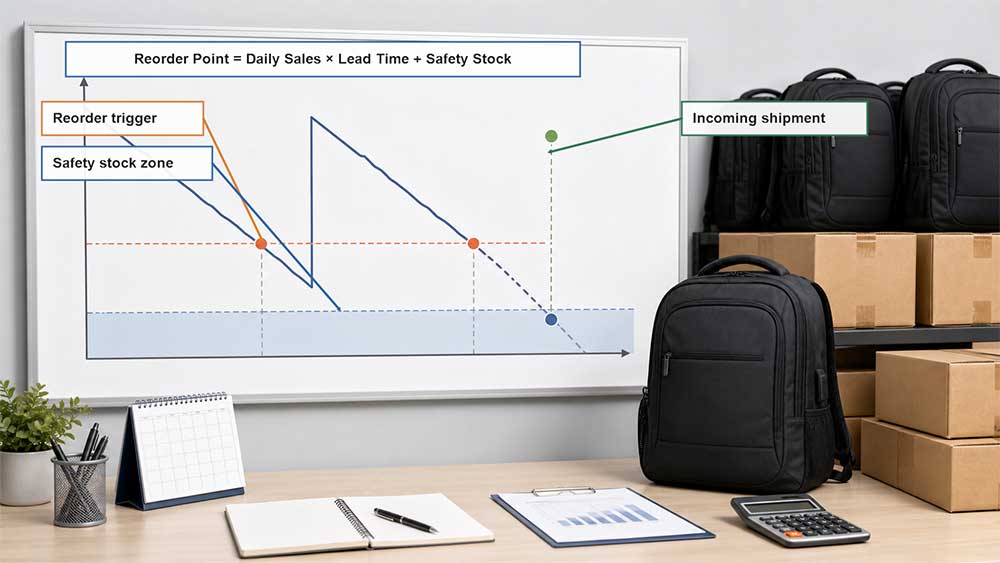
Once average demand, complete lead time, and safety stock are known, calculate:
Reorder Point = Average Daily Sales × Complete Replenishment Lead Time + Safety Stock
Suppose an SKU has:
- Average daily sales: 10 units
- Complete replenishment lead time: 109 days
- Safety stock: 300 units
The reorder point is:
10 × 109 + 300 = 1,390 units
When the inventory position falls to approximately 1,390 units, the business should release the purchase order.
Reorder-point planning generally combines expected lead-time demand with safety stock and compares that requirement with available and planned inventory. This relationship is also reflected in Oracle’s official overview of inventory planning and replenishment.
A reorder point is not permanent. Recalculate it when any of the following changes:
- Average demand
- Seasonality
- Supplier lead time
- Material availability
- Inspection requirements
- Transportation time
- Safety-stock policy
- Product specifications
- Channel commitments
Reorder Point and Order Quantity Are Different
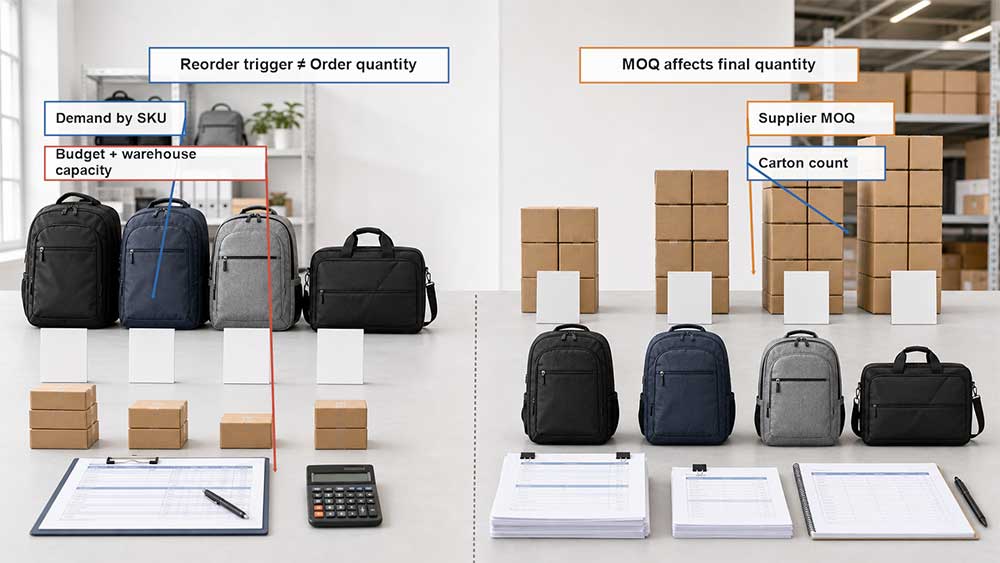
The reorder point tells the purchasing team when to act. It does not automatically determine how much to buy.
For businesses that review inventory or place orders at fixed intervals, a useful target-inventory calculation is:
Target Inventory = Forecast Demand During Lead Time and Review Period + Safety Stock
Reorder Quantity = Target Inventory − Inventory Position
The review period is the time between inventory reviews or ordering opportunities. If inventory is monitored continuously and an order can be released as soon as the reorder point is reached, this period may be very short or unnecessary.
For example:
- Forecast demand through the next replenishment and review period: 1,800 units
- Required safety stock: 300 units
- Current inventory position: 500 units
Target inventory is:
1,800 + 300 = 2,100 units
The preliminary reorder quantity is:
2,100 − 500 = 1,600 units
That number is a starting point. Before confirming it, compare it with:
- MOQ by style, color, and material
- Carton quantities and production multiples
- Supplier price breaks
- Available purchasing budget
- Warehouse capacity
- Product lifecycle
- Planned design or packaging changes
- Expected margin
- Obsolete-inventory risk
The final order may differ from the formula. What matters is understanding the cost and risk created by adjusting the number upward or downward.
How MOQ Affects the Decision
MOQ usually affects how much can be produced economically, rather than when replenishment demand begins.
Suppose forecast demand is:
- Black: 900 units
- Navy: 350 units
- Gray: 180 units
If the MOQ is 300 units per color or fabric batch, producing only 180 gray bags may not be economical. The buyer could consider:
- Increasing the quantity if future demand supports it
- Reducing the number of colors
- Sharing one material across compatible styles
- Negotiating staggered deliveries
- Combining compatible orders
- Replacing or discontinuing a slow color
- Using approved stock materials
- Accepting a small-order surcharge when feasible
Do not buy unnecessary inventory simply to obtain a lower unit price. The apparent saving may be offset by storage, tied-up working capital, markdowns, and obsolete products or packaging.
For custom laptop bags, finished-product MOQ is only one part of the calculation. Fabric dyeing, zipper colors, branded hardware, logo patches, lining, foam, and retail packaging may each have separate minimum quantities.
Checking component-level requirements with an experienced custom laptop bag supplier before inventory reaches the reorder point gives the buyer more time to consolidate colors, reserve materials, or adjust quantities without delaying production.
Separate Normal Demand From Temporary Sales Spikes
Repeating the previous order quantity without understanding why sales increased can create excess inventory.
Historical sales may include:
- A one-time wholesale order
- A short promotion
- A product-launch spike
- Influencer exposure
- A competitor’s temporary stockout
- Heavy discounting
- A seasonal peak
- Substitution demand caused by another unavailable SKU
These events should not automatically become the new demand baseline.
A practical SKU forecast can combine recent average sales, the same period last year, confirmed wholesale orders, planned promotions, seasonality, lifecycle stage, returns, cancellations, and channel expansion or contraction.
Use a rolling forecast instead of making one annual calculation. Core SKUs may be reviewed monthly, with more frequent checks before promotions or peak seasons.
Prepare Before the Trigger Is Reached
The reorder point is the inventory threshold for formally releasing an order under the current assumptions. Preparation should begin earlier.
A practical workflow is:
- Above the reorder point: Update the forecast, verify inventory, ask the supplier for current lead time, and check material availability.
- At the reorder point: Complete the final approval and release the purchase order.
- Below the reorder point: Recalculate the expected stockout date and evaluate recovery options.
Using the earlier example:
- Current inventory position: 1,700 units
- Reorder point: 1,390 units
- Difference: 310 units
- Average daily sales: 10 units
The SKU is approximately 31 days away from its reorder point.
This is the right time to prepare the forecast, confirm material availability, update pricing, and begin internal approval so the order can be released by the time inventory reaches about 1,390 units.
Waiting until only 500 units remain would be too late. At 10 units per day, the stock covers 50 days, while replenishment requires 109 days. Without reliable incoming inventory, the SKU could be unavailable for approximately 59 days.
What to Do When a Stockout Is Already Close
When remaining inventory coverage is shorter than the confirmed replenishment lead time, calculate the expected shortage before selecting an emergency response.
Possible options include:
- Air-freighting a limited quantity
- Prioritizing high-demand SKUs
- Producing or shipping in batches
- Rebalancing stock across warehouses or channels
- Reducing promotions temporarily
- Offering alternative colors or models
- Using previously approved stock materials
- Prioritizing contract or high-margin customers
- Negotiating partial deliveries with the supplier
Every option has a cost. Compare the expected contribution-margin loss from a stockout with the additional freight, production, material, and handling expenses.
Avoid promising customers a restock date based only on the factory completion date. International transport, customs clearance, warehouse receiving, and possible disruption still need to be included. A realistic availability window is more reliable than repeatedly changing an overly optimistic date.
Laptop Bag Reorder Checklist
Before releasing a repeat order, confirm that:
- Demand has been reviewed by SKU
- One-time orders and promotions are separated from baseline sales
- Usable stock has been verified
- Allocations and backorders have been deducted
- Only reliable inbound quantities have been included
- Customer demand has not been counted twice
- The complete replenishment lead time is current
- Internal approval time has been included
- Material and component availability has been checked
- Current supplier capacity has been confirmed
- Safety stock reflects actual demand and supply risk
- Reorder point and reorder quantity have been calculated separately
- Style, color, material, and component MOQs have been checked
- Corrective actions from the previous order are documented
- Product, packaging, and label changes are approved
- Inspection and possible corrective-work time are included
- Freight, customs, and warehouse receiving are included
- The expected available-to-sell date is realistic
- The next inventory review date has been scheduled
Final Advice
Avoiding a laptop bag stockout does not require holding as much inventory as possible. It requires starting the reorder process early enough for existing inventory to cover the complete supply cycle, while maintaining a buffer that reflects actual demand and delivery risk.
A dependable reorder decision combines SKU demand, inventory position, complete lead time, safety stock, MOQ, supplier capacity, and realistic transportation time. Because sales and supply conditions change, these inputs need regular review.
When the decision is made before inventory reaches a dangerous level, the buyer retains more options: normal production scheduling, economical ocean freight, sensible quantity negotiation, proper inspection, and planned product updates. Once a stockout is close, the remaining choices are usually faster, more expensive, and less flexible.
FAQ
How far in advance should a brand reorder custom laptop bags?
For an unchanged product shipped by ocean, planning approximately three to four months before the expected stockout may be reasonable. Custom materials, packaging changes, peak-season capacity, or unstable logistics may require four to six months or longer. Confirm the actual timeline for every order.
At what inventory level should a reorder be placed?
There is no universal fixed quantity. Place the order when inventory position reaches the expected demand during the complete replenishment lead time plus the required safety stock.
What is the formula for a laptop bag reorder point?
Use:
Reorder Point = Average Daily Sales × Complete Replenishment Lead Time + Safety Stock
The complete lead time should include internal approval, material sourcing, production, inspection, transportation, customs clearance, and warehouse receiving.
Are safety stock and reorder point the same?
No. Safety stock is the additional inventory held against unexpected demand or supply delays. The reorder point is the inventory threshold that triggers purchasing and includes both lead-time demand and safety stock.
Does MOQ determine when a repeat order should be placed?
Usually not. Demand, lead time, and safety stock determine when replenishment is needed. MOQ mainly affects how much can be produced economically and how quantities can be divided among styles, colors, and materials.
Is a repeat order always faster than the first order?
Not necessarily. An unchanged product may avoid some development work, but material availability, custom components, production capacity, packaging updates, inspection, peak season, and transportation can still extend the timeline.
Is air freight the best response to an approaching stockout?
Not always. Air freight may be suitable for a limited quantity of high-priority SKUs, but flying the entire order can significantly reduce margin. Compare partial air freight with ocean freight, split production, inventory transfers, substitute products, and promotional adjustments.





Comments are closed