Why Business Backpacks Lose Their Shape—and How to Prevent It
A business backpack may look clean and structured when new, then gradually begin to sag, lean, bulge, or develop permanent creases. The usual causes include overloading, uneven weight distribution, compressed foam, insufficient panel support, improper cleaning, and prolonged pressure during storage or shipping.
The solution is not always a thicker outer fabric. Shape retention depends on how the shell fabric, foam, lining, reinforcement, seams, piping, pockets, and pattern work together. How the bag is packed, cleaned, dried, and stored matters just as much.
A backpack that has been temporarily compressed may recover with careful reshaping. However, if its foam, base panel, seams, or structural layers have permanently broken down, filling the bag for a few days will not fully restore it.
A business backpack does not necessarily need to stand upright when empty. Some models are intentionally lightweight and flexible. Shape loss becomes a real problem when the bag can no longer maintain its intended appearance or function under normal use.
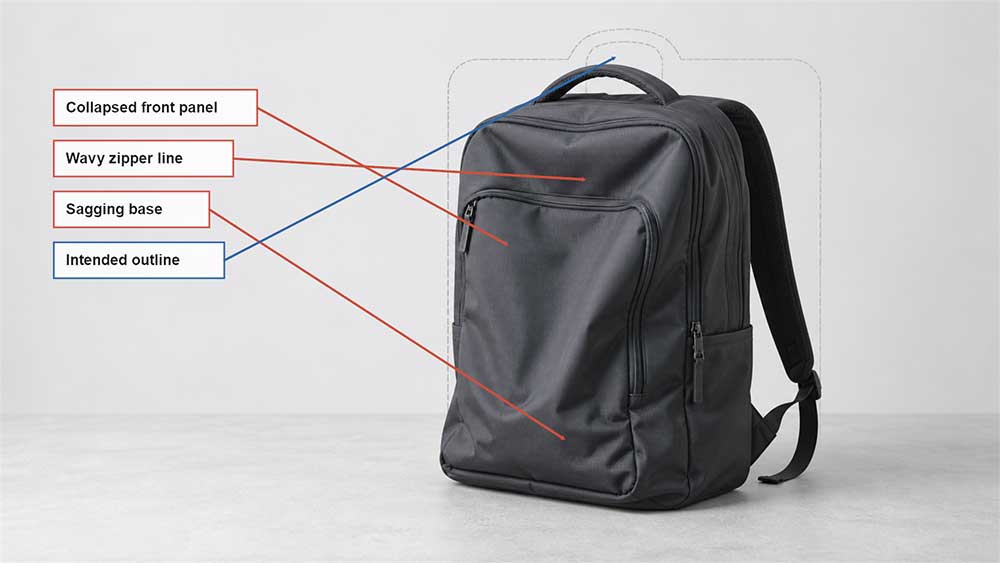
Common signs include:
The front panel collapses inward when partly loaded
The base sags below its original outline
One side appears taller or fuller than the other
The backpack leans noticeably when placed on a flat surface
The upper corners fold inward
The laptop compartment bends or twists
Exterior pockets develop permanent bulges
Deep creases remain after the bag is emptied
The zipper opening becomes wavy or difficult to operate
Before attempting a repair, determine whether the distortion comes from temporary compression, poor packing, or permanent structural damage.
Why Do Business Backpacks Lose Their Shape?
The Backpack Is Regularly Overfilled
Every backpack has a practical capacity, even when the brand does not publish an exact load limit. Filling every compartment until the zippers are under visible tension forces the fabric, seams, foam, and pockets away from their intended positions.
An overfilled front compartment pulls the front panel outward. A crowded main compartment can place constant pressure on the laptop sleeve. Repeatedly forcing oversized items through the opening may also stretch the zipper area and deform the upper corners.
Weight is not the only issue. A relatively light but bulky item can still distort a pocket that was not designed to hold it.
Heavy Items Are Packed in the Wrong Places
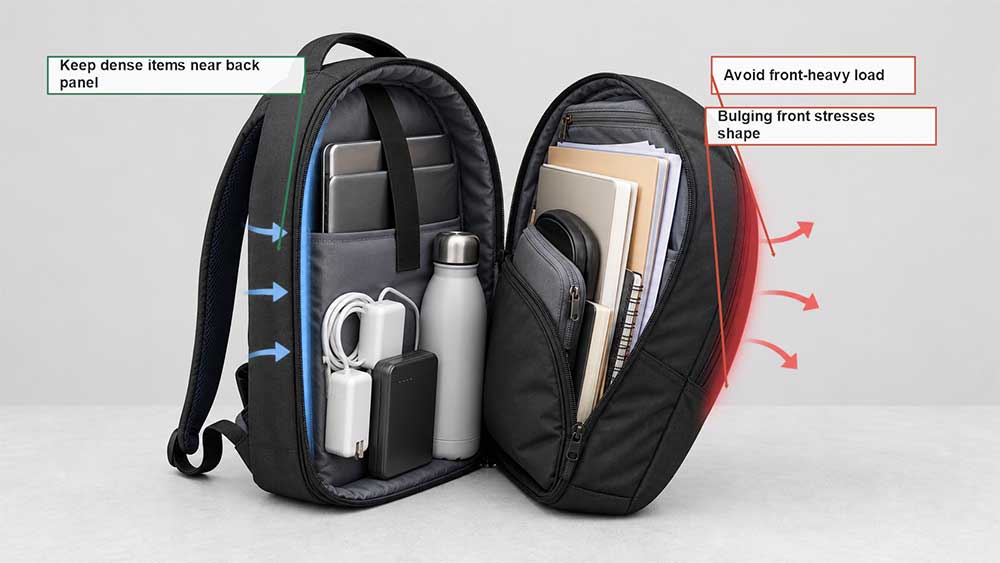
A laptop, charger, documents, power bank, and water bottle affect the bag differently. When dense items are positioned far from the back panel, they pull the backpack backward and place more stress on the front and base.
Keeping a heavy bottle in the same side pocket every day may gradually create an uneven silhouette. Chargers and power banks left loose at the bottom can also produce concentrated pressure points.
Place the laptop in its dedicated compartment and keep other dense items close to the back. Small exterior pockets are better suited to lightweight accessories than to extending the main compartment’s capacity.
The Shell Fabric Is Too Soft for the Intended Silhouette
Fabric weight and stiffness influence appearance, but denier alone does not determine whether a backpack will hold its shape. Two nylon or polyester fabrics with a similar denier can behave very differently because of their weave, coating, lamination, backing, and finish.
A flexible fabric may work well for a casual packable bag but struggle to support the broad front panel of a rectangular business backpack. Excessively stiff fabric creates a different set of problems: more weight, harder sewing, bulky seams, and potentially less carrying comfort.
Choosing among different materials for business and laptop bags therefore requires balancing appearance, structure, weight, cost, and intended use—not simply selecting the highest denier.
The Foam Has Compressed or Shifted
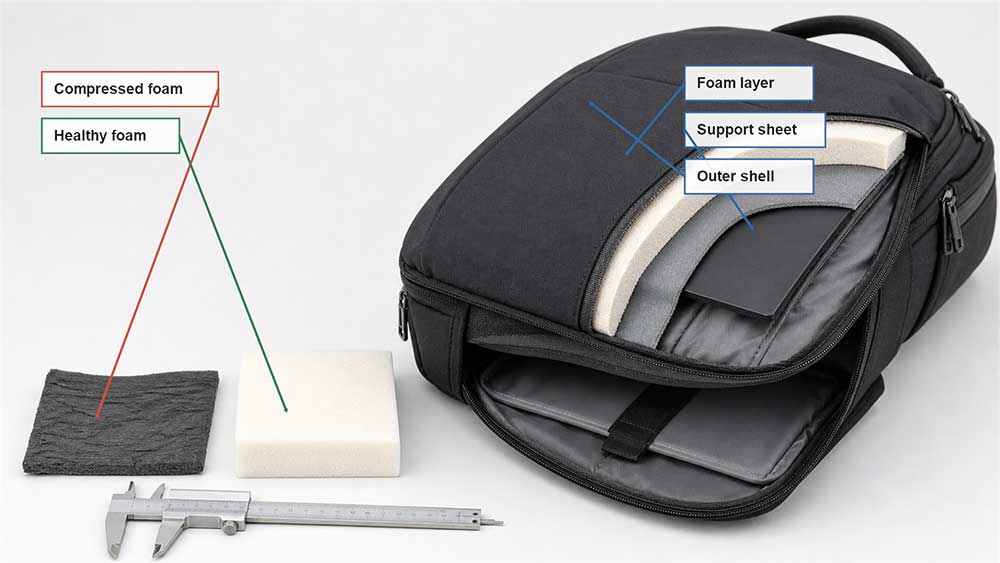
Foam provides cushioning and visual fullness, but not every foam offers lasting structural support. Lower-density foam may become thinner after repeated pressure. Foam that is not securely positioned may also shift, fold, or curl inside a panel.
Different parts of the backpack need different solutions. A laptop compartment requires protective cushioning, while the front panel may need a thinner stabilizing layer. The base may benefit more from a semi-rigid insert than from additional soft foam.
Adding padding indiscriminately can reduce internal capacity, create bulky seams, and make the bag look overstuffed. The right amount of laptop bag padding depends on density, placement, coverage, and construction—not thickness alone.
The Base or Front Panel Lacks Support
The bottom of a business backpack repeatedly carries the concentrated weight of a laptop, charger, documents, and daily accessories. If it consists only of shell fabric and lining, it may gradually curve downward.
A broad, uninterrupted front panel faces a similar risk. Without suitable backing, foam, seams, pocket structures, or reinforced edges, the material can collapse inward.
Not every bag needs a hard baseboard. Depending on the design, the better option may be a removable insert, a semi-rigid sheet, bonded backing, suitable foam, or localized reinforcement. A board that is too rigid can crack, create a permanent crease, or reduce comfort.
The Pattern and Proportions Are Unstable
Materials cannot fully correct unstable proportions. A tall backpack with a narrow base may tip easily. A deep front compartment can pull the entire bag forward, while a large panel with few seams is more likely to wrinkle.
Pocket placement also changes weight distribution. A large front pocket positioned far from the back creates more leverage when loaded. An oversized laptop compartment allows the device to move during walking, which can further distort the bag.
A professional-looking backpack needs more than clean styling; its proportions also have to remain stable under a realistic load. Panel dimensions, gusset depth, pocket capacity, opening shape, seam placement, and intended contents should be developed as one system.
Seams and Piping No Longer Hold the Edges
Seams do more than join materials. They define the edges of the backpack and influence where each panel bends.
Piping can create a cleaner outline, but it cannot compensate for unsupported panels. Binding, folded seams, reinforced edges, and panel divisions may also help control shape. Distortion can develop when seam allowances stretch, piping rolls inward, or sewing tension is inconsistent.
This should be distinguished from normal flexibility. A deliberately soft backpack is not defective simply because it cannot stand upright when empty. Uneven sides, twisted openings, and visibly displaced panels are more meaningful warning signs.
Cleaning or Drying Has Damaged the Structure
Hot water, aggressive machine cycles, harsh chemicals, and tumble drying can affect coatings, foam, laminated layers, reinforcement, adhesives, and hardware. The bag may become cleaner but come out twisted or permanently creased.
Always follow the care label first. If reliable instructions are unavailable, do not assume that a structured business backpack is machine washable. REI’s backpack cleaning guidance recommends gentle cleaning, avoiding washing machines and dryers, and air-drying away from direct sunlight.
Reshape the backpack while it is still damp. Do not allow it to dry while folded, twisted, or pressed beneath another object.
Storage or Shipping Has Compressed the Bag
Placing a backpack beneath heavy boxes can leave creases in its foam and reinforcement. Hanging a fully loaded bag from its top handle for long periods can also stretch and distort the upper structure.
Compression may occur before the customer receives the product. Excessive folding, shallow export cartons, high quantities per carton, or prolonged stacking pressure can flatten finished backpacks.
Temporary compression often improves after unpacking, but sharply creased reinforcement and foam kept under pressure for an extended period may not recover completely.
How Can Users Help a Business Backpack Keep Its Shape?
Pack According to the Compartment Design
Put the laptop in its sleeve, documents in a flat compartment, and lightweight accessories in smaller pockets. Avoid forcing thick chargers, bottles, or rigid cases into narrow sections simply because the zipper can still be closed.
Keep heavier objects close to the back panel. Distribute smaller items instead of allowing everything to collect on one side of the base.
Remove Unnecessary Contents Regularly
At the end of the day or week, take out items that do not need to stay in the backpack. Leaving it fully loaded during long periods of storage places continuous stress on the base, foam, pockets, and shoulder-strap attachment points.
If possible, alternate the side used for items such as a water bottle rather than creating the same uneven load every day.
Store It in Its Natural Shape
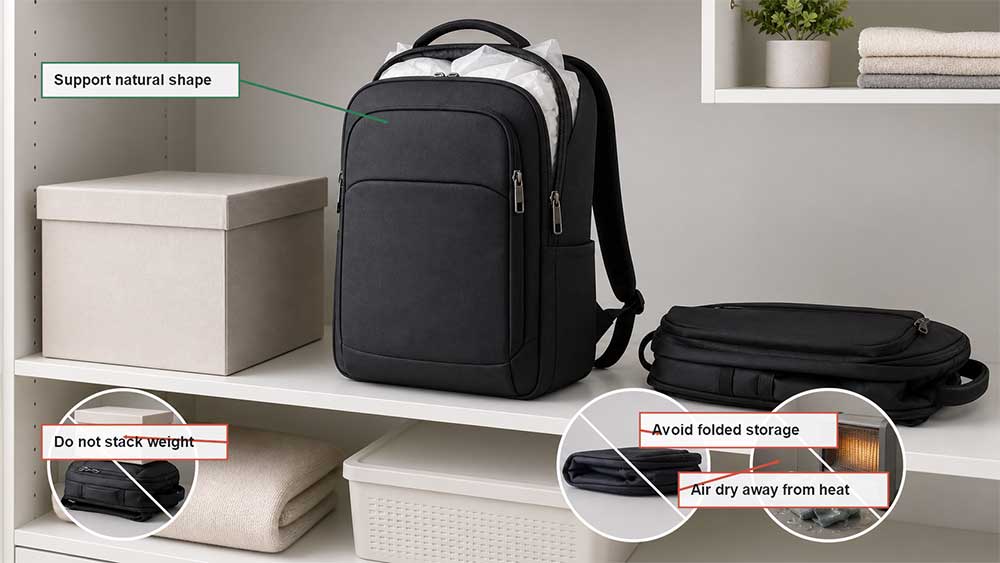
Empty the bag before long-term storage. Close the zippers without forcing the panels together, then place the backpack naturally on a shelf.
If the empty bag collapses easily, use clean tissue paper, unprinted packing paper, or a soft cloth to support its outline. The purpose is to maintain the original shape, not to stretch the seams.
Avoid:
Stacking luggage or cartons on top of the bag
Folding reinforced panels
Storing the backpack while damp
Placing it next to a heater
Hanging it fully loaded by the top handle
Using newspaper that may transfer ink
Clean It Conservatively
Removing dust and debris regularly can reduce the need for deep cleaning. When the care instructions permit, spot cleaning is usually less disruptive to the structure than soaking the entire bag.
Test any cleaning product on a hidden area first. After cleaning, straighten the corners, smooth the panels, open the compartments, and allow the backpack to dry completely.
Address Small Problems Early
A loose seam, displaced base insert, curling zipper edge, or detached internal layer may become a more serious structural problem if the backpack remains in use.
Early repair can prevent the load from shifting to areas that were not designed to support it.
Can a Misshapen Business Backpack Be Restored?
It depends on what has changed.
If the backpack was temporarily compressed during storage or shipping and the internal materials remain intact, it may recover. Empty the bag, gently reshape the panels by hand, add lightweight filling, and leave it in a dry, ventilated area. Avoid uncontrolled heat, including hair dryers and radiators.
Recovery is less likely when:
Foam remains flat after pressure is removed
A reinforcement sheet has cracked or developed a sharp fold
The shell fabric is permanently stretched
Seams have shifted or torn
Laminated layers have separated
The base has formed around a heavy object
The pattern cannot support the intended load
A third-party organizer or base insert may improve the appearance of an overly soft backpack, but it also adds weight and reduces internal space. Any rigid insert should remain clear of the laptop and should not create sharp pressure points.
What Should Brand Buyers Check Before Production?
For brand buyers, shape retention needs to become a measurable product requirement. “The backpack should look structured” is too subjective on its own.
Before approving production, define:
Whether the empty bag must stand upright
Which panels should remain flexible
The intended laptop dimensions and typical contents
The expected test load
The acceptable appearance when partly filled
The support required in the base, back, and front panel
The acceptable level of creasing after packing
The expected recovery after compression
In business backpack development, we often find that shape-retention problems come from the interaction between the pattern, foam, reinforcement, and packing method—not from the shell fabric alone.
Test the sample with realistic contents, including the intended laptop, charger, documents, and other common accessories. Check the front, side, and base profiles, zipper alignment, balance, pocket bulging, and recovery after unloading.
Packaging should also be tested before bulk production. More internal filling and larger cartons may preserve the silhouette, but they also increase material use, carton volume, and freight costs.
During a custom project, ask the laptop backpack manufacturer to explain how structural changes will affect appearance, capacity, weight, packing volume, cost, and production consistency. Keep the approved sample as the reference for bulk inspection.
A Practical Shape-Retention Checklist
For everyday users:
Keep dense items close to the back panel
Avoid forcing oversized objects into small pockets
Remove unnecessary contents regularly
Do not create the same heavy load on one side every day
Follow the care label
Reshape the backpack before drying
Store it dry and free from sustained pressure
Repair loose structural components early
For brand buyers:
Define the intended silhouette and load
Approve the complete material system
Test realistic contents
Review the bag after unloading
Run a controlled packaging trial
Keep an approved sample for production comparison
Final Thoughts
A business backpack usually loses its shape because several factors work together. Overloading, uneven packing, compressed foam, inadequate support, unstable proportions, unsuitable cleaning, and tight packaging can all contribute.
For users, the most effective approach is to stay within the intended capacity, keep dense items close to the back, clean the bag carefully, and store it without sustained pressure.
For product developers, the answer is not simply to choose thicker fabric or add more foam. A stable business backpack comes from balancing the shell material, reinforcement, padding, pattern, seams, expected load, and packaging method. It should maintain a clean professional outline without becoming unnecessarily rigid, heavy, or bulky.
FAQ
Should a good business backpack stand upright when empty?
Not necessarily. Some business backpacks are intentionally lightweight and flexible. The important question is whether the bag maintains its intended appearance and function when normally loaded. If standing upright is a product requirement, it must be supported by the base, pattern, and panel construction.
Does higher-denier fabric hold its shape better?
Not automatically. Denier describes yarn mass, not the complete structural behavior of a fabric. Weave, coating, lamination, backing, foam, panel size, and construction also affect stiffness and recovery.
Can stuffing restore a backpack’s shape?
Light filling may help a temporarily compressed backpack recover. It cannot repair permanently flattened foam, stretched fabric, cracked reinforcement, separated layers, or distorted seams.
Is it safe to machine-wash a structured business backpack?
Only when the care instructions specifically allow it. Machine washing and tumble drying may damage coatings, foam, reinforcement, adhesives, and hardware. Spot cleaning or careful hand cleaning is often safer.
Will adding more padding prevent sagging?
Not necessarily. Soft padding may compress without providing lasting support. The bag may instead require more suitable foam density, a base insert, localized reinforcement, improved proportions, or better load distribution.








Comments are closed