How to Make Bulk Bag Production Match the Approved Sample
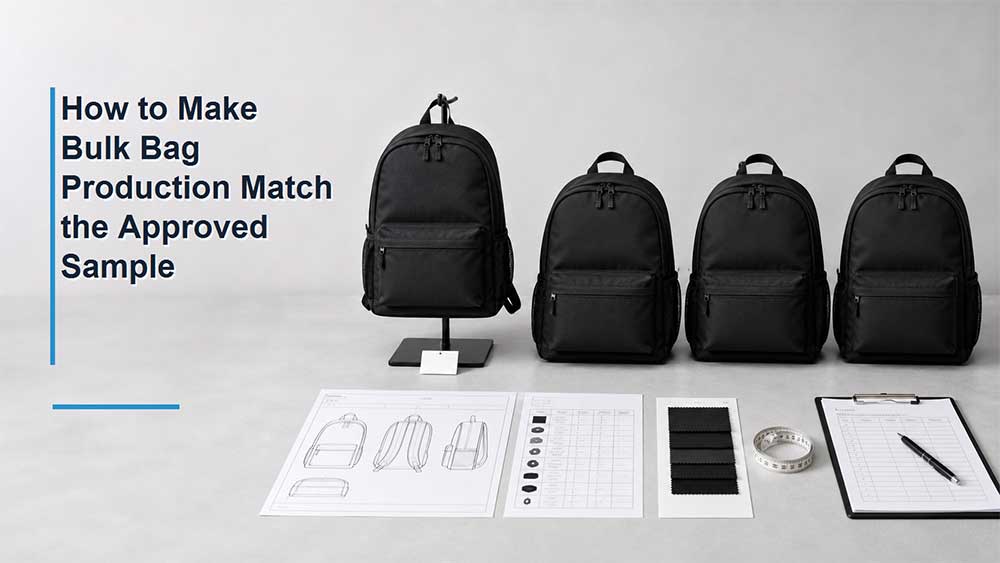
An approved sample gives buyers and factories a physical reference, but it cannot control bulk production on its own. To keep custom bag production consistent, the factory must also lock material codes, document versions, measurable tolerances, production methods, first production units, inspection points, and every change made before shipment.
In practice, preventing sample-to-bulk differences requires eight connected controls:
Confirm the correct pre-production sample.
Establish a controlled golden sample.
Freeze the tech pack, BOM, patterns, logo files, and packaging specifications.
Approve materials using supplier codes and physical swatches.
Define critical measurements and tolerances.
Inspect bulk materials and the first production units before full output.
Carry out inspections while problems can still be corrected.
Require written approval for every material, construction, or process change.
The goal is not to make every finished bag perfectly identical. Textile materials and sewn products naturally have minor variations. The goal is to keep those variations within the approved range and prevent unauthorized changes from entering production.
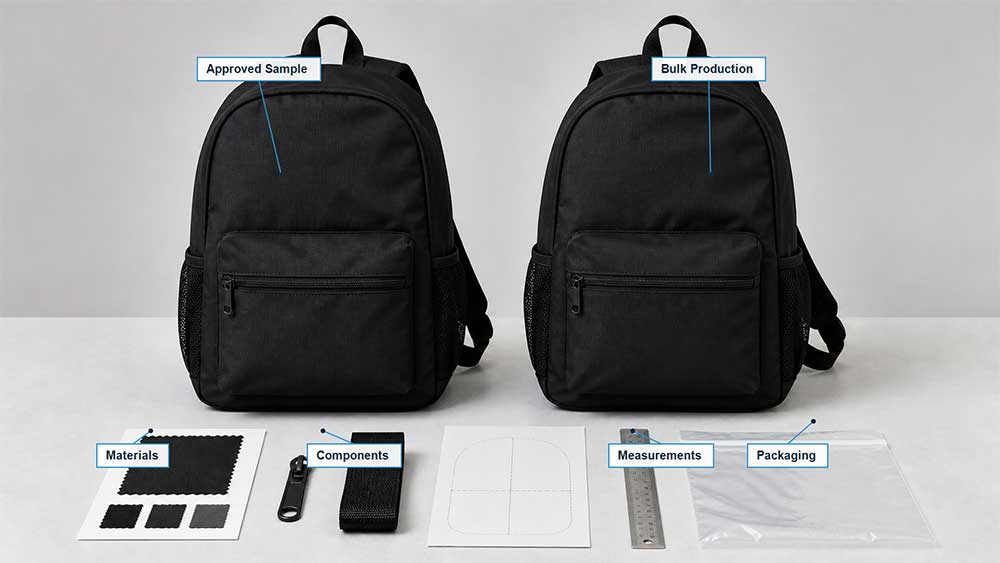
Bulk production should reproduce the approved product in all areas that affect appearance, function, durability, compliance, packaging, and consumer use.
Depending on the bag, this may include:
Control area
What should be confirmed
Overall appearance
Shape, proportions, balance, color combination and surface finish
Materials
Fabric, lining, webbing, mesh, foam, reinforcement and coating
Components
Zippers, sliders, buckles, hooks, snaps and other hardware
Construction
Seams, binding, edge finishing, reinforcement and assembly sequence
Measurements
Finished dimensions, pocket openings, strap lengths and logo position
Function
Fit, opening direction, compartment use, load performance and water resistance
Branding
Logo file, color, size, process, direction and location
Packaging
Folding method, polybag, labels, barcodes, inserts, carton assortment and shipping marks
A finished sample may visually represent many of these details, but it cannot show every production requirement. Internal reinforcement, seam allowance, exact material codes, coating specifications, chemical requirements, test methods, and measurement tolerances must still be documented.
Confirm the Right Type of Sample
Not every sample has the same purpose. Confusion often begins when a development sample is treated as though it were the final production standard.
Sample type
Main purpose
Can it normally control bulk production?
Prototype or development sample
Check shape, construction, fit, pocket layout and function
Not by itself, because temporary materials or processes may have been used
Sales or photography sample
Marketing, display or internal sales presentation
Not necessarily, because appearance may have been prioritized over production stability
Pre-production sample (PPS)
Confirm final specifications, materials, logo, workmanship and packaging
Yes, provided that all differences are recorded and the related documents are current
First production unit
Confirm whether the actual production line can reproduce the approved result
It verifies execution but does not replace the PPS or written specifications
Shipment or TOP sample
Represent completed production before or after shipment
It records the final result but is usually too late to prevent production problems
If a development sample contains substitute fabric, a temporary color, provisional hardware, or incomplete packaging, each difference should be recorded in the sample report. “Sample approved” must not be interpreted as approval of every unfinished detail.
For projects with higher material, construction, logo, or performance risks, buyers should approve a PPS made with actual bulk materials and the intended production processes before full cutting or assembly begins.
If this is temporarily impossible, every unresolved item should have a named owner, an approval method, and a completion deadline.
Establish a Controlled Golden Sample
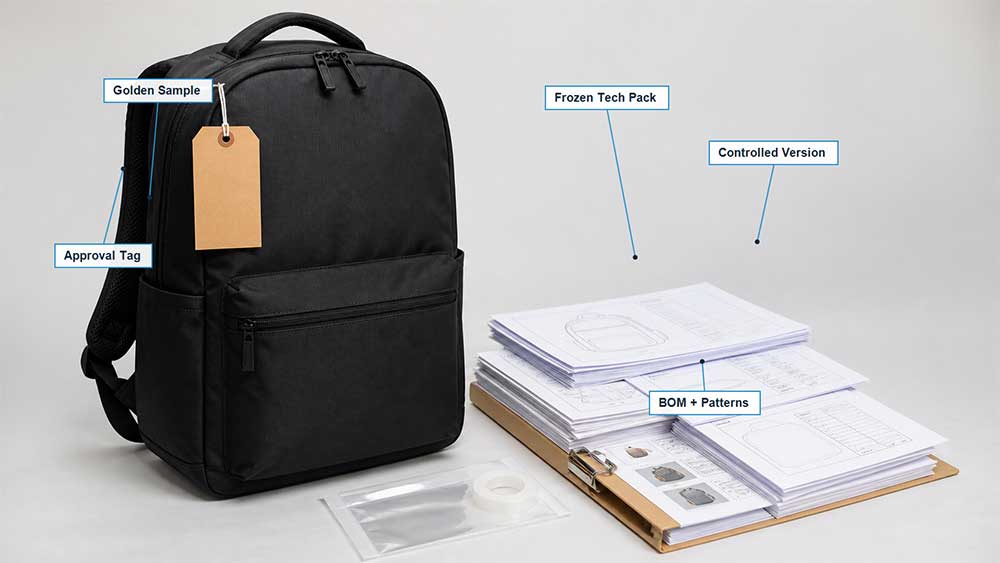
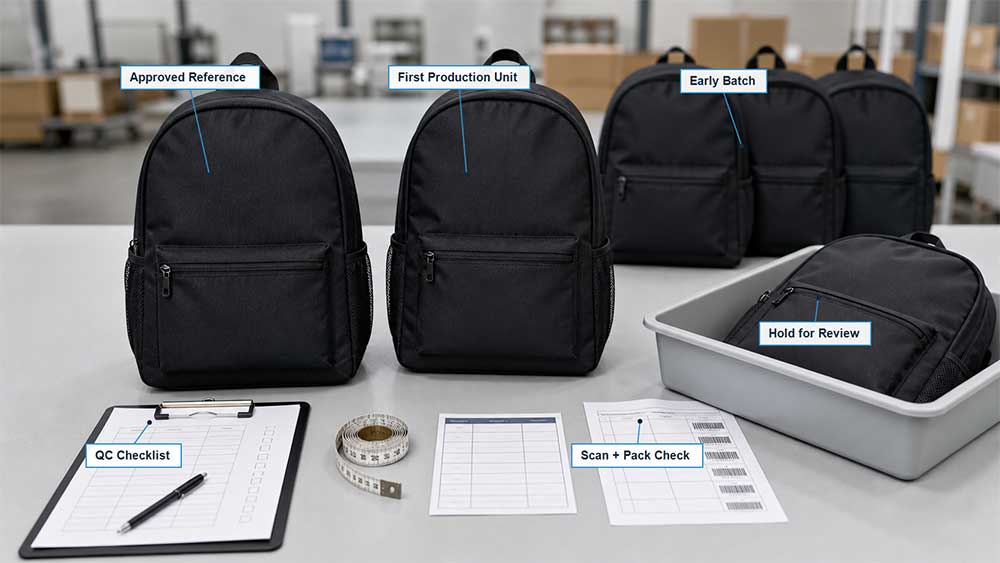
A golden sample, sealed sample, or approved reference sample gives the buyer, factory, and inspection team a shared physical standard. It is especially useful for comparing overall shape, hand feel, foam, color coordination, construction, logo appearance, and finishing.
The approval label should record:
Style number and buyer reference
Sample type
Colorway
Revision number
Approval date
Approver
Accepted differences and unresolved items
Corresponding tech pack and BOM versions
Ideally, the buyer and factory should each retain an identical approved sample. If only one sample exists, the parties should agree in advance who will keep it and how the production team and third-party inspectors can access the reference.
The finished bag should not become the only production standard. Internal reinforcement, seam allowance, exact material references, coating details, test requirements, and dimensional tolerances may not be identifiable from the finished product.
The purchase order or quality agreement should also state which standard takes priority if the physical sample conflicts with written documents. Any conflict should be resolved before production begins.
Freeze the Production Documents Before Bulk Manufacturing
Production documents need to explain how to reproduce the approved product, not merely describe what the finished sample looks like.
Depending on the project, the controlled production package may include:
Current tech pack and revision history
Final patterns and component numbers
Component-level bill of materials
Measurement specifications and tolerances
Material, color, and trim approval records
Logo files and placement instructions
Construction and reinforcement requirements
Functional and laboratory testing plans
Packaging specifications and approvals
Inspection checklist and defect classifications
Material and production change procedure
Consolidate every revision in one controlled record. Each comment should identify the affected component, the observed problem, the required result, and the reference that will be used to verify the correction. The principles in how to give useful feedback on a laptop bag sample can also be applied to other custom bag projects.
The factory should confirm the frozen version before ordering bulk materials or cutting fabric. Even when a change has been approved by email, it must still be transferred to the documents used by the material, pattern, sewing, logo, QC, and packaging teams.
Lock Materials With Supplier Codes and Physical Swatches
Generic descriptions such as “600D polyester,” “black lining,” or “5 mm foam” are rarely precise enough. Materials with the same general name can differ in yarn, construction, finished weight, coating, surface texture, stiffness, color, bonding behavior, and performance.
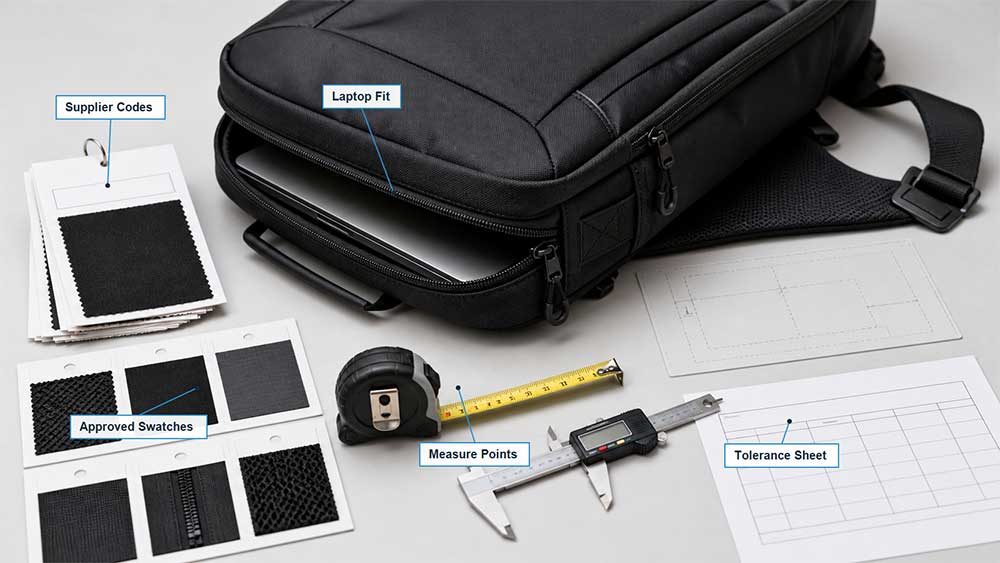
For each critical material, record the relevant information, such as:
Supplier and material code
Fiber or polymer composition
Yarn count or denier, where applicable
Woven, knitted, mesh, or webbing construction
Finished weight and applicable tolerance
Coating or lamination type
Color standard and approved physical swatch
Surface finish and hand-feel reference
Foam or structural material thickness, density, or hardness
Custom-dyed materials should normally be approved through a lab dip or another suitable color sample. For color-sensitive products, the buyer may also need to approve a fabric cutting taken from the actual bulk lot before production.
Colors should be compared with the agreed physical standard under controlled viewing conditions. Instrument readings can support the evaluation, but the acceptance range should still consider material type, texture, surface finish, and final use.
Pantone provides different color references for different material types. A Pantone number should therefore identify the specific color system and be physically evaluated on the material intended for production. Pantone’s guidance on choosing the right color standard for the right material provides additional context.
Set Practical Tolerances for Critical Measurements
A target measurement without a tolerance can create disputes during inspection. However, applying an excessively wide tolerance to every dimension provides little meaningful control.
Priority should be given to measurements that affect fit, function, symmetry, appearance, or packaging. Depending on the bag, these may include:
Finished width, height, and depth
Main opening and zipper length
Laptop or equipment compartment dimensions
Pocket opening and usable depth
Shoulder strap length and left-to-right difference
Handle drop and attachment position
Webbing, buckle, or hook-and-loop position
Logo size and placement
Reinforcement and bartack location
Folded or packed dimensions
A reasonable tolerance depends on material stretch, foam, construction, measurement method, product size, and functional risk. There is no universal tolerance suitable for every custom bag.
Even if individual results remain within tolerance, a consistent shift toward one limit deserves investigation. Repeated oversized, undersized, distorted, or asymmetrical results may indicate that the production process is drifting.
Make Sure Every Team Uses the Same Standard Before Cutting
A pre-production review transfers the approved product from development to purchasing, production, and quality teams. It may take place in a formal meeting or through a documented remote review, but every decision must be recorded.
Before production begins, confirm that:
The PPS, tech pack, patterns, BOM, and logo files use matching versions.
Bulk materials and components are available under the approved codes.
All temporary substitutions and unresolved items have been closed.
Critical measurements and tolerances are understood.
Complex sewing, binding, turning, reinforcement, and shaping processes are clearly explained.
The logo process, direction, size, position, and tolerance are locked.
Functional testing and each inspection stage have an assigned owner and schedule.
Packaging, labels, barcodes, carton assortment, and shipping marks are approved.
No material, process, subcontractor, or logo file may be changed without authorization.
The review should also identify details that look good on a sample but may be difficult to reproduce consistently during bulk manufacturing.
Depending on the risk, the solution may involve a placement template, gauge, sewing fixture, revised seam construction, or a slightly wider but still acceptable tolerance for a low-risk feature.
Add a Separate Approval Gate for Bulk Materials
Incoming material inspection should confirm that the materials entering production match the approved source and physical standard.
Depending on the project, the factory may check:
Supplier code and roll or lot number
Quantity and usable width
Fabric weight and thickness
Color and dye-lot grouping
Coating or lamination
Surface defects
Zipper operation
Buckle performance
Foam density
Compatibility between the logo process and the material
If several dyeing or coating lots are used, the factory should record which production batches received each lot. Visible shade differences mixed within one bag or retail set are usually more noticeable than differences kept consistent within separate production batches.
If materials must pass laboratory or performance testing before cutting, an acceptable visual inspection should not automatically release them for production.
Chemical compliance, certification, abrasion resistance, tear strength, colorfastness, coating adhesion, and waterproof performance address risks that visual inspection cannot determine.
Material control should form part of the complete custom bag production process, rather than becoming a set of documents assembled after the order is complete.
Inspect the First Production Units Before the Line Speeds Up
Before the production line reaches full output, inspect complete first production units made with bulk materials, production patterns, actual equipment, planned operators, and the approved logo process.
Compare the first units with the PPS and current approved production documents. Check:
Overall shape and balance
Panel alignment and symmetry
Measurements and compartment fit
Sewing, binding, and edge construction
Foam, reinforcement, and structural support
Zipper direction and operation
Shoulder strap and handle attachments
Logo size, color, direction, and position
Required functional or load performance
Packaging method
First-unit approval is a production-verification stage, not an informal opportunity to redesign the product. If the buyer requests a design change at this point, its impact on price, lead time, materials, patterns, testing, and already completed products should be recorded.
For tightly controlled branding, measurable placement specifications and early production checks are more reliable than asking operators to judge whether a logo “looks centered.”
Inspect Production While Problems Can Still Be Corrected
No single inspection stage can control every risk.
Inspection stage
Main purpose
Typical decision
Incoming material inspection
Stop incorrect or inconsistent materials before cutting
Release, isolate, retest, return, or request deviation approval
First-unit inspection
Confirm that the actual line can reproduce the approved standard
Continue, adjust the process, or stop production
Early production inspection
Identify systematic sewing, logo, measurement, and assembly problems
Revise work instructions and isolate affected products
During-production inspection
Verify that corrective action is effective and quality remains stable
Continue, increase inspection, rework, or stop
Final random inspection
Check finished quantity, workmanship, function, assortment, and packaging
Release, rework, screen, reinspect, or reject according to the agreement
Before production, the buyer and supplier should agree on the sampling method, critical checkpoints, defect classifications, acceptance criteria, and report format.
The current ISO 2859-1:2026 provides sampling schemes indexed by the acceptance quality limit (AQL) for lot-by-lot inspection by attributes. The buyer and supplier must still agree on the sampling plan, inspection level, AQL values, and defect definitions for the specific order.
A passing AQL result does not prove that bulk production matches the approved standard if materials, measurements, performance, and branding were never included in the inspection criteria.
Final random inspection also cannot replace incoming and process controls. A detailed laptop bag quality inspection checklist illustrates how an approved sample can be connected with measurable specifications and functional checks.
Do Not Allow Substitutions Without Approval
If an approved material or component becomes unavailable, production should not use a substitute until the buyer has reviewed a documented change proposal.
The change request should identify:
Affected styles, colorways, purchase orders, and quantities
Original material, component, process, or logo-file version
Proposed replacement
Reason for the change
Impact on appearance, construction, performance, certification, compliance, cost, and lead time
Samples, swatches, test results, or photos provided for approval
Current production stage and products already affected
Buyer decision, approver, and approval date
Documents and physical standards that need updating
Do not release the replacement into production until the buyer has approved it in writing.
When timing is critical, the buyer may approve a controlled deviation for one purchase order. That decision does not automatically make the alternative the new standard for future orders.
Separate Normal Production Variation From Nonconformity
Textile materials and sewn products naturally contain some variation. Minor differences in color, texture, grain, shaping, or measurement may be acceptable when they remain within the approved range and do not affect appearance, function, compliance, or consumer use.
The following issues normally require investigation and should not be dismissed as ordinary production tolerance:
Use of an unapproved supplier or material code
Color outside the approved range or visible mixed-lot shade differences within one product
Reduced fabric weight, foam thickness, reinforcement, or hardware grade
Measurements outside tolerance or systematic asymmetry
Compartments, closures, zippers, straps, handles, or buckles that do not perform as approved
Missing bartacks, reinforcement, labels, or specified packaging
Incorrect logo file, color, process, direction, size, or location
Failure to meet safety, chemical, performance, or certification requirements
Repeated defects that indicate loss of process control
Final acceptance should consider written specifications, the approved sample, tolerances, function, defect classifications, affected quantity, target market, and contract terms. It should not depend only on one person’s subjective judgment after production is complete.
What Should Buyers Do If Bulk Production Already Differs From the Sample?
First, contain the problem. If continued production will create more nonconforming goods, stop the affected operation and separate suspect materials and products from accepted inventory.
Then:
Describe the difference using measurements, photos, physical samples, lot numbers, and affected quantities.
Compare the product with the valid PPS, BOM, tech pack, purchase order, and approved deviation records.
Determine whether the cause is related to materials, patterns, equipment, operators, work instructions, subcontractors, or inspection failure.
Identify the full affected quantity instead of relying on a few visible samples.
Agree on the disposition, such as rework, sorting, retesting, replacement, reproduction, written concession, or rejection.
Verify the corrective action on newly produced units before normal production resumes.
Record the corrective action so the same problem does not return in a repeat order.
A price discount does not remove problems involving function, compliance, brand image, or consumer acceptance.
Buyers should consider concession acceptance only when the affected goods remain suitable for the target market and the commercial decision has been documented in writing.
Sample-to-Bulk Consistency Checklist
Before full production, confirm that:
The approved sample type and version are clearly identifiable.
All sample differences and unresolved items are documented.
The buyer and factory can access a controlled golden sample.
The tech pack, patterns, BOM, logo, and packaging documents use approved versions.
Materials and components are locked through supplier codes and physical references.
Critical measurements, tolerances, functions, and defect standards are documented.
Bulk materials are inspected before cutting or assembly.
First production units are made through the actual production process and approved.
Production inspection starts early enough to correct systematic problems.
Every substitution requires written approval.
The final inspection plan and shipment-release criteria are agreed before production.
Nonconforming materials and products have clear isolation, disposition, and corrective-action procedures.
Produce Custom Bags Through a Clear Approval Process
Vancharli Outdoor develops and manufactures custom backpacks, business bags, travel bags, tactical bags, and outdoor bags for brands, wholesalers, importers, and distributors.
Depending on the project, we can help buyers organize material and color approvals, component-level BOMs, samples, measurement tolerances, pre-production reviews, first-unit inspections, process inspections, performance testing, and final inspection records.
The goal is to reproduce the approved product consistently, keep normal production variation within the agreed range, and prevent unauthorized changes from entering production.
Working with an experienced custom bag manufacturer from the beginning of product development can help align the design, target price, materials, sampling process, production methods, and quality standards before bulk manufacturing begins.
Frequently Asked Questions
Is a golden sample enough to control a custom bag order?
No. A golden sample is an important physical reference, but it cannot fully communicate internal construction, exact material codes, dimensional tolerances, testing requirements, or packaging data.
It should be used together with the current tech pack, BOM, measurement specifications, approved swatches, logo files, and inspection plan.
Must bulk production be completely identical to the approved sample?
Bulk production should comply with the approved design, materials, color standards, construction, function, branding, and workmanship requirements.
Minor differences may be acceptable when they remain within the agreed range and do not affect appearance, function, compliance, or consumer use.
What is the difference between a development sample and a PPS?
A development sample is mainly used to refine shape, construction, fit, and function. It may contain temporary materials.
A PPS should represent the intended final product using approved bulk materials, components, logo processes, construction, and packaging. Any remaining differences must be documented.
Can buyers approve bulk materials using photos only?
Photos can help record versions and identify obvious visual differences, but they cannot reliably communicate exact color, texture, hand feel, stiffness, coating, foam density, or zipper quality.
These details should be controlled through numbered physical swatches, written specifications, samples, and test results.
What happens if an approved material becomes unavailable before production?
The factory should provide the replacement material code, specifications, appearance, performance, certification status, and impact on cost and lead time.
The buyer should approve or reject the proposal in writing. A major change may require a revised PPS or component sample.
When should the first production units be checked?
They should be checked after actual bulk materials and production processes are ready but before the line reaches full output.
The review must take place early enough for the factory to adjust patterns, equipment settings, work instructions, logo placement, or assembly methods before most of the order is affected.
Can a final AQL inspection prevent sample-to-bulk differences?
A final inspection can detect many differences, but it cannot prevent a systematic problem that has already affected the entire order.
Incoming inspection, first-unit approval, and during-production inspection are needed to stop problems earlier.
How should multiple colorways be controlled?
Each colorway should receive separate approval for the main fabric, lining, webbing, zipper tape, sewing thread, logo, labels, and packaging combination.
A structural sample in one color may confirm the pattern, but it does not automatically approve the material and color combinations of every other colorway.
Who should keep the golden sample?
Ideally, the buyer and factory should each keep an identical approved sample. The factory copy can support production and internal QC, while the buyer copy provides an independent reference for disputes, repeat orders, and third-party inspections.
If only one golden sample exists, the purchase order or quality agreement should state who keeps it and how other parties can access it.
Can a previous golden sample be reused for a repeat order?
Yes, provided that the design, materials, components, specifications, and compliance requirements have not changed and the sample remains in good condition.
Before placing the repeat order, the buyer and supplier should still reconfirm material availability, approved alternatives, document versions, target-market requirements, and any changes made after the previous production run.











Comments are closed