How to Inspect RF-Welded Seams in Waterproof Bags Before Bulk Production
Before approving bulk production, check whether every RF-welded seam is continuous, correctly positioned and free from lifting, wrinkles, burn-through and incomplete edges. Then confirm the result with an agreed seam-strength check and leak test.
Do not approve production if any part of the waterproof seam is open, peeling, burned through or leaking—even if the rest of the bag looks fine.
Here is the basic inspection logic:
What to check
Acceptable result
Do not approve if
Weld line
Continuous and correctly positioned
Gaps, missed areas or serious misalignment
Weld surface
Clean and reasonably even
Burn-through, pinholes or trapped contamination
Weld edges
Completely bonded
Edges lift or separate
Corners and intersections
Flat and fully sealed
Wrinkles or gaps cross the sealing path
Strength check
Seam stays bonded under the agreed test
Peeling, cracking or delamination occurs
Leak test
No leakage under the agreed conditions
Bubbles, moisture or pressure loss appear
A good-looking weld is a useful starting point, but appearance alone cannot prove that the seam is strong or waterproof.
Inspectors need something clear to compare against. “Make the seam strong” is not a measurable requirement.
Before checking the production trial units, confirm that you have:
The approved material specification
The approved sample or golden sample
The latest product drawing
The required weld location
The agreed weld width and tolerance
The required appearance standard
The agreed seam-strength check
The required leak or waterproof test
Clear pass/fail requirements
There is no single weld width, peel strength or test pressure that suits every waterproof bag.
A lightweight waterproof phone pouch, a roll-top dry bag and a heavy waterproof duffel place very different demands on their seams. The correct requirements depend on the material, bag design, intended use and waterproof claim.
The samples used for approval should also represent the planned production setup as closely as possible. That means using the intended bulk material, approved tooling and correct product construction—not a similar fabric or an earlier development sample.
Inspect the Complete Weld, Not Just One Easy Section
A long straight section may look perfect while the corner or end of the same weld remains weak.
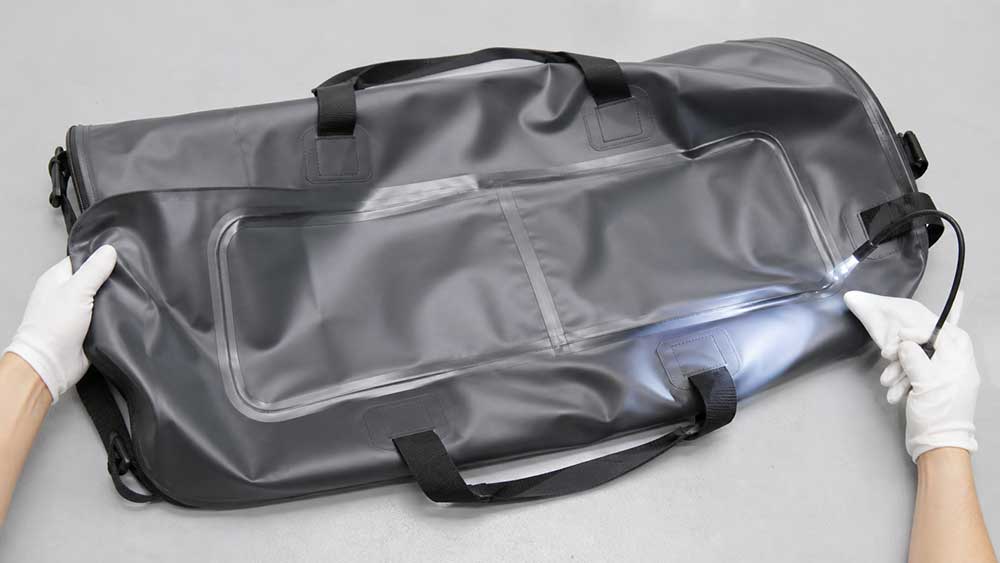
Use consistent lighting and inspect the entire seam. Where possible, look at both the inside and outside of the product.
Pay particular attention to:
The beginning and end of each weld
Corners and curved areas
Weld intersections
Areas where several material layers meet
Bottom and side seams
Welds close to handles, straps, valves or patches
Any point where the seam changes direction
The weld should follow the position shown in the approved drawing. Its width should remain within the agreed tolerance, and the edges should stay completely bonded along the waterproof path.
Do not assume that a deeper or shinier weld is stronger. Different materials can produce different surface appearances. The relevant question is whether the weld matches the approved reference and passes the required tests.
Measure More Than One Point
Measure the weld at several locations rather than taking one reading from the middle of a straight section.
Check:
Weld width
Distance from the panel edge
Panel overlap
Alignment
Continuity through corners and intersections
A wider weld is not automatically better. If the material is pressed or heated too aggressively, the welded area may become thin, hard or damaged.
The goal is to reproduce the width and position that were validated during sampling—not to make the weld as wide or deep as possible.
Know Which Defects Should Stop Approval
Some RF welding problems are easy to see. Others may only appear when the seam is flexed, pulled or leak-tested.
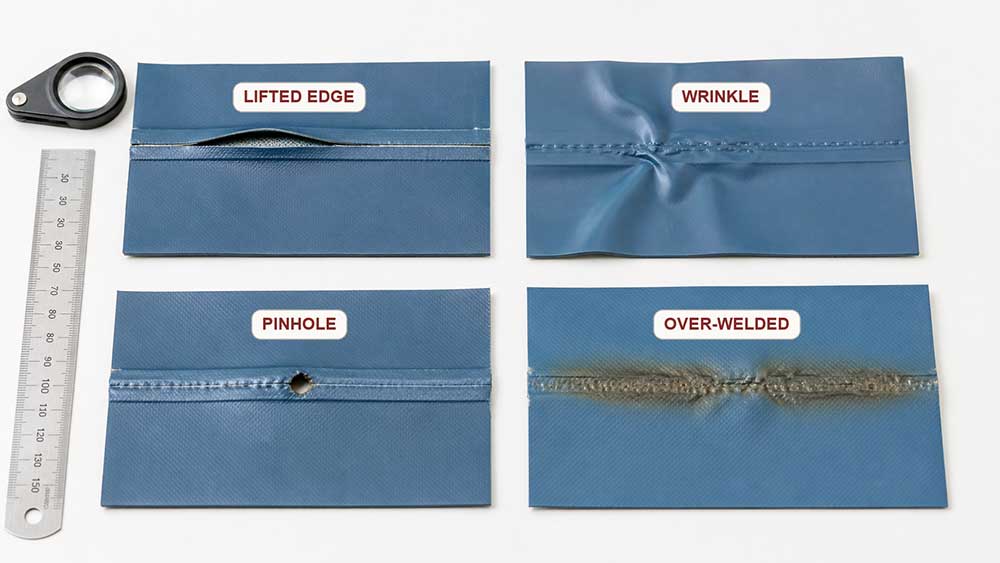
The table below focuses on what a buyer or inspector can observe and what to do next. The visible symptom may suggest a problem, but it does not always reveal the exact cause.
Possible defect
What it may look like
Why it matters
What to do
Under-welded or “cold” area
Light or uneven weld impression, lifting edge or a section that separates easily
The layers may not be fully bonded
Hold approval and confirm with a strength and leak test
Over-welded area
Excessive thinning, deep marks, stiffness, distortion or discoloration
The material may crack or tear beside the weld
Reject affected pieces and review the machine setup
Wrinkle across the weld
A fold passes through the waterproof sealing path
The fold may create a small leak channel
Do not approve until the area passes the required leak test
Burn-through or pinhole
Hole, scorched point, damaged coating or exposed base fabric
The waterproof barrier has been broken
Reject the piece and investigate the process
Incomplete weld edge
Gap, skipped area or interrupted bonding
Water can enter and the edge may begin to peel
Correct the weld before approving production
Misaligned weld
Weld is outside its intended path or does not leave enough overlap
The bonded area may be too narrow
Compare with the drawing and hold approval if strength is affected
Contamination
Dust, fibre, oil or another material is trapped in the weld
It may cause weak bonding, arcing or pinholes
Clean the work area and produce new test pieces
Weak corner or intersection
Straight seams pass, but a corner lifts or leaks
Corners can fail during folding, loading or use
Correct the tooling, positioning or bag design and retest
Avoid diagnosing the cause from appearance alone.
For example, a weak seam may be connected to the material, pressure, RF energy, welding time, cooling time, tooling or contamination. The factory should investigate the variables one at a time and confirm the correction with new test results.
Check Seam Strength Without Relying on Hand Pulling Alone
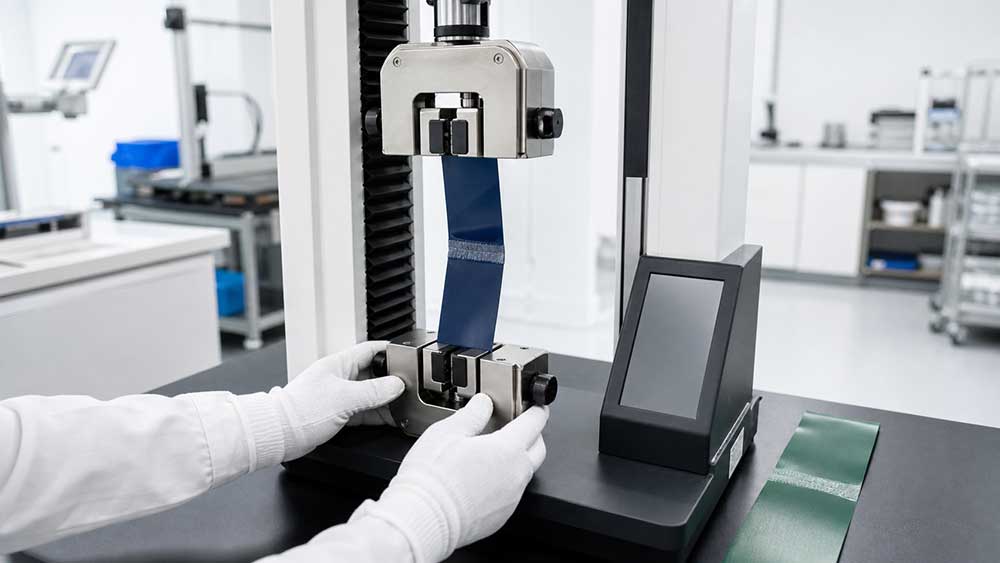
A gentle hand check can quickly reveal an obviously loose edge, but it cannot measure seam strength accurately. One inspector may pull much harder than another.
For initial screening, an inspector can:
Gently flex the seam in the direction it will bend during use
Check whether an edge begins to lift
Look for cracking, whitening or delamination
Compare the result with the approved sample
Record where any separation begins
Whenever possible, perform this screening on a test strip or designated sample rather than repeatedly pulling the finished approval sample.
For coated fabrics, ASTM D751 includes test methods for seam strength and other relevant material properties. However, referring to ASTM D751 alone is not a complete acceptance requirement. The specification should also state:
How the test sample is prepared
Which direction it is pulled
How the result is recorded
What minimum result is required
Which type of failure is acceptable
The way the sample fails can be as important as the final force reading.
Record whether the failure occurs:
Inside the welded joint
Between the coating and the base fabric
Through the coating
In the fabric next to the weld
At a corner or weld transition
This helps determine whether the problem comes from the welding process or the material construction.
Confirm Waterproof Performance on the Finished Bag
A seam can pass a visual inspection and still contain a hidden leak path. It can also be mechanically strong while the finished bag leaks through a corner, closure, zipper or valve.
The final check therefore needs to include the complete waterproof system.
Depending on the product, testing may include:
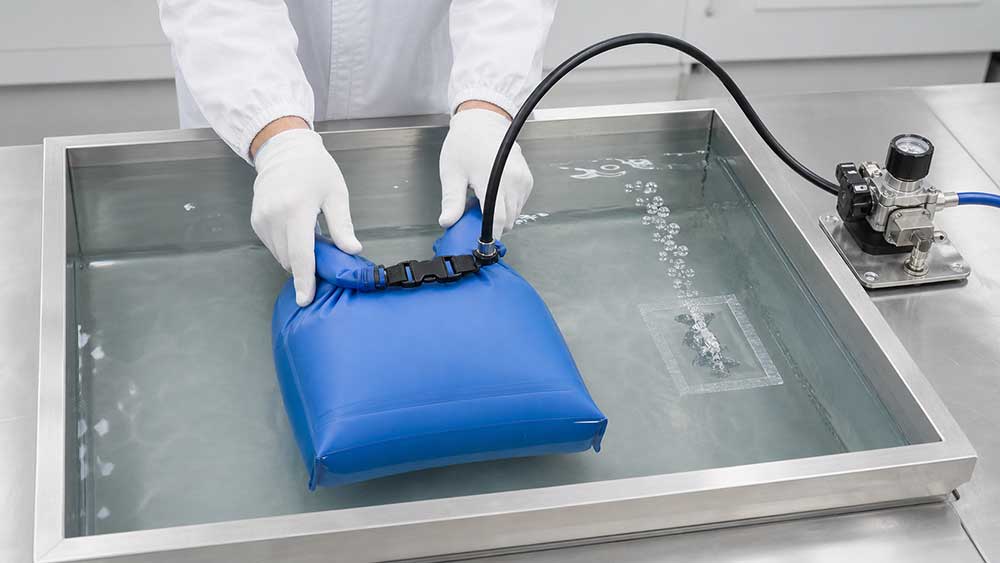
Air-leak or bubble testing
Pressure-decay testing for airtight products
Spray or water-exposure testing
Immersion testing under agreed conditions
Flexing followed by leak testing
Loaded handling followed by leak testing
Low-temperature conditioning followed by flex and leak testing
The test must match the intended use.
A waterproof phone pouch, kayak dry bag, soft cooler and inflatable product should not automatically use the same pressure, duration or immersion conditions. Do not apply an arbitrary internal pressure to a bag that was not designed to hold pressure.
The test report should clearly record:
Test method
Test duration
Water depth or pressure, if applicable
Product closure method
Sample identification
Pass/fail result
Location of any leakage
For a roll-top dry bag, even the number of folds matters. If that detail is not recorded, another inspector may close the same bag differently and get a different result.
A fabric waterproof test does not prove that the finished bag is waterproof. The seams, corners, zipper, roll-top, valve and attachments all need to work together.
Decide Whether to Approve, Hold or Reject
The final decision should be simple and evidence-based.
Approve Production
Production may be approved when:
The material matches the approved specification
The weld follows the correct path
Width and position meet the agreed tolerance
Corners, ends and intersections are completely bonded
No burn-through, open edge or contamination is present
Seam-strength checks pass
The finished product passes the agreed leak test
Appearance matches the approved standard
Hold Production
Hold approval when:
A wrinkle or surface variation may affect the sealing path
The seam looks acceptable but has not completed the required test
The material or tooling differs from the approved version
The cause of a failed result has not been confirmed
Corrective action has been taken but the new sample has not been retested
“Holding” does not necessarily mean rejecting the entire project. It means production should not continue until the uncertainty is resolved.
Reject the Sample
Reject the affected sample when:
The waterproof seam is open or incomplete
Burn-through or pinholes penetrate the waterproof chamber
The weld peels during the agreed test
The finished bag leaks
The weld falls outside a functional area shown in the drawing
The material has been damaged beyond an approved cosmetic limit
After correction, inspect and test a new sample. Do not approve production based only on a verbal promise that the settings have been changed.
Record What Was Approved
The factory and buyer should be able to identify exactly what passed.
A practical approval record should include:
Product name or SKU
Drawing version
Approved sample number
Material specification and lot
Tooling identification
Weld measurements
Test method and conditions
Actual results
Photos of important weld areas
Defects found
Corrective action
Retest result
Approval date
The factory may not disclose every proprietary machine setting, but the approved setup should be recorded and controlled internally. If the material, tooling or welding setup changes, the affected seam should be checked again.
The accepted production trial unit should be labelled and retained as a reference for the production line.
What Happens After Approval?
Pre-production approval shows that the selected setup can produce an acceptable seam. It does not guarantee that every later unit will be identical.
During bulk production, the factory should continue checking weld appearance, width, position and leak performance at an agreed frequency. Any failed test should trigger product isolation, investigation, correction and retesting.
Final AQL inspection may support the decision to accept a completed lot, but it cannot replace seam-strength or leak testing. Functional waterproof requirements need their own inspection plan.
RF seam inspection is also only one part of a complete waterproof bag quality inspection. Materials, closures, hardware, straps and finished dimensions still need to be checked.
Pre-Production RF Weld Checklist
Before approving bulk production, confirm that:
The production material matches the approved specification
The correct material surfaces are being welded
The latest drawing and tooling are being used
The weld is continuous and correctly positioned
Width remains within the agreed tolerance
Corners and intersections are completely sealed
No edge is lifting
No burn-through, pinhole or contamination is present
The seam passes the agreed strength check
The finished bag passes the required leak test
Any failed result has been corrected and retested
The approved production sample has been recorded and retained
If any functional requirement is still unclear, do not approve bulk production yet.
How Vancharli Outdoor Approaches RF-Welded Bag Inspection
At Vancharli Outdoor, our waterproof bag manufacturing process can include material confirmation, weld-layout review, production trial inspection and product-specific waterproof testing, depending on the bag design and performance requirement.
The goal is not simply to produce a seam that looks neat. The material, weld position, tooling, machine setup and testing method need to work together and remain consistent during production.
For dry bags, waterproof duffels, pouches, soft coolers and other welded products, these requirements are best agreed during sampling—before a quality problem reaches bulk production.
Final Thoughts
Inspecting an RF-welded seam does not need to be complicated.
Start with the approved sample and specification. Check the full weld, especially its edges, corners and intersections. Look for incomplete bonding, wrinkles, burn-through and misalignment. Then confirm the result with an agreed strength check and a leak test that matches the finished product.
A clean appearance is useful, but production should only be approved when the seam is correctly positioned, stays bonded and keeps water out under the agreed test conditions.
Frequently Asked Questions
Can an RF-welded seam look normal but still leak?
Yes. A small gap, wrinkle or incomplete bond may be difficult to see. That is why visual inspection should be followed by an appropriate leak test.
Is a deeper weld mark a sign of greater strength?
Not necessarily. A very deep weld may indicate that the material has been excessively compressed or damaged. Compare it with the approved sample and confirm the result through testing.
Is hand pulling enough to check the seam?
No. It can identify an obviously loose edge, but it cannot provide a consistent strength measurement. Use an agreed test method when a measurable result is required.
Must every waterproof bag be immersion-tested?
No. The test should match the product’s intended use and waterproof claim. A splash-resistant pouch and a dry bag intended for temporary immersion require different test conditions.
Should a wrinkle always cause rejection?
Not always. A wrinkle outside the waterproof path may only be cosmetic. A wrinkle crossing the complete welded path may create a leak channel and should be tested before approval.
Can AQL inspection replace waterproof testing?
No. AQL inspection can support lot acceptance, but it does not prove that a seam is strong or watertight. Waterproof performance requires a separate, clearly defined test.







Comments are closed