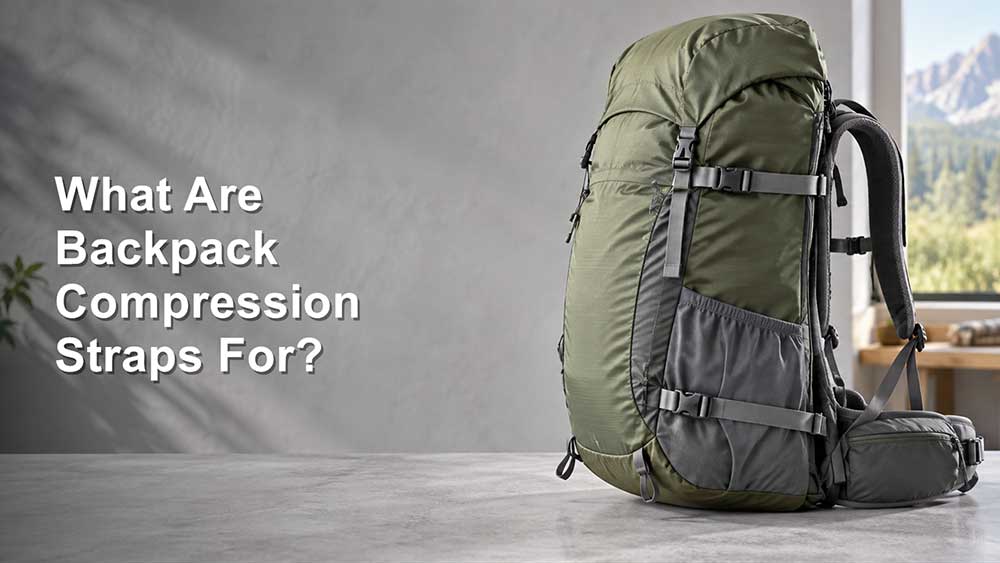
Backpack compression straps help stabilize the contents of a pack, reduce unused volume, and limit unwanted movement while you walk. Depending on their position and construction, they may also help secure lightweight equipment such as a foam sleeping pad, rain jacket, tent body, or trekking poles.
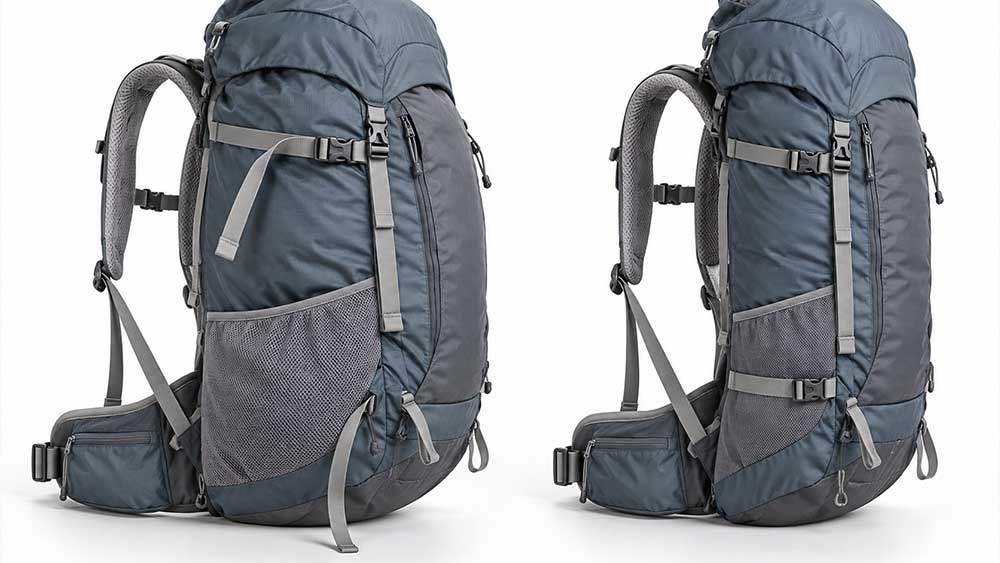
They are particularly useful when a backpack is only partly full. Tightening the straps draws the pack body inward so that loose contents are less likely to shift from side to side.
However, compression straps are not the same as load lifters, shoulder straps, gear loops, or a hip belt. Each component has a different job, and understanding those differences makes a backpack easier and safer to use.
They reduce its external bulk, but not its stated capacity
Can they hold external gear?
Some can, if their position and construction support it
Do they transfer weight to the hips?
No. That is mainly the job of the frame and hip belt
Are they the same as load lifters?
No. Load lifters adjust the upper relationship between the pack and your shoulders
Should they always be fully tightened?
No. They should be snug without deforming the pack or damaging the contents
What Is a Backpack Compression Strap?
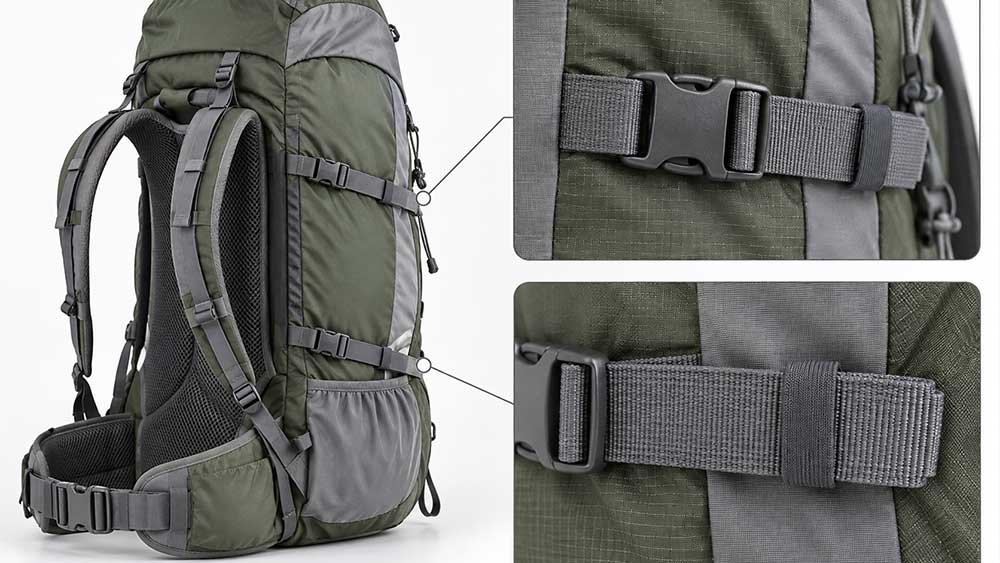
A backpack compression strap is an adjustable length of webbing positioned across the side, front, top, or bottom of a backpack.
The webbing is attached to the pack at one or more points and tensioned through a buckle, hook, cam, or other adjustment component. When tightened, it draws part of the backpack body inward.
Compression straps are commonly found on:
Hiking backpacks
Trekking packs
Mountaineering backpacks
Travel backpacks
Tactical packs
Technical daypacks
Their exact purpose depends on where they are located. Side straps normally control the depth of the pack, while top or bottom straps may also help secure suitable external equipment.
How Do Compression Straps Stabilize a Backpack?
A loosely packed backpack allows its contents to move every time the user changes direction, steps over an obstacle, or leans forward. This movement can make the pack feel less balanced than its actual weight would suggest.
Compression straps reduce that movement by pulling the outer fabric closer to the load. The pack becomes more compact, and soft items have less room to shift.
This can be especially helpful when:
The backpack is only partly filled
Food or clothing has been used during a multiday trip
The route includes scrambling or uneven terrain
The pack contains several soft items
The user needs a narrower pack profile
For example, Osprey describes the upper and lower side compression straps on its Stratos packs as features that stabilize the load. This reflects the primary purpose of compression straps across many hiking-pack designs.
That does not mean the straps can correct poor packing. Heavy equipment should still be positioned carefully, and dense items should not be left far from the back panel simply because the pack has compression straps.
Do Compression Straps Pull the Load Closer or Make the Pack Smaller?
Side compression straps can pull a soft, partially filled load inward and reduce the depth of the backpack. This may keep the load from sagging away from the back and can make the pack feel more controlled.
The effect depends on the design. A strap that spans a large section of the side panel usually compresses the pack more effectively than a short strap attached only to an external pocket.
Compression straps can also make a backpack look and feel smaller when it is not fully loaded. They reduce excess bulk, stop loose fabric from flapping, and may help the user move through narrow trails or crowded transport more easily.
However, they do not change the backpack’s official capacity. A 50-liter pack remains a 50-liter pack even when its side straps are fully tightened.
Compression straps also do not transfer most of the load to the hips. That function depends primarily on the frame or framesheet, the hip belt, and the overall suspension system. Load lifters can help fine-tune the upper fit, but they perform a different function.
What Types of Compression Straps Are Used on Backpacks?
Not every compression strap works in the same way. Its location determines what part of the pack it controls and whether it can safely hold external gear.
Side Compression Straps
Side compression straps are the most common type. They run across one or both side panels and reduce the front-to-back depth of the pack.
They are useful for:
Stabilizing a partially filled main compartment
Controlling tall items placed in side pockets
Securing trekking poles or tent poles when combined with lower pockets or loops
Keeping the pack profile compact
Some backpacks route the straps over the side pockets. Others position them underneath so the pockets remain accessible while the straps are tightened.
Neither layout is automatically better. The right design depends on whether compression, pocket access, or external gear retention is the priority.
Front Compression Straps
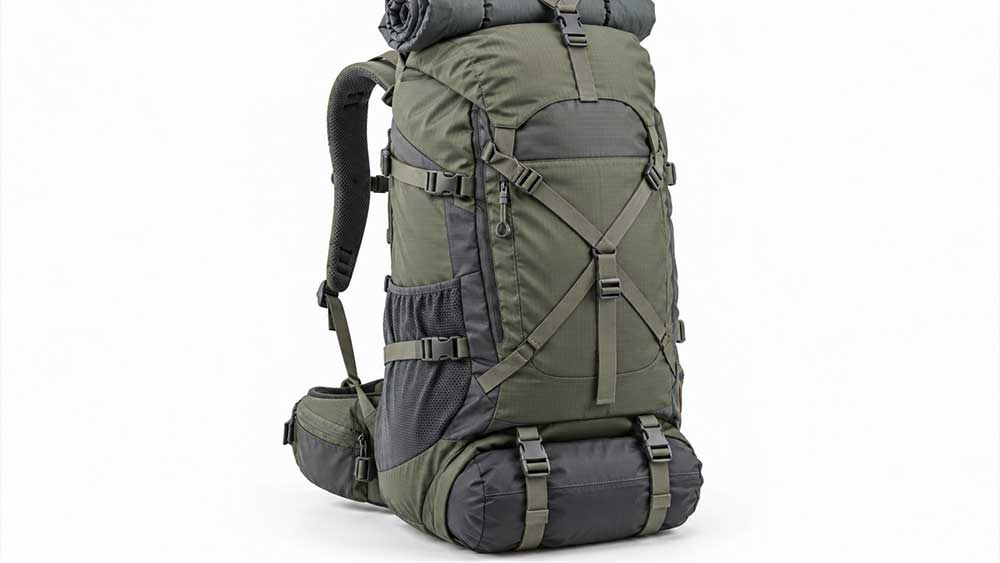
Front compression straps cross the outer face of the backpack. They may be straight, angled, or arranged in a crisscross pattern.
They can help contain bulky but lightweight items such as:
A wet rain shell
A folded foam pad
An empty helmet carrier
A compact tent body
Front straps should not be confused with front daisy chains or backpack gear loops. Loops provide individual attachment points, while compression straps apply tension across a wider area.
Top Compression Straps
Top compression straps run over the upper section of the pack or beneath a removable lid. They may help stabilize an overfilled main compartment or secure a lightweight item at the top.
Their usefulness is influenced by the pack’s opening. On a roll-top or drawcord pack, the strap may reinforce the closure. On a pack with a floating lid, it may help control the load underneath the lid.
Y-Straps
A Y-strap begins from one central point and divides into two branches. This shape distributes tension across a broader area than a single straight strap.
Y-straps are often used to secure:
A foam sleeping pad
A compact tent
A rope
A lightweight jacket bundle
The item must still fit the pack’s attachment geometry. A Y-strap does not automatically make every object safe to carry externally.
Bottom Compression Straps
Bottom straps are positioned beneath the pack and are commonly used for bulky, relatively light equipment such as a closed-cell foam pad.
Anything carried underneath should be tightly secured and should not hang low enough to interfere with the user’s legs. It should also be protected from abrasion, mud, and moisture.
Internal Compression Straps
Some backpacks, particularly travel and panel-loading models, include compression straps inside the main compartment.
These straps hold clothing or other soft contents in place when the bag is opened. Unlike external compression straps, their main purpose is organization rather than changing the outside profile.
Internal straps are especially useful in bags that open like a suitcase. You can learn more about this opening style in our guide to top-loading vs panel-loading backpacks.
What Can You Attach to Backpack Compression Straps?
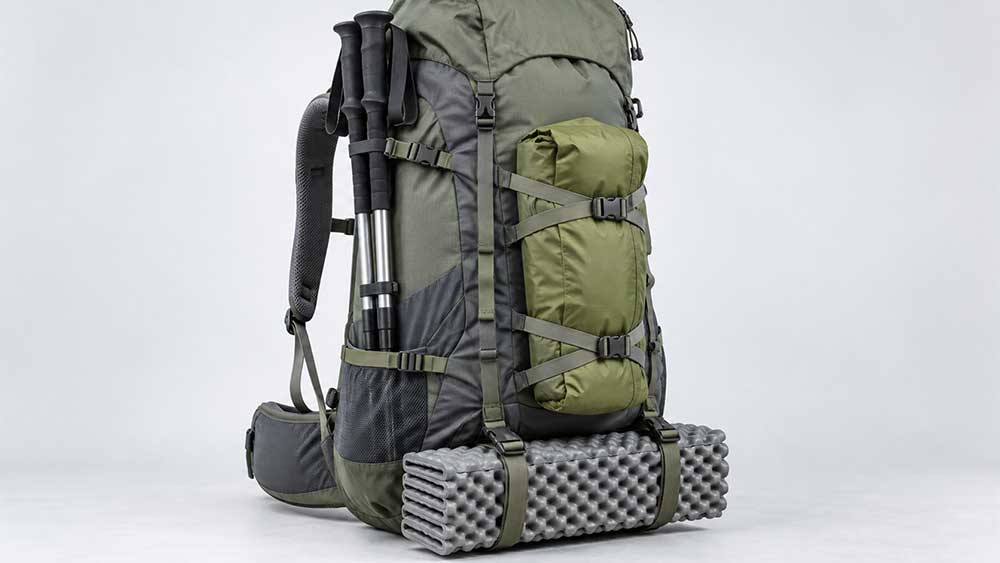
Compression straps can hold external gear, but only when the item is suitable and the backpack is designed for that use.
Typical examples include:
Foam sleeping pads
Tent bodies or lightweight tent components
Trekking poles
Tent poles
Rain jackets
Climbing ropes on compatible technical packs
Tripods on packs with an appropriate lower support point
Snowshoes on packs designed for winter equipment
The item should ideally be:
Relatively lightweight
Compact enough to control
Supported by more than one point
Unable to swing into the user
Clear of the ground and legs
Unlikely to damage the backpack fabric
A long item such as a trekking pole normally needs both an upper strap and a lower pocket, loop, or dedicated holder. The strap alone may stop the upper section from moving, but it may not support the whole item.
Before using a compression strap as an attachment point, check the backpack manufacturer’s instructions. Some straps are designed only to compress the pack body.
What Should You Avoid Attaching to Compression Straps?
Avoid placing dense, fragile, sharp, or poorly controlled objects under ordinary compression straps.
Examples may include:
Heavy water containers
Loose cookware
Unprotected sharp tools
Glass bottles
Electronics without weather protection
Items that extend far beyond the pack
Gear that blocks access to essential pockets
Objects that interfere with arm or leg movement
Water, cookware, food, and other dense items are generally more stable inside the backpack and close to the back panel.
If liquid fuel is carried inside, keep the bottle upright, tightly closed, and separated from food according to the manufacturer’s instructions. Do not place it where compression could damage the bottle, cap, or valve.
External gear also changes the balance of a backpack. Even a lightweight item can become distracting if it swings, catches on branches, or creates an uneven load.
Compression Straps vs Other Backpack Straps
Backpacks contain several straps that may look similar but perform different functions.
Component
Main function
Compression straps
Reduce bulk and stabilize the packed contents
Shoulder straps
Support and position the backpack on the torso
Hip belt
Transfers a significant part of the load to the hips
Load lifters
Adjust the angle between the upper pack and shoulder harness
Sternum strap
Helps position the shoulder straps across the chest
Gear loops
Provide individual attachment points
Daisy chains
Provide a series of external attachment points
Lid straps
Secure or adjust the top lid
Internal retention straps
Hold contents in place inside the compartment
One common mistake is to treat load lifters as upper compression straps. Load lifters usually connect the top of the shoulder harness to the upper pack structure. Their purpose is to fine-tune fit and load position, not to reduce the volume of the main compartment.
Similarly, a strap located near a floating backpack lid may adjust the lid, compress the load beneath it, or perform both jobs. Its attachment points reveal more than its appearance.
How Should You Tighten Backpack Compression Straps?
Compression straps work best when adjusted gradually and evenly.
Pack the backpack before tightening the straps.
Close the main compartment and all major pockets.
Tighten matching straps in small increments.
Check whether the load has shifted to one side.
Stop when the contents feel secure and the pack body looks controlled.
Tuck away or manage excess webbing so it does not flap or snag.
If the backpack has compression straps on both sides, alternate between them rather than fully tightening one side first.
The straps should be snug, not forced. Excessive tension may:
Distort the pack shape
Crush delicate contents
Restrict access to pockets
Place unnecessary stress on seams and buckles
Pull the load off-center
After walking for several minutes, check the straps again. Soft loads can settle, especially at the beginning of a trip.
Should Compression Straps Be Tightened When the Backpack Is Full?
Yes, but only when tightening them improves stability without deforming the pack.
A fully packed backpack may still contain small gaps between clothing, food bags, or other equipment. Light compression can remove some of that movement.
However, forcing the straps over an overstuffed pack is not a substitute for choosing the right capacity. If buckles are difficult to close, seams are under visible tension, or the pack has become rounded and unstable, the load may need to be reorganized or reduced.
When choosing a backpack, consider both trip length and equipment volume. A larger pack is not always necessary, but an undersized pack encourages overpacking and excessive external attachment.
How Do Compression Straps Work with a Floating Lid?
A floating lid is attached with adjustable webbing rather than being sewn tightly against the top of the pack. This allows the lid to rise when the main compartment carries extra volume.
Compression straps may work with the lid in several ways:
Side straps stabilize the expanded main compartment
A top strap controls gear placed beneath the lid
Lid straps draw the lid downward over the load
A Y-strap distributes tension across a larger object
The lid and compression system should function together. Tightening the side straps too aggressively while leaving the lid loose may create an uneven shape. Similarly, overloading the area beneath the lid can raise the center of gravity.
What Should Brands Check When Developing Compression Straps?
For backpack brands and product developers, compression straps should be evaluated as part of the complete carrying system rather than as isolated pieces of webbing.
Important factors include:
Strap position and adjustment range
Webbing width and hand feel
Buckle strength and cold-weather usability
Reinforcement at attachment points
Interaction with side pockets and zippers
Excess-webbing management
Compatibility with intended external gear
Ease of repair or component replacement
The intended user matters as well. A lightweight daypack may only require simple side compression, while a trekking or mountaineering pack may need multiple reinforced points, gloved-hand operation, and more precise load control.
Founded in 1995, Vancharli Outdoor works with brands on OEM and ODM backpack development, including strap layout, buckle selection, reinforcement construction, samples, and production. Explore our wholesale hiking backpack manufacturing options for more information.
Frequently Asked Questions
What is the main purpose of backpack compression straps?
Their main purpose is to reduce unused pack volume and prevent the contents from shifting. Some designs can also secure suitable lightweight equipment.
Do compression straps reduce backpack capacity?
No. They reduce the external bulk of a partially filled backpack, but they do not change its stated capacity.
Can compression straps hold a sleeping pad?
Yes, if the straps are long enough, the pad is lightweight, and the attachment points are designed to handle it. Bottom straps and Y-straps are commonly used for foam pads.
Can trekking poles be placed under side compression straps?
Often, yes. The poles should also have a lower support point such as a pocket, loop, or dedicated pole holder.
Are compression straps load-bearing?
They can apply considerable tension, but that does not mean every compression strap is intended to support heavy external equipment. Follow the manufacturer’s instructions and inspect the attachment points.
Are load lifters the same as compression straps?
No. Load lifters adjust the relationship between the upper backpack and the shoulder harness. Compression straps control the pack body and its contents.
Should compression straps be fully tightened?
Not necessarily. Tighten them until the load is stable. Stop if the backpack becomes distorted, pockets are blocked, or the contents are being crushed.
What should I do with loose compression-strap ends?
Use the built-in elastic keepers, hook-and-loop tabs, or webbing retainers if provided. Securing excess webbing reduces flapping and snagging.







Comments are closed