


What Should Buyers Do When a Bag Order Fails Inspection?
When a bag order fails inspection, buyers should hold the affected goods, document the defects, confirm how much stock is involved, and agree on a correction plan with the supplier. Check the results before approving the goods for shipment or sale.
The first action depends on when the problem is discovered:
- Before shipment: Ask the factory to hold the affected goods while the inspection findings are reviewed and corrected.
- After delivery: Isolate the affected inventory, preserve evidence, and notify the supplier before arranging repairs, replacements, or another remedy.
Also confirm whether the findings came from a full inspection or a sample inspection. This affects how buyers interpret the results and determine what still needs checking.
A failed inspection does not automatically mean the entire order must be rejected. The decision depends on the defects, their extent, and whether the goods can reliably meet the agreed requirements after correction.
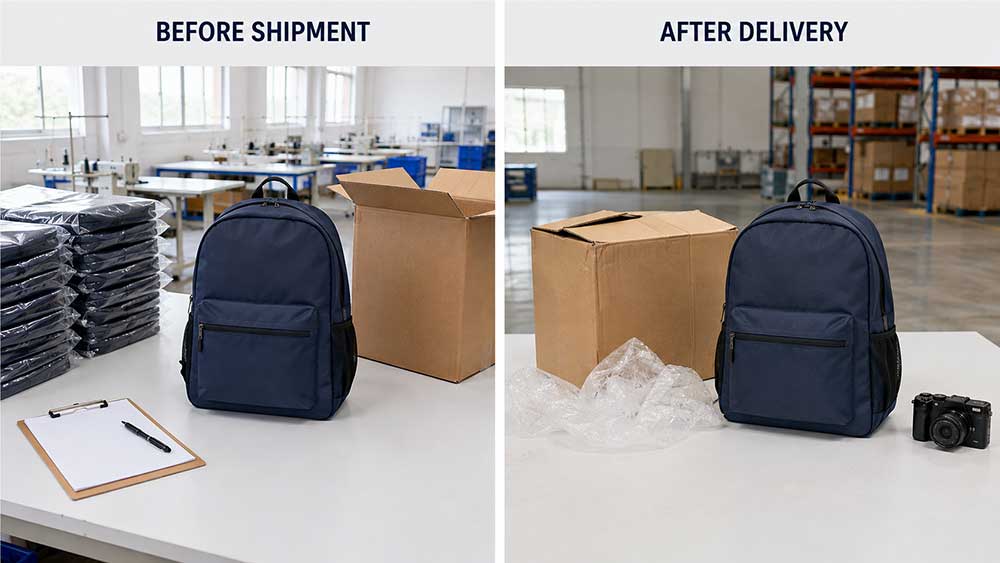
Before Shipment vs. After Delivery: What Changes?
| Factor | Problems found before shipment | Problems found after delivery |
|---|---|---|
| Typical situation | A buyer-appointed third party finds defects during factory inspection | Problems appear during receiving, unpacking, or product checks |
| Immediate action | Hold affected goods at the factory | Isolate affected inventory and pause its distribution |
| Main evidence | Inspection report, photos, test results, and production records | Receiving records, carton identification, packaging condition, photos, and retained samples |
| Investigation | Trace the problem through production and material batches | Compare production, inspection, transport, and storage evidence |
| Possible solutions | Factory sorting, rework, replacement, remake, or verified partial shipment | Local sorting or repair, replacement shipments, agreed returns, refunds, credits, or price adjustments |
| Completion check | Verify corrected goods before shipment approval | Verify repaired or replacement goods and confirm the agreed remedy is complete |
The distinction is when and where the problem is found. Third-party inspectors can assist at either stage.
What to Do When a Pre-Shipment Inspection Fails
1. Hold the goods and review the inspection findings
Send the factory a written hold instruction identifying the purchase order, styles, quantities, and inspection report. State who can approve shipment once the issue is resolved.
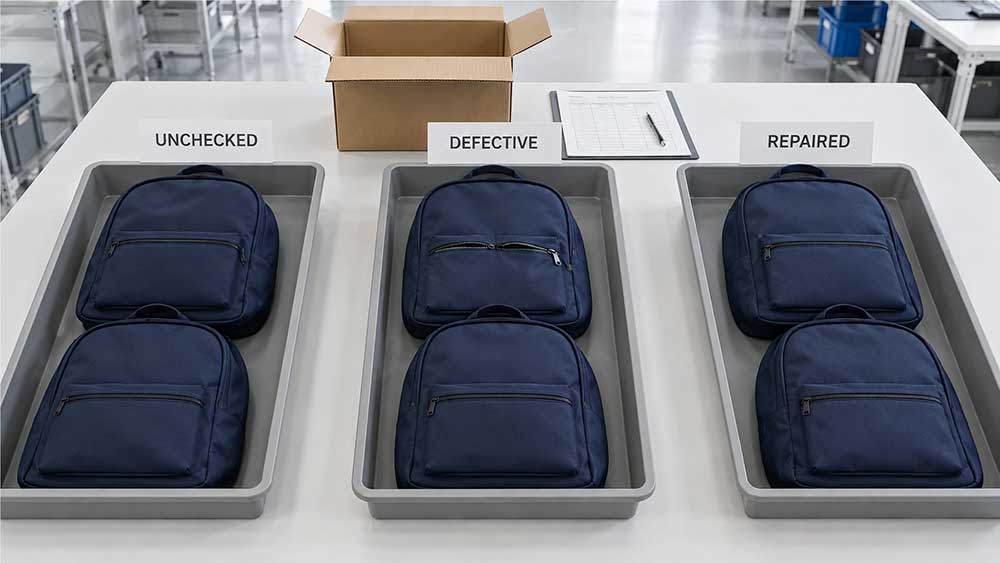
Ask the factory to separate unchecked goods, defective units, repaired stock, and goods approved for shipment. If pickup is already booked, coordinate with the factory and logistics provider before dispatch.
Then confirm why the inspection failed. Excessive workmanship defects, a failed function test, incorrect materials, and labeling errors require different responses.
Compare the findings with the approved sample, current specifications, tolerances, and inspection checklist. Make sure the factory and inspector used the same document versions and measurement methods. For product-specific checks, see this laptop bag quality inspection checklist.
Confirm whether the order was fully inspected or sampled. For a small order, such as 100 bags, checking every unit can be practical. Larger orders commonly use sampling inspection. There is no universal quantity cutoff: the method also depends on the inspection time, product risk, checks required, and buyer’s instructions.
A factory’s full inspection and a buyer’s third-party sampling inspection may both apply to the same order. Confirm who checked the goods, how many units were examined, and what each inspection covered.
Full inspection means every unit receives the agreed checks. It does not mean every bag undergoes every possible test or that defects cannot be missed.
For sampling inspections, check the agreed AQL criteria. Bag inspections commonly use AQL 2.5, with defect categories and the complete sampling plan agreed in advance. Review the lot size, inspection level, sample size, and acceptance and rejection numbers.
AQL 2.5 is not a blanket allowance for 2.5% defective bags. Also confirm whether the report counts defective units or individual defects, since one bag may contain several defects. ASQ’s introduction to sampling standards explains these different approaches.
Safety and specified functional requirements need their own acceptance criteria. If the report contains an error, request a documented correction rather than changing the requirements to obtain a pass.
2. Establish how much stock is affected
Use the inspection coverage and traceability records together.
After a sample inspection, investigate beyond the defective bags found in the sample. Ask the factory to trace the issue by style, color, production date, operation, component batch, and carton number.
After a full inspection, use the unit-level results to identify and separate defective goods. Check whether the inspection covered the problem now under review and whether any results need verification. A full appearance check, for example, would not establish the strength of a hidden reinforcement.
Suppose zipper failures appear in bags made with one component batch. That provides a starting point for investigation. Other stock should only be treated as unaffected when records and checks support that conclusion.
If the records cannot show which goods are affected, keep all potentially affected goods on hold. Repairing only the defective samples is insufficient, while reinspecting every characteristic of every bag may be unnecessary if reliable records already establish the scope.
3. Choose a correction that fits the defect
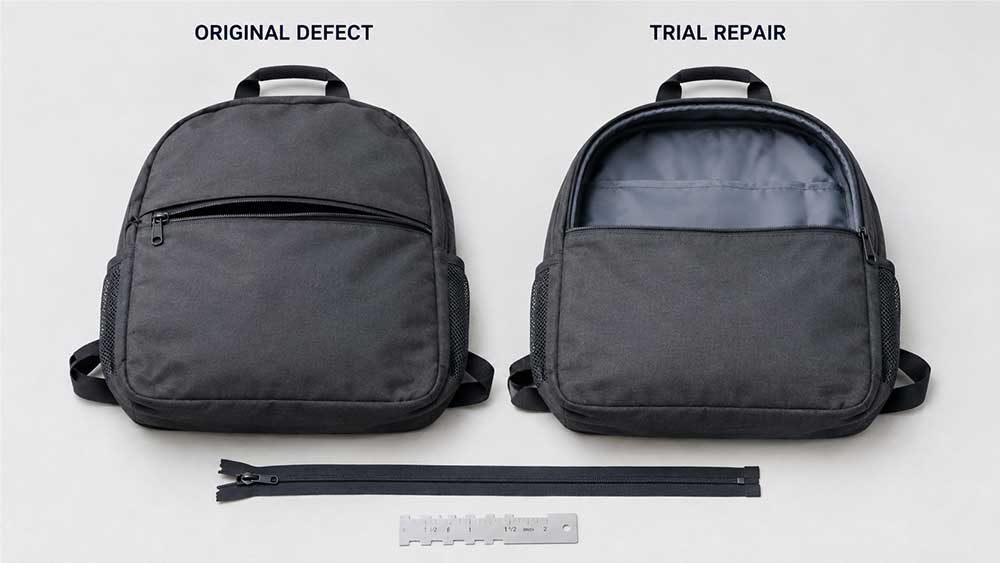
Ask the factory to explain what it will do and how the result will be checked.
Loose thread ends may be resolved through finishing work. Incorrect labels may require relabeling and a carton-content check. A failed zipper, missing reinforcement, or wrong fabric needs a closer assessment of whether repair can restore the product requirements.
Before full rework, have the factory repair a few affected bags:
- Removing and repositioning a sewn-on logo patch may leave visible needle holes.
- Replacing a zipper may distort the opening or catch the lining.
- Repeated stitching at a strap attachment may damage the surrounding material.
- Repairing a welded seam may affect its seal.
For welded waterproof bags, check the repaired construction against the agreed performance requirements. This RF-welded seam inspection guide covers relevant checks.
If the factory proposes full sorting after a failed sample inspection, define exactly what each unit will be checked for. Sorting screens for specified defects; it does not replace necessary material or performance testing.
4. Verify the corrected goods and approve release
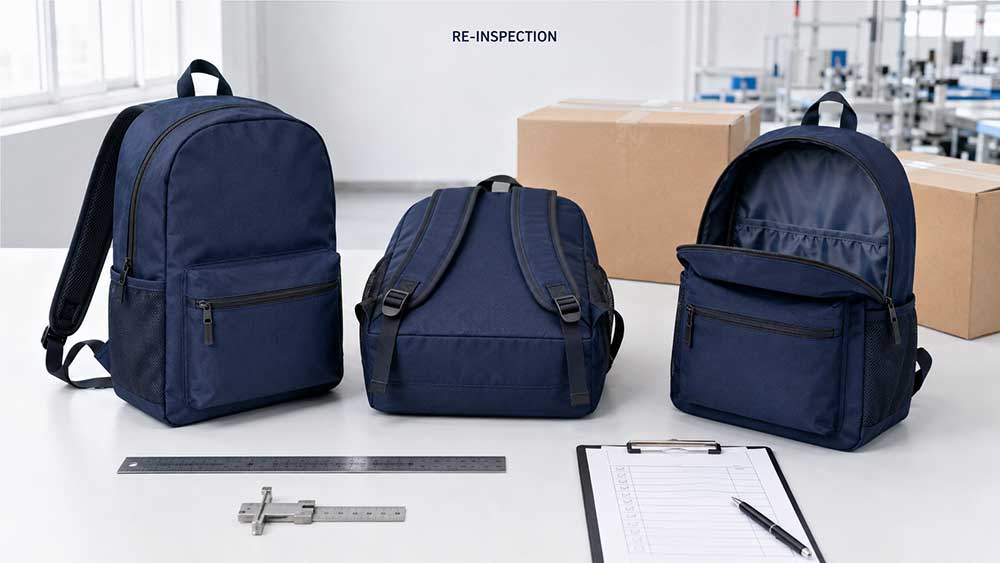
Request records showing the quantities checked, repaired, replaced, rejected, and repacked.
Match the verification method to the original inspection arrangement and the risks introduced by correction:
- For a small order inspected in full: Recheck repaired and replacement units against the agreed requirements. Extend the check where the defect or repair could affect other goods or characteristics.
- For a batch rejected through sampling: Verify the corrected batch under the agreed sampling procedure, including applicable rules for resubmitted batches. The inspector should select the sample.
- For a failed performance test: Repeat the relevant test using the agreed method and coverage. An appearance check alone cannot close a performance failure.
Include damage introduced by repair, final quantities, and packaging. Do not repeatedly sample an unchanged batch until one result passes.
When the evidence supports release, the authorized buyer representative should approve the exact quantity and cartons for shipment. If a specific deviation is accepted, document it clearly; that approval does not mean the goods met the original specification.
What to Do When Defects Are Found After Delivery
1. Isolate the inventory and preserve evidence
Separate affected goods from inventory approved for sale. Record their warehouse location and identify the styles, colors, batches, and cartons involved.
Before repairs or repacking change the condition of the goods, retain:
- Receiving date, purchase order, and delivery references
- Carton numbers and shipping labels
- Photos of external packaging and relevant internal packing
- Clear photos or videos of the defects
- Inspection method, quantity checked, and quantity found defective
- Representative defective samples, where practical
- Measurements or test results compared with the agreed requirements
Keep confirmed defective units separate from stock that has not yet been checked. State whether the receiving results come from a full check, a random sample, or selected cartons opened because damage was suspected.
If affected products have already been distributed, trace where they went and assess the necessary response, especially where safety or essential function is involved.
2. Notify the supplier promptly
Send a factual written summary of the order, discovery date, products involved, defects, and available evidence. Check the notification requirements in the purchase agreement and any relevant transport or insurance arrangements.
You do not need to finish the investigation before reporting the issue. Explain what is confirmed, what remains unknown, and when further results will be available.
For a full check, report the recorded defective quantity for the characteristics examined. For a small or targeted sample, avoid presenting the observed proportion as the exact defect rate of the whole delivery.
Request a named contact and agree on a response date.
3. Compare the findings with the original records
Review the received goods against the approved sample, specifications, pre-shipment report, retained factory samples, and production records. Check carton condition, delivery records, and relevant storage information as well.
A defect discovered after delivery may have originated during manufacturing, packing, transport, or storage. The discovery date alone does not establish the cause.
For illustration, crushed cartons and deformed bag panels may point toward handling damage. Missing reinforcement inside apparently undamaged bags may direct attention to production records. Both require supporting evidence.
The guide to common laptop bag manufacturing defects can help buyers describe stitching, zipper, lining, and reinforcement problems precisely.
If the pre-shipment inspection passed, review what it covered. A passed sample inspection does not establish the condition of every unit, as explained in NIST’s acceptance sampling guidance. For goods inspected in full, check whether the later defect was within the original scope or could have developed afterward.
If the evidence remains disputed, consider an independent inspection or suitable test. Agree on the scope, method, and cost before commissioning it.
4. Agree on a practical remedy
Compare the options against the defect, local repair capability, replacement lead time, and total handling cost.
| Remedy | When it may be practical | What to agree in writing |
|---|---|---|
| Local sorting | Defined checks can reliably identify the problem | Criteria, labor cost, records, and handling of rejected units |
| Local repair | A suitable method and capable service provider are available | Trial repair, approved method, cost, and verification |
| Replacement units or components | Replacement is more likely than repair to meet requirements | Quantity, specifications, timing, freight, and treatment of defective goods |
| Return for repair or replacement | Returning the goods is technically and commercially workable | Authorization, destination, quantities, transport, and costs |
| Refund, credit, or price adjustment | A financial remedy fits the confirmed problem | Amount, affected quantity, settlement date, and treatment of the goods |
Returning the entire shipment is not always necessary. Equally, a discount does not restore a failed handle or make an unsuitable product fit for its intended use.
Before local repairs begin, agree on a trial repair and the cost arrangement. Preserve representative evidence of the original condition, and record any agreed return or disposal before removing defective goods.
Verify repaired or replacement products before adding them to approved inventory. Confirm that any agreed refund, credit, or other financial arrangement has also been completed.
Get a Specific Correction Plan From the Supplier
The same concise record can support both situations.
| Item | Information needed |
|---|---|
| Affected goods | Purchase order, styles, colors, quantities, batches, and carton references |
| Findings | Specific defect, corresponding requirement, inspection coverage, and evidence |
| Scope | Confirmed affected stock and goods still awaiting checks |
| Action | Sorting, repair, replacement, return, or another agreed remedy |
| Responsibility | Named contacts for the supplier, buyer, and any service provider |
| Schedule and costs | Completion dates and agreed allocation of expenses |
| Verification | Checks and records needed to confirm completion |
| Prevention | Confirmed cause and the change intended to prevent recurrence |
“We will improve quality” does not explain how the current order will be resolved.
For a missing reinforcement operation, the supplier should investigate why it was missed and why existing checks failed to detect it. The resulting action might involve clearer work instructions or an additional operation check, depending on the findings.
A clear email or shared worksheet is sufficient for many orders. Each commitment needs an owner, a completion date, and evidence of completion.
Confirm Costs, Timing, and the Final Outcome
Before shipment, additional costs may include factory rework, replacement materials, re-inspection, repacking, and booking changes. After delivery, local labor, warehousing, replacement freight, and return transport may also matter.
Keep supporting records and confirm who will pay before authorizing additional work. If the cause is still under investigation, separate approved immediate actions from costs that remain under discussion.
Ask for a schedule that includes checking and packing after repairs. “Rework finished” may not mean the goods are ready for pickup or sale.
Payment and remedy decisions should follow the purchase agreement and relevant circumstances. Neither a failed report nor full payment alone settles the parties’ responsibilities.
Close the issue with a record of final quantities, product status, and the agreed financial outcome. For the next order, update the control that failed, such as a specification, component check, or production checkpoint. The sample-to-bulk consistency guide explains these earlier controls.
Discuss Bag Quality Requirements With Vancharli Outdoor
When developing a custom bag with Vancharli Outdoor, provide your specifications, intended use, approved sample requirements, and inspection criteria.
Agree on full inspection or sampling, how AQL 2.5 applies where sampling is used, and any additional product tests. Also confirm how quality concerns will be reported before shipment and after delivery. These details give both teams a clear reference for reviewing defects and proposed corrections.
Frequently Asked Questions
Should an order of 100 bags receive full inspection?
Full inspection can be practical for an order of this size, particularly for appearance and routine function checks. However, 100 units is not a universal cutoff. Confirm the scope, available inspection time, product risks, and any tests that require separate sampling.
Does full inspection guarantee zero defects?
No. It means every unit receives the agreed checks. Inspection may not cover every characteristic, and human or equipment errors can still occur. Keep the inspection scope and results clear.
Does AQL 2.5 mean buyers must accept 2.5% defective bags?
No. AQL 2.5 is used within an agreed sampling plan to determine acceptance and rejection criteria. It is not a blanket allowance for defective goods or a rule that settles every complaint after delivery.
Can buyers release the acceptable portion of an order?
Potentially, if that portion can be separated, traced, and verified, and no unresolved issue could also affect it. Identify the approved quantities and cartons while keeping defective and unchecked goods separate.
What if the order has already been paid in full?
Document the defects, notify the supplier promptly, and review the agreed quality and remedy terms. Discuss a specific resolution and record the quantity or amount, responsible party, and completion date.
What if the supplier refuses to cooperate?
Preserve the evidence and communication records, escalate to the appropriate management contact, and refer to the agreed quality and dispute-resolution terms. Independent inspection can help clarify disputed facts; further action depends on the agreement and circumstances.





Comments are closed