


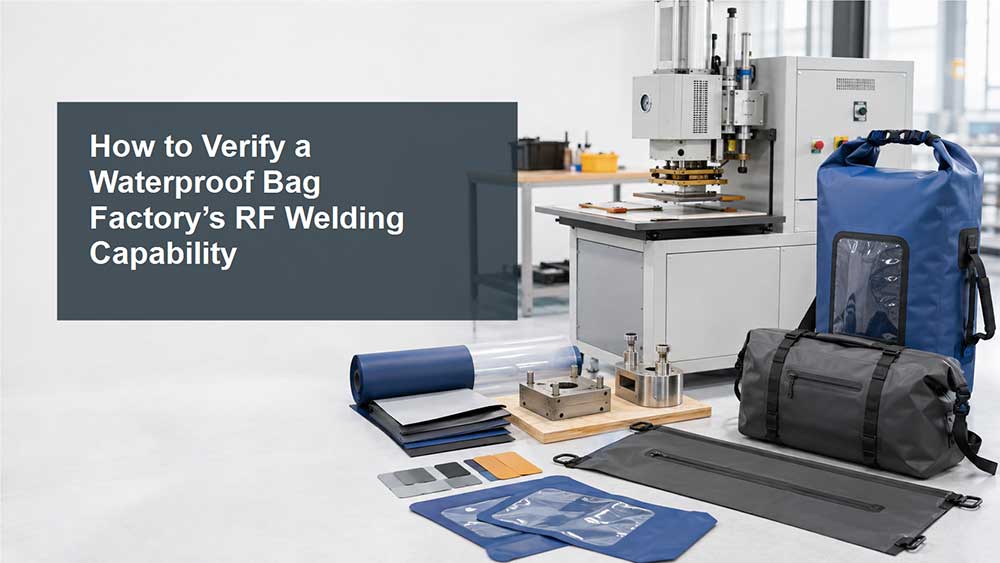
How to Verify a Waterproof Bag Factory’s RF Welding Capability
To verify a waterproof bag factory’s RF welding capability, do not stop at equipment photos or a general claim of welding experience. Ask the factory to demonstrate that it can weld your intended material, build the product with suitable tooling, deliver a meaningful sample within an agreed schedule, and repeat the approved result during bulk production.
A factory may have RF welding equipment but still struggle with a new material, difficult corner, waterproof zipper, multi-layer intersection, or complex bag structure. Stronger evidence comes from a sample made under the planned production conditions, supported by clear specifications, relevant test results, and controlled production methods.
| What to verify | Useful evidence | Weak evidence |
|---|---|---|
| Material compatibility | Trial welds made with the intended bulk material | “We weld TPU and PVC” |
| Relevant experience | Samples with similar materials and construction | A large product catalog |
| Equipment suitability | Equipment type and working range match the product | Machine quantity alone |
| Tooling capability | Product-specific electrode, fixture, and access review | Photos of unrelated molds |
| Sample delivery and quality | Realistic timing and a sample that meets agreed requirements | A rushed sample made with substitute materials |
| Process control | Approved setup, first-piece checks, and change control | Settings adjusted only by operator feel |
| Weld performance | Agreed strength and finished-product leak tests | Visual inspection alone |
| Production consistency | Trial run using the planned bulk process | One handmade development sample |
Define the Product Before Evaluating the Factory
A factory cannot prove that it is suitable for a project until the product requirements are reasonably clear.
Before evaluating the welding line, provide:
- Product type and dimensions
- Intended TPU- or PVC-based material
- Material thickness or construction
- Bag capacity and expected load
- Closure type
- Handles, straps, valves, windows, pockets, and reinforcements
- Required level of water protection
- Intended use
- Expected order quantity
- Required tests and acceptance criteria
A simple roll-top dry bag, waterproof backpack, clear equipment pouch, and zippered waterproof duffel do not create the same welding challenges.
The expected water protection also needs to be defined. “Waterproof” may refer to rain and splash protection, temporary water exposure, or a more demanding application. The construction and finished-product test should match the claim the product is expected to make.
Confirm Which Welding Process Will Be Used
RF welding is also known as high-frequency or dielectric welding. It uses electromagnetic energy together with pressure to join suitable thermoplastic materials.
However, not every process described as “welding” is RF welding. A factory may also use:
- Hot-air welding
- Hot-wedge welding
- Heat sealing
- Ultrasonic welding
- Sewn seams with seam tape
These methods are not automatically better or worse than one another. Their suitability depends on the material, seam design, bag shape, production volume, and performance requirement.
Ask the factory:
- Which seams will be RF welded?
- Will any seams use another joining method?
- Is the welding performed in-house or subcontracted?
- Which materials does the factory regularly weld?
- Has the proposed process been used on a similar construction?
- How will stitched attachments be kept outside the protected compartment?
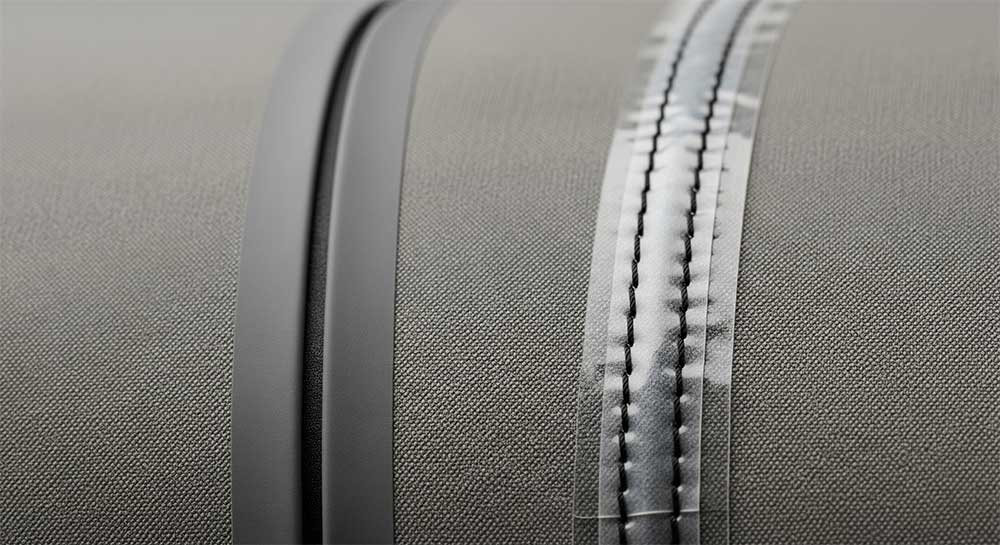
If a product combines welding with taped or sewn construction, the transition between the different methods should be shown clearly in the drawings. This guide to RF-welded and seam-taped dry bags explains the main differences between the two seam constructions.
Verify the Intended Material
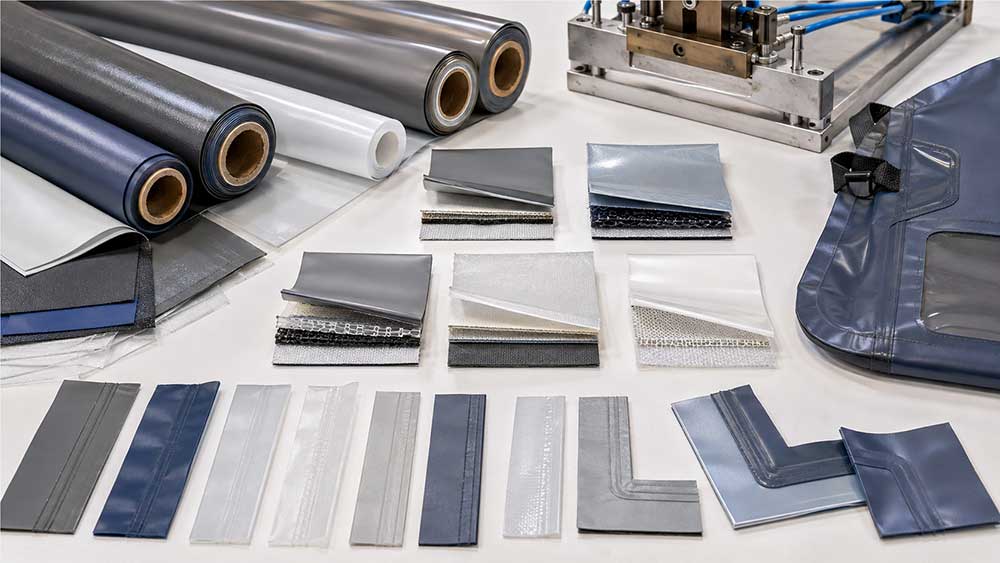
A factory saying it can weld TPU or PVC is only a starting point.
Welding behavior can change with:
- Polymer formulation
- Coating or film thickness
- Base fabric
- Surface texture and finish
- Reinforcement layers
- Printing or other surface treatments
- Material age and storage condition
- The number of layers in the joint
The TWI explanation of RF welding notes that the process uses electromagnetic energy and pressure to join suitable polar thermoplastics. Material compatibility is therefore part of the welding process and cannot be confirmed from appearance alone.
Ask the factory to make trial welds with the material intended for bulk production. If the exact production material is not yet available, record which development material was used and repeat the relevant checks when the bulk material arrives.
Do not rely only on a small, straight test strip. The material should also be evaluated in the actual product construction, particularly at corners, intersections, closures, reinforcements, and other difficult areas.
Look for Relevant Product Experience
A factory does not need to have produced your exact product before, but it should understand similar materials and construction challenges.
Relevant experience may include products with:
- A similar material construction
- Comparable seam length
- Similar bag capacity
- Waterproof zippers
- Transparent windows
- Valves or molded parts
- Welded reinforcement patches
- Multi-layer corners
- Load-bearing handles or straps
- A similar water-protection requirement
Ask the technical team to explain how a comparable product is assembled and which areas are the most difficult to weld. A useful answer should go beyond “we have made many dry bags.”
The team should be able to discuss:
- The order in which the seams are welded
- How corners are positioned
- How the tool reaches each joint
- How thick intersections are handled
- How attachments avoid puncturing the protected compartment
- Which areas need additional inspection or testing
Product photos can support the discussion, but they do not prove process control. Physical samples, approved drawings, test records with confidential information removed, and a clear technical explanation provide stronger evidence.
Check Whether the Available Equipment Is Suitable
RF welding machines are commonly used for multiple products. A factory does not need to assign one specific machine during an initial supplier review.
What matters is whether the available equipment has the right working range for the product and can accommodate the required tooling, material, and assembly process.
Review:
- Equipment type and usable working area
- Whether the product can be positioned correctly
- Access for long seams, deep gussets, and partly assembled bags
- Control of pressure, welding, holding, and cooling stages
- Compatibility with the required electrodes and fixtures
- Equipment condition and maintenance
- Available capacity for the expected order
A factory with several small machines may still be unable to handle a large waterproof duffel.
Ask what type and capacity of equipment will be used for sampling and bulk production, and whether production may move between compatible machines.
Moving production between suitable machines is not automatically a problem. However, the factory should confirm the setup and inspect the first finished pieces before continuing.
Review Tooling and Product Accessibility
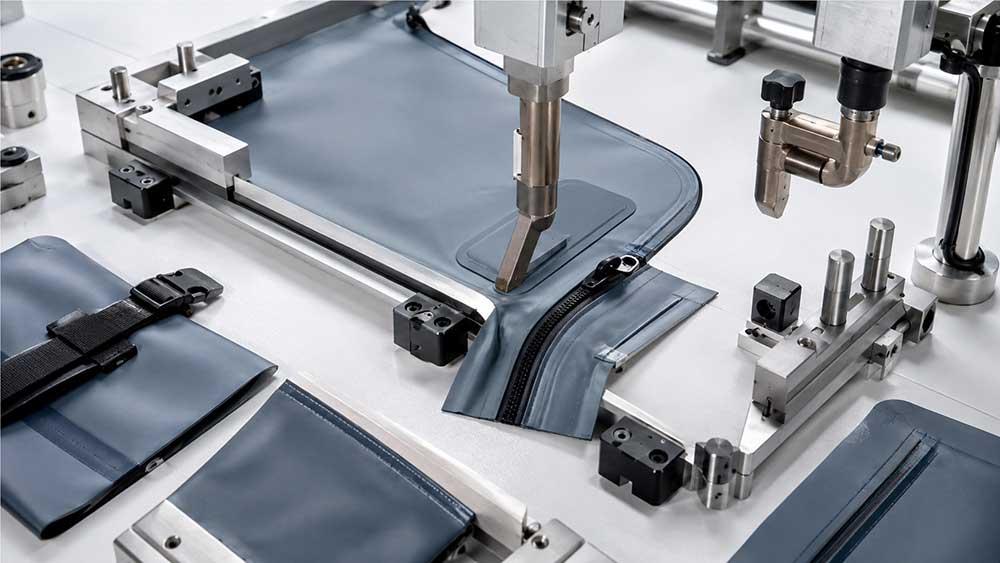
RF welding capability depends on more than the machine. The electrode, supporting surface, fixture, panel positioning, and assembly sequence all affect the result.
The factory should review:
- Electrode shape and weld path
- Required panel overlap
- Positioning guides and fixtures
- Support beneath the joint
- Access to every functional seam
- Corners and curved sections
- Areas where several layers meet
- The final closing seam
- The risk of cutting or thinning material beside the weld
A seam may look simple on a flat drawing but become difficult to reach after a zipper, base panel, reinforcement, or another section has been installed. Each seam should therefore be considered in its actual production sequence.
The design principles behind tool access, panel overlap, multi-layer intersections, and the final closing seam are covered in this guide to designing waterproof bags for RF welding.
The factory may develop tooling in-house or work with an outside supplier. Either approach can work, but responsibilities for modification, maintenance, ownership, and replacement should be clear.
Find Out How the Welding Setup Is Controlled
RF welding depends on several conditions working together. These may include energy, pressure, welding time, holding or cooling time, tooling, material construction, and joint thickness.
A buyer does not necessarily need the factory’s confidential machine-setting values. More important is whether the factory has a controlled method for developing, approving, recording, and changing the setup.
Ask:
- Who approves the welding setup?
- Are trial welds made before production?
- How is the first finished piece checked?
- What happens when material thickness or surface behavior changes?
- How is the setup checked when production moves to another compatible machine?
- Who is allowed to adjust the process?
- How are unauthorized changes prevented?
- Which changes require new samples or tests?
“We adjust it until it looks right” is not a strong answer.
Experienced operators remain important, but visual judgment should be supported by an approved sample, clear requirements, and suitable testing.
Evaluate the Sample, Timeline, and Revision Process
A development sample can show that the factory can make one acceptable bag. It does not automatically prove that the same result can be repeated during bulk production.
The sample should use, as far as practical:
- The intended material construction
- Production tooling or an agreed equivalent
- The planned assembly sequence
- The correct reinforcements and closures
- A suitable production line
- The agreed inspection and test methods
The sample must include the difficult areas of the product, not only an easy straight seam. Pay particular attention to:
- Weld beginnings and ends
- Corners and curves
- Seam intersections
- Areas with several layers
- Zipper ends
- Valves and windows
- Reinforcement edges
- The final closing seam
Detailed defect identification is covered in this guide to inspecting RF-welded seams before bulk production. At the factory-qualification stage, the main question is whether the supplier has a consistent way to find, record, correct, and retest unacceptable welds.
Check What the Sample Lead Time Includes
Sample timing is important because it reflects how well the factory coordinates material sourcing, engineering, tooling, welding, assembly, and testing. However, the fastest sample is not automatically the strongest evidence of capability.
A sample delivered quickly may have little value if it uses:
- A substitute material that behaves differently
- Temporary tooling that will not be used in production
- A simplified seam or reinforcement
- A different closure or accessory
- Handwork that cannot be repeated efficiently in bulk
- Incomplete testing
Before sampling begins, ask for a realistic schedule covering:
- Material confirmation or sourcing
- Drawing and construction review
- Electrode and fixture preparation
- Trial welding
- Product assembly
- Inspection and testing
- Sample revision and retesting, if required
There is no single correct lead time for every waterproof bag. A simple dry bag made with available material normally requires less preparation than a waterproof backpack with custom tooling, a new zipper, several reinforcements, and complex welded intersections.
The factory should explain what the quoted lead time includes. If a material, tooling, or technical issue may cause a delay, the buyer should be informed before the agreed delivery date.
Judge Sample Quality Against the Latest Requirements
A neat appearance alone is not enough. Check whether:
- The intended material or an agreed development material was used
- Dimensions and construction match the latest drawing
- Difficult corners and intersections are properly completed
- Welded seams meet the agreed appearance and strength requirements
- Closures, valves, handles, and reinforcements work as intended
- The finished product passes the agreed water-protection test
- Differences from the planned bulk process have been disclosed
- Problems, corrections, and retest results have been recorded
An initial development sample may still require revisions, especially when the product uses a new material or construction. However, critical weld or leak failures should not be ignored or presented as approval-ready.
What matters is whether the factory identifies the problems clearly, explains the required corrections, provides a realistic revision schedule, and proves that the changes work in the next sample.
The strongest evidence is not simply a short sample lead time. It is the ability to deliver a useful sample within the agreed schedule, find problems early, correct them efficiently, and turn the approved sample into a repeatable production process.
Require Tests That Match the Product
A neat-looking weld is a useful starting point, but appearance alone cannot confirm mechanical strength or water protection.
Depending on the product, the validation plan may include:
- Visual and dimensional inspection
- A controlled seam-strength test
- Leak or bubble testing
- Pressure-decay testing for suitable airtight products
- Spray or water-exposure testing
- Immersion testing under agreed conditions
- Flexing followed by leak testing
- Loaded handling followed by another inspection
Not every waterproof bag needs the same test. A rain-resistant backpack, roll-top dry bag, waterproof zipper pouch, and airtight product should not automatically use the same pressure, duration, or water depth.
ASTM D751 includes test methods for coated fabrics, including seam strength and other relevant properties. However, stating “test according to ASTM D751” is not a complete acceptance requirement.
The buyer and factory still need to agree on:
- Sample preparation
- Test direction
- Test conditions
- How the result will be recorded
- The minimum acceptable result
- The acceptable failure mode
For finished-product testing, record the closure method, test conditions, pass/fail requirements, location of any leakage, and retest result after corrective action.
Do not apply arbitrary internal pressure to a bag that was not designed to hold pressure.
Check Repeatability Before Bulk Approval
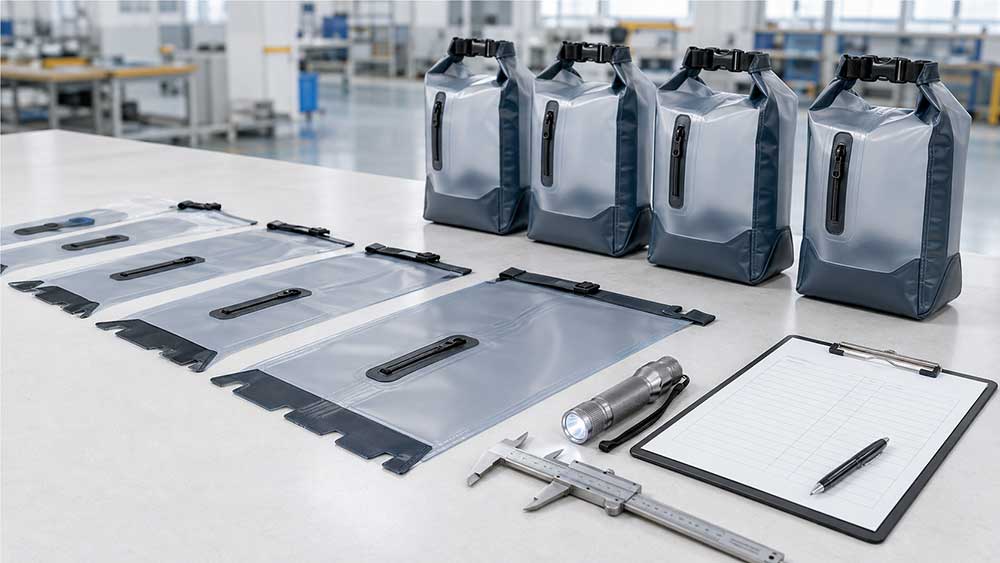
The real measure of factory capability is not whether one technician can make one good sample. It is whether the approved result can be repeated during normal production.
Ask how the factory controls:
- First-piece approval
- Production start-up
- Different operators or shifts
- Material-lot changes
- Movement between compatible machines
- Electrode repair or replacement
- In-process inspection
- Failed checks and line stoppage
- Corrective action and retesting
- Product identification and traceability
If practical, review several products made at different stages of a trial run rather than inspecting only the best sample selected by the factory.
The factory should also explain what happens after a weld fails. A credible process includes holding the affected products, investigating the likely cause, correcting the process, producing new samples, and confirming the result through retesting.
Repeated leaks, cracks, or layer separation should be investigated systematically. This waterproof bag failure analysis guide explains how to separate visible symptoms from likely causes.
Review the Welding Area and Material Control
A clean production area does not prove that a weld is strong, but poor handling can introduce preventable problems.
During an on-site or remote audit, look at:
- How material rolls are identified
- Whether approved and unapproved materials are separated
- How cut panels are stored and protected
- Whether welding surfaces are kept clean
- How electrodes and fixtures are stored
- How rejected pieces are separated
- Whether operators have the latest work instructions
- How welded parts move to the next production stage
Dust, oil, loose fibers, damaged coatings, incorrect material orientation, and mixed material lots can all affect production. The factory should have a practical way to prevent these problems and stop questionable parts from continuing through assembly.
If an on-site visit is not possible, ask for a live video walkthrough rather than relying only on edited promotional footage. Connect what you see—the materials, equipment, tooling, operators, testing, and records—to the actual project under review.
Watch for Warning Signs
Be cautious if a factory:
- Cannot explain whether its equipment is suitable for the product’s size, construction, and tooling requirements
- Claims that all TPU or PVC materials use the same settings
- Provides only a straight weld strip instead of a finished sample
- Cannot explain the assembly sequence
- Avoids discussing corners, intersections, or zipper ends
- Relies only on visual inspection
- Applies the same leak test to every product
- Cannot provide clear pass/fail requirements
- Moves production between machines without checking the setup
- Repeatedly misses the agreed sample schedule without explaining the material, tooling, or technical reason
- Delivers a fast sample using substitute materials or temporary processes that do not represent bulk production
- Treats critical weld or leak failures as minor sample issues
- Repairs failed samples without recording the cause
- Claims that one successful sample guarantees bulk consistency
- Promises “zero failure” without explaining the test conditions
A reliable supplier does not have to disclose every proprietary process detail. It should still be able to explain how the project will be controlled and what evidence will support approval.
RF Welding Capability Checklist
Before selecting a factory, confirm that:
- The intended material has been trial-welded
- The factory understands the required water-protection level
- The planned welding process has been identified
- In-house and subcontracted operations are clearly disclosed
- Suitable equipment is available for the product’s size and construction
- Tool access and assembly sequence have been reviewed
- Difficult corners, intersections, closures, and reinforcements are included in the sample
- The welding setup is approved and controlled
- Moving production between machines triggers setup confirmation and first-piece inspection
- The sample schedule covers material, tooling, assembly, and testing
- Sample quality is checked against the latest approved requirements
- Differences between sample and bulk methods are disclosed
- Strength and leak tests have clear methods and acceptance criteria
- The production trial represents the planned bulk process
- Material and tooling changes trigger a new review
- Failed products are held, investigated, corrected, and retested
- Approval samples, results, and revisions are recorded
The decision should be based on evidence from the buyer’s actual product—not simply on equipment quantity or the shortest sample lead time.
Final Takeaway
A capable RF welding supplier should be able to connect the material, product structure, equipment, tooling, sample process, testing, and production controls into one repeatable manufacturing plan.
Sample timing and quality are central to that assessment. The factory should provide a realistic schedule, communicate problems early, deliver a sample that represents the intended product, and correct identified issues efficiently. It should then show that the approved result can be reproduced during normal production.
For custom projects, Vancharli Outdoor can review material selection, welded construction, tool access, sample development, production planning, and product-specific testing as part of its waterproof bag manufacturing process. The welding, sampling, and acceptance requirements should be agreed during development before bulk production begins.
FAQ
Is the number of RF welding machines a reliable measure of factory capability?
No. Machine quantity may indicate potential capacity, but it does not prove material compatibility, suitable tooling, process control, sample quality, or product-level testing. Buyers should confirm that the available equipment and process are suitable for their product.
Does a waterproof bag need to stay on the same RF welding machine throughout production?
Not necessarily. Compatible machines may be used for the same product. If production moves to another machine, the factory should confirm the setup and inspect the first finished pieces before continuing.
Does a shorter sample lead time mean the factory is more capable?
Not always. Speed matters only when the sample uses the correct materials, construction, tooling, and testing. A realistic schedule may provide stronger evidence than a rushed sample that cannot be repeated during bulk production.
Is an imperfect first sample a sign of poor welding capability?
Not necessarily. An initial development sample may need revisions when it uses a new material or construction. However, critical weld or leak failures must be corrected and retested before the sample is presented for approval.
Should a buyer request the factory’s exact welding settings?
Not necessarily. Exact settings may be proprietary and can vary between machines. More important questions are how the factory approves the setup, controls changes, checks the first pieces, and confirms the result through testing.
Does every waterproof bag need an immersion test?
No. Testing should match the intended use and stated water-protection claim. Some products require spray or water-exposure testing, while others may need immersion, leak, or pressure-decay testing under agreed conditions.
How can a buyer verify welding capability without visiting the factory?
Use a live remote audit, request samples made under the planned production conditions, review the actual welding and testing process, and ask for clear specifications and test records. Edited videos and factory photos are not enough on their own.
When should the welding process be checked again?
Review the affected welds when the material construction, tooling, equipment type, seam design, assembly sequence, closure, reinforcement, production location, or acceptance requirement changes.


Comments are closed