Trekking vs Mountaineering Backpacks: Key Differences
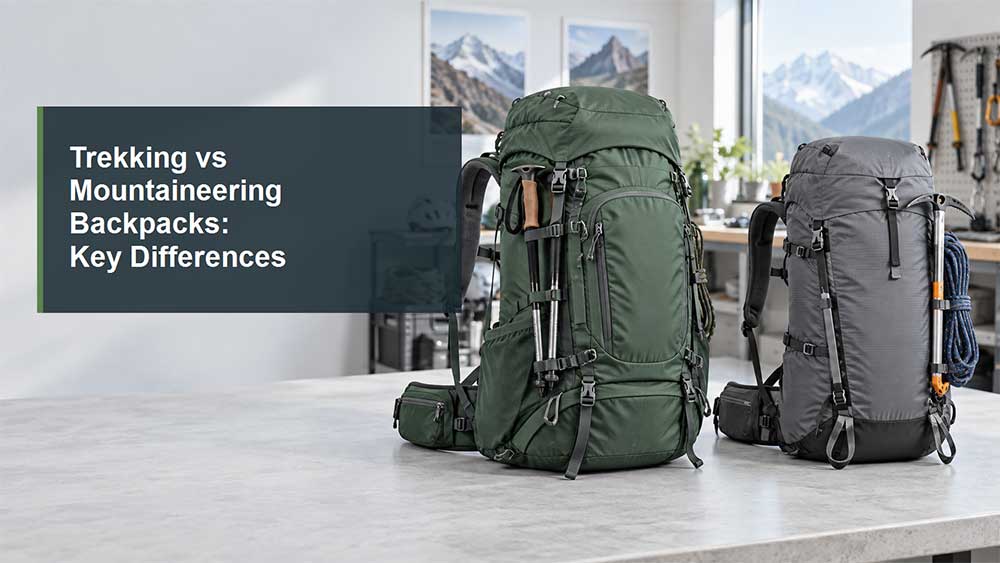
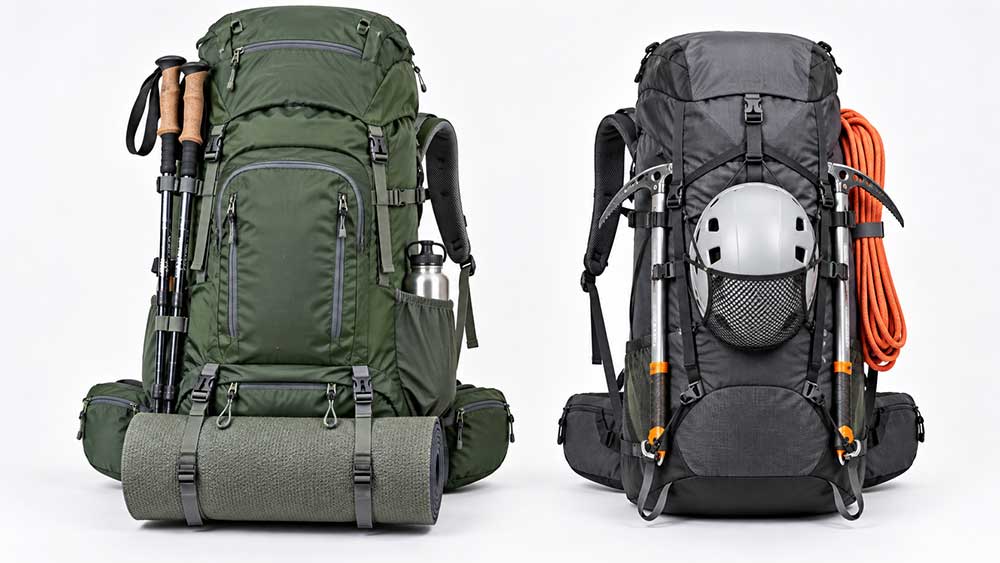
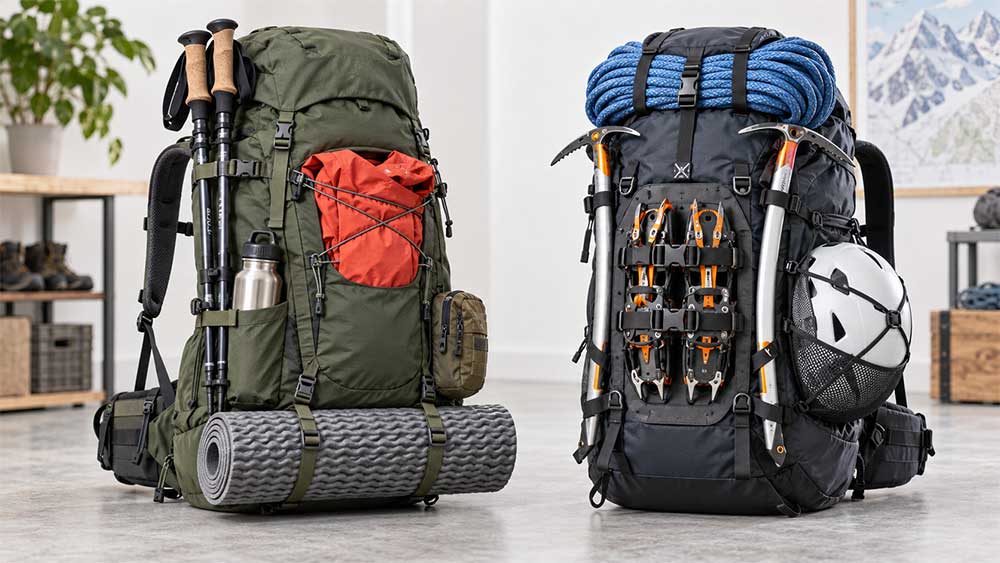
The main difference between trekking and mountaineering backpacks is what each pack needs to do. A trekking backpack is designed to carry supplies comfortably over long days, so it usually prioritizes load transfer, torso adjustment, ventilation, and accessible storage. A mountaineering backpack stays closer to the body for steep or technical terrain and favors stability, head clearance, harness compatibility, and secure carry for an ice axe, crampons, rope, or helmet.
Capacity and a metal frame alone do not define either type. A large trekking pack may have a substantial internal frame, while a compact technical mountaineering pack may use a flexible framesheet, removable aluminum stays, or no rigid frame at all.
Terminology note: In some Asian product catalogs, “mountaineering backpack” is used broadly for almost any large, framed outdoor pack. In North America and Europe, the term usually refers more specifically to a technical alpine pack. A trekking backpack may also be called a backpacking pack in North America.
Carrying supplies comfortably over long walking distances
Moving securely through steep or technical mountain terrain
Typical terrain
Trails, long-distance routes, hut-to-hut treks and wilderness trips
Rock, snow, ice, glaciers and exposed alpine routes
Suspension priority
Load transfer, adjustment, padding and ventilation
Close-to-body stability and freedom of movement
Pack shape
Often wider or deeper, with more storage compartments
Usually tall, narrow and streamlined
Organization
More pockets and convenient access
Simpler exterior with fewer snag points
Equipment carry
Trekking poles, sleeping mats, tents and camp gear
Ice axes, crampons, rope, helmet and other climbing equipment
Hip belt
Usually padded for long-duration load support
Often slimmer, removable or shaped around a climbing harness
Frame
Commonly uses a framesheet and internal stays
May use removable stays, a framesheet or a frameless structure
Capacity
Often 30–70+ liters, depending on trip style
Often 25–60 liters, but expedition packs may exceed 80 liters
How it is classified
Mainly by trip style, load and carrying comfort
Mainly by technical terrain and equipment requirements
These are common design patterns rather than fixed rules. A winter expedition pack, for example, may combine a strong load-bearing frame with many technical mountaineering features.
What Is a Trekking Backpack?
A trekking backpack is designed for trips that involve extended walking while carrying clothing, food, water, shelter and sleeping equipment. Comfort over time is usually more important than keeping the pack as compact as possible.
Most trekking packs therefore emphasize:
Effective weight transfer from the shoulders to the hips
Adjustable torso length
Padded shoulder straps and hip belts
Ventilated back panels
Multiple pockets and access points
Compression straps for stabilizing changing loads
Space for camping or hut-to-hut equipment
A trekking pack does not have to be extremely large. A supported hut-to-hut route may only require 30–45 liters, while a self-supported wilderness trip may need 50–70 liters or more.
A mountaineering backpack—often called an alpine pack—is intended for routes where technical equipment and more demanding movement become part of the trip.
Mountaineering Scotland defines mountaineering as ascending hills or mountains where technical equipment is essential for the hands or feet. This can include the use of crampons, an ice axe or a rope.
Because the wearer may need to scramble, climb, cross snow or move while attached to a rope, the pack must remain stable and avoid interfering with movement. Common design priorities include:
A tall, narrow profile
Close-to-body load positioning
Secure ice axe or ice tool attachments
Crampon, rope and helmet carry options
Minimal loose straps and external pockets
Head and helmet clearance
Compatibility with a climbing harness
Materials and reinforcement suited to contact with rock, ice and equipment
Mountaineering packs are not automatically larger or more heavily framed than trekking packs. Many one-day alpine packs are deliberately compact and simple.
How Do Their Back and Suspension Systems Differ?
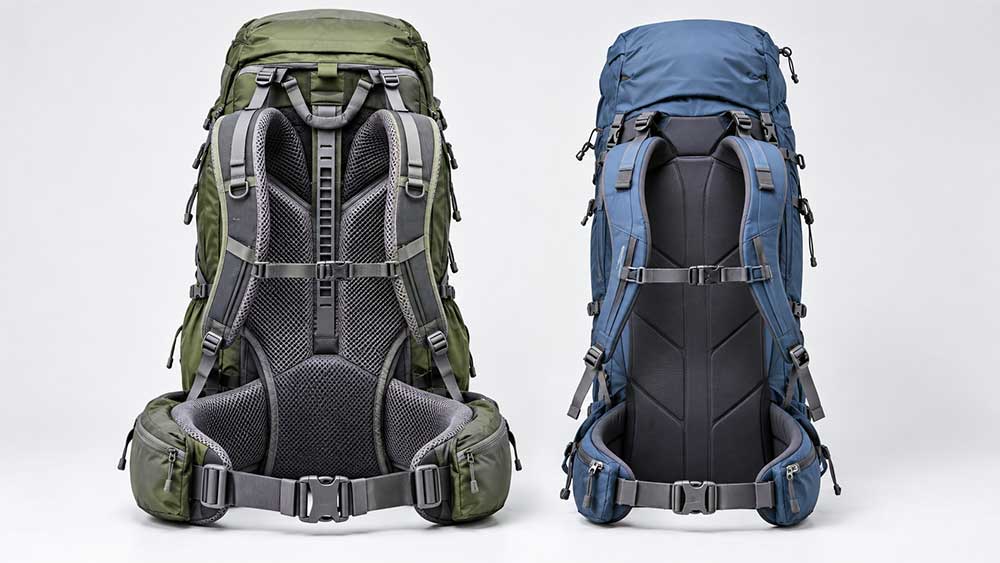
The back panel is only one part of a backpack’s suspension system. The full system may include the frame or framesheet, shoulder straps, hip belt, lumbar support, load lifters and torso adjustment.
The main difference is not whether a suspension system exists. It is what that system is designed to prioritize.
Trekking Suspension Prioritizes Carrying Comfort
A trekking backpack may be worn for six, eight or more hours while carrying food, water and overnight equipment. Its suspension is normally designed to transfer a large share of that weight to the hips.
Common features include:
One or two internal aluminum stays
A molded or semi-rigid framesheet
A supportive lumbar pad
A thick, structured hip belt
Adjustable torso length
Load-lifter straps
Foam channels or tensioned mesh for ventilation
Some trekking packs use a suspended mesh back panel that creates an air gap between the wearer and the pack. This can improve ventilation, especially in warm conditions. The trade-off is that the load may sit slightly farther away from the body, which can affect balance on steep or highly technical terrain.
Mountaineering Suspension Prioritizes Stability
On rock, snow or ice, a pack that shifts from side to side can interfere with balance. Mountaineering packs therefore tend to sit closer to the body and keep the load compact.
Depending on the pack size and intended load, the suspension may use:
A flexible framesheet
One or two removable aluminum stays
Thin foam padding
A low-profile or removable hip belt
A frameless design for lighter technical loads
A compact back panel with limited space between the pack and the wearer
Ventilation still matters, but it is rarely the only priority. Stability, arm movement, helmet clearance and climbing-harness compatibility may be more important.
Large expedition mountaineering packs are an exception. When climbers must carry tents, food, fuel and cold-weather equipment, the pack may need a strong internal frame, substantial padding and a supportive hip belt.
Do Mountaineering Backpacks Need a Metal Frame?
No. A metal frame is not what makes a backpack suitable for mountaineering.
Many large trekking and expedition packs use internal aluminum stays because they help transfer heavier loads to the hips. Some technical mountaineering packs also use aluminum stays, but these may be lighter, shorter or removable.
Other mountaineering packs use only a plastic framesheet or dense foam. Small alpine summit packs may be almost frameless because freedom of movement and low weight matter more than carrying a heavy load.
It also helps to distinguish three structures that are often confused:
Internal frame: Stays or a framesheet are hidden inside the pack. This is common in modern trekking and mountaineering packs.
External frame: A visible frame sits outside the pack body. It is now more common in specialized load-hauling, hunting or military packs than in modern alpine packs.
Tensioned mesh frame: A light perimeter frame holds a ventilated mesh panel away from the back. This is frequently used in hiking and trekking packs and is not a mountaineering identifier.
The correct frame depends on the target load, pack volume, terrain and required freedom of movement.
How Does External Gear Carry Differ?
Mountaineering packs often have more specialized attachment points, but that does not mean their exteriors are more cluttered.
A trekking pack may have:
Stretch side pockets
A large front pocket
Trekking pole loops
Sleeping-mat straps
Hip-belt pockets
A floating lid
Multiple compression straps
These features make food, water, layers and camp equipment easier to reach during a long walking day.
A mountaineering pack may have fewer general-purpose pockets but more specialized attachment points for:
One or two ice axes
Crampons
A climbing rope
A helmet
Skis or snow tools on certain models
Carabiners and technical equipment
Loose straps, open mesh and bulky pockets can catch on rock, branches or climbing equipment. Mountaineering packs therefore often use a cleaner exterior, reinforced attachment points and straps that can be secured when not in use.
Access and Organization
Trekking packs commonly provide more ways to reach stored equipment. Depending on the model, this may include top access, a front or side zipper, a bottom sleeping-bag compartment and several external pockets.
This is useful when the wearer needs to retrieve rainwear, food, a water filter or camp equipment without unloading the entire pack.
Mountaineering packs often use a simpler top-loading or roll-top structure. Fewer zippers and compartments can reduce weight, limit snag points and make the pack easier to operate while wearing gloves.
That simplicity comes with a trade-off: packing order matters more. Equipment needed during the route must remain accessible near the top or under the lid.
Hip Belts and Climbing-Harness Compatibility
A trekking hip belt is normally thick and structured because it must transfer weight to the pelvis over many hours. Pockets are also common because they provide convenient access to snacks, a phone or navigation tools.
A mountaineering hip belt may be thinner, narrower or removable. It should not cover climbing-harness gear loops or prevent the wearer from accessing equipment attached to the harness.
This does not mean that every mountaineering pack has minimal hip support. Packs designed for heavy approaches or high-altitude expeditions may still require a substantial hip belt. The belt design should match both the carried load and the climbing system.
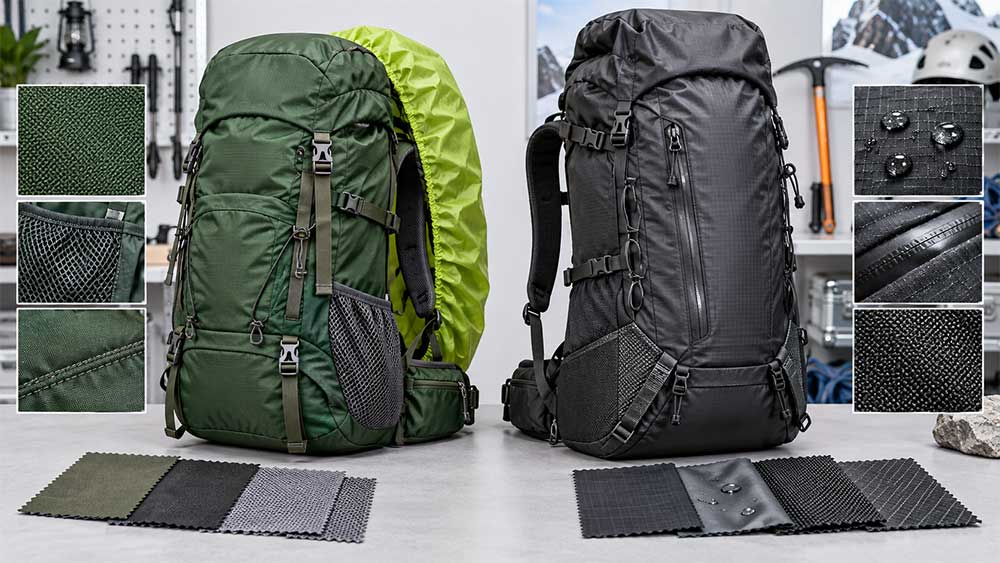
Materials and Weather Protection
Both types of backpacks need durable materials, but wear often occurs in different places.
Trekking packs usually balance abrasion resistance with ventilation, pocket access and long-distance comfort. Stretch mesh, breathable foam and multiple zippers may be practical on trails, although they introduce additional areas that can wear or admit water.
Mountaineering packs may reduce exposed mesh and reinforce areas that contact rock, ice tools or crampons. Smooth exterior fabrics can also shed snow more easily and are less likely to catch on rough surfaces.
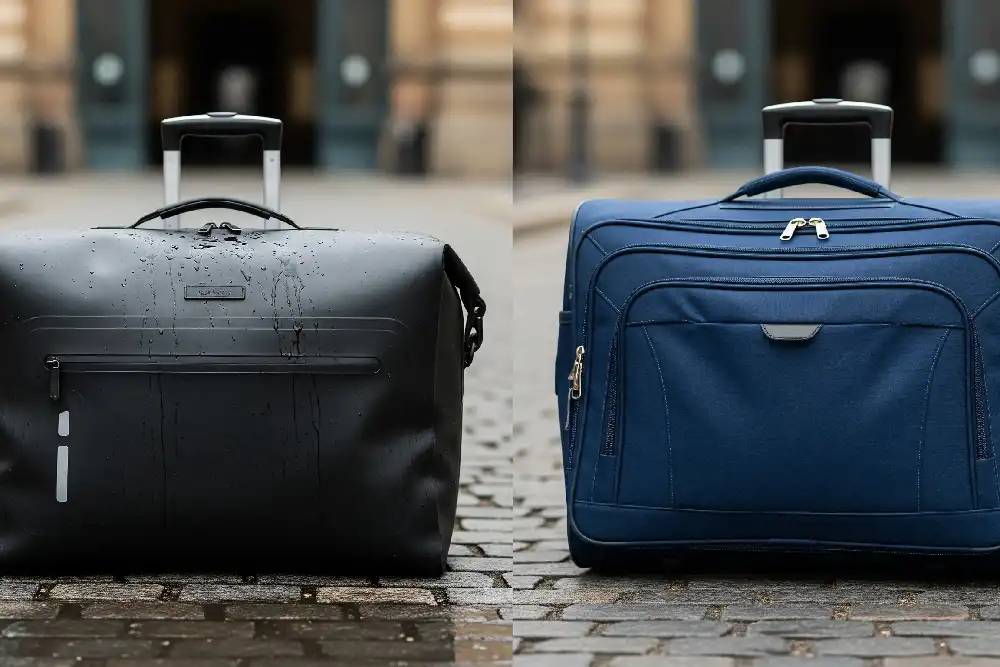
Neither category is automatically waterproof. Coated fabric can resist light rain, but zippers, seams and openings may still allow water inside. Liners, dry bags or a rain cover may still be needed. Our guide to protecting a backpack and essential gear from rain explains these options in more detail.
How Do Trip Duration and Equipment Affect Capacity?
There is no fixed capacity for either category. Trip length matters, but equipment volume, weather, resupply options and shared group gear can matter just as much.
Trip Type
Common Planning Range
Hut-to-hut trekking
30–50L
Self-supported multi-day trekking
50–70+L
One-day alpine climb
25–40L
Multi-day mountaineering
40–60L
Winter or high-altitude expedition
60–90+L
These ranges are starting points, not universal rules. A five-day hut trek can require less capacity than a two-day winter climb because the climber may need insulated clothing, a rope, crampons and emergency equipment.
Capacity and load-bearing ability are also different. Two 50-liter packs can feel completely different when carrying the same weight because of differences in frame strength, torso fit, hip-belt structure and load position.
The pack should be selected only after estimating the complete equipment list. Our article on how much a backpack should weigh when hiking provides additional guidance on managing total load.
Which Backpack Should You Choose?
Choose a trekking backpack if most of your trip involves long-distance walking with food, clothing, sleeping equipment or hut-to-hut gear. Prioritize torso fit, hip-belt support, load transfer, ventilation and convenient access.
Choose a mountaineering backpack if the route requires an ice axe, crampons, rope, climbing harness or frequent movement on steep technical terrain. Prioritize stability, a streamlined shape, technical gear attachments, head clearance and harness compatibility.
A simple decision rule is:
If the main challenge is carrying supplies comfortably for a long distance, start with a trekking pack.
If the main challenge is moving safely with climbing equipment, start with a mountaineering pack.
Can One Backpack Handle Both Activities?
Yes, especially when the activities overlap.
A stable 35–50L trekking pack can work for nontechnical mountain routes if it carries the required equipment securely. Likewise, a supportive mountaineering pack can be used for trekking if its capacity, fit and organization are suitable.
The compromises become more noticeable at the extremes. A highly ventilated trekking pack may feel less stable while climbing. A stripped-down alpine pack may become uncomfortable during a long approach with a heavy load.
For mixed use, look for:
A close-fitting but supportive suspension
Moderate padding rather than an oversized hip belt
Removable or stowable attachment straps
Secure ice axe and trekking-pole carry
Enough compression to stabilize a partially filled pack
A capacity based on the actual equipment list
What Should Brands Define Before Developing Either Pack?
For brands and importers, the label “trekking” or “mountaineering” is not enough to create a useful product specification. Before sampling, define:
Intended terrain and season
Target capacity and carried load
User torso range
Frame or framesheet structure
Required equipment attachments
Hip-belt and harness requirements
Access style and pocket layout
Fabric, reinforcement and weather-resistance needs
These decisions affect pattern shape, foam density, webbing placement, frame construction and load testing.
Trekking and mountaineering backpacks are not separated by capacity, appearance or the presence of a metal frame.
A trekking pack is generally optimized for carrying supplies comfortably over long distances. A mountaineering pack is generally optimized for close-to-body stability, technical equipment carry and unrestricted movement in steep terrain.
The best choice comes from the route, equipment and expected load—not the product name printed on the label.
FAQ
Can I use a mountaineering backpack for normal hiking?
Yes. A mountaineering pack can work well for day hikes or shorter trips if it fits comfortably and provides enough organization. However, it may have less ventilation, fewer pockets and a slimmer hip belt than a trekking pack.
Why can a technical alpine pack feel less comfortable with a heavy load?
Some alpine packs reduce padding, frame weight and hip-belt structure to improve mobility and save weight. That design may be excellent for climbing but less comfortable when carrying heavy camping equipment for many hours.
Is a heavier suspension system always better?
No. A more substantial suspension can improve load transfer, but it also adds weight and bulk. The suspension should match the intended load instead of being as heavy or complex as possible.
Is every 60-liter backpack a mountaineering backpack?
No. Capacity does not determine the category. A 60-liter pack may be designed for trekking, travel, hunting or mountaineering. Its shape, suspension, equipment attachments and intended terrain provide better clues.
What backpack capacity is suitable for a five-day trek?
Many self-supported five-day treks use a 50–70L pack, but this is only a planning range. Hut access, food resupply, climate, sleeping equipment and packing style can significantly change the required capacity.








Comments are closed