Custom Laptop Bag Packaging: A Retail Buyer’s Guide
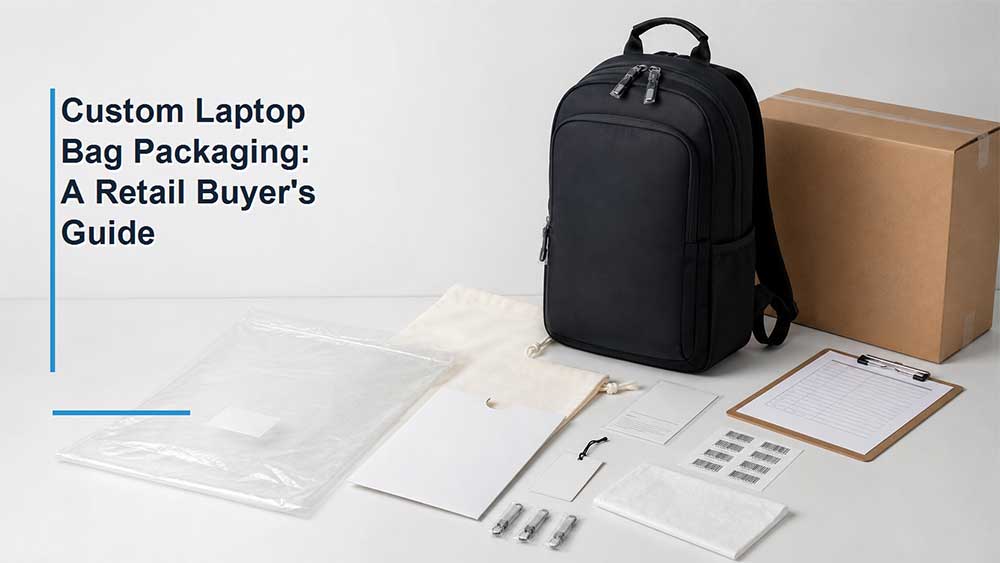
Custom laptop bag packaging should be planned around where the product will be sold and how it will be received—not simply how premium the package looks.
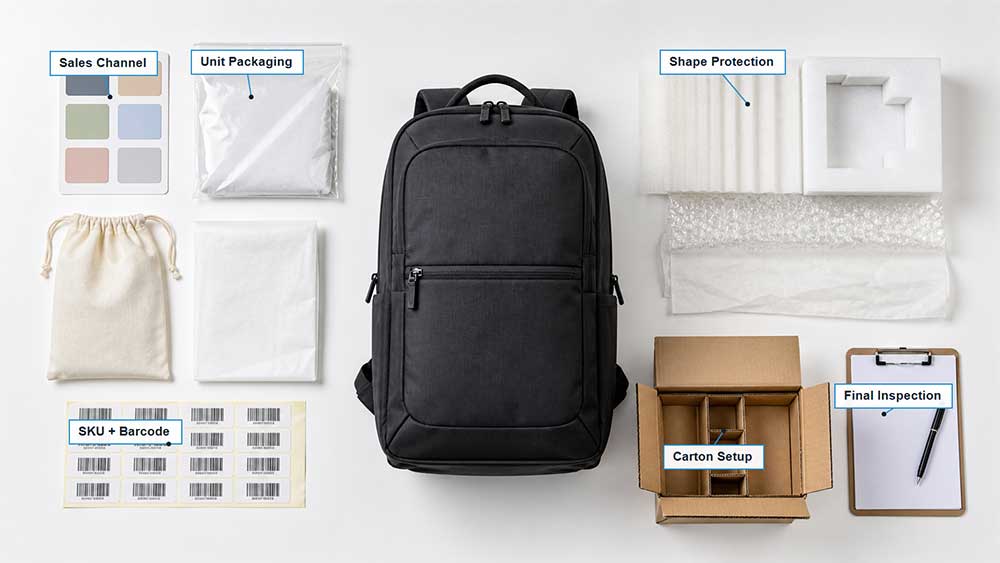
Before ordering bulk packaging materials, buyers should confirm six areas: unit packaging, folding and shape protection, tags and inserts, SKU and barcode responsibilities, carton requirements, and final inspection.
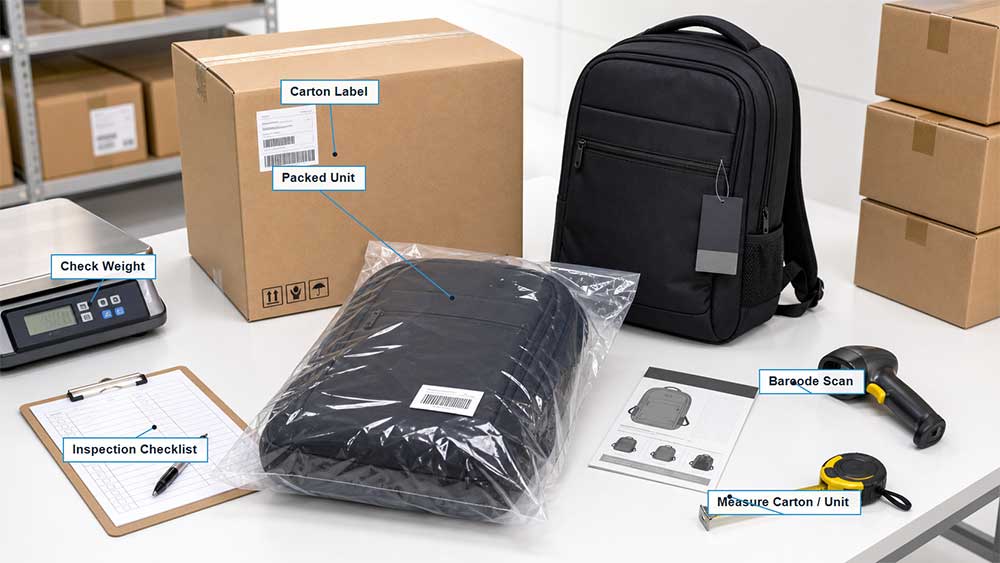
Whenever practical, approve one completely packed product. A flat artwork proof cannot show whether the package fits, protects the bag, or places the barcode correctly.
Polybag, dust bag, paper band, sleeve, box, or a combination
Product protection
Folding method, filling, hardware wrapping, and structural protection
Product identification
SKU, GTIN, UPC-A/EAN-13 barcode, marketplace label, and placement
Shipping configuration
Units per carton, mixed-SKU ratio, carton size, weight, and shipping marks
Approval and inspection
Packed sample, artwork version, barcode scan, and final packed-product checks
These decisions affect one another. A printed box may improve retail presentation, for example, but it can also increase packaging MOQ, storage requirements, carton volume, and freight cost.
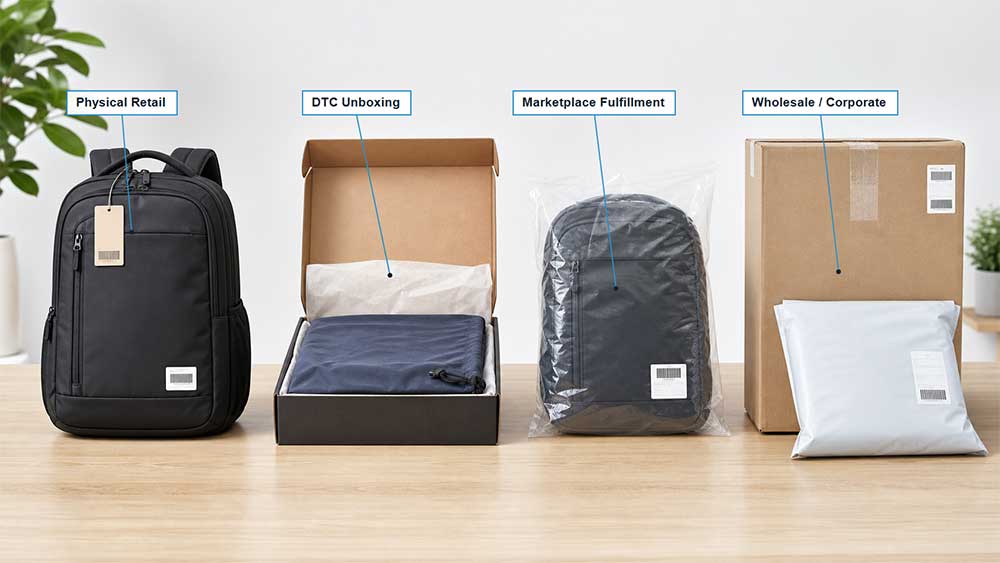
Plan Packaging Around the Sales Channel
Packaging accepted by one retailer or warehouse may not meet the requirements of another. Confirm how the laptop bag will reach the customer before discussing materials or artwork.
Sales channel
Main priorities
Common packaging approach
Physical retail
Display, product information, barcode scanning, and store handling
Polybag or paper sleeve, retail hang tag, barcode label, and shipping marks
DTC website
Clean arrival, unboxing experience, and parcel protection
Dust bag, tissue, brand card, fitted polybag, or shipping box
Marketplace or third-party fulfillment
Sealed units, product identification, and receiving compliance
Sealed polybag or box, SKU or marketplace label, and required carton labels
Wholesaler or distributor
Fast receiving, SKU separation, and carton identification
Simple unit packaging, SKU sticker, inner packs, and clear shipping marks
Corporate gifts
Cost control, logo presentation, and easy distribution
Standard polybag, optional card or sleeve, and event or destination markings
If one order will supply several channels, prepare a packaging version for each channel or create a clear packaging matrix. Instructions such as “retail-ready packaging” or “pack for Amazon” are too vague for consistent production.
For Amazon FBA orders, check the seller account and destination market before production. Amazon’s official FBA preparation, packaging, and labeling guide covers general requirements, but account- and product-specific instructions may also apply.
Choose the Right Unit Packaging
There is no single best package for every laptop bag. The choice depends on the bag’s structure, surface material, price position, sales channel, and shipping method.
Packaging format
Suitable applications
Points to check
Clear polybag
Wholesale, retail, marketplace, and general export orders
Dimensions, thickness, closure, warning text, and barcode visibility
Recycled-content polybag
Brands reducing virgin-plastic use
Recycled-content evidence, strength, claims, and destination requirements
Fabric or nonwoven dust bag
Premium business bags, PU bags, and gift programs
Material, drawcord, logo, color-transfer risk, and outer protection
Paper band or sleeve
Retail display and reduced-plastic presentation
Fit, tear resistance, printing, and transit protection
Printed paperboard box
Premium retail, gift sets, and structured briefcases
Dieline, board strength, inserts, MOQ, assembly, and shipping volume
Product card or insert
DTC products, corporate gifts, and care instructions
Artwork version, language, size, position, and attachment method
Polybags
A fitted polybag helps keep the product clean during factory handling, shipping, and storage. However, “one bag in one polybag” is not a complete specification.
Confirm the material, thickness, finish, closure, finished dimensions, ventilation holes, warning text, barcode position, and whether the barcode must scan through the film.
Avoid excessive loose film. An oversized polybag can look untidy, complicate warehouse measurements, and interfere with handling.
Dust Bags
Dust bags improve presentation and help protect surfaces that mark easily. They are especially suitable for structured business bags and some PU materials.
However, a dust bag alone may not provide enough protection from dust or moisture during export transit. Some products still need a simple outer protective bag.
Before approval, test whether dark fabric, printing, or drawcord components can transfer color onto the laptop bag.
Paper Sleeves and Boxes
Paper packaging can create a stronger retail presentation, but a box should not be selected only because it looks premium in a rendering.
A custom box may require printing plates, cutting dies, protective inserts, manual assembly, additional storage space, and a higher packaging MOQ. It can also increase carton volume and freight cost.
For a first order, standard protective packaging with a custom hang tag, sticker, or product card may provide enough brand recognition without the cost of a complex box.
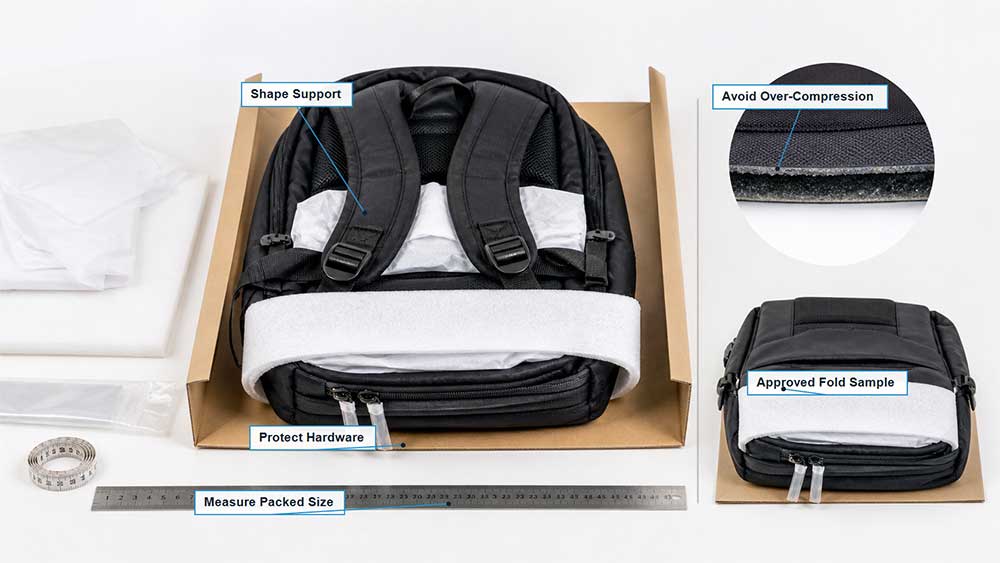
Test the Folding Method Before Finalizing Dimensions
Laptop backpacks are soft goods, but they cannot always be compressed without damage.
Excessive folding can crease foam panels, distort structured pockets, mark coated materials, or press zipper pulls and buckles into the bag body. A reinforced briefcase usually needs more shape protection than a lightweight laptop sleeve.
The packaging instructions should show:
Whether the product is packed flat or with filling
Which sections may be folded
Where tissue, inserts, or other support materials are placed
How shoulder straps and handles are arranged
Whether zipper pulls and metal hardware need wrapping
Which side faces the front of the package
The acceptable packed dimensions
Test the method on a physical sample. Keep it packed for a representative period, then unpack it and check whether the bag returns to the approved shape without permanent creasing or surface damage.
Many packaging errors begin when every product code is simply called “the barcode.”
In plain terms, the GTIN is the product’s unique identification number. UPC-A and EAN-13 are common barcode formats used to turn that number into something a scanner can read.
Identifier
Purpose
Usually controlled by
Internal SKU
Identifies a style, color, or size within a company’s own system
Brand, retailer, or distributor
GTIN
Uniquely identifies a trade item
Brand owner or authorized product owner
UPC-A or EAN-13 barcode
Encodes the GTIN for retail scanning
Brand provides the data; factory may print it
Marketplace label
Identifies inventory within a marketplace system
Seller-account owner
Carton or logistics label
Identifies cartons, shipments, purchase orders, or logistics units
Buyer, retailer, warehouse, or logistics program
GS1 explains that a GTIN uniquely identifies a trade item. The brand owner should assign or obtain the number and match it to the correct SKU. The factory may print and apply an approved barcode, but it should not create the GTIN independently.
Marketplace labels such as Amazon FNSKUs should come from the seller’s account. The buyer should also state whether the original manufacturer barcode must remain visible, be covered, or be moved to another approved position.
Before bulk packing begins:
Print each label at the actual production size.
Scan it with suitable equipment or an application.
Compare the result with the approved SKU and barcode matrix.
Check its position on the packed product.
Retain an approved physical label or signed digital proof.
A label can look correct while containing the wrong data. For multi-SKU orders, test every SKU-barcode combination rather than checking only one label.
Prepare One Complete Packaging Specification
Packaging information needs version control, just like the product specification.
Packaging item
Information required
Channel and destination
Retailer, DTC site, marketplace, distributor, corporate program, and destination country
Product identification
Style number, SKU, color, size, GTIN, and corresponding barcode
Unit package
Material, dimensions, thickness, finish, closure, and printing
Folding and protection
Folding steps, filling, inserts, hardware wrapping, and no-fold zones
Tags and inserts
Size, material, language, printing, attachment, and placement
Labels
Artwork, encoded data, dimensions, material, and exact position
Packaging claims
Approved wording and supporting documents
Carton configuration
Units per carton, mixed-SKU ratio, and allowed tolerance
Master carton
Board requirement, dimensions, weight limit, and sealing method
Shipping marks
Purchase order, SKU, quantity, carton number, destination, and symbols
Approval and inspection
Packed sample, signed artwork, scan results, sampling, and reporting method
Avoid instructions such as “use normal export packaging.” They leave important decisions open to interpretation.
Keep the main product and branding details in the product specification. The private-label laptop bag preparation guide explains what brands should organize before production. The packaging specification can then focus on execution for each sales channel.
Check Environmental Claims and Destination Requirements
Do not add terms such as “recyclable,” “eco-friendly,” “compostable,” or “made with recycled content” simply because a packaging supplier describes the material as sustainable.
Confirm:
Whether the claim applies to the product, unit package, or master carton
The material type and recycled-content percentage
The documents available to support the claim
Whether suitable recycling infrastructure exists in the destination market
Whether qualifying language is required
Whether symbols and certification marks are accurate and authorized
The US Federal Trade Commission’s Green Guides are intended to help businesses avoid misleading environmental claims. Claims should be specific and supported by suitable evidence.
Products sold in the European Union should also be reviewed against the applicable packaging rules. The European Commission states that the Packaging and Packaging Waste Regulation entered into force on February 11, 2025, and generally applies from August 12, 2026.
Regulations and retailer manuals can change. The importer or brand owner should confirm current destination-market requirements before approving artwork or ordering packaging materials.
Understand the Effect on Cost and MOQ
Packaging cost includes more than the price of a polybag or hang tag.
A quotation may also need to cover:
Printing plates, setup charges, and cutting dies
Custom paper, board, or printed film
SKU and barcode labels
Tissue, inserts, and hardware protection
Manual assembly
Separate packaging versions for different channels
Additional inspection
Larger cartons and increased shipping volume
Each packaging component may have its own MOQ. Meeting the factory’s laptop bag MOQ does not mean the order will automatically meet the minimum quantity for a custom printed box or special packaging material.
Do not wait until finished bags are beside the packing line to confirm labels, inserts, or shipping marks.
Project stage
Packaging decision
Quotation
State the channel, approximate unit packaging, and special labeling needs
Product development
Test folding, protection, and expected packed dimensions
Before ordering packaging
Approve materials, dimensions, artwork, dielines, and label data
Pre-production
Freeze the packaging specification and SKU matrix
First packed production unit
Check labels, tags, inserts, folding, and protective materials
Final inspection
Verify scans, packing method, quantities, shipping marks, and carton condition
When requesting a revision, identify the exact component, describe the current result, and state the required outcome. The same approach used when giving feedback on a laptop bag sample helps prevent packaging changes from being misunderstood.
Inspect the Completely Packed Product
A laptop bag can pass its product inspection and still be unsellable if it carries the wrong barcode, arrives with permanent folds, or is packed in the wrong SKU ratio.
The final inspection should verify:
Style, color, size, SKU, tags, and inserts
Barcode data, scan result, print quality, and placement
Unit-package dimensions, closure, and warning text
Folding, strap arrangement, shape recovery, and surface protection
Units per carton and mixed-SKU ratio
Carton dimensions, weight, sealing, and visible condition
Shipping marks, destination labels, and carton numbers
For a multi-SKU order, scan each SKU-barcode combination. Packaging checks should form part of the complete laptop bag quality inspection checklist, not be treated as a last-minute task.
Five Packaging Mistakes to Avoid
1. Confirming Packaging Too Late
Late approval of artwork, barcodes, or shipping marks can leave finished bags waiting while packaging remains incomplete.
2. Using One Instruction for Every Channel
Retailers, marketplaces, distributors, and corporate programs may require different labels, inserts, and carton configurations.
3. Asking the Factory to Create Product Codes
The factory can print approved labels, but the brand or seller should control SKU, GTIN, and marketplace data.
4. Approving Artwork Without Scanning the Barcode
A barcode that looks correct on a screen may fail after it is resized, printed, or placed on a curved or reflective surface.
5. Compressing the Bag Too Much
Lower carton volume provides little benefit if foam panels, structured pockets, or coated surfaces arrive permanently damaged.
Final Packaging Checklist
Before approving bulk packaging, confirm:
Sales channel and destination market
Unit-package format, dimensions, and closure
Folding and shape-protection method
Hang-tag and insert artwork
SKU, color, size, GTIN, and barcode matrix
Marketplace labels, where applicable
Barcode scan results
Warning text and environmental claims
Units per carton and mixed-SKU ratio
Master-carton specification and shipping marks
Complete packed-product approval
Inspection requirements
Final artwork and specification version numbers
Vancharli Outdoor can help coordinate product structure, branding details, folding methods, unit packaging, and master-carton requirements during custom laptop bag development. Buyers can discuss the complete packaging plan with Vancharli Outdoor before approving the final quotation and production specification.
Final Takeaway
Effective laptop bag packaging starts with the sales channel. Once receiving and selling requirements are clear, buyers can define the unit package, folding method, product identification, carton configuration, approval process, and inspection criteria.
A good specification should allow the factory to pack every SKU consistently. It should also help retailers, warehouses, and fulfillment centers receive the products without unnecessary relabeling or repacking.
Frequently Asked Questions
When should retail packaging be finalized?
State the basic packaging plan during quotation. Approve the final materials, dimensions, artwork, label data, and carton requirements before the factory orders bulk packaging components.
Does every laptop bag need an individual polybag?
No. The right packaging depends on the sales channel, bag material, handling environment, and destination requirements. Dust bags, paper sleeves, or boxes may also be suitable, although extra transit protection may still be needed.
Can the manufacturer provide UPC or EAN numbers?
The factory can usually print and apply UPC-A or EAN-13 barcodes. However, the brand owner should control the GTIN and provide approved data for each SKU.
Can several colors share the same packaging?
They may share the same basic polybag, sleeve, or box if the dimensions are suitable. However, each color may still need a separate SKU and GTIN when treated as a distinct trade item.
Does a premium laptop bag need a printed box?
Not necessarily. A fitted dust bag, professional hang tag, or paper sleeve can provide a premium presentation with less cost and shipping volume.
Why can packaging increase the order MOQ?
Printed film, boxes, special paper, labels, and other components may each have a separate supplier MOQ. These minimums can be higher than the MOQ for the laptop bag itself.
What packaging sample should the buyer approve?
Whenever practical, approve one complete package containing the actual bag, folding method, tags, inserts, labels, and protective materials. Flat artwork alone cannot confirm fit, protection, or barcode placement.









Comments are closed