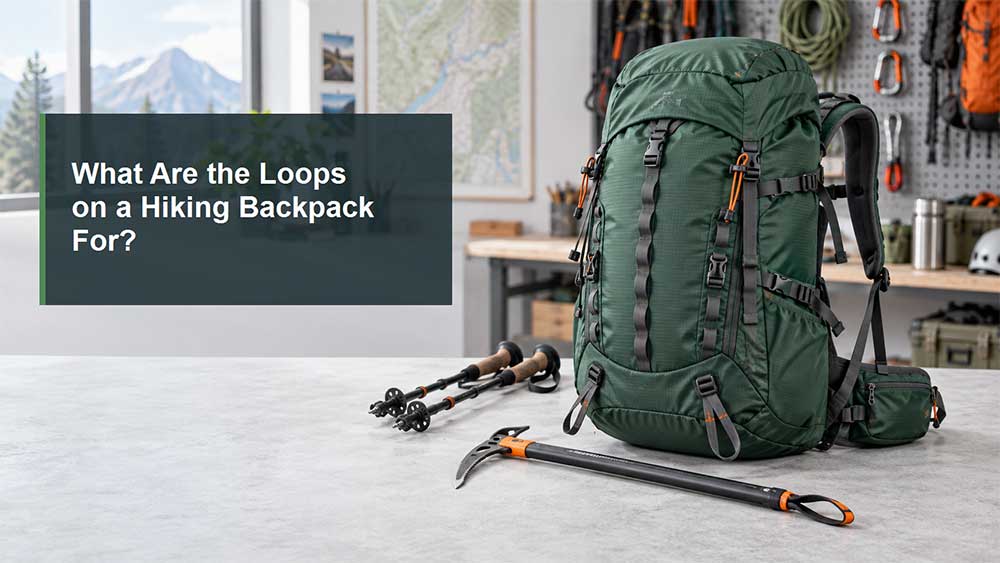
The loops on a hiking backpack are external attachment points for gear that is awkward, wet, or inconvenient to store inside the main compartment. Depending on their location and design, they may hold an ice axe, trekking poles, a sleeping pad, a helmet carrier, or small accessories.
However, similar-looking loops do not always serve the same purpose. Their intended use depends on where they are placed, how they are reinforced, and whether they work with an upper strap, buckle, or elastic retainer. Unless the manufacturer provides a load rating, backpack loops should not be treated as climbing anchors or personal safety equipment.
Secures folded trekking poles with an upper retainer
Daisy chain
Front panel or sides
Provides multiple attachment positions for lightweight gear
Lash tab
Front panel, lid, or lower panel
Allows cord or removable webbing to be threaded through
Small accessory loop
Shoulder strap or hip belt
Holds lightweight accessories or helps route a hydration tube
Bottom webbing loop
Base of the backpack
Works with straps to secure a sleeping pad or similar equipment
REI’s backpack selection guide also identifies tool loops, daisy chains, reinforced crampon patches, and extra gear loops as common external attachment features on backpacking packs.
The table is a useful starting point, but location alone does not confirm a loop’s function. Always check whether there is matching hardware elsewhere on the pack.
What Are Ice Axe Loops For?
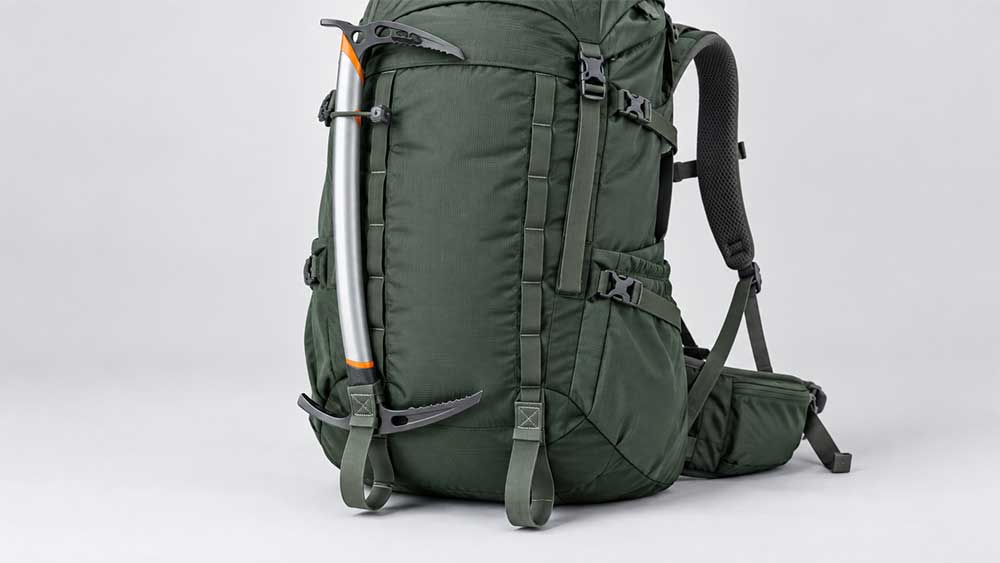
A traditional ice axe loop is usually found near the bottom of the front panel. It is commonly made from webbing and is large enough for the head of an ice axe to pass through.
The loop normally works with a second attachment point higher on the backpack. The lower loop holds the axe head, while an upper strap, buckle, or elastic cord secures the shaft and prevents it from swinging.
Some mountaineering backpacks use more specialized systems, such as tool sleeves, adjustable buckles, or covered attachment points that keep sharp components closer to the pack. These systems are designed around technical equipment and are usually more secure than a single open loop.
A loop that looks like an ice axe attachment should not automatically be used as one. Check the manufacturer’s instructions, protect sharp edges where appropriate, and make sure the tool cannot move into the wearer or other people.
Most importantly, an ice axe loop is a carrying feature. It is not a climbing anchor and should never be used to support a person’s weight.
How Do Trekking Pole Loops Work?
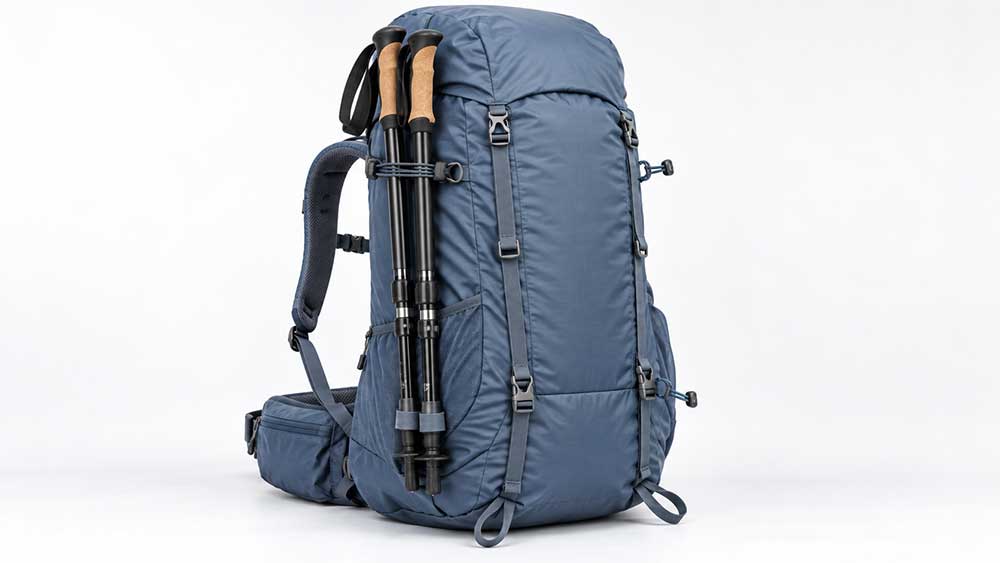
Trekking pole attachments are often positioned on the front or sides of a hiking backpack. A typical system uses two parts:
A lower loop, pocket, or cup that holds the pole tips
An upper elastic cord or webbing strap that secures the pole shafts
Some backpacks also include a quick-stow system on the shoulder strap or side panel. This allows hikers to put away their poles temporarily without removing the backpack. It can be useful when scrambling, checking a map, or using both hands for a short section of trail.
Before walking, confirm that the poles are tight against the pack and cannot swing. Pole tips should face downward or be covered so they do not catch on branches, damage the backpack, or injure someone nearby.
Attachment systems vary considerably, so follow the instructions provided for the specific backpack rather than assuming every pole loop works the same way.
What Are Gear Loops and Daisy Chains For?
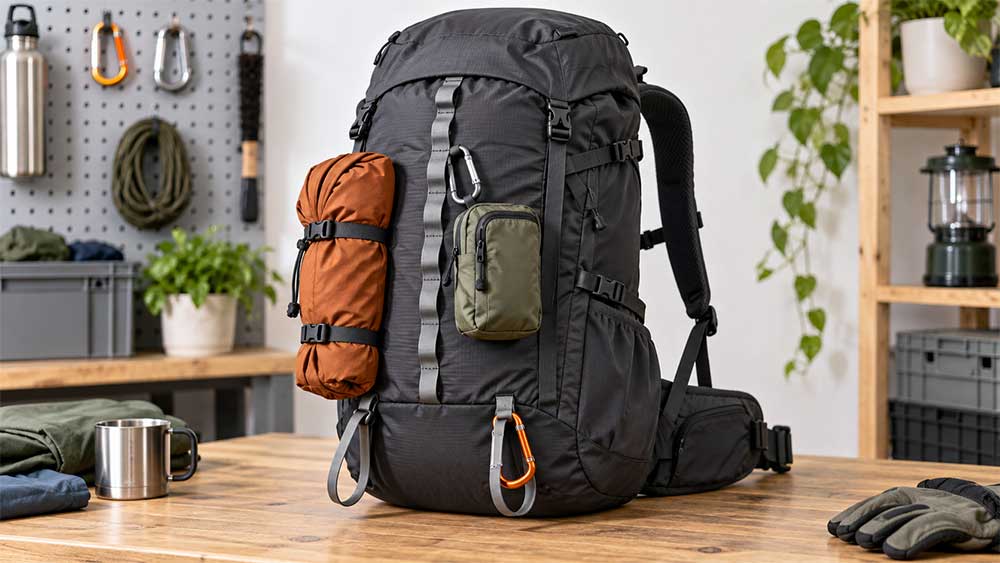
A gear loop is a general attachment point for lightweight items. A daisy chain is a strip of webbing sewn down at intervals, creating a row of small loops.
They can be useful for attaching items such as:
A small pouch
Lightweight sandals
A wet towel
A helmet carrier
A compact accessory
Gear that needs to dry before being packed inside
A small accessory carabiner can make these items easier to attach, but it should be used only for carrying equipment. Backpack daisy chains and gear loops are not equivalent to climbing slings, harness gear loops, or certified anchor points.
Avoid covering the pack with loose equipment simply because attachment points are available. Hanging gear can swing, make noise, catch on vegetation, and shift the backpack’s balance.
What Are Lash Tabs?
Lash tabs are reinforced patches with slots or openings through which cord or webbing can be threaded. Traditional versions are often diamond-shaped and are sometimes called “pig snouts.” Modern hiking backpacks may instead use oval or low-profile coated tabs.
Lash tabs can help secure equipment such as a rain jacket, foam sleeping pad, or other light and bulky items. They are flexible because the user can choose the cord or strap arrangement, but their safe use still depends on the construction of the pack and the intended load.
A decorative patch may resemble a functional lash tab. If the opening is not reinforced or the manufacturer does not describe it as an attachment point, do not assume it is designed to carry equipment.
What Are the Small Loops on Shoulder Straps For?
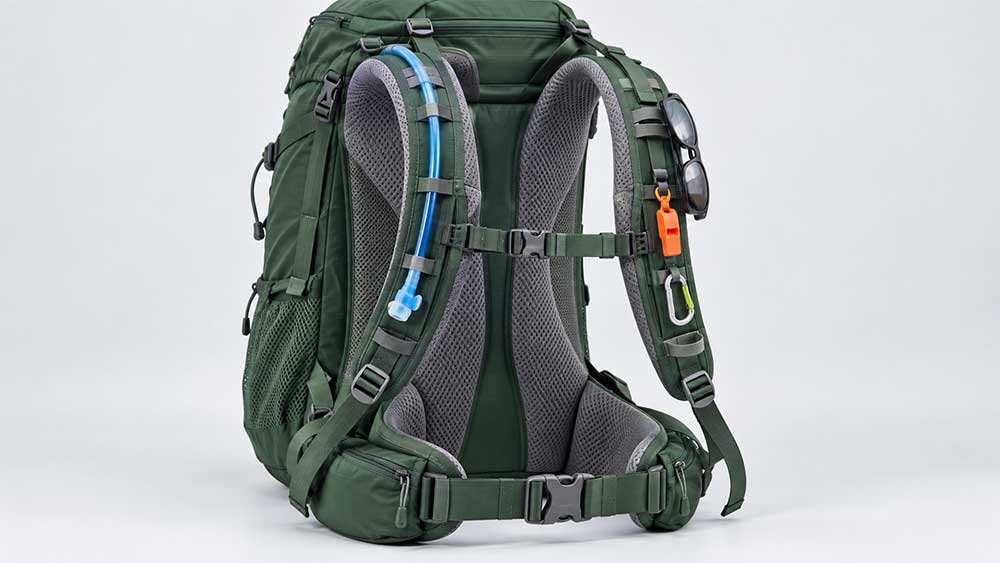
Small loops on shoulder straps may have several purposes. Some guide a hydration tube, while others provide a place for a whistle, sunglasses holder, lightweight pouch, or other small accessory.
Certain loops are part of the backpack’s construction rather than external gear attachments. For example, webbing may help position a sternum strap or connect sections of the shoulder harness.
Because weight on the shoulder straps can bounce and interfere with movement, these loops are best reserved for lightweight objects that need to remain within easy reach.
Are Loops, Straps, and Bungee Cords the Same?
They are related, but they do different jobs.
Component
Main Function
Loop
Provides a fixed attachment point
Compression strap
Pulls the load closer to the pack and may secure larger items
Bungee cord
Temporarily holds light or flexible gear
Daisy chain
Offers several attachment positions
Lash tab
Allows the user to add cord or removable webbing
Compression straps are especially important because their main purpose is load control. They reduce unused volume and limit movement inside the pack. Although they can sometimes hold a jacket, tent poles, or a sleeping pad, this is a secondary function.
Elastic bungee cords are convenient for wet layers or a light jacket, but they can stretch, lose elasticity, or release an object if overloaded. They should not be used for heavy or safety-critical equipment.
How Can You Identify an Unfamiliar Backpack Loop?
Look at the loop as one part of a complete attachment system.
A large loop near the bottom of the front panel, combined with an upper retainer, is likely intended for an ice axe or similar tool. A smaller lower loop paired with an elastic cord may be designed for trekking poles. A vertical row of repeated webbing sections is usually a daisy chain.
You can also check:
Location: Tool attachments are often found on the front or lower part of the pack.
Matching hardware: Look for an upper strap, buckle, cord lock, or elastic keeper.
Shape and size: A large webbing loop and a small hydration-tube keeper are unlikely to have the same purpose.
Reinforcement: Functional attachment points are often connected to stronger seams or reinforced areas.
Product instructions: The manufacturer’s diagram or manual is more reliable than appearance alone.
If the intended use remains unclear, avoid attaching heavy, sharp, or valuable equipment until the manufacturer confirms the loop’s function.
Should You Carry Gear Outside a Hiking Backpack?
External attachment is useful, but it should not replace proper packing.
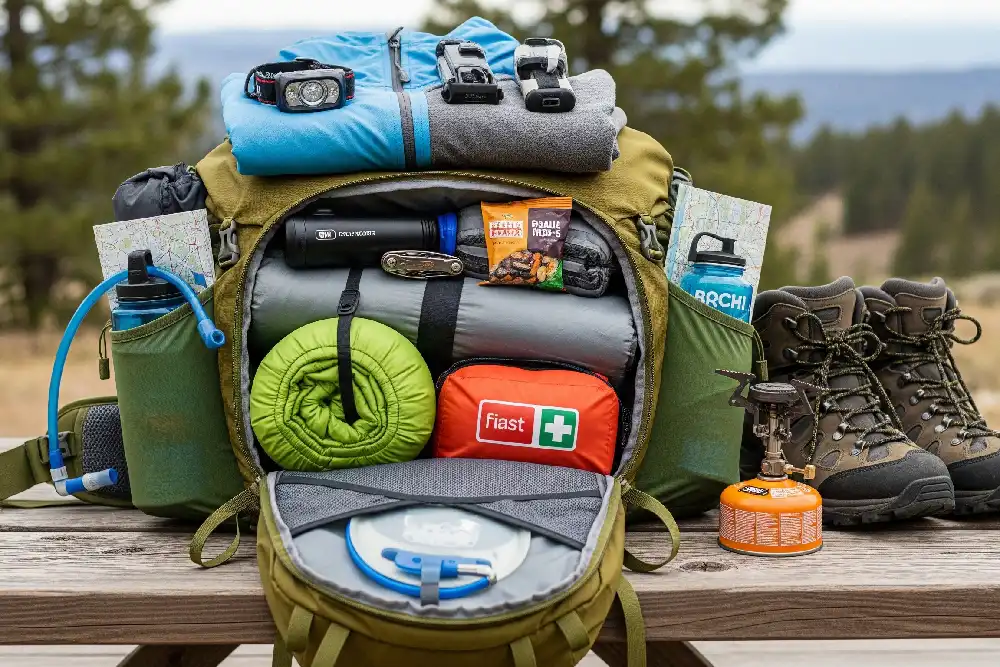
Heavy and dense equipment is usually more stable inside the backpack, close to the wearer’s back. Keeping weight near the body helps reduce swinging and limits the leverage created by items hanging far from the pack.
External loops are most useful for equipment that is:
Too long or awkward to fit inside
Wet or muddy
Needed frequently
Designed for an external attachment system
Separated from other gear for safety or cleanliness
Loose items should not block access to the pack, interfere with arm movement, or extend so far that they catch on rocks and branches. Before starting a hike, shake the loaded backpack gently and check whether anything swings, slips, or creates an uncomfortable imbalance.
What Determines Whether a Backpack Loop Is Durable?
A loop’s appearance does not reveal its actual strength. Durability depends on the entire construction, including the attachment material, stitching, reinforcement, surrounding fabric, and direction of force.
Nylon or polyester webbing is commonly used for structured attachment points, but actual strength depends on the webbing specification, stitching, and surrounding construction.
Reinforcement can spread the load across a wider area and reduce stress on the outer fabric, but it does not establish a certified load rating. Stitch patterns should also be selected for the intended load direction rather than judged by appearance alone.
Low-profile coated or laminated tabs can provide slots for threading cord or removable webbing. Their durability depends on the base material, coating or lamination, thickness, hole geometry, and how the tab is connected to the pack.
Elastic components require different consideration. Shock cord may be convenient, but repeated stretching, abrasion, sunlight, and temperature changes can gradually reduce its elasticity.
For product developers, the attachment system should be evaluated with the intended equipment during sampling. A loop for trekking poles, for example, should be tested with the expected pole diameter and pack load rather than reviewed only as an isolated piece of webbing.
Do Hiking and Mountaineering Backpacks Use the Same Loops?
They may share some features, but their attachment systems are usually designed around different activities.
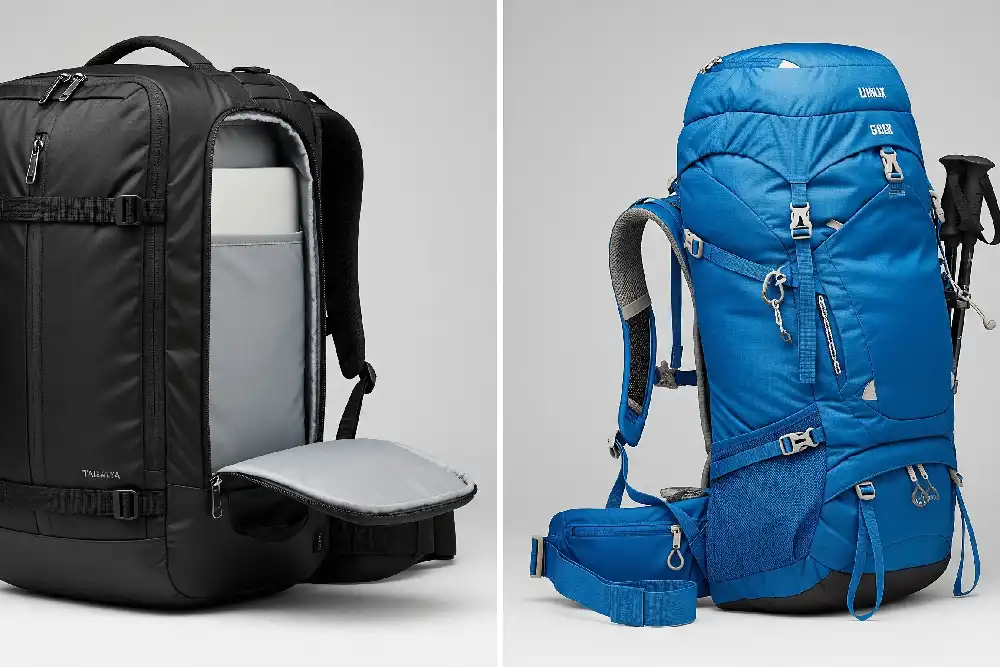
A day-hiking backpack may have only trekking pole holders, side compression straps, and a simple front bungee. A trekking pack may add bottom straps, more compression points, and additional places for bulky multi-day equipment.
A mountaineering backpack is more likely to include dedicated ice axe attachments, technical tool retainers, rope-carrying options, crampon-compatible panels, or removable components. These features help carry specialized equipment while keeping the pack relatively narrow and stable.
This does not mean that every mountaineering pack must have a complicated metal frame or a large number of loops. The overall design depends on the expected load, terrain, trip duration, and technical equipment. Our comparison of trekking and mountaineering backpacks explains these differences in more detail.
Designing Attachment Systems for Custom Backpacks
For brands and importers developing a hiking backpack, the first question should not be how many loops to add. It should be what equipment the intended user actually needs to carry.
Loop placement should be considered together with:
Backpack capacity and expected load
Intended activity and terrain
Tool dimensions
Access while wearing the pack
Compression strap placement
Fabric reinforcement
Potential contact with sharp equipment
Compatibility with rain covers and external pockets
Unnecessary loops add material, sewing operations, and possible snag points. A simpler attachment system can be more useful when every component has a clear function.
Vancharli Outdoor works with brands, wholesalers, importers, and purchasing teams to develop custom hiking and outdoor backpacks. During development, attachment points can be adjusted according to the intended equipment, construction, materials, and test requirements instead of being copied from an unrelated pack style.
FAQ
What is the large loop at the bottom of my backpack?
It is often an ice axe or tool loop, especially when there is a matching strap higher on the front panel. On some packs, it may form part of a trekking pole or sleeping-pad attachment system. Check the manufacturer’s instructions before using it.
Can I attach a sleeping bag to backpack loops?
You can attach a sleeping bag only if the backpack has suitable bottom straps or reinforced lash points. The sleeping bag should be protected from moisture and secured tightly enough that it cannot swing. Storing it inside a waterproof compartment is usually safer.
Can backpack loops hold my body weight?
No. Standard backpack loops, daisy chains, and lash tabs are not climbing anchors. Never use them for belaying, rappelling, fall protection, or supporting a person unless the product is specifically certified for that purpose.
What are the diamond-shaped patches on a backpack?
They are usually lash tabs, sometimes called pig snouts. Cord or webbing can be threaded through their openings to secure lightweight external equipment.
Can I put carabiners on backpack loops?
Yes, accessory carabiners can be used to organize lightweight gear. They should not be confused with climbing-rated carabiners, and the backpack loop itself should still be treated as a carrying point rather than safety equipment.
Why does my backpack have loops that I never use?
Backpacks are often designed for more than one activity or packing style. Some users need tool attachments, while others carry everything internally. An unused loop is not necessarily a problem, provided it does not catch on obstacles or interfere with movement.







Comments are closed