What Tests Should a Laptop Bag Pass Before Bulk Production?
Before bulk production, every laptop bag should at least be checked for specification accuracy, device fit, compartment protection, load-bearing construction, zipper and hardware function, workmanship, and packaging.
Additional tests—such as abrasion, colorfastness, dynamic load, water resistance, impact performance, and chemical compliance—should be selected according to the bag’s materials, intended use, product claims, target market, and buyer requirements.
There is no single test package or universal pass standard for every laptop bag. A slim laptop sleeve, an everyday business backpack, and a travel laptop bag carry different loads and face different risks. What counts as a pass must therefore be agreed upon before testing begins.
Without those details, a statement such as “the sample passed testing” provides little useful information.
Begin With the Bag’s Intended Use
Testing should begin with a clear product definition, not a generic checklist copied from another backpack.
The development team should establish:
Intended laptop dimensions
Target user
Typical and maximum packed load
Carrying method
Expected frequency of use
Target sales market
Product claims
Materials and construction
Relevant buyer or retailer requirements
A compact briefcase designed to hold a laptop, charger, and documents should not automatically use the same test conditions as a travel backpack carrying clothing, electronics, bottles, and other personal items.
Consider a laptop backpack that feels balanced when empty. Once a laptop, charger, water bottle, and documents are added, the bag may pull backward, its shoulder straps may slip, or a full front pocket may press into the computer compartment. Testing an empty sample would miss all three problems.
The load, duration, cycles, exposure, and acceptable result should therefore reflect realistic use. These conditions should be written into the product specification before testing—not selected after a sample fails.
1. Confirm the Production Specification
Before conducting performance tests, compare the pre-production sample with the latest controlled product specification.
The review should cover:
Finished dimensions and tolerances
Laptop compartment dimensions
Pocket size and position
Strap and handle lengths
Exterior fabric, lining, coating, and backing
Foam and reinforcement materials
Webbing, binding, and thread
Zipper type, size, tape color, slider, and puller
Buckles and metal hardware
Stitching and seam construction
Reinforcement locations
Logo method, size, color, and placement
Labels, barcodes, and packaging
All promised product functions
This review is especially important after several sampling rounds. The factory should not have to combine an old tech pack, comments from different emails, and unrecorded changes made to the latest sample.
The pre-production sample should also represent the construction planned for bulk manufacturing. A prototype made with substitute fabric, temporary hardware, hand-cut foam, or a sample-room-only technique may look correct without proving that the same result can be repeated on the production line.
The laptop bag sampling process should end with a production-representative sample and one controlled specification—not simply a visually approved prototype.
2. Test Laptop Fit and Compartment Protection
A “15.6-inch laptop compartment” should not be approved from its diagonal measurement alone. Laptops with the same advertised screen size can have different body dimensions and thicknesses.
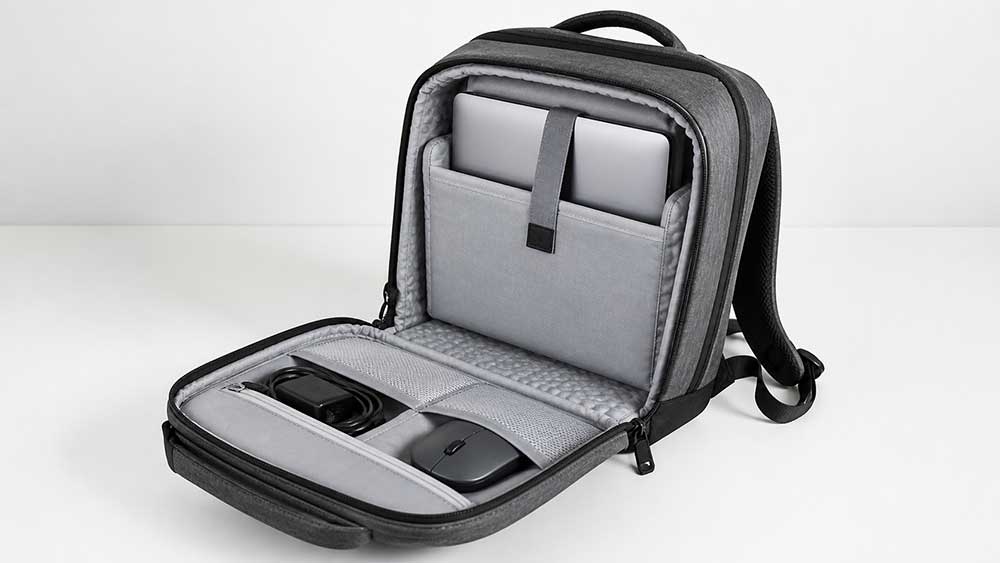
Test the finished compartment with the buyer’s specified device dimensions or a suitable rigid mock-up representing the largest intended laptop. A real device can be used for non-destructive fit checks, while destructive impact testing should use appropriate test equipment or a simulator.
Confirm that:
The laptop passes through the opening without excessive force
The compartment closes normally with the device inside
The zipper does not scrape or press against the laptop
Corners do not catch on seams, binding, or zipper ends
The device is retained without becoming difficult to remove
Adjacent pockets do not compress the laptop space when loaded
The compartment remains usable when the complete bag is packed
Smaller approved devices do not move excessively
The test should include the charger, cables, mouse, documents, and other items the intended customer is likely to carry. An empty bag may fit correctly but become difficult to close once the surrounding pockets are filled.
Look Beyond Soft Padding
Soft foam does not by itself prove that a laptop is protected. The reviewer should examine the complete compartment construction, including:
Front, back, side, bottom, and lower-corner coverage
Foam thickness, density, and recovery
Bottom clearance in a suspended compartment
Gaps between padding panels
Compression caused by exterior pockets
Rivets, zipper pullers, buckles, and seam allowances facing the device
Hard edges created by reinforcement boards
The closure or retention system
Lining seams that may rub against the laptop
Place the loaded bag on a firm surface and check whether compressed foam allows the laptop to reach the exterior bottom. Press around the compartment to identify hard points that could scratch or concentrate force on the device.
If the brand plans to make a measurable impact, shock, or drop-protection claim, it should agree on a documented test protocol with its laboratory or quality team. The protocol should identify the device simulator, load, drop height, orientation, number of drops, surface, conditioning, and acceptable result.
A simple factory drop demonstration does not justify a broad “drop-proof” claim.
3. Test the Carry System Under Static and Repeated Loads
A laptop bag may survive a stationary load but fail after repeated lifting, walking, and setting down. That is why both static and dynamic stress may need to be evaluated.
Static load testing
A static test checks whether the assembled bag can support an agreed load for a specified time without failure or unacceptable deformation.
Depending on the design, test the bag through its:
Top handle
Backpack shoulder straps
Single shoulder strap
Detachable strap
Side handle
Other intended load-bearing points
Inspect the bag before and after testing for:
Broken stitches
Seam opening or slippage
Fabric tearing
Loose bar tacks
Webbing movement
Foam distortion
Cracked or deformed buckles
Detached rivets
Damaged hooks or D-rings
Permanent handle elongation
Unacceptable body deformation
A report stating that the bag held “10 kg” is incomplete unless it also identifies the loading method, duration, sample condition, and acceptance criteria.
Dynamic testing
Dynamic testing applies repeated movement or shock to a loaded bag. It can expose problems that a stationary test may miss:
Gradual stitch breakage
Strap-anchor tearing
Webbing slippage through adjusters
Buckle release
Seam growth
Binding failure
Delamination
Permanent deformation
Loosening or noise from metal hardware
The test should reflect how the product will be carried. A backpack places repeated stress on two shoulder anchors, while a briefcase may concentrate the load on its top handle and detachable strap attachments.
The load, number of cycles, movement, speed, and permitted damage must be agreed upon for the specific product. There is no responsible universal cycle count for every laptop bag.
Test the complete anchor construction
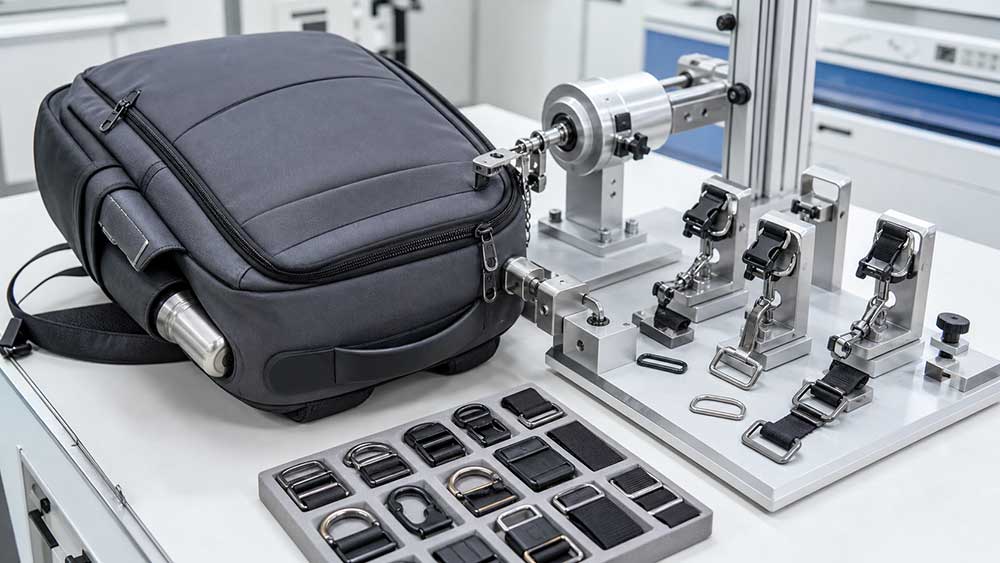
Supplier data showing that a webbing strap has high tensile strength does not prove that the finished shoulder strap is secure. The fabric, internal reinforcement, seam allowance, stitch pattern, thread, bar tack, and webbing must work as one load-bearing system.
If an anchor fails, repairing one sample is not enough. The correction must be added to the pattern, bill of materials, sewing instructions, and inspection standard before production.
4. Check Zippers, Buckles, and Hardware in the Finished Bag
Zippers are among the most frequently operated components on a laptop bag. Test them after they have been sewn into the finished product, not only as loose components.
Check:
Smooth opening and closing
Operation around curves and padded corners
Slider locking, when specified
Resistance to accidental opening
Puller attachment
Zipper-end reinforcement
Tape alignment
Teeth or coil engagement
Operation when the bag is fully packed
Fabric or lining caught by the slider
Coating or finish damage after repeated use
A zipper may run smoothly on a flat material swatch but become difficult to operate when installed around a thick, curved laptop compartment.
Buckles, hooks, adjusters, magnetic closures, snaps, and metal fittings should also be tested according to their intended function. Inspect them for:
Cracking or deformation
Accidental release
Sharp edges
Webbing slippage
Loose attachment
Plating damage
Corrosion risk
Noise during use
When laboratory testing is required, the method should match the component and property being evaluated. A statement such as “ASTM-tested zipper” is too vague. The report should identify the exact method, specimen, conditions, and result.
5. Verify Material and Color Performance
Material testing should be selected according to where and how each material is used.
Depending on the product and buyer requirements, testing may cover:
Fabric weight and composition
Tensile strength
Tear strength
Seam slippage
Abrasion resistance
Pilling
Coating adhesion
Flex resistance
Delamination
Colorfastness to dry and wet rubbing
Colorfastness to water or perspiration
Dimensional stability
Foam thickness, density, compression, and recovery
Odor
Leather finish and color performance
Moisture condition or mold risk
Not every panel needs the same performance priority. Abrasion resistance may be especially important for the bottom and high-contact areas. Coating adhesion and flex resistance may matter more on folded coated fabrics. Foam recovery is particularly relevant to shoulder straps, back panels, and the laptop compartment.
Dark or highly saturated materials should be checked for color transfer, especially when they may contact light clothing, device surfaces, or lining materials. Both dry and wet conditions may be relevant.
Bulk fabric should also be compared with the approved color standard under agreed lighting. A laboratory performance result does not replace visual shade approval, and an approved lab dip does not guarantee that every bulk dye lot will look identical.
6. Match Water-Resistance Testing to the Claim
“Water-repellent,” “water-resistant,” and “waterproof” do not describe the same level of protection.
A laptop bag made from coated fabric can still allow water to enter through:
Needle holes
Zippers
Unsealed seams
Binding
Pocket openings
Logo stitching
Handle attachment points
Openings around hardware
Material, seam, and finished-product tests answer different questions. A fabric result alone cannot prove that the completed bag provides the same level of protection.
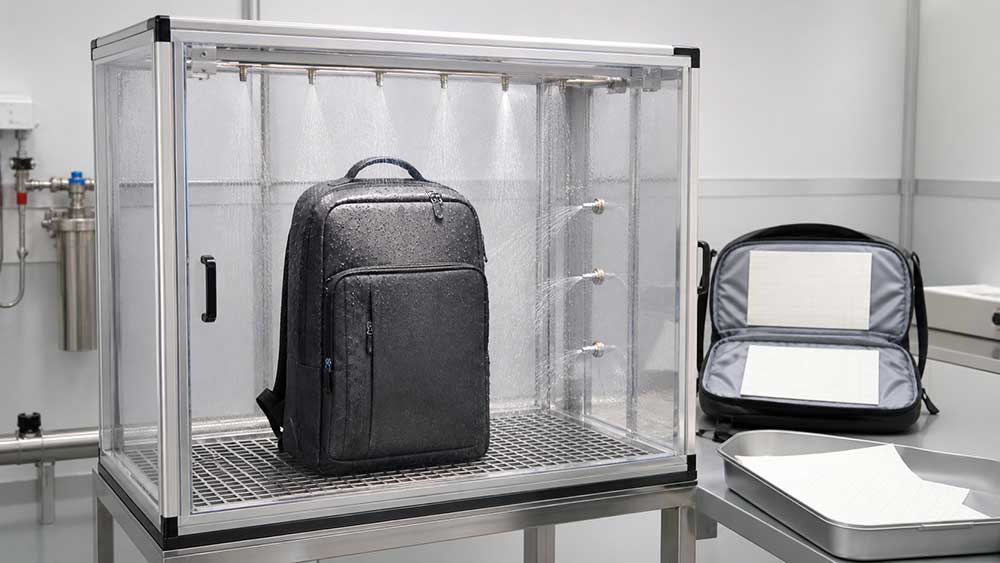
For an everyday water-resistant laptop bag, a controlled spray or rain-simulation test may be appropriate. The test plan should define:
Exposure time
Water volume or intensity
Bag orientation
Whether the bag is loaded
Internal absorbent indicators
The permitted amount and location of moisture
Record where water first enters. That information helps the factory correct the actual weakness instead of simply replacing the exterior fabric.
A product intended only for light rain should not be marketed as suitable for submersion. If the brand claims that the complete bag is waterproof, its seams, closures, zippers, and attachment points must all support that claim.
7. Conduct a Realistic Packed-Bag Trial
Laboratory tests measure specific properties, but they do not always show whether the bag is comfortable or practical in daily use.
Pack the sample with the intended laptop, charger, documents, bottle, accessories, and other expected items. Then carry it, open it, place it down, remove the computer, and use the main pockets.
Evaluate:
Weight distribution
Shoulder pressure
Strap adjustment range
Back-panel comfort
Handle comfort
Bag balance
Pocket accessibility
Zipper operation
Laptop removal
Stability when placed down
Interference between full compartments
Trolley-sleeve fit, if applicable
Shape after carrying
Noise from hardware
Heat or moisture buildup
This type of trial may reveal that a charger pocket presses into the laptop, a shoulder strap rubs the neck, or a bottle makes the bag tip sideways. Those problems may not appear during an isolated component test.
A wear trial does not replace mechanical testing, but it provides a valuable check on the complete user experience. Feedback should record the packed load, duration, activity, user, problem location, and required improvement. “The bag feels uncomfortable” is less useful than identifying where pressure occurs and under what load.
8. Review Workmanship and Production Repeatability
The final sample must not only look good; its construction must be repeatable on a bulk production line.
Review:
Stitch alignment and density
Seam allowance
Reverse stitching and bar tacks
Binding tension
Symmetry
Piping shape
Edge finishing
Loose, broken, or skipped stitches
Exposed material edges
Thread trimming
Glue marks
Wrinkles and puckering
Foam positioning
Logo alignment
Pocket alignment
Finished shape
The technical team should identify any operation that depends too heavily on a sample maker’s manual adjustment. A difficult curve, critical logo position, or narrow binding operation may need a template, positioning mark, sewing guide, revised pattern, or different construction method.
This is where sample quality and production feasibility meet. A beautiful sample is not ready for manufacturing if the factory cannot reproduce its important details consistently.
9. Determine the Applicable Compliance Tests
Performance testing and legal compliance are separate responsibilities. A laptop bag can be structurally durable and still fail a target market’s chemical or product requirements.
The appropriate test scope depends on:
Country of sale
Whether the product is intended for adults or children
Exterior, lining, coating, and trim materials
Leather or synthetic leather content
Metal components
Plasticized parts
Water-repellent treatments
Printed inks
Retailer restricted-substances requirements
Certification or labeling claims
For products entering the European Union, buyers should review the applicable obligations under the official REACH legislation, together with any relevant restricted-substance or information requirements.
In the United States, an adult business laptop bag does not automatically have the same obligations as a children’s product. Products designed or intended primarily for children aged 12 or younger may be subject to additional testing and certification requirements explained by the U.S. Consumer Product Safety Commission.
Depending on the materials and market, a qualified laboratory may recommend tests covering substances such as restricted azo colorants, certain phthalates, heavy metals, formaldehyde, organotin compounds, PAHs, chromium VI in leather, or specific PFAS-related substances.
These are examples, not a universal laptop bag test list. The final scope should be confirmed for the exact product, material set, age classification, destination market, buyer requirements, and current regulations.
Testing should use production-representative materials wherever possible. A report for a supplier’s similar black fabric does not automatically cover a newly dyed blue fabric, another coating, printed logo ink, synthetic leather trim, or a different zipper puller.
10. Test the Planned Packaging
Packaging can damage an otherwise approved laptop bag.
Complete a packing trial using the intended:
Folding method
Stuffing material
Dust bag or polybag
Desiccant, when appropriate
Hangtag and barcode
Retail box
Export carton
Carton quantity
After the packed sample has remained compressed for an agreed period, inspect it for:
Permanent creases
Collapsed foam
Misshapen panels
Logo transfer
Color migration
Hardware marks
Scratches
Trapped moisture
Odor
Barcode visibility problems
Excessive movement inside the carton
If the buyer requires carton drop, vibration, compression, climatic, or distribution testing, the test should use the packing configuration planned for shipment.
Which Tests Can the Factory Perform?
Depending on its equipment and quality-control setup, a factory may perform or coordinate:
Specification and measurement checks
Laptop fit tests
Packed-use trials
Static load checks
Selected dynamic tests
Zipper and buckle cycling
Spray tests
Workmanship reviews
Packaging trials
The factory should record the sample number, date, method, conditions, result, photographs, and observed failure.
Independent laboratory testing is more appropriate when:
A law or retailer requires it
Chemical analysis is needed
Calibrated equipment is necessary
A standardized report is required
The product makes a measurable performance claim
The buyer needs independent verification
The commercial or safety risk is high
A factory test record and an independent laboratory report serve different purposes. The buyer should determine which type of evidence is needed before approving production.
What Should a Test Report Include?
A useful report should identify:
Buyer and product
Style number
Sample version
Material and color
Testing date
Test method
Sample conditioning
Equipment
Load, duration, cycles, distance, or exposure
Number of samples
Acceptance criteria
Individual results
Pass or fail conclusion
Photographs
Failure location and mode
Corrective action
Retest result
Report issuer
A photograph of a weight hanging from a bag is not a complete load-test report. It does not show the test duration, load distribution, sample condition, damage assessment, or acceptance limit.
What Happens If the Bag Fails?
A failed test should lead to root-cause analysis, not just a repaired sample.
Failure
Possible cause
Corrective direction
Strap anchor tears
Insufficient reinforcement, poor stitch placement, or weak shell fabric
Enlarge the reinforcement or revise the material, seam, and stitch pattern
Zipper jams when packed
Tight curve, insufficient opening allowance, or lining interference
Revise the pattern, opening geometry, zipper specification, or lining control
Laptop reaches the floor
Foam compression or insufficient suspension
Increase effective bottom clearance or revise the compartment construction
Color transfers when wet
Inadequate dye or finish performance
Change the material lot, color process, or supplier
Water enters at the top
The zipper, seam, or flap does not support the claim
Revise the closure or narrow the marketing claim
Adjuster slips under load
The buckle and webbing are incompatible
Match the buckle geometry with the webbing width and thickness
Bag loses its shape
Insufficient reinforcement or packaging compression
Revise the internal structure, material, assembly, or packing method
After correction:
Update the pattern, bill of materials, tech pack, artwork, or work instructions.
Produce a revised sample using production-intended materials.
Repeat the failed test and any related tests affected by the change.
Record the result and approve the new controlled version.
Add critical requirements to incoming, inline, and final inspection documents.
Useful sample comments should identify the location, current condition, required result, and measurable reference. The same principle is explained in how to give useful feedback on a laptop bag sample.
When Can Bulk Production Begin?
The laptop bag is ready for production release when:
The final sample matches the controlled specification
Production materials and components are approved
Critical performance tests have passed
Required compliance evidence is available
Packaging has been confirmed
Corrective actions appear in the production documents
The approved sample is clearly identified
The factory and inspector have the same acceptance criteria
Any accepted deviations have written buyer approval
Approval should be recorded in writing. Approval of a photograph or a verbal comment may leave uncertainty about which sample and specification the factory must follow.
Pre-production testing does not replace bulk quality control. Incoming materials, first production units, work in progress, and finished orders still require inspection. The approved sample and test requirements become the references used during the laptop bag quality inspection.
Turn Expectations Into Testable Requirements
“Strong shoulder straps,” “fits a 15.6-inch laptop,” and “water-resistant” are not complete production requirements.
A usable specification connects each expectation to a dimension, material, test condition, acceptance limit, or approved physical reference. That gives the buyer a defensible approval decision and gives the factory a standard it can apply during sourcing, production, and inspection.
The objective is not to run every test in a laboratory catalog. It is to identify the risks that could affect device protection, user experience, compliance, product claims, and repeat production—and verify them while changes are still manageable.
Before manufacturing begins, our team can review the intended use, device dimensions, materials, construction, target load, packaging, and buyer testing requirements. When independent laboratory evidence is required, the scope should be confirmed for the destination market and exact production materials.
Frequently Asked Questions
Does every laptop bag need third-party laboratory testing?
No. A factory may complete many fit, function, load, workmanship, and packaging checks internally. Third-party testing may be needed for legal compliance, retailer protocols, standardized performance claims, calibrated measurements, or independent verification.
Should testing use the first prototype or the final pre-production sample?
Early prototypes should be tested to identify design weaknesses. Final approval testing should use a production-representative pre-production sample made with the intended materials, components, dimensions, and construction.
How many samples are needed?
The required quantity depends on the test method, product risk, buyer protocol, number of colors, and whether the test damages the sample. The laboratory or agreed test plan should define the sample quantity.
Can one laboratory report cover every color?
Not always. Different colors may use separate dye lots, coatings, inks, zipper tape, synthetic leather, or printed materials. The laboratory should confirm whether the original report covers the additional colorway.
Is a static load test enough to prove durability?
No. Static loading evaluates only part of the risk. Repeated movement, abrasion, seam behavior, zipper use, hardware cycling, material performance, and workmanship can also affect product durability.
Does a padded compartment guarantee drop protection?
No. Padding alone does not establish a measurable impact-protection level. A drop or shock claim should be supported by a documented test protocol covering the complete compartment and finished bag.
Should the sample be tested with a real laptop?
A real laptop or dimensionally accurate mock-up is useful for non-destructive fit and usability checks. Destructive impact tests should use suitable test equipment or device simulators.
Is pre-production testing the same as final inspection?
No. Pre-production testing validates the product design, materials, construction, and performance standard. Final inspection samples finished bulk goods to determine whether production conforms to the approved requirements.












Comments are closed