



Chalk Bag vs Chalk Bucket: Choosing for Climbing (2026)
Introduction
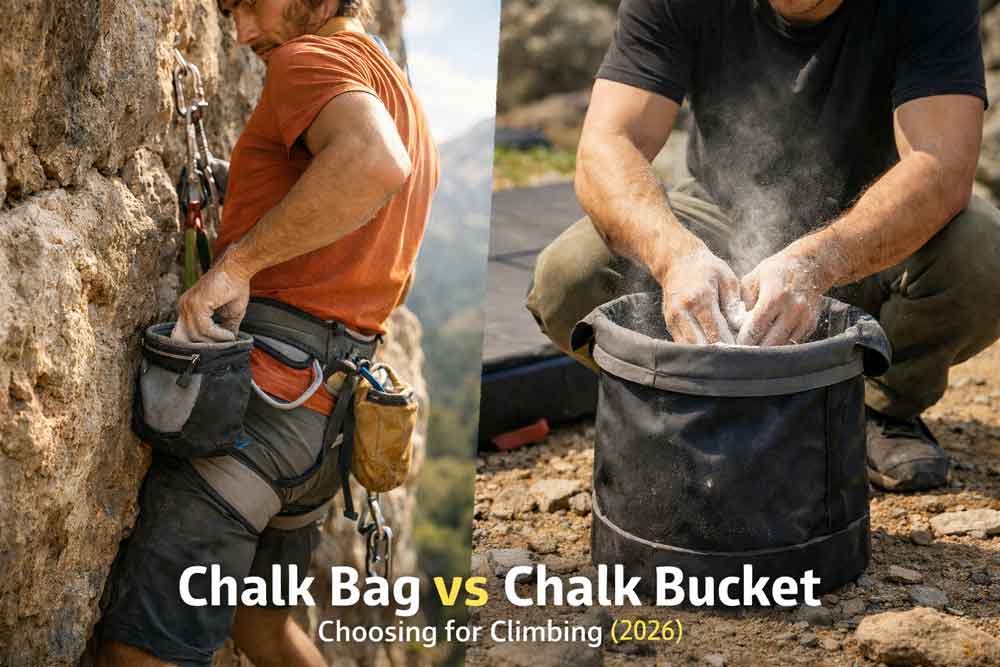
You’re deciding between a chalk bag vs chalk bucket for your climbing. This guide breaks down how they differ in access, portability, capacity, spill control, and discipline fit so you can choose with confidence. You’ll also find practical pros and cons, critical features to prioritize, and realistic price breakdowns with our expert buying tips.
Key takeaways
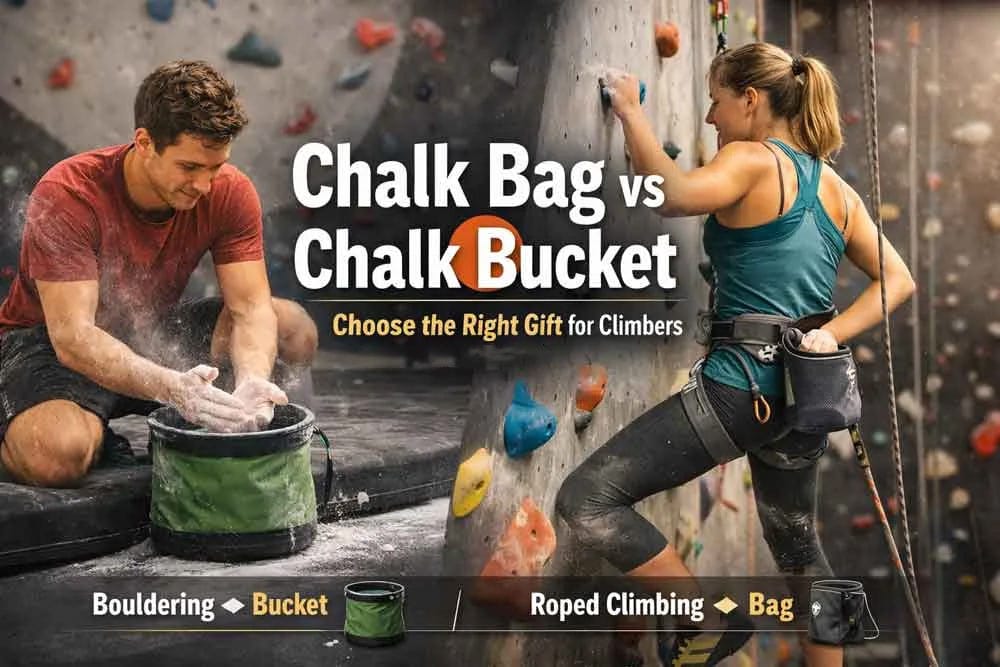
- For outdoor sport and trad, pick a wearable chalk bag for one‑hand, mid‑route chalking; for indoor/outdoor bouldering, choose a freestanding chalk bucket with stable, two‑hand access.
- Prioritize rim stiffness, a quality fleece lining, and a reliable drawcord on bags; prioritize a stable base plus magnetic and/or roll‑top closure on buckets.
- Capacity and spill control are the big trade‑offs: bags are lighter and personal‑sized; buckets hold more chalk and manage mess better when set down.
- Typical 2024–2026 pricing: bags ~$35–$55, buckets ~$40–$55 (sales can dip lower). Always verify current prices.
- If you split time 60/40 between roped routes and bouldering, start with a chalk bag; add a compact bucket later as your bouldering volume grows.
Core differences
Access and portability
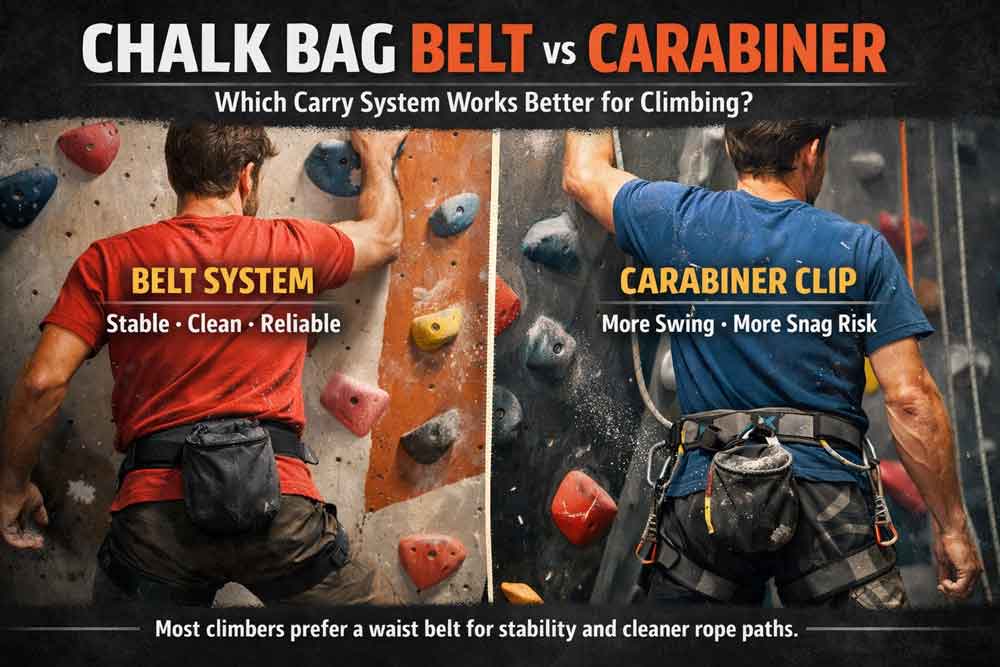
Think of a chalk bag as your on-route companion. It is worn on a belt or clipped to your harness, letting you dip one hand while you are hanging on with the other. This mid-route access is exactly why a bag excels for sport and trad climbing. Expert guidance from retail leaders like REI emphasizes that waist-mounted bags are built specifically to support on-route chalking for roped climbing, whereas ground-based chalk pots are engineered to serve bouldering and group training sessions.
A chalk bucket, by contrast, sits on the ground. It offers a wide opening for two‑hand dips between attempts and tends to include pockets and brush holders. Petzl’s official description of its ground‑placed bouldering bucket underscores this purpose and non‑wearable format (Petzl’s SAKAB page describing a ground‑placed bouldering chalk bag).
Capacity and spill control
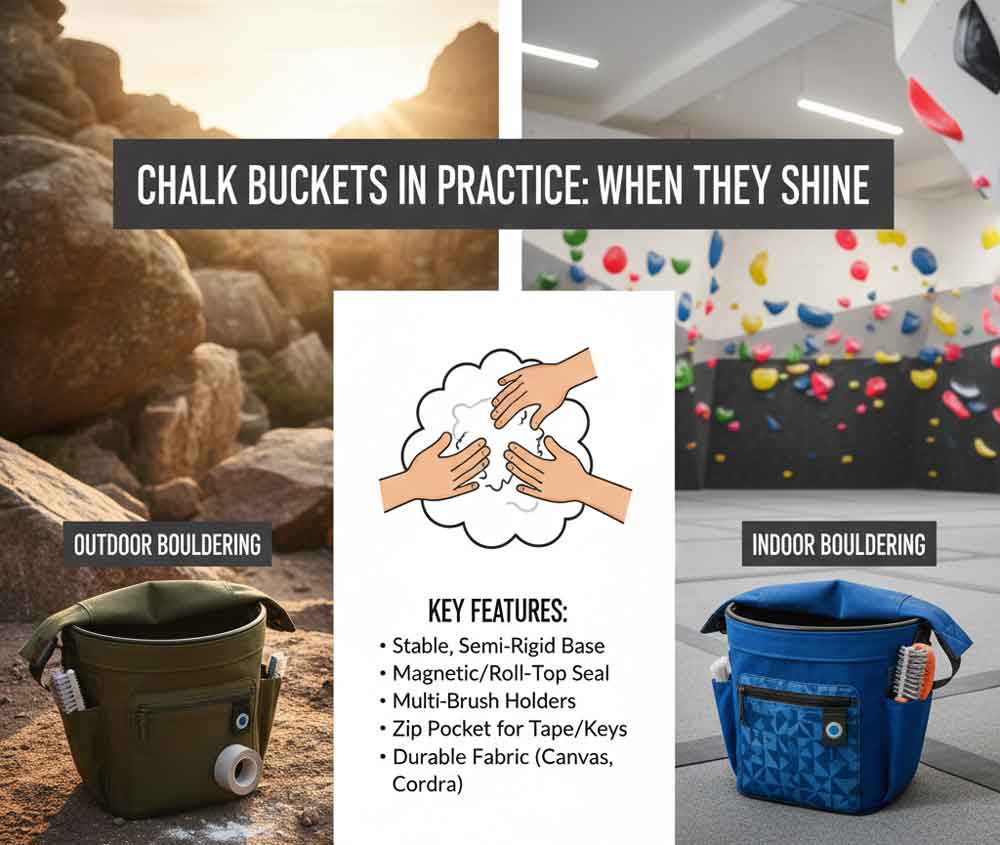
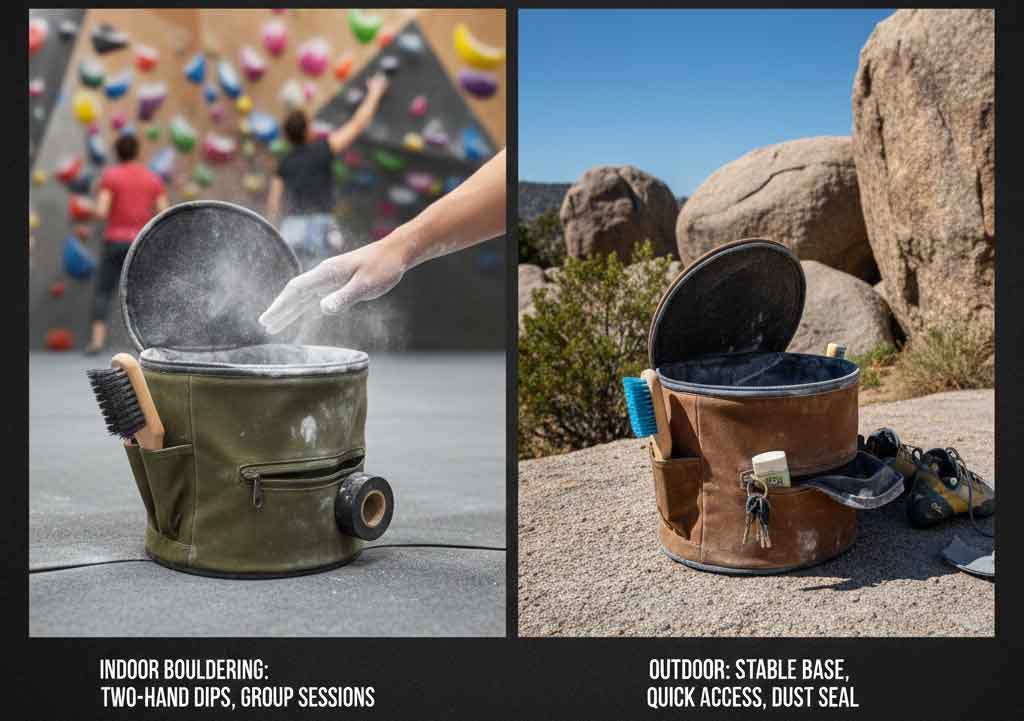
Buckets shine when you need more chalk on tap for long sessions, circuits, or partners sharing one container. To keep a bucket from tipping over on uneven dirt, you need a heavy-duty base. As a professional gear manufacturer, we typically use at least 600D Polyester or heavy TPU-coated nylon to provide the rigid vertical stability needed. Modern chalk pots feature stable, semi-rigid bases combined with magnetic roll-top closures that snap shut instantly to seal dust when you move between blocks.
Bags carry less by design, but they’re light and always with you. A secure drawcord keeps chalk where it belongs when you’re scrambling between routes or tossing your pack in the car. Many modern bags add dense fleece linings to help chalk adhere evenly and cut down airborne dust—benefits repeatedly mentioned on reputable retailer product pages for current models in 2024–2026; for example, a popular wearable bag listing notes that its soft fleece lining helps minimize dust and distribute chalk evenly (REI product page highlighting fleece lining benefits).
Best-fit disciplines
- Choose a chalk bag for outdoor sport or trad (including multipitch) where wearable, one‑hand access matters and approaches can be longer.
- Choose a chalk bucket for indoor/outdoor bouldering, circuits, and coaching or group sessions when stable, two‑hand access and larger capacity save time and refills.
- If you alternate between roped routes and bouldering, begin with a chalk bag for maximum versatility; later add a compact bucket to optimize your bouldering flow.
Chalk bags in practice
When they shine (sport, trad, mixed days)
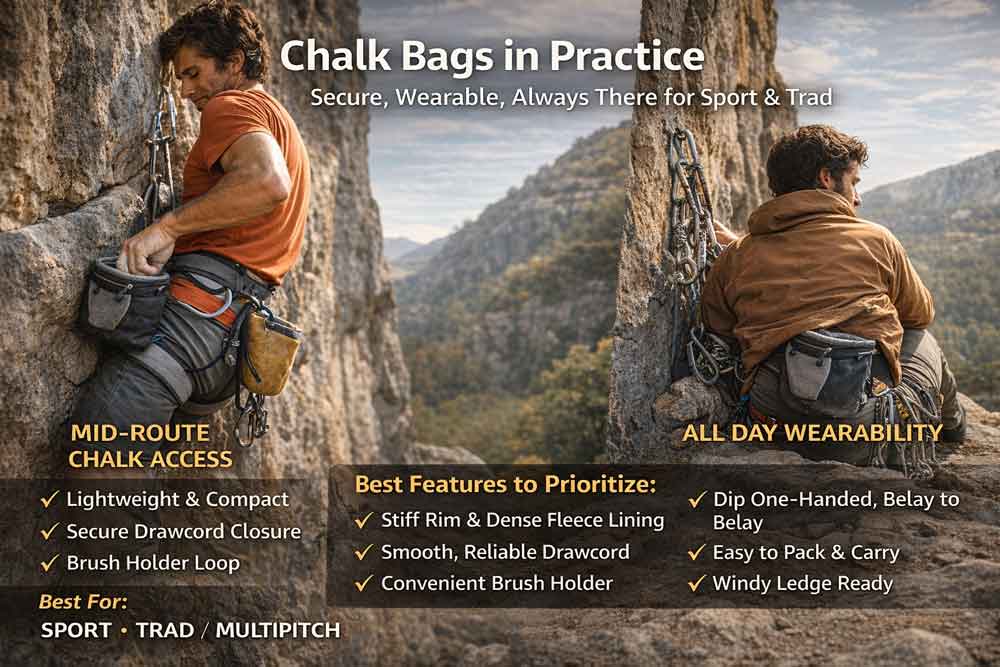
On a sport day, a bag disappears on your waist until you need it. You can chalk at a stance, mid‑move, or at the anchor without breaking rhythm. On windy ledges, you can even tuck the bag under your jacket momentarily to contain dust. For long approaches, a lightweight bag adds almost nothing to your carry. And on multipitch, it’s the only realistic option—your chalk stays with you from belay to belay.
Key features to prioritize
Look for a rigid or stiffened rim that holds a round opening so you can dip one‑handed without fighting collapsing fabric. Prioritize a dense fleece lining that helps chalk cling and spread evenly on your fingers. Choose a smooth, reliable drawcord that seals fully; gritty cords lead to leaks in your pack. Make sure brush storage sits where you can reach it from either hand, and confirm the bag rides well over your harness or belt—no awkward swinging or constant flipping. Petzl’s wearable bag documentation calls out a rigid rim and wearable ergonomics, which are hallmarks of a good on‑route bag (Petzl’s SAKA page outlining a rigid rim and wearable shape).
Limits to be aware of
Bags hold less chalk, so marathon sessions or sharing with partners means more refills. If you leave the top open on the ground, a gust or a kicked bag can make a mess. And while some bags can stand upright on flat rock, they’re not meant for station‑to‑station bouldering where you want two‑hand dips.
Chalk buckets in practice
When they shine (indoor and outdoor bouldering)
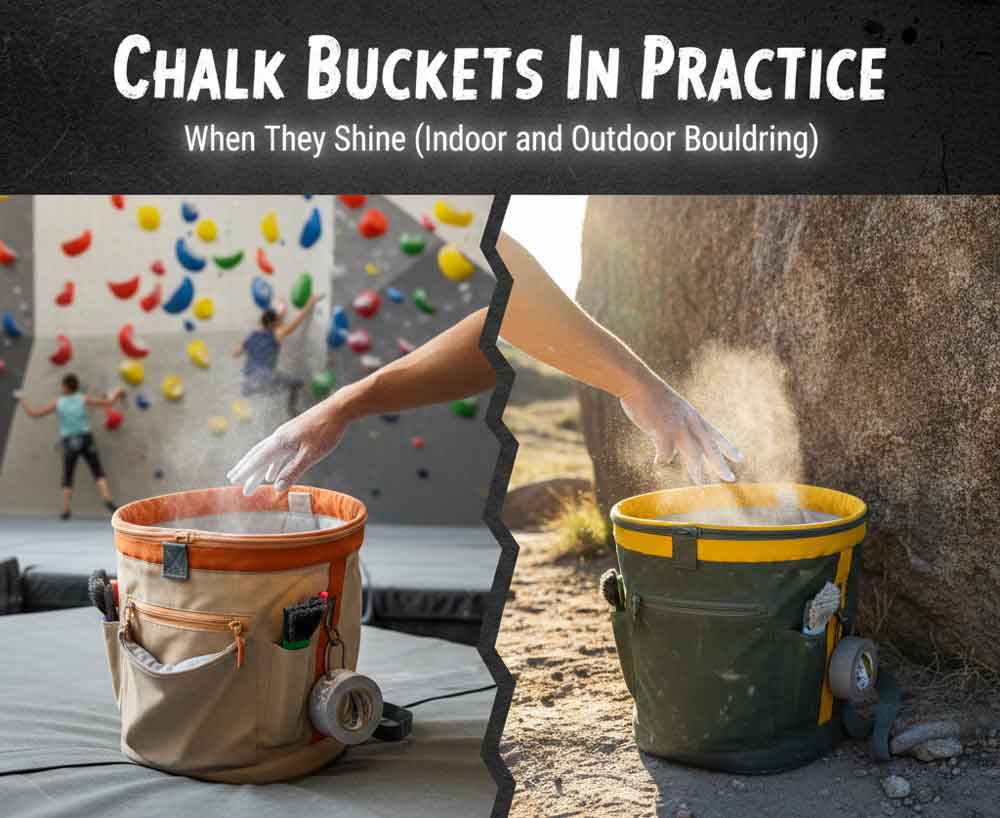
Buckets thrive in bouldering circuits. The wide mouth encourages full‑hand coverage before an attempt and between tries, and you can set brushes and tape in quick‑grab pockets. A semi‑rigid base resists tipping on uneven dirt, and magnetic or roll‑top closures snap shut to seal dust when you move to the next boulder or toss it in a tote. Official descriptions of modern buckets emphasize exactly these points: ground‑placed format, large opening, stability, and magnetic/roll‑top sealing (see Petzl’s SAKAB link above).
Key features to prioritize
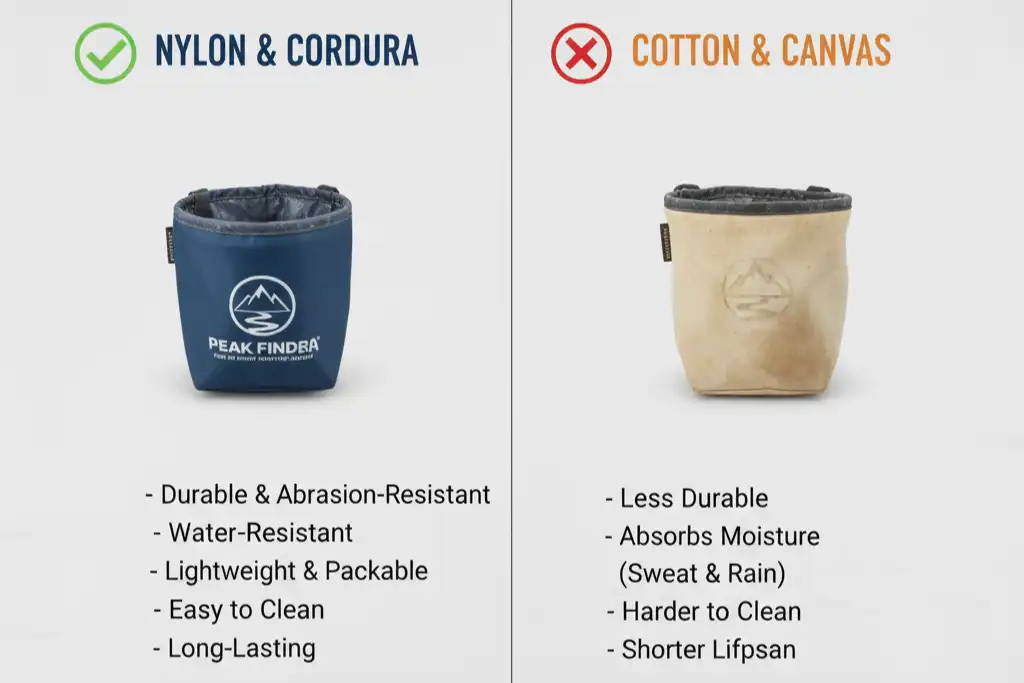
Seek a stable, semi‑rigid base that won’t crumple; it should stay upright even when nudged. A magnetic top paired with a roll‑top strip adds both quick access and a tight seal for transit. Multiple brush holders are handy when you and a partner each carry one. A zip pocket for tape or keys is a bonus. Durable fabric—canvas, Cordura, or similarly tough weaves—extends lifespan when you’re dragging it around blocs.
Limits to be aware of
Buckets aren’t wearable and don’t work for roped leads or multipitch. They’re bulkier in a crag pack and can be awkward on long, brushy approaches. In gusty conditions, even a stable bucket benefits from being closed between attempts to keep dust down.
Decision and buying guide
Match to your style and environment
1.The 80% Rule: Buy for the discipline you practice most. If you only boulder once a month, stick with a $35–$45 rigid-rim wearable bag. It works perfectly fine resting on the bouldering mat during casual sessions.
2.The Group Factor: If you usually climb with partners or coach youth teams, invest in a single $45–$55 chalk bucket. It gives everyone shared access and prevents messy spills from kicked personal bags.
3.Travel Smart: For long, steep approaches or minimal packing, a compact drawcord bag compresses down to nothing and won’t bulk up your crag pack.
Feature checklist and 2024–2026 trends
Chalk bags: Emphasize a stiff rim that stays open, quality fleece lining, a smooth drawcord that fully seals, dependable brush storage, and harness/belt compatibility. Wearable bags that call out rigid rims and precise stitching are easier to use mid‑move (see Petzl’s rigid‑rim wearable bag reference linked above for an example of the design intent).
Chalk buckets: Favor a semi‑rigid base for stability, a wide mouth, multiple brush holders, and a magnetic top backed by a roll‑top seal for transport. Pockets help manage tape, keys, or skin care items. Official pages for ground‑placed buckets consistently highlight these attributes (see Petzl’s SAKAB reference above for magnetic roll‑top and stability language).
Neutral care/selection workflow (brand‑agnostic): Decide by discipline first (bag for roped, bucket for bouldering). Inspect closures next: a crisp‑sealing drawcord on bags; magnetic plus roll‑top on buckets. Check rim stiffness on bags and base stability on buckets. Verify the lining is dense fleece and the interior is dark enough to show coverage. For care, empty excess chalk outside or into a sealed container, spot‑clean with mild soap, air‑dry fully, keep closures free of grit, and store sealed to limit dust. General retail education and official product guidance support these best practices for 2024–2026; for an overview of how retailers frame these choices and care basics, see the REI Expert Advice reference cited earlier.
Budget and value considerations
As of early 2026, expect these typical ranges in the U.S. market, noting that promotions and retailer differences can shift prices:
- Chalk bags: roughly $35–$55 for well‑featured models (rigid rim, fleece lining, brush storage). A representative mid‑range wearable bag sits around $45 at major outdoor retailers in 2026 (Backcountry listing showing a mid‑range wearable bag price point).
- Chalk buckets: roughly $40–$55 for modern “chalk pot” designs with magnetic and/or roll‑top closures, stable bases, and pockets. A commonly cited price point for a current bucket model is about $45–$50 at specialty retailers; official pages describe the magnetic closure and stability that define this tier (Black Diamond’s Team Chalk Pot page illustrating magnetic closure and organization).
Value heuristic: If roped climbing dominates your season, a $35–$45 bag with a stiff rim and dense fleece gives the best return. If bouldering dominates, a $40–$55 bucket with magnetic plus roll‑top closure and a stable base reduces spillage and refill frequency. If you’re mixed, start with a bag, then add a compact bucket when your bouldering volume or group sessions increase.
Conclusion
Choose the option that best matches your primary discipline and session style. For outdoor sport and trad, a wearable bag with a stiff rim, dense fleece lining, and a trustworthy drawcord keeps your chalk where and when you need it. For bouldering, a stable bucket with magnetic and roll‑top closure, a wide mouth, quality lining, and durable fabrics makes two‑hand dips fast and clean. Start with the one that fits today’s climbing, and add the other later as your goals—and your sessions—evolve.
Comments are closed