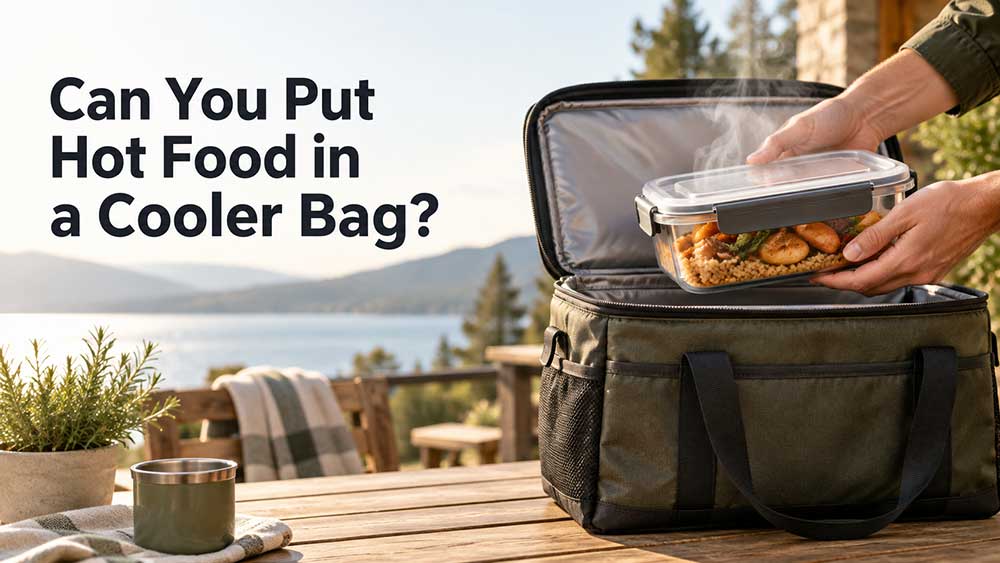
Yes, a cooler bag can carry hot food because its insulation slows heat transfer in both directions. However, the food should normally be placed in a sealed, heat-safe container rather than poured directly into the bag or placed against its liner.
A cooler bag can slow heat loss, but it does not actively heat food. It also cannot guarantee that food will remain at a safe temperature for a specific number of hours. The result depends on the starting temperature, container, insulation, empty space, outside temperature, opening frequency and length of the journey.
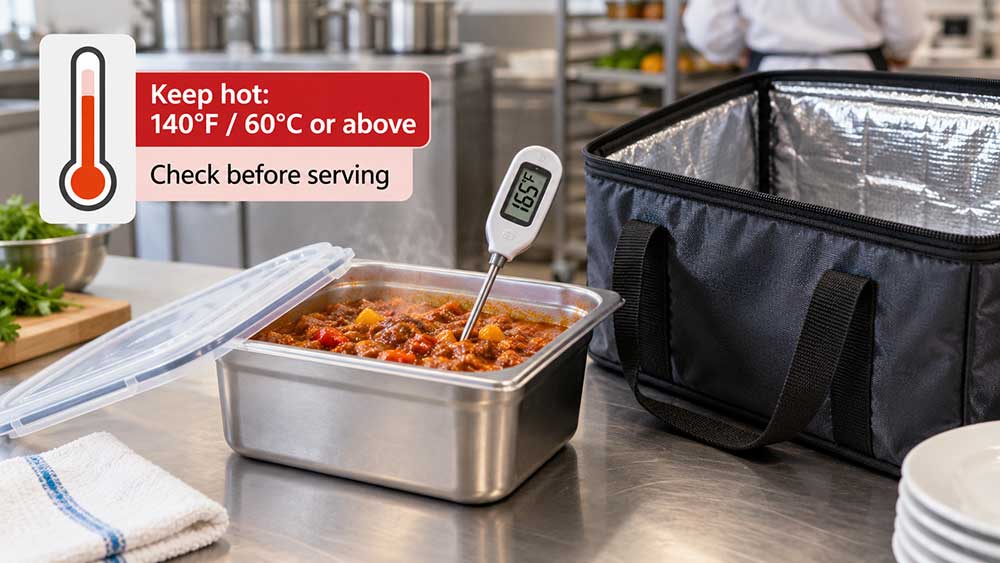
For food safety, hot perishable food should remain at 140°F (60°C) or above. If a cooler bag cannot maintain that temperature, the total time the food spends between 40°F and 140°F (4°C and 60°C) becomes important.
A cooler bag is an insulated bag, not a cooling device. Its foam and liner slow the movement of heat between the contents and the surrounding air.
This means it can help keep cold food cold when used with ice packs and slow heat loss from hot food packed in a suitable container. It cannot reheat food, maintain one exact temperature indefinitely or make food safe again after it has remained too long at an unsafe temperature.
Packing situation
Is a cooler bag suitable?
Main concern
Hot food in a sealed insulated food jar
Usually suitable
Confirm the food stays at or above 140°F
Hot food in a sealed heat-safe container
Suitable for limited transport
Retention depends on the bag and container
Uncovered hot food touching the liner
Not recommended
Hygiene, leakage and material compatibility
Hot and cold food in the same compartment
Not recommended
Neither item may stay at a safe temperature
Boiling liquid poured directly into the bag
Not recommended
Damage to the liner, seams, foam or adhesive
Long-distance hot-food transport
A cooler bag alone may be insufficient
Temperature must be monitored and controlled
A Cooler Bag Is Not the Same as an Insulated Food Jar
A cooler bag insulates an entire compartment. An insulated food jar is a sealed container specifically designed to hold hot food or liquid.
For soup, chili, stew and similar meals, an insulated food jar is generally the more reliable primary container. A cooler bag can provide another insulating layer and make the container easier to carry.
The USDA recommends filling an insulated food container with boiling water, allowing it to stand for a few minutes, emptying it and then adding thoroughly heated food. The container should remain closed until the food is ready to be eaten. The goal is to keep the food at 140°F (60°C) or above. See the USDA’s guidance on keeping bag lunches safe.
This preheating method applies to a container designed for hot food. Do not pour boiling water directly into a cooler bag to preheat its liner.
How to Pack Hot Food in a Cooler Bag
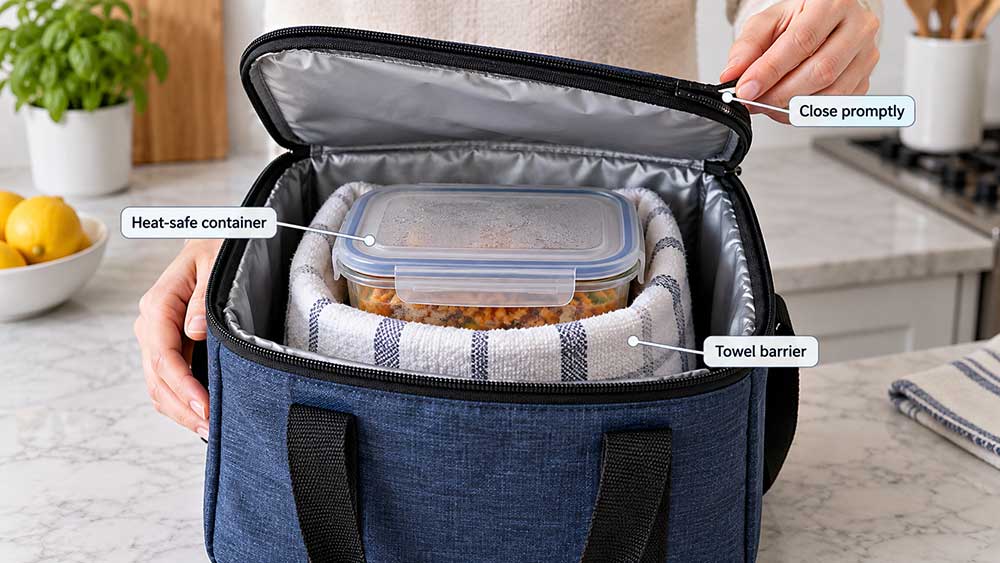
The safest approach is to use the cooler bag as secondary insulation around a suitable food container.
1. Check the Bag’s Instructions
Start with the care label or manufacturer’s instructions.
Check:
Whether hot contents are permitted
The intended use of the bag
Any recommended temperature limit
The liner material
Cleaning instructions
Whether the liner is approved for direct food contact
If no temperature information is provided, do not assume the bag can safely hold boiling liquid, extremely hot cookware or unpackaged hot food.
2. Heat the Food Properly
Pack the food while it is thoroughly hot rather than allowing it to cool to room temperature.
USDA guidance recommends reheating cooked-ahead food to at least 165°F (74°C). Where applicable, soups, sauces and gravies should be reheated to a boil before transport.
Starting with lukewarm food may leave it in the food-safety danger zone for longer, even when it is placed inside an insulated bag.
3. Use a Sealed, Heat-Safe Container
Choose a container that is:
Designed for the temperature of the food
Suitable for food contact
Leak-resistant or leakproof
Easy to clean
Secure enough to remain closed during transport
An insulated stainless-steel food jar is usually more suitable for soup and other liquids. Solid meals can be placed in a heat-safe container with a secure lid.
Hot takeaway containers can also be carried for a short journey if they are rated for hot food, close securely and do not leak. Thin disposable containers should remain upright and should not have heavy items stacked on top. Liquid meals are safer in a leakproof insulated container than in a disposable takeaway box.
Do not place a very hot cooking pot directly into a cooler bag unless the finished bag has been designed and tested for that use. A hot pot base may damage the liner, foam, coating, adhesive or bottom support.
4. Use a Bag That Fits and Keep It Closed
Too much empty space allows the contents to lose heat more quickly. Choose a cooler bag that fits the food containers reasonably well without forcing the zipper closed.
Pack everything at once, close the bag completely and avoid reopening it until the food is needed. Each opening allows warm air to escape.
5. Keep Hot and Cold Foods Separate
Do not place an ice pack next to food that you are trying to keep hot. The two temperature-control methods work against each other.
If one meal contains both hot and cold items, use separate bags or insulated compartments designed for that purpose. Another option is to place the warm meal in an insulated food jar and carry the chilled items in a separate cooler bag with ice packs.
Raw food and ready-to-eat food should also be kept in separate, securely closed containers to reduce the risk of cross-contamination.
Reusable heat packs should only be used when their manufacturer confirms that they are suitable for the intended temperature and application. Do not improvise with heated stones, metal objects, disposable hand warmers or electrical products inside a bag not designed for them.
6. Check the Temperature
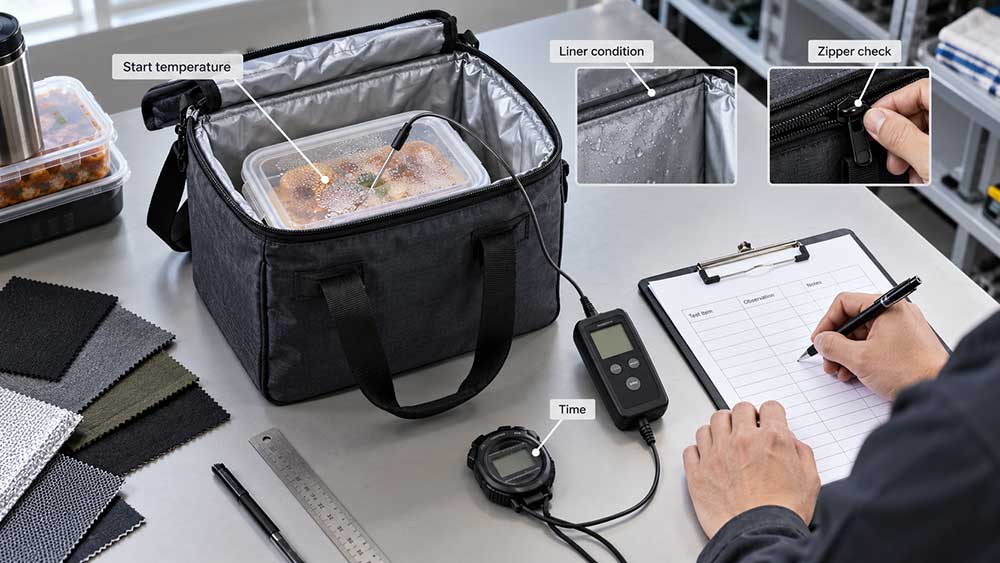
A food thermometer is the only reliable way to know whether food has remained hot enough.
Check the temperature when using a new bag, a different container or a longer journey. For commercial products, test the bag under realistic loading and environmental conditions rather than relying only on foam thickness or a supplier’s estimate.
How Long Will Food Stay Hot in a Cooler Bag?
There is no universal answer.
The same cooler bag can produce different results depending on:
Starting food temperature
Food quantity
Container type
Amount of empty space
Foam thickness and coverage
Zipper and opening design
Ambient temperature
Number of times the bag is opened
Whether the bag is stored in a hot or cold vehicle
The relevant question is not simply whether the food still feels warm. Food can feel warm while already being below the recommended hot-holding temperature.
According to FoodSafety.gov, food that is not being maintained above 140°F (60°C) or below 40°F (4°C) should not remain at room temperature for more than two hours. This limit is reduced to one hour when the surrounding temperature is above 90°F (32°C). The same guidance recommends keeping hot food at or above 140°F during transport. See the official guidance on transporting and holding food safely.
This limit includes the total time the food spends outside proper temperature control during preparation, packing and transport. Placing food in a cooler bag does not restart the clock.
The two-hour rule is not a promised holding time for a cooler bag. It is a food-safety limit for perishable food that is no longer under proper hot or cold temperature control.
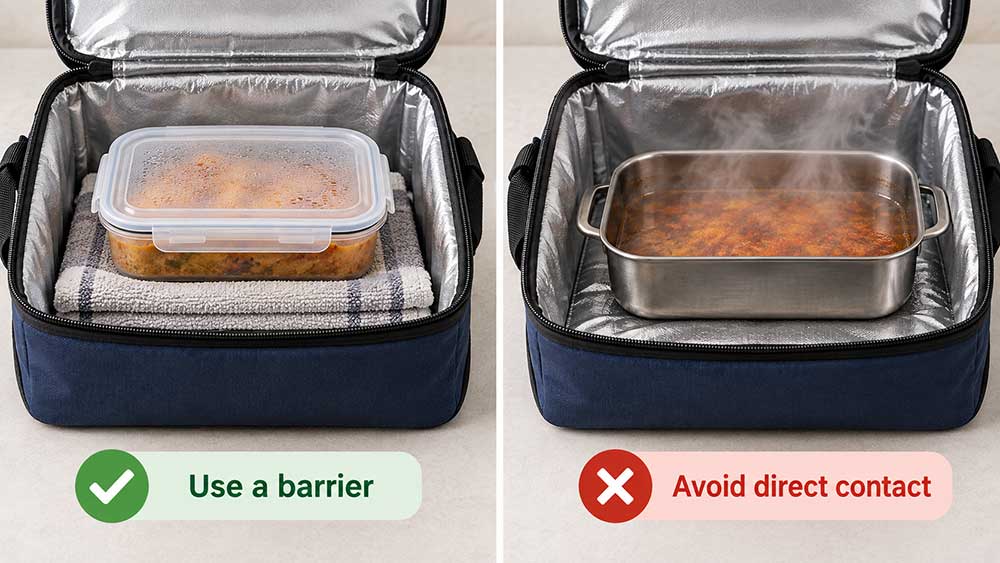
Should Hot Food Touch the Cooler Bag Liner?
Generally, no.
Hot food should be placed in a separate food-safe container because:
The liner may not be approved for direct contact with unpackaged hot food
Oil, sauces and liquid can enter stitched seams
Heat may affect the liner, coating, adhesive or printed surface
Sharp containers or utensils may puncture thin liners
Steam and condensation can remain in corners or foam layers
Direct spills are harder to clean completely
A material described as food-safe is not automatically approved for every type of direct contact with hot food. The actual lining, coating, adhesive, printing, temperature and contact conditions all need to be considered.
How Do Different Liner Materials Affect Hot-Food Use?
The material name alone does not establish the maximum safe temperature of a finished cooler bag. Formulation, thickness, backing fabric, lamination, adhesives and construction can all change its performance.
Liner type
What buyers should consider for hot-food use
PEVA
Flexible and easy to wipe, but thin films may wrinkle, stretch or be damaged by high heat or sharp containers
Aluminum foil lining
Lightweight and reflective, but the foil layer or laminated backing may crease, puncture or separate
PVC
Can provide a smooth, wipeable surface, but temperature performance depends on the formulation, coating and backing fabric
TPU
Often used in higher-performance or welded coolers, but the complete laminate and welded construction still require testing
Do not publish a maximum temperature for PEVA, PVC, TPU or aluminum foil unless it is supported by the material supplier’s technical data and confirmed on the finished product.
For carrying sealed hot-food containers, useful features include:
Continuous insulation around the main compartment
A zipper or lid that closes fully
A stable, reinforced base
Enough height for containers to remain upright
Minimal unnecessary internal space
A liner that is easy to wipe clean
Dividers or straps that prevent containers from tipping
Handles and shoulder straps designed for the loaded weight
A thicker bag is not automatically better. Gaps in the insulation, a loose opening or a poorly fitting container can reduce real-world performance.
The right design also depends on whether the bag is intended for a single lunch container, several takeaway meals or commercial food delivery.
Clean the Bag After Carrying Hot Food
Hot meals can produce steam, condensation, grease and odors even when the container does not visibly leak.
After use, remove all containers, wipe away spills and clean the liner according to the care label. Check the seams, corners and underside of removable panels, then leave the bag fully open until it is completely dry.
Our guide on how to clean a cooler bag explains how to clean sewn and RF-welded cooler bags without unnecessarily damaging their liners or insulation.
Specifying Hot-Food Use in a Custom Cooler Bag Project
For OEM buyers, “keeps food hot” is not a complete product requirement.
The RFQ should explain how the finished bag will be used, including:
Type of food
Starting food temperature
Whether food is packaged or directly exposed
Container dimensions and material
Number of containers
Required transport time
Minimum acceptable food temperature
Expected ambient temperature
Cleaning method
Required liner material
Whether the bag will carry hot food, cold food or both
Applicable food-contact and labeling requirements
The manufacturer should also know whether the project is a lunch bag, takeaway delivery bag, catering bag or general-purpose cooler.
Test the Complete Bag, Not Only the Liner
A liner supplier’s temperature data does not prove that the entire bag can handle the same conditions.
Finished-product testing may need to check:
Temperature retention over time
Liner wrinkling, softening or discoloration
Lamination or adhesive separation
Foam deformation
Welded or stitched seam condition
Leakage from food containers
Odor after repeated use
Cleaning performance
Zipper operation
Handle and shoulder-strap strength
Changes after repeated hot-food use
The test should record the food or test medium, starting temperature, container, load, ambient temperature, measurement intervals and acceptance criteria. Without these details, different suppliers may interpret “keeps food hot” differently.
A cooler bag can help carry hot food because insulation slows heat loss as well as heat gain. However, it should normally be used around a sealed, heat-safe food container rather than as the food container itself.
For safer hot-food transport:
Start with thoroughly heated food
Use a sealed insulated or heat-safe container
Keep hot and cold items separate
Keep the bag closed
Check the food with a thermometer
Maintain hot food at 140°F or above
Follow the two-hour or one-hour limit when food is no longer under safe temperature control
Do not assume that every PEVA, aluminum foil, PVC or TPU-lined cooler bag is suitable for the same temperature. Any hot-food claim should be supported by material specifications and finished-product testing.
Developing a Cooler Bag for Hot or Cold Food
Vancharli Outdoor supports OEM and ODM development of sewn insulated cooler bags and RF-welded waterproof coolers.
Buyers can define the intended food containers, temperature range, transport time, liner, insulation, closure, cleaning method and test conditions during product development. This makes the final care instructions and temperature-retention claims easier to verify.
It can slow heat loss from food stored in a sealed, heat-safe container. Check the bag’s instructions first, and do not assume that it can maintain food above 140°F for a specific number of hours.
Can I put hot food directly into a cooler bag?
Usually not. The liner may not be approved for direct contact with unpackaged hot food, and liquids can enter seams or insulation. Use a separate food-safe container.
Will a cooler bag keep food hot for four hours?
It may or may not. Performance depends on the food, container, insulation, bag size, outside temperature and opening frequency. Use a food thermometer rather than relying on a fixed time claim.
Should I add an ice pack to hot food?
No. An ice pack works against the goal of keeping the food hot. Pack hot and cold items in separate bags or separately insulated compartments.
Can I place a hot cooking pot in a cooler bag?
Only if the finished bag has been designed and tested for that use. A very hot pot can damage the liner, foam, adhesive or base panel. Transferring the food to a suitable insulated container is safer.
Does waterproof mean heat-resistant?
No. Waterproofing and heat resistance are different properties. A waterproof liner or welded seam does not automatically mean the complete bag is suitable for hot food.
What temperature should hot food maintain during transport?
Hot perishable food should remain at 140°F (60°C) or above. A food thermometer should be used when safe temperature control is important.
What should OEM buyers test before claiming that a cooler bag keeps food hot?
They should test the complete bag with the intended containers, load, starting temperature, transport time and ambient conditions. Testing should cover temperature retention as well as the liner, foam, seams, adhesive, zipper and carrying system.









Comments are closed