




Can You Put Dry Ice in a Cooler Bag? Safety Guide
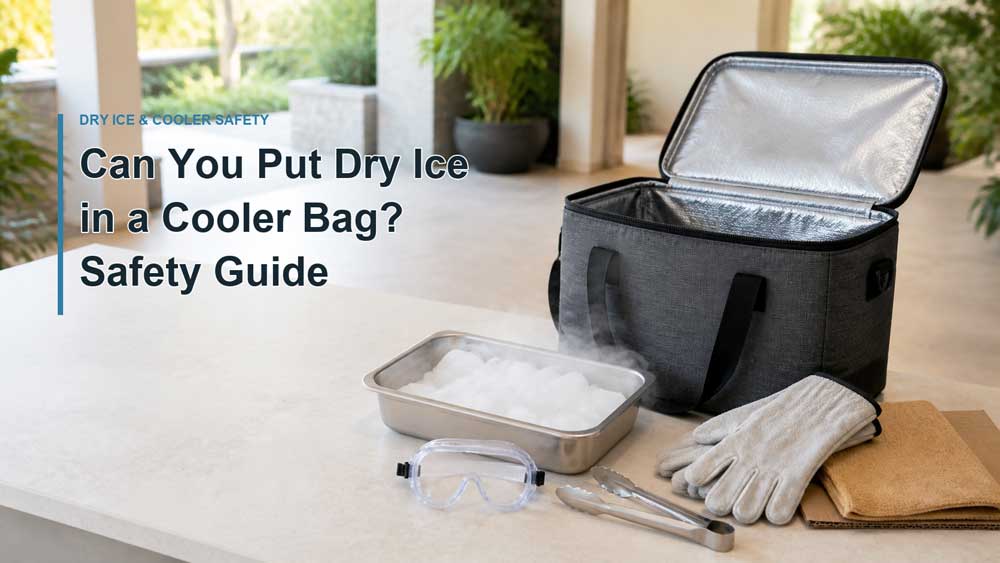
You should not put dry ice in a cooler bag unless the manufacturer explicitly confirms that the exact model is dry-ice compatible.
Dry ice is extremely cold, and as it warms, it turns directly into carbon dioxide gas. In an unsuitable or tightly sealed cooler, it can damage materials, freeze the contents, and create dangerous pressure if the gas cannot escape.
Cooler construction makes an important difference. Some hard-sided coolers are designed for dry ice, while most conventional sewn cooler bags and welded waterproof soft coolers are not. If the care label, product manual, or manufacturer’s website does not clearly approve dry ice use, choose regular ice or reusable cold packs instead.
Dry Ice Compatibility by Cooler Construction
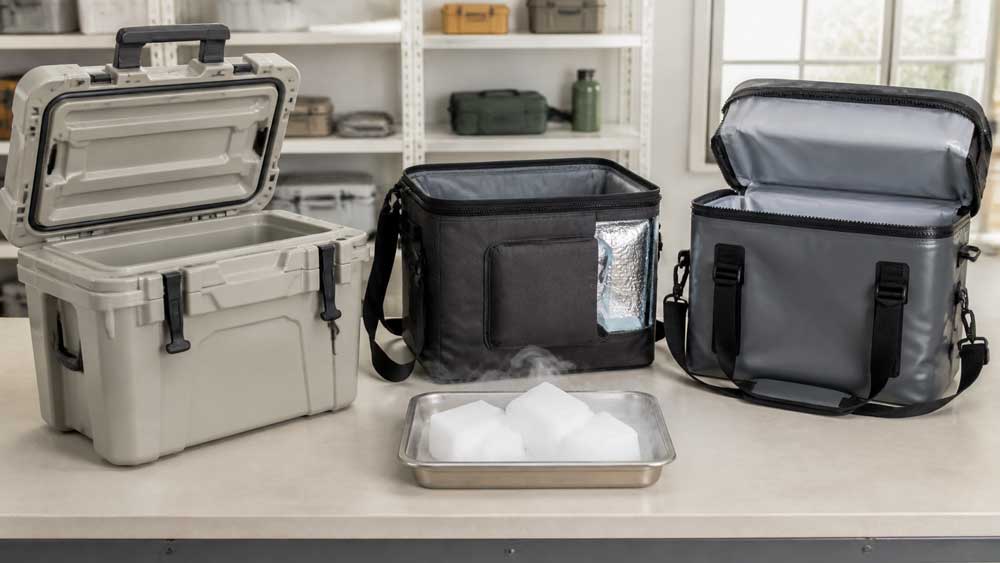
| Cooler type | Typical construction | Can it hold dry ice? | What to check |
|---|---|---|---|
| Conventional sewn cooler bag | Fabric shell, foam, liner, stitched seams, and standard zipper | Usually no | Escaping gas does not prove that the materials can tolerate dry ice |
| Welded waterproof soft cooler | Coated fabric, welded seams, and a highly sealed closure | Usually no | The sealed construction may increase pressure risk |
| Insulated lunch bag | Lightweight fabric, thin insulation, and standard zipper | No in most cases | These products are normally designed for reusable cold packs |
| Standard hard-sided cooler | Rigid shell and insulated body | Some models can | Check the instructions for the exact model |
| Rotomolded hard cooler | Rigid one-piece shell and thick insulation | Often, but not always | Confirm compatibility, quantity, packing, and ventilation requirements |
| Unlabelled or unidentified cooler | Materials and construction cannot be verified | No | Never assume compatibility based on thickness or appearance |
The overall shape of a cooler does not determine dry-ice compatibility by itself. The materials, seams, insulation, closure, structural strength, and gas-release design must all be considered.
Why Is Dry Ice Different From Regular Ice?
Dry ice is solid carbon dioxide rather than frozen water.
Its surface temperature is approximately −78.5°C (−109.3°F), making it far colder than ordinary ice. It also does not melt into water. Instead, it sublimates, changing directly from a solid into carbon dioxide gas.
These properties make dry ice useful for keeping frozen food, laboratory materials, and other temperature-sensitive contents cold during suitable transport. However, they also create three important risks:
- Extreme cold can damage the cooler or its contents.
- Direct contact can cause serious cold burns or frostbite.
- Carbon dioxide gas can build pressure or displace oxygen in enclosed spaces.
The U.S. Centers for Disease Control and Prevention warns that dry ice should never be kept in a sealed container because accumulating gas can cause the container to rupture. The CDC also recommends insulated gloves, suitable eye protection when necessary, and adequate ventilation when handling or transporting it. See the official CDC guidance on dry ice safety.
Why Most Soft-Sided Coolers Are Not Suitable
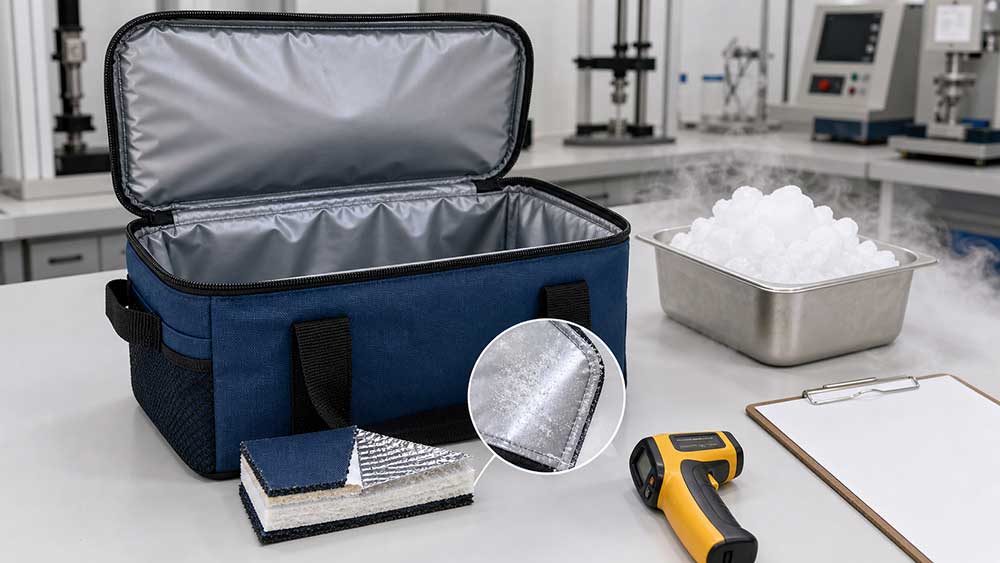
Conventional sewn cooler bags and welded waterproof soft coolers have different constructions, but neither should be treated as dry-ice compatible simply because it looks durable or well insulated.
Conventional sewn cooler bags are not designed for extreme cold
A conventional sewn cooler bag may use:
- Polyester or nylon outer fabric
- PEVA or another flexible liner
- Open- or closed-cell foam
- Laminated films
- Binding tape
- Adhesives
- Stitched seams
- Standard plastic zippers and buckles
These components are normally selected for regular ice or cold packs. Performance at normal outdoor temperatures does not prove that they will remain flexible and stable at −78.5°C.
Extreme cold may cause some materials to stiffen, shrink, become brittle, separate, crack, or lose adhesion. Even if carbon dioxide can escape through the zipper or needle holes, the bag may still be damaged by the temperature.
A cooler that leaks gas is not automatically a safely vented dry-ice container.
Welded waterproof soft coolers can create a different risk
A welded waterproof soft cooler may use TPU- or PVC-coated fabric, high-frequency or heat-welded seams, thicker insulation, and a more tightly sealed closure.
This structure can improve water resistance, leak resistance, and ice retention. It does not automatically make the cooler suitable for dry ice.
A highly sealed zipper, magnetic opening, or roll-top closure may restrict the release of carbon dioxide. As the dry ice sublimates, pressure can build inside. The flexible body may swell or distort, the closure may be forced open, or a seam or another weak point may fail.
YETI, for example, states that its Hopper soft coolers are not compatible with dry ice, while selected Tundra and Roadie hard coolers are approved for it. RTIC also approves dry ice for certain hard-sided models but does not recommend it in its soft coolers.
Do not try to make a welded waterproof soft cooler compatible by puncturing the body, cutting a vent, or leaving its closure partly open. Those changes do not prove that the liner, foam, lamination, adhesives, hardware, or other components can tolerate dry ice.
The contents can become too cold
A cooler normally keeps food and drinks chilled. Dry ice can freeze them solid.
This may cause:
- Fresh produce to suffer freezing damage
- Prepared foods to change in texture
- Cans or bottles to split as liquids freeze and expand
- Glass containers to crack
- Food packaging to become brittle
- Items touching the dry ice to develop localized freeze damage
Dry ice should never be placed directly into a drink or consumed. Food and beverages also need a suitable physical barrier from the dry ice.
How to Check Whether Your Cooler Is Compatible
Do not judge compatibility by touching the material, looking at the insulation thickness, or checking whether the product is sewn, welded, waterproof, leak-resistant, or hard-sided.
Use the following evidence instead:
- Read the care label and warning label.
- Check the product manual.
- Search the manufacturer’s official website.
- Look for the exact model—not a general statement about the brand.
- Contact the manufacturer if the instructions are unclear.
- Request written confirmation when the cooler is used for commercial or professional transport.
The instructions should clearly answer:
- Whether dry ice is permitted
- How carbon dioxide gas can escape
- Whether there is a maximum quantity
- Whether a barrier or wrapping is required
- How the cooler should be transported
- Which warranty limitations apply
- Whether the product is approved for food, medical, or air transport use
Descriptions such as “heavy-duty,” “airtight,” “fully waterproof,” or “premium insulation” are not evidence of dry-ice compatibility.
If the Manufacturer Approves Dry Ice
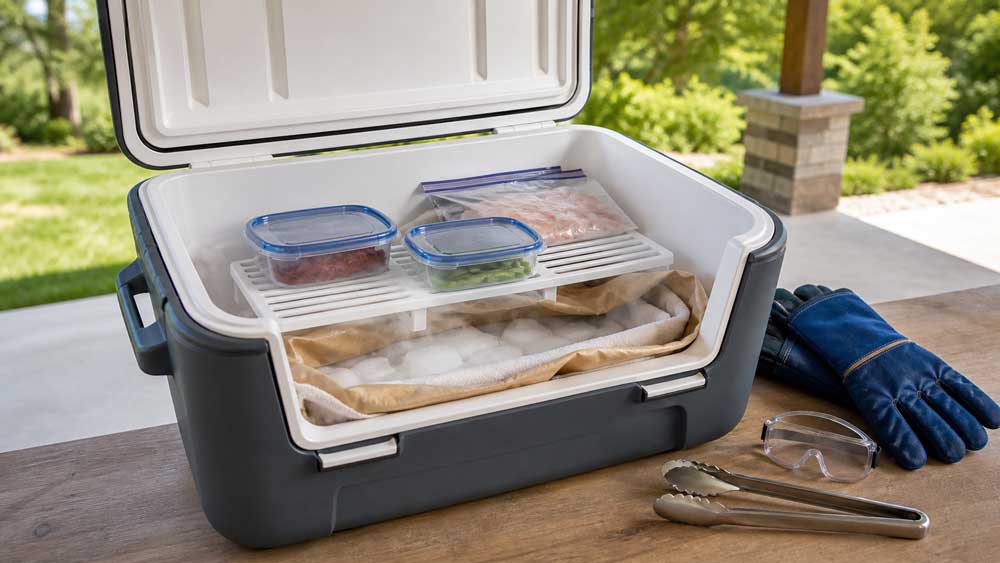
Follow the manufacturer’s instructions for the exact cooler model. General safety practices include the following.
Protect your hands and eyes
Never handle dry ice with bare hands. Wear insulated gloves designed to protect against extreme cold and use suitable tongs when moving it.
Avoid cutting or breaking dry ice unnecessarily. If it must be divided, follow the supplier’s handling instructions and use appropriate eye protection.
Do not seal it in an airtight container
The approved cooler and any internal packaging must allow carbon dioxide gas to escape.
Do not place dry ice in a sealed glass jar, bottle, plastic container, or tightly closed inner compartment. Never assume that opening the cooler occasionally provides adequate ventilation.
Keep a barrier between dry ice and the cooler
If the cooler manufacturer permits it, wrap the dry ice as directed and use cardboard, paper, or another recommended insulating barrier.
This can slow sublimation and reduce direct contact between the extremely cold dry ice and the cooler liner, food packaging, or other contents. The correct method still depends on the instructions for the approved cooler.
Separate it from food and drinks
Keep food properly packaged and prevent direct contact with dry ice. Pay particular attention to liquids, cans, glass containers, fruit, vegetables, and foods that should remain chilled rather than frozen.
When the goal is to keep items frozen, dry ice is commonly placed above the contents because the cold carbon dioxide gas moves downward. However, packing direction, quantity, and barriers should follow the instructions supplied with the approved cooler.
Use it only in well-ventilated areas
Dry ice releases carbon dioxide continuously as it warms.
Do not keep dry ice in:
- A closed passenger compartment
- A parked vehicle
- A tent
- A small cabin
- A tightly closed room
- An unventilated storage compartment
When transporting dry ice by vehicle, provide continuous fresh-air ventilation and follow the dry ice supplier’s safety instructions. Never leave a dry-ice cooler in a parked vehicle.
Keep it away from children and animals
Store and use dry ice where children and animals cannot touch it, consume it, or become trapped in an enclosed space with accumulating carbon dioxide gas.
Allow unwanted dry ice to sublimate naturally in a secure, well-ventilated area. Do not dispose of it in a sink, toilet, drain, sealed bin, or enclosed room.
Can You Carry Dry Ice in a Cooler on a Plane?
Dry ice may be permitted for air travel, but only under specific conditions.
According to the U.S. Federal Aviation Administration, dry ice used to refrigerate perishables is limited to 2.5 kg (5.5 lb) per package and per passenger. Airline approval is required, and the package must allow carbon dioxide gas to vent.
For checked baggage, the package must also be marked with:
- “Dry ice” or “Carbon dioxide, solid”
- The net quantity of dry ice, or a statement that it contains 2.5 kg (5.5 lb) or less
These rules do not make an incompatible cooler safe. Both the packaging and the cooler itself must be suitable for the intended use.
Check the current FAA PackSafe requirements for dry ice, then confirm the airline’s own rules before travelling. Requirements outside the United States may differ.
What Can You Use Instead of Dry Ice?
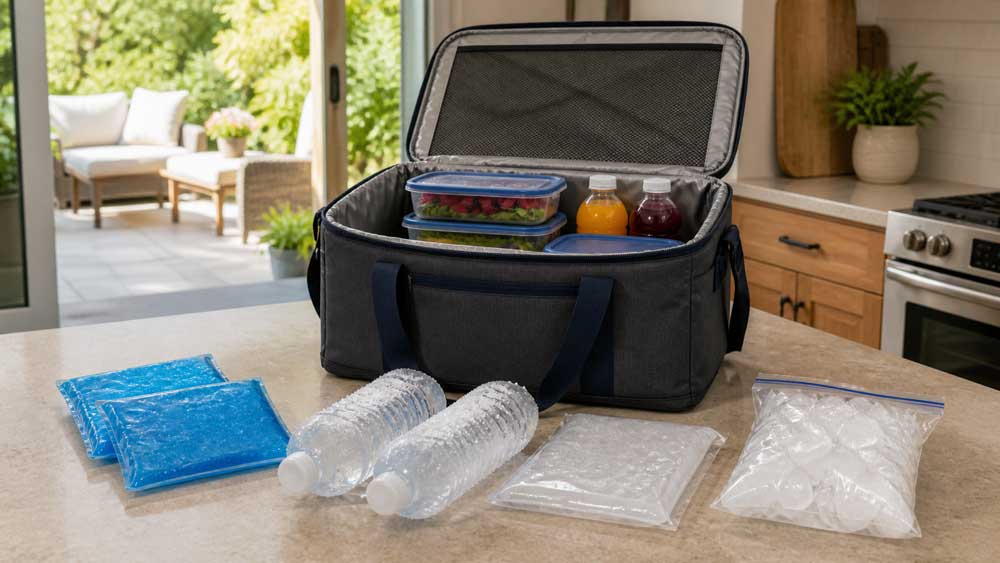
For coolers that are not approved for dry ice, regular ice and reusable cold packs are safer and more practical.
Reusable cold packs
Reusable packs do not create carbon dioxide gas and are less likely to expose cooler materials to extreme cold. They also help keep food dry and are easy to position around the contents.
Choose the type and temperature range according to whether the contents need to remain chilled or frozen.
Frozen water bottles
Frozen bottles act as cooling blocks without releasing meltwater into the cooler. As they thaw, they can also provide drinking water.
Leave enough expansion space in the bottle before freezing it.
Block ice
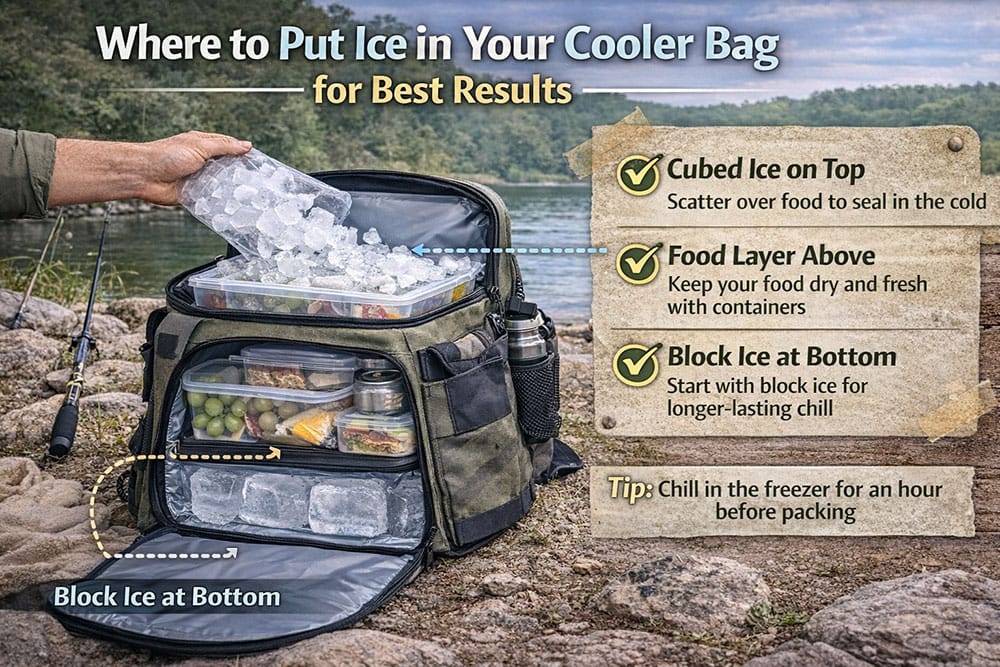
Block ice usually melts more slowly than small cubes because it has less exposed surface area. It works well at the bottom of a larger cooler when long cooling duration is the priority.
Cubed ice
Cubed ice cools contents quickly and fills spaces around food and drinks. It melts faster than block ice but is convenient for day trips, picnics, and beverages.
Combine different cooling methods
A practical setup may use:
- A large frozen block or cold pack at the bottom
- Pre-chilled food and drinks in the middle
- Smaller packs or cubed ice around the sides and top
- Towels or dividers to fill unnecessary air gaps
Our guide to where to put ice in a cooler bag explains how placement affects cooling performance.
You can also improve cooling duration without dry ice by pre-chilling the cooler, cooling the contents before packing, limiting openings, keeping it shaded, and choosing an appropriate ice-to-content ratio. See our practical guide to maximizing ice retention in a waterproof cooler bag.
Dry Ice Is Not the Only Way to Improve Performance
A cooler’s real-world performance depends on more than the temperature of the cooling medium.
Important factors include:
- Insulation type and thickness
- Air gaps and thermal bridges
- Liner construction
- Seam construction
- Zipper or closure design
- Cooler size
- Starting temperature of the contents
- Amount and placement of ice
- Frequency of opening
- Outdoor temperature
- Exposure to sunlight and hot surfaces
A well-designed cooler packed with ordinary ice can be more useful for daily outdoor activities than an unsuitable product packed with dry ice.
If you are comparing products, first determine whether a soft cooler or hard cooler better matches the intended trip, carrying distance, capacity, and cooling duration.
What Brands Should Consider Before Claiming Dry-Ice Compatibility
For a cooler brand, “dry-ice compatible” should be treated as a technical performance claim—not a marketing phrase.
The product-development team should first define whether the intended product is:
- A conventional sewn cooler bag
- A welded waterproof soft cooler
- A rigid hard-sided cooler
That choice changes the materials, closure, seam construction, gas-release design, testing method, and expected risks.
The team should then evaluate:
- The intended amount and form of dry ice
- The lowest expected internal temperature
- Outer material performance at low temperatures
- Liner flexibility and resistance to cracking
- Foam behavior under extreme cold
- Adhesive and lamination performance
- Welded or stitched seam stability
- Zipper and closure behavior
- Gas-release requirements
- Internal barriers and dividers
- Warning labels
- Handling and transportation instructions
- Food-contact requirements
- Applicable transport regulations
- Product misuse that can reasonably be anticipated
A normal leak test or ice-retention test does not establish dry-ice compatibility. Samples must be evaluated under defined low-temperature and gas-release conditions using an appropriate test plan.
The specification should also state whether the product is intended to keep contents chilled or fully frozen. Those are different functions and may require different insulation, construction, packaging, and warnings.
Brands developing conventional cooling products can compare cooler bag insulation materials before choosing a structure for their target market.
Developing Custom Cooler Bags With Vancharli Outdoor
Vancharli Outdoor supports OEM and ODM development of conventional sewn cooler bags and welded waterproof soft coolers for brands, wholesalers, importers, and procurement teams.
Our team can assist with cooler type, capacity, insulation, liner, outer material, stitched or welded construction, opening design, carrying system, logo application, packaging, sampling, and bulk-production requirements.
If dry-ice compatibility is part of the intended product claim, it must be defined at the beginning of development and supported by suitable materials, construction, instructions, and testing. Thickness, waterproof construction, welded seams, or coated fabric alone cannot confirm dry-ice compatibility.
Frequently Asked Questions
Can I put dry ice in an insulated lunch bag?
Usually not. Most insulated lunch bags are designed for reusable cold packs or frozen bottles. Use dry ice only if the manufacturer of the exact product explicitly approves it.
Will dry ice damage TPU or PVC?
It may. Performance depends on the material formulation, thickness, lamination, additives, seams, and exposure conditions. A general TPU or PVC description does not establish dry-ice compatibility.
Can I mix dry ice with regular ice?
Only in a cooler that the manufacturer has approved for dry ice. Dry ice can help keep regular ice frozen, but the container must tolerate the temperature and release carbon dioxide safely.
Is it safe to leave a dry-ice cooler in a car?
No. Carbon dioxide can accumulate in a closed vehicle as the dry ice sublimates. Maintain ventilation during transport and never leave the cooler in a parked vehicle.
Can I leave the cooler zipper slightly open?
A partly open zipper does not make an incompatible cooler safe. It does not address possible damage to the liner, insulation, adhesive, seams, or other materials.
How long does dry ice last in a cooler?
There is no single reliable time. It depends on the amount and form of dry ice, cooler construction, outside temperature, packing density, openings, and ventilation. Follow the cooler and dry ice suppliers’ guidance rather than relying on a universal estimate.




Comments are closed