How to Lower Custom Bag MOQ Without Sacrificing Quality
Launching a custom bag does not always require a large first order. In many cases, the minimum order quantity can be lowered by simplifying the parts of the project that create purchasing or production complexity—not by weakening the bag.
The safest ways to lower custom bag MOQ are to use readily available materials, launch with fewer colors and SKUs, share components across related styles, choose proven hardware and a practical logo method, and keep packaging simple. If a material supplier requires a larger purchase, you may also be able to buy the material MOQ but manufacture fewer finished bags for the first run.
What should not change are the product’s non-negotiable performance requirements: load-bearing seams, padding, closures, approved measurements and tolerances, material performance, logo accuracy, and inspection standards.
Custom Bag MOQ Is Not Just One Number
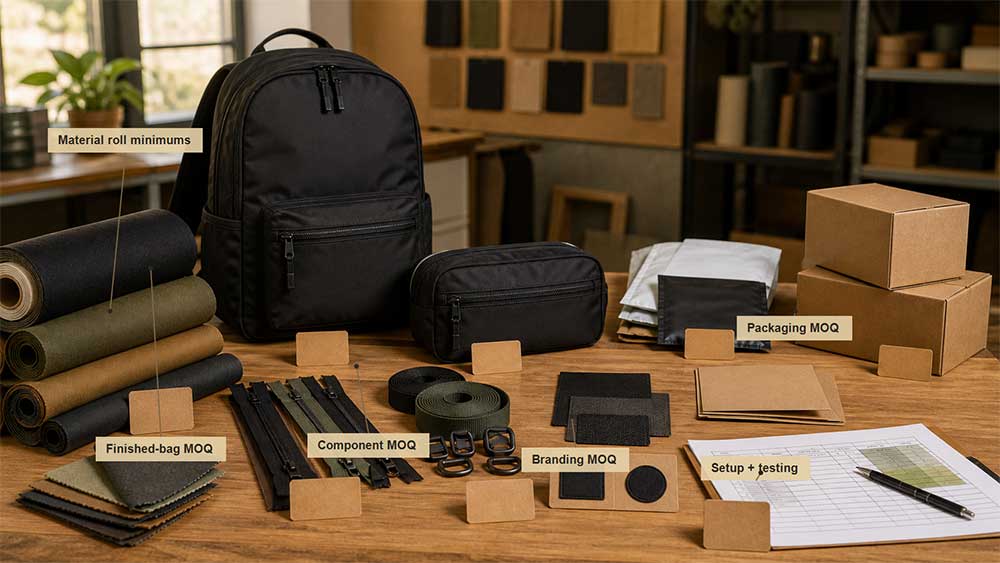
A factory may quote one MOQ for the finished bag, but several minimums can sit behind that number.
MOQ layer
What may create the minimum
Possible response
Finished-bag MOQ
Cutting setup, line preparation, production control, and efficiency
Use a proven construction, simplify assembly, or accept a higher unit price
Main-material MOQ
Mill roll length, custom dyeing, coating, lamination, printing, or weaving
Select a regularly sourced material or purchase the mill minimum
Color MOQ
Dyeing, coating, printing, webbing, thread, or branding-component setup
Reduce launch colors or use established colors
Component MOQ
Zippers, buckles, webbing, frames, wheels, molded parts, or metal trims
Use approved standard parts or share parts across styles
Branding MOQ
Woven labels, rubber patches, metal plates, embroidery, or printing setup
Match the logo method to the order quantity
Packaging MOQ
Printed polybags, retail boxes, inserts, labels, or special paper
Start with protective standard packaging plus a sticker, card, or hangtag
Testing and setup
Laboratory fees, tooling, screens, molds, and production preparation
Treat necessary setup and testing as fixed project costs
This distinction matters. A factory may be able to sew 300 bags while the fabric mill requires more material than 300 bags will consume. Reducing the finished quantity does not automatically remove the upstream purchasing requirement.
Before negotiating, ask:
What specifically is driving the MOQ for this project, and is the minimum calculated per style, per color, per material, or across the whole order?
A specific answer gives you something useful to adjust. “It is our factory policy” does not explain the actual production constraint.
Protect the Quality Requirements That Cannot Move
Before simplifying the design, separate product requirements into two groups.
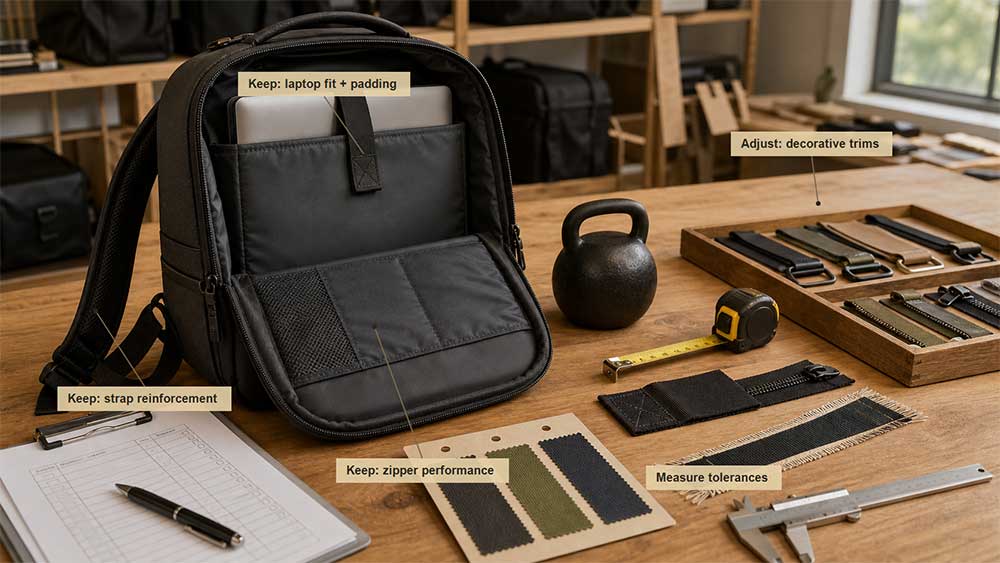
Keep unchanged
Consider adjusting
Intended capacity and product dimensions
Number of launch colors
Load-bearing seam construction
Decorative panels
Handle and shoulder-strap reinforcement
Custom zipper-puller shapes
Required padding or protective structure
Special hardware finishes
Zipper and closure performance
Printed lining
Material performance required for the use case
Multiple small contrast materials
Approved measurements and tolerances
Low-use secondary pockets
Logo accuracy and attachment strength
Premium retail boxes
Applicable safety and compliance requirements
Decorative stitching and trims
The non-negotiable requirement depends on the bag. A laptop bag must protect and fit the intended device. A travel bag must handle its expected load. A welded dry bag must meet its agreed seam and closure performance. Cost or MOQ reductions should preserve that core promise.
1. Start With Readily Available, Identifiable Materials
Using materials that the factory or its suppliers source regularly is often the most effective way to lower MOQ. However, “available in the warehouse” is not a complete specification.
Ask the supplier to confirm:
Fiber content and construction
Weight or other agreed technical specifications
Coating, backing, or lamination
Available colors and usable quantity
Whether the stock comes from one production lot
Visible shade variation
Compatibility with the selected logo method
Required abrasion, water-resistance, or colorfastness performance
The likelihood of sourcing the same material for a reorder
Approve the actual material on a swatch card or sample, then record the supplier material code and approved reference in the specification or bill of materials (BOM).
Unidentified remnants may be enough for a small run, but they can create shade variation, inconsistent performance, and difficult reorders. In-stock material is useful only when its identity and performance can be controlled. If the material direction is still open, compare common backpack materials and their performance before choosing a specification that unnecessarily raises the purchasing minimum.
2. Launch With Fewer Colors and SKUs
Total order quantity and per-color quantity are not the same. For example, a hypothetical order of 600 bags may not support six colorways of 100 pieces each. Fabric mills, dye houses, webbing suppliers, branding-component suppliers, and production lines may each impose a minimum by color or SKU.
A lower-risk first run might use:
One core launch color
A second color only when demand has some supporting evidence
One main size instead of several similar sizes
The same lining and hardware color throughout the range
One approved logo version across the order
Ask for the minimum per style, per color, per material, and per logo version. Adding colors to make a range look larger can make a small order harder to produce consistently.
3. Share Materials and Components Across Related Styles
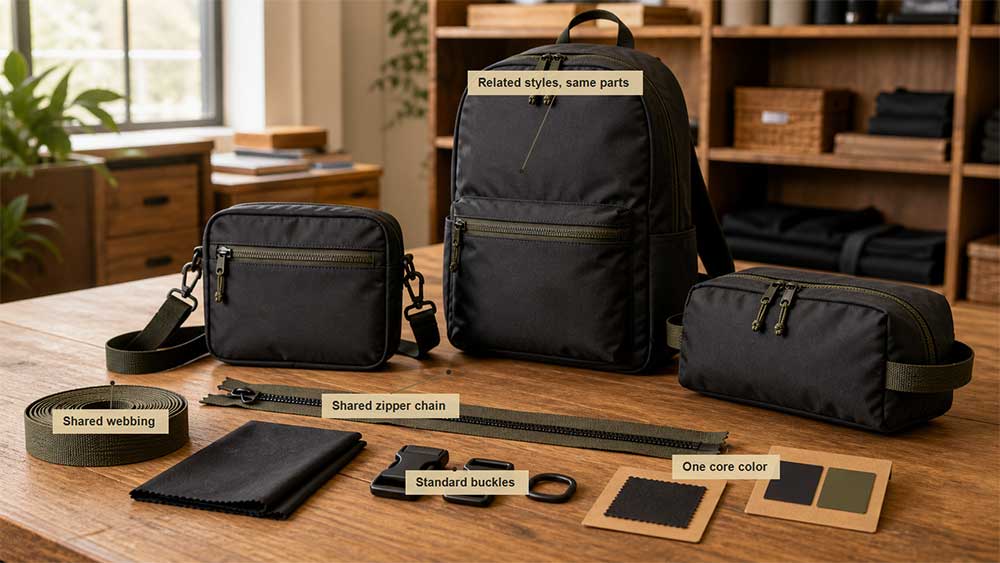
If you are developing several bags at the same time, standardizing selected components can help you reach upstream purchasing minimums without making every product identical.
Related styles may share:
Lining
Foam
Webbing
Zipper chain and sliders
Buckles
Hardware finish
Thread color
Brand labels
Packaging materials
A backpack, duffel, and crossbody bag can have different patterns while using the same black lining, zipper chain, webbing, and label. The BOM should clearly show which parts are identical across styles and which are style-specific.
The factory still needs to calculate actual consumption. Shared components can help with supplier minimums, but different patterns, cutting plans, and sewing operations may still require a finished-product MOQ for each style.
4. Use a Proven Base Design and Standard Hardware
Developing a completely new bag may require new patterns, several sample rounds, tooling, and additional production setup and additional production setup. Starting with a proven factory pattern can reduce some of that work while still allowing changes to the material, color, logo, pocket layout, labels, and packaging.
Ask which changes keep the original production conditions. A small change to the opening, back panel, carrying system, or overall dimensions may require new patterns even when the bag looks similar at first glance.
Standard zippers, buckles, pullers, frames, and metal trims can also prevent separate tooling charges and component MOQs. “Standard” does not mean unverified: the approved sample should still confirm the component size, finish, operation, attachment method, and expected strength. Record the approved part number so bulk production does not substitute a similar-looking but weaker component.
5. Simplify Details That Add Little Customer Value
A simpler structure can reduce purchasing complexity, sewing time, and assembly errors. Good candidates include:
Decorative panels that do not improve function
Several small contrast materials
Duplicate storage features
One-off hardware used in only one position
Complex molded decoration
Unnecessary trim variations
The decision should be based on user value. A pocket customers use every day should not disappear merely because it requires extra sewing. A decorative panel with no practical purpose is a better place to simplify.
This step is also where factory input is useful. A mature sewing method may produce the same function with fewer parts and more stable tolerances. The custom outdoor bag production process explains how design decisions affect pattern making, sampling, cutting, assembly, and inspection.
6. Match the Logo and Packaging to the Order Quantity
Logo methods can create separate setup fees or component minimums. Depending on the material and brand position, compare screen printing, heat transfer, embroidery, woven labels, printed labels, PU or rubber patches, debossing, and metal plates.
There is no single logo method that is always best for a low MOQ. Ask for two suitable options and compare:
Appearance and durability
Setup or tooling cost
Unit price and minimum quantity
Material compatibility
Consistency on future reorders
Whichever method you choose, approve the artwork, size, color, location, and attachment method. A small order still needs clear placement dimensions and a signed-off sample.
Packaging should protect the product and meet the retailer, distributor, or e-commerce platform’s receiving requirements without creating unnecessary new minimums. A practical first-run solution may use a standard protective bag, export carton, barcode label, branded sticker, hangtag, or product card instead of a custom rigid box or molded insert.
Before production, confirm the packaging material, dimensions, folding method, barcode position, units per carton, and shipping marks.
7. Buy the Material MOQ but Produce Fewer Finished Bags
Sometimes the cleanest solution is to purchase the material or component supplier’s minimum but convert only part of it into finished bags for the first run. The remaining approved material can be held for a reorder.
This reduces initial finished-goods inventory, not the raw-material commitment. Put the following in writing:
Who owns the remaining material
Exact remaining quantity, material code, lot, and color
Storage location, period, and fees
Protection from moisture, contamination, and fading
How production waste will be recorded
Whether the stock is reserved exclusively for your company
What happens if no reorder is placed
The supplier should also confirm that the specific fabric, foam, coating, adhesive, or synthetic component is suitable for storage. Unused material can still age.
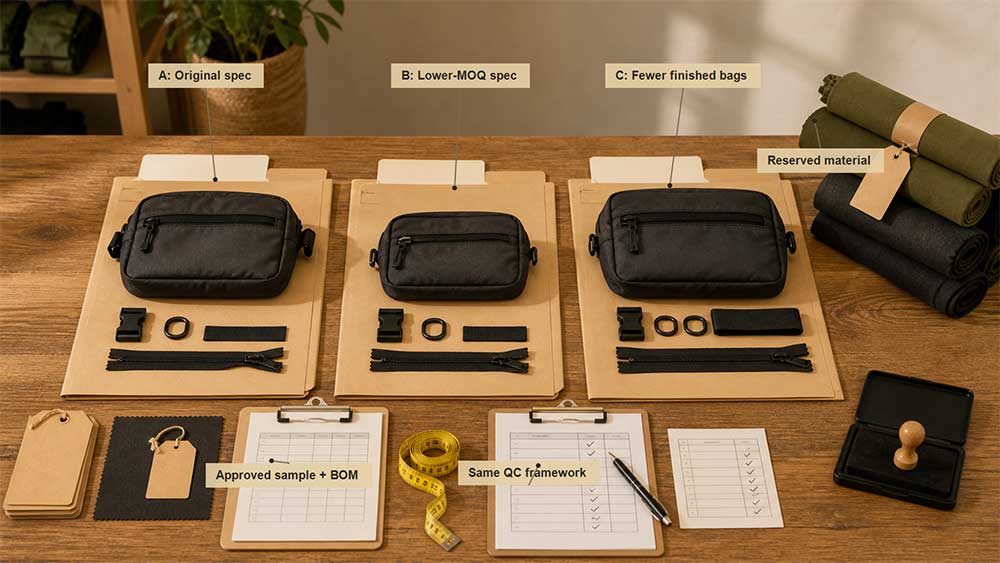
Compare Three Quotation Scenarios
Instead of asking only for the “lowest possible MOQ,” request three comparable quotations.
Scenario
What to request
Why it helps
A: Original specification
Normal MOQ and price with the design unchanged
Shows the true cost of the intended product
B: Lower-MOQ specification
Readily available materials, standard hardware, practical branding, and simpler packaging while protecting critical quality
Shows which changes genuinely lower the minimum
C: Lower finished quantity
Purchase the material minimum, produce fewer bags, and hold the approved balance
Reduces finished-goods exposure while protecting material consistency
Each quotation should state the MOQ per style, color, and logo version; unit price; setup and tooling charges; excess material commitment; sample cost; packaging cost; lead time; testing and inspection scope; reorder conditions; and ownership of unused materials.
This comparison prevents a low finished-bag MOQ from hiding a larger raw-material purchase or unexpected setup costs.
Expect a Realistic Small-Order Cost
A lower MOQ usually means a higher unit price. Pattern preparation, cutting setup, logo screens or tooling, production management, and inspection costs are spread across fewer units. Small material and component purchases may also cost more.
A transparent setup charge or small-order surcharge is safer than an unexplained price reduction achieved through:
Unapproved material substitutions
Reduced padding or reinforcement
Weaker zippers or hardware
Fewer inspection steps
Mixed material lots
Unclear packaging
Compare total commercial exposure, not only unit price. For an untested product, a controlled small run at a higher unit cost may carry less risk than a large quantity of inventory that has not yet proved its demand.
Keep the Same Quality-Control Framework
Low MOQ should not mean informal production. Keep the same core controls:
Approved specification or tech pack
Approved sample
Controlled BOM
Approved material and color references
Defined measurements and tolerances
Approved logo artwork and placement
First-piece check
In-line inspection
Final inspection
Packaging and barcode verification
Functional checks should reflect the bag type and intended use. They may include zipper operation, seam strength, strap attachment, load testing, compartment fit, closure performance, water-resistance checks, or shape recovery after packing.
Final inspection can follow an agreed sampling plan. ISO 2859-1:2026 provides lot-by-lot sampling schemes indexed by acceptance quality limit (AQL), but buyer and supplier must still agree on the inspection level, defect classifications, and acceptance criteria.
“Good quality” is not an inspection standard. The requirements must be measurable and approved before bulk production begins.
When Lower MOQ Is the Wrong Goal
A normal production quantity may make more commercial sense when:
A custom material or color is central to the brand identity
The product already has stable, validated demand
The small-order unit cost is not commercially viable
Critical components cannot be sourced reliably in small quantities
Fast reorders depend on continuous material availability
Testing, tooling, or development costs are too high to spread over a small run
The required process cannot be scheduled reliably at the requested quantity
The raw-material purchase remains nearly the same even after the finished quantity is reduced
The right order quantity balances inventory risk, landed cost, product positioning, manufacturing stability, and the reorder plan.
Low-MOQ Custom Bag Checklist
Before approving a lower-MOQ plan, confirm:
What is actually driving the MOQ
Whether minimums apply per order, style, color, material, or logo version
Which product requirements are non-negotiable
The identity, lot, shade, and available quantity of the materials
Whether the same materials can be sourced for a reorder
The number of launch colors and SKUs
Which components can be shared across styles
Whether hardware is standard or custom
Logo method, setup cost, and component MOQ
Packaging minimums and receiving requirements
Price differences at realistic quantity breaks
Ownership and storage terms for unused materials
The approved sample, BOM, measurements, and tolerances
First-piece, in-line, and final inspection requirements
Reorder MOQ and future material availability
Final Takeaway
The safest way to lower custom bag MOQ is to remove unnecessary purchasing and production complexity while protecting the product itself.
First identify what is creating the minimum. Then protect the non-negotiable performance requirements and adjust the material, color count, shared components, hardware, branding, or packaging that is actually driving the quantity. When needed, pay the real setup cost or purchase the raw-material minimum while producing fewer finished bags.
A well-planned small order should still have an approved sample, controlled BOM, measurable tolerances, and complete inspection requirements. That allows a brand to test demand without creating avoidable quality problems or making the next reorder harder.
For brands, wholesalers, importers, and product teams developing custom bags, Vancharli Outdoor provides OEM and ODM support from material selection and sampling through production and quality control. The typical starting MOQ for most custom bag projects is around 300 pieces, while the final requirement depends on the style, material, color, structure, hardware, logo, packaging, and testing specifications.
Frequently Asked Questions
What is a typical MOQ for custom bags?
There is no universal number. MOQ depends on the bag type, material, color, components, logo method, packaging, and production setup. Ask the supplier to clarify whether the minimum applies to the total order, each style, each color, or each logo version.
Can MOQ be lowered without reducing quality?
Yes. Order quantity and quality standards are separate decisions. MOQ can often be lowered by reducing colors, using readily available materials and proven components, or simplifying nonessential details while keeping the same approved construction and inspection requirements.
Can one order be divided among several colors?
Sometimes, but each color may have its own minimum. Custom dyeing, printing, webbing, thread, and branding components can all create per-color requirements. Ask the supplier to state both the total MOQ and the MOQ per color.
Can different bag styles be combined to reach MOQ?
They may share some material or component minimums when the parts are genuinely identical. However, different patterns, cutting plans, and sewing setups may still create a separate finished-product MOQ for each style.
Is in-stock material suitable for retail-quality bags?
It can be, provided the supplier can identify and verify the material’s construction, performance, lot, shade, and available quantity. Unidentified remnants should not replace an approved material simply because they are available.
How can reorders stay consistent after a small first run?
Record the material and component codes, approved colors, BOM, measurements, logo details, pattern version, packaging, and quality requirements. Before each reorder, reconfirm material availability—especially when the first run used in-stock material.








Comments are closed