Convertible Backpack Briefcase: Is a 3-Way Bag Practical?
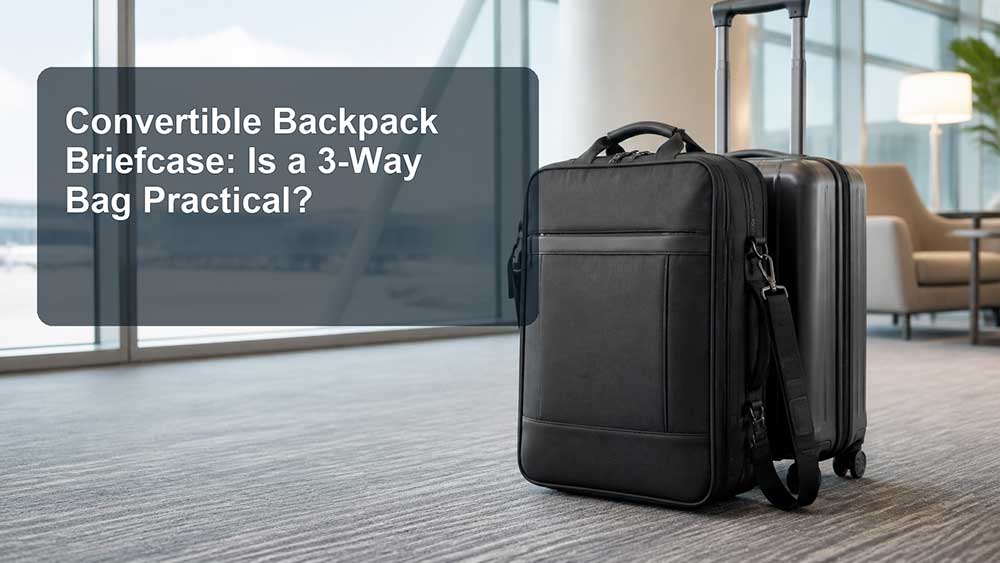
A convertible backpack briefcase can be practical for people who regularly move between commuting, meetings, and business travel. Backpack straps are useful for longer walks, handles create a cleaner look in professional settings, and a removable shoulder strap works well for short carries and quick access.
The compromise is that three carrying options do not automatically create three equally good carrying experiences.
A well-designed 3-way business bag stores unused straps cleanly, stays balanced in every orientation, protects the laptop when the bag is turned, and remains comfortable under a realistic load. A poorly resolved model may be heavier than necessary, awkward to convert, uncomfortable as a backpack, and visibly cluttered in briefcase mode.
The practical question is not simply, “How many ways can I carry it?” It is:
Does each carrying mode work well enough for the situation in which it will actually be used?
A 3-way bag is practical when the user genuinely switches between carrying modes and each mode remains comfortable, balanced, secure, and easy to use under a realistic load.
Hidden straps may be thinner or less supportive than those on a dedicated backpack
Briefcase
Meetings, offices, and short-distance carrying
Becomes tiring when the bag is heavily packed
Shoulder bag
Quick access and frequent carry transitions
Places most of the weight on one shoulder
Convertible design overall
Users who genuinely switch between settings
Added straps, pockets, clips, and reinforcement increase weight and complexity
What Is a Convertible Backpack Briefcase?
A convertible backpack briefcase is a work bag designed to change between two or more carrying modes.
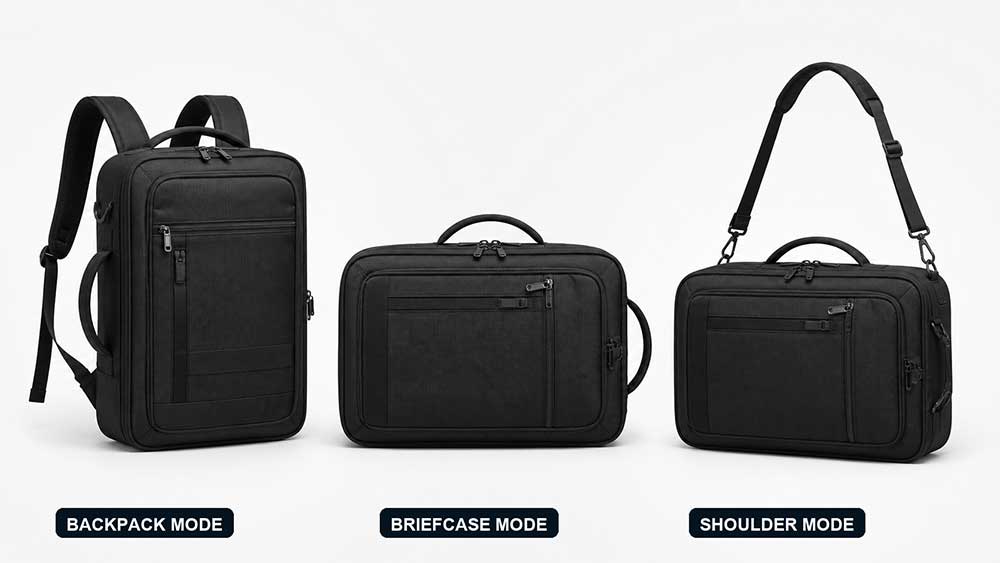
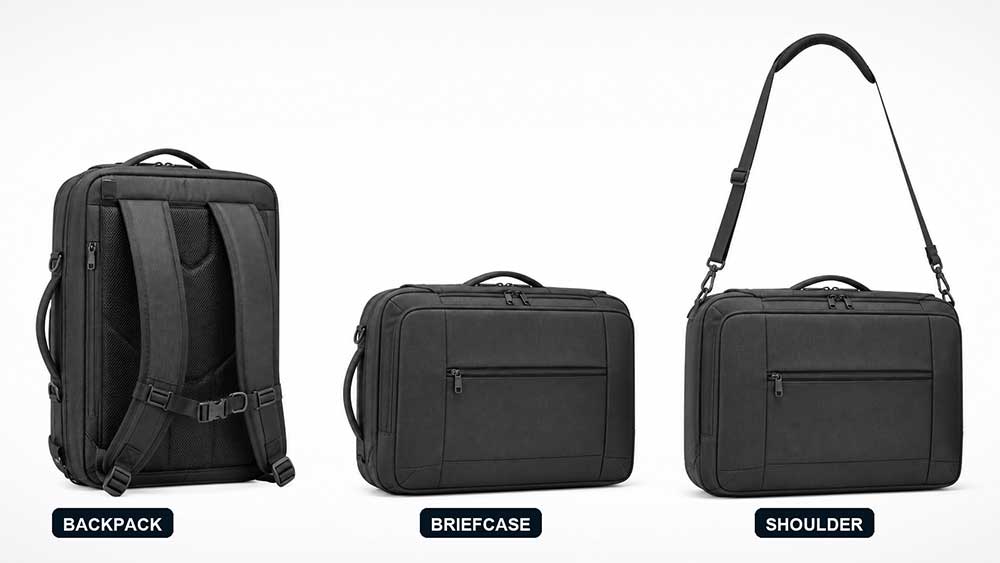
A typical 3-way version can be used as:
A backpack with two shoulder straps
A briefcase carried by top or side handles
A shoulder or crossbody bag with a removable long strap
The product may also be described as a:
Convertible briefcase backpack
3-way briefcase
3-way business bag
Convertible laptop bag
Backpack briefcase hybrid
Backpack messenger briefcase
These names are not standardized. Some products described as “3-way” count top-handle, shoulder, and backpack carry. Others use a duffel-style configuration as the third mode. Buyers should check how the straps attach, adjust, and store instead of relying only on the product name.
When Is a 3-Way Business Bag Genuinely Useful?
The design makes the most sense when the user changes environments during the same day.
Someone might walk or take a train to work with the bag in backpack mode, hide the shoulder straps before entering a client meeting, and use the removable long strap while moving between an airport lounge and a boarding gate.
In that type of routine, the conversion solves a real problem.
A 3-way bag can be useful for:
Commuters who walk part of their journey
Professionals who want a cleaner look in meetings
Business travelers moving through airports and hotels
Sales representatives carrying a laptop and documents
Trade-show visitors who alternate between walking and meetings
Hybrid workers moving between home, shared offices, and client locations
The design is less convincing when the bag is almost always carried in one way. If it will be used as a backpack most of the time, a dedicated business backpack may offer better shoulder straps, back padding, ventilation, and weight distribution without the additional hardware.
Backpack mode is convenient for walking and public transport. Briefcase mode can look more appropriate in an office or meeting. Shoulder mode allows quick access without requiring the user to hold the bag continuously.
That flexibility may reduce the need to own separate bags for commuting, meetings, and short business trips.
Backpack mode can reduce one-sided pressure
A briefcase or messenger bag places most of its load on one hand or shoulder. Two backpack straps distribute the load more evenly and are generally more practical for longer walks.
However, this advantage depends on the quality and position of the hidden straps. A convertible bag with narrow, flat straps may still become uncomfortable when fully packed.
Carrying modes can change during a journey
A traveler might carry the bag as a backpack through a station, place it over a suitcase handle at the airport, and switch to the handles when entering a meeting.
This flexibility matters only when conversion is quick enough that the user is willing to do it in real life. If straps are difficult to remove or store, the additional modes may remain unused.
It can bridge casual and professional use
A controlled silhouette, restrained branding, coordinated hardware, and well-hidden straps can help one bag work across commuting and office environments.
It may not look as formal as a structured leather briefcase or feel as athletic as a purpose-built commuter backpack. Its value lies in covering the middle ground.
Where Convertible Bags Compromise
Versatility adds parts, and every additional part affects the rest of the product.
One carrying mode usually comes first
Most 3-way bags have a primary identity.
Some are briefcases with secondary backpack straps. Others are backpacks that can hide their straps and be carried by a side handle. Travel-oriented models may use a deeper main compartment and add both briefcase and shoulder options.
This is not necessarily a flaw. Trying to make all three modes identical in comfort, appearance, and access can produce a heavy and complicated bag. A more successful design establishes one primary mode and makes the other two credible secondary options.
Hidden straps still take up space
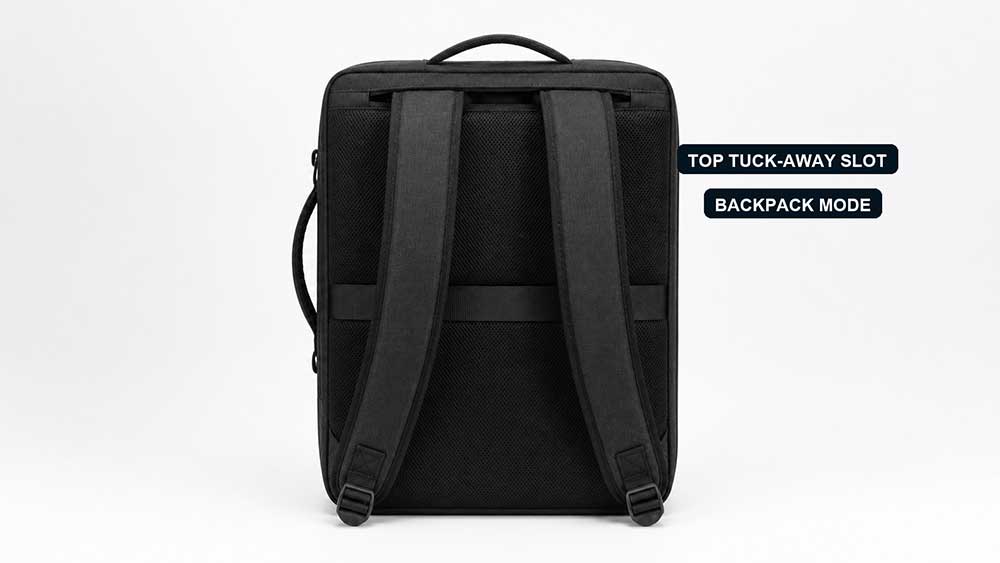
Backpack straps need somewhere to go when the bag is carried as a briefcase. They may tuck behind a rear panel, fold into a zippered compartment, or detach completely.
Each solution has a trade-off:
A storage panel adds material and thickness
A zippered compartment may reduce ventilation
Detachable straps can be misplaced
Thin straps store easily but may be less comfortable
Thick straps improve comfort but create more bulk when hidden
Stored straps should not form a hard ridge against the user’s back or make the bag look uneven in briefcase mode.
More hardware means more weight
A 3-way bag may require:
Two backpack straps
A detachable shoulder strap
Multiple clips or hooks
Additional strap anchors
Top and side handles
Storage panels
Extra zippers
Reinforcement at several load points
None of these components is especially heavy on its own. Together, however, they can make the empty bag noticeably heavier than a simpler backpack or briefcase.
Conversion can become inconvenient
If changing modes requires removing several clips, opening multiple zippers, folding straps precisely, and storing loose parts elsewhere, users may stop converting the bag.
A practical design should make the process easy to understand and repeat without requiring instructions each time.
Check Each Carrying Mode Separately
A convertible bag should not be judged only while sitting empty on a display table. Each mode needs to be tested with the intended contents inside.
Backpack Mode
Check:
Shoulder strap width, shape, and padding
Distance and angle between the upper anchors
Lower strap attachment points
Adjustment range
Back-panel comfort
Whether briefcase handles can be secured
Whether the removable shoulder strap must be taken off
Whether the bag pulls backward when the front compartment is full
The shoulder straps should not be designed only around how easily they can be hidden. If the target user carries a laptop, charger, documents, bottle, and travel accessories, the straps need to remain comfortable under that load.
A sternum strap may improve stability on some travel-oriented models, but it can also make the bag look more technical. Whether it belongs on the product depends on the target user and primary carrying mode.
Briefcase Mode
Turn the packed bag sideways and check:
Whether the handles are centered over the load
Whether the bag hangs level
Whether hidden shoulder straps remain invisible
Whether unused buckles or webbing dangle
Whether the side panel can support the bag’s weight
Whether pockets and zippers remain securely closed
Whether the logo and front-panel details are correctly oriented
The briefcase handles and their anchors must support the intended load. They should not be treated as decorative additions to a backpack pattern.
A bag may technically have a side handle and still look unmistakably like a backpack. If professional appearance matters, the silhouette, zipper paths, strap storage, logo orientation, and side construction must all support briefcase use.
Shoulder Mode
Attach the long strap and check:
Whether the bag hangs level or tips forward
Whether the strap pad stays on the shoulder
Whether the attachment points twist
Whether the clips press against the bag or clothing
Whether the strap length suits shoulder and crossbody use
Whether the top handles interfere with access
Whether the load becomes uncomfortable after a realistic walking period
Shoulder mode usually works best for short distances and lighter loads because most of the weight remains concentrated on one side.
This is one of the most overlooked problems in convertible bag design.
A briefcase is normally carried horizontally, while a backpack is carried vertically. When the bag rotates, everything inside rotates with it.
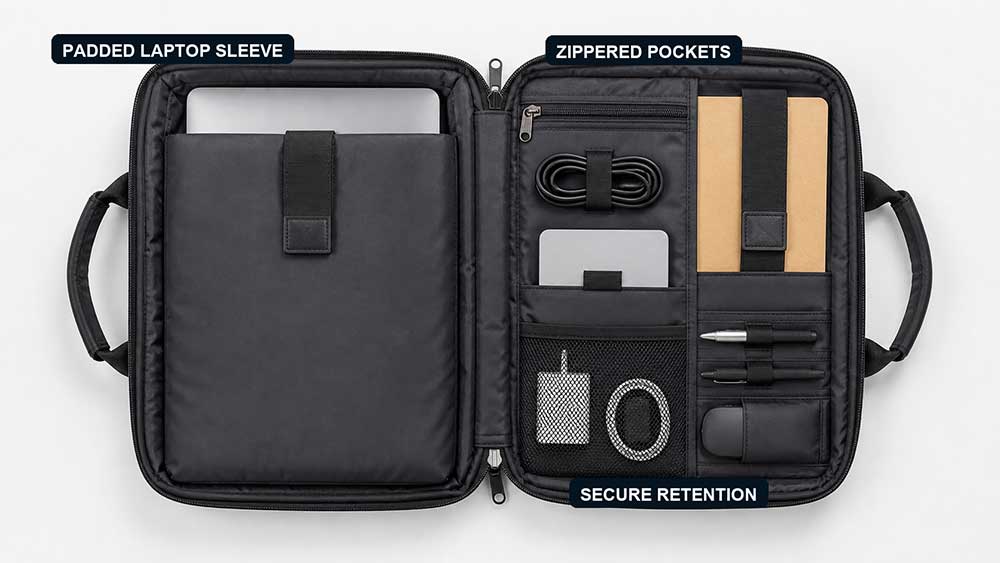
Loose accessories may fall to what has become the new bottom. Pens can slide out of open organizer slots. A cable pouch may move across the compartment. A bottle stored upright in one mode may become horizontal in another.
Practical solutions include:
Zippers or flaps on pockets used for small items
Elastic retention that works in both orientations
A secure laptop-compartment closure
Dividers that control movement without consuming too much space
Access openings that do not face downward in another mode
Bottle storage that remains safe when the bag rotates
A layout that keeps hard accessories away from the laptop
The main compartment does not need dozens of pockets. It needs organization that remains predictable after the bag changes direction.
The broader guide to what makes a good laptop bag explains how device fit, padding, organization, materials, and carrying comfort work together.
Laptop Protection Needs Special Attention
A convertible bag may place the laptop compartment in a different orientation depending on how the bag is carried.
Check that:
The laptop cannot slide toward an unprotected edge
The compartment opening cannot face downward unintentionally
The device is retained by a zipper, flap, or suitable closure
Padding covers the sides and corners that may contact the ground
The compartment has appropriate bottom clearance
Hardware and strap anchors do not press directly against the device
The laptop can be removed without emptying the main compartment
Screen-size labels alone are not enough. The compartment should be evaluated against the physical width, height, and thickness of the intended devices.
Does a 3-Way Bag Still Look Professional?
It can, but the conversion system should disappear when it is not being used.
A business-oriented design usually benefits from:
A controlled silhouette
Shoulder straps that hide completely
Minimal exposed webbing
Coordinated buckles and zipper pulls
Handles that lie flat or remain visually balanced
Restrained branding
Pockets that do not bulge when filled
Materials suitable for the intended workplace
If several straps, clips, loops, and adjustment tails remain visible, the product may look more like a travel or technical bag than a formal business briefcase.
That may be appropriate for a casual office, creative team, field-sales role, or technology company. It may be less suitable for a conservative legal, financial, or executive environment.
Before buying or approving a sample, pack the bag as it would be used on a normal workday and complete the following test:
Wear it as a backpack for a realistic walking period.
Convert it to briefcase mode without storing loose parts elsewhere.
Carry it by the handles and check whether it stays level.
Attach the shoulder strap and observe whether the bag tips.
Open the main and laptop compartments in each mode.
Check whether small items moved after the bag changed orientation.
Store all unused straps and look for bulges, loose clips, or hard edges.
Repeat the conversion several times and inspect the attachment points.
The bag is practical when these transitions feel natural and every mode works well for as long as the user will realistically carry it. It does not need to perform exactly like three separate specialist bags.
Who Should Choose a 3-Way Business Bag?
A convertible backpack briefcase is a good option for someone who:
Regularly switches between walking, public transport, meetings, and travel
Wants backpack comfort without carrying a visible backpack into every meeting
Carries a moderate daily load rather than heavy equipment
Values versatility more than the lowest possible empty weight
Is willing to store or adjust straps when changing environments
Needs one bag to cover several parts of the workday
A dedicated bag may be better for someone who:
Uses only one carrying style
Walks long distances with a heavy load
Needs maximum backpack ventilation and support
Wants a highly structured formal briefcase
Prefers the lowest possible empty weight
Does not want to manage removable or hidden straps
What Brands Should Define Before Development
For a custom 3-way business bag, the product team should decide which carrying mode is primary before pattern development begins.
The specification should define:
The three intended carrying modes
Expected use and duration of each mode
Target laptop dimensions
Typical and maximum packed load
Shoulder-strap storage method
Removable strap and clip construction
Handle position and reinforcement
Back-panel padding and ventilation
Pocket orientation in every mode
Laptop retention and bottom protection
Strap adjustment ranges
Acceptable conversion steps
Appearance when all unused straps are stored
Mode-by-mode sample checks
The sample should be reviewed while loaded, carried in every orientation, and converted repeatedly.
Feedback should identify the exact mode and problem. For example:
The bag tilts forward in shoulder mode when the laptop and charger are loaded.
That is more useful than asking the factory to “improve the balance.”
Developing Convertible Business Bags With Vancharli Outdoor
Vancharli Outdoor supports OEM and ODM development of laptop backpacks, briefcases, messenger bags, and convertible business bags for brands, importers, wholesalers, and corporate buyers.
Our team can review the intended primary carrying mode, strap-storage system, handle and anchor construction, laptop protection, internal orientation, materials, hardware, target cost, and packed-use requirements before bulk production.
A successful 3-way bag is not simply a backpack with more straps. Its carrying system, organization, structure, and appearance must continue to work as the product changes direction.
Frequently Asked Questions
Is a 2-way bag different from a 3-way bag?
Usually, yes. A 2-way business bag commonly offers backpack and briefcase carry. A 3-way version normally adds a removable shoulder or crossbody strap. Product names are not standardized, so check the actual strap configuration.
Can a convertible backpack briefcase be used in a formal office?
It can if the shoulder straps hide completely, the silhouette remains controlled, the hardware is restrained, and the materials suit the workplace. It may still look less formal than a structured leather briefcase.
Are hidden backpack straps comfortable?
They can be, but easy storage sometimes encourages thinner padding and simpler strap shapes. Comfort should be tested with the intended load rather than judged by appearance alone.
Can a 3-way laptop bag be used for business travel?
Yes. It can work well for travelers who want backpack carry in airports and briefcase carry at meetings. Airline acceptance still depends on the bag’s packed dimensions, weight, ticket, and carrier rules—not the number of carrying modes.
Is a convertible business bag heavier than a normal briefcase?
It may be. Extra shoulder straps, clips, handles, storage panels, zippers, and reinforcement all add weight. The actual difference depends on the materials and construction.
Which carrying mode should a brand prioritize?
The mode the target customer will use most often should be the primary one. The secondary modes should remain practical, but trying to give every mode identical structure and comfort may make the product unnecessarily complicated.








Comments are closed