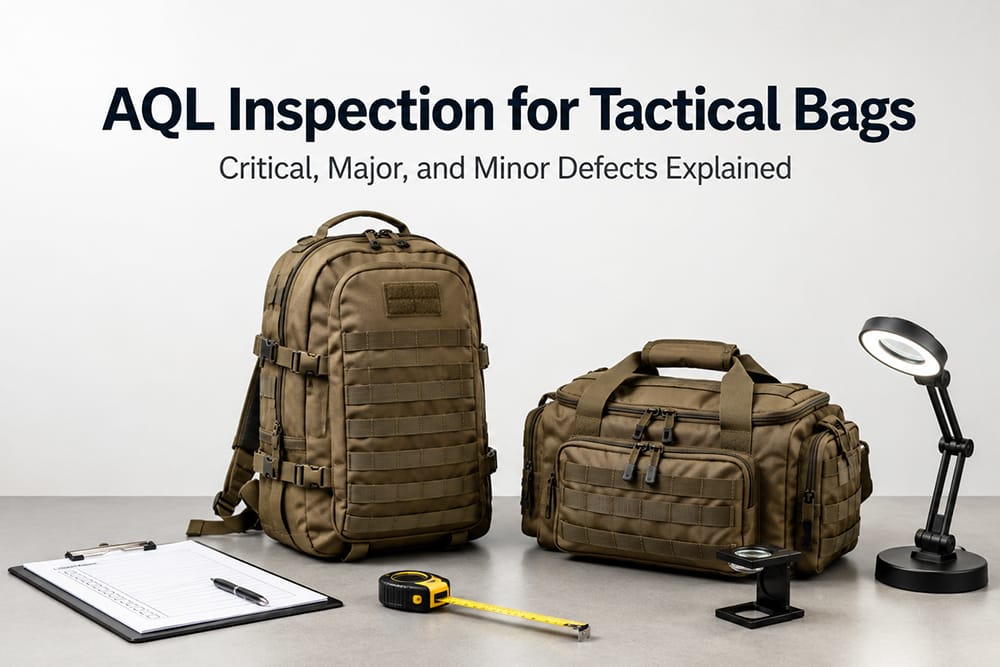
AQL Inspection for Tactical Bags: Critical, Major, and Minor Defects Explained
For tactical bags, quality inspection is not only about checking whether the product looks clean. A tactical backpack, range bag, rifle bag case, tactical pouch, or modular gear bag often depends on stitching strength, zipper performance, buckle reliability, MOLLE alignment, fabric consistency, and load-bearing structure. If one of these details fails, the problem may affect usability, safety, shipment approval, or brand reputation.
This is why AQL inspection matters in tactical bag production. AQL helps buyers, factories, and third-party inspectors classify defects in a structured way before shipment. Instead of treating every issue as the same problem, AQL inspection separates defects into critical, major, and minor categories.
For OEM and ODM buyers, this classification is especially important. A small loose thread may be a minor workmanship issue, while weak shoulder strap stitching can become a major functional problem. A sharp metal edge on a buckle may even become a critical safety concern. Without a clear defect classification list, buyers and suppliers may disagree during final inspection, rework, or shipment approval.
This guide explains how AQL inspection applies to tactical bags, what critical, major, and minor defects mean, and how buyers can define practical inspection standards before mass production.
AQL stands for Acceptable Quality Limit. It is a sampling method used to inspect a production batch and decide whether the shipment meets the agreed quality level. Instead of checking every single unit in a lot, inspectors randomly select a sample quantity based on the order size, inspection level, and AQL setting.
AQL inspection is widely used for bags, apparel, accessories, consumer goods, and many other manufactured products. The sampling logic is commonly based on recognized standards such as ISO 2859-1 sampling procedures and ANSI/ASQ Z1.4 sampling standards, which are designed for inspection by attributes.
In practical terms, AQL inspection helps answer three questions:
How many pieces should be inspected from this shipment?
How many defects are acceptable within the inspected sample?
Should the shipment pass, fail, be reworked, or be re-inspected?
For tactical bags, AQL inspection is usually performed near the final shipment stage. However, it should not be treated as the only quality control step. A reliable QC process also includes material checking, pre-production sample approval, in-line sewing inspection, functional testing, and final packaging verification.
AQL is a decision-making tool. It helps both buyer and supplier use the same quality language when reviewing defects.
Why Defect Classification Matters for Tactical Bags
Not all defects carry the same level of risk. A loose thread on an inner seam is different from a broken shoulder strap. A slight carton wrinkle is different from a missing barcode label. A small surface scratch on a buckle may be cosmetic, while a buckle that opens under light force can affect product function.
This difference matters more for tactical bags than for many simple fashion bags because tactical bags often include functional components. These may include MOLLE webbing, bar-tack reinforcement, compression straps, hook-and-loop panels, heavy-duty zippers, padded compartments, buckles, D-rings, handles, and load-bearing seams.
In AQL inspection, defects are usually divided into three levels:
Defect Type
General Meaning
Typical Result
Critical Defect
A serious defect that may create safety, compliance, or severe functional risk
Usually not acceptable
Major Defect
A defect that affects function, structure, appearance, saleability, or approved specifications
May cause inspection failure if above the limit
Minor Defect
A small defect that does not affect main function but affects workmanship or appearance
Usually tolerated within the agreed limit
For tactical bag projects, the buyer and supplier should agree on the defect classification before production starts. This is especially important when the order involves a custom tech pack, private label packaging, special material, special color, MOLLE layout, or brand-specific QC standard.
A practical defect list prevents confusion. It also makes final inspection more objective.
Critical Defects in Tactical Bag Inspection
Critical defects are the most serious defect category. These are problems that may create safety risks, serious compliance issues, or severe product failure. In many inspection programs, critical defects are not tolerated.
For tactical bags, critical defects are usually less common than major or minor defects, but they must be clearly defined. A tactical bag is not automatically a safety product, but it may still contain defects that can injure the user, violate buyer requirements, or make the product unsafe for normal handling.
Examples of critical defects may include:
Critical Defect Example
Why It Matters
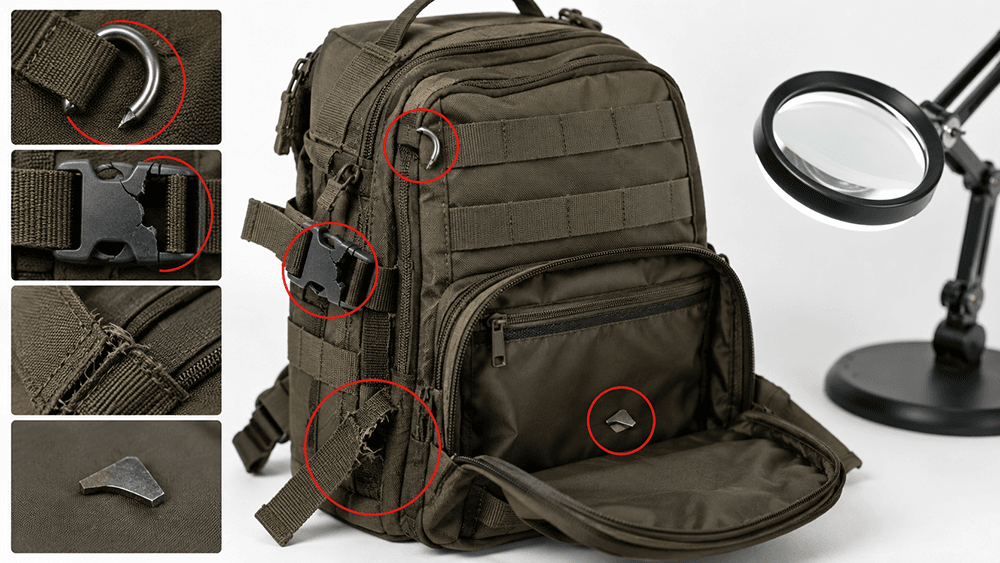
Sharp metal edge on buckle, D-ring, zipper puller, or hook
May scratch or injure the user
Broken metal part with exposed sharp point
Creates a handling safety risk
Severe needle or metal contamination inside the bag
Serious safety issue before shipment
Restricted material risk or strong chemical odor beyond buyer requirement
May create compliance or market acceptance concern
Missing mandatory warning label required by the buyer or target market
May affect compliance or retail acceptance
Severe load-bearing failure that creates direct user safety risk
May cause the bag to fail during normal use
In most tactical bag inspections, a normal loose thread should not be treated as critical. But a sharp component, metal contamination, severe structural failure, or missing required safety information may justify critical classification.
The key question is: Can this defect create a safety, compliance, or severe usage risk? If yes, it should be reviewed as a potential critical defect.
Major Defects in Tactical Bag Inspection
Major defects are the most important category in tactical bag inspection because they directly affect product function, structure, customer acceptance, or approved specifications. A major defect may not create immediate danger, but it can make the product fail its intended use or fail the buyer’s quality standard.
For tactical bags, many functional problems belong in the major defect category. These include zipper failure, buckle malfunction, wrong material, wrong size, weak stitching, incorrect MOLLE spacing, wrong compartment layout, or visible branding errors.
Examples of major defects may include:
Major Defect Example
Why It Matters
Zipper does not open or close smoothly
Affects daily use and customer experience
Zipper slider breaks during normal operation
Makes the compartment difficult or impossible to use
Buckle does not lock properly
Affects strap adjustment and carrying function
Shoulder strap stitching is weak, skipped, or broken
Affects load-bearing performance
Handle seam opens during pull check
Reduces product durability
MOLLE webbing spacing is incorrect
Affects modular attachment compatibility
MOLLE rows are visibly misaligned
Damages function and professional appearance
Wrong fabric, wrong color, or wrong coating
Does not match approved sample or buyer requirement
Coating peeling, delamination, or obvious material defect
Affects appearance and expected performance
Wrong logo size, wrong position, or wrong print color
Affects brand presentation
Wrong size or wrong compartment layout
Does not match the approved tech pack
Missing accessory required by the order
Shipment is incomplete
Major defects usually require rework, replacement, sorting, or re-inspection if the number exceeds the agreed AQL limit.
For OEM tactical bag projects, major defects should be defined carefully in the tech pack and inspection checklist. This is especially important for custom tactical bags with special hardware, modular webbing, padded compartments, or private label branding.
Minor Defects in Tactical Bag Inspection
Minor defects are small issues that do not affect the main function of the product. They are usually related to appearance, workmanship, trimming, or packaging presentation. Minor defects are still recorded during inspection, but a limited number may be accepted depending on the agreed AQL level.
Examples of minor defects may include:
Minor Defect Example
Why It Matters
Loose thread ends that do not affect seam strength
Workmanship issue
Slightly uneven stitch line in a non-stress area
Cosmetic issue
Small fabric mark in a non-obvious area
Appearance issue
Slight color shade difference within agreed tolerance
Visual consistency issue
Small surface scratch on hardware without functional impact
Cosmetic issue
Slightly uneven label stitching without readability issue
Workmanship issue
Minor packaging wrinkle
Presentation issue, not functional failure
Small trimming imperfection inside the bag
Does not affect normal use
Minor defects should not be ignored, especially for retail or premium tactical gear brands. However, they should be separated from functional failures. Treating every small defect as major can create unnecessary disputes, while treating functional problems as minor can damage quality control.
A clear standard helps both sides decide fairly.
Common AQL Levels Used for Tactical Bag Orders
AQL levels should always be agreed between buyer and supplier before production. They may vary depending on product type, target market, order value, brand positioning, risk level, and inspection method.
For many consumer goods and bag products, a common reference setting is:
Defect Type
Common AQL Setting
Critical Defects
0
Major Defects
2.5
Minor Defects
4.0
This does not mean every tactical bag order must use the same setting. Some buyers may request stricter levels for military-style gear, high-value retail products, safety-sensitive accessories, or large-volume orders. Other buyers may use different standards depending on their market, distribution channel, and price point.
The most important point is not the number alone. The buyer and supplier should agree on:
Inspection level
AQL values for critical, major, and minor defects
Sample size method
Defect classification list
Measurement tolerance
Rework and re-inspection rules
Approved sample and reference standard
AQL works best when the inspection standard is clear before production starts.
Tactical Bag Defect Classification Table
The following table shows how tactical bag defects can be classified during AQL inspection. The final classification should always be confirmed based on the buyer’s product specification, approved sample, and intended use.
Inspection Area
Critical Defect
Major Defect
Minor Defect
Fabric & Material
Restricted material risk, severe chemical smell beyond requirement
This table should not be copied blindly into every project. A small tactical pouch, a heavy-duty range bag, and a large tactical backpack do not carry the same functional risk. Buyers should adjust the defect list according to the product structure.
For example, MOLLE spacing may be a major issue on a modular tactical backpack, but it may not apply to a simple padded pistol case. Shoulder strap pull strength may be critical for a heavy load-bearing bag, but less important for a small accessory pouch.
Key Areas to Inspect on Tactical Bags
A good tactical bag inspection checklist should not only count defects. It should also focus on the areas that affect real product performance. The following areas are especially important.
1. Fabric and Coating
Fabric should match the approved sample in material, color, weight, texture, and surface finish. Tactical bags often use polyester, nylon, canvas, coated fabric, or water-repellent materials. If the fabric is wrong, the entire shipment may fail the buyer’s specification.
Inspectors should check for stains, holes, coating peeling, delamination, color shade difference, fabric defects, odor, and material mismatch.
For tactical bags, fabric problems may become major defects when they affect durability, appearance, or agreed performance. A small hidden mark may be minor, but wrong material or obvious coating failure should usually be treated as major.
2. Stitching and Reinforcement
Stitching is one of the most important quality points in tactical bag production. Many tactical bags depend on reinforced seams, bar-tack stitching, shoulder strap attachment, handle reinforcement, and MOLLE webbing sewing.
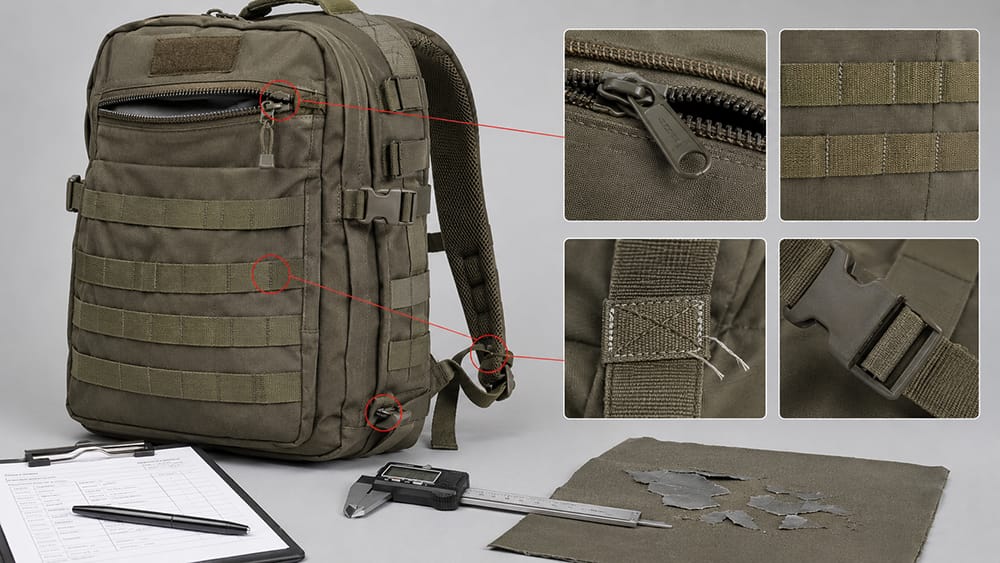
Inspectors should check stitch density, skipped stitches, broken thread, uneven seam, seam opening, bar-tack position, and thread color. Stress points should receive special attention.
A loose thread may be minor. A weak seam on a shoulder strap, handle, MOLLE panel, or load-bearing area should usually be major. If the failure creates a direct safety risk, it may need to be escalated.
3. Zippers
Zippers are one of the most common problem areas in bag inspection. Tactical bags often use long zippers, reverse coil zippers, waterproof-style zippers, or dual sliders. If the zipper is not smooth, the user experience is immediately affected.
Inspectors should open and close zippers several times. They should check for stuck sliders, broken teeth, wrong zipper direction, missing pullers, uneven sewing, zipper waviness, and poor end stops.
A slightly wavy zipper without function impact may be minor. A zipper that cannot open or close properly should usually be major.
4. Buckles, D-Rings, Hooks, and Other Hardware
Hardware quality affects both function and perceived value. Tactical bags may include side-release buckles, ladder locks, D-rings, hooks, metal clips, compression strap adjusters, and zipper pullers.
Inspectors should check whether the hardware matches the approved sample, locks correctly, releases smoothly, and has no sharp edges. They should also check whether the hardware is securely attached to webbing or fabric.
A small surface scratch may be minor. A weak buckle, wrong hardware size, or loose D-ring attachment should usually be major. Sharp metal edges or broken parts with injury risk may be critical.
5. MOLLE Webbing and Modular Attachment
MOLLE webbing is a key functional feature in many tactical bags. If the spacing, alignment, or stitching is wrong, compatible pouches may not attach properly.
Inspectors should check webbing width, spacing, row alignment, stitch position, bar-tack strength, and symmetry. They should compare the product with the approved sample or technical drawing.
Wrong MOLLE spacing should usually be treated as a major defect because it affects modular function. Slight stitch unevenness may be minor only if attachment performance is not affected.
6. Hook-and-Loop Panels
Hook-and-loop panels are often used for patches, flap closure, removable dividers, admin panels, and modular accessories. Poor quality hook-and-loop material can reduce product usability.
Inspectors should check size, position, grip strength, sewing, edge finish, and alignment. If a hook-and-loop panel detaches easily or does not hold properly, it may become a major defect.
7. Measurements and Capacity
Tactical bags often need accurate size, compartment layout, strap length, and accessory placement. A small dimension difference may be acceptable if it is within tolerance. But incorrect size can affect fit, capacity, modular compatibility, packaging, or retail description accuracy.
Buyers should define measurement points and tolerances clearly in the tech pack. Without this, inspection disputes are more likely.
8. Branding, Labels, and Packaging
Branding and packaging are not only visual details. For many buyers, they are part of retail compliance and customer experience. Logo position, label content, barcode accuracy, hangtag, polybag, carton mark, and SKU information should all be checked.
Wrong logo placement may be major. A missing barcode or wrong carton mark may affect warehouse receiving or retail shipment. Minor packaging wrinkles may be minor, but wrong SKU labeling can become a serious shipment issue.
AQL Inspection Is Not the Whole QC Process
AQL final inspection is important, but it cannot replace the entire quality control process. It is a sampling method performed near shipment. If defects are already widespread at that stage, rework can be expensive and shipment schedules may be affected.
For tactical bag production, quality should be controlled earlier.
A stronger QC process usually includes:
QC Stage
Purpose
Material Inspection
Confirm fabric, lining, webbing, zipper, buckle, and hardware before cutting
Pre-Production Sample Approval
Confirm structure, size, workmanship, logo, packaging, and function
In-Line Sewing Inspection
Find stitching, alignment, and construction issues during production
Functional Testing
Check zipper, buckle, strap, MOLLE, handle, and compartment function
Final AQL Inspection
Evaluate finished goods against agreed defect limits
Packaging Verification
Confirm label, barcode, carton mark, polybag, and packing method
This staged process is especially important for OEM tactical bag projects. A final inspection can reject a bad shipment, but it cannot easily fix poor early production control.
What OEM Buyers Should Confirm Before Production
Many inspection disputes happen because the buyer and supplier did not define standards clearly before production. AQL works better when the buyer provides clear requirements at the beginning of the project.
Before mass production, OEM buyers should confirm:
Approved Sample
The approved sample should be the physical reference for structure, material, size, color, hardware, branding, and workmanship. Inspectors can compare mass production goods with this sample during final inspection.
Tech Pack
A detailed tactical bag tech pack should include dimensions, material specification, stitching requirements, hardware details, MOLLE layout, logo placement, packaging instructions, and measurement tolerance. If you are preparing a custom project, a clear tactical bag tech pack can help reduce confusion between design, sampling, and bulk production.
AQL Level
The buyer should confirm which AQL levels apply to critical, major, and minor defects. This should be written in the purchase order, quality agreement, or inspection instruction.
Defect Classification List
A defect classification list should define which issues are critical, major, and minor. This is very useful for tactical bags because different buyers may classify the same problem differently.
Measurement Tolerance
Measurement tolerance should be clear for bag height, width, depth, strap length, pocket size, MOLLE spacing, handle drop, and compartment dimensions.
Testing Requirements
Buyers should confirm whether specific tests are required, such as zipper function test, buckle pull test, shoulder strap load test, colorfastness test, seam strength test, or carton drop test.
Rework and Re-Inspection Rules
If the shipment fails inspection, both sides should know what happens next. The agreement should clarify whether products must be sorted, repaired, replaced, or re-inspected.
Clear standards do not make inspection stricter for no reason. They make inspection fairer and easier to manage.
How AQL Helps Tactical Bag Buyers Reduce Risk
AQL inspection gives buyers a structured way to evaluate shipment quality. It does not guarantee that every unit in the lot is perfect, but it helps reduce the risk of accepting a shipment with too many defects.
Protect brand reputation before products enter the market
AQL is most useful when combined with a strong supplier communication process. Before starting an OEM project, buyers should ask about material control, sample approval, in-line inspection, final inspection, testing capability, packaging control, and rework procedures. These questions are just as important as price and lead time.
For brands developing custom tactical bags, inspection standards should be discussed early, not only at the end of production.
Practical Example: How to Classify Common Tactical Bag Defects
The following examples show how the same product area can include different defect levels.
Example 1: Shoulder Strap Stitching
If there are a few loose thread ends on the strap edge, this may be minor. If the stitch line is skipped on the strap connection point, it is likely major. If the strap breaks under a normal pull test and creates a safety concern, it may be escalated further.
Example 2: MOLLE Webbing
If the MOLLE stitch line is slightly uneven but attachment works normally, it may be minor. If the spacing is wrong and accessories cannot attach properly, it should usually be major. If the webbing detaches under light use and creates unsafe load handling, the issue may need stricter classification.
Example 3: Zipper Function
A slightly wavy zipper tape may be minor if the zipper works smoothly. A stuck zipper or broken slider is usually major. A sharp broken puller that may cut the user may be critical.
Example 4: Logo and Label
A slight print shade variation may be minor if it remains within the approved tolerance. A logo printed in the wrong location is usually major. A missing mandatory warning label may become a critical or compliance-related issue depending on the buyer’s market.
These examples show why defect classification should be product-specific. The same visual issue can have different severity depending on location, function, and buyer requirement.
Final Thoughts
AQL inspection is not just a technical formality. For tactical bag production, it is a practical way to align buyer expectations, supplier workmanship, and shipment approval standards.
The most important point is not simply whether a defect exists. The important question is how serious the defect is. Does it affect safety? Does it affect function? Does it violate the approved sample? Does it damage brand presentation? Or is it only a small cosmetic issue?
When critical, major, and minor defects are clearly defined before production, both buyers and suppliers can make better decisions. The inspection process becomes more objective, rework becomes easier to manage, and final shipment approval becomes less stressful.
For OEM tactical bag projects, AQL inspection should work together with material control, approved samples, tech packs, in-line QC, functional testing, and packaging checks. That is the best way to reduce risk before products reach the market.
FAQ
What does AQL mean in tactical bag inspection?
AQL stands for Acceptable Quality Limit. It is a sampling method used to inspect a batch of tactical bags and decide whether the shipment meets the agreed quality level.
What is a critical defect in tactical bags?
A critical defect is a serious issue that may create safety, compliance, or severe usage risk. Examples may include sharp hardware edges, metal contamination, restricted material risk, or missing mandatory warning labels.
What is a major defect in tactical bag inspection?
A major defect affects product function, structure, appearance, saleability, or approved specifications. Examples include zipper failure, weak shoulder strap stitching, wrong MOLLE spacing, wrong material, or obvious logo placement errors.
What is a minor defect in tactical bag inspection?
A minor defect is a small issue that does not affect the main function of the bag. Examples include loose thread ends, slight stitch unevenness, small hidden fabric marks, or minor packaging wrinkles.
Is MOLLE webbing misalignment a major defect?
In most tactical bag inspections, incorrect MOLLE spacing or serious misalignment should be treated as a major defect because it affects modular attachment function.
Can AQL inspection replace in-line quality control?
No. AQL inspection is usually performed near the final shipment stage. It should be combined with material inspection, sample approval, in-line sewing inspection, functional testing, and packaging checks.
What AQL level is commonly used for tactical bags?
Many consumer goods inspections use critical 0, major 2.5, and minor 4.0 as a common reference. However, the final AQL level should be confirmed based on the product type, buyer requirement, market risk, and order agreement.
Should buyers define defects before production starts?
Yes. Buyers should define critical, major, and minor defects before mass production. This helps reduce disputes during final inspection and makes quality decisions more objective.
What should be included in a tactical bag inspection checklist?
A tactical bag inspection checklist should include fabric, stitching, zippers, buckles, MOLLE webbing, hook-and-loop panels, measurements, logo, labels, packaging, and carton information.
Why is AQL important for OEM tactical bag projects?
AQL helps OEM buyers and suppliers use the same quality standard before shipment. It reduces confusion, supports fair inspection decisions, and helps protect brand reputation before products reach the market.







Comments are closed