Questions to Ask a Tactical Bag Supplier Before Starting an OEM Project
Choosing a tactical bag supplier is not only about finding a factory that can quote a lower unit price. For an OEM project, the bigger question is whether the supplier can understand your product, control materials, manage sampling, protect bulk order consistency, and solve problems before they become expensive.
Tactical bags are more demanding than standard backpacks or promotional bags. A tactical backpack, range bag, sling bag, pouch, duffel bag, or helmet bag may require reinforced stitching, MOLLE compatibility, heavy-duty webbing, durable zippers, protective padding, private label branding, and structured quality control.
Before you start sampling or mass production, the questions you ask can reveal how a supplier thinks, works, and handles risk. A good tactical bag supplier should not only say “yes” to every request. They should be able to explain material choices, reinforcement methods, sample revisions, production control, packaging requirements, and realistic lead times.
Use the questions below to evaluate whether a supplier is suitable for your OEM tactical bag project.
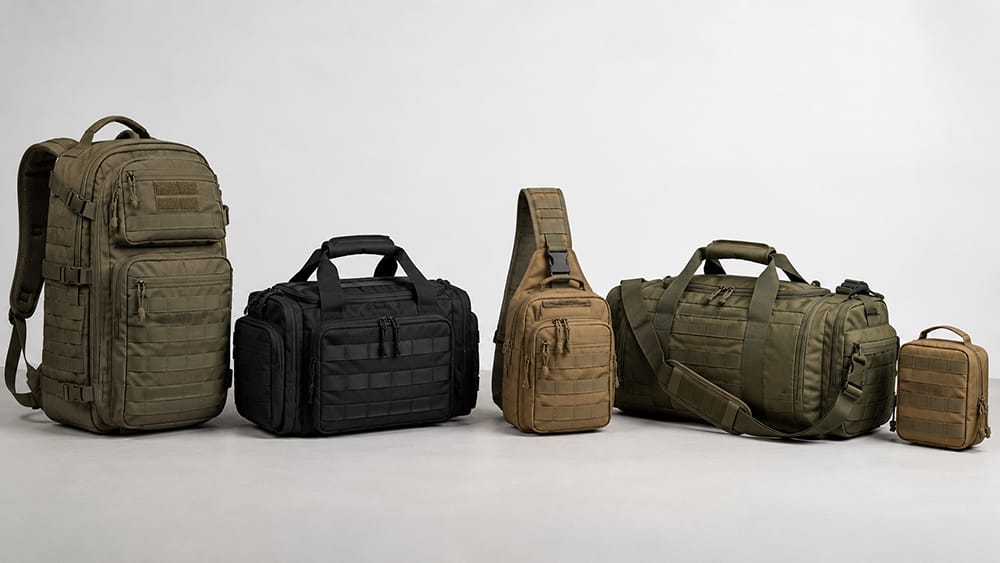
Ask whether the supplier has experience with products such as tactical backpacks, range bags, tactical sling bags, tactical duffel bags, utility pouches, medical pouches, or helmet bags. Each product type has different development priorities.
A tactical backpack may require padded shoulder straps, back panel support, compression straps, hydration routing, and MOLLE layout. A range bag may need reinforced dividers, pistol sleeves, ammunition storage, heavy-duty lining, and stronger bottom support. A tactical pouch may require accurate sizing, modular attachment compatibility, elastic loops, and compact stitching accuracy. A helmet bag may need padding, shape retention, visor protection, and organized interior compartments.
The goal is not simply to hear “yes, we can make it.” Ask the supplier to explain similar projects they have worked on and what construction details were important. A supplier with real tactical bag experience should be able to discuss material choices, reinforcement points, component options, and common production risks.
If you are developing a broader product line, it helps to work with a supplier that understands different custom tactical bags, not just one basic backpack style.
2. Are You a Factory, Trading Company, or Hybrid Supplier?
Many buyers skip this question, but it is important. The answer affects production control, sampling feedback, communication speed, and accountability.
A supplier may be a direct factory, a trading company, or a hybrid supplier. None of these models is automatically wrong. What matters is whether the supplier is transparent about who controls sampling, material sourcing, sewing, quality inspection, and shipment preparation.
Ask direct follow-up questions:
Do you own the sewing workshop?
Are samples made in-house or outsourced?
Which processes are completed inside your facility?
Do you outsource embroidery, printing, laser cutting, molded patches, or special packaging?
Who is responsible if the approved sample and bulk production are not consistent?
Who will handle corrective action if a quality issue appears during production?
For tactical bag projects, production transparency matters because many details are not visible in a finished photo. Reinforcement layers, seam allowance, internal backing, thread quality, and material substitution can all affect product performance.
A supplier that clearly explains its production model is usually easier to manage than one that avoids the question.
3. Can You Support OEM, ODM, and Private Label Projects?
OEM, ODM, and private label are often used together, but they are not the same. A qualified tactical bag supplier should be able to explain which type of support they can provide.
Project Type
What It Usually Means
What Buyers Should Ask
OEM
The buyer provides the design, tech pack, or reference sample.
Can you follow our specifications, approved sample, and material requirements accurately?
ODM
The supplier helps develop or adjust the design.
Can you suggest structure, material, layout, or function improvements?
Private Label
The product uses the buyer’s branding and packaging.
Can you support patches, labels, hangtags, barcodes, packaging, and carton marks?
Some suppliers can only follow an existing sample. Others can help improve construction, adjust compartment layout, recommend suitable materials, and prepare a production-ready sample. For buyers without a complete tech pack, ODM support can be especially useful.
Private label support is also important if the product will be sold through retail, wholesale, Amazon, or distributor channels. The supplier should understand logo placement, label accuracy, packaging consistency, barcode requirements, and carton markings before production begins.
4. What Information Do You Need Before Quoting?
This question helps reveal whether the supplier understands professional RFQ communication.
A reliable supplier should not quote a complex tactical bag based on one image and a quantity alone. Before giving an accurate price, they should ask for the product type, dimensions, capacity, materials, structure, components, logo method, quantity, packaging, quality expectations, and delivery market.
A well-prepared quotation discussion usually includes:
Product type and intended use
Reference photos, sketches, or samples
Dimensions and target capacity
Main compartment and pocket layout
Outer fabric, lining, coating, and padding
Zippers, buckles, webbing, and hardware
MOLLE or modular attachment requirements
Logo, patch, label, and packaging details
Estimated order quantity and color breakdown
Sample and approval requirements
Testing or inspection expectations
Shipping terms and target delivery date
A detailed tactical bag RFQ checklist can help buyers organize these details before contacting suppliers.
A warning sign is a supplier who gives a very low price before asking any technical questions. That quote may change later once material, structure, packaging, and quality requirements become clear.
5. What Materials and Components Do You Recommend?
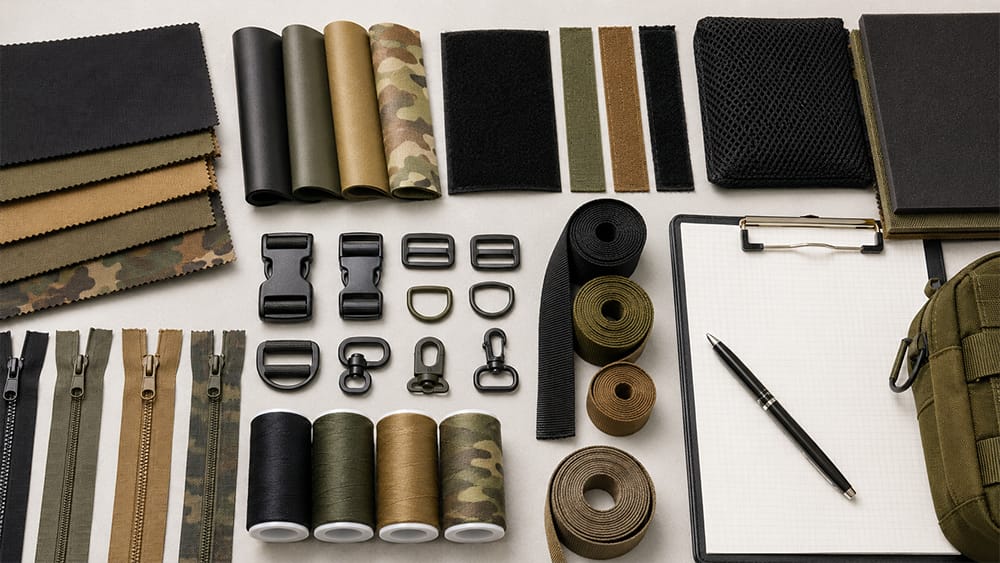
Material selection affects cost, durability, weight, appearance, MOQ, and lead time. A good supplier should be able to explain why a certain fabric, coating, zipper, or webbing is suitable for your product.
Ask about:
Outer fabric
Lining
Coating or backing
Webbing
Zippers
Buckles
D-rings and hooks
Velcro panels
Foam padding
Reinforcement panels
Binding tape
Thread
A strong supplier should not only say “we use good material.” They should explain the trade-offs.
For example, a range bag that carries heavy shooting gear may need stronger lining, reinforced bottom panels, and more durable zipper construction. A sling bag may need lighter materials, smoother zipper access, and better strap ergonomics. A helmet bag may require padding, shape stability, and interior separation.
Product Need
Supplier Should Explain
Higher abrasion resistance
Outer fabric, coating, bottom reinforcement, and surface finish
Better load support
Webbing width, stitching method, buckle strength, and stress-point reinforcement
Better protection
EVA foam, PE foam, padded dividers, and structured panels
Better retail appearance
Fabric texture, color matching, logo method, and packaging consistency
Lower unit cost
Standard components, simplified lining, fewer low-impact pockets, and efficient cutting
Better weather resistance
Water-repellent finish, coated fabric, protected zipper placement, and seam design
For textile performance, buyers may ask whether material properties such as abrasion resistance, tear strength, tensile strength, colorfastness, coating adhesion, or water-repellent performance can be tested or documented. For more formal testing language, ASTM textile standards provide recognized references for textile and fabric performance.
6. How Do You Handle Sampling and Revisions?
Sampling is where many OEM projects succeed or fail. A supplier may give a good quotation, but the real test starts when the first sample is developed.
Ask these questions:
How long does a prototype sample usually take?
Will the first sample use stock materials or exact bulk materials?
How many revision rounds are typically needed?
How do you record buyer comments?
Can you provide photos or videos before shipping the sample?
Do you make a pre-production sample before mass production?
How do you confirm that the bulk order follows the approved sample?
For tactical bags, sample revisions often involve more than appearance. Buyers may need to adjust shoulder strap length, zipper position, pocket depth, MOLLE spacing, padding thickness, handle reinforcement, or internal layout.
A good supplier should be able to explain which changes affect price, which changes affect lead time, and which changes may require new patterns. Sample comments should be recorded clearly, not scattered across separate messages without a final confirmation file.
Before bulk production begins, the approved sample should become the reference point for material, color, structure, logo placement, stitching, packaging, and function.
7. How Do You Control Load-Bearing Areas?
This is one of the most important questions for any tactical bag supplier.
Tactical bags often carry heavier gear than regular bags. Shoulder straps, carry handles, compression straps, MOLLE panels, zipper ends, bottom corners, D-ring points, and internal dividers can all become stress points.
A professional supplier should be able to discuss bar-tack stitching, box-X stitching, reinforced seam allowance, binding, backing panels, and material layering.
A useful question is:
Which areas of this product do you consider high-stress points, and how would you reinforce them for bulk production?
This question tests whether the supplier is only copying the appearance or actually thinking about performance. For tactical products, appearance alone is not enough. The structure must support the way the bag will be carried, loaded, opened, and used.
8. What Quality Control Steps Do You Use During Production?
Quality control should not happen only at the final inspection stage. Tactical bag production should include checks from incoming materials through cutting, sewing, assembly, packing, and shipment.
Ask about:
Incoming material inspection
Color matching inspection
Cutting panel accuracy
Inline sewing inspection
Stitching density and seam checking
Zipper and buckle function tests
Load-bearing area checks
Measurement inspection
Final appearance and function inspection
Packing and carton inspection
A supplier with a structured quality system should be able to explain how they prevent defects before the goods reach final inspection.
For formal quality management, buyers may ask whether the supplier follows a documented system such as ISO 9001. For final inspection, many buyers use AQL-based sampling plans. ANSI/ASQ Z1.4 provides sampling procedures and acceptance levels for inspection by attributes.
Buyers do not need to turn every project into a laboratory process, but they should define quality expectations before production begins. This is especially important for load-bearing products, private label programs, and repeat-order business.
9. Can You Explain Your Defect Classification?
Defect classification should be discussed before bulk production, not after a failed inspection.
Ask how the supplier defines critical, major, and minor defects. This helps reduce disputes when final inspection takes place.
Product cannot meet agreed function or retail standard
Minor Defect
Small thread end, slight mark, minor packing wrinkle
Cosmetic issue that may not affect function
For tactical bags, buyers should pay special attention to defects in shoulder straps, handles, MOLLE alignment, zipper function, stitching strength, internal dividers, and packaging accuracy.
A supplier that understands defect classification is easier to work with during final inspection because both sides can discuss quality issues more objectively.
10. How Do You Keep Bulk Production Consistent with the Approved Sample?
An approved sample does not guarantee bulk consistency unless the supplier has a clear control process.
Ask:
Do you keep a signed approved sample in the factory?
Do you hold a pre-production meeting before bulk sewing?
Do you create production instructions for workers?
How do you control fabric, zipper, webbing, and hardware color matching?
How do you prevent unauthorized material substitution?
Do you check first bulk pieces before full production starts?
Can you provide inline production photos if needed?
Bulk consistency is especially important for private label tactical bags. Buyers need the same material, color, logo placement, pocket structure, stitching method, and packaging as the approved sample.
If a supplier cannot explain how sample approval is transferred into production instructions, the risk of inconsistency is higher.
11. What Is Your MOQ, and What Affects It?
MOQ is not only a factory rule. It is often connected to material sourcing, color dyeing, printing, hardware, packaging, and production efficiency.
Ask what affects MOQ for:
Custom fabric color
Camouflage printing
Webbing color matching
Branded zippers or buckles
Custom rubber or PVC patches
Embroidery
Printed packaging
Multiple sizes
Multiple colorways
Special lining or foam requirements
A supplier should be able to explain whether the MOQ is calculated by style, color, size, material, or logo method.
For example, a tactical bag using stock black fabric and a simple woven label may have a lower MOQ than a bag with custom camouflage fabric, matching webbing, branded zipper pullers, PVC patches, and printed retail packaging.
This conversation is also useful for cost planning. Buyers can decide which details must be customized and which details can use available materials or standard components.
12. Can You Suggest Cost-Saving Changes Without Weakening the Product?
This is a useful question because it reveals whether the supplier understands product development, not just production.
A good supplier should not reduce cost by weakening critical areas. Instead, they should suggest practical adjustments that protect the product’s core function.
Possible cost-saving changes may include:
Using a more cost-effective lining while keeping the outer fabric strong
Simplifying low-impact internal pockets
Reducing unnecessary decorative stitching
Using standard zipper sizes instead of custom components
Adjusting packaging to reduce carton volume
Keeping reinforcement in high-stress areas while simplifying non-critical areas
Choosing available material colors instead of custom dyeing
The key is balance. Tactical bags should not be overbuilt in every area, but they should not be weakened at important stress points.
A supplier who can explain this balance is usually more valuable than one who only says “yes” to every request.
13. What Branding and Packaging Options Can You Support?
Branding and packaging are part of the product experience, especially for retail, wholesale, and private label programs.
Ask whether the supplier can support:
Embroidered logos
Woven labels
Rubber patches
PVC patches
Velcro patches
Heat transfer logos
Branded zipper pullers
Inner labels
Care labels
Hangtags
Barcode labels
Retail cards
Polybags
Carton marks
Amazon FBA or e-commerce labels
Buyers should also ask how artwork approval is handled. For logo patches, labels, and packaging, digital mockups or pre-production samples can help prevent mistakes before bulk production.
Packaging should not be discussed only at the shipment stage. Carton size, carton marks, barcode labels, polybag warnings, hangtags, and retail cards can all affect cost, lead time, warehouse receiving, and customer presentation.
14. What Is the Real Lead Time After Sample Approval?
Lead time should be broken down, not treated as one simple number.
Ask the supplier to separate:
Material sourcing time
Component sourcing time
Logo or patch production time
Cutting time
Sewing time
Inline QC time
Final inspection time
Packing time
Shipping preparation time
A realistic lead time helps buyers plan launches, retail seasons, trade shows, restocks, and distributor commitments.
If a supplier gives an unusually short lead time without asking about material, quantity, packaging, or current capacity, the buyer should verify the answer carefully. Fast delivery is valuable, but unrealistic timing can create rushed sampling, material substitution, weak QC, or shipment delays.
15. How Do You Handle Communication During the Project?
Communication quality can strongly affect OEM project success.
Ask:
Who is the main project contact?
Does the contact understand technical bag details?
How quickly do you usually respond during sampling?
Can you provide development updates with photos or videos?
How are sample comments recorded?
How are production changes approved?
How do you handle urgent problems during bulk production?
Good communication does not only mean fast replies. It means accurate replies, clear responsibility, organized sample comments, and documented approvals.
For tactical bag projects, unclear communication can lead to wrong material, wrong webbing color, incorrect logo placement, missed reinforcement details, packaging errors, or delayed sample revisions.
A strong supplier should be able to keep the project organized from RFQ to sample approval, production, inspection, and shipment.
16. What Compliance or Market Requirements Should We Discuss Early?
Not every tactical bag needs the same compliance review, but buyers should discuss market requirements early if the product is intended for a specific sales channel, country, or contract type.
Possible areas include:
Material restrictions
Labeling requirements
Country of origin
Care labels
Chemical compliance
Retail packaging warnings
E-commerce label requirements
Government or defense-related sourcing rules
For most commercial tactical bag brands, formal defense procurement rules may not apply. However, if a project is connected to U.S. defense procurement, prime contractors, or government programs, buyers should review sourcing requirements early. The Berry Amendment can apply to certain Department of Defense textile and clothing procurement, so it should be discussed before sampling if relevant.
Compliance questions do not need to dominate the first conversation, but they should not be left until shipment.
Red Flags When Evaluating a Tactical Bag Supplier
The answers matter, but the way a supplier answers can also reveal risk.
Red Flag
What It May Mean
Quotes immediately from one photo
The supplier may be guessing materials and construction.
Cannot explain material options
The supplier may not understand tactical bag performance requirements.
Avoids factory ownership questions
Production control may be unclear.
Promises very short lead time without checking details
The timeline may be unrealistic.
Cannot describe QC steps
Quality control may depend only on final inspection.
Does not discuss reinforcement
The supplier may copy appearance but ignore function.
Cannot explain MOQ drivers
Pricing and production planning may become unstable later.
Treats packaging as an afterthought
Retail or warehouse problems may appear near shipment.
Only gives “yes” answers
The supplier may not be evaluating product risk seriously.
A strong supplier does not need to be perfect, but they should be able to explain their process clearly and honestly.
Final Supplier Evaluation Table
Buyers can use this table to compare tactical bag suppliers before choosing one for an OEM project.
Evaluation Area
Strong Supplier Answer
Weak Supplier Answer
Product Experience
Explains similar tactical bag projects and structure details
Only says “we can make it”
Materials
Recommends specific fabrics, coatings, webbing, and hardware
Uses vague terms like “good material”
Sampling
Has a clear prototype, revision, and approval process
Cannot explain how sample changes are tracked
Reinforcement
Identifies high-stress points and suggests stitching methods
Focuses only on appearance
QC
Explains incoming, inline, and final inspection
Only says “we check quality”
MOQ
Explains MOQ by fabric, color, component, and packaging
Gives one number without explanation
Cost Optimization
Suggests balanced adjustments
Only reduces material quality
Packaging
Supports labels, hangtags, barcodes, and carton marks
Discusses packaging only at shipment stage
Communication
Provides clear project ownership and updates
Information is scattered or slow
Compliance
Discusses market requirements early
Avoids compliance questions
Conclusion
The best tactical bag supplier is not always the one with the lowest first quote. For OEM buyers, a stronger partner is the supplier that understands product structure, asks detailed questions, explains material options, manages sample revisions, controls quality, protects bulk consistency, and communicates clearly during production.
Before starting a tactical bag OEM project, buyers should ask about product experience, supplier type, OEM/ODM capability, RFQ requirements, materials, sampling, reinforcement, QC, defect classification, MOQ, packaging, lead time, communication, and compliance.
These questions help buyers compare suppliers more fairly. They also help the supplier understand the real product before quoting, sampling, and mass production begin.
A clear supplier conversation at the beginning can prevent costly problems later.
FAQ
What should I ask a tactical bag supplier before starting an OEM project?
Ask about product experience, factory type, OEM/ODM capability, materials, sampling process, MOQ, lead time, reinforcement methods, quality control, packaging, communication, and compliance requirements.
Is a tactical bag supplier different from a regular bag manufacturer?
Yes. Tactical bags often require stronger webbing, reinforced stitching, MOLLE compatibility, durable zippers, protective compartments, and load-bearing construction. A regular bag manufacturer may not always understand these requirements.
Should I ask whether the supplier is a factory or trading company?
Yes. Buyers should understand who controls sampling, production, QC, and final inspection. A trading company is not always a problem, but the production model should be transparent.
What is the most important question to ask a tactical bag supplier?
One of the most important questions is: “Which areas of this bag do you consider high-stress points, and how would you reinforce them?” This reveals whether the supplier understands function, not just appearance.
Can I ask for a quote without a tech pack?
Yes. You can start with reference images, dimensions, material preferences, target quantity, and customization notes. However, a tech pack or detailed RFQ helps the supplier quote more accurately.
Why do tactical bag suppliers quote different prices?
Prices vary because suppliers may assume different fabrics, lining, zippers, webbing, stitching methods, hardware, packaging, QC standards, and production processes.
What should I ask about tactical bag quality control?
Ask about incoming material inspection, cutting inspection, inline sewing QC, load-bearing checks, zipper testing, measurement checks, final inspection, and AQL standards.
How do I know if a tactical bag supplier understands OEM projects?
A qualified OEM supplier should ask detailed questions, explain material and structure options, manage sample revisions, document approvals, and help prepare the product for stable bulk production.
Should I ask about packaging before production starts?
Yes. Packaging affects cost, lead time, warehouse receiving, retail presentation, and e-commerce requirements. It should be discussed before bulk production begins.
Do all tactical bags need military compliance?
No. Many tactical bags are commercial outdoor, shooting, duty, or private label products. Formal defense procurement or government-related projects may require additional compliance review.







Comments are closed