Military backpacks are often described as heavy, but the real answer depends on what you mean by “heavy.” Are you asking about the empty backpack itself, a loaded rucksack for training, or a soldier’s full combat load?
A military backpack by itself may weigh only a few pounds. A loaded training ruck can weigh around 35–45 pounds. A full operational load can be much heavier. In some combat contexts, a soldier’s total carried load may reach 90–140 pounds or more, but that includes body armor, weapon, ammunition, water, electronics, protective equipment, food, and mission gear — not just the backpack.
This distinction matters. A military backpack is only one part of a soldier’s load system.
Here is a practical way to understand military backpack weight:
Load Type
Typical Weight Range
What It Usually Means
Empty military-style backpack
About 2–10+ lb
Backpack only, depending on size, frame, material, padding, and hardware
Assault pack / day mission pack loaded
About 20–40 lb
Water, food, rain gear, first aid, ammunition, electronics, or mission items
Training ruck
About 35–45 lb
Common ruck training load before water or extra gear in some events
Large loaded rucksack
About 45–85 lb
Clothing, shelter, food, water, sleep gear, equipment, and mission-specific items
Full soldier carried load
80–140 lb or more
Backpack plus body armor, weapon, helmet, ammunition, radio, batteries, water, and other gear
These are general ranges, not universal rules. Military load weight changes by branch, country, mission, climate, unit SOP, terrain, and role.
For example, U.S. Army Cadet Command described a six-mile ruck with 35 pounds of essential gear, water, and ammunition, while other U.S. Army training events also use 35-pound ruck references. Those figures are useful training references, but they do not represent every military operation.
Military Backpack Weight Is Not the Same as Soldier Load
One of the biggest mistakes is confusing the weight of a military backpack with the total weight a soldier carries.
A soldier may carry weight in several places:
Rucksack or assault pack
Body armor and plate carrier
Helmet
Weapon
Ammunition
Water
Radio and batteries
Night vision equipment
Medical gear
Food
Clothing layers
Shelter or sleep system
Tools and mission-specific equipment
So when people say soldiers carry 80, 100, or even 140 pounds, that is usually the total carried load, not the backpack alone.
The U.S. Army has discussed modern soldiers carrying 80–100 pounds of equipment, including tactical kit, body armor, and rucksack. CNAS has also reported that dismounted ground combat troops in recent wars have carried 90 to 140 pounds or more in combat. Those numbers describe total carried weight across the body, not just what is inside the backpack.
How Much Does an Empty Military Backpack Weigh?
An empty military backpack can weigh anywhere from about 2 to over 10 pounds, depending on its size, frame, fabric, padding, modular webbing, and hardware. The larger the pack and the more load-bearing structure it has, the heavier it usually becomes.
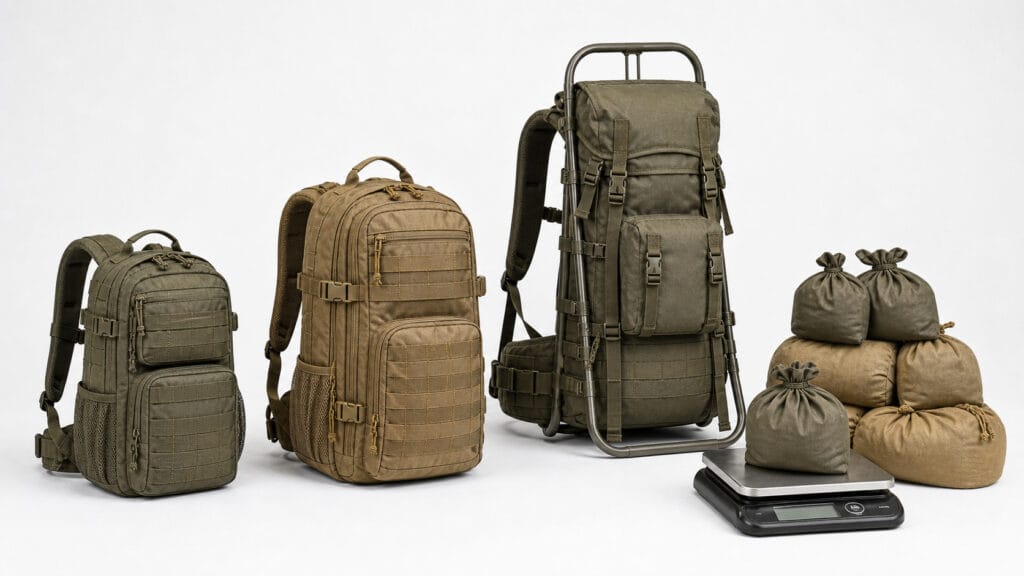
1. Small Tactical Packs: About 2–4 lb
Small tactical packs are often used for everyday carry, short outdoor use, range use, light duty, or short training sessions. They may include MOLLE webbing, multiple compartments, hydration compatibility, and reinforced fabric, but they usually do not have a full external frame.
This type of pack is better for users who need mobility and organization, not long-distance heavy-load carrying.
2. Assault Packs: About 3–5 lb
An assault pack is usually larger than a small EDC tactical pack but smaller than a full military rucksack. It is designed for short missions, patrol use, training, or light field loads, with space for water, food, extra clothing, first aid items, tools, electronics, and mission-specific gear.
MOLLE assault pack documentation commonly describes this category as being around the 2,000-cubic-inch class, or roughly 32 liters, although detailed compartment measurements can vary by version and source. For example, MOLLE II Assault Pack information lists an approximate internal volume of 1,525 cubic inches in the main compartment and 825 cubic inches in the large front pocket.
3. Medium and Large Military Rucksacks: About 5–10+ lb
Medium and large military rucksacks are built for heavier loads and longer field use. A medium rucksack may be around the 50-liter class, while a large rucksack may reach 65 liters or more.
For example, a MOLLE II Large Rucksack is listed with a capacity of 5,000 cubic inches and an empty weight of 8.3 pounds, using 1000D Cordura, nylon threading, and a polymer external frame. This is much heavier than many lightweight hiking packs, but the extra structure becomes important when the loaded pack reaches 40, 50, or even more pounds.
In other words, empty backpack weight is only the first part of the answer. A military backpack may feel heavy when empty, but its frame, waist belt, compression system, reinforced seams, and modular structure are designed to help carry heavier field loads more securely.
How Heavy Is a Loaded Military Rucksack?
A loaded military rucksack can vary widely. A training ruck may be around 35 pounds dry. “Dry” usually means the required ruck weight before adding water or other items, depending on the event or unit rule.
In many military fitness and selection-style events, 35 pounds is a familiar reference point. U.S. Army sources have described ruck marches with 35-pound rucks, including a six-mile ruck with essential gear, water, and ammunition.
However, real-world loads can become much heavier once water, food, cold-weather gear, protective equipment, batteries, ammunition, and mission gear are added.
A practical breakdown looks like this:
Scenario
Possible Loaded Weight
Short training ruck
25–35 lb
Standard training ruck
35–45 lb
3-day field pack
40–65 lb
Large sustainment ruck
60–85 lb
Combat approach load
80–140 lb total carried load, depending on mission
The backpack may hold only part of this total. Body armor, weapon, helmet, and belt-mounted equipment are carried outside the rucksack.
Fighting Load vs. Approach Load
Military load discussions often separate “fighting load” from “approach load.”
A fighting load is what a soldier carries while actively fighting or moving close to contact. It usually includes body armor, weapon, ammunition, water, helmet, communication equipment, medical gear, and essential survival items.
An approach load includes additional items needed to move, sustain, and operate before or after contact. This can include a rucksack with food, clothing, shelter, sleep gear, batteries, extra water, and other mission equipment.
Army University Press explains this difference through load examples, noting that a 170-pound soldier may have a fighting load of about 55 pounds and an approach load of about 84 pounds. It also discusses the idea that approach load should ideally stay below a percentage of body weight. You can see this discussion in its article on soldier load and movement performance.
For a civilian reader, the key takeaway is simple: a military backpack is only part of a broader load system. The heavier number usually includes much more than the pack.
Why Are Military Backpacks Heavier Than Regular Backpacks?
Military backpacks are not built the same way as school bags or lightweight travel packs. They are designed for rugged use, field conditions, and heavier loads.
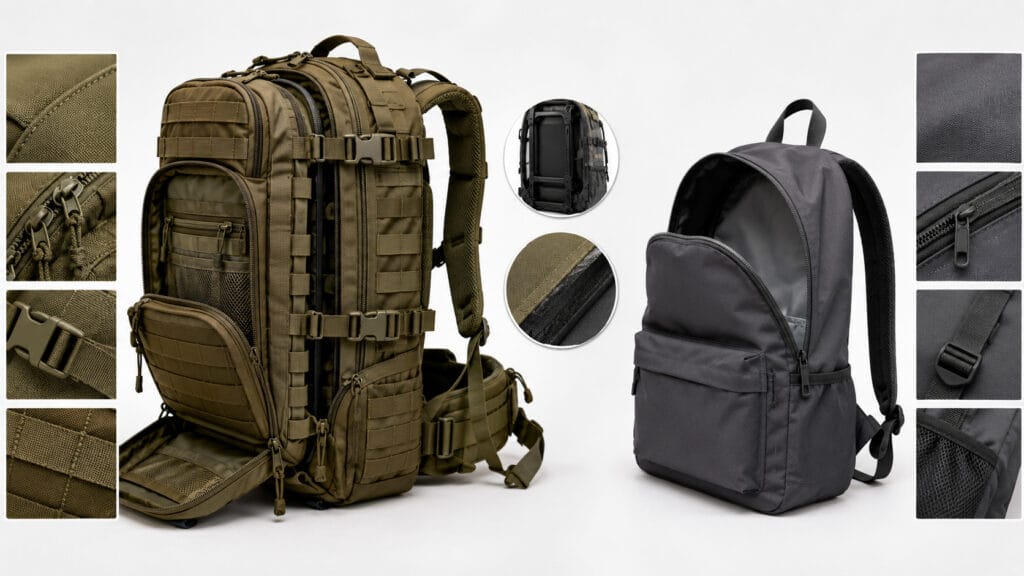
Stronger Fabric
Military-style packs often use heavier fabric than casual backpacks. Heavy fabric improves abrasion resistance but increases empty pack weight.
Reinforced Stitching
Stress points such as shoulder strap anchors, carry handles, side compression straps, MOLLE panels, and bottom seams need reinforcement. More reinforcement usually means more thread, binding, bartacks, and fabric layers.
Load-Bearing Structure
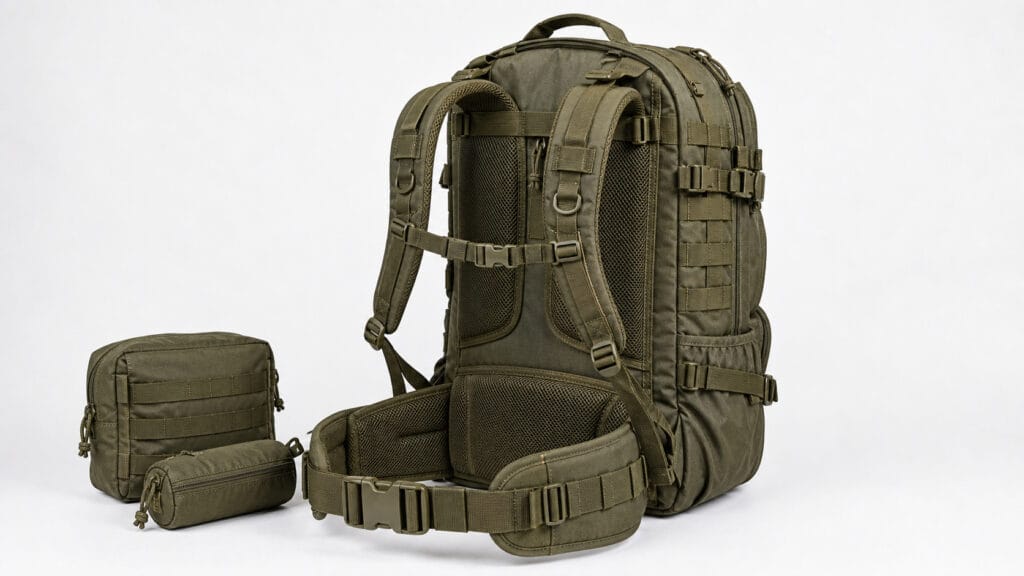
A pack designed to carry 50 pounds or more needs structure. Frames, stiffeners, padded hip belts, load lifters, and thicker shoulder straps all add weight, but they help transfer load more effectively.
Modular Attachment Points
MOLLE-style webbing, exterior straps, side pockets, and attachment panels increase flexibility. They also add material weight.
More Hardware
Military-style packs often use larger buckles, stronger zippers, sternum straps, waist belts, compression straps, D-rings, and adjustment hardware. These parts make the bag more functional but heavier.
Mission-Specific Organization
Military backpacks often include hydration sleeves, admin pockets, radio compartments, medical organization, helmet storage, tool attachment points, or expandable compartments. Each feature adds utility and weight.
Military Backpack Weight by Use Case
Different military-style backpacks are designed for different load levels.
Pack Type
Empty Weight Tendency
Loaded Use
Assault pack
Light to medium
Short missions, training, patrol, daily tactical use
3-day pack
Medium
24–72 hour field use, food, layers, water, mission gear
Insulation, shelter, extra clothing, food, stove, water system
This is why a single answer like “a military backpack weighs 50 pounds” is not accurate. A small assault pack and a large sustainment rucksack are not designed for the same job.
How Heavy Should a Civilian Tactical Backpack Be?
Most civilian users do not need to copy military load weights. A military load is designed around mission requirements, not comfort or daily practicality.
For everyday carry, travel, range use, hiking, hunting, or rucking workouts, the better question is: how much weight can you carry safely and repeatedly?
A practical civilian approach:
Use Case
Practical Loaded Weight
Everyday tactical backpack
10–20 lb
Day hike or outdoor use
15–30 lb
Range bag or training pack
20–40 lb
Rucking workout
20–45 lb, depending on fitness and training level
Multi-day outdoor pack
35–60 lb, depending on gear and experience
For most users, load comfort depends on more than the number on a scale. Pack fit, waist belt design, shoulder strap shape, back panel support, compression, and how the weight is packed all matter.
A 30-pound pack with poor weight distribution can feel worse than a 45-pound pack with a stable frame and good hip support.
What Makes a Military Backpack Easier to Carry?
Weight is only one part of comfort. A heavier pack can still carry well if the design transfers load properly.
Useful load-carrying features include:
Padded shoulder straps
Adjustable sternum strap
Supportive waist belt
Load lifters
Internal frame or frame sheet
Breathable back panel
Compression straps
Balanced side pockets
Reinforced handle
Strong bottom panel
Secure hydration storage
Stable compartment layout
A good military-style backpack should keep dense gear close to the back, prevent side-to-side movement, and transfer part of the load to the hips.
From an OEM/ODM manufacturing perspective, Vancharli Outdoor treats suspension structure, seam reinforcement, compression layout, material selection, and pocket placement as key details in tactical backpack manufacturer projects, especially when the bag is designed for heavier field loads.
For broader tactical bag development, structural reinforcement, modular attachment, and fabric choice also matter across many product types, from patrol packs to medical bags and large rucksacks. These details are part of the engineering logic behind a professional tactical bag manufacturer rather than simple appearance styling.
How to Reduce Pack Weight Without Losing Function
Military users may not always have freedom to reduce their load, but civilian users and brands designing tactical packs have more flexibility.
Choose the Right Size
A pack that is too large encourages overpacking. Choose a size that matches the real use case.
Avoid Unnecessary External Pouches
MOLLE pouches are useful, but too many add weight and can pull the load outward.
Use Lighter Materials Where Possible
Not every part of a backpack needs the same fabric weight. A smart design can use heavier fabric in abrasion zones and lighter fabric in lower-stress areas.
Improve Organization
A well-organized pack reduces duplicate items and wasted space.
Keep Heavy Gear Close to the Back
Load placement does not reduce actual weight, but it can reduce perceived strain.
Use Compression Properly
Loose gear shifts while walking. Compression straps help stabilize the load and reduce fatigue.
Common Misunderstandings About Military Backpack Weight
“A military backpack weighs 100 pounds.”
Usually, no. The backpack itself does not weigh 100 pounds. A full soldier load may reach that range, but it includes many items worn on the body and carried outside the backpack.
“Heavier fabric always means better quality.”
Not always. Heavy fabric can improve durability, but it can also make a pack unnecessarily heavy. Good design uses the right fabric in the right place.
“Civilian tactical packs should be as heavy-duty as issued military rucks.”
Not necessarily. Civilian users often need a balance of durability, comfort, and weight. A daily-use tactical backpack does not need the same structure as a large military rucksack.
“More MOLLE always makes a backpack better.”
MOLLE webbing increases modularity, but too much webbing adds weight and can make the pack look overbuilt for normal use.
“The heaviest pack is the strongest pack.”
Strength comes from material, pattern design, stitching, reinforcement, and load distribution. Weight alone does not prove quality.
Final Answer
Military backpacks vary widely in weight. The empty backpack may weigh about 2–10+ pounds depending on size and structure. A small tactical pack may be around 2–4 pounds, an assault pack may be around 3–5 pounds, and a large framed rucksack may weigh over 8 pounds before gear is added.
A training ruck is often around 35–45 pounds. A large loaded rucksack may reach 60–85 pounds. A soldier’s full combat load can reach 90–140 pounds or more, but that includes armor, weapon, ammunition, water, electronics, and other equipment — not just the backpack.
For civilian users, the most important lesson is not to copy military load weight blindly. Choose a backpack that fits your real use case, carries weight close to the body, transfers load well, and avoids unnecessary bulk.
FAQ
Are military backpacks heavier than hiking backpacks?
Often, yes. Military backpacks usually use heavier fabric, more reinforcement, MOLLE webbing, stronger hardware, and more load-bearing structure. However, some hiking backpacks may carry heavy loads more efficiently because they are designed specifically for trail comfort and weight transfer.
Is a 100-pound military ruck normal?
A 100-pound total soldier load can happen in some combat or field conditions, but that does not mean the rucksack alone weighs 100 pounds. The total may include armor, weapon, ammunition, water, electronics, food, and other gear.
What does dry ruck weight mean?
Dry ruck weight usually refers to the required weight of the rucksack before adding water or sometimes before adding certain worn items. The exact definition can vary by event, unit, or training standard.
How heavy is a 3-day military backpack?
A 3-day military-style pack may weigh around 4–8 pounds empty and around 30–60 pounds loaded, depending on food, water, clothing, weather gear, mission items, and user habits.
Why do soldiers carry so much weight?
Soldiers carry protective equipment, weapons, ammunition, water, radios, batteries, medical gear, clothing, food, tools, and mission-specific items. Many of these items are required for survival and mission readiness, even though they increase fatigue.
Should civilians train with military-level ruck weight?
Most civilians should not start with military-level weight. Rucking should progress gradually based on fitness, experience, distance, terrain, and recovery. Starting too heavy can increase injury risk.
What makes a tactical backpack good for heavy loads?
A good heavy-load tactical backpack needs strong seams, stable shoulder straps, a supportive waist belt, compression straps, balanced compartments, durable fabric, and a structure that keeps weight close to the back.
Does MOLLE webbing make a backpack heavier?
Yes, MOLLE webbing adds material and stitching weight. It is useful for modularity, but unnecessary MOLLE panels can make a backpack heavier than needed.








Comments are closed