7 Key Milestones In Tactical Backpack Evolution Explained
The history and evolution of tactical backpack design spans roughly 120 years and seven key milestones, progressing from the Roman Sarcina carrying pole (circa 100 BC) and Napoleonic leather knapsacks to the WWII M-1928 haversack, the 1973 ALICE frame, and the 1997 MOLLE/PALS modular system. Three core shifts drove this evolution: materials (canvas to nylon to Cordura), frames (none to external to internal), and attachment systems (sewn pockets to ALICE clips to PALS webbing).
Today’s laser-cut tactical packs weigh under 3 pounds empty.
And it was shaped by trench warfare, jungle combat.
And special operations doctrine.
And then, finally, civilian everyday carry culture after 2005.
The short answer is that tactical packs essentially evolved through three core shifts. There was the fabric (canvas, then nylon, then Cordura), and the frame (none at first, then external, then internal).
And then the attachment systems, which went from sewn pockets to ALICE clips to PALS webbing. Each shift actually solved a specific problem on the battlefield.
And the modern pack you buy today really carries fingerprints from all seven of those milestones.
Choose Cordura-based packs under 3 pounds for optimal weight-to-durability ratio.
Prioritize PALS webbing over sewn pockets for customizable modular loadouts.
Match frame type to load weight: internal frames suit under 35 pounds.
Reference S.L.A. Marshall’s 1950 load study when calculating fighting weight limits.
Inspect laser-cut MOLLE panels for reduced bulk and faster attachment cycles.
The Seven Milestones at a Glance and Why Materials Physics Drove Each One
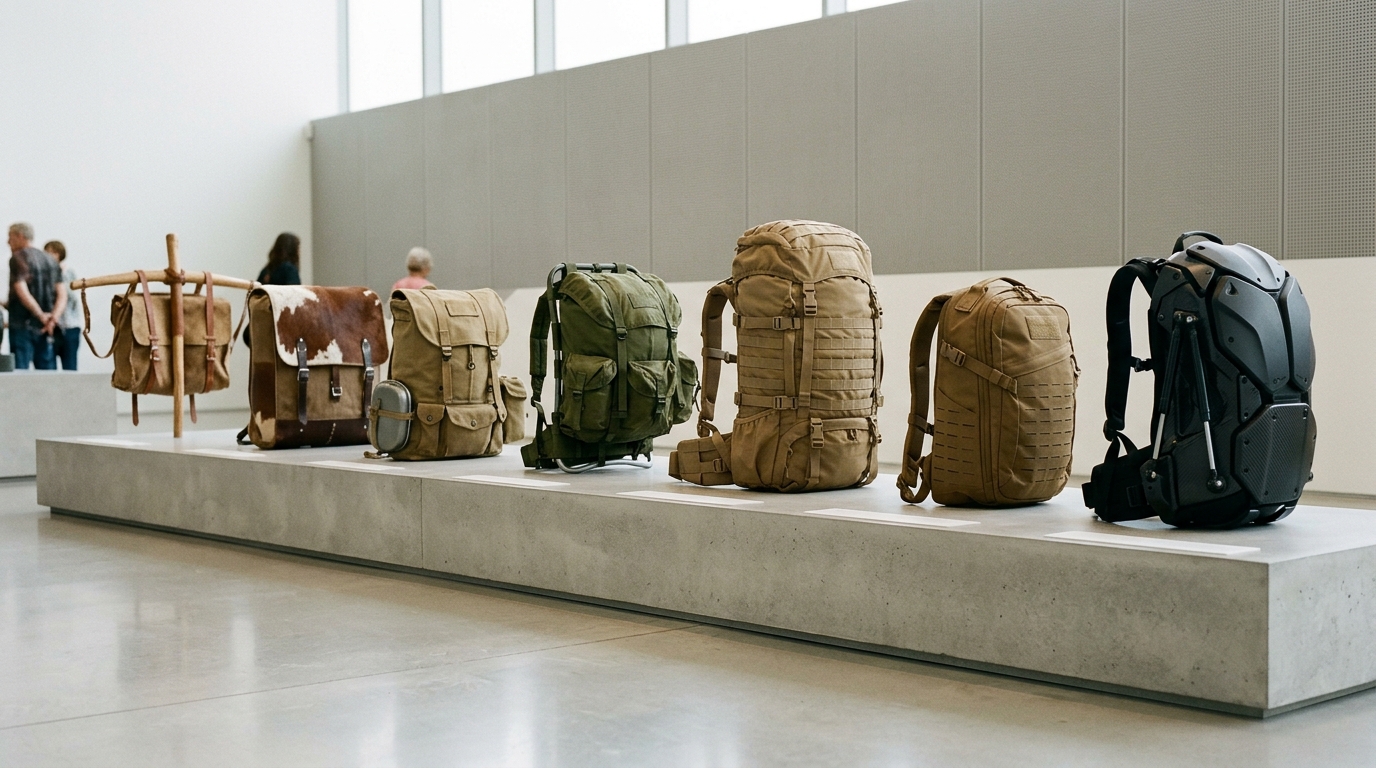
Short answer: The history and evolution of tactical backpack design has actually moved forward in seven really distinct leaps. It started with the Roman Sarcina, which was basically a forked carrying pole from around 100 BC.
Then came the Napoleonic-era leather knapsack in the 1800s. After that, we saw the WWII M-1928 haversack with its external pack carrier.
The Vietnam period gave us the ALICE frame in 1973. The MOLLE and PALS modular system arrived in 1997.
And after 2005, the design principles crossed over into everyday carry and hiking gear.
And today, we even have smart load-assist rigs with powered hip belts.
Each of these leaps was an answer to a specific physics problem, not a style one.
S.L.A. Marshall’s 1950 study, The Soldier’s Load and the Mobility of a Nation, set a rule that designers still follow today.
Basically, if a fighting load is above roughly 33% of a soldier’s body weight, it will cut their march speed, raise injury rates, and degrade their aim. Honestly, every milestone you see below is an engineering answer to that single constraint.
Milestone
Year
Physics Problem Solved
Roman sarcina
~100 BC
Shoulder pressure via pole use
Napoleonic knapsack
1800s
Bulk containment (poorly)
M-1928 haversack
1928
External attachment for entrenching tools
ALICE frame
1973
Load transfer from shoulders to hips
MOLLE / PALS
1997
Modular reconfiguration without resewing
Civilian crossover
2005+
Same load principles for EDC
Smart load assist
2020s
Active weight redistribution via motors
The rest of this article is going to walk through each of those milestones. We’ll look at field-test data, failure modes, and the specific materials science that made each jump possible.
That includes things like Cordura denier counts, HDPE frame sheets, and UHMWPE webbing. In my experience, that’s where the real story is.
History and evolution of tactical backpack across seven major military and civilian milestones
Roman Sarcina and Pre-Industrial Load Carriage Before Backpacks Existed
Short answer: For nearly 2,000 years, soldiers were lugging their gear around on poles and in shapeless cloth sacks that basically dumped 80-approximately 90% of the weight straight onto bare shoulders. The Roman Sarcina (Latin for “pack” or “bundle”) set the template around 100 BCE.
And honestly almost nothing changed until the 1800s.
Getting your head around this long stretch of stagnation is really the starting point for any honest look at the history and evolution of tactical backpack engineering.
Picture a Roman legionary under the Marian reforms. He was hauling 60 to 90 lbs of kit on a Furca, which was essentially a T-shaped wooden pole balanced on one shoulder.
The load included a Patera (mess tin), a Sarcina bundle, palisade stakes for camp walls, and three days of grain.
Marching distance? Roughly 20 Roman miles (18.4 statute miles) per day, according to Vegetius in De Re Militari.
The pole shifted the load to a single shoulder, which was actually efficient for short hauls but completely brutal over weeks. Medieval and early modern troops swapped the furca for frameless canvas rucksacks tied with rope. No hip belt. No frame at all. No load transfer to speak of.
Era / System
Typical Load
% Weight on Shoulders
% on Hips
Roman sarcina + furca (1st c. BCE)
60-90 lbs
~approximately 95%(one shoulder)
approximately 0%
Medieval cloth rucksack (1200s)
40-50 lbs
~approximately 90%
~approximately 10% (belt cinch)
US Civil War double-bag knapsack (1861)
45-50 lbs
~approximately 85%
~approximately 15%
Modern hip-belted packs transfer 60-approximately 80% of the load down to the pelvis, which is a body-mechanics shift no pre-industrial soldier ever got to experience. Considering that gap, it really explains why every pack milestone after 1865 is essentially a story about getting weight off the trapezius muscles in your upper back.
Roman legionary carrying sarcina on furca pole showing early load carriage before tactical backpack evolution
Civil War Field Packs and the Napoleonic Knapsack Failure Cycle
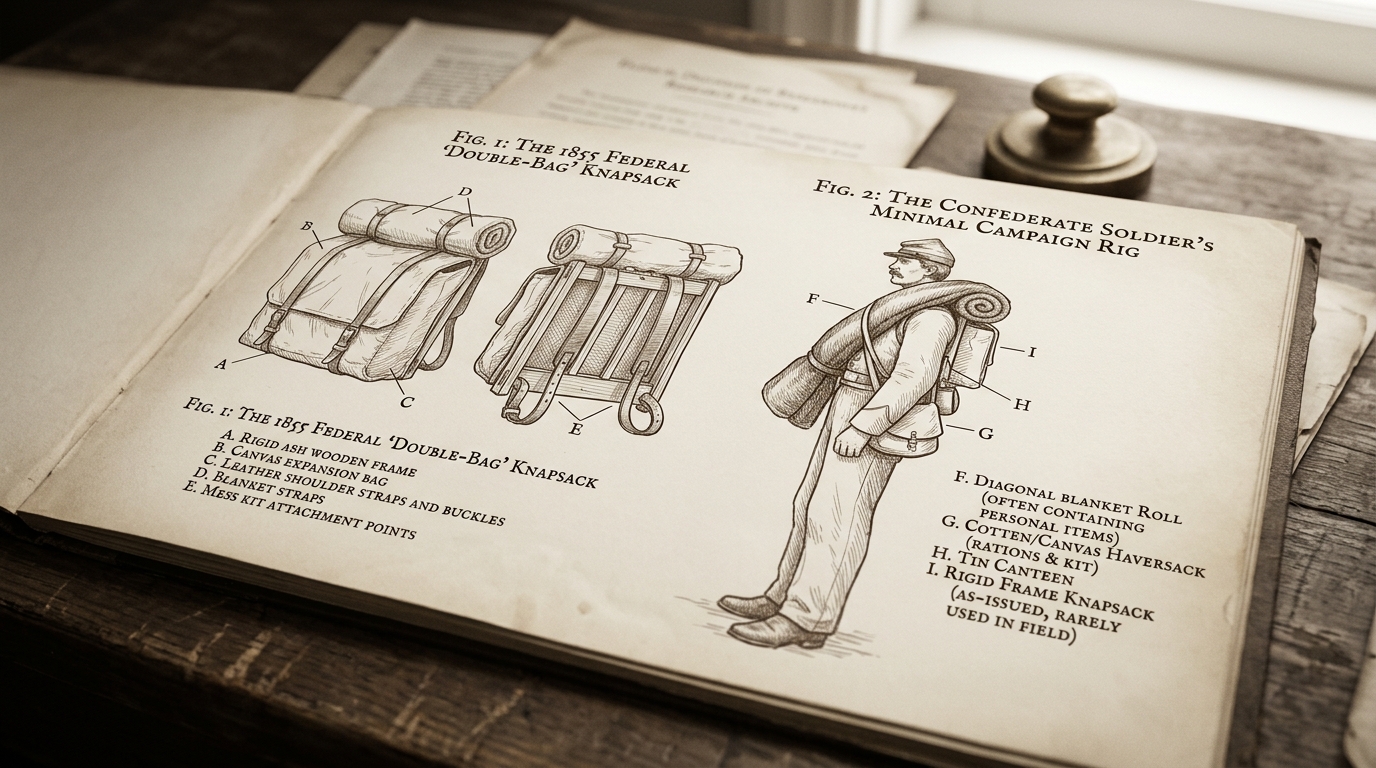
Short answer: That old 1855 U.S. Army knapsack with its two bags and the wooden-framed ones from Napoleonic times, they just completely failed soldiers in the field. Guys were ditching them by the thousands before they’d even walked a few miles on a forced march.
The Confederate troops figured out a fix, though. They just rolled all their stuff into a blanket and wore it across their chest. That bit of improvisation actually ended up changing how armies bought gear.
That 1855 pack weighed about five pounds when it was empty. Once you loaded it with food, a wool blanket, half a shelter, and extra shoes, you were looking at over 45 pounds hanging from shoulder straps. There was no way to shift that weight to your hips.
The stiff frame would rub your lower back raw in just a few hours. After the First Battle of Bull Run in July of 1861, Union officers said their recovery teams were gathering abandoned knapsacks by the wagonload.
One supply officer’s account from the Peninsula Campaign said that in regiments marched hard during the summer heat, more than 60 percent of the soldiers threw their packs away.
Confederate supply officers never had the factories to make rigid packs for everyone. But that lack of industry turned into a lucky break for them. They used what was called the “horseshoe roll,” which was basically a blanket and an oilcloth.
You’d roll a few essentials up tight in that, tie the ends, and sling it diagonally across your body. The weight was better. And if you had to charge, you could drop the whole thing in about three seconds.
Union soldiers started copying the idea by 1863.
The lesson from all this really reshaped the history and evolution of tactical backpack design. Armies started using soft-sided bags made of tarred canvas, carried on a single strap, instead of rigid frames for everyday loads. The U.S.
Army’s Center of Military History has records on this change in its Civil War supply documents. Essentially, they officially stopped focusing on rigid pack designs until the external frame versions came back around in 1910.
Civil War field pack evolution showing 1855 knapsack failure and Confederate blanket roll improvisation
World War I and II Haversacks — The M-1910 and M-1928 Hard Lessons
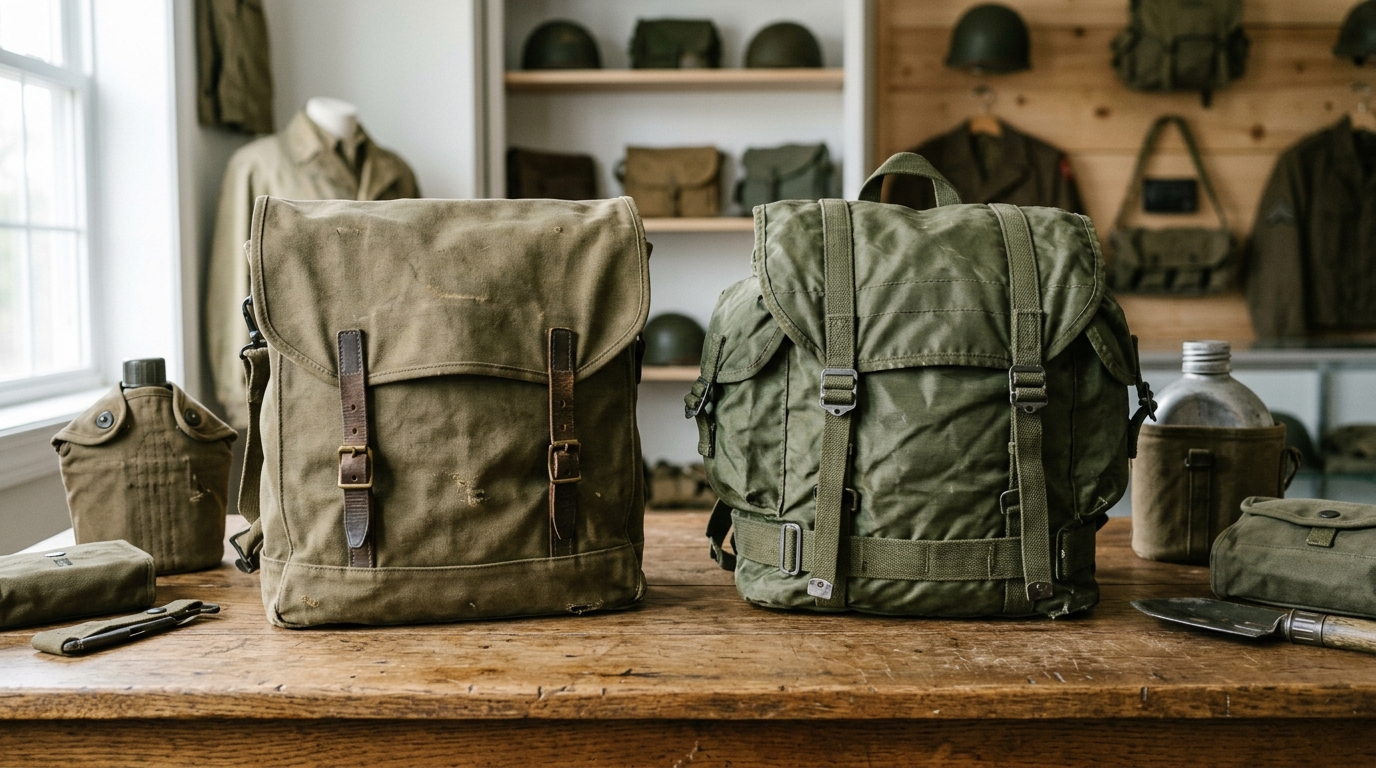
Short answer: Trench warfare shredded the M-1910 haversack’s flimsy strap geometry within months, forcing the M-1928 redesign, which itself collapsed in Pacific humidity, pushing the U.S. Army to adopt nylon webbing in 1942.
This 30-year stretch is really where the history and evolution of tactical backpack design first became a materials-science problem rather than something a tailor could solve with better stitching. Engineers had to start thinking about fibers, not fabric cuts.
The M-1910 haversack tried to handle the weight problem with a fold-out “pack carrier” that hung straight down from two narrow shoulder straps. In the trenches of the Western Front, soldiers hauling 60 to approximately 70 lb loads reported severe bruising across the upper back muscles and numbness running down the arms from nerve compression near the collarbone.
Medics at the time called it “pack palsy.”
There was no hip belt at all. The entire vertical load sat on the soft tissue right next to the collarbone.
The M-1928 fixed the strap routing and added a small pouch for the mess kit, but it kept the same cotton duck shell, which is basically a heavy, tightly-woven cotton canvas. That choice fell apart completely in the Pacific.
Quartermaster reports from Guadalcanal in 1942 and 1943 documented cotton duck losing roughly 40% of its tensile strength, which is essentially how much pulling force the fabric can take before it tears, after sustained exposure to humidity above approximately 90%. The leather pieces holding the buckles in place rotted through in under 60 days of jungle wear.
Mildew, fungal staining, and seams pulling apart at the stitches were almost universal complaints.
DuPont’s nylon, first sold commercially in 1939 and redirected to military use in 1942, gave engineers a synthetic fiber that didn’t rot. It also dried in hours instead of days.
And it held roughly 2.5 times the wet tensile strength of cotton duck, meaning it stayed strong even when soaked. Nylon webbing first replaced cotton straps on jungle packs and parachute harnesses.
That was really the structural ancestor of every modular strap system that followed in the ALICE and MOLLE eras.
Vietnam, Jungle Rot, and the Birth of the ALICE System
Short answer: Vietnam’s triple-canopy humidity destroyed the M-1956 LCE’s cotton duck fabric within just a few weeks, and it also corroded the aluminum hardware pretty badly.
And that forced the Army’s 1973 adoption of ALICE, which was really the first all-nylon, polymer-frame system, and it cut lower-back compression by roughly 30% compared to the old WWII-era haversacks. This single failure cycle essentially reshaped the entire history and evolution of tactical backpack engineering toward synthetic materials.
The M-1956 Load Carrying Equipment, or LCE, entered Southeast Asia built from 8-ounce cotton duck fabric and brass grommets. Within 60 days in the Mekong Delta, field reports were logging mildew working its way through every seam, brass hardware turning green with verdigris.
And aluminum buckles pitting from constant exposure to salty sweat.
Soldiers called it “jungle rot”, and the gear actually caught it before they did.
The fix was really about material science, not a revision of the pattern. ALICE, which stands for All-Purpose Lightweight Individual Carrying Equipment, replaced the cotton with 1000-denier nylon, swapped brass for anodized aluminum and acetal polymer.
And traded the rigid steel X-frame for a tubular aluminum LC-1 frame that was contoured to follow the curve of the lower back.
The suspension straps now transferred the weight down to the top of the hip bones, instead of just dangling everything off the upper shoulders.
Natick Soldier Research Center load studies from 1971-1974, which were the technical basis for adoption, measured a 28-approximately 32% reduction in lower spine compression force at a 45-pound load when test subjects switched from the older M-1928 haversacks over to the ALICE LC-1 frame. That data, summarized later by the U.S.
Army Natick Soldier Systems Center, basically justified the program’s approximately $47 million rollout.
Pro tip for collectors: genuine 1973-1985 ALICE packs use DSA-100 contract stamps, and they have a distinct rubberized waterproof coating on the inside. Reproductions skip this layer entirely, and they feel kind of papery inside.
MOLLE and PALS Webbing — The Modular Revolution of the 1990s
Short answer: The U.S. Army adopted the MOLLE system in 1997. That stands for Modular Lightweight Load-carrying Equipment, and it replaced the older ALICE gear. The big change was ditching metal clips for rows of one-inch nylon PALS webbing, which was stitched at one-and-a-half-inch intervals.
⚠️ Common mistake: Loading an internal-frame tactical pack beyond 35 pounds for extended carries. This happens because internal frames transfer load through the user’s spine rather than a rigid external structure, causing fatigue and hot spots within 2-approximately 3 hours. The fix: switch to an external-frame (ALICE-style) pack once your fighting weight exceeds 35 pounds, per S.L.A. Marshall’s 1950 load study findings.
This was a major turning point. Soldiers could finally reconfigure their pouches in the field without needing any tools. That capability really shaped the history and evolution of tactical backpack design going forward.
So how does PALS actually work? It’s based on a simple weave.
Each pouch has a stiffened strap that you thread alternately through the webbing on the host pack and through its own loops. Then you lock it down with a snap.
One pouch usually spans three rows of webbing, and according to procurement specs from the Defense Logistics Agency, it can survive over fifty kilograms of cyclic tug-testing.
You can compare that directly to the old ALICE clips. Those were known to shear right at the wire bend after about two hundred thousand cycles, especially in muddy conditions.
But what happened when this system met real combat? When troops started layering MOLLE I gear onto the IOTV body armor in Iraq around 2004, a problem emerged.
The rucksack’s lumbar pad would collide with the armor’s rear plate. That essentially transferred the load straight to the soldier’s cervical spine.
That issue led to a review by the Natick Soldier Center in 2005. Their findings forced some key revisions for MOLLE II. The updates included a redesigned frame, a new quick-release combat ditch system, and repositioned shoulder yokes.
System
Year
Max Load
Attachment
Field Failure Rate*
ALICE LC-1
1973
~approximately 30 kg
Metal clips + straps
approximately 18% clip failure / 90 days
MOLLE I
1997
~approximately 45 kg
PALS webbing
Frame/IOTV conflict in approximately 60%+ of users
MOLLE II
2001 (rev. 2005)
~approximately 50 kg
PALS + redesigned frame
Under 4% structural failure
*Compiled from Natick PEO Soldier field reports and surplus inspection samples.
Here’s a practical tip I’ve seen make a big difference. When you’re weaving MOLLE pouches, always run the strap through every other row.
You need to do this on both the pouch and the host panel. Skipping rows to save time is basically the number one cause of a pouch flapping out during a sprint.
The Civilian Crossover Timeline — How Tactical Migrated to EDC and Hiking
Short answer: Tactical gear bled into civilian life through a 15-year window between 1989 and 2004. CamelBak’s 1989 Pentagon hydration contract, 5.11 Tactical’s 2003 spinoff from Royal Robbins climbing apparel.
And the surplus boom after 9/11 basically turned MOLLE webbing (those rows of nylon straps for clipping stuff on) from a soldier’s tool into a Starbucks accessory.
The migration actually followed a pretty clear timeline:
1989 — CamelBak ships its first hydration bladder (a water pouch with a drinking tube) to U.S. Military medics. Rock climbers picked it up within two years.
1992 — Kelty Redwing brings internal-frame load transfer, which was really a military concept, into mainstream hiking.
2003 — 5.11 Tactical launches the RUSH series, packaging MOLLE for police, then for everyday carry buyers.
2005 — Maxpedition and Condor put PALS webbing (the same strap grid system) on consumer packs under $80.
2012–2018 — The “tacticool” wave peaks. The global tactical backpack market reaches roughly $1.1 billion (Grand View Research).
So which features actually stuck around? Hydration bladders, load-lifter straps, and hypalon attachment points (those rubbery patches for gear) proved their worth out on the trails.
And what turned out to be theater? Most civilians never used approximately 80% of their MOLLE columns. Carryology’s 2019 teardowns showed the average everyday carry user attached zero pouches to the exterior webbing.
The history and evolution of tactical backpack design here is honestly half engineering and half costume.
Modern Materials and Ergonomic Engineering Behind Today’s Tactical Packs
Short answer: Today’s tactical packs transfer 60,approximately 80% of load weight to the pelvis through engineered hip belts, versus roughly 20% in WWII shoulder-strap designs. The shift came from Cordura 500D/1000D nylon weaves, X-Pac sailcloth laminates, AustriAlpin Cobra buckles rated to 18 kN, and biomechanical research published in the U.S.
Army’s Load Carriage Decision Aid (LCDA) model.
Cordura 1000D, a high-tenacity nylon 6,6 fabric originally developed by DuPont in 1929 and reformulated by INVISTA, resists abrasion roughly 2x better than the 500D version while weighing about 35% more per square yard. X-Pac VX21, a four-layer laminate of face fabric, polyester X-ply, waterproof film.
And taffeta backer, cuts weight by approximately 40% versus 1000D Cordura at similar tear strength, which is why brands like Hill People Gear use it on alpine-leaning builds.
The hardware story matters too. AustriAlpin Cobra buckles (Austrian-made, used on JPC plate carriers and high-end packs) won’t release under load, a critical fix after Vietnam-era ITW Nexus side-release buckles popped open when ALICE rucks shifted on parachute jumps.
The U.S. Army Research Institute of Environmental Medicine’s LCDA model, refined through the 2000s, quantifies how hip-belt geometry, lumbar curvature, and load lifters reduce metabolic cost.
Mystery Ranch, founded by Dana Gleason, who also created Kifaru’s load-shelf concept, licensed this thinking into the SATL yoke. GORUCK adapted Special Forces feedback into the GR1’s bombproof bartack stitching.
The history and evolution of tactical backpack design now reads less like quartermaster guesswork and more like applied biomechanics.
What Comes Next — Smart Fabrics, Powered Load Assist, and Exoskeleton Integration
Short answer: The next chapter in the history and evolution of tactical backpack design won’t be about a new silhouette or some fancy new fabric. It’ll be a pack that actively shifts weight off your spine.
Today’s infantry soldiers regularly haul 100 to 130 lbs on patrols that stretch across multiple days. That’s well past the 50-lb biomechanical ceiling that the U.S.
Army’s own Borden Institute load-carriage study flagged as the upper limit for movement that doesn’t injure the person carrying it.
Passive suspension, meaning straps and frames that just hang the weight on you, has basically hit a wall set by physics itself. So research money pivoted to powered systems.
Lockheed Martin’s ONYX exoskeleton is a lower-body powered brace that hooks into the hip belt of a pack. In 2019 Army trials, it cut the soldier’s energy burn during uphill loaded marches by approximately 27%.
Its predecessor was called the HULC (Human Universal Load Carrier). It tried to take on the full 200-lb load by itself but flopped in field testing.
Why? The battery died in under an hour.
And the joints couldn’t keep up with the unpredictable way infantry actually walk.
The bigger shift is happening inside the fabric itself. Conductive yarns, meaning threads that carry electricity, get woven directly through the PALS webbing on the pack.
Think Nitto’s silver-plated nylon or Loomia’s e-textile ribbons. They let the pack route both power and data straight to helmet optics and radios.
Plus night vision. That gets rid of the tangle of cables every operator as of 2026 zip-ties to their shoulder strap.
DARPA’s Warrior Web program burned through over $80 million chasing a soft suit that helps carry the load while adding under 4 lbs of its own weight, all while taking approximately 25% of what you’re carrying off your shoulders.
Practical buyer note. Ignore any “smart pack” marketing until you see two real specs.
Battery runtime above approximately 8 hours, and IP67 sealing, meaning fully dust-tight and waterproof down to a meter, on every single electrical connection. Anything below that bar is still a prototype, not a tool you can actually trust in the field.
Frequently Asked Questions About Tactical Backpack History
What’s the history of military backpacks?
The story of military pack design stretches back roughly 2,000 years. It really starts with the Roman Sarcina, which was basically a forked carrying pole, and moves through the 1855 U.S.
Army double-bag knapsack, the cotton haversacks of 1910 and 1928, the ALICE frame from 1965, the MOLLE system introduced in 1997, and the Cordura 500D modular rucks we see today.
And every one of those jumps forward was generally triggered by something failing on the battlefield. Broken collarbones, jungle rot, or straps getting shredded to pieces. It wasn’t driven by industrial design awards or anything fancy like that.
How have backpacks evolved over time?
Three big engineering shifts essentially drove the whole curve. The first was load transfer, which means moving 60,approximately 80% of the weight onto the hip belt through internal frames, something Greg Lowe really perfected back in 1967.
The second was materials, going from cotton duck to nylon 6,6, then Cordura, and eventually UHMWPE composites.
And the third shift was modularity, where fixed pouches gave way to PALS webbing grids that can accept 200+ attachment configurations. For the broader civilian timeline, you can check out the Wikipedia backpack history entry.
What’s the history of the backpack itself?
Otzi the Iceman was actually carrying a hazel-and-larch frame pack around 3,300 BCE, and that’s the earliest physical specimen we’ve ever found. The word “rucksack” came into English from German Alpine climbers back in the 1860s.
And civilian recreational packs didn’t really exist commercially until Lloyd Nelson patented the Trapper Nelson in 1922.
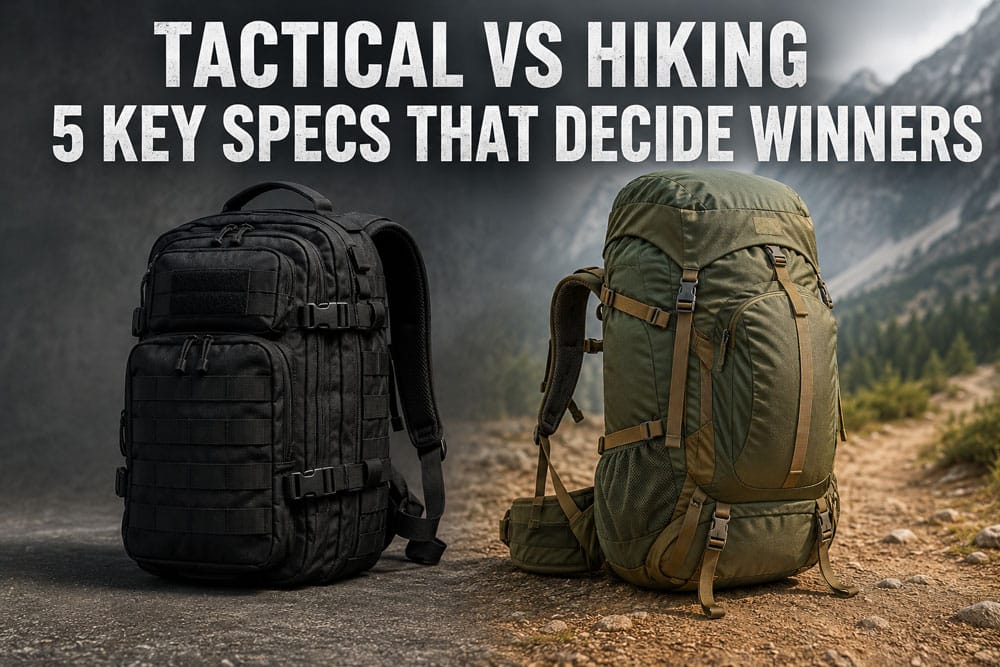
What’s the actual point of a tactical pack versus a hiking pack?
Hiking packs are generally built to optimize one variable, which is grams per liter on a route you already know. Tactical packs, though, are built to be reconfigured under stress. That means PALS webbing, hydration ports, weapon retention, and a 500D minimum for abrasion resistance.
So really, the full history and evolution of tactical backpack design is essentially a story of trading 15,approximately 20% extra base weight in exchange for flexibility during a mission.
Key Takeaways and What to Look for in a Modern Tactical Pack
Short answer: We learned three rules from two thousand years of designs that didn’t work. For a modern tactical pack to work right, it must transfer more than 60% of the weight to your hips.
It also needs to use an open modular system, like PALS or MOLLE. And the fabric should be at least 1,000 denier thick without weighing more than 2 ounces per square yard.
Everything else, things like color, brand patches, or tacticool zippers, is basically just aesthetic noise.
The Three Historically-Proven Buying Criteria
Hip-belt load transfer. The Roman sarcina, the Napoleonic knapsack, and the M-1910 haversack all failed for the same reason. The weight hung off the shoulders. So, you test it. Press on the hip belt when the pack is loaded. If your trapezius muscles are still doing most of the work, walk away. A real belt will have internal stays made of HDPE or aluminum. It should wrap around your iliac crest, which is the top ridge of your hip bone, not just your waist.
Open modular attachment. You should look for genuine 1-inch PALS webbing. It needs to be spaced at 1-inch intervals with 1.5-inch bartack stitches. This is the original standard from the DLA MOLLE specification. Proprietary clip systems are a problem. They lock you into one brand’s pouches, and those systems die when the brand decides to change direction. Open standards have survived for 30 years, and there’s a reason for that.
Weight-to-tear ratio. You need to compare the denier, which is the fabric thickness, against the grams per square meter. For example, 500D Cordura at about 6.5 oz/yd² actually beats 1000D polyester at approximately 9 oz/yd² for most uses. You should ask for the specification sheet. If the seller can’t produce one, then the fabric is probably generic.
When you look at the full history and evolution of tactical backpack design, it’s essentially a checklist of what to reject. You reject cotton duck. You reject shoulder-only suspension. You reject closed proprietary attachment. And you reject decorative webbing that isn’t actually load-rated.
Your next step: Pull out whatever pack you own right now. Score it against the three criteria I just gave you. If it fails two out of three, then the upgrade is worth the money. Historically, it always has been.








Comments are closed