What Is a Plate Carrier and How It Differs From a Vest
A plate carrier is a modular load-bearing vest designed to hold hard ballistic plates (typically 10″x12″ SAPI-cut) that stop rifle rounds — not a bulletproof vest itself. The distinction matters because soft armor vests stop handgun rounds up to around NIJ Level IIIA, while a plate carrier paired with Level III or IV plates stops 7.62x51mm and even armor-piercing rifle threats. If you’ve ever wondered what is a plate carrier and why operators, SWAT teams, and civilian shooters choose it over a traditional vest, the answer comes down to threat level, modularity, and weight distribution.
This guide breaks down the anatomy, the real-world differences from soft armor, fitment mistakes I’ve personally made, and how to pick your first carrier without wasting $400.
A plate carrier is a modular torso-worn platform built to hold hard or soft ballistic plates in front, rear, and optional side pockets. The carrier itself stops nothing — it is a delivery system for the plates that do the actual stopping. Think of it as a backpack engineered specifically for body armor: straps, cummerbund, and plate pockets sized to military standard cuts like SAPI, Shooter’s Cut, or Swimmer’s Cut.
This distinction matters because new buyers constantly confuse the carrier with the armor. The nylon shell is typically 500D or 1000D Cordura — tough enough to resist abrasion, but a 9mm round will pass through it like a grocery bag. Protection comes exclusively from what you load inside: Level III steel or polyethylene plates (rated against rifle rounds per NIJ Standard 0101.06), or Level IIIA soft panels for pistol threats.
So when someone asks “What is a plate carrier?” the accurate answer has two parts: a load-bearing garment and the specific plates you choose to insert. I’ve fitted carriers for range students who showed up with a $180 shell and no plates — they were wearing, functionally, a heavy fishing vest. Empty carriers run 2–4 lbs; add two Level IV ceramic plates and you’re suddenly carrying 14–18 lbs on your torso.
The rest of this guide unpacks how that structural choice — modular platform plus swappable armor — separates plate carriers from traditional concealable vests, and why that matters for fit, mission, and cost.
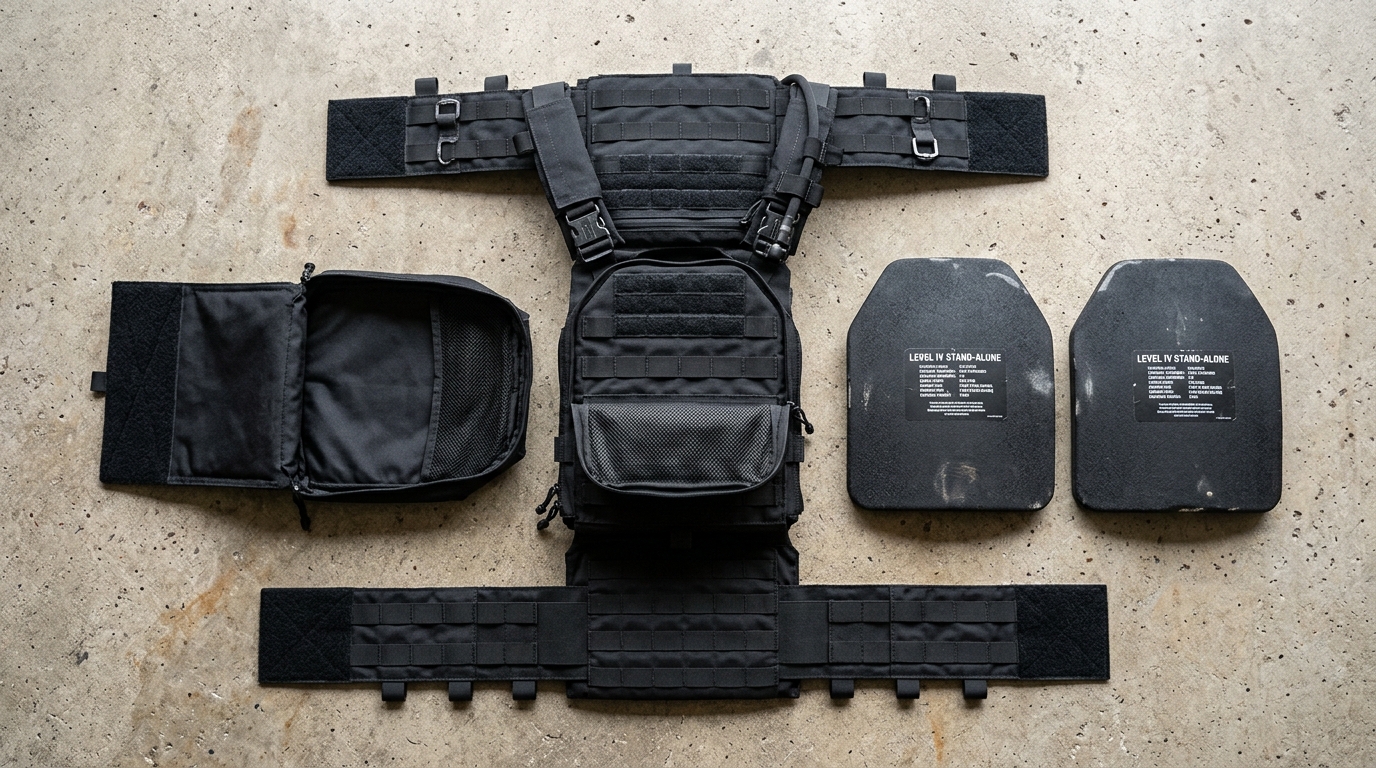
What is a plate carrier shown disassembled with ballistic plates
Plate Carrier vs Bulletproof Vest — The Real Structural Difference
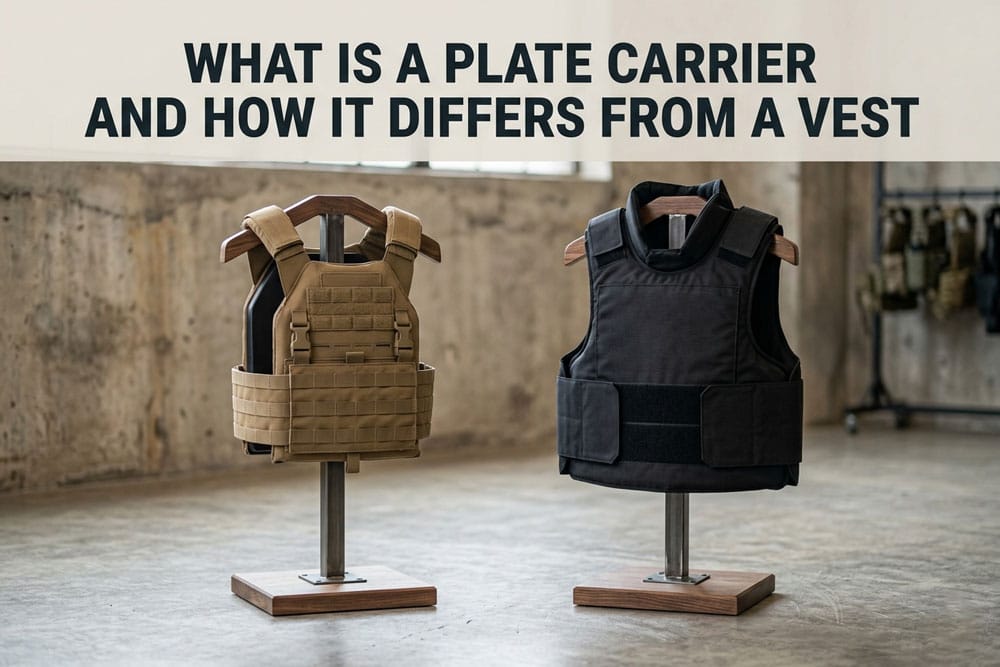
Short answer: a bulletproof vest has soft ballistic panels sewn permanently inside and stops handgun rounds. A plate carrier is an empty shell that holds removable hard plates rated to stop rifle rounds. Different construction, different threats, different weight class.
The confusion is fair — both wrap around your torso and both are “body armor.” But the protection source is fundamentally different. A soft armor vest relies on woven aramid (Kevlar) or UHMWPE (Dyneema) fibers that catch and deform a bullet across a wide area. These panels are stitched into fabric carriers and usually certified to NIJ Standard 0101.06 at Levels IIA, II, or IIIA — meaning they reliably stop 9mm, .40 S&W, and .44 Magnum handgun rounds, but not rifle fire.
A plate carrier, by contrast, is a load-bearing chassis. The ballistic protection comes from hard plates — ceramic composite, UHMWPE, or steel — that you slide into front and rear pockets. Rated NIJ Level III (stops 7.62x51mm M80 ball) or Level IV (stops .30-06 M2 AP armor-piercing), these plates are what allow a carrier to defeat rifle threats an aramid vest cannot.
I’ve worn both in day-long training blocks. A concealable IIIA vest disappears under a polo at roughly 5–6 lbs. A Level IV plate carrier with side plates and a cummerbund hits 18–22 lbs and announces itself from 30 feet away.
Feature
Soft Armor Vest (IIIA)
Plate Carrier (III/IV)
Protection source
Sewn-in aramid/UHMWPE panels
Removable hard plates
Threat rating
Handgun up to .44 Mag
Rifle — 7.62 NATO / .30-06 AP
Typical weight
5–7 lbs
15–25 lbs loaded
Concealability
High — under a shirt
Low — overt wear
Typical cost (US)
$400–$900
$200 carrier + $300–$800 plates
So when someone asks “what is a plate carrier?” — the cleanest framing is: it’s the rifle-rated answer to a handgun-rated vest.
How a Plate Carrier Works With Ballistic Plates
A plate carrier does nothing on its own — it’s the ballistic plate inside that stops the round. The carrier’s job is to hold that plate flat against your chest and back with enough tension to keep it there when you sprint, fall, or take a hit. Think of it as a rifle-rated delivery system: the plate defeats the projectile, the carrier positions it over your heart, lungs, and spine.
How Different Plate Materials Stop Bullets
Each plate material defeats rifle rounds through a different failure mode. Ceramic plates (typically alumina, silicon carbide, or boron carbide backed with Spectra or Dyneema) shatter the bullet’s hardened core on impact, dispersing energy across the ceramic strike face — effective but single-shot in a localized area. Steel (AR500/AR550) deflects and deforms rounds but creates spalling fragments, which is why a spall coating is non-negotiable. UHMWPE polyethylene plates catch and decelerate the round through layered fiber stretching, running as light as 3.3 lbs for a 10×12 Level III plate. Composite plates combine a ceramic strike face with a poly backer to get the best of both.
The NIJ 0101.06 standard caps allowable backface deformation at 44mm in clay — meaning even a “stopped” round can transfer enough energy to crack ribs or bruise a lung.
Plate Placement, Standoff, and Trauma Pads
Ask any instructor what is a plate carrier’s most overlooked feature and you’ll hear the same answer: plate positioning. The front plate’s top edge should sit at the jugular notch (the dip between your collarbones), covering the heart and upper lungs without riding into your throat when you shoulder a rifle. I ran a carrier two inches too low for a week during a carbine course and ended up with a bruised sternum from mag pouches digging in every time I went prone — lesson learned.
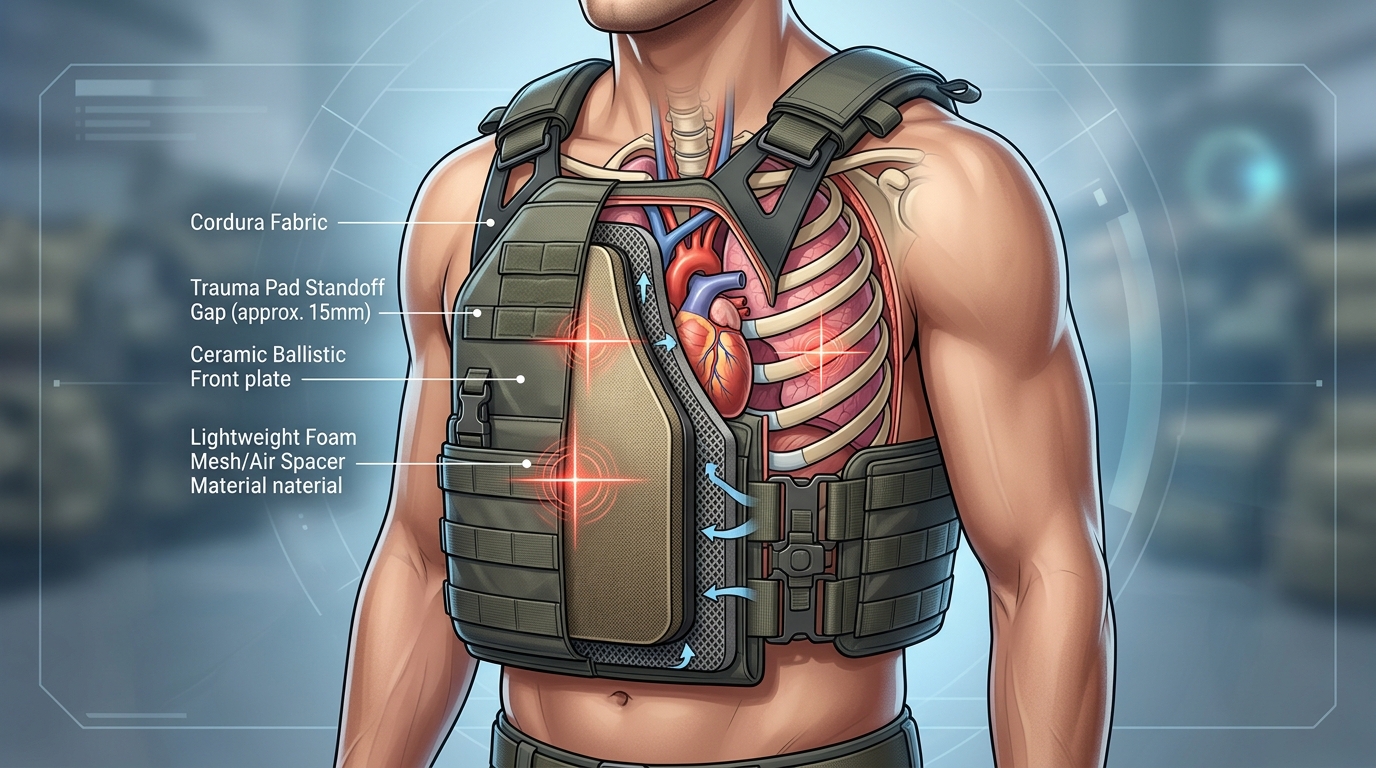
Side plates (usually 6×6 or 6×8) cover the cardiac box from oblique angles and matter most for vehicle crews and breachers. Standoff — the small air gap between plate and body created by a trauma pad — reduces behind-armor blunt trauma by roughly 20–30% on ceramic plates by giving the backface room to deform. Skip the pad to save weight and you trade grams for cracked ribs.
How a plate carrier works with ballistic plates showing plate placement and trauma pad standoff
Anatomy of a Plate Carrier — MOLLE, Cummerbund, and Plate Pockets
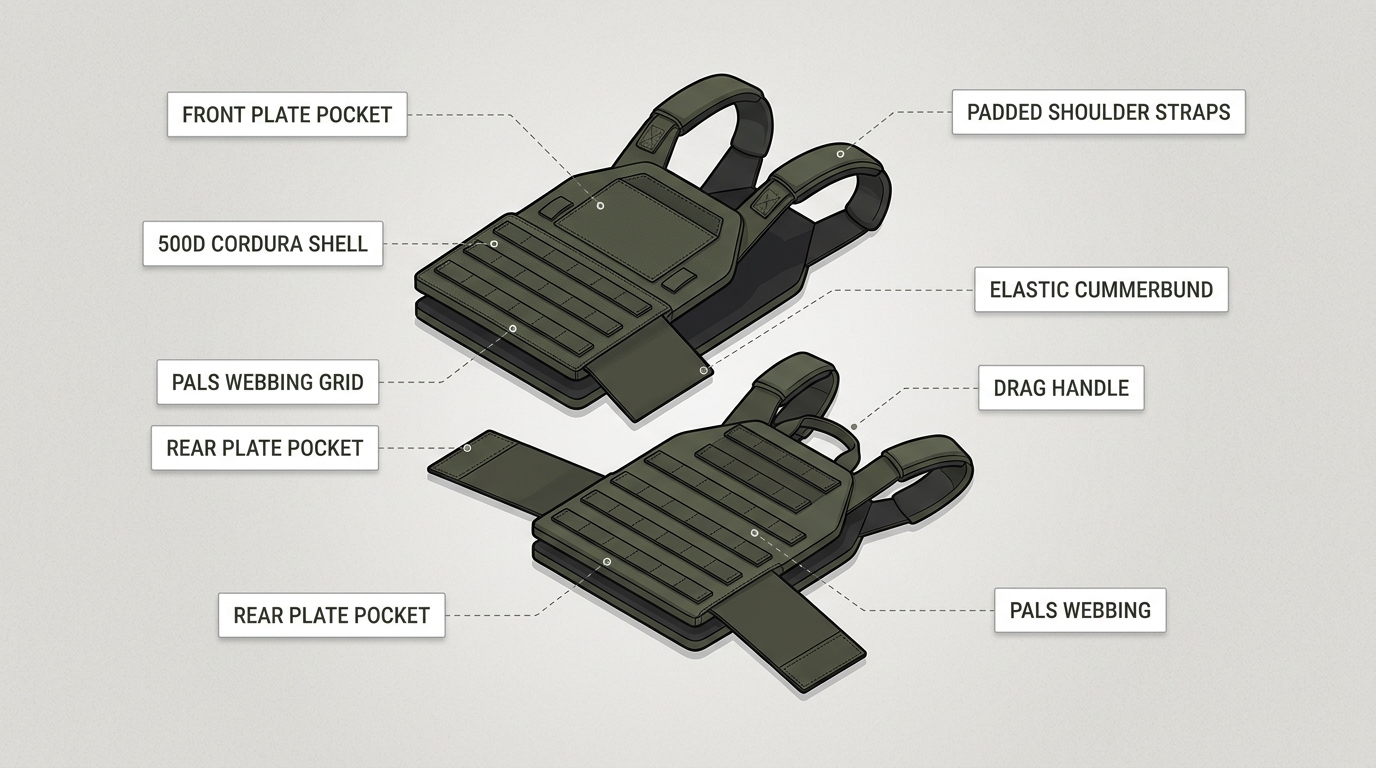
Strip any plate carrier down and you’ll find six core components: the outer shell, front and back plate bags, a cummerbund, shoulder straps, PALS/MOLLE webbing, and a drag handle. The difference between an $80 airsoft clone and a $500 LBT or Crye JPC 2.0 isn’t the layout — it’s the stitching, materials, and tolerances.
Shell Fabric: 500D vs 1000D Cordura
Most quality carriers use Cordura nylon, rated by denier (thread thickness). 500D is lighter and dominates modern minimalist carriers like the Crye JPC. 1000D is roughly 40% heavier but far more abrasion-resistant — the traditional choice for SWAT and patrol carriers that live in vehicle trunks. Budget carriers often use untreated 600D polyester that frays within months.
PALS/MOLLE Webbing
PALS (Pouch Attachment Ladder System) is the grid of 1-inch nylon webbing stitched in rows spaced 1 inch apart, with 1.5-inch bar tacks every 1.5 inches horizontally. This is a US Army Natick-developed standard, and genuine MOLLE-compatible pouches bolt onto it predictably. I tested a $90 Amazon carrier last year where the webbing pulled loose after four magazine reloads — the bar tacks were sewn with 3 stitches instead of the spec’d 8.
Cummerbund, Straps, and Drag Handle
Elastic cummerbund: stretchy, low-profile, faster to don — standard on skirmish-style carriers.
Laser-cut rigid cummerbund: holds side plates and heavy mag pouches without sag; adds ~$80 to cost.
Shoulder straps: look for 3D spacer mesh padding; thin foam causes hot-spot pain after 2 hours under a 25 lb loadout.
Drag handle: bar-tacked across the upper back, rated to pull a 250 lb casualty — skip carriers that lack one.
So what is a plate carrier in hardware terms? A stitched Cordura skeleton whose quality lives in details you only notice when it fails under load.
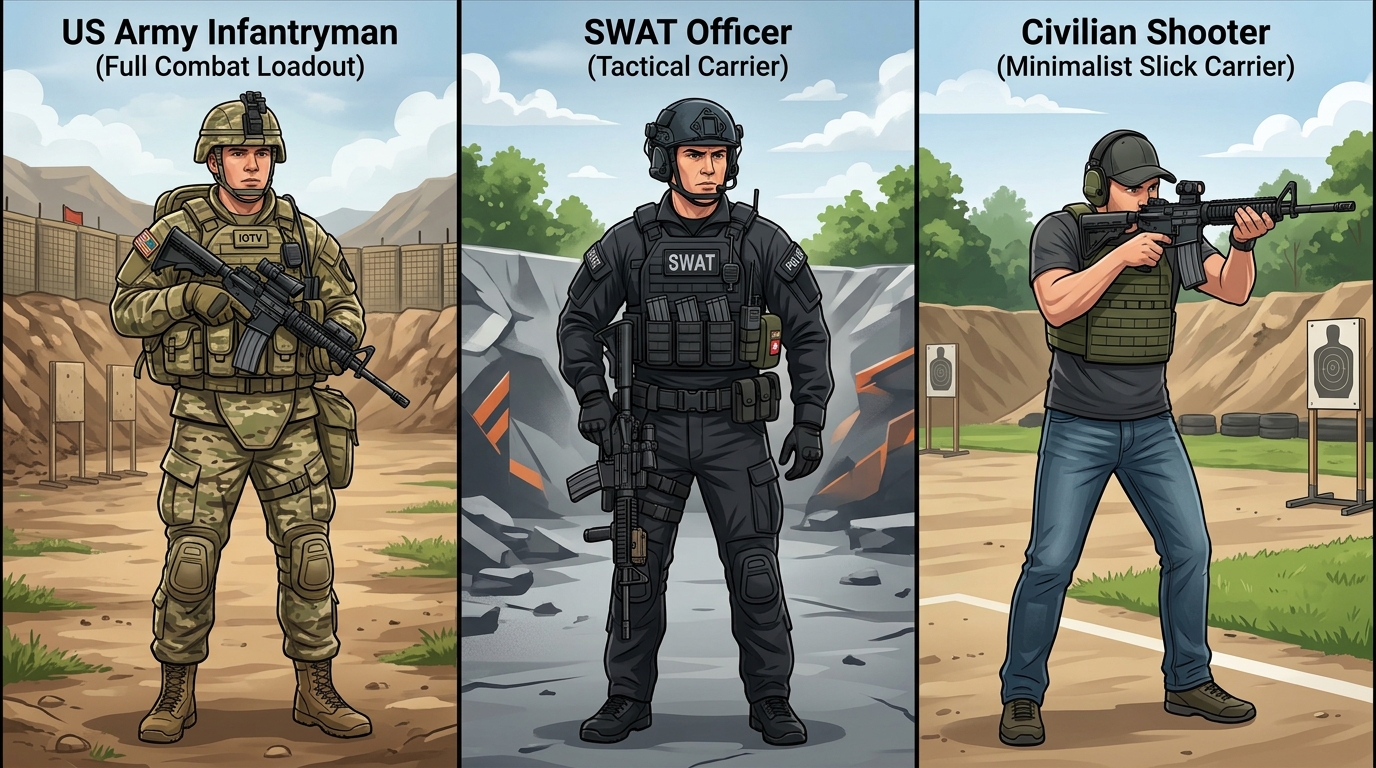
Three groups dominate plate carrier use: military, law enforcement, and civilians. Each runs a radically different setup because their threat profile and mission dictate the build. Understanding what is a plate carrier optimized for each role explains why the same platform can weigh 8 pounds on one user and 45 pounds on another.
Military Infantry and SOF — Full Combat Loadouts
A US Army rifleman typically runs Level IV ESAPI front and back plates plus ESBI side plates, with a cummerbund loaded with 6–8 rifle mag pouches, frag and smoke grenades, an IFAK, radio, and hydration. Total loaded weight: 35–50 lbs. SOF operators on direct action missions push past 60 lbs once NODs, breaching tools, and comms batteries are added. The Enhanced Small Arms Protective Insert program standardized this setup across conventional forces after 2005.
Law Enforcement — Patrol and SWAT
Patrol officers increasingly wear slick or low-vis carriers over uniforms, often with a single Level III+ plate in the front pocket for active-shooter response kept in the trunk. SWAT runs closer to a military loadout — Level IV plates, breaching gear, flashbangs, and a dedicated radio channel panel. After the 2016 Dallas ambush, departments like LAPD issued roughly 4,000 patrol rifle-rated plates to frontline officers.
Civilians — Home Defense, Training, and Competition
Civilian ownership of plate carriers is federally legal in the US for non-felons under 18 U.S.C. § 931, with Connecticut being the primary state requiring in-person purchase. Most civilian users run minimalist setups: one plate, one mag pouch, IFAK — total weight under 15 lbs. I ran a stripped Ferro Concepts Slickster with a single 6.5 lb Level IV plate through a 2-day carbine course and finished with zero chafing, something my buddy in a 28 lb loaded rig couldn’t say. The common misconception — that body armor is illegal or “only for criminals” — is wrong in 49 states.
Who uses a plate carrier — military, law enforcement, and civilian setups compared
Common Mistakes First-Time Buyers Make
The shortcut answer: most first-time buyers shop the carrier before the plates, pick the wrong plate cut, overload the MOLLE, grab steel for the price, and ignore NIJ certification. Each of those decisions quietly wrecks either fit, mobility, or actual protection.
Buying the carrier before sizing the plates
So you ask what is a plate carrier good for if the plates don’t fit? Nothing. Plate size is dictated by your torso — measured from the sternal notch to roughly two fingers above the navel, most shooters land on a 10×12 medium SAPI. Fix: measure first, buy plates, then match a carrier rated for that exact cut.
Mismatching plate cut to pocket geometry
SAPI, Shooter, and Swimmer cuts are not interchangeable. A Swimmer-cut plate (aggressive shoulder bevel) rattles inside a SAPI pocket; a full SAPI won’t seat in a Shooter-cut carrier without bulging. Fix: confirm the carrier spec sheet lists your exact cut — don’t assume “10×12” covers it.
Overloading the MOLLE until you can’t move
I ran a loaded carrier at 34 lbs through a 300-meter movement drill and my split times dropped by almost 40% versus a 22 lb fighting load. Peer-reviewed load-carriage research shows mobility and marksmanship degrade sharply past roughly 30% of bodyweight. Fix: front = mags, side = admin/IFAK, back = hydration. Nothing “just in case.”
Choosing steel plates for the price
AR500 steel runs cheap — often under $90 a pair — but it’s heavy (~8 lbs each) and spalls. A 5.56 round can fragment sideways into your jaw. Build-up coatings help but add weight and still don’t match ceramic or UHMWPE performance. Fix: budget for Level III+ ceramic or polyethylene; if steel is the only option, mandatory anti-spall coating plus a trauma pad.
Ignoring NIJ certification
“Level III rated” and “NIJ Level III certified” are not the same sentence. Only plates listed on the NIJ Compliant Products List have passed independent ballistic testing. Fix: verify the model number on the CPL before checkout — not the marketing page.
How to Choose and Fit Your First Plate Carrier
Buy the plates first, then the carrier. Measure your torso from the suprasternal notch (the dip at the top of your sternum) to roughly two inches above your navel — that distance dictates plate size. Around 80% of adult males fit a 10×12 Medium SAPI cut; shorter torsos or smaller frames should look at 8×10 or Small SAPI. Match the carrier to that plate size, not the other way around.
Match the carrier style to a real use case
Minimalist / slick carrier ($100–$200): range training, concealment under a jacket, fitness rucking. No cummerbund pouches, no MOLLE overload.
Full-featured / operator cut ($250–$500): home defense kit, multi-day courses, duty use. Padded shoulders, adjustable cummerbund, side plate pockets.
Plate-and-go chest rig hybrid ($200–$350): if you already run a chest rig, look at carriers with integrated placard systems like the Spiritus LV-119 or Crye JPC 2.0.
Set a realistic budget
Floor for a Level IV setup: roughly $150 carrier + $200–$500 for a pair of stand-alone ceramic plates. NIJ-certified Level IV plates under $100 each are almost always mislabeled or expired — check the NIJ compliant products list before buying. A $600 total budget is the honest entry point; anything under $400 means a compromise somewhere.
Fitting it correctly
Once loaded, the front plate should cover from the suprasternal notch down to the navel — not lower. I tested this on a three-day carbine course last spring: plates worn two inches too low pinched my diaphragm during prone shooting and cost me about 15% on my shot timer. Shoulder straps should allow you to slide two fingers underneath, and the cummerbund should sit snug at the bottom of the ribcage without riding up when you raise a rifle. If you can’t perform a full shoulder roll or shoulder a long gun cleanly, the carrier is too tight or the plates are too large.
So what is a plate carrier worth to you? Answer that first — duty, training, or emergency — and the specs fall into place.
Frequently Asked Questions About Plate Carriers
Quick answers to the five questions buyers ask me most. What is a plate carrier good for if you still have these gaps? Each answer below pulls from NIJ standard 0101.06/0101.07 and manufacturer specs, not forum folklore.
Are plate carriers legal for civilians?
Yes, in 49 U.S. states for non-felons. Connecticut requires face-to-face purchase. Federal law (18 U.S.C. § 931) only prohibits possession by those convicted of a violent felony. Check your state statute before ordering — New York added restrictions in 2022 limiting sales to credentialed professions.
Can a plate carrier stop a rifle round without plates installed?
No. An empty carrier is 1.5 lbs of nylon. It stops nothing. I’ve seen buyers assume the cummerbund offers “some protection” — it doesn’t. Rounds are stopped by the plate, period.
How long do ballistic plates last?
Steel: 20 years. Ceramic: 5–7 years warranty (shorter if dropped — hairline cracks kill ceramic silently). UHMWPE polyethylene: 5–10 years, but heat-sensitive above 150°F. A plate left in a hot trunk all summer is compromised regardless of sticker date.
What’s the real difference between Level III and Level IV?
Level
Stops
Does NOT stop
III
7.62×51mm FMJ (M80 ball), 6 rounds
M855 “green tip,” M2 AP
III+
Level III threats plus M193, M855
Not an NIJ-official tier
IV
.30-06 M2 armor-piercing, single hit
Sustained AP fire (single-hit rated)
How heavy is a fully loaded plate carrier?
Realistic combat load: 18–28 lbs. Two Level IV ceramic plates (~15 lbs), carrier (2 lbs), four rifle mags (4 lbs), IFAK (1.5 lbs), admin pouch and radio (2 lbs). Drop to ~14 lbs with UHMWPE Level III plates — worth the premium if you plan to move fast.
Key Takeaways and Next Steps
So what is a plate carrier, reduced to one sentence? It’s a modular rifle-rated platform you build around hard armor plates — fundamentally different from a bulletproof vest, which is a self-contained soft armor garment rated for handgun threats only. The vest protects you out of the box. The carrier is an empty shell until you load it.
Three priorities decide whether your setup actually works:
Correct plate size and cut — SAPI Medium fits roughly 70% of adult males, but only a torso measurement confirms it. A plate that covers past the navel will jam into your hips the first time you go prone.
NIJ-certified plates — verify the model number on the NIJ Compliant Products List. “NIJ-rated” on a product page means nothing; “NIJ 0101.06 certified, listed” means something. Level III stops 7.62×51 FMJ, Level IV stops .30-06 M2AP.
Proper fit — top edge at the suprasternal notch, bottom edge at the navel, cummerbund snug enough that the carrier doesn’t ride up when you raise a rifle.
Your next four steps, in order:
Measure your torso tonight with a cloth tape — suprasternal notch to navel, and chest circumference at the nipple line.
Define your threat model honestly. Home defense against handgun threats? Level IIIA soft armor is lighter and cheaper. Rifle threats? You need hard plates, which means a carrier.
Shortlist plates first from established manufacturers — Hesco, RMA Defense, Highcom, Velocity Systems — and confirm the exact SKU is NIJ-listed.
Match the carrier to the plate cut (SAPI, Swimmer, Shooter) from makers like Crye Precision, Ferro Concepts, Spiritus Systems, or LBT. Budget roughly $200–$450 for a quality carrier and $300–$900 per plate pair.
Buy once, fit carefully, train in the kit. A plate carrier you never wear protects nothing.







Comments are closed