


How to Carry Trekking Poles on a Running Vest
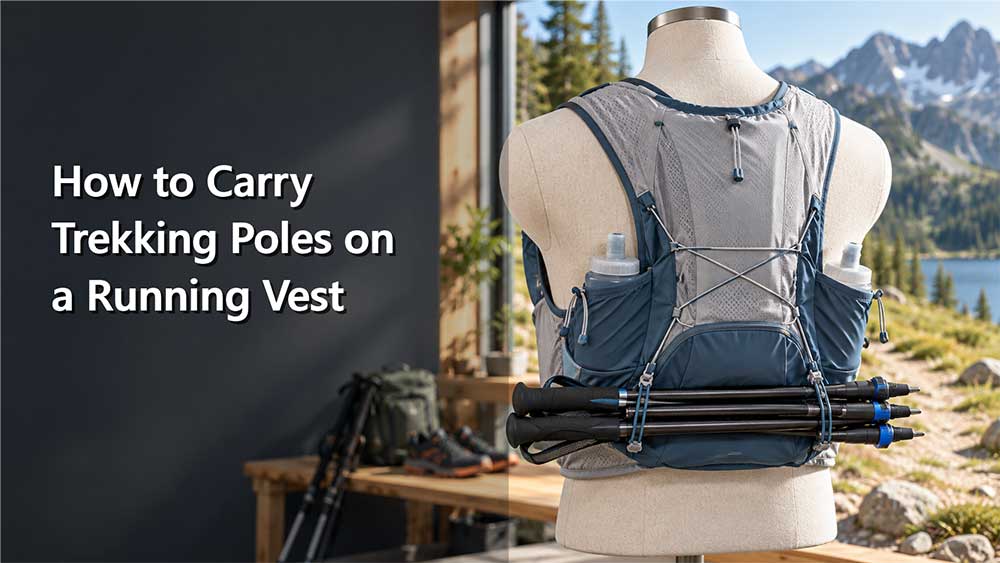
To carry trekking poles on a running vest, fold or collapse them and secure them using the vest’s designated pole attachments or a compatible pole quiver. Check that the poles stay in place without blocking your arm swing, bottles, or pockets.
Here, “running vest” means a trail-running hydration vest. Some carry poles across the lower back, some hold them at the front or sides, and others accept a separate quiver. The right method starts with the attachment system on your vest.
Check Your Vest’s Pole-Carrying System First
Look up the instructions for your exact vest model and version. A cord that holds a bottle or closes a pocket can look like a pole loop, but it may have a different purpose.
Check for:
- Dedicated trekking pole attachments, such as the loops, pockets, or retaining cords identified in your vest’s instructions.
- Connection points for a compatible pole quiver.
- Diagrams showing whether the poles are carried together or separately.
- Limits on pole type or packed dimensions.
- Removable cords or hardware supplied with the vest.
If the attachment points are unclear, a model-specific diagram or video is more useful than guessing how the elastic cords should work.
Choose Between Built-In Attachments and a Pole Quiver
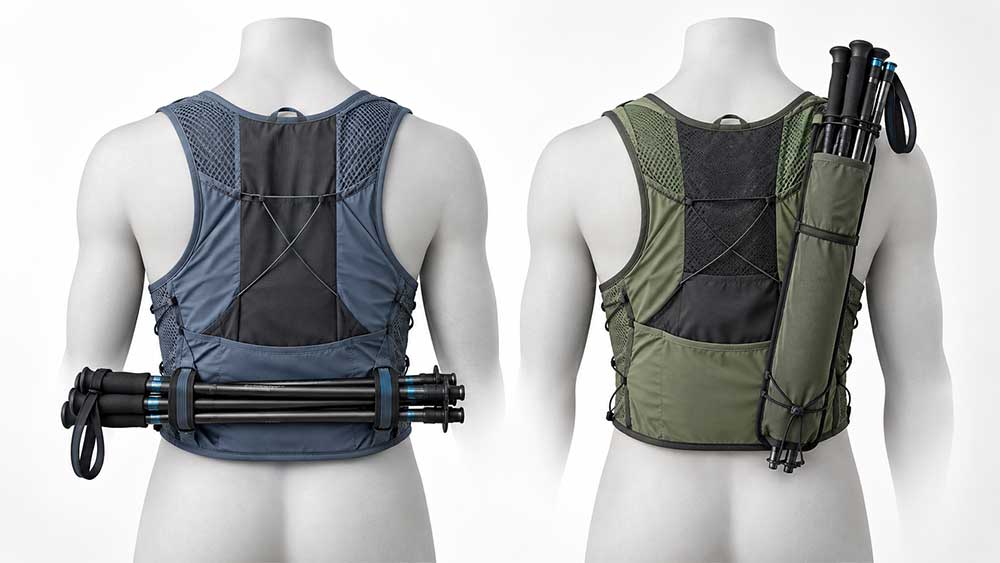
Use a method your vest supports, then test whether it works with your normal load.
| Carry method | How it works | What to check |
|---|---|---|
| Front carry | Poles attach to designated points on the front | Clearance around your face, arm swing, bottles, and chest pockets |
| Rear horizontal carry | Folded poles sit across rear attachments | Sideways protrusion, secure retention, and access |
| Rear or side vertical/diagonal carry | Poles follow the vest’s intended storage route | Head and hip clearance, movement, and reach |
| Pole quiver | A separate carrier connects to compatible attachment points | Pole fit, carrier stability, closure, and access |
A pole quiver is a carrying pouch, often positioned behind a shoulder. It can be convenient when you frequently switch between using and storing your poles, provided you can reach the opening comfortably.
Built-in attachments may be enough when you expect to leave the poles stored for a longer section. Neither option is automatically more stable; the fit and retention system matter more than the category.
If pole storage is one reason you are considering a vest, our guide to whether hydration vests are worth it helps you weigh it alongside your other carrying needs.
Check the Poles’ Packed Size
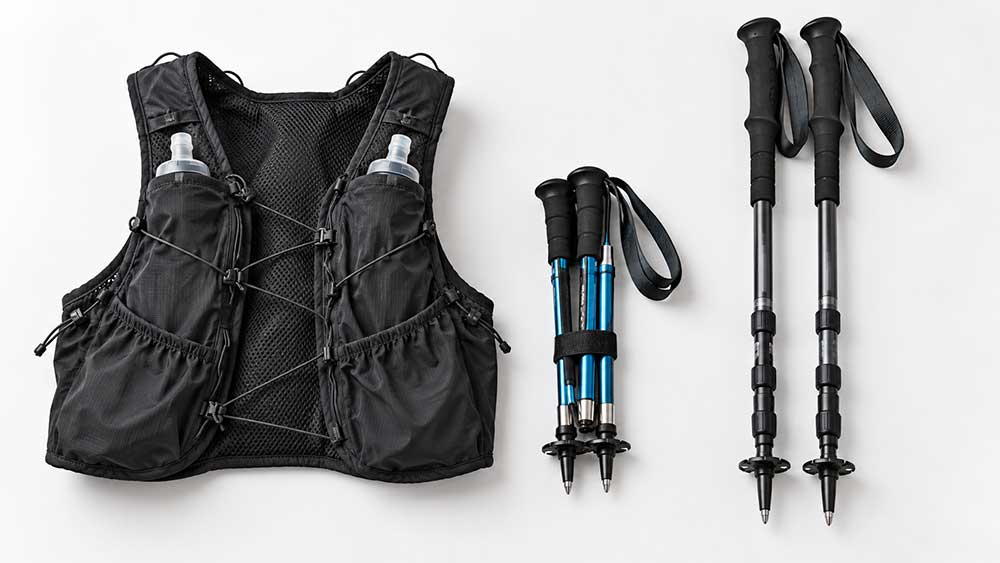
Measure the poles in their stored position rather than relying on their extended length.
Folding poles separate into connected sections. Telescoping poles shorten by sliding sections inside one another. Some designs combine both features. Check the packed length and the widest part of the bundle, including grips and baskets.
Even different sizes of the same model can require different amounts of storage space. For example, the listed specifications for Black Diamond Distance Carbon Z poles give these measurements:
| Pole length when assembled | Listed collapsed length |
|---|---|
| 110 cm | 37 cm / approximately 14.6 in |
| 120 cm | 40 cm / approximately 15.7 in |
| 130 cm | 44 cm / approximately 17.3 in |
These are specifications for that particular listing, with inches converted from the centimeter measurements. They are not universal dimensions for folding poles or a guarantee of vest compatibility.
Compare your own poles with the carrier’s requirements. A large basket or bulky grip can prevent proper seating even when the packed length appears suitable.
How to Secure Poles Using Built-In Attachments
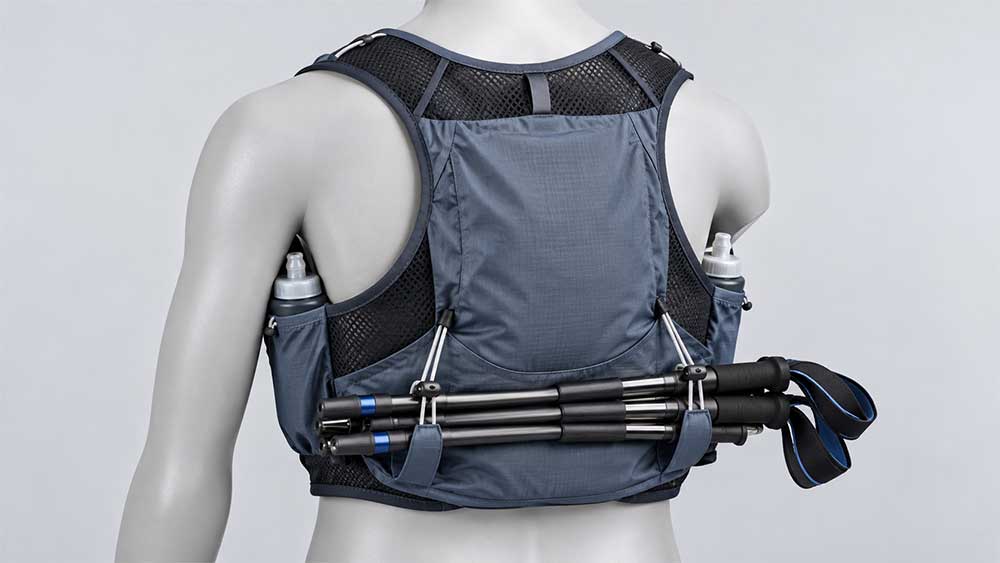
Cord routing and pole orientation vary, so keep your vest’s diagram nearby during the first setup.
1. Fold or collapse the poles
Use the pole maker’s procedure. Keep folded sections together with the supplied retainer, if provided, and gather loose wrist straps so they cannot catch on the vest.
Do not force sections to bend or shorten beyond their intended range.
2. Seat the poles in the designated holders
Place the poles into the pockets or loops shown in the instructions. Some systems carry both together; others hold one on each side.
Use the specified orientation. Grips-up or tips-down is not a universal rule.
3. Fasten every required retainer
If the design uses a lower support and a separate upper cord, use both. The lower attachment may support the bundle while the upper one limits rotation or outward movement.
Take up slack until the poles are held firmly without deforming the vest or putting excessive pressure on the shafts. Gently move the bundle to check that the cord locks hold.
4. Check your movement and access
Put the loaded vest on. Swing your arms, turn your head, bend forward, and reach for your bottles and pockets.
If a pole hits your arm or blocks a bottle, adjust its position within the system’s intended layout. If that does not help, try another supported carrying position.
How to Carry Poles in a Compatible Quiver
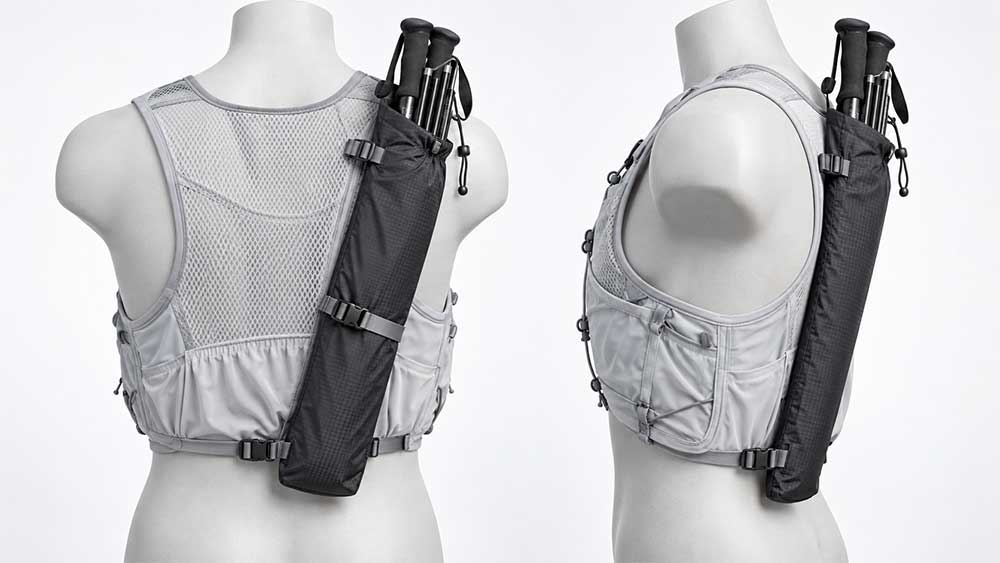
Confirm that the quiver fits your vest’s model and version before buying it. A hook fitting through a loop does not establish that the complete attachment will work.
To set it up:
- Connect every required attachment point. Use the side and orientation shown in the instructions.
- Adjust with the vest loaded. Water, food, and clothing can change where the carrier rests.
- Insert the poles as directed. Check that grips, baskets, and folded sections do not prevent proper seating.
- Secure the closure. Tighten the supplied retaining cord or engage the other retention mechanism.
- Check reach and stability. Retrieve the poles, put them back, and confirm that the loaded carrier stays close to the vest.
Some quivers leave part of the pole bundle exposed. The poles should sit securely in the carrier without sliding out or swinging as you move.
If you cannot comfortably reach the opening, take the vest off to load it. You do not need to master stowing poles while running for the system to be useful.
Check for Bounce, Slipping, and Blocked Access
Test with the water, food, and clothing you normally carry. Walk first, then try an easy jog on familiar ground.
| Problem | First thing to check |
|---|---|
| Poles slide downward | Seating position, required retainers, and bundle fit |
| The bundle swings outward | A missed connection or excessive cord slack |
| Poles hit your arms or hips | Carrying position and packed length |
| A quiver rocks against your back | Attachment points and adjustment |
| Bottles or pockets become difficult to use | Interference from grips, cords, or the carrier |
| The whole vest bounces | Vest fit and overall load placement |
Fix loose pole attachments before pulling the chest cords tighter. A tighter vest will not secure poles that are moving inside their holders.
If the whole vest moves, our hydration backpack bounce guide explains how to distinguish harness movement from loose equipment.
Recheck the setup after taking out a jacket, refilling, or rearranging your gear.
What If Your Vest Has No Pole Attachments?
Check whether the manufacturer offers a compatible accessory kit or quiver. An add-on may require specific loops or reinforced attachment points.
Do not improvise by loading unsupported mesh, bottle-retention cords, or chest closures unless the manufacturer identifies them for that use.
If there is no compatible option, a purpose-designed pole belt or another vest may be more practical. For larger equipment loads, our hydration vest vs. hydration pack comparison explains the broader carrying differences.
Practice Taking the Poles Out and Putting Them Away
Practice with the vest loaded. Notice whether wrist straps catch on cords and whether you can refasten every retainer after putting the poles back.
Start while standing still. If you progress to walking practice, choose clear, level ground. Stop when terrain or nearby runners make the movement awkward.
Once stored, the poles should leave your arms free and your supplies accessible. If retrieval requires excessive twisting or repeated attempts, change the adjustment or remove the vest when needed.
Developing a running vest for your outdoor brand? Explore custom hydration pack options from Vancharli Outdoor.
FAQ
Can every running vest carry trekking poles?
No. Check for designated pole attachments or compatibility with an accessory carrier. Pockets and elastic cords alone do not confirm that a vest supports pole storage.
Do you need a pole quiver?
Not necessarily. Built-in attachments may suit your poles and routine. A compatible quiver is worth considering if you frequently stow and retrieve poles and can reach its opening comfortably.
Can you carry telescoping poles instead of folding poles?
Possibly. Check their collapsed length, bundle thickness, and the carrier’s requirements. Telescoping poles may remain too long for a particular system even when fully shortened.
Should the pole tips face up or down?
Follow the instructions for the vest or quiver. The correct orientation varies. Keep exposed tips away from your body and nearby runners, and use compatible protective caps where appropriate.
Can you attach a quiver from another brand?
Only if the attachment system is compatible. Check the required hooks, loops, spacing, and supporting connections. One hook being able to attach is not enough to confirm a secure fit.
Is it better to carry poles at the front or back?
Choose a position your vest supports and that works with your equipment. Front carry needs clearance around bottles and arm swing; rear carry needs secure retention and a retrieval method you can manage.
Can you put poles away without taking off the vest?
Some systems allow it, but reach and ease of use vary. Practice with your loaded vest first. If you cannot secure the poles comfortably, stop and take the vest off.





Comments are closed