What Size Fanny Pack Do I Need? Capacity & Dimensions
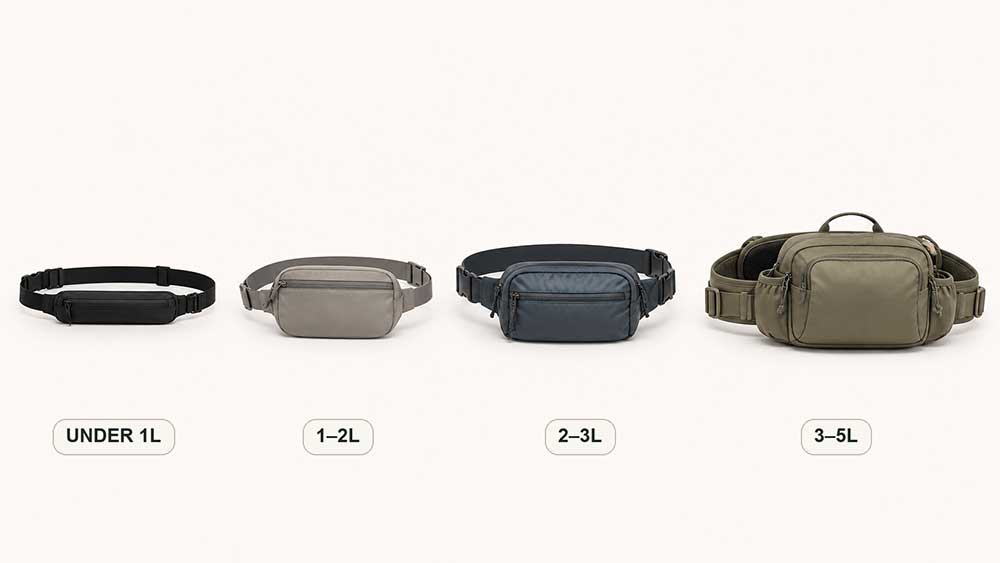
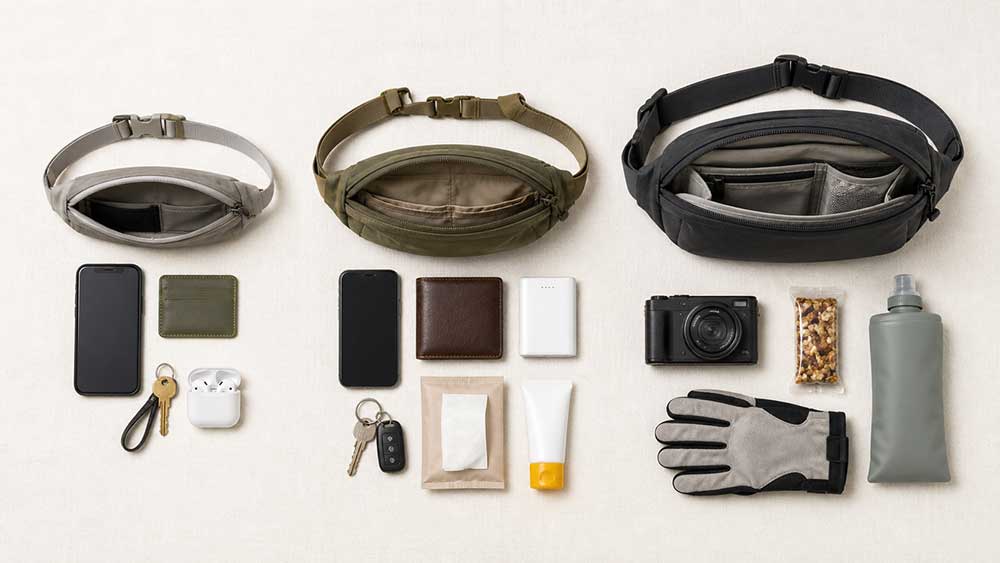
For most people, a 1–2L fanny pack is a practical starting point. It can usually hold a phone, wallet or cardholder, keys, earbuds, and a few small essentials without feeling unnecessarily bulky.
Choose a pack under 1L if you only need to replace your pockets. Move up to 2–3L for travel documents, a portable charger, sunglasses, and snacks. Packs above 3L are more suitable when you need water, a compact camera, outdoor accessories, or more substantial daily storage.
These are starting points, not universal standards. Two fanny packs with the same listed capacity may hold different items because their shapes, zipper openings, linings, pockets, and internal structures are different.
To choose accurately, check three things together:
Capacity in liters
External and usable internal dimensions
The complete waist or crossbody fit range
If you are unsure, lay out everything you carry most days. Choose the smallest category that holds those items without forcing the zipper closed.
Phone, wallet, keys, earbuds, small power bank or sunscreen
Internal organization and strap range
2–3L
Travel, festivals and longer days out
Daily essentials, passport, charger, sunglasses case and snacks
Packed depth and body comfort
3–5L
Outdoor use and larger personal loads
Compact camera, snacks, small bottle or light accessories
Weight distribution and belt support
Above 5L
Technical hiking, fishing or specialty use
Water, camera equipment, larger outdoor items
Whether a technical lumbar pack would fit better
What fits depends on the product’s shape and the size of your belongings. A rigid sunglasses case or thick phone case may use more space than its volume suggests.
There is no reliable universal conversion between liters and external dimensions. A 2L pack may be wide and slim or short and deep, so use these capacity categories as a starting point rather than a fixed size chart.
What Do Fanny Pack Dimensions Mean?
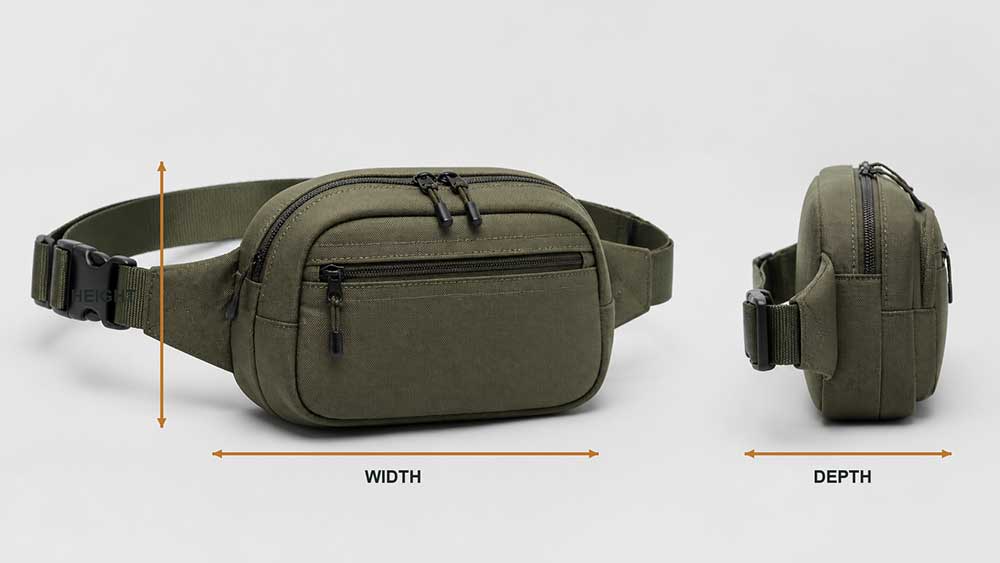
Fanny pack listings commonly show three exterior measurements:
Width
Height
Depth
Brands do not always list measurements in the same order. Check whether the specification uses W × H × D, H × W × D, or another format before comparing two products.
These measurements help you judge the bag’s overall size, but they do not tell you exactly how much usable storage is inside.
Width
Width is usually measured across the front of the bag from one side to the other at its widest point.
A wide bag may fit a large phone horizontally, but only if the zipper opening and internal compartment are also wide enough. Curved side panels and tapered ends can make the usable width smaller than the exterior measurement.
Height
Height is measured from the bottom to the top of the bag.
A taller body can provide space for a passport, wallet, or upright phone. However, a zipper positioned below the top edge may reduce the usable opening height.
Depth
Depth is the distance from the back panel to the front of the bag at its fullest point.
Depth often has a strong effect on capacity, but it also affects how far the loaded pouch projects away from the body. A deep fanny pack may hold more, yet feel bulkier when walking, sitting, bending, or wearing it crossbody.
External Dimensions Are Not Internal Dimensions
Exterior measurements include fabric, seams, piping, foam, lining, and structural panels. The usable interior will normally be smaller.
For example, a rectangular box measuring 25 × 15 × 7 cm has a theoretical volume of 2,625 cubic centimeters, or 2.625L. A soft, curved fanny pack with the same external measurements will not necessarily provide 2.625L of usable capacity.
The following details reduce or redistribute internal space:
Curved or tapered corners
Foam and padding
Thick lining
Internal dividers
Bound seams
Zipper construction
Front and back pockets
Folded or gusseted panels
This is why multiplying exterior dimensions should only be treated as a rough comparison, not an accurate capacity measurement.
How Much Can Different Fanny Pack Sizes Hold?
Under 1L: Minimal Carry
An under-1L pack is intended for a small set of essentials. Depending on the shape, it may hold:
Phone
Slim cardholder
One or two keys
Earbuds
Lip balm
This size works well for running, short walks, concerts, or situations where you want to empty your clothing pockets without carrying a visible bag.
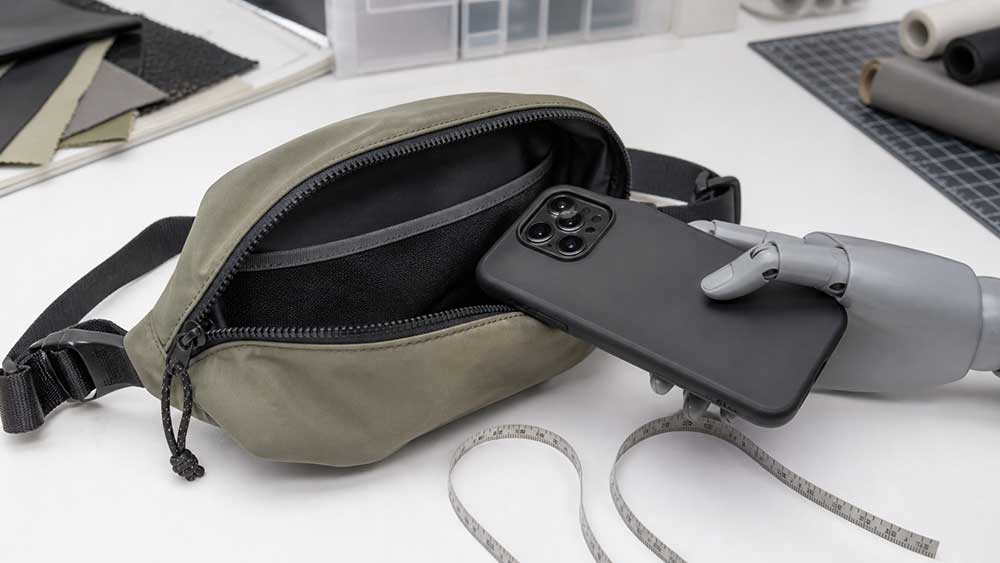
The main risk is phone fit. A pack may have enough theoretical volume but still have a zipper opening that is too short for a large phone with a protective case.
1–2L: Everyday Essentials
A 1–2L fanny pack is a versatile starting point for many users. It may hold:
Phone
Wallet or cardholder
Keys
Earbuds
Small power bank
Tissues
Sunscreen or hand sanitizer
Passport, depending on the internal dimensions
A 1L design tends to sit closer to the body, while a 2L design gives you more flexibility for a longer day out. However, doubling the stated volume does not mean every item becomes twice as easy to pack. Pocket layout and opening size still matter.
2–3L: Travel and All-Day Carry
A 2–3L model works for users who want daily essentials plus a few additional items, such as:
Passport and travel documents
Portable charger and cable
Sunglasses case
Snack
Tissues
Small notebook
Compact personal-care items
This range can work well for airports, sightseeing, festivals, theme parks, and long walks. Check how the bag feels when fully loaded. A deep pouch may become uncomfortable when sitting, while a wide design may fit more closely against the waist.
3–5L: Outdoor or Larger Loads
A 3–5L waist pack may carry:
Daily essentials
Compact camera
Extra snacks
Small water container
Light gloves or accessories
Basic outdoor items
At this size, strap width, back-panel shape, and load distribution become more important. A narrow fashion strap may not support the same load as a wider technical belt.
If you regularly carry water, clothing, food, and outdoor equipment together, a technical hip pack or small backpack may be more comfortable than an oversized general-purpose fanny pack.
Above 5L: Technical Waist Packs
Products above 5L often move beyond the classic fanny pack category. They may include:
Padded hip wings
Compression straps
Bottle holders
Wider waist belts
Structured back panels
Multiple equipment pockets
These designs are useful for hiking, fishing, photography, and specialized outdoor activities. They offer more storage, but they are not automatically better for errands, festivals, or everyday walking.
How Are Fanny Pack Liters Measured?
One liter equals 1,000 cubic centimeters of volume, but measuring the usable capacity of a soft bag is not as simple as filling it with water or multiplying its exterior dimensions.
WIRED’s explanation of bag capacity describes how some brands use small plastic balls to fill enclosed compartments before transferring the balls into a calibrated container. This method accounts for curved and irregular shapes more effectively than a basic width-by-height-by-depth calculation.
ASTM F2153 provides a standardized method for measuring backpacks and related bags, including lumbar packs. However, the standard states that the method cannot practically be used for capacities below 4L.
That limitation matters because many everyday fanny packs fall below 4L. For small products, brands should clearly document how the capacity was estimated or tested instead of presenting a liter figure without a measurement method.
Consumers should treat liters as a useful starting point, then confirm:
Internal usable dimensions
Zipper-opening size
Pocket layout
Reference-item photos
Complete loaded shape
What Size Fanny Pack Fits Your Phone?
Do not compare the bag only with the phone’s advertised screen size. A 6.7-inch screen measurement describes the display diagonal, not the phone’s full length and width.
Measure the phone with its normal case installed:
Measure the full length.
Measure the full width.
Measure the thickness, including raised camera areas.
Compare those measurements with the usable pocket size.
Check the zipper-opening length.
Allow enough space to insert and remove the phone without forcing the zipper.
A bag can be wider than the phone but still fail the fit test if the zipper opening is shorter, curved, or partly blocked by binding.
Also consider what will share the compartment. Keys, a power bank, or a thick wallet may press against the phone even when everything technically fits. A separate phone sleeve or key pocket can improve protection and access.
How to Measure for Waist Wear
The pack body and strap work together, so “strap length” alone may not tell you whether the product fits.
Step 1: Choose the Wearing Position
Decide whether you will wear the bag at:
Natural waist
Upper hips
Lower hips
Front
Side
Back
Measure at the actual position where the strap will sit.
Step 2: Wear Your Normal Clothing
Measure over the clothing you expect to wear. A coat or thick sweatshirt requires a longer fit range than a T-shirt.
Step 3: Measure Around Your Body
Use a soft measuring tape and wrap it around the selected position. Keep it comfortably close without pulling it tight.
Record the circumference and allow room for your preferred fit.
Step 4: Check What the Product Listing Measures
A listing may provide:
Strap-only length
Strap length including the buckle
Complete circumference including the bag body
Minimum and maximum wearable fit
Crossbody strap length
These numbers are not interchangeable. The most useful specification is the complete minimum and maximum wearable circumference, including the bag body and fastening system.
If the listing only gives strap length, ask whether the bag body and buckle are included.
How to Measure for Crossbody Wear
Crossbody fit depends on torso size, preferred bag position, clothing, and attachment-point placement. Height alone alone is not enough.
The easiest method is to use a bag that already fits well:
Wear it in your preferred position.
Adjust it over the clothing you normally use.
Remove it and measure the complete strap path from one attachment point to the other.
Check whether clips or buckles are included.
Compare the result with the new product’s adjustment range.
If you do not have a reference bag, use a piece of non-stretch string or a soft tape measure. Run it from one estimated attachment point, across the torso, over the opposite shoulder, and back to the other side of the bag.
Hold a book, pouch, or piece of cardboard of a similar height where you want the new bag to sit. This helps account for the bag body rather than measuring the strap in isolation.
Choosing a Fanny Pack Size by Activity
Everyday Walking and Errands
A 1–2L model is a practical starting point for a phone, wallet, keys, earbuds, and small personal items.
Choose a slim design if you want the bag to stay close to your body. Move toward 2L if you regularly carry a charger, sunglasses, tissues, or sunscreen.
Travel and Sightseeing
A 2–3L fanny pack provides more flexibility for:
Passport
Wallet
Phone
Charging cable
Portable charger
Sunglasses
Small snacks
Look for separate pockets so you do not have to remove everything to find a passport or card.
Running and Workouts
For running, stability usually matters more than capacity. An under-1L running belt or low-profile waist pack may be enough for a phone, key, card, and energy gel.
A compact 1–2L pack may hold a phone, small wallet, key, and permitted personal items without unnecessary bulk.
Venue rules vary. Check the event’s official bag policy before buying, especially if it limits external dimensions, requires transparent materials, or restricts the number of compartments.
Hiking and Outdoor Use
A 2–3L waist pack may be enough when it is used with a backpack and only needs to hold quick-access essentials.
A 3–5L technical hip pack can work for short outings with a compact camera, snacks, or small water container. For larger loads, choose a design with a wider supportive belt or use a backpack.
Why a Larger Fanny Pack Is Not Always Better
Extra capacity can be useful, but it also creates trade-offs.
A larger fanny pack may:
Encourage overpacking
Pull away from the body
Bounce during movement
Feel bulky when sitting
Trap more heat
Interfere with bending
Require a wider or more supportive strap
Choose the smallest size that comfortably holds your regular items with a little room left for access. A completely full pocket can be difficult to open and may place unnecessary pressure on the zipper.
What Brands Should Include in a Fanny Pack Size Specification
For a custom fanny pack project, “approximately 2L” is not enough information to control sampling and bulk production.
A useful specification should include:
External dimensions with illustrated measurement points and the agreed measuring condition
Internal usable dimensions
Main zipper-opening and individual pocket dimensions
Minimum and maximum wearable circumference
Whether the bag body and buckle are included in the fit range
Strap width and adjustment range
Reference items used for the load test
Agreed dimensional tolerances
Brands should also distinguish between main-compartment capacity, total enclosed capacity, open-pocket capacity, extended capacity, and a marketing estimate.
For products below 4L, a documented project-specific fill method and real-item load test can be more practical than claiming compliance with a capacity standard that is not designed for such small volumes.
The approved sample should be tested with the intended reference items. A pack can meet its external measurements but still fail to fit the specified phone, passport, sunglasses case, or water container because of its zipper opening or internal construction.
Vancharli Outdoor supports custom fanny pack development with adjustable dimensions, capacity, pocket layout, strap range, materials, logo methods, and packaging. Size specifications can be confirmed during sampling before bulk production begins.
Final Answer
Start with a 1–2L fanny pack for everyday essentials. Choose under 1L for a phone, cardholder, keys, and minimal workout carry; 2–3L for travel documents, a charger, sunglasses, and snacks; or 3–5L for a camera, water, and more outdoor gear.
Do not choose by liters alone. The best size is the smallest one that holds your regular items comfortably while still providing a suitable zipper opening, fit range, and loaded shape.
FAQ
Is a 1L Fanny Pack Big Enough?
A 1L fanny pack may be enough for a phone, slim wallet or cardholder, keys, earbuds, and one or two small items. Actual fit depends on the shape, opening, and internal pockets.
Is a 2L Fanny Pack Too Large for Everyday Use?
Usually not. A well-designed 2L pack can still feel compact while providing room for a charger, sunglasses, tissues, or sunscreen. Check its depth and loaded shape, not only the liter figure.
Should the Strap Measurement Include the Bag?
Ideally, the product page should provide the complete minimum and maximum wearable circumference, including the bag body and buckle. If it lists only strap length, confirm exactly what is included.
Can Two Bags With the Same Dimensions Have Different Capacities?
Yes. Shape, curved corners, lining, foam, seams, dividers, and pocket construction can produce different usable capacities even when the exterior measurements look similar.









Comments are closed