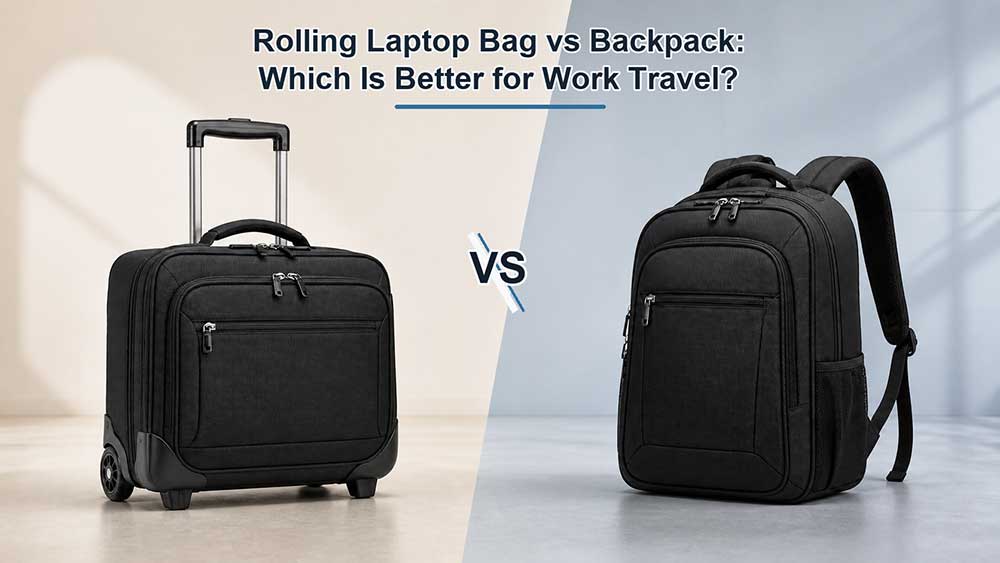
Rolling Laptop Bag vs Backpack: Which Is Better for Work Travel?
A rolling laptop bag is usually better when you carry a heavy laptop, documents, samples, or other work equipment through airports and office buildings with smooth floors. A backpack is usually better when your trip involves stairs, public transportation, crowded streets, or frequent walking.
The practical difference is simple:
Choose a rolling laptop bag when reducing the weight on your shoulders matters most.
Choose a laptop backpack when mobility, hands-free carrying, and moving across different surfaces matter more.
Neither option is better for every business trip. The right choice depends on how much you carry, how you travel, and where you need to take the bag.
Convenient but may become tiring when heavily packed
Stairs
Must usually be lifted
Easy to carry
Public transportation
Can be awkward in crowds
More compact and hands-free
Uneven streets
Wheels may struggle or become noisy
Easier to move across curbs and rough surfaces
Laptop access
Often organized like a mobile office
Depends on the opening and compartment layout
Empty bag weight
Usually heavier
Usually lighter
Underseat use
Less flexible because of wheels and frame
More likely to fit if compact and not overpacked
Professional appearance
Often resembles business luggage or a rolling briefcase
Can look professional when the design is clean and structured
Best suited to
Heavy work loads and airport-based travel
Mixed transportation and mobile work
Why a Rolling Laptop Bag Works Well for Heavy Loads
The main advantage of a rolling laptop bag is that the wheels carry most of the load.
This can make a noticeable difference when the bag contains more than a laptop and charger. Business travelers may also carry paper files, catalogs, samples, a tablet, cables, a power bank, a headset, and personal travel items. A backpack can hold the same equipment, but the full weight stays on the wearer’s shoulders and back.
A rolling bag is especially useful when most of the journey takes place on smooth surfaces, such as:
Airport terminals
Train stations with elevators
Convention centers
Office buildings
Hotels
Paved indoor walkways
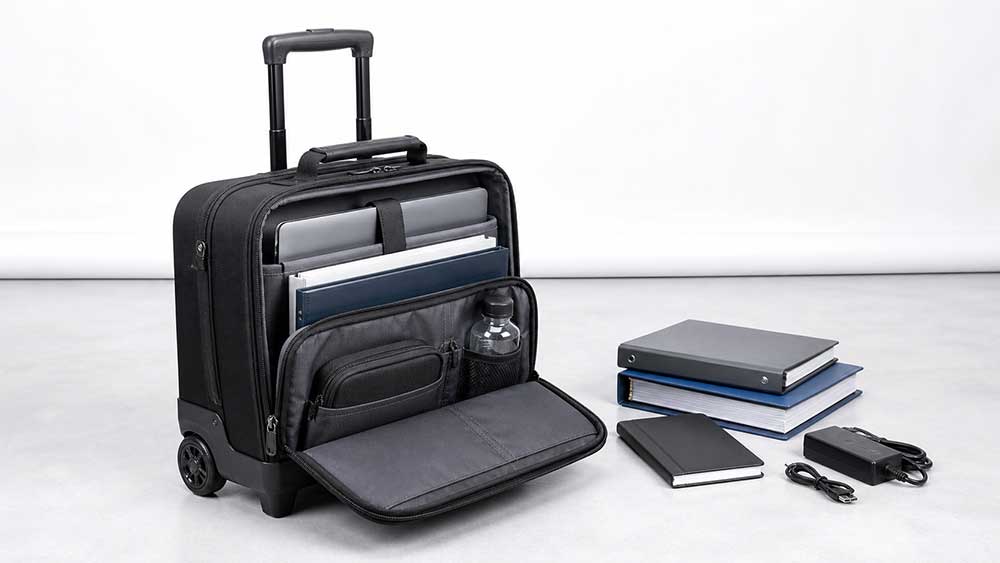
It can also provide a more structured interior. Many rolling laptop bags are designed like compact mobile offices, with separate areas for a laptop, documents, folders, accessories, and travel essentials.
However, the wheels, trolley handle, reinforced bottom, and internal frame add weight before anything is packed. That extra structure becomes most noticeable when the bag must be lifted into a vehicle, carried upstairs, or placed in an overhead compartment.
Why a Backpack Is Easier for Mobile Work Travel
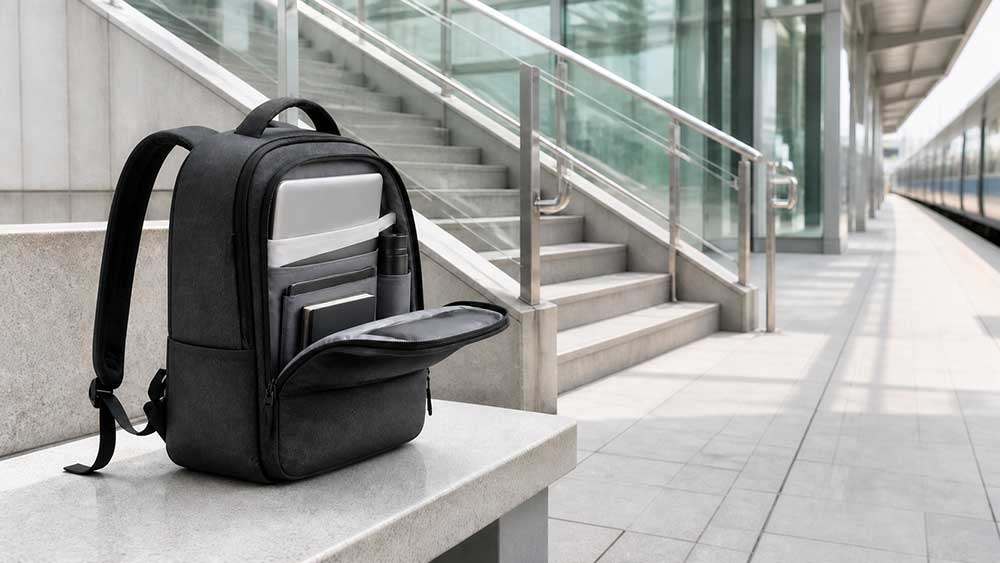
A laptop backpack keeps both hands free and moves with the wearer rather than behind them.
That makes it practical for travelers who need to manage a phone, ticket, passport, coffee, or suitcase at the same time. It is also easier to use on stairs, escalators, buses, subways, and uneven streets.
A backpack is often the better option when a trip includes:
Walking between stations and hotels
Moving through crowded public transportation
Climbing stairs without elevator access
Crossing curbs, cobblestones, or uneven sidewalks
Switching frequently between walking and riding
Carrying only a laptop and normal daily work essentials
The trade-off appears when the bag becomes heavy. A well-designed backpack can distribute weight across two shoulder straps, but it does not remove the load from the body. Carrying a heavily packed laptop backpack through a large airport can still become uncomfortable.
The shoulder straps, back panel, top handle, and load-bearing seams also need to match the intended capacity. A large backpack with thin straps may technically hold the equipment but still be unpleasant to carry.
Which Is Better at Airports?
For long airport corridors, a rolling laptop bag is often more comfortable. It allows the traveler to pull a heavy work load instead of carrying it for the entire journey.
A backpack has advantages at security checkpoints and during boarding because it is easier to lift, reposition, and carry through crowded areas. It can also leave one hand free to pull a separate suitcase.
The better choice therefore depends on the rest of the luggage:
If the laptop bag is your main piece of luggage, wheels can be very useful.
If you are already pulling a rolling suitcase, a backpack is often easier than managing two wheeled bags.
If the backpack includes a luggage pass-through sleeve, it can sit on top of the suitcase while moving through the terminal.
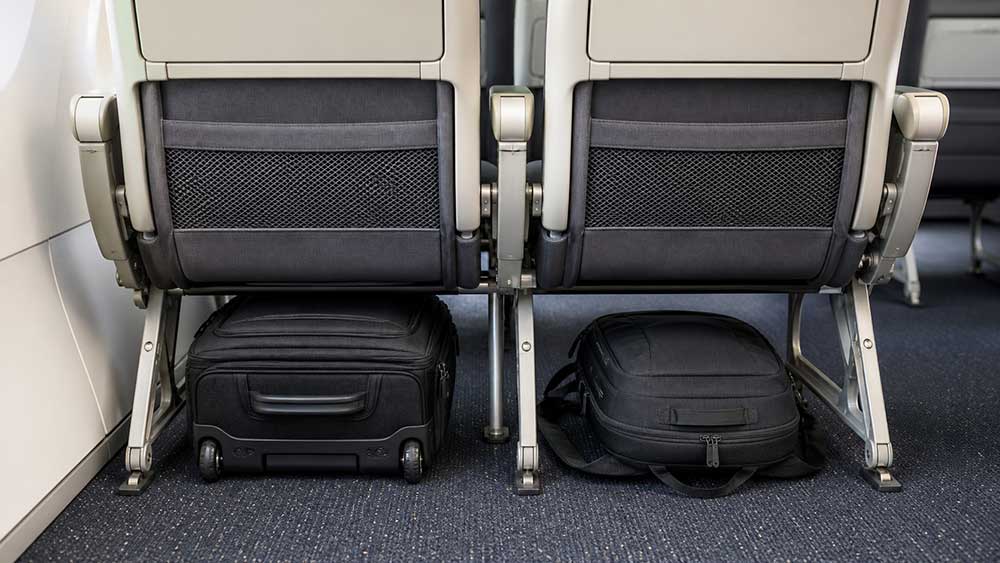
Travelers should also consider where the bag will be stored during the flight. Wheels, a telescopic handle, and a rigid base make a rolling laptop bag less flexible than a soft-sided backpack.
Carry-On and Underseat Considerations
Do not assume that every laptop bag qualifies as a personal item simply because it carries a laptop.
A compact backpack may fit under the seat when it stays within the airline’s size limits and is not overpacked. A rolling laptop bag is more likely to be treated as carry-on luggage because its wheels, handle system, reinforced corners, and structured base increase its external dimensions.
The Federal Aviation Administration advises travelers to check directly with their airline because baggage allowances and maximum dimensions can vary. It also notes that some aircraft have limited overhead space and that personal items may need to fit under the seat. Travelers can review the official FAA carry-on baggage guidance.
If underseat storage matters, measure the packed bag rather than the empty shell. Include:
Both styles can protect a laptop well when the compartment is properly designed.
Good laptop protection depends more on construction than on whether the bag has wheels. Look for:
Padding on the front, back, and sides of the laptop compartment
A raised or padded bottom
A compartment that prevents excessive device movement
A secure strap, flap, or zipper
Separation from hard accessories
Reinforcement around the bag base and corners
Suitable protection for the intended laptop size
Rolling laptop bags often have a firm base that protects the bottom of the bag while it stands upright. However, vibration from wheels and repeated contact with curbs can transfer movement through the bag. Chargers, samples, or other hard objects should not press directly against the laptop.
Backpacks may have a softer exterior but can provide very good protection when the laptop sleeve is suspended above the bottom and held close to the back panel.
The better-protected laptop is the one held securely inside a properly sized and padded compartment—not simply the one carried in the heavier bag.
Organization and Access During a Work Trip
Rolling laptop bags often provide more structured organization for files and office equipment. Their wider opening and upright shape can make documents, chargers, and accessories easier to find without emptying the whole bag.
Backpacks vary more. Some use one large compartment, while business and travel models may include:
A separate laptop opening
A document section
Front organizer pockets
Quick-access passport storage
Cable and charger pockets
A luggage pass-through sleeve
A hidden valuables pocket
For frequent airport use, a separate laptop compartment can be more convenient than placing the device behind clothes and personal items.
However, adding more compartments is not always better. Too many small pockets increase weight, reduce usable space, and make the bag harder to manufacture consistently. The layout should reflect what the traveler actually carries.
Stairs, Streets, and Public Transportation
This is where backpacks usually have the clearest advantage.
Small wheels work well on smooth airport floors but can struggle with:
Stairs
High curbs
Cobblestones
Broken pavement
Thick carpet
Wet or dirty streets
Gaps between train platforms
Crowded buses and subways
When the surface becomes difficult, the traveler has to lift the rolling bag. Because a wheeled bag is heavier and less comfortable to hold against the body, repeated lifting can become inconvenient.
A backpack handles these transitions more naturally. It also takes up less floor space in crowds and does not trail behind the user where someone may step on it.
For trips involving European railway stations, city streets, underground systems, or older buildings without elevators, a backpack is often the more practical choice.
Professional Appearance
A rolling laptop bag often has a formal business-travel appearance. Structured black or neutral-colored models can work well for consultants, sales teams, legal professionals, corporate trainers, and travelers carrying documents or product materials.
A backpack can also look professional. The details matter more than the carrying style:
Clean exterior panels
Neutral colors
Limited visible straps
Subtle branding
Structured shape
Well-integrated pockets
Durable, low-profile hardware
A bulky outdoor backpack may look out of place in a formal meeting, while a clean business backpack can fit naturally into modern offices and coworking spaces.
Professional appearance should therefore be judged by the specific design, not by assuming that every rolling bag is formal and every backpack is casual.
Durability and Maintenance
A backpack has fewer mechanical parts. Its main wear points are usually the shoulder straps, top handle, zippers, seams, and bottom panel.
A rolling laptop bag adds several components that require attention:
Wheels and wheel housings
Axles
Telescopic handle
Handle release mechanism
Reinforced bottom
Corner protection
Internal support structure
These parts can make the bag more functional, but they also create more possible failure points. Wheel alignment, handle extension, fastener strength, and base stability should be checked during product development and inspection.
Replaceable wheels can extend product life, although they may increase construction complexity and cost. For a B2B product program, repairability should be considered early rather than added after the bag has been designed.
What About a Rolling Laptop Backpack?
A rolling laptop backpack combines wheels and a telescopic handle with backpack straps. It can be pulled across smooth terminals and carried when stairs or rough surfaces make rolling difficult.
This sounds like the best of both designs, but the hybrid has compromises:
It is heavier than a normal backpack.
The back panel may feel rigid because of the handle structure.
Wheels can touch clothing unless they are covered.
The straps need a storage system so they do not drag near the wheels.
Internal space is reduced by the handle tubes and wheel housing.
Carrying comfort is usually lower than that of a purpose-built backpack.
A rolling backpack is useful when the traveler genuinely needs both carrying methods. If it will be worn most of the time, a regular backpack is normally more comfortable. If it will be rolled most of the time, a dedicated rolling laptop bag may provide better organization and stability.
Which One Should You Choose?
Choose a rolling laptop bag if:
Your laptop and work equipment are heavy
Most of your route has smooth floors
You frequently travel through large airports or convention centers
You carry files, catalogs, samples, or other business materials
You prefer structured organization
You do not expect to climb many stairs
The bag will serve as your main carry-on
Choose a laptop backpack if:
You carry a light or moderate work load
Your trip involves public transportation
You need both hands free
You frequently use stairs
You walk on mixed or uneven surfaces
You already pull a separate suitcase
You want a bag that can work for both commuting and travel
Underseat flexibility is important
Consider a rolling backpack if:
Your route includes both smooth terminals and occasional stairs
You need wheels but cannot avoid carrying the bag
You accept extra weight and reduced backpack comfort
Both carrying modes will genuinely be used
What Should Brands and Product Buyers Evaluate?
For brands developing a travel laptop bag, choosing between wheels and shoulder straps is only the beginning. The product should be designed around a clear use case.
Important questions include:
What equipment will the user normally carry?
What is the realistic packed weight?
Will the bag be used with a separate suitcase?
Does it need to fit under an airline seat?
What laptop sizes should the compartment support?
Will users travel mainly through airports, cities, or public transportation?
How often will the bag be lifted?
Which parts need reinforcement or replaceability?
Does the target market expect a formal or casual appearance?
How should the packed sample be tested before production?
A rolling bag should be evaluated while loaded, pulled, turned, lifted, and placed on different surfaces. A backpack should be tested for strap comfort, balance, laptop movement, handle strength, and access while packed.
Final Recommendation
For heavy work loads and airport-focused travel, a rolling laptop bag is usually the more comfortable choice. For lighter loads, public transportation, stairs, and mixed city travel, a backpack is usually more practical.
If the traveler already uses a rolling suitcase, a laptop backpack with a luggage pass-through sleeve often provides the most flexible combination. If the laptop bag itself must carry heavy documents, samples, and equipment, wheels may offer greater day-to-day comfort.
The best design is not determined by style alone. It is the bag that fits the traveler’s route, load, storage requirements, and method of transportation.
Vancharli Outdoor supports B2B buyers developing both custom laptop backpacks and wheeled business bags as part of broader laptop bag product programs. Materials, laptop protection, wheel systems, trolley handles, storage layouts, branding, sampling, and bulk-production requirements can be developed around the intended travel scenario.
FAQ
Is a wheeled laptop bag worth the extra weight?
It can be when the packed load is heavy and most of the journey takes place on smooth floors. If the traveler frequently climbs stairs or uses crowded public transportation, the added wheel and handle weight may become a disadvantage.
Can a rolling laptop bag go in an overhead compartment?
Many compact models can, but acceptance depends on the airline’s current carry-on limits and the bag’s packed external dimensions, including wheels and handles. Check with the airline before traveling.
Can a laptop backpack be used for business meetings?
Yes. A clean, structured backpack in a neutral color can work well in professional settings. Exterior design, materials, organization, and branding influence appearance more than the presence of shoulder straps.
Are two wheels or four wheels better for a laptop bag?
Two-wheel designs are usually simpler and may use less exterior space. Four-wheel spinner systems move easily in terminals but add hardware, weight, and construction complexity. The better option depends on the bag size and intended route.
Should a laptop compartment touch the bottom of the bag?
Ideally, the laptop should have padding or clearance beneath it. A raised or suspended compartment can reduce direct impact when the bag is placed on the floor.
Is a rolling backpack better than both separate options?
Not always. It offers two carrying methods but is heavier than a normal backpack and usually less comfortable on the back. It works best when the user will regularly switch between rolling and carrying.








Comments are closed