PU Leather vs Nylon Business Bags: Which Is Better?
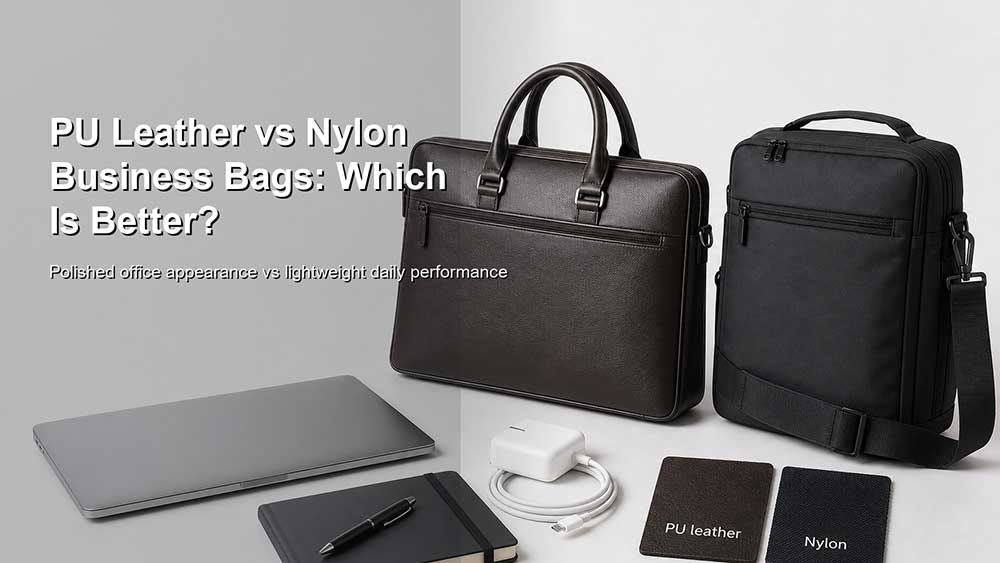
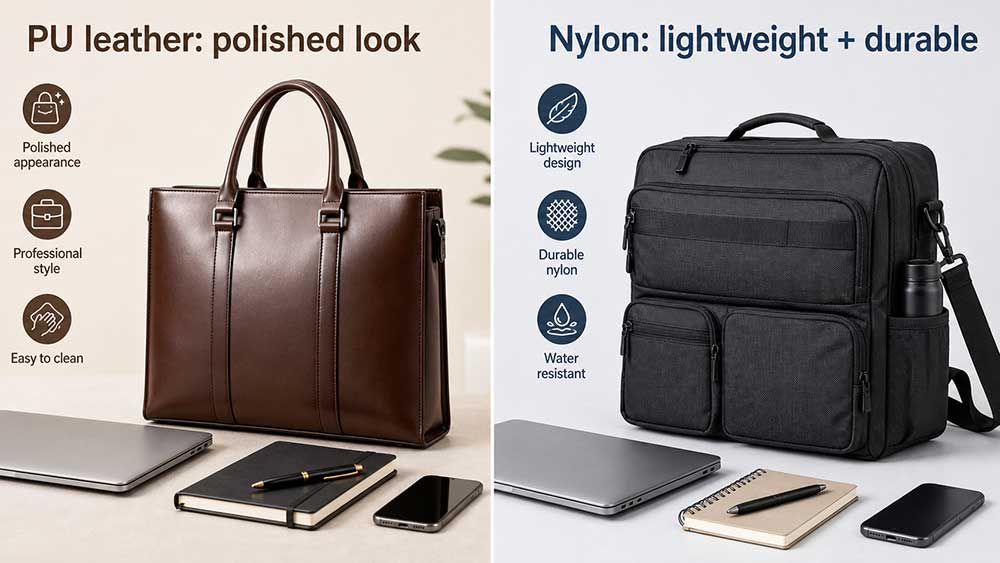
PU leather and nylon are both common materials for business bags, but they serve different purposes. Nylon is usually better for daily commuting, travel, lightweight carry, and long-term abrasion resistance. PU leather is usually better when the bag needs a polished, formal business look at a lower cost than genuine leather.
The better choice depends on what the bag needs to do. A commuter laptop backpack may perform better in nylon because it needs to be lightweight, durable, and water-resistant. A slim business tote or briefcase-style laptop bag may look more professional in PU leather because the surface is smoother, cleaner, and more formal.
For brands and buyers, the decision should not be based only on material name. A high-quality nylon business bag can outperform a low-grade PU leather bag in daily use. A well-selected PU leather bag can look more refined than a basic nylon bag in formal office settings. The right answer depends on the target user, bag type, retail price, design style, and expected use environment.
The Direct Answer: Nylon for Performance, PU Leather for Appearance
If your priority is daily performance, nylon is usually the safer choice. It is lighter, more flexible, and better suited for business backpacks, laptop backpacks, messenger bags, travel work bags, and bags that are carried every day.
If your priority is a formal business look, PU leather may be the better choice. It gives the bag a smooth, polished surface and can create a cleaner office appearance without the cost of genuine leather.
A simple way to decide:
Priority
Better Choice
Daily commuting
Nylon
Lightweight carry
Nylon
Travel and frequent movement
Nylon
Formal office appearance
PU leather
Budget-friendly executive style
PU leather
Easy surface cleaning
PU leather
Abrasion resistance
Nylon, if well specified
Corporate gifts
Depends on brand positioning
Laptop backpacks
Usually nylon
Briefcase-style business bags
PU leather or nylon, depending on style
For a product that sits between a business bag and laptop bag, the best material should support both appearance and function. A business bag should look professional, but a laptop bag also needs structure, padding, and protection.
What Is PU Leather in Business Bags?
PU leather is a synthetic material designed to create a leather-like appearance. It usually has a polyurethane surface layer applied to a fabric backing. In business bags, it is often used when brands want a polished look without using genuine leather.
PU leather is common in:
Business totes
Laptop sleeves
Briefcase-style bags
Corporate gift bags
Portfolio bags
Budget-friendly work bags
Fashion business backpacks
The main advantage of PU leather is appearance. It can look smooth, clean, and formal, which works well for office environments. It is also easier to wipe clean than many woven fabrics, especially when dealing with dust, light stains, or surface marks.
PU leather is also useful for branding. It can work well with debossed logos, embossed logos, metal plates, foil stamping, and clean label applications. For corporate gift programs or retail business bags, this can make the product look more polished.
However, PU leather quality varies widely. Low-grade PU leather may crack, peel, wrinkle, or become sticky over time, especially under heat, humidity, repeated bending, or poor storage conditions. The durability depends on the surface layer, base fabric, thickness, coating quality, flex resistance, peel strength, and production process.
PU leather should not be confused with genuine leather. It can create a business-friendly look, but it does not age like full-grain or top-grain leather. If a brand wants a long-term premium executive image, genuine leather may be a better material than PU leather.
What Is Nylon in Business Bags?
Nylon is a synthetic woven fabric commonly used in backpacks, travel bags, laptop bags, messenger bags, and work bags. It is valued for its strength-to-weight ratio, flexibility, and practical performance in daily carry products.
Nylon is common in:
Business backpacks
Laptop backpacks
Commuter work bags
Travel laptop bags
Messenger bags
Rolling laptop bags
Tech organizer bags
The biggest advantage of nylon is performance. It can be lightweight, durable, and abrasion-resistant when the specification is right. High-denier nylon, ballistic nylon, ripstop nylon, and CORDURA-style performance fabrics are often used for bags that need stronger daily use performance.
CORDURA describes its advanced fabrics as being used in products such as backpacks, work boots, and outdoor gear where comfort, durability, and reliability matter: CORDURA Advanced Fabrics.
Nylon also works well with coatings and backings. PU coating, DWR finish, laminated backing, and structured foam panels can improve water resistance, body shape, and durability.
The weakness of nylon is appearance. Some nylon fabrics look sporty, technical, or casual. That may be fine for a modern commuter backpack, but it may not suit a formal briefcase or executive tote. For business bags, nylon needs the right texture, finish, color, zipper, hardware, and logo treatment to look professional.
Appearance: Which Looks More Professional?
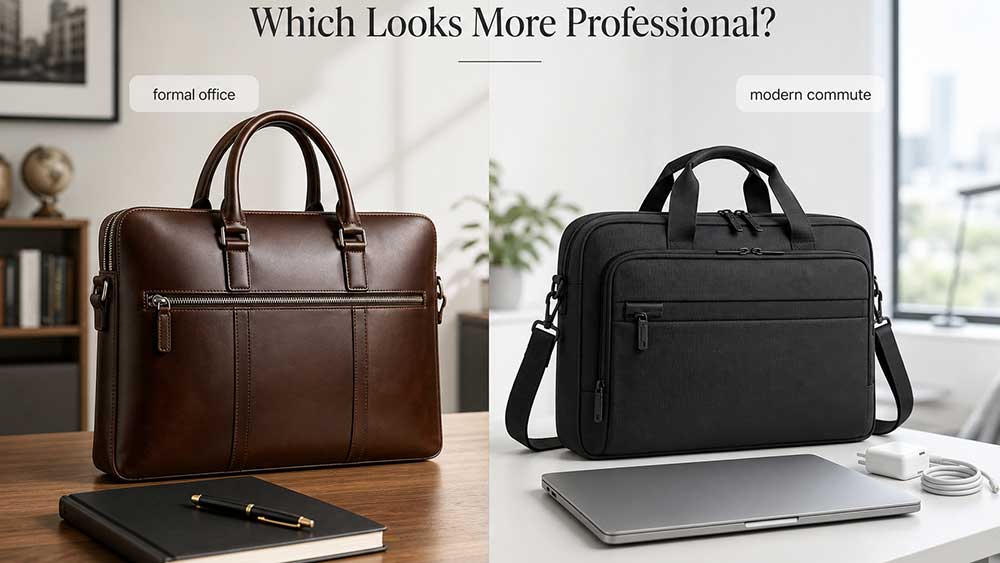
PU leather usually looks more formal than nylon. It has a smoother surface and can imitate the clean look of leather, which makes it suitable for business totes, briefcase-style bags, laptop sleeves, and corporate gift bags.
Nylon usually looks more functional. It can look modern, minimal, and professional when the texture is clean and the color is controlled, but it may not feel as formal as PU leather in traditional office settings.
The right choice depends on the type of professional image you want.
Business Style
Better Material
Formal office bag
PU leather
Executive-style budget bag
PU leather
Minimal commuter backpack
Nylon
Tech-focused work bag
Nylon
Travel business bag
Nylon
Corporate gift tote
PU leather
Corporate laptop backpack
Nylon
Clean retail work bag
PU leather or coated nylon
PU leather is usually better when the bag needs to look polished at first glance. Nylon is usually better when the bag needs to carry a laptop, charger, documents, bottle, and daily accessories without adding too much empty weight.
For users choosing a business bag for work and travel, appearance should be considered together with weight, weather exposure, laptop protection, and daily carrying comfort.
Durability: Which Lasts Longer?
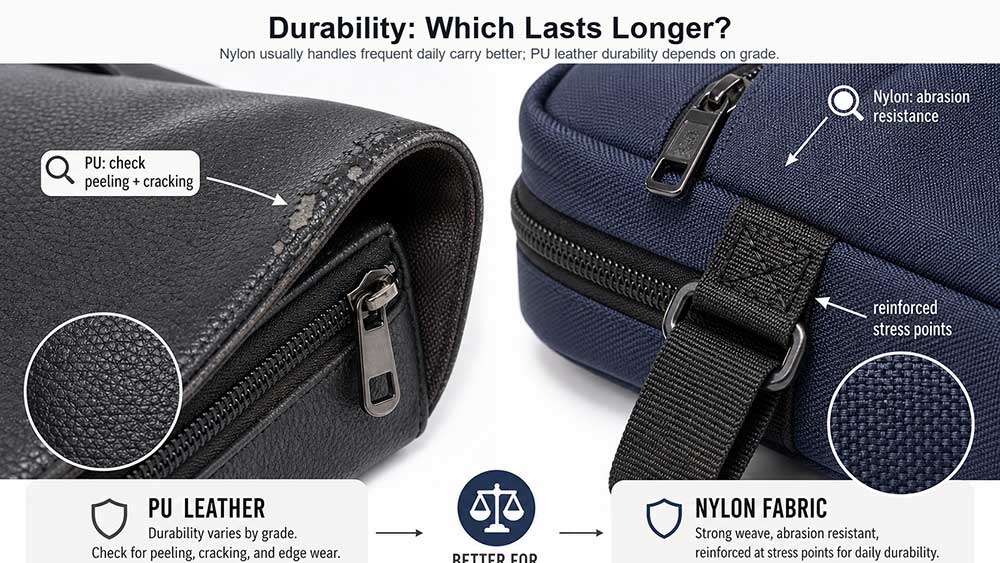
Nylon is usually better for high-frequency daily use, especially when the bag is carried through commuting, travel, office routines, and outdoor movement. A well-specified nylon fabric can handle abrasion, bending, and repeated movement better than many low-grade PU leather materials.
PU leather can also be durable if the material grade is good, but it is more sensitive to surface aging. Low-quality PU leather may peel, crack, or become sticky over time. This is especially common in areas that bend frequently, such as handles, flap edges, zipper corners, strap connections, and folded seams.
Nylon durability depends on:
Denier
Yarn quality
Weave structure
Coating
Backing
Abrasion resistance
Stitching density
Reinforced stress points
Zipper and hardware quality
PU leather durability depends on:
Surface layer thickness
Base fabric quality
Flex resistance
Peel strength
Hydrolysis resistance
Scratch resistance
Color fastness
Heat and humidity resistance
Storage conditions
So the answer is not “nylon always wins” or “PU leather is always weak.” The material grade matters. However, for daily commuting and repeated carry, nylon usually has the advantage.
Weight and Carry Comfort
Nylon is usually lighter than PU leather. This makes it better for backpacks, messenger bags, travel bags, and larger laptop bags that need to carry a laptop, charger, documents, bottle, and daily accessories.
PU leather often feels heavier or stiffer. That can help a bag look structured, but it may become less comfortable when the bag is large or fully loaded.
Weight matters most in:
Business backpacks
Laptop backpacks
Messenger bags
Travel laptop bags
Rolling laptop bags
Daily commuter bags
A PU leather tote or slim briefcase may be fine for short office carry. But for laptop backpacks used for daily commuting, nylon is usually more practical because it reduces weight while allowing padding, compartments, and hardware to be added without making the bag too heavy.
If the user carries the bag for long periods, nylon usually has a comfort advantage. If the bag is carried mostly from car to office or meeting room to meeting room, PU leather can still work well.
Water Resistance and Cleaning
PU leather is easy to wipe clean because it has a smooth surface. Light dust, fingerprints, and small stains can often be removed with a soft cloth. This makes PU leather attractive for office bags and corporate gift bags.
However, PU leather is not automatically waterproof. Water can still enter through seams, zippers, stitching holes, and lining. Prolonged moisture, heat, and poor storage can also affect low-quality PU leather.
Nylon can be water-resistant when it has the right coating or finish. PU coating, DWR finish, and laminated backing can help nylon resist light rain and daily splashes. However, untreated nylon fabric may absorb moisture, and water can still enter through openings and seams.
For laptop bags, water resistance should not be judged only by the outer material. A safer design should include:
Water-resistant outer fabric
Protected zippers
Proper seam construction
Laptop compartment away from bottle storage
External water bottle pockets
Lining that does not trap excessive moisture
A structured laptop sleeve
This is especially important because business bags often carry electronics. Even a good-looking PU leather or nylon bag can be risky if the laptop area is poorly designed.
Maintenance and Aging
PU leather and nylon age differently.
PU leather is easy to clean in the short term, but it needs proper storage and material quality control. It should be kept away from long-term humidity, excessive heat, and repeated sharp folding. Low-grade PU leather may show peeling, cracking, surface stickiness, or edge wear over time.
Nylon is usually easier to maintain for daily commuting. It can handle movement, bending, and repeated carry better in many work and travel situations. However, nylon can also wear down. It may develop abrasion marks, coating breakdown, fading, fraying, or surface fuzzing depending on material grade and usage.
PU leather usually ages visually on the surface. Nylon usually ages through fabric wear, coating wear, and stitching stress.
For business bags, this matters because appearance is part of product value. PU leather may look more polished when new, but poor-quality PU can age badly. Nylon may look less formal, but it often remains more practical during frequent use.
Cost and Branding
PU leather and nylon can both support cost-effective business bag production, but the cost structure is different.
PU leather can create a cleaner, leather-like business appearance at a lower material cost than genuine leather. It is useful for business totes, laptop sleeves, gift bags, and briefcase-style bags where appearance matters.
PU leather branding methods often include:
Debossed logo
Embossed logo
Metal logo plate
Foil stamping
Printed logo
Patch logo
Nylon works better for functional business bags, laptop backpacks, and travel work bags. It is easier to combine with webbing, mesh, foam panels, organizer pockets, and outdoor-inspired structures.
Nylon branding methods often include:
Woven label
Rubber patch
TPU patch
Embroidery
Screen printing
Heat transfer logo
Silicone label
For B2B projects, cost should not be judged only by material price. Buyers should also consider cutting waste, sewing difficulty, bonding requirements, edge finishing, logo method, testing, MOQ, defect rate, and packaging needs.
A PU leather bag may need better edge finishing to look clean. A nylon backpack may need more panels, padding, webbing, zipper pulls, and reinforcement. The final cost depends on the whole construction, not only the surface material.
PU Leather vs Nylon Comparison Table
Factor
PU Leather
Nylon
Appearance
More polished and formal
More modern and functional
Business image
Good for office and corporate style
Good for commute and tech style
Weight
Usually heavier or stiffer
Usually lighter
Durability
Depends heavily on grade
Strong for daily use if well specified
Water resistance
Easy to wipe, surface-resistant
Good with coating or DWR finish
Maintenance
Easy to clean, but may peel or crack if low quality
Low maintenance, but can show abrasion or coating wear
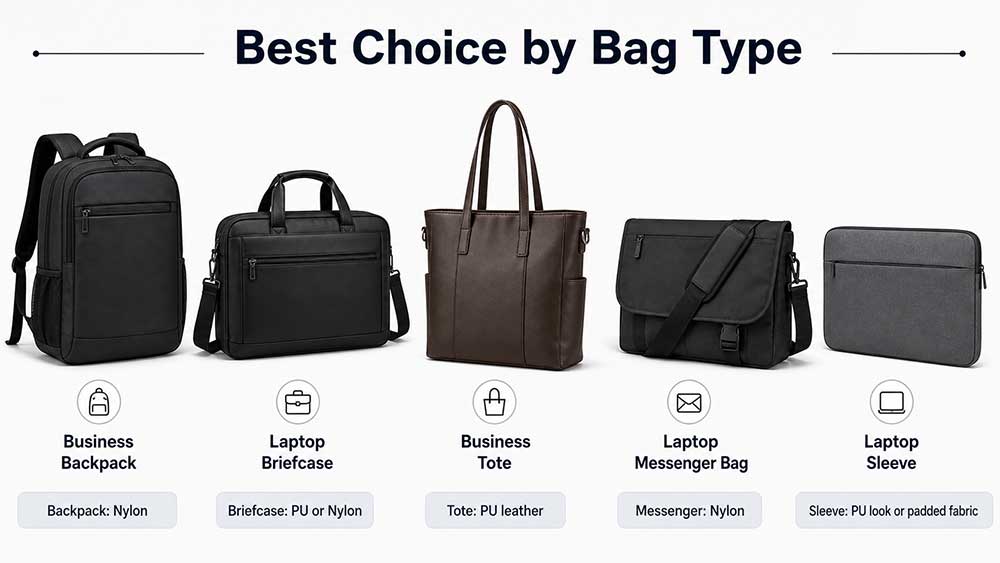
Different business bag styles need different material choices. PU leather and nylon can both work, but not always for the same reason.
Business Backpack
For a business backpack, nylon is usually the better choice. It is lighter, more flexible, and more suitable for padded shoulder straps, back panels, laptop compartments, and organizer pockets.
PU leather can be used for fashion business backpacks, but it may become heavier and less breathable for daily carry.
Laptop Backpack
For a laptop backpack, nylon is usually better. A good laptop backpack needs padding, structure, water resistance, and comfort. Nylon works well with these features without adding too much weight.
If the design needs to protect electronics, material choice should also support laptop bag padding, bottom structure, and a stable laptop compartment.
Business Tote
For a business tote, PU leather can be a strong choice because it gives the bag a clean and formal appearance. It works well for women’s work bags, corporate totes, office bags, and polished everyday business styles.
Nylon can also work if the tote is designed for lightweight commuting or travel.
Laptop Briefcase
For a laptop briefcase, both materials can work. PU leather is better when the product needs a formal office look. Nylon is better when the briefcase needs to be lightweight, weather-resistant, and easy to carry daily.
Laptop Messenger Bag
For a laptop messenger bag, nylon is usually better for commuting because it is lighter and more flexible. PU leather can work if the bag is designed for a more formal or fashion-oriented business look.
The right material depends on whether the user wants a professional appearance or a lighter daily carry experience.
Laptop Sleeve
For a laptop sleeve, PU leather is good for appearance, while nylon, neoprene, polyester, or foam-padded structures are better for practical protection. When deciding between a laptop sleeve or laptop bag, fit and daily protection matter more than surface material alone.
Corporate Gift Bag
For corporate gift bags, both PU leather and nylon can work. PU leather feels more polished and formal. Nylon feels more practical and durable. The better choice depends on the brand image, budget, gift purpose, and expected user.
What Brands Should Consider Before Choosing
For brands, wholesalers, and product development teams, choosing between PU leather and nylon should happen early in the design process. The decision affects appearance, construction, weight, logo method, packaging, testing, cost, and long-term customer experience.
Before choosing, brands should ask:
Is the bag mainly for office, commuting, travel, or corporate gifting?
Does the target user care more about formal appearance or lightweight function?
Will the bag carry a laptop every day?
Does the bag need water resistance?
Will the material be folded, bent, or stressed often?
What logo method is required?
What retail price range must the product meet?
What tests are required for the target market?
Does the material need odor, color fastness, flex, or abrasion testing?
Will the product sell in the US, EU, or other compliance-sensitive markets?
For textile safety and chemical management, OEKO-TEX STANDARD 100 is a useful reference because it identifies textiles tested for harmful substances from yarn to finished product: OEKO-TEX STANDARD 100.
For OEM and ODM business bag projects, Vancharli Outdoor usually reviews the material surface, backing, lining, padding, logo method, color consistency, and compliance requirements together before sampling. A nylon laptop backpack and a PU leather business tote may both be business bags, but they require different material checks, different construction logic, and different quality control points.
Final Answer: PU Leather or Nylon?
Choose nylon if the business bag needs to be lightweight, durable, commute-ready, and suitable for daily laptop carry. Nylon is usually better for business backpacks, laptop backpacks, travel work bags, messenger bags, and products used frequently in changing weather or crowded commuting environments.
Choose PU leather if the business bag needs a polished, formal, leather-like appearance at a lower cost than genuine leather. PU leather is usually better for business totes, laptop sleeves, briefcase-style bags, portfolio bags, and corporate gifts where appearance matters more than heavy daily performance.
Neither material is always better. The best choice depends on the bag type, user scenario, price point, and target brand image.
If the priority is daily performance, choose nylon. If the priority is formal appearance, choose PU leather. If the priority is long-term premium executive style, consider genuine leather instead of PU leather. If the priority is laptop protection, material choice should be combined with padding, lining, bottom structure, and compartment fit.
FAQ
Is PU leather better than nylon for business bags?
PU leather is better when the bag needs a formal, polished office look. Nylon is better when the bag needs to be lightweight, durable, and practical for commuting or travel.
Is nylon more durable than PU leather?
High-quality nylon is usually more suitable for repeated daily carry, abrasion, and commuting. PU leather durability depends heavily on material grade. Low-quality PU leather may crack, peel, or become sticky over time.
Does PU leather look more professional than nylon?
Usually yes. PU leather has a smoother and more formal appearance, which works well for office bags, business totes, briefcase-style bags, and corporate gift products. Nylon can also look professional if the texture and design are clean.
Is nylon good for business bags?
Yes. Nylon is good for business backpacks, laptop backpacks, travel work bags, and commuter bags. It is lightweight, practical, and suitable for water-resistant coatings and padded laptop structures.
Is PU leather good for laptop bags?
PU leather can be good for laptop sleeves, slim briefcase-style laptop bags, and formal business totes. For heavy daily laptop carry, nylon or a structured fabric system may be more practical.
Which material is lighter, PU leather or nylon?
Nylon is usually lighter than PU leather. This makes it more suitable for backpacks, messenger bags, and travel work bags that carry laptops and accessories every day.
Which material is easier to clean?
PU leather is usually easier to wipe clean on the surface. Nylon is also low-maintenance, but stains may depend on weave, coating, and fabric color.
Which is better for corporate gift bags?
PU leather works well for polished corporate gifts, while nylon works better for practical laptop backpacks or commuter bags. The better choice depends on the brand image, budget, and how the recipient will use the bag.
Can PU leather business bags be waterproof?
PU leather can resist light surface moisture, but that does not make the whole bag waterproof. Water can still enter through seams, zippers, stitching holes, and openings.
Which material should brands choose for OEM business bags?
Brands should choose PU leather when appearance and corporate style are the priority. They should choose nylon when daily performance, lighter weight, and commuting function are more important. Material grade, testing, logo method, and target price should be confirmed before production.









Comments are closed