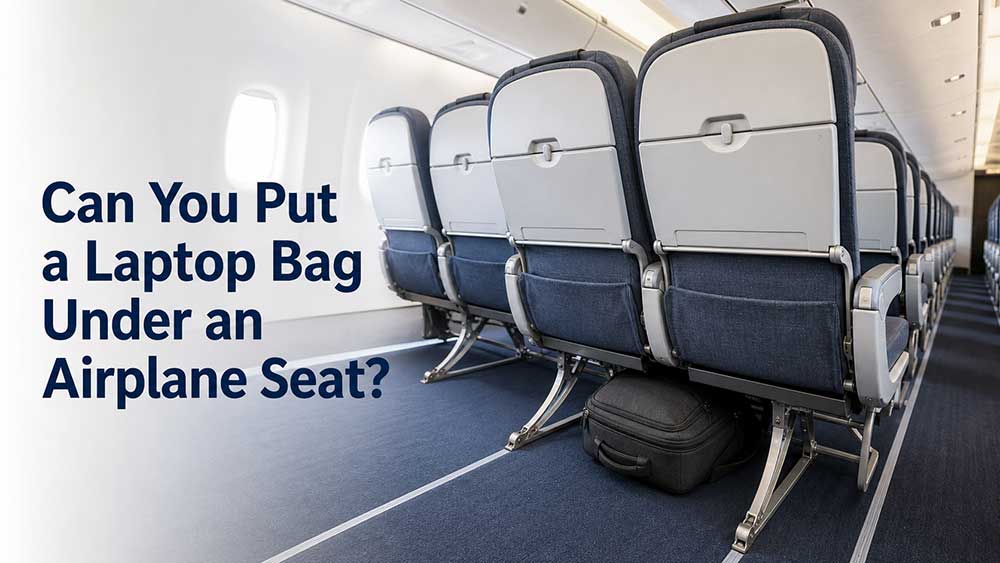
Yes, you can usually place a laptop bag under the seat in front of you if it fits the airline’s personal item rules and can be stowed fully without blocking the aisle or foot area. A slim laptop backpack, laptop briefcase, laptop messenger bag, or laptop tote often works well. An overpacked travel backpack, large 17-inch laptop bag, or rolling laptop bag may be harder to fit.
The key point is this: airlines do not judge only by the name “laptop bag.” They care whether the bag fits under the seat safely without blocking the aisle, foot area, or safety equipment. Under-seat space can also vary by airline, aircraft, seat position, and cabin layout.
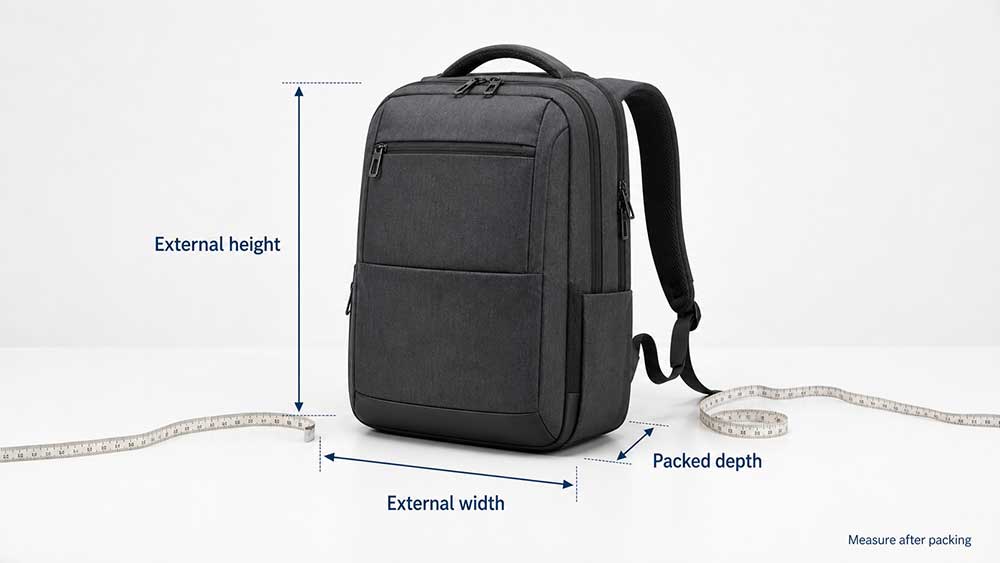
For travelers, the safest approach is to check your airline’s personal item rules before flying and measure the laptop bag when it is packed, not when it is empty.
A laptop bag can usually go under the seat in front of you. In most cases, it is treated as a personal item, similar to a purse, small backpack, briefcase, or laptop case.
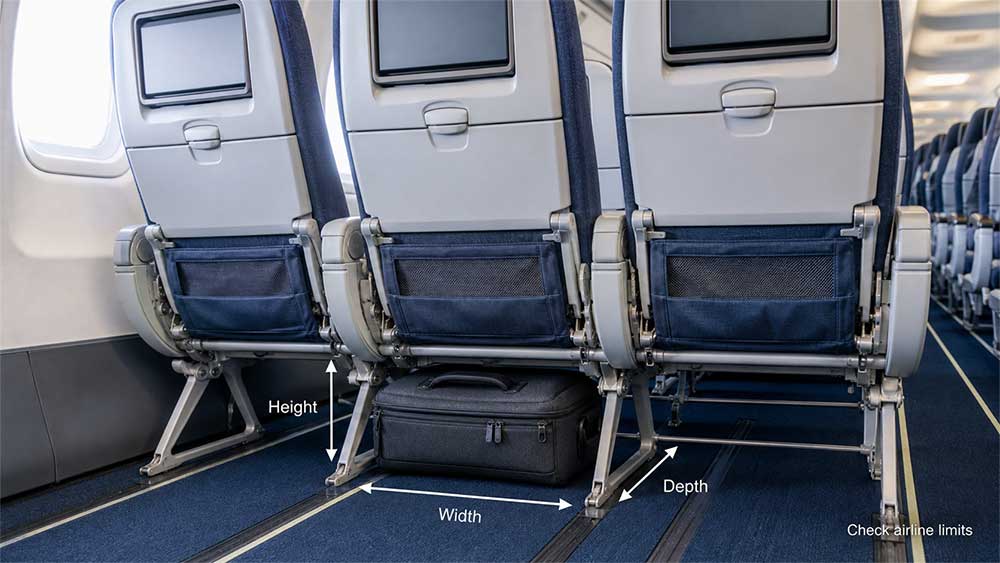
However, the bag must fit fully under the seat. It should not stick out into the aisle, block the foot area in a way that affects safety, or prevent the crew from checking that items are properly stowed during takeoff and landing.
American Airlines says a personal item must fit under the seat in front of you and should not exceed 18 × 14 × 8 inches: American Airlines carry-on bags. Delta also lists a laptop bag as an example of a personal item that can be brought along with a carry-on bag: Delta carry-on baggage.
So the answer is usually yes, but the bag must match the airline’s size rules and the real under-seat space on your flight.
Tip: Do not judge by empty bag dimensions only. Measure the laptop bag after packing your laptop, charger, documents, bottle, and accessories.
Is a Laptop Bag a Personal Item?
A laptop bag is usually considered a personal item when it is small enough to fit under the seat in front of you. This is why many travelers fly with one carry-on suitcase in the overhead bin and one laptop bag under the seat.
Common personal item examples include:
Laptop bag
Small backpack
Briefcase
Purse
Tote bag
Camera bag
Small messenger bag
But there is an important limit. If you bring a carry-on suitcase, a backpack, and a separate laptop bag, the airline may count that as too many items unless one bag can be consolidated. The personal item allowance usually covers one smaller bag, not several separate bags.
A laptop bag is usually fine as a personal item. A large travel backpack that also contains a laptop may be treated differently if it is too big to fit under the seat.
What Size Laptop Bag Fits Under an Airplane Seat?
There is no single universal under-seat size. Each airline can set its own personal item rules, and the actual space under the seat may vary by aircraft.
Here are a few official examples:
Airline
Personal Item / Underseat Rule
American Airlines
Personal item must fit under the seat and should not exceed 18 × 14 × 8 in
Delta Air Lines
Allows 1 carry-on and 1 personal item, with laptop bag listed as an example
United Airlines
Personal item must fit under the seat and measure no more than 9 × 10 × 17 in
Southwest Airlines
Allows 1 carry-on and 1 personal item; personal items go under the seat
This is why a laptop bag that works on one airline may feel tight on another. If you fly often, do not design your packing around only one airline’s size limit.
For a broader view of airline carry-on and personal item size rules, check the airline before each trip, especially if you are flying budget fares, regional aircraft, or international routes.
Which Laptop Bag Styles Fit Best Under the Seat?
Different laptop bag styles fit under airplane seats differently. The shape, thickness, structure, and packing style matter as much as the stated dimensions.
Laptop Bag Type
Underseat Fit
Slim laptop backpack
Usually good if not overpacked
Laptop briefcase
Usually good because it is flatter
Laptop messenger bag
Usually good if the width is controlled
Laptop tote
Usually good, but soft sides may collapse
Rolling laptop bag
Risky because wheels and handles add height
Large travel laptop backpack
Depends on packed thickness
17-inch laptop backpack
Check dimensions carefully
Laptop sleeve only
Easy to fit, but offers limited storage
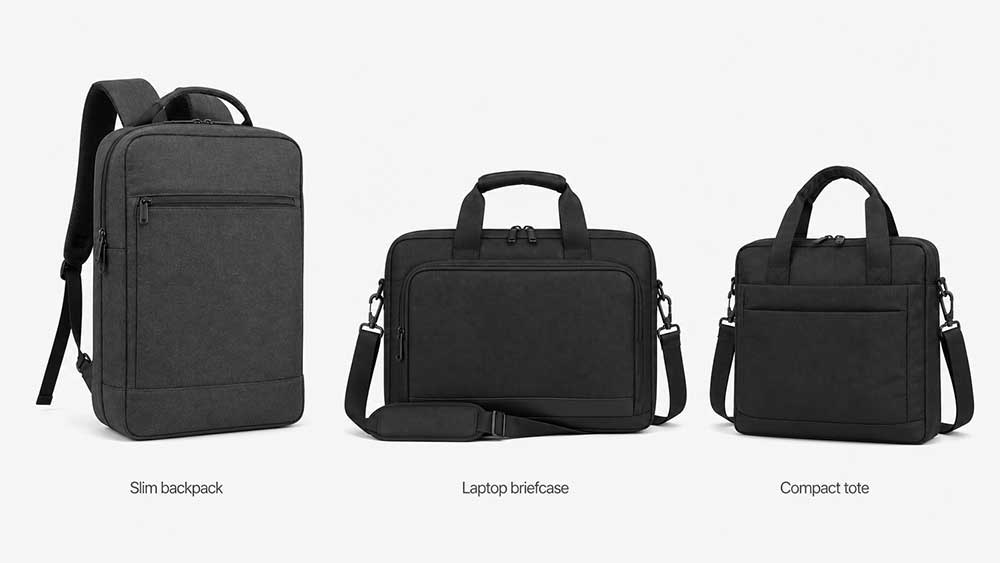
A slim laptop backpack is practical because it can hold a laptop, charger, documents, and personal items while still fitting under many seats. A briefcase is usually flatter and easier to slide under the seat, but it may hold less. A messenger bag can work well, but wide or heavily packed messenger bags may be awkward in tight foot space.
For travelers choosing between a backpack and a shoulder-carry style, the laptop backpack and messenger bag comparison can help clarify which style fits your travel and work routine better.
Why Some Laptop Bags Do Not Fit Under the Seat
A laptop bag may fail to fit under an airplane seat for several reasons. The problem is often not the laptop itself, but the packed thickness or bag structure.
Common reasons include:
The front pocket is overpacked
The bag has a rigid bottom panel
Wheels and handles add extra height
The laptop compartment is too thick
Side bottle pockets stick out
The bag carries bulky headphones or lunch boxes
The main compartment is stuffed with clothing
The bag is designed more like a travel backpack than a personal item
The seat has limited under-seat space
The traveler sits in a bulkhead or exit row with different storage rules
Bulkhead rows can be especially different because there may be no seat directly in front of you for under-seat storage during takeoff and landing. In those cases, personal items often need to go in the overhead bin.
Some aisle seats may also have less usable under-seat space because of seat supports, entertainment boxes, or cabin equipment. This is why a bag that fits under one seat may feel tight under another.
Tip: If your laptop bag is close to the airline size limit, avoid overpacking the front pocket. Extra depth is usually what causes under-seat fit problems.
How to Measure a Laptop Bag for Underseat Fit
When measuring a laptop bag for air travel, measure the packed bag, not just the empty bag.
Check these dimensions:
Height
Width
Depth
Packed thickness
Handle height
Wheel base, if any
Bulging front pockets
Side bottle pocket width
Soft bags may compress slightly, but you should not rely on forced compression. If the bag only fits when you crush it, it may be uncomfortable at your feet and may not pass airline checks if the gate agent asks you to place it in a sizing box.
Hard-shell or heavily structured laptop bags are less flexible. Rolling laptop bags are also more difficult because wheels and telescoping handles take up space.
Laptop size matters too. A laptop bag designed for a 13-inch laptop will usually be slimmer than one designed for a 17-inch laptop. Before choosing the bag itself, travelers should know the correct method for measuring laptop size for a bag.
13-Inch, 15.6-Inch, and 17-Inch Laptop Bags: Which Is Easier?
Smaller laptop bags are usually easier to fit under airplane seats. A 13-inch or 14-inch laptop bag is often slim enough for personal item use. A 15.6-inch laptop bag can also work well if the bag is not too thick. A 17-inch laptop bag needs more careful checking.
General underseat fit:
Laptop Size
Underseat Fit Expectation
13-inch laptop bag
Usually easiest
14-inch laptop bag
Usually easy
15.6-inch laptop bag
Usually fine if slim
16-inch laptop bag
Depends on bag structure
17-inch laptop bag
Check carefully
Gaming laptop bag
Higher risk due to thickness
Laptop size is not the only issue. Thickness, padding, pocket depth, and structure all matter. A slim 16-inch laptop briefcase may fit better than a bulky 15.6-inch backpack.
For buyers comparing laptop compartments and overall bag size, the laptop bag size guide is more useful than relying only on the laptop screen size.
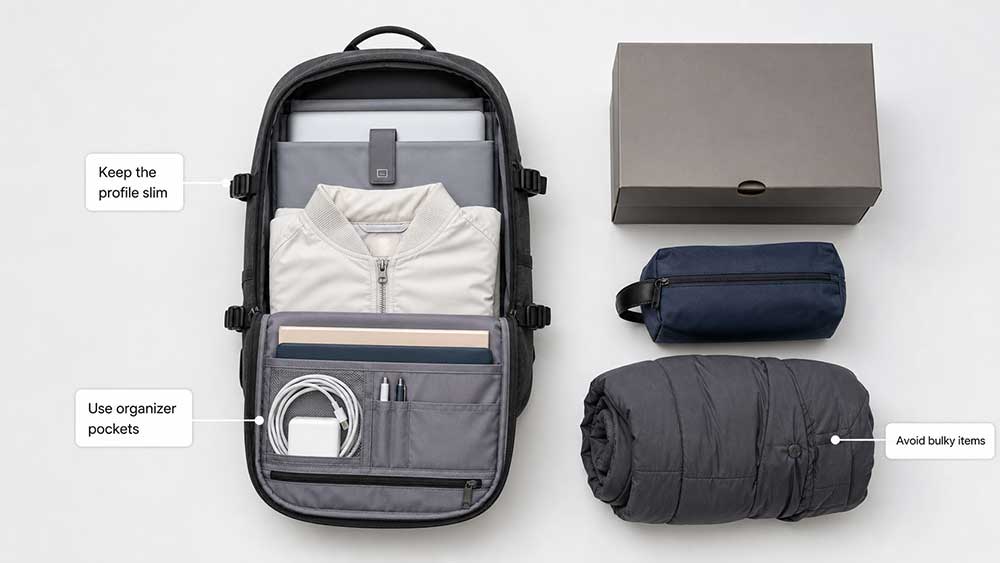
Packing Tips: How to Make a Laptop Bag Fit Under the Seat
A laptop bag that should fit under the seat can become too bulky if packed poorly. Good packing makes a big difference.
Use these tips:
Keep the laptop close to the back panel
Do not overpack the front pocket
Put the charger in a flat side pocket if possible
Keep the water bottle pocket empty during boarding if space is tight
Avoid large headphone cases in the front compartment
Do not pack shoes or bulky clothing in a laptop personal item
Keep documents flat
Use smaller pouches instead of hard accessory cases
Leave room for the bag to slide under the seat
Place your larger carry-on in the overhead bin
The goal is to keep the bag slim, flat, and easy to slide under the seat. Bulging pockets are often the reason a bag becomes difficult to fit under the seat.
Tip: If you need the bag at your feet during the flight, keep essentials near the top or front pocket. Once the bag is under the seat, it can be hard to open a deep main compartment.
Will a Laptop Bag Under the Seat Reduce Legroom?
Yes, it can reduce legroom. This is one of the trade-offs of using a laptop bag as a personal item.
A slim briefcase or compact laptop backpack usually leaves more room for your feet than a thick travel backpack. A soft tote may fit easily but may collapse into your foot space. A structured backpack may protect the laptop better but can feel bulkier.
If legroom is important, choose a laptop bag with:
Slim depth
Flat back panel
Low-profile front pocket
Soft but stable side panels
No bulky wheel base
Clean rectangular shape
External pockets that do not stick out too much
For long flights, comfort matters. A laptop bag may technically fit under the seat but still feel annoying if it takes up all your foot space.
What Happens If Your Laptop Bag Does Not Fit?
If your laptop bag does not fit under the seat, the crew or gate agent may ask you to place it in the overhead bin. If overhead space is full or the bag exceeds allowance rules, the bag may need to be checked or gate-checked, depending on the airline and situation.
This can be a problem if the laptop is inside the bag. Because laptops and valuable electronics are sensitive and may be subject to battery-related airline rules, it is safer to keep them accessible and follow the airline’s instructions before checking any bag.
To avoid this situation:
Check the airline’s personal item dimensions
Measure the packed bag
Avoid bringing multiple small bags
Keep the laptop bag slim
Do not rely on overhead bin space for your laptop
Choose a personal item size that works across multiple airlines
A laptop bag under the seat is convenient because it keeps your computer close. But that convenience depends on choosing a bag that actually fits.
What Brands Should Consider When Designing Underseat Laptop Bags
For brands, wholesalers, and product development teams, an underseat laptop bag should be designed around real packed dimensions, not just empty sample measurements.
Important design points include:
Underseat-friendly proportions
Slim packed depth
Padded laptop sleeve
Raised laptop compartment
Low-profile front pocket
Soft but stable side panels
Flat base shape
Comfortable top handle
Luggage strap
External bottle pocket that does not add too much width
Compact organizer pockets
Lightweight construction
Clear “personal-item friendly” or “underseat-friendly” wording
Testing with a packed sample
A laptop bag made for underseat travel should not become too deep when filled. Many bags look compact when empty but expand too much after packing a laptop, charger, mouse, bottle, notebook, and travel accessories.
For OEM and ODM laptop bag projects, Vancharli Outdoor usually reviews packed dimensions, laptop sleeve structure, pocket depth, bottom shape, luggage strap placement, and clear underseat-friendly wording before sampling. The goal is not only to make a bag that carries a laptop, but to make a bag that works in real airport and cabin conditions.
For buyers developing custom laptop bags, it is better to define the use case early: daily commute, business travel, underseat personal item, carry-on companion, or hybrid work travel. Each use case needs a different balance of size, padding, organization, and structure.
Tip: If a product is marketed as underseat-friendly, test the packed sample, not only the empty prototype.
Final Answer: Can a Laptop Bag Go Under an Airplane Seat?
Yes, a laptop bag can usually go under an airplane seat if it fits the airline’s personal item rules and can be stowed fully under the seat in front of you.
A slim laptop backpack, laptop briefcase, messenger bag, or tote is usually easier to fit than a bulky travel backpack or rolling laptop bag. The bag name matters less than the real packed dimensions.
Before flying, check your airline’s personal item size rules, measure the laptop bag when packed, and avoid overfilling the front pockets. Under-seat space can vary by airline, aircraft, and seat position.
For most travelers, the best underseat laptop bag is slim, padded, organized, and easy to slide under the seat without taking up too much legroom.
FAQ
Can I put a laptop bag under an airplane seat?
Yes. Most laptop bags can go under the airplane seat if they fit the airline’s personal item rules and can be stowed fully under the seat in front of you.
Does a laptop bag count as a personal item?
Usually yes. Many airlines treat laptop bags, small backpacks, purses, briefcases, and similar small bags as personal items if they fit under the seat.
What size laptop bag fits under an airplane seat?
It depends on the airline and aircraft. Some airlines give exact personal item dimensions, while others simply require the bag to fit under the seat in front of you.
Can a laptop backpack fit under an airplane seat?
Yes, a laptop backpack can fit under an airplane seat if it is slim enough and not overpacked. Large travel backpacks or thick laptop backpacks may be harder to fit.
Can a 17-inch laptop bag fit under an airplane seat?
Sometimes, but it depends on the bag’s dimensions and thickness. A slim 17-inch briefcase may fit better than a bulky 17-inch laptop backpack.
Is a rolling laptop bag good for underseat storage?
It can be risky. Wheels, handles, and rigid frames add height and reduce flexibility. A rolling laptop bag may fit on some aircraft but not others.
Can I bring a carry-on suitcase and a laptop bag?
Usually yes, if the suitcase is your carry-on and the laptop bag is your personal item. The laptop bag must fit under the seat in front of you.
What if my laptop bag does not fit under the seat?
You may be asked to place it in the overhead bin. If overhead space is full or the bag exceeds allowance rules, it may need to be checked or gate-checked depending on the airline.
Should I put my laptop bag overhead or under the seat?
If the bag fits under the seat, keeping it there gives you easier access to your laptop and personal items. Larger carry-on luggage should usually go in the overhead bin.
What is the best laptop bag for underseat travel?
The best laptop bag for underseat travel is slim, padded, organized, and not too deep when packed. A compact laptop backpack, briefcase, messenger bag, or tote can all work if the dimensions are controlled.











Comments are closed