Cooler Bag Linings: PEVA vs Aluminum Foil vs PVC vs TPU
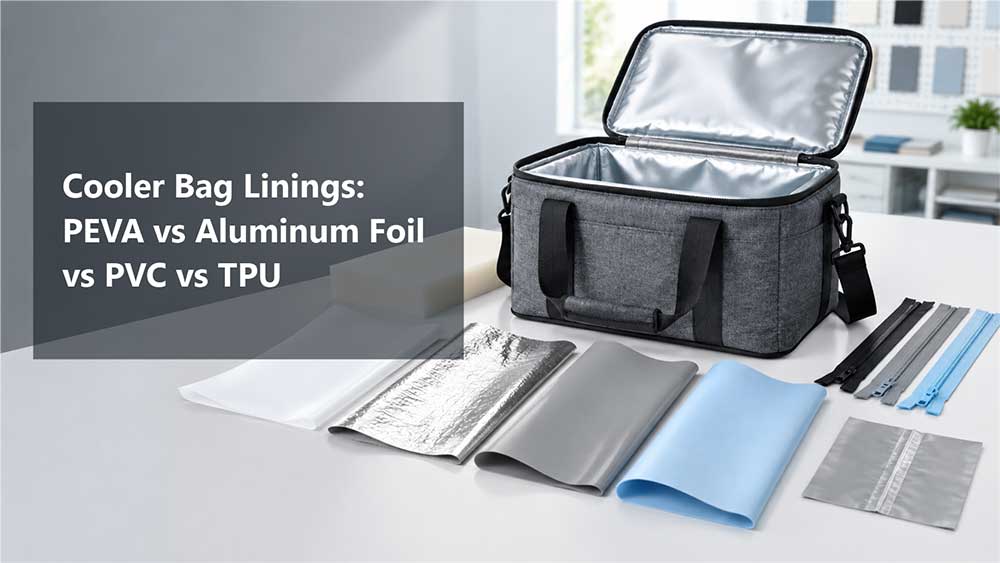
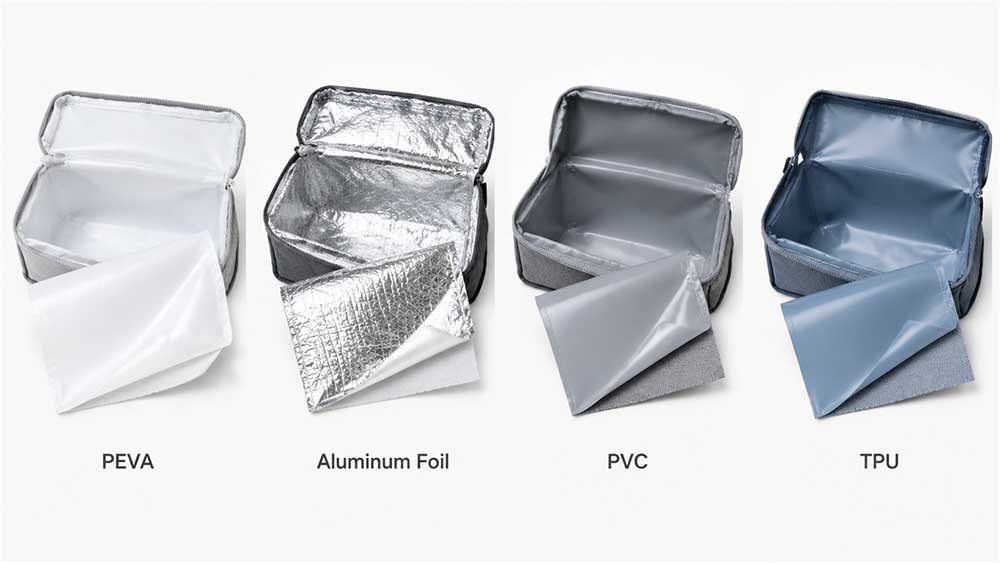
PEVA, aluminum foil, PVC, and TPU can all be used inside cooler bags, but they suit different products and manufacturing methods.
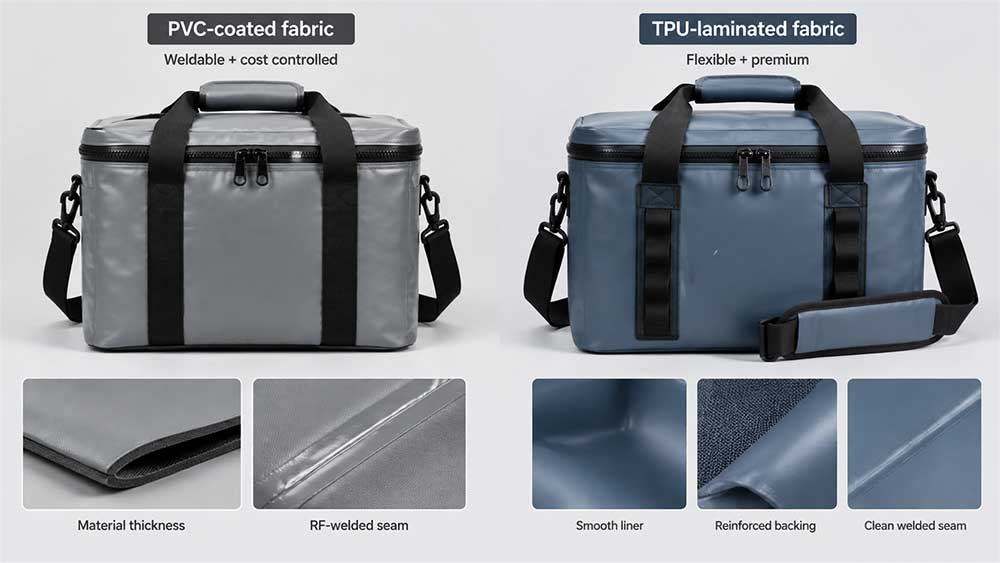
For an ordinary sewn lunch bag or promotional cooler, PEVA and aluminum foil laminates are common choices. PVC may be used as a flexible film in sewn bags or as a coated fabric in welded coolers. TPU-laminated fabric is generally used for premium RF-welded waterproof soft coolers.
The lining material alone does not make a cooler insulated or leakproof. Buyers must also consider the foam, backing fabric, seams, zipper, material thickness, intended contents, and finished-product test results.
Lining material
Common construction
Typical application
Main advantage
Main limitation
PEVA film
Usually sewn
Lunch bags, picnic bags, and everyday coolers
Smooth, easy to wipe, and widely available
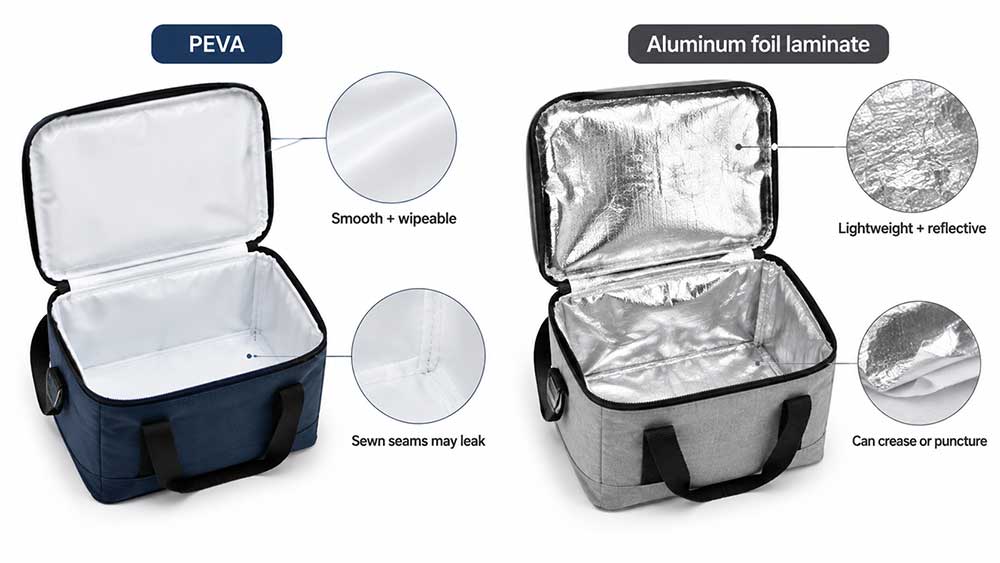
Sewn seams may leak; thin film can puncture
Aluminum foil laminate
Usually sewn
Promotional coolers and low-cost thermal bags
Lightweight, economical, and reflective
Can crease, puncture, or delaminate
PVC film or coated fabric
Sewn or RF welded
Everyday coolers and cost-controlled waterproof coolers
Available in multiple structures and weldable when compatible
May be heavier or stiffer; formulation must be checked
TPU-laminated fabric
Usually RF welded
Premium waterproof soft coolers
Flexible, durable, and suitable for welded construction
Higher material and production cost
There is no single best cooler bag lining. The right choice depends on how the cooler will be made, what it will carry, how often it will be used, and which market requirements it must meet.
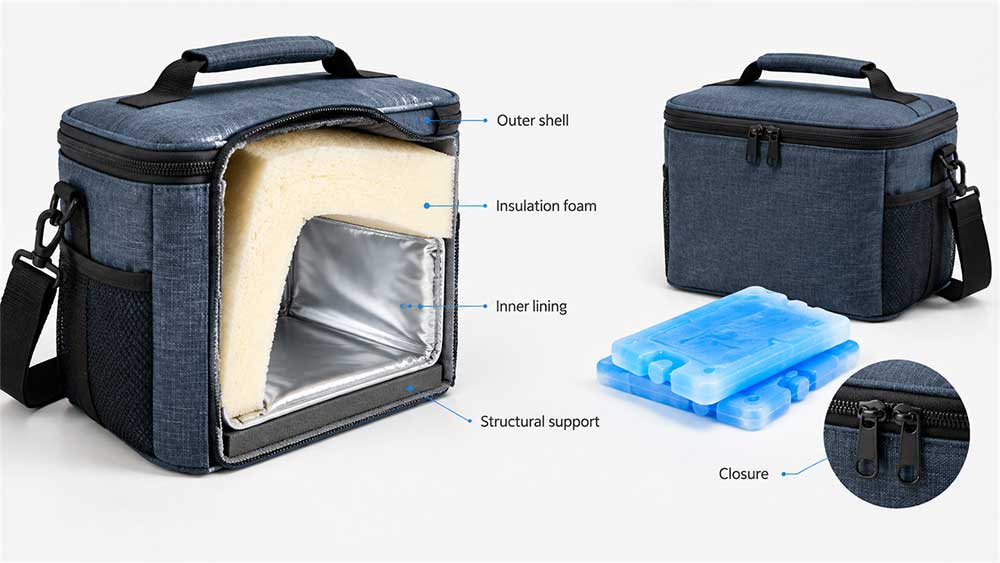
A cooler bag normally contains several functional layers:
An outer fabric or coated shell
Insulation foam
An inner lining
Supporting boards or reinforcement where required
The foam provides most of the resistance to heat transfer. The lining mainly affects cleaning, liquid containment, flexibility, appearance, durability, and seam construction.
A shiny aluminum foil lining does not automatically keep a cooler colder than PEVA, PVC, or TPU. Cold retention also depends on:
Foam type and thickness
Gaps in the insulation
Closure and zipper design
Air leakage
Seam construction
Internal capacity
Ice or ice-pack quantity
Starting temperature
External temperature
Test duration
If buyers want to compare thermal performance, they should test finished samples under the same conditions. Comparing only the lining materials will not provide a reliable result.
What Is a PEVA Cooler Bag Lining?
PEVA film is widely used inside sewn lunch bags, picnic coolers, grocery coolers, and other everyday insulated bags. It normally has a smooth surface that can be wiped after use.
However, “PEVA lining” is not a complete OEM specification. Buyers should also confirm:
Film thickness or material weight
Color and surface texture
Backing material, if any
Seam method
Intended temperature range
Food-contact requirements
Whether the film will be sewn, taped, or sealed
When PEVA Is a Practical Choice
PEVA is often suitable when:
The bag uses conventional sewing
The user will mainly carry packaged food and drinks
Ice packs are used instead of loose ice
Easy cleaning is important
The project has a moderate target price
White PEVA is common because spills and residue are easy to see during cleaning. Other colors and finishes may be available, depending on the material supplier and order quantity.
Limitations of PEVA
PEVA film can resist water, but a sewn PEVA liner is not automatically leakproof. Water may pass through needle holes, seam intersections, or unsealed corners.
Thin PEVA can also be damaged by sharp food containers, bottle caps, can edges, or repeated folding. Its actual durability depends on the grade, thickness, backing, and finished construction.
Buyers should therefore approve PEVA in a complete cooler sample rather than relying only on a small material swatch.
What Does Aluminum Foil Lining Mean?
“Aluminum foil lining” is a broad sourcing term. In many cooler bags, the silver inner surface is not a loose sheet of pure aluminum foil.
It may be:
Aluminum foil laminated to plastic film
Metallized PET film
Foil laminated to woven fabric
Foil-faced foam
Another multilayer reflective material
These materials may look similar but differ in strength, flexibility, cleanability, and cost. The supplier should identify the complete layer structure.
When Aluminum Foil Is a Practical Choice
Aluminum foil laminates are commonly used for:
Promotional cooler bags
Supermarket thermal bags
Lightweight grocery coolers
Short-term event products
Cost-sensitive projects
Products that require a silver inner surface
A reflective surface may reduce radiant heat transfer under suitable conditions, but it does not replace insulation foam.
Limitations of Aluminum Foil Laminates
Some foil laminates crease easily. Thin surfaces may also be punctured by sharp packaging edges or damaged by repeated folding.
Other possible problems include:
Permanent fold lines
Surface scratches
Bubbling
Separation from the backing
Tearing around sewn seams
Wrinkles that are difficult to clean
A sewn aluminum foil lining should not be described as leakproof unless the complete cooler has passed a defined leak test.
What Is a PVC Cooler Bag Lining?
PVC can be used in two main ways.
An ordinary sewn cooler may use flexible PVC film as its inner lining. A waterproof soft cooler may use PVC-coated or PVC-laminated fabric so that compatible panels can be joined by RF welding.
These constructions should not be treated as identical simply because both contain PVC.
A PVC specification should identify:
PVC film or PVC-coated fabric
Base-fabric type
Film or coating thickness
Total material weight
Surface finish and color
Chemical or plasticizer requirements
Welding method, if applicable
Intended food-contact conditions
Target-market compliance requirements
When PVC Is a Practical Choice
PVC may be suitable when:
A flexible, wipeable surface is required
The project needs a weldable material at a controlled cost
The cooler uses a PVC-coated body or liner
The factory has a stable welding process for that PVC construction
The approved weight and flexibility suit the product
PVC-coated fabric has long been used in welded waterproof products because compatible PVC surfaces can be joined by RF welding.
Limitations of PVC
PVC performance varies with its formulation, coating thickness, backing fabric, and operating temperature.
Depending on the selected construction, PVC may be heavier or stiffer than the approved TPU alternative. An unsuitable grade may also develop a noticeable odor, lose flexibility in cold conditions, or show surface cracking after repeated use.
These are not automatic problems with every PVC material. The actual production material should be sampled and tested.
PVC should not automatically be described as unsafe. At the same time, the word “PVC” does not prove that a specific material meets food-contact, REACH, phthalate, California Proposition 65, or retailer requirements.
What Is a TPU Cooler Bag Lining?
In a waterproof soft cooler, TPU lining usually means a textile fabric coated or laminated with thermoplastic polyurethane. It is normally not a loose, unsupported sheet of TPU film.
The backing fabric provides structural strength. The TPU surface creates a smooth inner layer and allows compatible panels to be welded.
Depending on the material formulation, TPU films and laminates can be joined using methods such as heat sealing, ultrasonic welding, and high-frequency welding. Covestro’s TPU film welding guide explains these joining methods and the need to match the process to the material and application.
When TPU Is a Practical Choice
TPU-laminated fabric is often selected when:
The product is a premium waterproof soft cooler
Loose ice and meltwater are expected
The body or liner will be RF welded
Flexibility is important
Repeated outdoor use is expected
The approved TPU construction offers the required weight
The project can support a higher material cost
Limitations of TPU
For comparable specifications and order quantities, TPU-laminated fabric usually costs more than basic PEVA, foil, or many PVC options.
TPU production also requires:
Compatible backing fabric
Stable lamination quality
Suitable welding equipment
Controlled welding settings
Consistent incoming material
Experienced production operators
Changing the TPU thickness, backing fabric, surface finish, or adhesive system may change the welding result. An OEM request that only says “use TPU” is therefore incomplete.
Which Cooler Bag Lining Should You Choose?
The quickest way to narrow down the options is to start with the product type.
Product requirement
Suitable starting point
Low-cost promotional cooler
Aluminum foil laminate
Reusable sewn lunch bag
PEVA
Everyday sewn cooler with a wipe-clean liner
PEVA or flexible PVC film
Cost-controlled welded waterproof cooler
PVC-coated fabric
Premium welded soft cooler
TPU-laminated fabric
Cooler intended for loose ice and meltwater
Tested PVC- or TPU-welded construction
Cooler intended mainly for ice packs
PEVA, foil, PVC, or TPU depending on cost and durability
Product with a PVC-free material policy
PEVA or TPU, subject to full material verification
These are starting points, not fixed rules. The final choice should be confirmed through material sampling and finished-product testing.
Sewn and RF-Welded Coolers Need Different Linings
The manufacturing process should be decided before the lining is finalized.
Ordinary Sewn Cooler Bags
Sewn coolers commonly use PEVA, aluminum foil laminates, or flexible PVC film. These materials are practical for lunch bags, grocery coolers, promotional bags, and picnic products.
However, sewing creates needle holes. Even when the lining material resists water, the seams may leak.
For that reason, ordinary sewn coolers are generally better suited to ice packs than loose ice.
RF-Welded Waterproof Soft Coolers
RF-welded coolers commonly use compatible PVC- or TPU-coated fabrics. The main panels can be joined without sewing through the liquid-holding area.
The material is only one part of the waterproof system. Buyers must also check:
No cooler should be called leakproof only because it uses PVC or TPU. The claim must be based on the complete construction and a defined test.
Food-Contact Compliance Depends on the Exact Material
PEVA, aluminum foil, PVC, and TPU are material categories. None of these names automatically proves food-contact compliance.
A finished lining may include:
Polymer film or coating
Backing fabric
Lamination adhesive
Ink
Surface treatment
Colorants and additives
The required documents also depend on whether the lining will contact packaged food, loose ice, meltwater, or unpackaged food.
For the US market, food-contact substances are assessed according to their identity, intended use, and conditions of use. Buyers can refer to the FDA’s information on food-contact substances.
For the European market, food-contact materials must meet applicable EU requirements. The European Commission provides an overview of food-contact materials legislation.
Depending on the project, an OEM buyer may need to request:
Material specification and declaration
Applicable food-contact test report
Restricted-substance results
Phthalate information for PVC where required
REACH or retailer-specific documents
Tested material color and thickness
Test conditions and food simulants
Traceability to the production material
Avoid accepting a general statement such as “all our linings are FDA approved.” The supporting documents should match the actual material and intended use.
How to Test the Lining Before Bulk Production
A flat swatch cannot show how the lining behaves at corners, seams, welds, zipper ends, and attachment points. Testing should therefore include the finished cooler sample.
1. Inspect the Surface
Check for pinholes, scratches, creases, bubbles, contamination, exposed backing, poor lamination, and damage caused by sewing or welding.
Pay particular attention to the bottom corners and zipper ends.
2. Test Cleaning
Use the cleaning method that will appear in the product instructions. Check how the lining handles water, colored drinks, food residue, oil, meltwater, and repeated wiping.
Record any staining, odor, surface damage, or separation between layers.
3. Check for Leakage
The test method should specify:
Water quantity
Test duration
Bag position
Whether the zipper is included
Whether the bag is moved or tilted
Acceptable leakage level
Pass/fail criteria
A short standing-water test may find obvious holes, but it does not prove long-term waterproof performance.
4. Check Puncture and Abrasion Risk
Test the lining with the products users are expected to carry, such as beverage cans, bottles, food containers, ice packs, and loose ice.
The test should reflect realistic use rather than intentionally using an unusually sharp object.
5. Check Folding and Cold Flexibility
Flex the lining repeatedly at the bottom and corners. If the cooler will be used in cold conditions, inspect it at the agreed temperature.
Look for cracking, whitening, stiffness, permanent creases, delamination, and damage around seams or welds. This is especially useful when comparing PVC and TPU constructions.
6. Inspect Laminations and Welds
For laminated materials, check whether the surface separates from its backing.
For RF-welded PVC or TPU structures, inspect:
Weld continuity and width
Missed sections
Burns or excessive thinning
Wrinkles across the weld
Corner consistency
Material distortion
Contamination in the weld area
If the material, thickness, backing fabric, or welding process changes after sample approval, the relevant tests should be repeated.
What Should Buyers Put in the RFQ?
Avoid vague requirements such as “PEVA lining,” “silver foil inside,” “food-grade PVC,” or “TPU waterproof liner.”
A clearer lining specification should include:
Intended cooler type and use
Packaged food, unpackaged food, ice packs, or loose ice
Two TPU laminates may use different backing fabrics and coating thicknesses. Two PEVA films may also have very different surface strength.
Compare the complete material specification, not only the name.
Assuming Silver Foil Provides the Best Insulation
The reflective surface is only one part of the thermal system. Foam, closure, seams, and overall construction may have a greater effect.
Assuming PVC Is Always Low Quality
PVC is available in different grades and constructions. A properly specified PVC-coated fabric can be suitable for welded cooler products.
Assuming TPU Is Automatically Better
TPU is often suitable for premium coolers, but it costs more and still requires stable lamination and welding. It may be unnecessary for a simple promotional bag.
Calling a Sewn Liner Leakproof
A water-resistant film can still leak through needle holes. Claims should be based on the complete finished product.
Approving Only a Material Swatch
A swatch cannot reveal problems at corners, seams, welds, or zipper ends. Always confirm the finished prototype.
Conclusion
PEVA, aluminum foil, PVC, and TPU serve different cooler bag markets.
PEVA is a practical choice for many reusable sewn lunch bags and everyday coolers. Aluminum foil laminates suit lightweight promotional and cost-sensitive products. PVC can be used as a film in sewn coolers or as a coated fabric in cost-controlled welded constructions. TPU-laminated fabric is commonly selected for premium RF-welded waterproof soft coolers.
The final decision should consider:
Complete material structure
Thickness and backing
Sewn or welded construction
Cleaning requirements
Loose-ice use
Weight and flexibility
Compliance documents
Finished-sample test results
Target cost and expected product life
The best lining is the one that meets the product’s real use conditions without adding unnecessary cost or unsupported performance claims.
Develop the Right Cooler Bag with Vancharli Outdoor
During sampling, buyers can compare PEVA, aluminum foil, PVC, and TPU constructions based on target cost, cleaning, flexibility, leak resistance, compliance, and intended use.
PEVA, flexible PVC, and smooth TPU surfaces can all be easy to wipe. The result depends on the surface texture, seams, corners, and resistance to staining and odor.
Is PEVA better than aluminum foil?
PEVA is often more practical for reusable sewn coolers that need regular cleaning. Aluminum foil laminates are commonly selected for lightweight, promotional, or cost-sensitive products.
Can PVC be used inside a cooler bag?
Yes. Flexible PVC film can be used in sewn cooler bags, while PVC-coated fabric can be used in compatible RF-welded constructions. The exact specification and compliance documents must be confirmed.
Is TPU safer than PVC?
This cannot be decided from the material name alone. Safety and compliance depend on the formulation, intended use, target market, and supporting documents.
Can PEVA or aluminum foil linings hold loose ice?
The material surface may resist water, but sewn seams can still leak. Loose ice should only be recommended when the complete finished cooler has passed a defined meltwater test.
Do RF-welded PVC and TPU linings automatically make a cooler leakproof?
No. Leakage can still occur at welds, zippers, corners, drains, patches, and attachment points. The complete cooler must be tested.
Which lining keeps ice frozen the longest?
The lining alone cannot answer this. Foam, closure, seams, capacity, ice quantity, starting temperature, and external conditions all affect cold retention.









Comments are closed