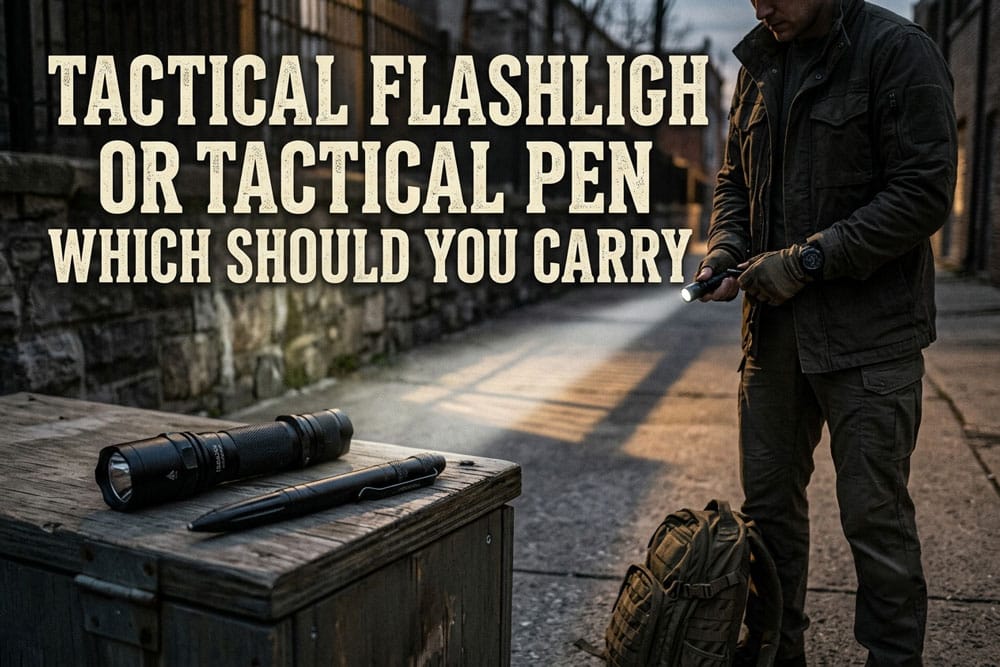
Tactical Flashlight vs. Tactical Pen: Which Should You Carry?
So which one belongs in your pocket? The short answer: a tactical flashlight wins for general everyday carry because light solves more real-world problems, finding dropped keys, walking dark parking lots, signaling for help.
Pick a tactical pen only when you want a defensive tool that passes as ordinary office gear and slips through places where flashlights or knives raise eyebrows.
This guide breaks down what each tool actually does, where each one shines, and how to choose based on your daily routine rather than marketing hype.
Pick a tactical pen only as discreet backup where blades are banned.
Flashlights pass airport security; pens face metal-detector scrutiny and weapon rules.
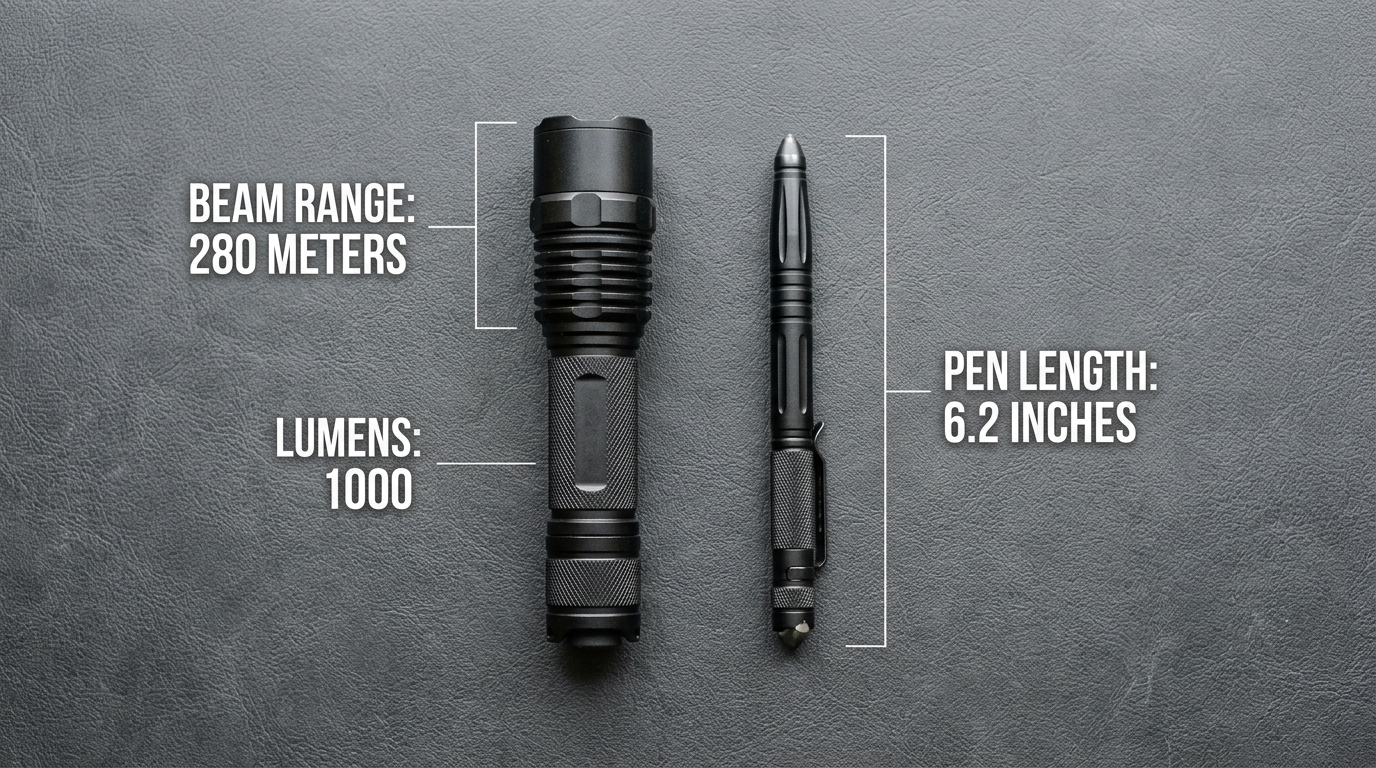
Use 1,000-lumen beams to disorient attackers without physical contact.
Match your tool to environment: lights for parking lots, pens for transit.
Tactical Flashlight Vs Tactical Pen Quick Answer For Everyday Carry
Carry the tactical flashlight if you can only pick one. It handles low-light awareness, signals for help, and disorients an attacker with a high-output beam, all without touching anyone.
The tactical pen earns its spot as a discreet backup for close-range defense, especially where blades or sprays are banned.
So what separates the two? A tactical flashlight is a rugged, high-output light built to identify targets in the dark and temporarily blind a threat.
A tactical pen is a writing pen made from aircraft-grade aluminum, often with a glass-breaker tip, doubling as a kubotan-style impact tool (a short rod used to strike pressure points).
Three criteria settle the choice for most people:
Legality: A flashlight is legal almost everywhere, including airport security checkpoints. Pens face metal-detector scrutiny and local weapon rules.
Environment: Dark parking lots, hiking trails, and roadside breakdowns favor the light. Crowded transit or office settings favor the pen’s low profile.
Skill: Pointing a 1,000-lumen beam takes seconds to learn. Striking effectively with a pen demands repeated training — most users never practice it.
Here’s the honest part. Surveys of everyday carry users repeatedly show people buy a tactical pen and never train with it.
That untrained pen becomes a paperweight in a real fight. The deep dive below breaks down each tool’s specs, legal traps, and the scenarios where one clearly beats the other.
What’s a tactical flashlight vs tactical pen for everyday carry comparison
What Is A Tactical Flashlight And Its Core Self Defense Features
So what is a tactical flashlight? Basically, it’s a tough, super-bright light made for defending yourself and rough conditions, not for reading in bed at night.
The official definition usually pairs it with a gun so you can spot targets in the dark while aiming, but honestly, most regular folks just carry it in their hand.
Here’s the thing. That same bright beam you use to light up a target can also briefly blind or confuse someone attacking you, and the heavy metal body works as a striking tool too.
Four features really set apart a true tactical light from the cheap one you grab at a gas station:
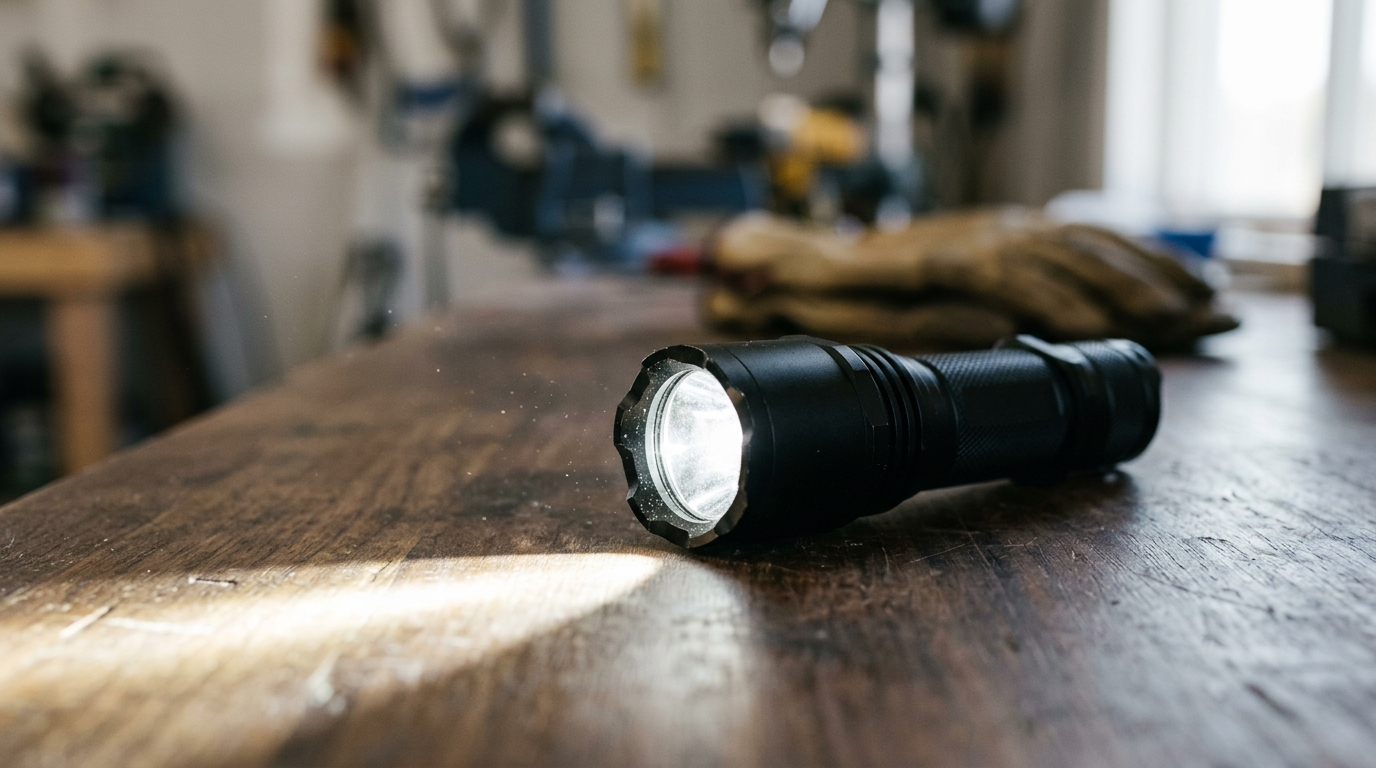
1000+ lumens output — A lumen is just a way to measure total light. Once you go above 1000 lumens, shining a beam straight at someone sets off a startle reflex in their eyes. At about 3 to 5 meters away, the attacker’s pupils snap shut and they instinctively turn their head. That half-second actually gives you room to get away.
Strobe mode — The fast flashing messes with how someone judges distance. It makes it tough for them to tell how far away you are or to close the space between you.
Crenelated strike bezel — That’s the toothed metal ring sitting around the lens. It focuses a hammer-fist hit into sharp points instead of a flat surface.
Aircraft-grade aluminum body — A hardened aluminum alloy called Type III 6061 survives drops and doubles as a small handheld impact tool.
Want the simple rule for buying one? Go with a light that has a momentary tail switch. You press it for light, and you release it for darkness.
That way you control exactly when you give away your spot. Switches that stay on the whole time make you fumble around during a confrontation, which is the last thing you want.
Use lithium CR123A or 18650 cells instead of AAA batteries. The AAA ones drain fast when you pull a lot of power, and they cut your runtime by more than half at full brightness.
And that’s really why the quick answer leaned toward the light. Section 3 breaks down the spots where a tactical pen still comes out ahead.
tactical flashlight core self defense features crenelated bezel and 1000 lumen beam
What Is A Tactical Pen What It Looks Like And How It Works
A tactical pen is a working ink pen built from aircraft-grade aluminum or steel so it doubles as a self-defense and emergency tool. It writes like any pen, but the body is heavy enough to strike, and the tip can break glass.
Think of it as a low-profile defense tool that hides in plain sight.
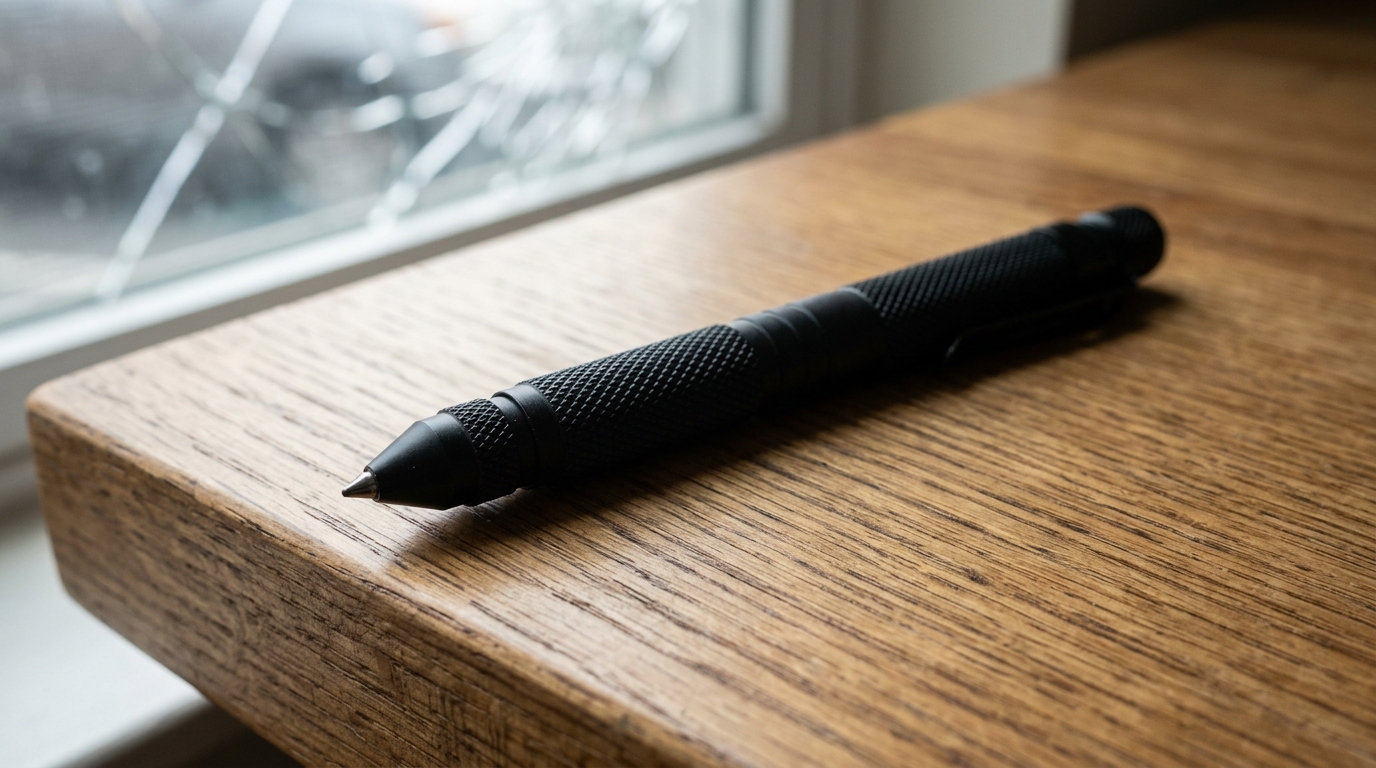
Look closely and the design tells the story. Most have a matte metal barrel about 5.5 inches long and thicker than a normal pen.
The non-shiny finish cuts glare and hides wear. One end carries a pointed, hardened tip, often tungsten carbide, called a glass breaker.
Press it hard against a corner of a car window and the focused point cracks tempered glass in one strike. That feature matters: drowning trapped in a flooded vehicle is a real risk, and a glass breaker tip gives you a fast exit.
The grip is knurled, a diamond-pattern texture machined into the metal. It keeps the pen locked in your fist when your palm sweats.
That grip points to the real function. A solid tactical pen works as a kubotan-style impact tool, meaning you jab it into soft, painful targets, the back of the hand, the collarbone notch, the thigh nerve, to create a window to escape.
Here is the test that separates a real one from a gimmick. Squeeze the barrel.
If it flexes, dents, or rattles, it will fold on impact. A genuine tactical pen survives a firm strike on concrete with no bend.
Cheap aluminum tubes priced under $5 fail this, they look the part but crumple. Spend approximately $25 to $40 for machined, single-piece construction that holds up.
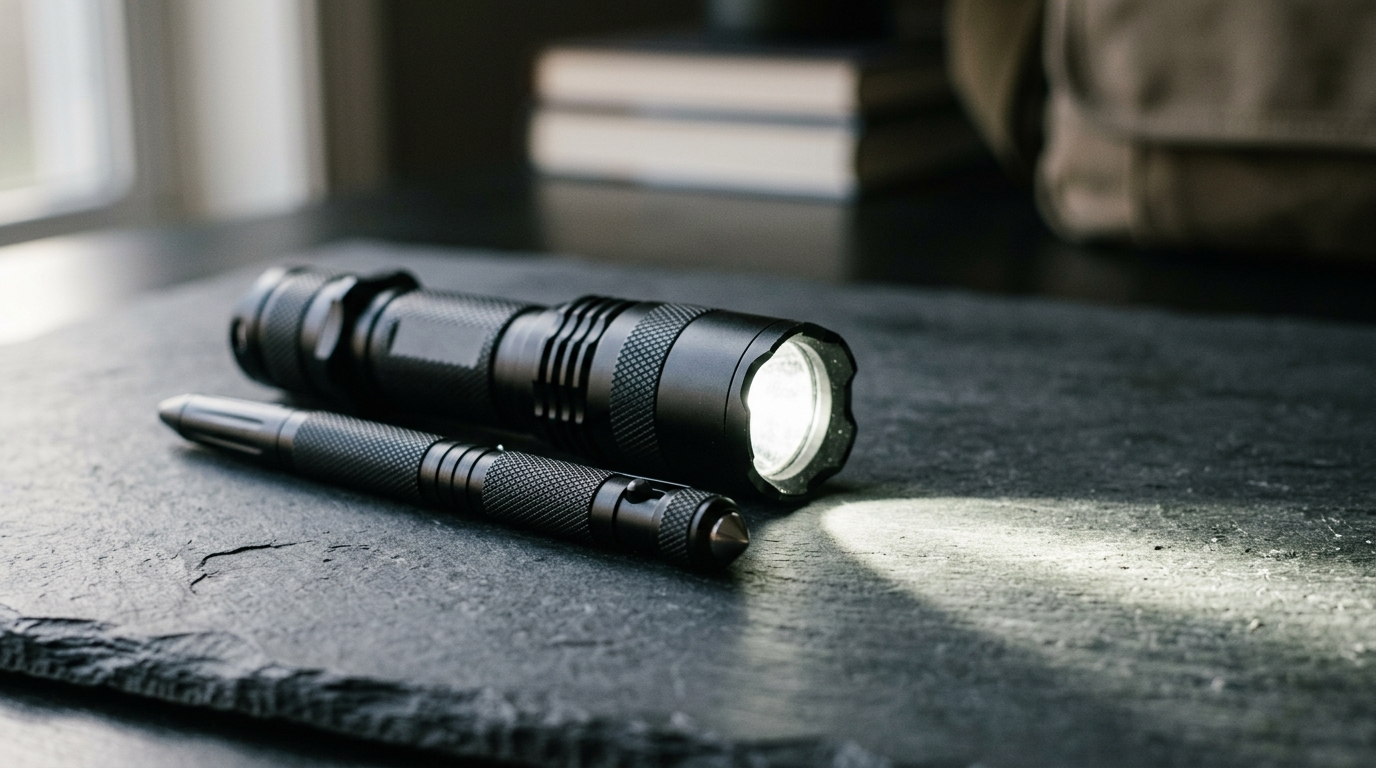
So when you ask what’s a tactical flashlight versus what is a tactical pen, the answer splits clean: one floods light, the other delivers focused force in your hand.
What’s a tactical pen showing matte metal barrel knurled grip and glass breaker tip
Direct Comparison Table By Scenario Low Light Close Quarters Deterrence And Signaling
Look at four situations you might actually run into, and the tactical flashlight comes out on top in three of them. The pen only pulls ahead when you need to defend yourself up close in a tight space where nobody can see what you’re holding.
The table below scores each tool on real numbers, not on whatever the box promises.
Scenario
Tactical Flashlight
Tactical Pen
Low-light navigation
Effective beam 100–200 m at 1,000+ lumens
None — no light output
Close-quarters defense
Strike or blind at arm’s length; bulky
Kubotan strikes within approximately 60 cm; fast draw
Public deterrence
High — a momentary 1,000-lumen burst disrupts vision for several seconds
Low — looks like a pen, no visible threat
Emergency signaling
Strobe mode visible 1.5+ km at night
Glass-breaker tip only; no signal range
Concealability
Clips to a pocket; obvious shape
Sits in a shirt pocket; invisible
Draw-to-use speed
~1.5 s, includes mode selection
~1 s; point-and-strike
That blinding effect isn’t a sales pitch. It’s something you can actually measure.
A tactical light can temporarily disorient a target, and when you hit someone with 1,000 lumens from up close, their eyes squint shut on their own. Honestly, that reaction buys you a few seconds to get away, and a pen simply can’t do that.
So what is a tactical flashlight worth out in the dark, and what is a tactical pen worth when you’re packed into a crowded elevator? In the end, it really comes down to reach.
The pen’s glass-breaker tip only earns its keep when you’re trapped inside a vehicle and need to get out, since a light does nothing for you there. Choose based on the threats you genuinely expect to deal with. That’s what we’ll get into next in the legality section.
Tactical flashlight vs tactical pen comparison by scenario low light defense and signaling
Legality Of Carrying Tactical Pens And Flashlights By Location
Flashlights are legal almost everywhere you go. Tactical pens, though, are a different story.
And that’s really the gap that most buying guides just skip right over. A flashlight will pass through airport security, those courthouse metal detectors, and school checkpoints without any issue at all.
A pen that’s built like a kubotan-style impact tool, which is basically a short rod meant for striking someone and pressing on pressure points, can actually get taken away from you. Or it could get you charged with carrying a hidden weapon.
So why the difference? Well, a flashlight just reads as a useful everyday object.
The people checking bags see a light and that’s it. But a tactical pen with a sharp steel tip and a glass breaker end reads as something you’d hit somebody with, even though it does actually write.
It really comes down to what the thing was designed for and what you mean to do with it, not the name printed on the box.
So here is where each one of these tools either passes or fails actual screening:
Location
Tactical Flashlight
Tactical Pen
TSA carry-on (US airport)
Allowed in carry-on
Pointed or metal pens often get pulled aside. The TSA officer makes the final call and can make you check the bag
Federal courthouse
Allowed after the X-ray check
Taken away as a banned weapon
K-12 school grounds
Generally allowed
Banned as a weapon in a lot of states. It can even be a felony in some places
Most US states (street carry)
Legal
Legal in most places, though “deadly weapon” intent laws can come into play if you use it in a fight
The TSA “What Can I Bring?” tool lists flashlights as fine for your carry-on bag, but it flags self-defense items for a case-by-case review instead.
Want to bring a pen on a flight? Just pack a plain plastic one and put the metal kubotan version in your checked bag.
And asking “what is a tactical pen” at a checkpoint really won’t help you much, because the officer is just judging the object sitting in front of them.
So check your own state law before you carry one. New York and California treat certain impact tools pretty strictly, while most other states leave plain flashlights alone and don’t regulate them at all.
Minimum Training And Grip Techniques To Actually Use Each Tool
The flashlight is the easier tool to learn. You need one grip and one timing drill. The pen demands real skill, hammer-fist mechanics and pressure-point targeting that fall apart fast under adrenaline.
Start with the flashlight. Hold it in a “sword grip”, fist wrapped around the body, thumb on the tail switch, beam pointing forward like a short blade.
This is the same hold a knife junkie review of tactical lights describes for both handheld defensive use. The skill is timing: blast the light into the eyes, then move or strike during the 1,2 seconds the person is blinded.
That window is short. A tactical flashlight can disorient a target, but only if you act immediately. Most people can drill this to reliability in approximately 3,5 hours of practice. Flash, step, repeat.
The pen is harder. You hold it in a hammer fist, point sticking out the bottom of your closed hand, like an ice pick.
Strikes land on soft pressure points: the back of the hand, the collarbone notch, the thigh nerve. Acebeam and similar makers design these as kubotan-style impact tools for exactly this.
Flashlight: ~3–approximately 5 hours to one reliable grip and timing pattern
Tactical pen: 15–approximately 20 hours minimum for usable hammer-fist accuracy under stress
Skip the fancy pen-spinning tricks. Drill one strike to one target until it’s muscle memory. That’s what actually works.
Realistic Self Defense Scenarios Where Each Tool Performs
One tool wins in three of four common scenarios. The flashlight handles distance, lighting, and deterrence. The pen only wins when an attacker already has hands on you. Here is how each plays out.
Dark parking garage, someone following you
You hear footsteps closing from 20 feet back. This is the flashlight’s home turf.
A 1,000-lumen burst to the face triggers an involuntary blink-and-flinch response, buying you two to three seconds to move toward an exit. A tactical flashlight works here because it acts at range.
The pen does nothing at 20 feet. You can’t strike what you cannot touch.
Crowded subway, a grab from behind
Someone seizes your wrist or pins you against a pole. Now the pen earns its place.
Held in a forward grip, the steel tip drives into the hand, forearm, or collarbone, kubotan-style pressure points that force a release. The flashlight is useless this close; blinding light loses effect under 3 feet, and you’ve no room to aim it.
Roadside breakdown at night
Engine dead, traffic roaring past. The flashlight signals your position and inspects the engine bay. A strobe mode flagged a stalled-driver fatality risk that the NHTSA ties to roughly 600 pedestrian deaths yearly along highways. The pen offers nothing here.
Building fire, jammed exit
Smoke fills the stairwell, the door won’t budge. The pen’s tungsten glass-breaker tip shatters tempered glass in one strike, the only scenario where a flashlight can’t substitute.
So what’s a tactical flashlight best at? Distance and visibility. The pen owns contact range and glass. Carry both if you can.
Common Mistakes And Counterintuitive Truths About These EDC Tools
The biggest mistake? Buying the cheapest tool you can find.
A approximately $6 tactical pen often uses thin-wall aluminum that bends or crumples on a hard strike. If the pen folds the first time you need it, you carried dead weight.
Spend at least $25,$40 on a pen with a solid one-piece body and a real glass-breaker tip rated for tempered auto glass.
Strobe mode is oversold. Yes, a rapid flash can disorient an attacker.
But in a dark hallway or stairwell, that same strobe bounces off walls and disorients you too. Many trainers now teach steady high-output bursts instead.
A 2025 review at The Knife Junkie notes that constant-on and momentary switches matter more than gimmick modes for real defensive use.
Another trap: thinking a pen replaces awareness. A kubotan-style impact tool only works at arm’s length, and only if you saw the threat coming. The pen doesn’t scan the parking lot for you. Head up, phone down, that habit prevents more trouble than any gear.
Here is the counterintuitive truth most people miss when they ask what’s a tactical flashlight or what is a tactical pen. The flashlight prevents far more confrontations than it ever ends.
A bright beam on a stranger’s face signals “I see you” and ends the threat before it starts. Avoidance beats engagement every time.
Don’t: rely on strobe indoors — it blinds the user too
Do: test your glass-breaker on a junk window once, so you trust it
Don’t: assume any tool replaces situational awareness
How To Decide Which One To Carry Based On Your Lifestyle
Match the tool to where you spend your hours, not to what looks coolest online. Your commute, your travel pattern, and the laws where you live decide the answer faster than any spec sheet. Use the framework below.
If you drive at night often, delivery, rideshare, long highway stretches, carry the flashlight. You can light up a stalled car, signal another driver, and a model with a glass breaker-style hardened tip lets you exit a sinking or crashed vehicle.
The light earns its pocket space every shift.
If you’re a daily city commuter on foot or transit, carry both if your laws allow. The flashlight covers dark stairwells and parking garages.
The tactical pen sits in your bag as a backup contact tool. They don’t overlap, one works at distance, one works in a grapple.
If you cross airport security regularly, leave the pen behind. The TSA bans pointed metal objects in carry-ons, and seized items run into the millions of prohibited items collected yearly. A small flashlight under 6 inches usually clears screening. Travelers should default to the light.
Carrying both makes sense only when each has a clear job. Clip the pen to your shirt pocket where it reads as a pen.
Drop the light in a front pants pocket for one-handed draw. Avoid stacking redundant gear, two impact tools doing the same thing just adds weight.
So what’s a tactical flashlight worth in your kit versus a pen? The flashlight wins for most lifestyles. The pen is the specialist you add second.
Frequently Asked Questions
Quick answers to the questions buyers ask most before they spend money on either tool.
What’s the point of a tactical pen?
It gives you a discreet defensive option that passes as ordinary office gear. A tactical pen writes like a normal pen but uses kubotan-style strikes (short jabs to pressure points like the wrist or collarbone) for defense.
Many models also include a glass-breaker tip to escape a sinking or burning car.
Are tactical pens legal to carry?
In most U.S. states, yes, because a working ink pen isn’t a defined weapon.
But airport security treats the steel point as a sharp object, so the TSA will confiscate it at the checkpoint. Some courthouses and schools also bar metal striking tools, so check local rules before you carry one inside government buildings.
How does a tactical pen work?
You grip it in a closed fist with the pointed end out, thumb on the cap, and drive short strikes into soft targets. The aircraft-grade aluminum body concentrates your force into a tiny contact area, so a 6-ounce pen hits far harder than a knuckle.
Which is better for self-defense?
The flashlight wins for most people. Understanding what a tactical flashlight is versus what a tactical pen is comes down to range: light disorients an attacker from 10 feet away, while a pen needs contact distance. Carry the flashlight first.
Final Verdict And Choosing Your Everyday Carry Setup
Buy the tactical flashlight first. It’s legal almost everywhere, needs one grip and one drill to use, and beats the pen in three of four real scenarios. Add a tactical pen only after you confirm your local laws allow it and you commit to monthly strike practice.
The decision comes down to three filters, in this order.
Legal — Can you carry it where you live and travel? A flashlight clears nearly every airport, courthouse, and school zone. A kubotan-style pen (a pointed impact tool) doesn’t.
Skill — Will you train? The flashlight works on day one. The pen needs roughly 20 to 30 reps a month to keep the grip and target recall sharp under stress.
Environment — Where do your hours go? Dark parking lots and night commutes favor the light. Crowded transit and tight venues favor the pen’s discreet profile.
So what’s a tactical flashlight versus a tactical pen at the buying stage? It’s a question of friction, not coolness. The light disorients an attacker from 10 feet away; the pen demands you already be in arm’s reach. Distance is safety.
Skip the impulse buy. The U.S.
Bureau of Labor Statistics reported tens of thousands of nonfatal workplace assaults yearly, many in low-light service roles,proof that lighting and awareness matter more than any strike tool. Test your daily route this week.
If it’s dark, get the light. If you’ll train and your laws permit, add the pen.









Comments are closed