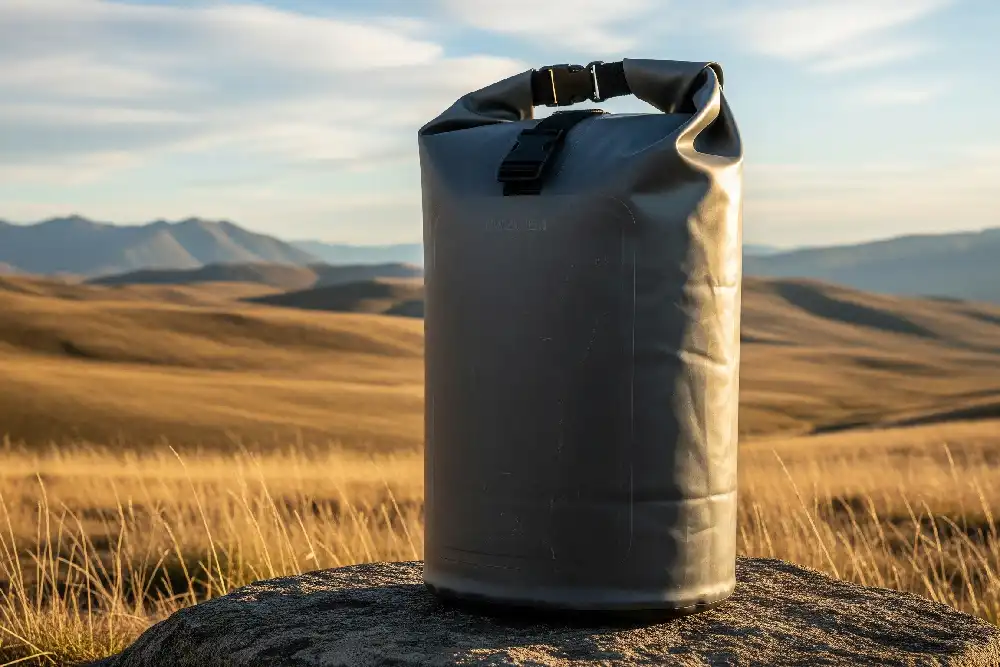
The challenge of designing a truly waterproof bag is not just about keeping water out — it’s also about managing the air trapped inside. Anyone who has tried to roll a dry bag knows the “balloon effect”: trapped air makes sealing difficult, wastes internal space, and affects carrying comfort.
This is where breathable valve design comes in. By allowing trapped air to escape without letting water in, these systems dramatically improve storage efficiency and overall usability. For OEM and ODM brands, understanding this technology opens a new path toward optimizing both user experience and production efficiency. If you’re evaluating new suppliers or structures, explore our waterproof bag manufacturing capabilities and dry bag production expertise.
The Challenge of Waterproof Storage
Waterproof means airtight — and airtightness is a double-edged sword. It keeps water out but also locks air in. The result?
Bulky, inflated bags that are difficult to seal
Inefficient use of internal space
Uneven weight distribution and awkward handling
Designers have long searched for a way to maintain IPX-level waterproofing while improving airflow management and packing usability. This pursuit led to two dominant engineering approaches: mechanical purge valves and breathable waterproof membranes.
Two Engineering Paths: Valve vs. Membrane
A. Purge / Air Valve Design (Mechanical Venting)
The purge valve is a small but powerful addition to any waterproof bag. It allows trapped air to escape through a one-way mechanism, maintaining internal pressure balance.
During packing, users can squeeze air out while keeping the roll-top securely closed. Once sealed, the valve automatically prevents air or water from re-entering, ensuring reliable compression.
In real-world applications, this design significantly improves both packing efficiency and sealing performance — as verified in field tests.
Key Benefits:
Enables maximum compression and compact storage
Reduces stress on zippers and seams
Suitable for heavy or bulky gear (sleeping bags, clothing, etc.)
Prevents “ballooning” during travel or altitude changes
Considerations:
Requires precision welding and leak testing
Slightly higher cost; possible clogging in muddy environments
Ideal for high-performance, high-volume waterproof products
To compare different dry bag structures and production methods, visit our dry bag manufacturer page.
B. Breathable Waterproof Fabric (Membrane-Based Solution)
An alternative approach is to integrate breathable yet waterproof membranes, similar to technologies like eVent® or eVac®. These materials allow air molecules to pass through microscopic pores while blocking water droplets — providing passive venting with no moving parts.
Across multiple production cycles, these systems have proven reliable for compression dry bags and lightweight travel gear, validated through independent testing.
Key Benefits:
No mechanical components → lighter and simpler
Lower maintenance and failure risk
Ideal for small to medium-volume or minimalist designs
Works seamlessly with coated nylon or polyester bases
Considerations:
Air release rate slower than mechanical valves
Breathability may be affected by mud, oil, or salt contamination
May require double-layer reinforcement for durability
TIP: For lightweight, small-capacity waterproof bags, membrane venting offers the best balance between performance and cost.
Comparing Both Systems
Feature
Purge Valve
Breathable Membrane
Air Release Speed
Very fast
Moderate
Maintenance
Requires cleaning
Minimal
Durability
Mechanical wear possible
Fabric-based, no moving parts
Ideal For
Large-volume dry bags
Lightweight compression bags
Cost
Slightly higher
Lower
Manufacturing Complexity
Welding or injection mount
Lamination process
Insight: Both systems enhance usability — purge valves excel in maximum compression, while membranes are ideal for lightweight, portable gear.
How Breathable Valve Design Improves Storage Experience
The benefits of a well-engineered venting system go far beyond comfort — it completely changes how users interact with their gear.
Easier Packing and Sealing Releasing trapped air allows faster, smoother roll-top closure with less effort.
More Efficient Space Usage Flattened bags take up to 25% less volume, optimizing storage in vehicles, lockers, or cargo containers.
Improved Weight Distribution Even internal compression prevents awkward bulges, keeping the load balanced for more stable carrying.
Longer Lifespan and Durability Reduced stress on seams and closures extends product life — especially when paired with PE board reinforcements and DWR-coated polyester.
At Vancharli, we treat vent design as a core engineering system, not an accessory. Every waterproof bag project starts with a structural decision — valve-based compression vs. membrane venting — depending on intended capacity and use case.
Recommended Material Combinations
Component
Preferred Option
Notes
Shell Fabric
70D–210D Nylon / 600D Polyester
PU/DWR coating
Valve Housing
TPU or ABS with ultrasonic welds
Must pass leak test
Membrane Panel
Waterproof, air-permeable fabric
Use C0 PFAS-free version
Base Reinforcement
1.5–2 mm PE board
Avoid delamination
Seal Method
HF welding / Seam taping
ISO 811 compliant
TIP: When developing OEM waterproof bags, specify early whether your design requires valve-based compression or membrane venting — it impacts tooling, cost, and testing protocols. For more insight into our multi-country facilities, explore about us and our waterproof bag manufacturing overview.
Real Use Scenarios: When Breathable Valve Design Makes a Difference
Breathable valve technology isn’t just theoretical — it changes how users pack, carry, and store their gear in everyday life.
Outdoor Expedition & Camping Purge-valve dry bags compress bulky items like tents and sleeping bags, reducing strain during long-distance trekking.
Urban Commuting & Daily Gym Use A membrane-vented backpack slowly releases humidity from used clothing, preventing odor buildup — ideal for daily commuters or gym users.
Kayaking & Water Sports By releasing excess air before sealing, purge valves prevent ballooning and improve buoyancy control in water.
Travel & Luggage Organization Vented duffels compress flat for efficient storage in overhead compartments or checked luggage.
Rescue & Tactical Operations One-way valves enable rapid compression for medical or rescue kits — combining waterproof protection with speed and convenience.
TIP: From mountain expeditions to daily commutes, airflow management defines modern waterproof performance.
OEM/ODM Recommendations for Buyers
For OEM and ODM brand buyers, integrating valve systems should consider not just appearance but manufacturability, testing capability, and regional production advantages.
1.Choose by Use Scenario
Use Case
Recommended System
Example
Expedition / Diving
Purge Valve
Heavy-duty dry bags
Urban Commuter
Membrane
Slim waterproof backpacks
Rescue / Military
Valve
Quick compression and release
Lightweight Travel
Membrane
Foldable waterproof pouches
2.Consider Production Regions
Valve assembly and welding lines are well-developed in Vietnam and Indonesia.
Breathable panels are efficiently integrated into stitched-and-taped construction in China and Myanmar (see our about us for factory details).
3.Testing and Compliance Always verify standards: ASTM D751, ISO 811, AATCC 61, and maintain AQL ≤ 2.5 for major defects. Additional references are available from ISO’s technical overview.
Sustainability and Long-Term Maintenance
Modern buyers value performance and environmental integrity. Vancharli uses GRS-certified rPET and C0 PFAS-free coatings to maintain waterproof performance while reducing environmental impact.
Learn more through our Sustainability and Custom Fabric Options programs. Additional information can also be found in relevant technical documentation.
Key Takeaways for Product Developers
Valve vs. Membrane: Each serves different markets — compression vs. lightweight designs.
User Experience: Controlled airflow = faster packing and smoother sealing.
Factory Precision: Welding and sealing accuracy determine long-term reliability.
Sustainability: Choose rPET and PFAS-free coatings whenever possible.
Testing: Every prototype must pass hydrostatic and burst-pressure validation.
Conclusion
The breathable valve system represents a small innovation with major impact. Whether through a precision-engineered purge valve or a passive breathable base, airflow control transforms the way waterproof bags perform.
For OEM/ODM brands, it’s not just about keeping gear dry — it’s about making bags smarter, more efficient, and more user-friendly.
Start exploring professional customization through OEM & ODM Bag Manufacturing, learn more about our waterproof bag manufacturing, and meet the team behind it in about us.
Q1: Do breathable valves reduce waterproof performance? No. High-quality valves are welded and sealed to maintain IPX6–IPX8 ratings, verified under multiple pressure tests.
Q2: Which type is better for lightweight gear — valve or membrane? Membrane systems are ideal for light and compact bags, offering good venting with minimal added weight.
Q3: Can Vancharli integrate custom valve systems into OEM designs? Yes. Our engineering team can customize valve size, position, and logo to suit brand specifications.
Q4: How does this design improve storage and logistics efficiency? By allowing air release, bags can be flattened up to 25% more, optimizing shipping and warehousing volume.
Q5: Are the materials eco-friendly? Yes. We use GRS-certified rPET fabrics and PFAS-free waterproof coatings that meet international environmental standards.
Q6: What industries most benefit from breathable valve design? Outdoor, tactical, sports, and travel brands — especially those requiring high compression and waterproof durability.






Comments are closed