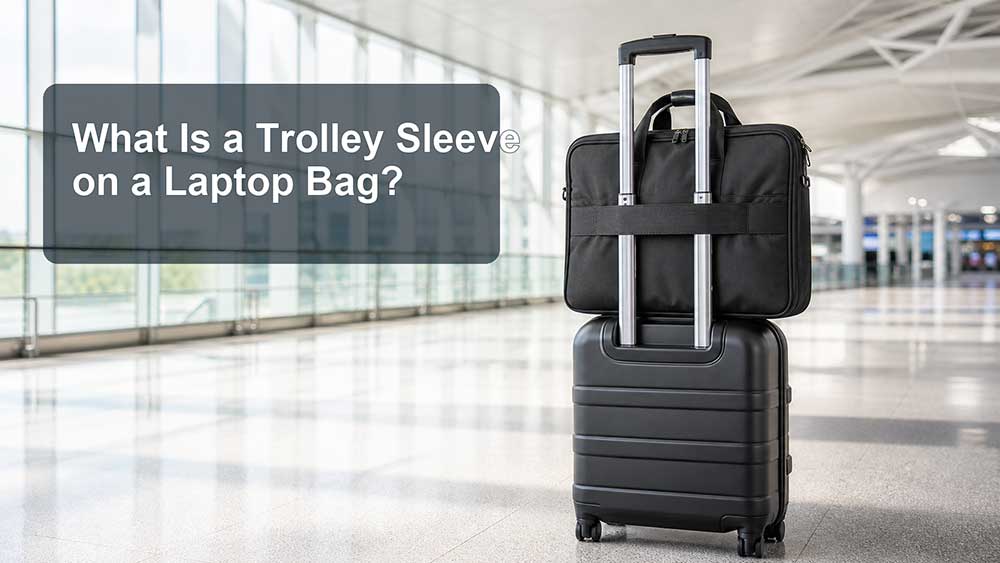
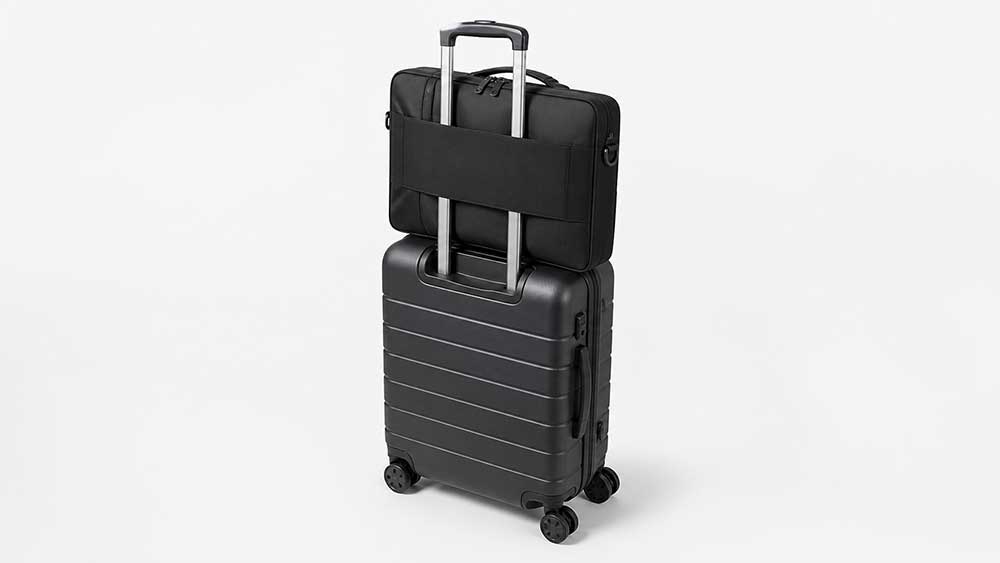
A trolley sleeve is a strap or fabric panel on the back of a laptop bag that slides over the extended handle of a rolling suitcase. It helps the bag stay on top of the suitcase so the traveler can move both pieces together instead of carrying the laptop bag on one shoulder.
In simple terms, it lets a laptop bag ride more securely on rolling luggage.
This feature is also commonly called a luggage sleeve, luggage pass-through, trolley strap, or luggage strap. The names are often used interchangeably, although the construction can range from a narrow webbing strap to a wide fabric panel or a convertible zippered pocket.
A trolley sleeve does not give the laptop bag wheels or a retractable handle. It simply connects the bag to luggage that already has a telescoping handle.
To help stabilize the laptop bag on top of the suitcase
Is it the same as a laptop sleeve?
No. A laptop sleeve holds the computer; a trolley sleeve connects the bag to luggage
Does it fit every suitcase?
Not necessarily; the handle shape, sleeve opening, placement, and packed bag all matter
Is it only used on backpacks?
No. It can be added to briefcases, messenger bags, totes, duffels, and travel backpacks
How Does a Trolley Sleeve Work?
Using one is straightforward:
Extend the suitcase handle fully.
Turn the rear panel of the laptop bag toward the handle.
Slide the handle through the trolley sleeve.
Lower the bag until its bottom rests on top of the suitcase.
Check that the bag does not lean heavily, rotate, or interfere with the handle grip.
A well-fitted sleeve is intended to reduce side-to-side movement while the suitcase supports most of the laptop bag’s weight. This makes it easier to move through airports, train stations, hotel lobbies, and exhibition halls with two bags.
The suitcase still needs to be pulled or pushed, so describing the feature as completely “hands-free” is not quite accurate. The practical advantage is that the traveler can manage two bags as one rolling unit and keep the other hand available for a phone, passport, boarding pass, or coffee.
Trolley Sleeve, Luggage Sleeve, and Luggage Strap: Are They Different?
Bag brands do not use one consistent name for this feature.
You may see:
Trolley sleeve
Luggage sleeve
Luggage pass-through
Suitcase sleeve
Trolley strap
Luggage strap
Handle pass-through
In most product descriptions, these terms refer to the same basic purpose: securing a second bag over the handle of rolling luggage.
The construction may still be different. “Sleeve” or “pass-through” often describes a fabric panel with openings at the top and bottom. “Strap” may describe a narrower piece of webbing or fabric. However, brands do not always follow this distinction, so buyers should check the product photos and specifications instead of relying only on the name.
A trolley sleeve should also not be confused with the padded laptop compartment inside the bag. The internal compartment holds and protects the computer. The rear trolley sleeve connects the complete bag to a suitcase.
Common Trolley Sleeve Designs
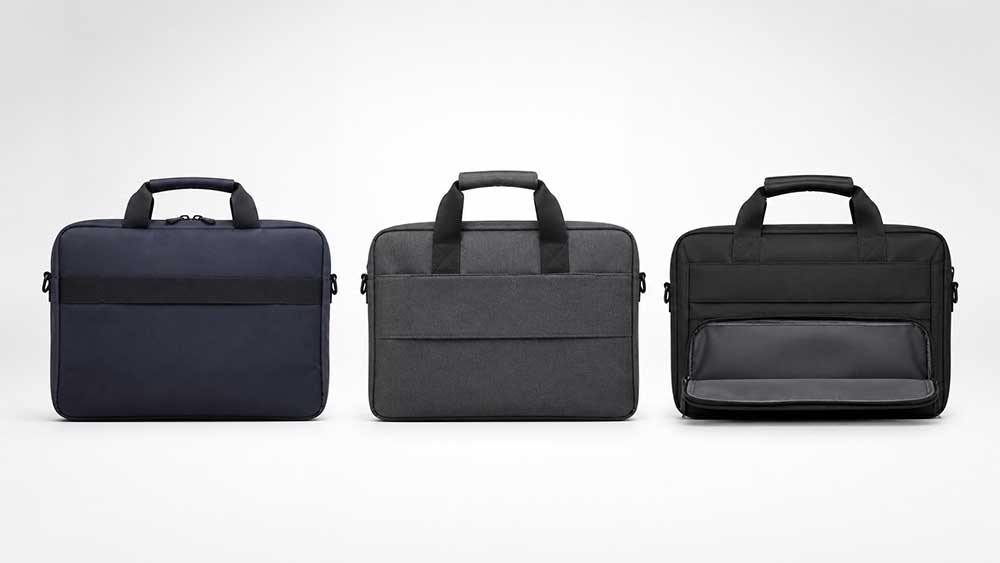
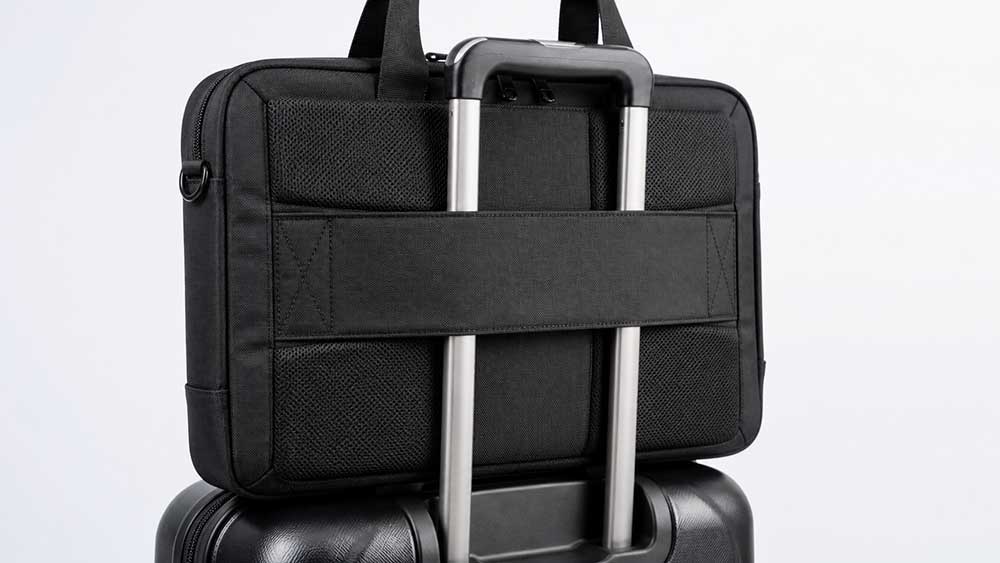
Simple webbing strap
A horizontal piece of webbing is sewn to the rear panel at both ends, leaving enough space behind it for the suitcase handle.
This construction uses little material and keeps the back panel relatively simple. Its performance depends on the strap width, usable opening, stitching, reinforcement, and placement. If it is too loose, the packed bag may rotate during turns.
Wide fabric pass-through
A wider fabric panel creates a larger contact area across the back of the bag. When the opening and position are designed correctly, it can provide better stability than a narrow strap.
The panel still needs enough clearance for the suitcase grip and handle posts to pass through without excessive force.
Convertible zippered pocket
Some laptop bags have a rear pocket with a zipper or opening along the bottom. When the bottom is closed, it works as a storage pocket. When opened, the suitcase handle can pass through it.
This design makes better use of the rear panel, but the closure needs to be secure and easy to understand. A user should not mistake an open pass-through for a closed pocket and lose small items through the bottom.
Detachable luggage strap
An external strap can help secure a bag that does not have an integrated sleeve. It offers flexibility but may shift, loosen, or get misplaced. For frequent business travel, a correctly positioned built-in sleeve is usually more convenient.
Why Is a Trolley Sleeve Useful for Business Travel?
The feature is most useful when a laptop bag is regularly carried with rolling luggage.
It can:
Reduce the time the bag spends on one shoulder
Help prevent it from sliding off the suitcase during normal movement
Make travel documents and a phone easier to manage
Keep the laptop bag off airport or station floors
Reduce loose straps and separate items while moving through queues
Make a briefcase, tote, or business backpack more practical for travel
It does not replace comfortable straps or handles. Travelers still need to carry the laptop bag on stairs, uneven streets, public transport, and anywhere the suitcase cannot roll easily.
Not necessarily. A trolley sleeve may fit many common suitcase handles without being compatible with every model. There is no single sleeve size used by every bag and luggage brand.
Check the following before assuming the combination will work.
1. Measure the widest part of the handle
Do not measure only the distance between the two handle posts. The top grip may be wider, thicker, curved, or shaped differently from the posts below it.
The widest section that must pass through the sleeve determines whether the bag can be attached.
2. Check the usable sleeve opening
The outside width of the fabric panel is not the same as the usable opening. Seams, folded edges, foam, and reinforcement can reduce the space available for the handle.
A sleeve that is too tight is difficult to use. One that is too loose may allow the bag to move or rotate.
3. Make sure the bag rests on the suitcase
The bottom of the laptop bag should sit on top of the suitcase. The sleeve is intended to control movement, not suspend the full weight of the packed bag from the handle.
If the sleeve is too high or too low, the bag may hang above the suitcase, lean at an awkward angle, or interfere with the grip.
4. Consider the packed center of gravity
A laptop bag may appear stable when empty but behave differently after it is packed.
A heavy laptop, charger, documents, bottle, and full front pocket can shift the weight away from the suitcase handle. The bag may then lean, rotate during turns, or make a small, lightly packed suitcase more likely to tip when standing.
5. Test movement as well as static fit
A practical check should include:
Straight movement
Tight turns
Sudden stops
Changes in walking speed
Small floor transitions
The suitcase standing unsupported
The laptop bag packed with realistic contents
Testing an empty bag on one suitcase cannot confirm compatibility with every handle or travel load.
What Makes a Good Trolley Sleeve?
A reliable trolley sleeve should work with the complete bag, not just look acceptable as a separate strip of fabric.
A practical opening
The finished opening should provide enough clearance for the intended handles without being excessively loose. The usable measurement after stitching and padding is more important than the original pattern-piece size.
Correct placement
The sleeve should allow the bag to sit on the suitcase while keeping its loaded weight reasonably close to the handle. It should not prevent the traveler from holding the suitcase grip comfortably.
Reinforced attachment points
The ends of a strap experience repeated pulling and twisting. Depending on the design and expected load, the construction may use backing material, backstitching, box stitching, or bar tacks.
Extra stitching alone does not guarantee strength. The attachment should connect to a stable part of the rear-panel construction rather than only to a weak outer layer.
Suitable materials
The material should tolerate repeated contact with a metal or plastic suitcase handle without quickly stretching or wearing through. It should also match the appearance and intended use of the bag.
A formal business briefcase may need a more discreet construction than a lightweight travel backpack.
Comfortable integration
On a backpack, the sleeve should not create a hard edge against the user’s back. Stitching, folded edges, zipper pulls, and internal reinforcement should not reduce normal carrying comfort.
A travel-oriented sleeve should therefore be considered together with the shoulder straps, back padding, laptop compartment, pockets, and overall shape. Our guide to designing a professional business backpack explains why features need to work as part of one product rather than as a checklist of additions.
Does a Trolley Sleeve Make a Laptop Bag Carry-On Approved?
No. A trolley sleeve does not determine whether a laptop bag qualifies as a carry-on or personal item.
A laptop bag may fit securely on a suitcase and still exceed an airline’s personal-item limit. Our explanation of whether a laptop bag counts as carry-on luggage covers this distinction in more detail.
Should Your Laptop Bag Have One?
A trolley sleeve is worth considering if you frequently travel with both a laptop bag and rolling luggage. It is particularly helpful in airports, train stations, hotels, trade shows, and other places where the two bags need to move together.
It may be less important if the bag is mainly used for office commuting, cycling, driving, or one-bag travel.
The feature should not take priority over laptop fit, padding, carrying comfort, sensible organization, durable construction, or appropriate overall size. Travelers should also consider how they pack a laptop bag for business travel, because the packed weight and distribution affect how well it sits on a suitcase.
What Brands Should Specify During Product Development
For a custom laptop bag, “add a trolley sleeve” is not a complete instruction.
The specification should clarify:
Sleeve type and construction
Finished usable opening
Position on the rear panel
Intended suitcase-handle range
Material, backing, and reinforcement
Stitching method
Whether it also functions as a pocket
Zipper direction and closure, where applicable
Target packed load
Compatibility and movement checks
Appearance and comfort requirements
The sample should be evaluated with the kind of suitcase and packed load the target customer is likely to use. If a brand sells coordinated luggage, the laptop bag should also be tested with the brand’s own suitcase handles.
Developing Travel-Friendly Laptop Bags With Vancharli Outdoor
Vancharli Outdoor supports OEM and ODM laptop bag development for brands, importers, wholesalers, and corporate buyers.
Our team can evaluate trolley-sleeve construction together with laptop fit, back-panel design, carrying comfort, materials, reinforcement, pocket layout, target cost, and expected travel use. The sample can then be checked in a realistically packed condition before the product is prepared for bulk manufacturing.
The objective is to ensure that the sleeve fits the intended luggage, holds the bag in a practical position, remains comfortable during normal carrying, and can be produced consistently.
Can a luggage pass-through be added to an existing laptop bag?
A detachable luggage strap may work with some existing bags. Permanently sewing a sleeve onto a finished laptop bag is more difficult because the rear panel may contain padding, lining, hidden pockets, or structural reinforcement. Poorly placed stitching can affect comfort or damage the panel.
Should a trolley sleeve run horizontally or vertically?
Many laptop bags use a horizontal band across the rear panel, with openings at the top and bottom so the extended suitcase handle can pass vertically behind it. Some bags use a side-opening orientation and need to be turned when attached. Product photos should be checked carefully because the user experience is different.
Can the sleeve support the full weight of a packed laptop bag?
It should not be treated as a lifting handle or suspension point. The laptop bag should rest on top of the suitcase while the sleeve controls movement. Lifting or hanging the full packed weight by the sleeve can overload its seams.
Is a convertible pocket better than a simple strap?
Not automatically. A convertible pocket provides additional storage when the pass-through is not being used, but it needs a secure bottom closure. A reinforced strap may be lighter and simpler. The better option depends on the intended use, product structure, appearance, and price level.










Comments are closed