A custom bag factory may be able to make one sample but still decline an order for 20 or 50 finished bags. This can seem unreasonable to buyers, especially when the factory already has sewing machines, workers, and manufacturing experience.
The reason is that bulk production is not simply the sample-making process repeated several times. Even for a small order, the factory may still need to prepare patterns, source materials, match colors, arrange cutting, set up logo applications, schedule production, approve the first finished unit, conduct quality inspections, prepare packaging, and manage the order.
Much of this work takes nearly the same amount of time whether the order contains 50 bags or 500. When these costs are divided among fewer products, the unit price increases significantly. The resulting price may then be too high for the buyer to accept.
Meanwhile, fabric mills, zipper suppliers, hardware manufacturers, label producers, and packaging suppliers may impose minimum quantities of their own.
For these reasons, a factory MOQ is not simply the smallest number of bags the factory is technically capable of sewing. It is usually the lowest commercially workable production quantity at which sourcing, setup, production efficiency, quality control, unit cost, and the buyer’s expected price can reach a practical balance.
Custom bag manufacturers have minimum order quantities because small orders still require development, sourcing, production setup, quality control, and order management.
The final MOQ may be controlled by different requirements:
MOQ factor
Why it affects the order
Product development
Patterns, construction details, and samples must be prepared before production
Fabric and color
Fabric mills may require a minimum quantity for a material or custom dye lot
Zippers and hardware
Custom colors, finishes, shapes, and logos can carry separate supplier minimums
Branding
Printing, embroidery, woven labels, and molded logos require setup
Cutting
Patterns, markers, fabric spreading, and cutting equipment must be prepared
Production line
Machines, attachments, templates, and operators may need adjustment
Quality control
First-piece, in-line, and final inspections are still required
Packaging
Printed boxes, hangtags, inserts, and barcode labels may have separate MOQs
Surplus materials
Unused custom materials may not be suitable for another customer
Unit cost
Fixed work must be divided among enough products to keep the price commercially workable
A factory may technically be able to make a very small quantity. However, if the calculated unit price is too high for the buyer and the order cannot be produced efficiently, accepting it may not make commercial sense for either party. This is one of the main reasons factories establish MOQs.
What Does MOQ Mean in Custom Bag Manufacturing?
MOQ stands for minimum order quantity—the smallest quantity a supplier is prepared to sell or manufacture under specified conditions.
In custom bag manufacturing, buyers also need to confirm what that quantity applies to. A quotation may include several different minimums:
Finished-bag MOQ
MOQ per style
MOQ per color
MOQ per material
MOQ per logo design
Custom-hardware MOQ
Printed-packaging MOQ
Minimum order value
For example, an MOQ of 300 pieces does not necessarily mean the buyer can divide the order among three styles and five colors. Each style-color combination may require different materials, cutting patterns, logo preparation, and production arrangements.
The quotation should therefore clearly state whether the MOQ applies to the total order, each style, each color, or each style-color combination.
Why Can a Factory Make One Sample but Not 20 Production Bags?
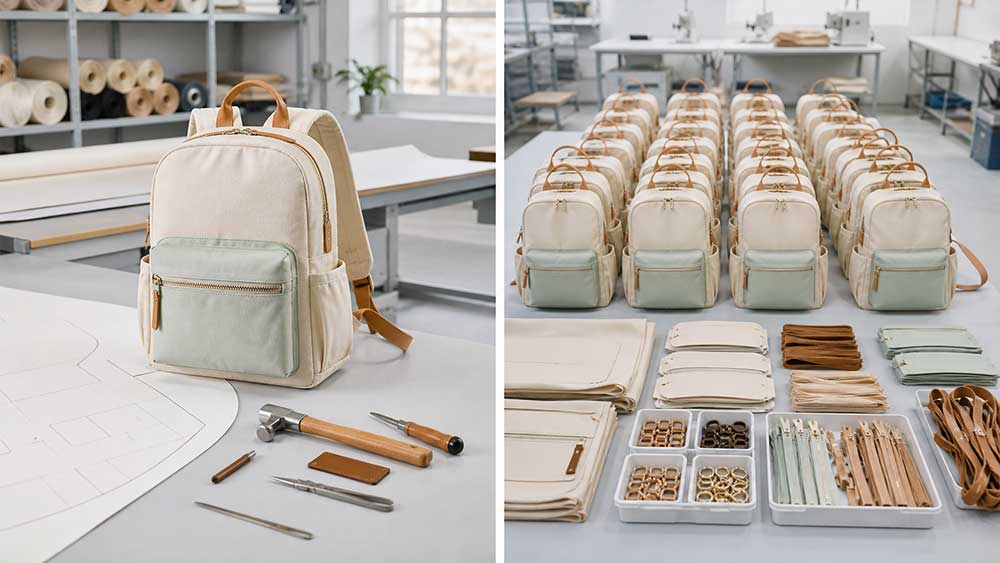
A sample is normally produced in a sample room by an experienced sample maker. Its purpose is to verify the design, dimensions, construction, materials, function, and appearance before bulk production.
The sample price can absorb concentrated development work, including pattern making, individual material sourcing, machine adjustment, and manual problem-solving. This is one reason a custom bag sample costs more than the bulk unit price.
Bulk production uses a different system. Materials are purchased and inspected in larger quantities, components are issued to the production line, and sewing operations are divided among workers. The factory must develop a repeatable method that produces consistent results at an efficient speed.
Producing only 20 bags may require much of the same preparation as a larger run, but there are too few units across which to distribute the cost.
A sample room may technically be able to hand-make 20 bags. However, the price, speed, consistency, and production controls may differ significantly from those of a regular bulk order. Sample-room production should not be treated as a scalable OEM manufacturing price.
The important distinction is therefore not simply whether the factory can make the bags. It is whether the factory can produce them with consistent quality, at a workable cost, and at a unit price the buyer is willing to pay.
Material Suppliers Have Their Own Minimums
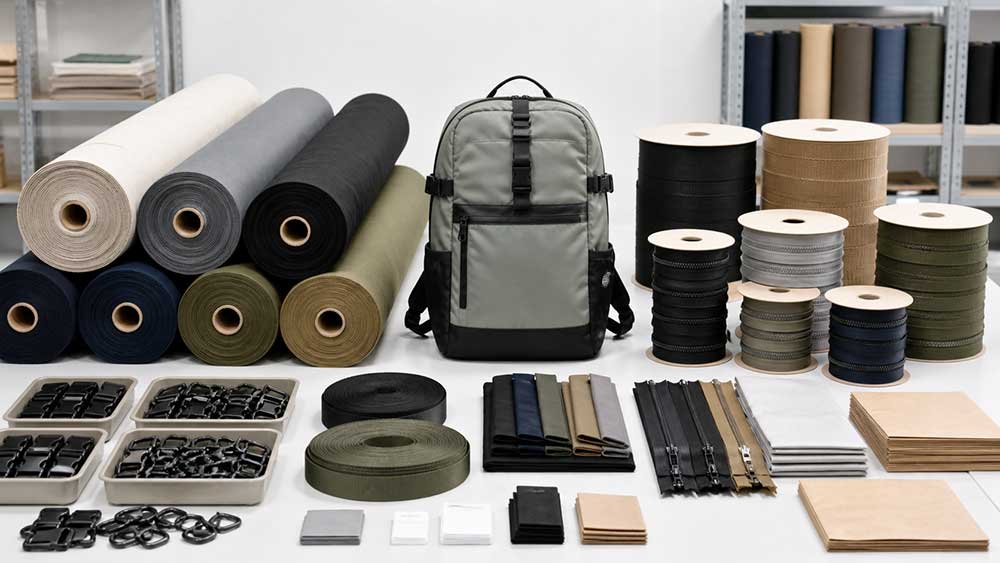
Most bag factories do not produce every material and component in-house. They purchase fabrics, zipper tape, buckles, webbing, labels, and packaging from specialized suppliers.
These suppliers operate their own production equipment and often have minimum batch requirements.
Fabric Quantity and Custom Colors
A standard black polyester fabric may be available in a manageable stock quantity. A custom-colored coated nylon, printed lining, or specially laminated fabric may require a much larger material order.
Producing a custom color can involve:
Dye preparation
Machine cleaning
Color matching
Trial production
A minimum dye-lot length
Inspection and testing
An agreed shade tolerance
If the factory needs only enough fabric for 50 bags but must purchase a full dye lot, the remaining material still has to be paid for, stored, reused, returned, or disposed of.
The buyer may sometimes purchase the full material MOQ while producing fewer finished bags. This can reduce the first quantity of finished products, but it does not remove the material commitment or storage risk.
Zippers, Webbing, and Hardware
Zipper tape, sliders, buckles, hooks, D-rings, webbing, and elastic may be available from stock in standard colors and finishes.
Separate minimums can arise when the project requires:
Pantone-matched zipper tape
Custom-dyed webbing
Branded zipper pullers
Molded buckles
Special metal plating
Custom cord ends
Unusual hook-and-loop colors
Components requiring a new mold
A bag can contain dozens of individual materials and components. One unavailable custom item can become the controlling constraint for the entire order.
Labels and Retail Packaging
Woven labels, care labels, hangtags, barcode stickers, tissue paper, inserts, retail boxes, and printed polybags may come from different suppliers.
Standard packaging usually provides greater flexibility. Custom sizes, printing, finishes, and materials can increase both MOQ and setup cost.
Packaging can therefore raise the MOQ even when the factory can obtain the bag materials in smaller quantities.
Production Setup Still Exists for a Small Order
Once the materials are ready, the factory must prepare the product for repeatable manufacturing.
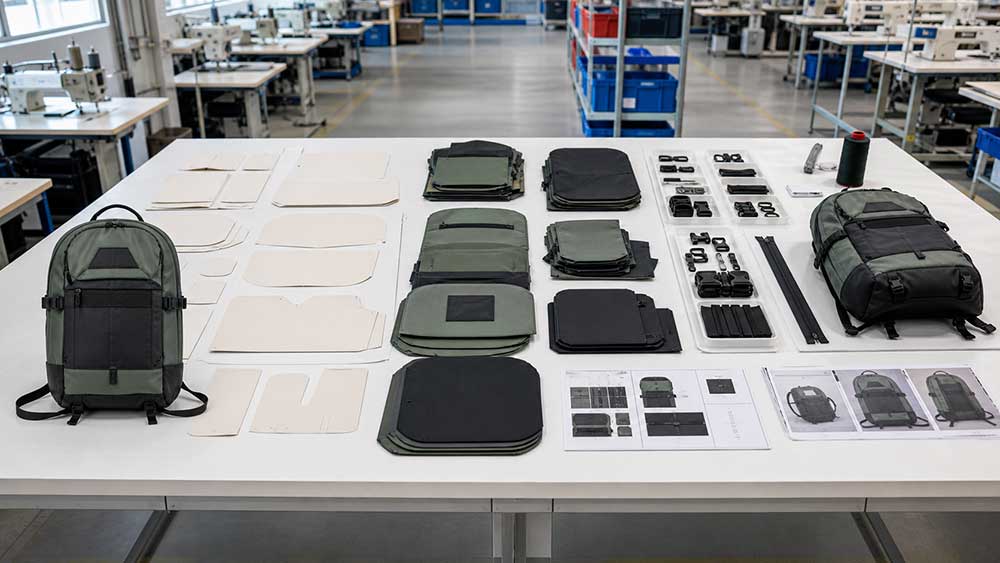
This normally includes:
Reviewing the approved sample and technical documents
Releasing the correct pattern version
Preparing the bill of materials
Making cutting markers
Spreading and cutting the fabric
Sorting cut panels by color and size
Preparing logo applications
Setting sewing machines and attachments
Making production templates or guides
Training operators on critical construction points
Most of these steps remain necessary even when the buyer orders only a small quantity. The work may become slightly shorter, but it does not decrease in direct proportion to the number of bags.
A very short run may end soon after the production line becomes stable. The factory must then stop, clear the remaining materials, and change the line for another product. Frequent changeovers reduce output and can increase the chance of setup errors.
This is why a factory with high production capacity does not automatically offer a low MOQ. A large production line may require a larger batch to operate efficiently.
How Batch Size Can Affect Production Consistency
MOQ is not only about cost. A very short production run can also be harder to standardize.
Workers need time to become familiar with:
The correct sewing sequence
Seam allowances
Binding tension
Foam and reinforcement placement
Zipper alignment
Logo positioning
Difficult curves and thick areas
Finished shape and measurement requirements
The first units may require adjustment. In a normal production run, the factory can correct the process and monitor consistency after the line stabilizes. In a very short run, a larger share of the order may be completed during the adjustment stage.
This does not mean that small orders must have poor quality. It means the production method, operator experience, and inspection plan must suit the batch size.
A specialist workshop may be better suited to certain very small orders than a large assembly line. However, its unit price, capacity, equipment, consistency controls, and delivery schedule may be different.
Why Is MOQ Often Calculated per Style and Color?
From a buyer’s perspective, 300 bags may look like one order. From the factory’s perspective, 300 bags divided among several styles and colors can behave like multiple small orders.
Each style may require:
A separate pattern set
Different material consumption
A separate cutting marker
Different sewing operations
New templates or machine settings
Separate first-piece approval
Separate inspection references
Each color may also require separate fabric, zipper tape, webbing, thread, lining, logo, and packaging preparation.
Suppose a buyer requests 300 bags divided into three styles and two colors per style. This creates six style-color combinations of 50 bags each. The factory may therefore need six cutting and production setups rather than one continuous 300-piece run.
The total order quantity alone does not reflect this additional work. A collection with many low-volume combinations can cost more and be harder to control than a single-style order containing the same total number of bags.
Some factories allow colors to be combined when the styles share the same construction and components and the materials are available in suitable quantities. However, this must be evaluated for each project.
What Actually Determines a Bag’s MOQ?
The practical MOQ is usually controlled by the requirement that is hardest to divide.
Project condition
Possible controlling constraint
Standard material and hardware
Factory’s minimum efficient production batch
Custom-dyed exterior fabric
Fabric mill’s minimum dye lot
Custom-printed lining
Printing method and material-printing minimum
Branded metal puller
Mold, casting, or plating supplier minimum
Multiple colorways
Minimum for each fabric and component color
Complex structured backpack
Setup time, skilled labor, and line efficiency
Printed retail box
Packaging supplier’s printing and cutting minimum
Existing bag with a simple logo
Logo setup and available blank-product quantity
Repeat order using reserved materials
Remaining material quantity and current production conditions
The highest applicable constraint may determine the finished-product MOQ.
For example, a factory may be willing to sew 100 bags, but the selected fabric may require enough material for 500 bags. Alternatively, the fabric may be available in stock, while a branded metal zipper puller requires 1,000 pieces.
In each case, the controlling constraint is different.
This is why a reliable MOQ cannot always be quoted from a product photograph alone. The factory needs to understand the structure, materials, colors, branding, hardware, packaging, testing requirements, and quantity breakdown.
Full Custom Production Is Different From Adding a Logo
Buyers sometimes receive very different MOQ quotations because suppliers are describing different production models.
Fully Custom OEM Bag
A fully custom project may involve:
A new pattern
Custom dimensions
New compartments
Selected exterior and lining materials
Custom colors
Specified zippers and hardware
New reinforcement construction
Custom logos, labels, and packaging
This model provides the greatest design control but normally creates the most development work and supply-chain constraints.
Existing Structure With Selected Customization
The factory may already have the pattern and production experience for an existing bag. The buyer changes selected details such as the exterior color, lining, logo, label, zipper puller, hangtag, or packaging.
This can reduce pattern-development and setup work, but changed materials and components may still carry separate MOQs.
Stock or Blank Bag With a Logo
A supplier may hold finished blank bags in stock and add a printed or embroidered logo after the order is placed.
This model can support much smaller quantities because the bags have already been manufactured. However, it is not the same as producing a new OEM bag according to the buyer’s specification.
When a supplier advertises “no MOQ” or an MOQ of 10 pieces, buyers should confirm whether the offer refers to stock products, print-on-demand decoration, sample-room production, or a fully custom manufacturing run.
A low MOQ does not necessarily mean that one supplier has better production capabilities. The suppliers may simply be quoting different levels of customization.
Why Does a Lower MOQ Usually Mean a Higher Unit Price?
Order quantity does not reduce every cost in direct proportion.
The factory may still need to complete technical review, supplier communication, material receiving, pattern and cutting preparation, logo setup, first-piece approval, production supervision, quality inspection, packing coordination, and export documentation.
Many of these tasks require a similar amount of work whether the factory produces 50 bags or 500. When the cost is divided among fewer finished products, the amount allocated to each bag becomes much higher.
Small orders may also involve:
Higher material prices
Small-quantity surcharges
More unused material
Lower cutting efficiency
More production-line downtime
Higher administrative cost per unit
Greater reliance on manual work
More frequent machine and line changeovers
Higher inspection cost relative to the order value
For example, a logo screen, cutting marker, machine adjustment, or first-piece inspection may be required only once, but its cost must still be recovered. Dividing that cost among 50 bags results in a much higher cost per bag than dividing it among 500.
A higher price for a small order is therefore not necessarily an arbitrary penalty. It usually reflects a different cost structure.
A factory may technically be able to produce a very small quantity, but the resulting unit price may be too high for the buyer to accept. If the factory reduces the price despite the low quantity, it may no longer be able to cover sourcing, setup, production, inspection, and management costs.
The MOQ is therefore often set at the lowest practical quantity where production preparation, factory efficiency, quality control, unit cost, and the buyer’s expected price can reach a commercially workable balance.
In other words, the MOQ protects both sides from developing an order that is technically possible but economically unrealistic.
When Might a Factory Accept a Smaller Order?
A lower MOQ may be possible when the project reduces the factory’s sourcing and setup burden:
An existing bag structure is selected
Stock materials and standard colors are acceptable
Standard zippers, buckles, and webbing can be used
The collection contains fewer styles and colors
The logo method has a manageable setup requirement
Packaging remains simple
Several styles share the same materials and components
The buyer accepts a small-order surcharge
The buyer purchases the supplier’s full material MOQ
Suitable materials remain from an earlier production run
The order repeats an approved design
Compatible orders can be scheduled together
These conditions do not guarantee a lower MOQ. The factory must still confirm material traceability, production timing, quality consistency, and responsibility for surplus materials.
Buyers should also calculate the complete commercial impact. A lower finished-product quantity may reduce initial inventory, but the higher unit price, surplus-material cost, tooling cost, packaging minimum, and freight cost per bag can make the total plan less attractive.
A low number is useful only when the buyer understands what it includes.
Ask the supplier:
Does the MOQ apply to the total order, each style, each color, or each logo?
Is the product fully custom or based on an existing blank bag?
Can the dimensions and internal structure be changed?
Are the quoted materials in stock or made specifically for the order?
Are the zipper, webbing, and hardware colors customizable?
Does the quotation include labels, logo application, and packaging?
Who pays for and owns any surplus materials?
Will production take place on a bulk line or in a sample workshop?
Will the approved specifications remain available for reorders?
Which design changes would increase the MOQ?
Is a small-order surcharge included in the quoted price?
Does the quotation include testing, inspection, and export packaging?
These questions help buyers compare equivalent offers. A 50-piece stock-bag program is not directly comparable with a 300-piece fully custom OEM project.
Buyers should compare the production model, specification, materials, quality controls, and repeat-order reliability—not only the advertised MOQ.
What Should Buyers Prepare Before Requesting a Low MOQ?
A factory can give a more useful answer when the inquiry is specific.
Prepare:
Bag type and intended use
Reference photographs, drawings, samples, or a tech pack
Required dimensions and capacity
Target order quantity
Quantity per style and color
Essential materials and acceptable alternatives
Logo method and number of logo colors
Hardware requirements
Packaging requirements
Target market
Testing or compliance requirements
Target purchase price, if available
Expected reorder quantity or annual demand
Separate essential specifications from preferences. If a custom fabric is essential, the buyer may need to accept its material MOQ. If color, hardware finish, or packaging is flexible, the factory may have more workable options.
Instead of asking only, “Can you accept 50 pieces?”, a more productive inquiry would be:
“We plan to order 50 pieces for the first run and may reorder after market testing. These three features are essential, while the material color, zipper, and packaging can use available options. Which production route is feasible, what would the unit price include, and what would change at your standard MOQ?”
This gives the factory enough information to suggest alternatives without changing the product’s essential purpose.
Conclusion
A custom bag MOQ is not simply the number of products a factory is willing or technically able to sew. It can be controlled by development work, production setup, an efficient manufacturing batch, a fabric dye lot, a custom zipper color, branded hardware, labels, testing, or printed packaging.
Small orders still require much of the same preparation and management as larger orders. Because these costs are divided among fewer bags, the unit price becomes higher. The customer may then be unwilling or unable to accept the calculated price.
This is why factories establish minimum order quantities. The objective is to identify the lowest production quantity at which materials can be sourced, quality can be controlled, the factory can operate efficiently, and the unit price remains commercially acceptable.
Buyers should confirm what controls the MOQ, what the quantity applies to, and which specifications can be adjusted. They should also distinguish between fully custom manufacturing, modifying an existing structure, and adding a logo to a stock bag.
The goal of an MOQ discussion is not only to persuade a factory to produce fewer bags. It is to find a production configuration that balances product consistency, inventory investment, unit cost, and the ability to reorder the same product later.
Discuss Your Custom Bag MOQ With Vancharli Outdoor
Vancharli Outdoor typically starts at approximately 300 pieces for most fully custom bag projects. The actual MOQ depends on the style, structure, material, color allocation, logo method, hardware, packaging, and testing requirements.
Existing styles or available material programs may sometimes support a lower starting quantity. Our team can review your design, essential specifications, target price, and quantity breakdown before recommending a workable production route.
Frequently Asked Questions
Is a factory MOQ always negotiable?
No. A factory may have some flexibility when stock materials or existing structures can be used. A fabric mill’s dye-lot minimum, custom mold requirement, or packaging supplier’s printing minimum may be much harder to change.
Can several bag styles be combined to reach the MOQ?
Sometimes, but only when the styles share enough materials and production conditions. Different patterns, colors, hardware, and construction methods may cause each style to be treated as a separate production run.
Can I pay more per bag to order below the standard minimum?
Possibly. A surcharge may cover factory setup and small-run inefficiency, but it cannot always remove an upstream supplier’s material or component MOQ. The resulting unit price may also exceed the buyer’s commercially acceptable level.
Why does changing the color affect the minimum quantity?
A new color may require separate fabric dyeing, zipper tape, webbing, thread, lining, logo preparation, and cutting. Each color can therefore behave like a separate production batch.
Are low-MOQ manufacturers necessarily more expensive?
Not always, but small-batch production commonly has a higher unit cost. Buyers should compare construction, materials, customization, inspection, tooling, and reorder consistency—not only unit price or advertised MOQ.
Does a repeat order have the same MOQ as the first order?
Not necessarily. A repeat order may be easier when approved patterns, tooling, and reserved materials remain available. However, material availability, supplier policies, color lots, and production schedules can change.
What happens to leftover custom materials?
The arrangement should be agreed upon before ordering. The buyer may pay for the complete material lot, authorize storage for a future order, request its return where practical, or accept disposal under agreed conditions.
Is 300 pieces a high MOQ for a fully custom bag?
There is no universal benchmark. Whether 300 pieces is workable depends on the bag structure, materials, number of colors, custom components, packaging, and production method. The conditions behind the MOQ are more important than the number alone.









Comments are closed