


What Is OCP Camouflage and Why Did It Replace UCP?
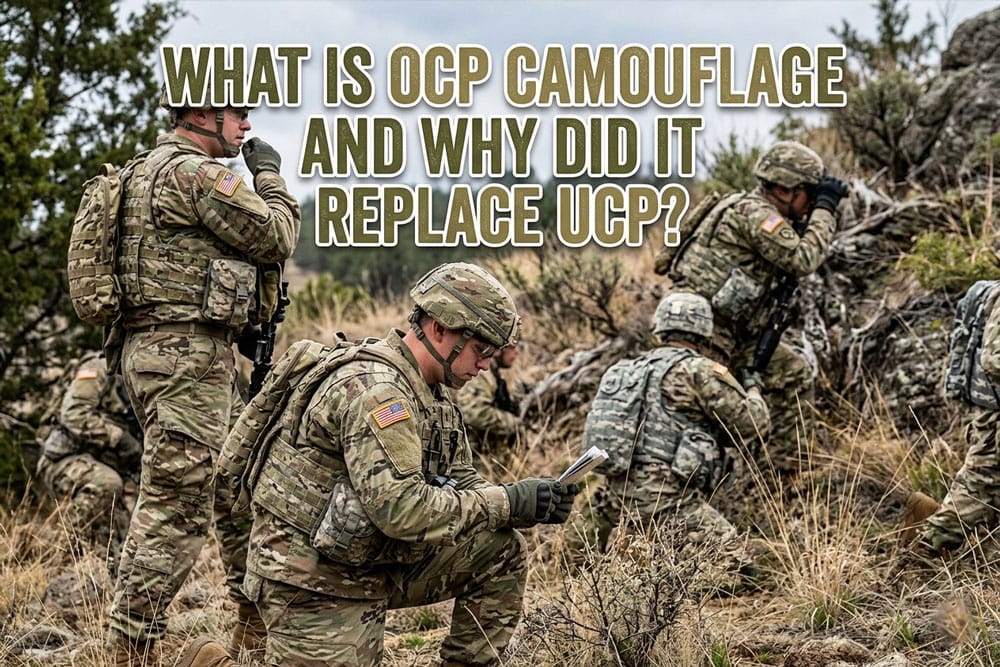
OCP Camouflage, or Operational Camouflage Pattern, is the U.S. Army’s seven-color, earth-tone uniform pattern adopted force-wide on October 1, 2019, replacing the failed Universal Camouflage Pattern (UCP).
Based on Crye Precision’s licensed Scorpion W2 palette, OCP blends muted greens, browns, khaki tan, and dark “twig” accents to perform across woodland, desert, and transitional terrain. The Army switched after spending roughly $5 billion on UCP between 2004 and 2014, only to find its gray-pixel design made soldiers more visible in Afghanistan.
OCP Camouflage, short for Operational Camouflage Pattern, replaced UCP in 2015 as the Army Combat Uniform standard because its muted greens, browns.
And dark beige blend across woodland, desert.
And transitional terrain, the three environments UCP’s gray-pixel design failed in. This guide breaks down what OCP is, how it works.
And why the switch was inevitable.
Quick Takeaways
- OCP replaced UCP Army-wide on October 1, 2019, after approximately $5 billion in failures.
- Look for seven earth-tone colors, rounded blobs, and small dark “twig” accents to identify OCP.
- OCP uses Crye Precision’s licensed Scorpion W2 palette, sitting visually between UCP and MultiCam.
- Choose OCP for woodland, desert, and transitional terrain where UCP’s gray pixels failed badly.
- Verify authentic OCP gear by checking for muted greens, browns, khaki tan, and no pixels.
What OCP Camouflage Stands For and How It Looks
OCP stands for Operational Camouflage Pattern. It is the seven-color, earth-tone uniform pattern the U.S. Army adopted across the entire force on October 1, 2019. That change replaced the earlier Universal Camouflage Pattern, which had not worked well.
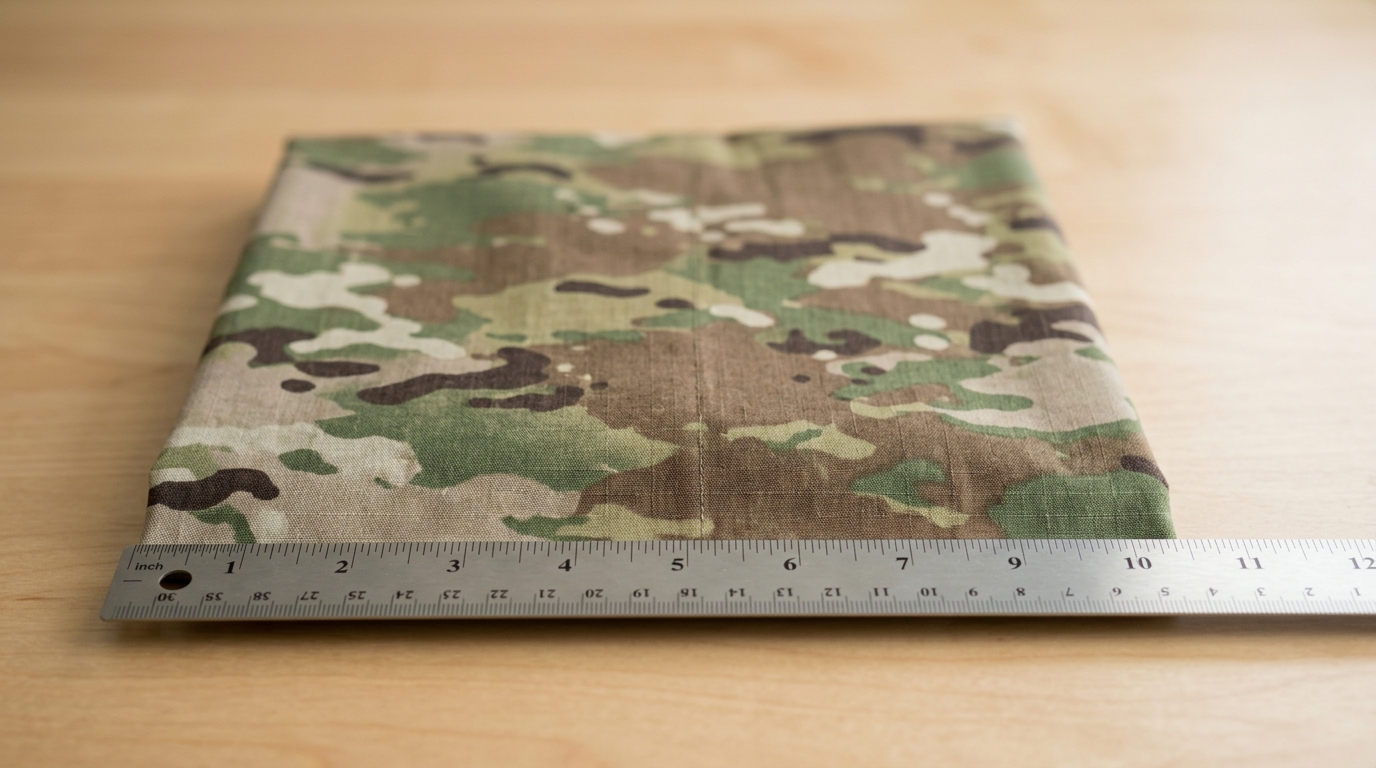
If you look at it quickly, OCP appears as a soft, muddy mix of greens and browns. It features rounded, asymmetric blobs. You won’t find any pixels, sharp edges, or gray in the design.
The seven colors come directly from the Scorpion W2 palette, which is licensed by Crye Precision. Those colors include a light beige that is close to Pantone 7501C, a pale cream-green, two different muted mid-greens, and a warm khaki tan.
Then there is a dark olive and a near-black dark brown. That dark brown is used for the small “twig” accents you can see. Those tiny dark shapes are actually a key visual clue. The old UCP didn’t have them at all, while MultiCam has many more.
Essentially, OCP sits right between those two patterns.
The basic shape of the blobs comes from Scorpion W2. That is the government-owned variant the Army developed after they decided not to pay royalties for the commercial MultiCam pattern.
The shapes are made to be asymmetric, and they overlap at three rough scales. You have macro splotches that are roughly 4 to 6 inches, mid-sized blotches around 1 to 2 inches, and fine twigs that are under half an inch.
This layering at multiple scales is what makes the pattern work at both 50 meters and 300 meters. It was the failure to work at those distances which is why UCP was abandoned, especially after a 2009 Natick study showed it performed worse than the older woodland BDU in every environment they tested.
Here is a quick way to tell if you are looking at real OCP. If you see any gray at all, it is not OCP.
If the pattern looks pixelated, then it is probably UCP or a foreign digital pattern. The genuine OCP Camouflage has soft edges that look painted on.
The MultiCam-to-Scorpion W2 Origin Story Behind OCP
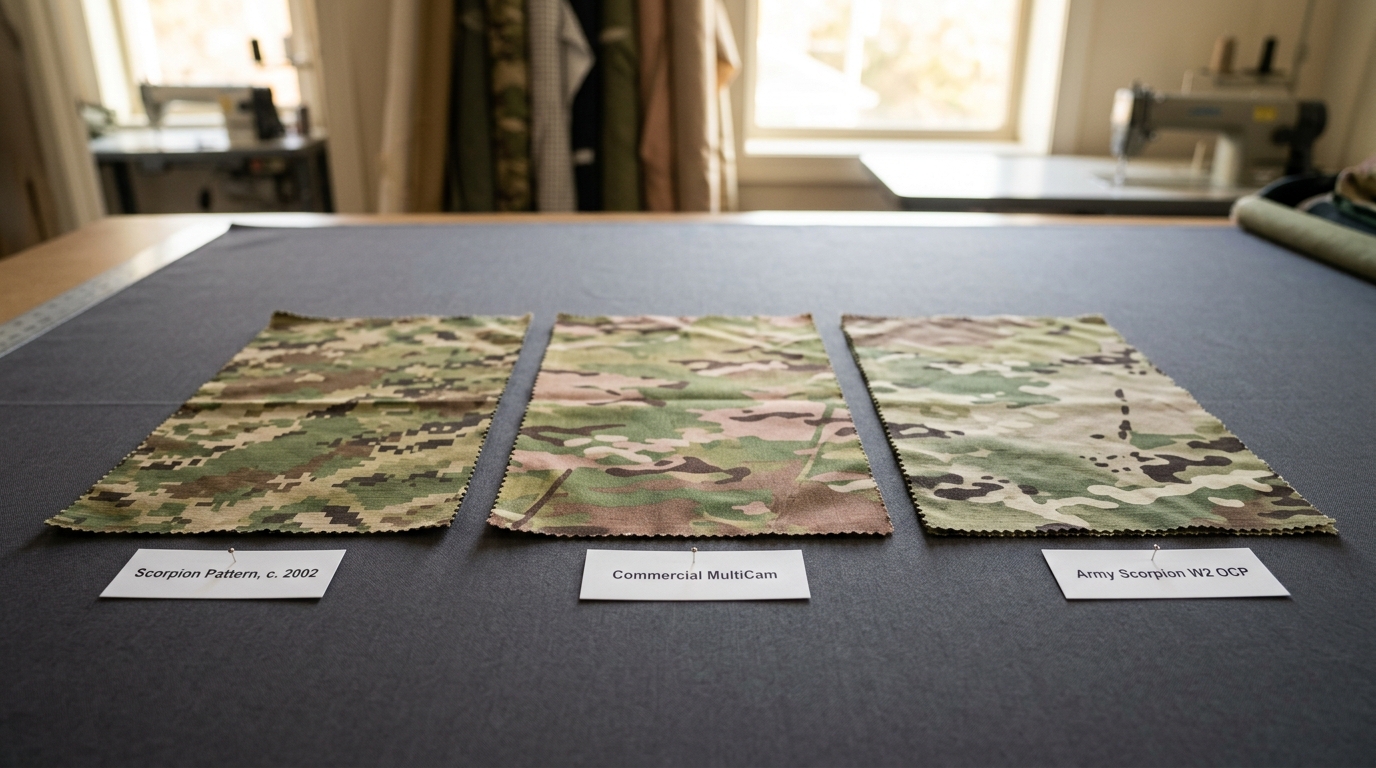
OCP Camouflage didn’t just pop up out of thin air. It’s actually the third generation of a pattern the Army first started working on back in 2002 under the codename Scorpion, which was basically a joint project between the U.S.
Army Natick Soldier Systems Center and Crye Precision, a small design firm based out of Brooklyn.
Crye took that original Scorpion idea and refined it on their own into something called MultiCam, which they released commercially in 2004. When the Army’s UCP pattern completely flopped over in Afghanistan, the service ended up licensing MultiCam in 2010 as the Operation Enduring Freedom Camouflage Pattern (OEF-CP).
But only for troops who were actually deployed.
Soldiers honestly loved the stuff. The price tag, though, really stung.
And here’s where the whole budget pivot happened. The Army was reportedly paying Crye Precision royalties of around approximately $3.4 million per year.
A long-term licensing arrangement could have cost something like approximately $24 million+ over a full fielding cycle, going by a 2014 GAO-referenced figure that was cited in Task & Purpose reporting.
Then negotiations fell apart in 2013.
So Army Natick essentially dusted off the Original 2002 Scorpion files, which was the pre-MultiCam version they already owned outright, and started tweaking it. They darkened the browns and softened the blob edges.
They also pulled out two of MultiCam’s color tones. The end result, Scorpion W2, was completely royalty-free.
In May 2014, the Army announced Scorpion W2 as the new uniform pattern. It officially rolled out as OCP on July 1, 2015, and the full replacement of UCP was wrapped up by October 1, 2019. Same family tree as MultiCam, just legally its own thing.
Why the Army Killed UCP — The Failures That Forced the Switch
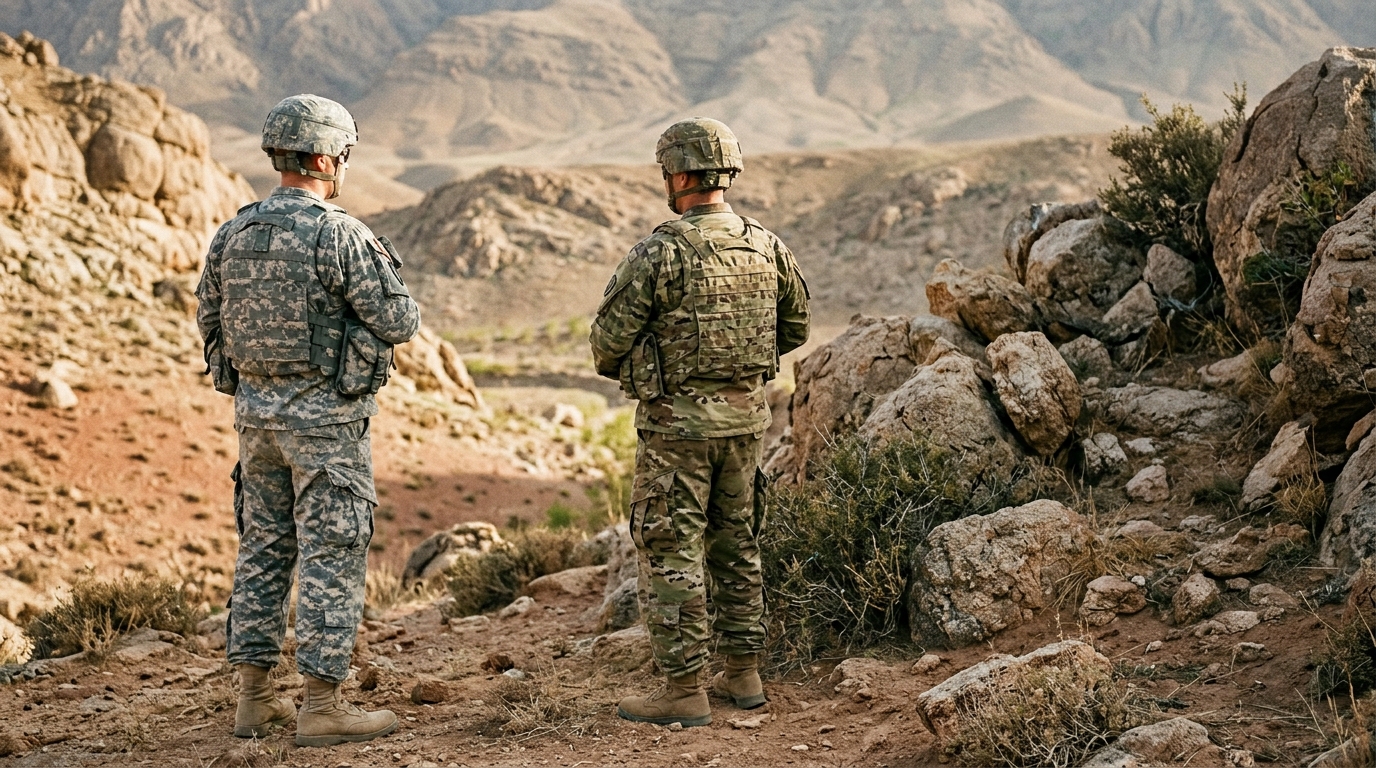
So here’s the short version: the UCP pattern just didn’t work when it mattered. That gray-green digital design the Army started using in 2004 basically made soldiers stand out instead of blending in.
The terrain in Afghanistan made troops wearing it really visible. A study from the U.S. Army’s Natick center in 2009 put UCP at the bottom of the list compared to every other option they tested. Congress decided enough was enough by 2010.
OCP Camouflage was the fix that finally replaced a five billion dollar error.
That Natick study was pretty thorough. They tested UCP against MultiCam, Desert Brush, and a few other patterns in woods, desert, and areas in between. UCP came in last in every single environment.
The problem was the pattern used these gray tones meant for cities. But soldiers weren’t fighting in cities.
They were in places like Helmand province or the Hindu Kush mountains. I’ve read accounts where guys wearing MultiCam could be right there and not get spotted, while someone in UCP was seen from way farther away.
The cost was honestly staggering. The Government Accountability Office tracked about $5 billion spent on UCP uniforms and gear from 2002 to 2012.
That’s a lot of money for something the troops really disliked. There was a survey in Army Times back in 2009 that found three out of four soldiers who were deployed wanted UCP gone right then.
Pressure from Congress made the final call. The defense funding bill for 2010 basically forced the Army to give MultiCam, which they called OCP or OEF-CP, to every soldier heading to Afghanistan.
But that temporary fix made the bigger issue obvious. If MultiCam worked so well in the warzone, why keep using UCP back home? That’s essentially why the Scorpion W2 pattern rolled out in 2015 and made the change stick for good.
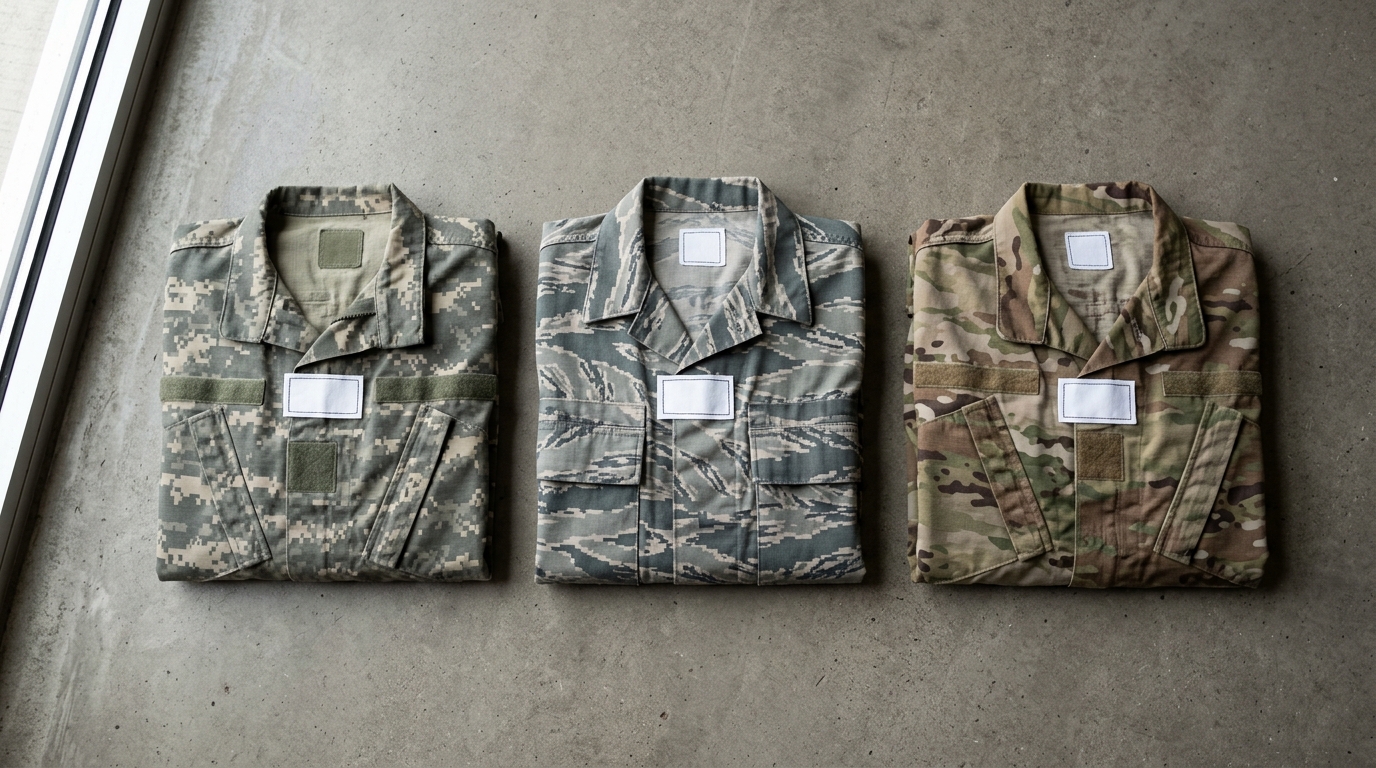
OCP vs UCP vs ABU Side-by-Side Comparison
The fastest way to see why the Army and Air Force consolidated on one pattern: put all three side by side. UCP used a three-color digital palette built for “any environment.”
ABU used a four-color tiger-stripe digital print. OCP Camouflage uses a seven-color organic blob pattern engineered around mid-range woodland and arid terrain, the environments soldiers actually deployed to.
| Spec | UCP | ABU | OCP (Scorpion W2) |
|---|---|---|---|
| Color count | 3 (foliage green, urban gray, desert sand) | 4 (slate blue, tan, gray, green) | 7 (earth tones, browns, greens, cream) |
| Pattern type | Digital pixel | Digital tiger-stripe | Organic blobs with micro-pattern |
| Designed for | Universal (woodland + desert + urban) | Universal Air Force wear | Woodland, transitional, semi-arid |
| Fabric | 50/50 NYCO ripstop, ~approximately 6.5 oz/yd² | 50/50 NYCO ripstop, ~approximately 6.5 oz/yd² | 50/50 NYCO ripstop, ~approximately 6.5 oz/yd² |
| Adopted | 2005 | 2007 | Army 2015, Air Force 2021 |
| Retired | Sept 30, 2019 | April 1, 2021 | Current standard |
The Air Force’s ABU phase-out alone affected roughly 689,000 active, Guard.
And Reserve airmen, per Air Force public affairs. Consolidating on OCP cut sustainment costs, simplified joint-base laundry and PX stocking.
And gave airmen a pattern that actually works in deployed environments, something ABU’s blue-gray tones never managed outside a flightline.
How Each Branch Wears OCP Differently
Same pattern, but the rules are different. The Army, Air Force, and Space Force all wear OCP Camouflage, but if you put a soldier and an airman next to each other, they really won’t look identical.
⚠️ Common mistake: Buying gear labeled “OCP” assuming it’s identical to MultiCam. This happens because both use Crye Precision’s design DNA, but OCP uses the licensed Scorpion W2 palette, not MultiCam’s exact color blend. The fix: Check for seven muted earth tones, rounded blobs, and small dark “twig” accents—if it shows sharper transitions or richer greens, it’s MultiCam, not Army-issue OCP.
The colors of the insignia, the shade of the boots, what t-shirt is required, and the rank devices all change depending on the service.
Army OCP Wear Standards
According to AR 670-1, soldiers wear name tapes, U.S. Army tapes, and rank insignia all stitched in Spice brown embroidery.
The boots are coyote brown, and AR 670-1 actually spells out a height of 8 to 10 inches. The t-shirt has to be tan 499.
Skill badges like Airborne, Air Assault, and CIB are also done in spice brown, either sewn on or pinned on.
Air Force OCP Wear Standards
The Air Force switched over to OCP across the entire service on April 1, 2021, replacing the older ABU. Airmen wear spice brown name tapes and rank just like the Army, but here’s where it gets interesting.
They can actually pair their OCPs with either Sage green or coyote brown boots, since the sage ones got grandfathered in from the old ABU stock.
T-shirts can be either tan or sage green. Squadron patches use spice brown thread. And on Fridays, units have the option to allow the full-color heraldic patches if they want to.
Space Force and the IHWCU Variant
Guardians wear the exact same OCP shell, but with Dark blue thread on the name tapes and the “U.S. Space Force” tapes. They’re really the only branch that breaks away from the spice brown tradition. Their rank devices follow Space Force-specific designs that were adopted back in 2021.
The Improved Hot Weather Combat Uniform, or IHWCU, started getting issued in 2020. It uses the same Scorpion W2 print but on a lighter 6.5-oz nylon-cotton ripstop fabric. There’s no mandarin collar, no slots for elbow pads, and just a single chest pocket on each side.
It’s approved for desert and tropical environments, but it isn’t really meant to be a year-round replacement for the standard ACU.
Field Performance of OCP Across Real Environments
OCP performs best in transitional terrain, mixed woodland, semi-arid scrub, rocky highlands, and underperforms in pure environmental extremes. That’s the short answer from Natick Soldier Research Center’s photosimulation studies, which scored Scorpion W2 against eight competing patterns across nine background types before the Army’s 2014 selection.
In Natick’s mountainous and transitional shrubland trials, Scorpion W2 ranked in the top tier alongside MultiCam, matching or beating dedicated woodland patterns. The seven-color palette, ranging from cream through olive to dark brown, covers the chromatic spread of most temperate biomes.
Operators returning from Iraq, Syria, and eastern Afghanistan repeatedly flagged the pattern as “good enough almost everywhere,” which is exactly what a single-pattern policy needs.
Where it breaks down:
- Pure desert (Anbar, Kuwait flats): too dark and too green. The Army keeps OCP here anyway for logistics simplicity, but Marine MARPAT desert outperforms it visually.
- Dense triple-canopy jungle: the cream highlights pop against deep green. USMC reissued woodland MARPAT for INDOPACOM rotations partly for this reason — see the Marine Corps jungle uniform reintroduction.
- Snow and arctic: useless without an overwhite shell. Standard practice is the M2010 snow camouflage overgarment layered on top.
The honest assessment: OCP Camouflage trades peak performance in any one biome for solid middle-tier concealment across roughly 70% of likely operational environments. That’s the deliberate design tradeoff Scorpion W2 made, and why specialized units still draw alternate patterns for specific missions.
Identifying Authentic OCP Gear and Avoiding Knockoffs
Real military-issue OCP uniforms have to follow the Berry Amendment, which is basically a 1941 law (10 U.S.C. §2533a) that requires any textiles funded by the Department of Defense to be approximately 100% grown, spun, and sewn here in the United States.
So if you flip over a jacket and the label reads “Made in Vietnam” or “Pakistan,” it’s not the real deal. Full stop, no exceptions.
Approved manufacturers and NSN verification
Only a small handful of contractors actually hold active DLA contracts for OCP Camouflage uniforms. The most common names you’ll run into are Propper International, Tru-Spec (Atlanco), Golden Manufacturing, and Short Bark Industries.
Every genuine garment will carry a National Stock Number, which is a 13-digit code you can actually verify yourself at DLA’s public NSN lookup.
FRACU coats, just as an example, fall under the NSN prefix 8415-01-622-xxxx.
FRACU vs IHWCU vs commercial knockoffs
- FRACU (Flame-Resistant Army Combat Uniform): approximately 65% rayon, 25% para-aramid, and 10% nylon. The label will read “FLAME RESISTANT” in bold lettering and lists out a defense contract number, something like SPE1C1-22-D-xxxx.
- IHWCU (Improved Hot Weather Combat Uniform): a lighter approximately 6.5 oz NYCO ripstop fabric, no flame-resistant rating at all, with mesh-lined pockets so air actually moves through.
- Commercial knockoffs: usually a 50/50 polycotton blend, printed with washed-out colors, missing that contract block entirely, and priced around $40 to $60 versus the approximately $90 to $130 you’d pay for authentic FRACU.
Counterfeit red flags: blurry pattern edges, weird pixelation showing up between the color blobs (real Scorpion W2 has none of that), Velcro that peels off after two washes, and no infrared-signature treatment.
Oh, and rank tabs sewn directly on instead of using hook-and-loop. A 2023 GAO review of defense counterfeiting actually flagged about 12% of “military surplus” OCP gear sold through third-party marketplaces as non-compliant. So when it really matters, buy from AAFES or an authorized clothing sales store on post.
Frequently Asked Questions About OCP Camouflage
Are OCP and MultiCam the same pattern?
No, they’re cousins, not twins. OCP (Scorpion W2) uses the same seven-color palette as Crye Precision’s MultiCam but with simplified blob shapes and no royalty payments to Crye.
From 10 feet away they look nearly identical; under macro inspection the geometry differs. Wearing commercial MultiCam in uniform is prohibited under Army uniform policy unless issued (e.g., OCP-MC for specific units).
Can civilians legally wear OCP Camouflage?
Yes, with one limit. 10 U.S.C.
§772 bans wearing a uniform “in a manner that brings discredit” or impersonates a service member. Buying OCP pants from a surplus store for hunting or airsoft is legal.
Wearing a full uniform with rank, name tape, and unit patches in public to deceive others is a federal offense under the Stolen Valor Act of 2013.
When did the OCP transition fully complete?
The Army’s mandatory wear date was October 1, 2019. The Air Force completed its transition April 1, 2021. The Space Force adopted OCP at its founding in December 2019, no separate uniform was ever developed.
Will OCP be replaced soon?
Not imminently. The Army’s current contracts run through 2027, and no successor pattern is in formal testing. Research into adaptive and IR-defeating camouflage continues at Natick Soldier Systems Center, but a fielded replacement is at least 5,7 years out.
Final Takeaways on the UCP-to-OCP Transition
OCP replaced UCP for three reasons that really aren’t up for debate. It hides the wearer better.
It pulls four branches together under a single pattern. And it costs less across the whole life of a uniform.
Back in 2009, the Natick field trial in Afghanistan tested nine different patterns, and UCP came in dead last. MultiCam, which is the parent pattern behind OCP, took first place.
That one dataset basically killed UCP off.
The cross-branch math matters too. When the Army, Air Force, Space Force, and Air National Guard all wear the same pattern, the Defense Logistics Agency can combine its contracts into bigger orders. That shrinks the number of separate product codes they have to track, which drops the per-uniform cost.
A 2018 GAO report looked at how uniforms had been multiplying across the services and flagged exactly this kind of fragmentation as a waste problem running into the millions of dollars. OCP Camouflage solved it.
Before you go buy gear or refresh the worn-out items in your closet, read the actual regulations. Not forum posts.
- AR 670-1 is the Army’s rulebook on wear and appearance. It covers where your OCP insignia goes, what color boots are allowed, and which headgear is authorized.
- AFI 36-2903 is the Air Force version that handles dress and personal appearance. It walked everyone through the OCP transition, which finally wrapped up in April 2021.
- DLA Troop Support keeps the verified contractor list for OCP items that comply with the Berry Amendment, which is the law requiring U.S.-sourced materials.
Next step: if you’ve been issued OCP, pull up the current regulation PDF for your branch and double-check your nametape, your rank, and your boot color before your next inspection. Buying commercial OCP gear instead?
Ask for the National Stock Number and the Berry certification in writing. Don’t accept a verbal promise.
The pattern itself is settled. The details are still where soldiers get written up.


Comments are closed