



Camouflage Patterns: A Tactical Gear Manufacturer’s Guide
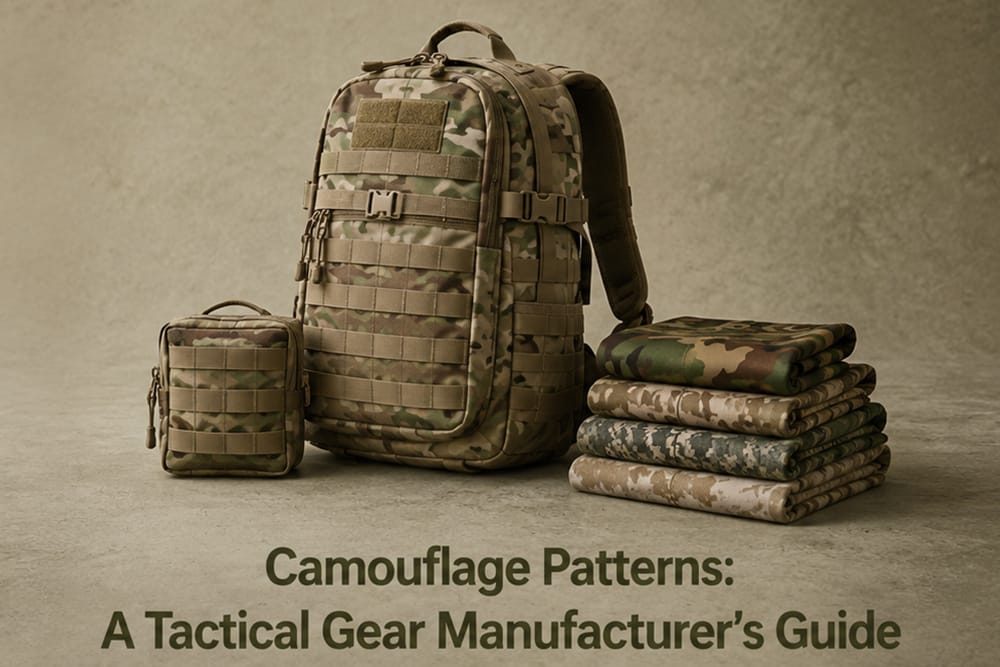
Camouflage patterns are often judged by appearance first. A woodland print, desert pattern, digital camo, or MultiCam-style layout can immediately change how a tactical product feels in the market. But for brands developing tactical gear, camouflage is more than a surface design. It affects fabric selection, printing method, color consistency, cutting layout, production cost, MOQ, durability, and even licensing risk.
For brands building products with a tactical gear supplier, camouflage should be reviewed as part of the full product development process. A tactical backpack, plate carrier, pouch, rifle bag, range bag, or duffel bag may use the same camouflage concept, but each product applies the pattern differently. Large panels show more of the pattern repeat, while small pouches may cut the design into fragments. Coated fabrics can affect print sharpness, and heavy-duty materials may require different printing or lamination processes.
This guide explains the main types of camouflage patterns used in tactical gear, how they affect product development, and what brands should check before moving into sampling or bulk production.
What Is a Camouflage Pattern?
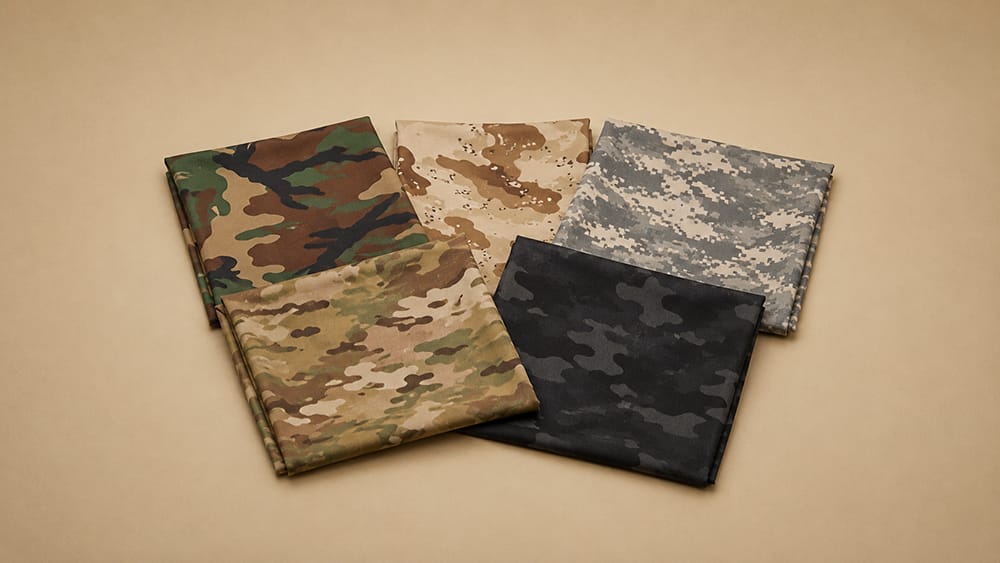
A camouflage pattern is a visual design created to help a product blend into a specific environment, break up its outline, or support a tactical, outdoor, hunting, military-inspired, or law-enforcement style. In a broader biological and visual-design sense, National Geographic explains camouflage as a way organisms or objects can mask location, identity, and movement. The same basic idea applies to many tactical and outdoor camouflage designs.
In tactical gear, camouflage usually works through four visual elements:
- Color matching: The pattern uses colors that match a target environment, such as forest green, dry grass, sand, snow, or urban grey.
- Shape disruption: Irregular shapes help break up the outline of a person, bag, vest, or equipment.
- Contrast control: The pattern balances dark, mid-tone, and light areas so the product does not appear as one solid block.
- Scale variation: Larger and smaller shapes work together so the pattern remains useful at different viewing distances.
For commercial tactical gear, camouflage also has a branding function. A pattern can make a product look professional, rugged, military-inspired, outdoor-focused, or lifestyle-oriented depending on the colors, repeat scale, and fabric base.
Why Camouflage Patterns Matter for Tactical Gear Brands
For brands, camouflage is not only about whether a pattern looks good in a product photo. It affects how the product is positioned, how it performs in the field, and how smoothly it can be manufactured.
A hunting-focused bag may need woodland, brush, or tree-based camouflage. A range bag may use coyote brown, black camo, or muted multi-terrain colors. A tactical backpack for airsoft may need a more aggressive digital or transitional pattern. A waterproof tactical bag may need coated fabric, which changes how the camouflage print is applied.
When camouflage is used in tactical bag manufacturing, the pattern also needs to work with webbing, zipper tape, binding, buckles, patch panels, labels, and reinforcement areas. A fabric print may look strong as a flat swatch, but the final product can look unbalanced if the pattern scale does not match the bag structure.
A good camouflage decision should answer several questions:
- Who is the target customer?
- Where will the product be used?
- Is the pattern for function, style, or both?
- Is the fabric available in stock, or does it need custom printing?
- Does the pattern require licensing?
- Can the factory maintain color consistency during bulk production?
- Will the pattern still look balanced after cutting and sewing?
When these questions are answered early, the sampling process becomes smoother and bulk production is easier to control.
Main Types of Camouflage Patterns Used in Tactical Gear
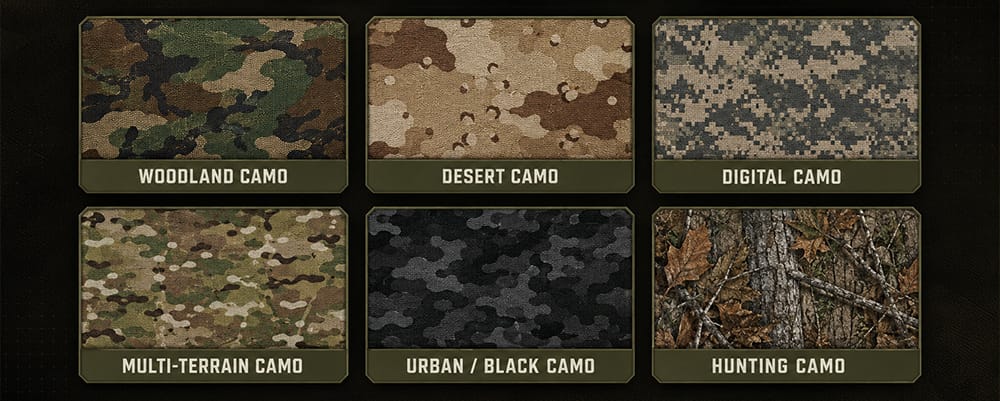
There are many camouflage patterns in the market, but most tactical gear projects fall into several practical categories. For OEM/ODM development, it is more useful to understand the application logic than to memorize every pattern name.
Woodland Camouflage
Woodland camouflage is one of the most recognizable camouflage families. It usually combines green, brown, black, and earth tones to match forest, brush, and mixed vegetation environments.
For tactical gear, woodland camo works well on tactical backpacks, hunting bags, rifle bags, outdoor pouches, field duffel bags, and gear organizers. It feels familiar, rugged, and practical, especially for outdoor, hunting, survival, and military-inspired product lines.
From a manufacturing perspective, woodland patterns need careful color control. Green and brown tones can shift noticeably between fabric lots. If the same collection includes backpacks, pouches, and gun bags, the supplier should confirm whether all items can use the same fabric batch or whether a reasonable shade tolerance needs to be approved before production.
Desert Camouflage
Desert camouflage is designed around sand, tan, beige, light brown, and dry earth tones. It is suitable for arid environments, open terrain, desert training aesthetics, and tactical products with a dry outdoor visual direction.
Desert camo is often used on tactical backpacks, range bags, hydration packs, pouches, duffel bags, and field equipment covers. Tan-based color palettes are also easy to pair with coyote brown webbing, zipper tape, buckles, and hook-and-loop panels.
For production, tan and beige shades require strict approval because small color differences can become obvious across large panels. If the bag uses multiple materials, such as printed fabric, solid webbing, mesh, binding, and coated panels, the full trim package should be reviewed together instead of approving the fabric alone.
Digital Camouflage
Digital camouflage uses pixel-like shapes instead of traditional organic shapes. It became widely recognizable through modern military uniform development and later entered commercial tactical, airsoft, and outdoor gear markets. The U.S. Army’s Operational Camouflage Pattern transition also shows why camouflage selection is often tested across terrain, vegetation, seasons, and lighting conditions rather than judged only by appearance.
For commercial tactical gear, digital camo can create a modern, technical, military-inspired look. It is commonly used for airsoft gear, tactical backpacks, MOLLE pouches, helmet bags, tactical vests, and range bags.
The main caution is pattern ownership. Brands should avoid asking a factory to directly copy protected military patterns. A safer approach is to develop a commercially inspired digital pattern, choose available stock camouflage fabric, or use properly licensed materials when a specific protected pattern is required.
Multi-Terrain Camouflage
Multi-terrain camouflage is designed to work across several environments rather than one fixed background. These patterns often combine green, brown, tan, and neutral tones in a layered structure. The official MultiCam pattern family is a well-known example, with different variants developed for general, arid, tropical, alpine, and black tactical applications.
For brands, multi-terrain camouflage is attractive because it feels versatile and current. It can be used across tactical backpacks, plate carriers, pouches, range bags, rifle bags, and outdoor gear. It is especially useful when the target market does not focus on one single environment.
The main issue is licensing. Not every popular pattern can be freely copied. If a buyer needs an exact licensed pattern, the material source should be confirmed early. If the buyer wants a similar market feeling without legal risk, a custom commercial camouflage design may be a better option.
Urban and Black Camouflage
Urban camouflage usually uses grey, black, charcoal, or muted neutral colors. Black camo is more about tactical style than natural concealment. It is common in law-enforcement-inspired products, airsoft gear, EDC bags, and street tactical collections.
Urban and black camouflage works especially well on tactical sling bags, EDC backpacks, concealed carry bags, waist bags, crossbody bags, and compact pouches. These patterns are easier to bring into everyday-use collections because they look less military than woodland or desert camo.
For manufacturing, black and grey camouflage can still have color-matching challenges. Black fabric, black webbing, black zipper tape, and black rubber patches may all come from different suppliers, so the final product should be checked as a complete set.
Hunting Camouflage
Hunting camouflage usually focuses on natural vegetation, tree bark, leaves, branches, grass, or brush. Unlike many military patterns, hunting camo may use more realistic environmental shapes.
This type of pattern is suitable for hunting backpacks, bow hunting bags, rifle bags, shotgun bags, blind bags, and outdoor storage products. For hunting markets, the region matters. A pattern that works in dense woodland may not work well in dry grassland, wetland, or open mountain terrain.
For brands developing custom gun bags, hunting camouflage should be considered together with padding, carry method, zipper strength, storage layout, and fabric durability. A rifle case or shotgun bag needs the right appearance, but it also needs reliable protection and transport structure.
Solid Tactical Colors as an Alternative
Not every tactical product needs camouflage. Solid colors such as black, coyote brown, ranger green, OD green, wolf grey, and khaki are often more practical for commercial product lines.
Solid colors are easier to control in production, easier to match across accessories, and often have lower MOQ than custom camouflage fabric. They are also useful when brands want a cleaner professional appearance without strong military styling.
For many tactical bag collections, the best approach is to offer a mix: core solid colors for stable sales and selected camouflage patterns for tactical, outdoor, hunting, or limited-edition programs.
How to Choose the Right Camouflage Pattern for a Tactical Gear Project
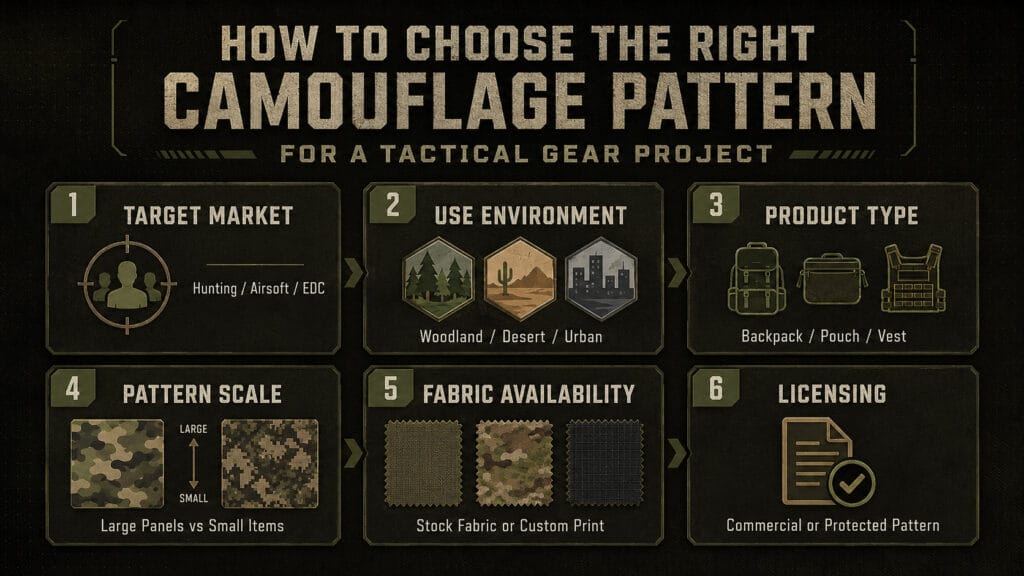
Choosing camouflage should start from product strategy, not from the print file. Before sampling, brands should define the target user, application scenario, product category, and production budget.
Start with the Target Market
Different buyers expect different camouflage styles. A hunting brand may prefer realistic natural patterns. An airsoft brand may prefer digital or multi-terrain camo. A law-enforcement-style product line may use black camo, grey camo, or solid black. A military-inspired outdoor brand may prefer coyote, ranger green, or transitional camouflage.
The target market affects not only the pattern but also the fabric, trims, product structure, and retail price point.
Match the Environment
A camouflage pattern should make sense for the intended environment. Woodland camo works better for forests and brush. Desert camo fits dry and sandy areas. Snow patterns are suitable for winter or alpine conditions. Urban camo is better for style and law-enforcement-inspired gear than for natural concealment.
Even when concealment is not the main purpose, environmental logic still helps the product feel authentic.
Consider the Product Size
The same camouflage pattern can look very different on different products. A large tactical duffel bag shows more of the pattern repeat. A small pouch may only show a few parts of the print. A backpack front panel may need balanced placement so the pattern does not look awkward after sewing.
This is especially important for modular collections. A camouflage system used on backpacks, pouches, vests, and range bags should be checked at different product sizes before bulk production.
Check Fabric Availability
Some camouflage fabrics are available as stock materials. Others require custom printing. Stock camouflage fabric usually offers faster sampling, lower development risk, and easier MOQ control. Custom camouflage gives more brand differentiation but requires longer development time and higher control over color, repeat, and printing quality.
For tactical bags, common fabric choices include 600D polyester, 900D polyester, nylon, Cordura-type fabrics, canvas, TPU-coated materials, and PVC-coated materials. Each material behaves differently during printing, cutting, sewing, bonding, and lamination.
Confirm Licensing and Pattern Rights
This is one of the most important steps. Popular camouflage names and patterns may be protected by trademark, copyright, patent, or licensing agreements. Buyers should avoid sending a protected pattern and asking a factory to copy it directly.
For commercial OEM/ODM projects, safer options include using licensed material, selecting existing commercial camouflage fabric, or developing a new custom camouflage pattern inspired by the target environment instead of copied from a protected design.
Fabric Selection for Camouflage Tactical Gear
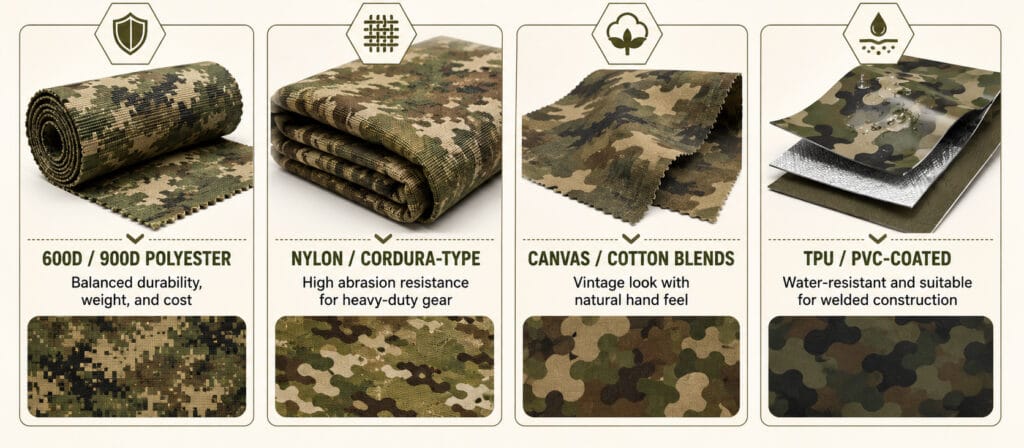
The fabric base affects the final appearance and performance of camouflage tactical gear. Even the best pattern will not work well if the fabric is not suitable for the product.
600D and 900D Polyester
600D and 900D polyester are widely used for tactical bags because they offer a practical balance between durability, weight, availability, and cost. They are suitable for tactical backpacks, pouches, range bags, waist bags, and general outdoor tactical products.
For camouflage printing, polyester can support many print methods. It is also relatively stable for bulk production. If the project requires water-repellent performance, a PU backing or surface treatment can be added.
Nylon and Cordura-Type Fabrics
Nylon and Cordura-type fabrics are often chosen for higher-end tactical gear. They offer stronger abrasion resistance and a more premium hand feel. These materials are suitable for heavy-duty backpacks, plate carrier components, pouches, rifle bags, and professional tactical equipment.
The challenge is cost and sourcing. Some high-performance fabrics may have longer lead times or higher MOQ. If the customer needs a specific camouflage pattern on a specific high-denier nylon, material planning should start early.
Canvas and Cotton Blends
Canvas and cotton blends can create a vintage military, hunting, or outdoor lifestyle look. They are not always the best choice for modern high-performance tactical gear, but they work well for certain product lines where texture and heritage styling matter.
For camouflage printing, canvas may produce a softer and more natural surface effect. However, colorfastness, shrinkage, and coating options should be checked before bulk production.
TPU and PVC-Coated Fabrics
TPU and PVC-coated fabrics are used for waterproof or water-resistant gear, such as dry bags, waterproof pouches, waterproof duffel bags, and certain outdoor equipment cases. Camouflage printing on coated materials requires special attention because coating surface, ink adhesion, welding compatibility, and lamination performance can affect the final result.
For waterproof tactical gear, the camouflage design must be considered together with seam construction, high-frequency welding, zipper selection, and closure system.
Printing Methods for Camouflage Tactical Gear
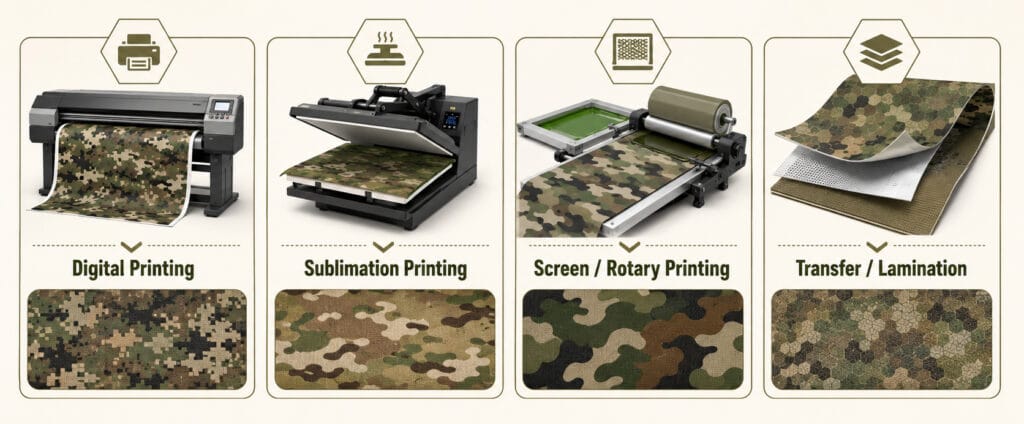
The printing method affects color accuracy, pattern sharpness, durability, cost, and MOQ. For brands developing camouflage tactical gear, the print method should be selected according to material type, order quantity, pattern complexity, and performance requirements.
Digital Printing
Digital printing is suitable for complex camouflage artwork, multiple colors, and sample development. It is useful when a brand wants to test a new pattern before committing to a larger fabric order.
Digital printing gives flexibility, but the final bulk result still needs color approval. Buyers should review lab dips, printed swatches, and pre-production samples before mass production.
Sublimation Printing
Sublimation printing is commonly used on polyester fabrics. It can produce clear patterns and good color penetration when applied correctly. It is suitable for many tactical and outdoor bag fabrics, especially when the project uses polyester as the main material.
However, sublimation is not suitable for every fabric. Nylon, coated materials, and some treated fabrics may require other processes.
Screen Printing or Rotary Printing
Screen printing and rotary printing can be effective for larger orders and repeated patterns. They can offer stable results when the artwork and color standards are well controlled.
The main advantage is production efficiency for bulk orders. The main limitation is that setup cost and MOQ may be higher, especially for multi-color camouflage patterns.
Transfer Printing and Lamination
For coated materials or special fabric constructions, transfer printing and lamination may be used. This approach must be tested carefully because the printed layer needs to remain stable during cutting, sewing, welding, and use.
For waterproof bags, the factory should test whether the print affects welding strength, surface adhesion, and folding durability.
Quality Control for Camouflage Tactical Gear
Camouflage tactical gear needs quality control beyond ordinary appearance checking. A pattern may look good in a digital file but fail during production if color, scale, cutting, and fabric performance are not controlled.
Color Consistency
Color consistency is critical for camouflage products. Slight shade differences can make panels look mismatched, especially on large backpacks, duffel bags, or rifle bags.
During production, color should be checked against approved swatches under standard lighting. If multiple fabric rolls are used, roll-to-roll shade variation should be monitored.
Pattern Scale and Repeat
The scale of the pattern must match the product. A large camouflage repeat may look good on a duffel bag but too fragmented on a small pouch. A small pattern may look detailed on accessories but too busy on large panels.
Before bulk production, the factory should confirm repeat direction, scale, and cutting layout.
Cutting Placement
Cutting affects the final visual balance. On front panels, pocket flaps, shoulder straps, and MOLLE areas, poor placement can make the product look inconsistent. Pattern alignment does not always need to be perfect, but the visual result should look intentional and balanced.
Abrasion Resistance
Tactical gear often faces friction from belts, plates, equipment, vehicles, ground contact, and outdoor use. The printed surface should resist rubbing and peeling. Abrasion testing helps check whether the camouflage surface can survive normal use.
Colorfastness to Rubbing and Water
Camouflage fabric should be tested for dry rubbing, wet rubbing, and water exposure where relevant. This is especially important for tactical bags used in outdoor, hunting, range, or travel environments.
UV and Outdoor Exposure
Outdoor products may be exposed to sunlight for long periods. UV exposure can fade colors, especially green, tan, and brown shades. For hunting and tactical outdoor gear, UV resistance should be discussed during material selection.
Near-Infrared Requirements
Near-infrared performance is not necessary for most commercial tactical bags. However, it may matter for military, government, or professional contracts. Marine Corps Systems Command has discussed visible and near-infrared camouflage performance in relation to camouflage dye behavior, which is why NIR requirements should be confirmed before material sourcing and sample development.
If a customer requires NIR or IR performance, this should be stated at the beginning of the project. It affects material sourcing, dye selection, testing, and compliance requirements.
Product Applications: Where Camouflage Works Best
Camouflage can be applied across many tactical gear categories, but each product type needs a different design approach.
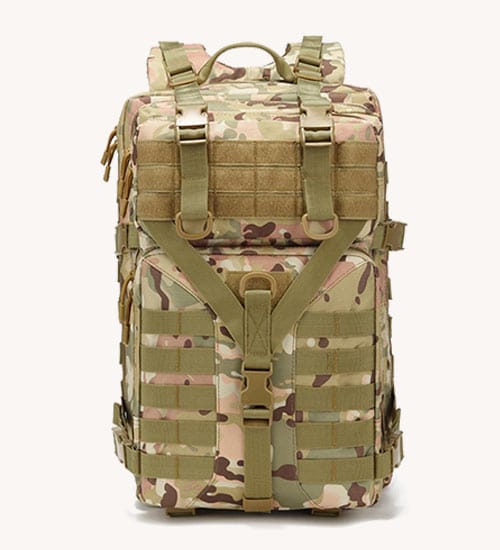
Tactical Backpacks
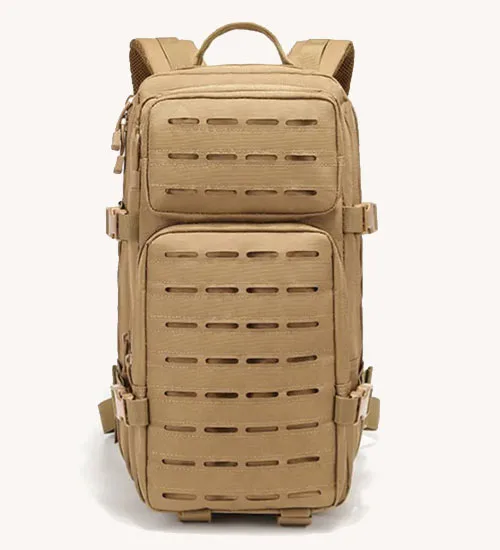
Tactical backpacks are one of the best products for camouflage patterns because they have large visible panels, MOLLE webbing, shoulder straps, and multiple compartments. Woodland, multi-terrain, digital, and black camo can all work depending on the target market.
For brands developing with a tactical backpack manufacturer, the main challenge is not only choosing the pattern but also balancing that pattern across front panels, side pockets, zipper areas, webbing, and straps.
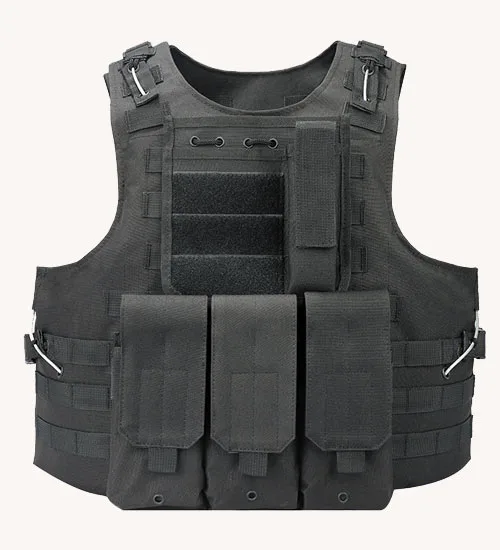
Tactical Vests and Plate Carriers
Vests and plate carriers require stronger attention to material, webbing, reinforcement, and modular attachment systems. Camouflage fabric may be used on the main body, shoulder areas, cummerbunds, pouches, and front panels.
For professional projects, the camouflage should coordinate with webbing, hook-and-loop panels, binding tape, hardware, and reinforcement zones.
Tactical Pouches and Accessories
Pouches are small, so the pattern scale matters. A large camo repeat may not show well on a compact pouch. Smaller or medium-scale camouflage is usually more suitable.
For modular products, the camouflage fabric also needs to match solid-color webbing and accessory components. A tactical accessories manufacturer should check how the same material performs across pouches, holsters, helmet bags, and other add-on products.
Gun Bags and Range Bags
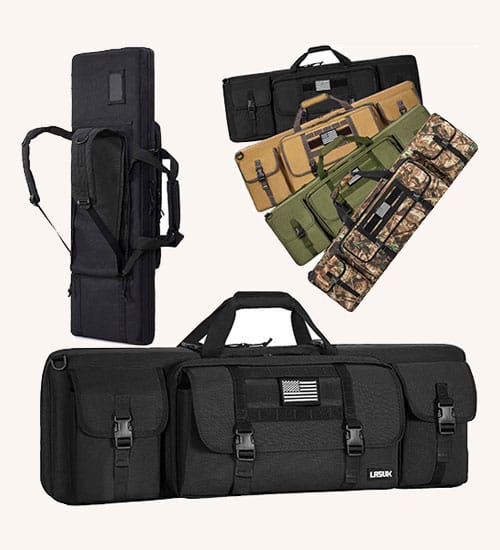
Gun bags and range bags often use camouflage for hunting, shooting sports, or tactical markets. Rifle bags may use woodland, brush, or coyote-based camo, while range bags may use black camo, grey camo, or multi-terrain colors.
Because these products often carry heavy equipment, fabric strength, padding, zipper quality, handle reinforcement, and stitching quality are more important than appearance alone. A rifle bag manufacturer must consider both visual positioning and protective structure, while a range bag manufacturer also needs to plan interior organization, accessory storage, and transport stability.
Waterproof Tactical Bags
Camouflage waterproof bags require special material planning. TPU-coated, PVC-coated, or tarpaulin materials may not accept the same printing process as woven polyester or nylon. The factory must test printing adhesion, welding strength, and folding durability.
For this category, the camouflage pattern should not compromise waterproof construction.
Custom Camouflage Development for OEM/ODM Projects
For brands that want stronger differentiation, custom camouflage development can be a good option. Instead of using a common stock pattern, the brand can develop a unique camouflage direction based on its target market, product category, and long-term collection strategy.
A custom camouflage project may include:
- selecting the target environment
- defining the color palette
- adjusting the pattern scale
- developing artwork repeats
- printing sample swatches
- testing colorfastness and abrasion
- making a prototype sample
- confirming bulk fabric standards
- applying the pattern across multiple products
For a tactical gear collection, one custom camouflage system can be used across backpacks, waist bags, sling bags, pouches, rifle bags, range bags, and duffel bags. This creates stronger brand consistency and makes the product line look more professional.
Vancharli Outdoor supports OEM and ODM tactical gear projects with material selection, pattern application, sample development, logo customization, private label packaging, and bulk production control. For brands, wholesalers, importers, and procurement teams, this helps turn a camouflage concept into a production-ready product line.
Licensing and Commercial Safety
Camouflage development must also consider legal and commercial risk. Some patterns are generic. Some are brand-owned. Some are official military patterns. Some include embedded marks, logos, or protected elements.
A factory should not treat every camouflage file as free to copy. Buyers should confirm whether they own the artwork, have permission to use it, or need a new custom pattern.
For commercial tactical gear, there are three safer options:
| Option | Best For | Notes |
|---|---|---|
| Stock commercial camouflage fabric | Faster sampling and lower development risk | Suitable for standard tactical bag programs. |
| Licensed camouflage fabric | Brands that need a specific protected pattern | Requires proper sourcing and documentation. |
| Custom camouflage design | Private label and long-term product lines | Higher differentiation, but needs artwork and testing. |
This step protects both the buyer and the manufacturer.
Camouflage Pattern Selection Checklist for Buyers
Before starting a camouflage tactical gear project, buyers can use the following checklist:
| Question | Why It Matters |
|---|---|
| What is the target market? | Hunting, airsoft, military-style, law enforcement, outdoor, and EDC markets need different camo directions. |
| What environment is the product designed for? | Woodland, desert, urban, snow, and mixed terrain require different color palettes. |
| What product category will use the pattern? | Backpacks, pouches, vests, gun bags, and range bags show camouflage differently. |
| Is the fabric stock or custom printed? | This affects MOQ, cost, lead time, and sampling speed. |
| Does the pattern require licensing? | Protected patterns should not be copied without permission. |
| What printing method is suitable? | Digital, sublimation, screen, rotary, and transfer printing have different limits. |
| Has the color been approved on actual fabric? | Digital artwork alone is not enough for production approval. |
| Will the pattern survive abrasion and rubbing? | Tactical gear needs surface durability, not only good appearance. |
| Does the project require NIR performance? | Most commercial products do not, but professional contracts may require it. |
| Can the same camo be used across a full product line? | Consistency helps build stronger brand identity. |
Conclusion
Camouflage patterns are an important part of tactical gear design, but they should never be selected by appearance alone. For brands and procurement teams, the right pattern must match the market, environment, product type, fabric, printing method, color standard, and legal requirements.
A successful camouflage tactical gear project depends on both creative direction and manufacturing control. The pattern must look right, print correctly, cut cleanly, match trims, pass durability checks, and remain consistent during bulk production.
For OEM/ODM tactical gear development, working with an experienced manufacturer can help reduce sampling risk, improve material selection, and turn camouflage concepts into reliable production-ready products.
What are the most common camouflage patterns for tactical gear?
The most common camouflage patterns include woodland camo, desert camo, digital camo, multi-terrain camo, black camo, urban camo, and hunting camo. Solid tactical colors such as coyote brown, ranger green, OD green, black, and khaki are also widely used in tactical gear.
How do I choose the right camouflage pattern for a tactical bag?
Start with the target user and environment. Hunting bags may need woodland or brush camo, while range bags may use black camo, grey camo, or coyote-based patterns. Tactical backpacks can use woodland, digital, or multi-terrain camouflage depending on the brand’s positioning.
Can a tactical gear manufacturer develop custom camouflage fabric?
Yes. A tactical gear manufacturer can help develop custom camouflage fabric by adjusting colors, pattern scale, artwork repeat, printing method, and fabric base. Custom camouflage is useful for private label brands that want a unique product identity.
Can I use MultiCam or MARPAT for my private label products?
Not automatically. Some well-known camouflage patterns, names, and embedded marks may be protected by trademark, copyright, patent, or licensing rules. Buyers should use licensed fabric, choose commercial stock camouflage, or develop a custom pattern instead of directly copying protected designs.
What fabric is best for camouflage tactical backpacks?
600D polyester and 900D polyester are common choices for commercial tactical backpacks because they balance durability, cost, and availability. For higher-end tactical backpacks, nylon or Cordura-type fabrics may be used. The final choice depends on performance requirements, budget, MOQ, and target market.
Is digital camouflage better than woodland camouflage?
Not always. Digital camouflage gives a modern military-inspired appearance, while woodland camouflage is better suited for forests, brush, and hunting markets. The best choice depends on the product’s target environment and customer base.
What is the MOQ for custom camouflage tactical bags?
MOQ depends on the fabric, printing method, product structure, and order complexity. Stock camouflage fabric usually supports lower MOQ, while custom printed camouflage fabric may require higher MOQ because the fabric needs separate artwork, printing, and color approval.
How do manufacturers control camouflage color consistency?
Manufacturers control color consistency by approving printed swatches, checking fabric rolls under standard lighting, monitoring roll-to-roll shade variation, and comparing bulk production against approved samples. Color control is especially important for large bags with multiple visible panels.
Can camouflage be used on waterproof tactical bags?
Yes, but the material and printing method must be tested carefully. TPU-coated, PVC-coated, and tarpaulin fabrics require attention to print adhesion, welding strength, folding durability, and waterproof construction.
Do tactical bags need near-infrared camouflage performance?
Most commercial tactical bags do not need near-infrared performance. NIR requirements are usually relevant for military, government, or professional contracts. If a buyer needs NIR performance, it should be confirmed before material sourcing and sample development.
Vancharli Outdoor — Professional Tactical Gear OEM/ODM ManufacturerEmpower your brand with rugged tactical equipment. Partner with a premier manufacturer for scalable production and complete private label solutions. ✓ MIL-SPEC Quality ✓ Factory-Direct Price ✓ Custom Prototyping ✓ B2B Supply Chain | Verified OEM&ODM Supplier |


Comments are closed