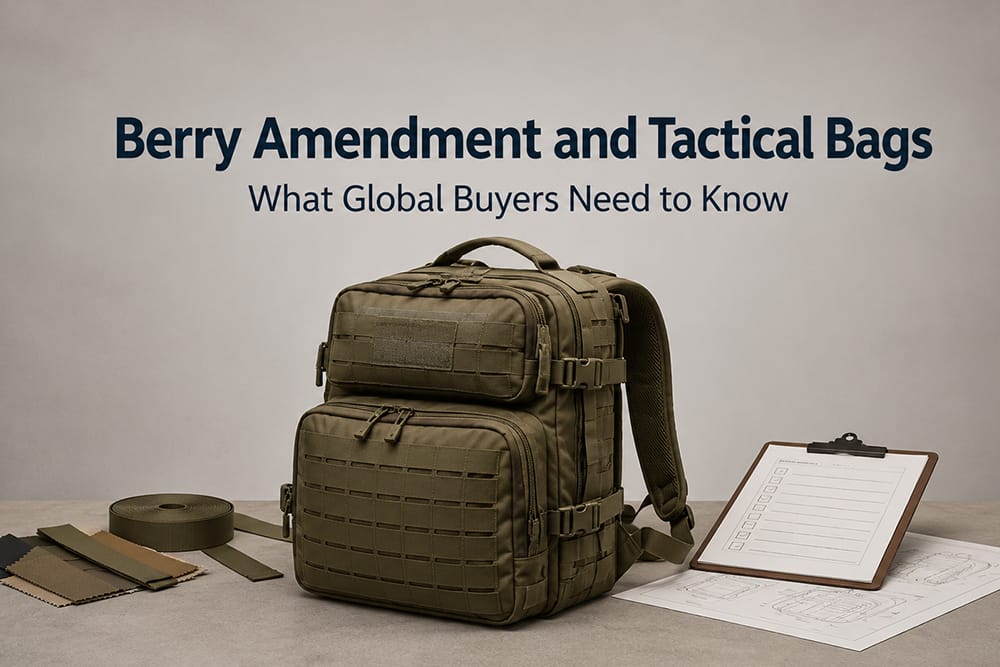
Berry Amendment and Tactical Bags: What Global Buyers Need to Know
For tactical bag buyers, sourcing decisions are not only about fabric strength, MOLLE layout, stitching quality, or unit price. In some projects, compliance rules can decide whether a supplier is suitable before product development even begins.
The Berry Amendment is one of those rules.
For global buyers, importers, private-label brands, and procurement teams, the most important question is not simply “What is the Berry Amendment?” The real question is: Does it apply to this tactical bag project, and what should we check before choosing a manufacturer?
This guide explains how the Berry Amendment relates to tactical bags, when it matters, how it differs from general “Made in USA” claims, and when international OEM/ODM manufacturing may still be suitable for commercial tactical bag programs.
This article is for general information only. It is not legal advice. Buyers working on U.S. Department of Defense contracts should confirm contract language with qualified legal or procurement specialists.
The Berry Amendment is a U.S. domestic sourcing requirement connected mainly to Department of Defense procurement. In simple terms, it restricts the DoD from using certain funds to buy covered items that are not grown, reprocessed, reused, or produced in the United States.
For textile-related products, the rule is especially important because it can cover:
clothing and related materials;
fabrics, fibers, and yarns;
other made-up textile items;
synthetic and coated synthetic fabrics;
canvas products;
certain individual equipment items made from covered materials.
For tactical bag buyers, this matters because many tactical bags are textile-based products. Even when a bag is not clothing, it may contain covered materials such as nylon fabric, polyester fabric, coated fabric, canvas, webbing, thread, binding tape, zipper tape, hook-and-loop material, and textile reinforcement panels.
In ordinary commercial sourcing, buyers often focus on durability, price, MOQ, sampling time, branding, and quality control. Under a Berry-related DoD procurement requirement, the sourcing question becomes much stricter: where did each covered component come from, and where was it processed, assembled, and finished?
Why Tactical Bags Can Be Affected
Tactical bags are often described by their function: assault packs, range bags, medical bags, hydration packs, radio pouches, admin pouches, helmet bags, tactical sling bags, or modular backpacks. But from a compliance perspective, the important issue is not the product name. It is the material structure.
A tactical bag may include many textile and hardware components, such as:
Component
Why It Matters
Main fabric
Nylon, polyester, Cordura-type fabric, coated fabric, canvas, and similar materials may fall into textile-related sourcing requirements.
Webbing
MOLLE webbing, shoulder straps, compression straps, and waist belts are usually textile components.
Thread
Stitching thread can become a compliance concern because it is part of the finished textile product.
Zippers
Zipper tape and related components may need to be reviewed depending on the contract requirement.
Hook-and-loop
Loop panels, name tape fields, and modular patches may be treated as textile components.
Binding and reinforcement
Edge binding, bartack reinforcement zones, and internal support panels can affect component traceability.
Buckles and hardware
Plastic or metal hardware may also need review when a contract requires full domestic traceability.
This is why a tactical bag cannot be treated as “compliant” only because the final sewing happens in one country. For strict DoD-related Berry projects, buyers may need documentation for the full chain of materials and components.
Berry compliance should not be confused with product performance. It is a procurement and sourcing requirement, not a durability rating.
A tactical bag can be well-built, abrasion-resistant, and suitable for commercial field use without being Berry compliant. At the same time, a Berry-compliant product still needs proper material selection, reinforcement, stitching, testing, and quality control to perform well in real use.
This distinction is important for global buyers.
If a tactical bag project is tied to U.S. DoD procurement, Berry compliance may be mandatory before performance is even considered. If the project is for commercial tactical retail, outdoor use, hunting, training, EDC, or international distribution, buyers may be able to evaluate factories based on product quality, development ability, material options, MOQ, branding support, and production consistency instead.
In other words, Berry compliance answers one question:
Can this product meet a specific U.S. defense procurement sourcing requirement?
It does not automatically answer another question:
Is this tactical bag well designed, durable, and suitable for the target market?
Both questions matter, but they are not the same.
Berry Amendment vs. Made in USA
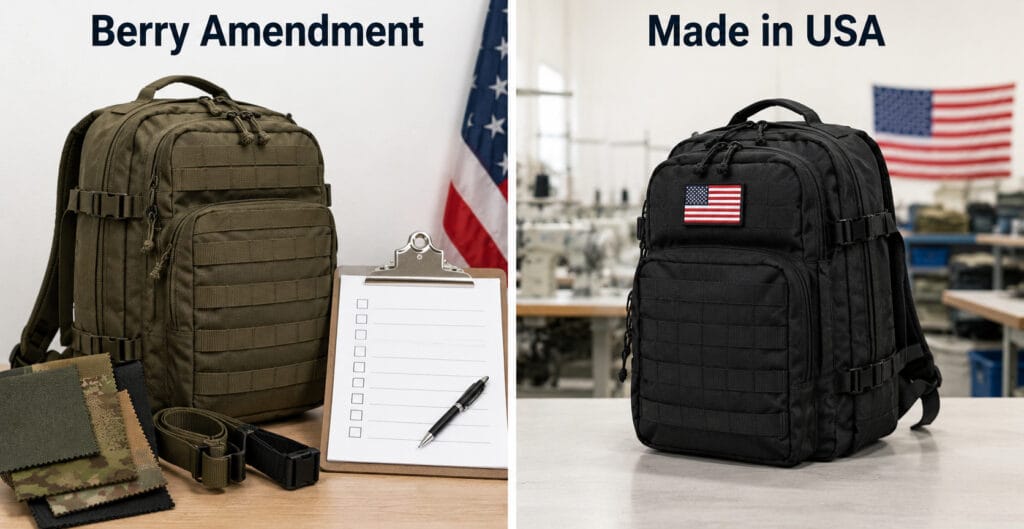
One of the most common misunderstandings is treating “Made in USA” and “Berry compliant” as the same thing. They are not the same.
A product may be assembled in the United States and marketed as Made in USA under one framework, but that does not automatically mean it satisfies Berry Amendment requirements for a DoD procurement contract.
For tactical bags, the difference can be significant:
Term
Basic Meaning
What Buyers Should Understand
Made in USA
A general origin or marketing claim related to U.S. production
It may not guarantee that every material, fiber, fabric, zipper, buckle, thread, or component meets a DoD sourcing requirement.
Berry compliant
A stricter DoD-related sourcing requirement for covered items
It usually requires deeper domestic sourcing and production traceability for covered materials and components.
Assembled in USA
Final assembly happens in the United States
This alone may not be enough if fabric, webbing, thread, or components are imported.
Designed in USA
Product design is created in the United States
This does not mean the product is domestically manufactured or Berry compliant.
For buyers, the safest approach is to avoid relying on labels alone. If a project is tied to DoD funding or a prime contractor requirement, ask for the exact contract clause, required certifications, and component-level documentation before confirming the supplier.
Berry Amendment vs. Buy American, TAA, ISO 9001, and GSA
Buyers often see several terms used together in government and defense procurement. They may sound similar, but they do not mean the same thing.
Term
What It Usually Refers To
Relevance to Tactical Bags
Berry Amendment
A U.S. domestic sourcing rule mainly tied to DoD procurement of covered items
Critical when textile-based tactical bags, packs, pouches, or individual equipment are purchased under Berry-restricted DoD requirements.
Buy American
A broader U.S. federal domestic preference framework
Important in some government procurement contexts, but it is not the same as Berry compliance for DoD textile items.
TAA
Trade Agreements Act country-of-origin compliance for certain government purchases
May matter for some government contracts, but TAA eligibility does not automatically mean Berry compliance.
Made in USA
A product origin or marketing claim governed by U.S. origin-claim standards
Useful for commercial labeling, but it should not be treated as a substitute for Berry documentation.
ISO 9001
A quality management system standard
Helpful for process control, traceability, and quality management, but it is not a Berry compliance certification.
GSA Schedule
A U.S. government purchasing contract vehicle
A useful procurement channel, but buyers still need to confirm whether the specific product and contract require Berry compliance.
This comparison is especially important for tactical bag buyers because a supplier may have strong quality systems, a government sales channel, or Made in USA claims, but the buyer still needs to confirm whether the exact product meets the exact contract requirement.
For Berry-restricted projects, the question is not simply “Is this supplier reliable?” The question is more specific: Can this supplier document the required domestic sourcing and production chain for this item?
Does the Berry Amendment Apply to All Tactical Bags?
No. The Berry Amendment does not automatically apply to every tactical bag sold in the market.
Many tactical bags are sold through commercial channels, outdoor brands, law enforcement distributors, private-label retail programs, e-commerce brands, hunting brands, and non-U.S. government markets. These projects may still require high quality, durability, and reliable manufacturing, but they may not require Berry Amendment compliance.
The key is the buying context.
Berry Amendment concerns usually become important when the project is connected to:
U.S. Department of Defense procurement;
DoD-funded contracts;
prime contractors working on DoD programs;
subcontractors supplying covered items into a DoD contract;
solicitations that include Berry Amendment or DFARS language;
tactical gear intended for certain U.S. military procurement programs.
If the tactical bag is for a commercial outdoor brand, a private-label tactical gear line, a training gear collection, an international distributor, or a non-DoD market, the Berry Amendment may not be the controlling requirement.
That distinction matters for global buyers. A tactical bag can be excellent for commercial use while still not being suitable for a Berry-restricted DoD procurement project.
Buyer Scenarios: When Berry Usually Matters
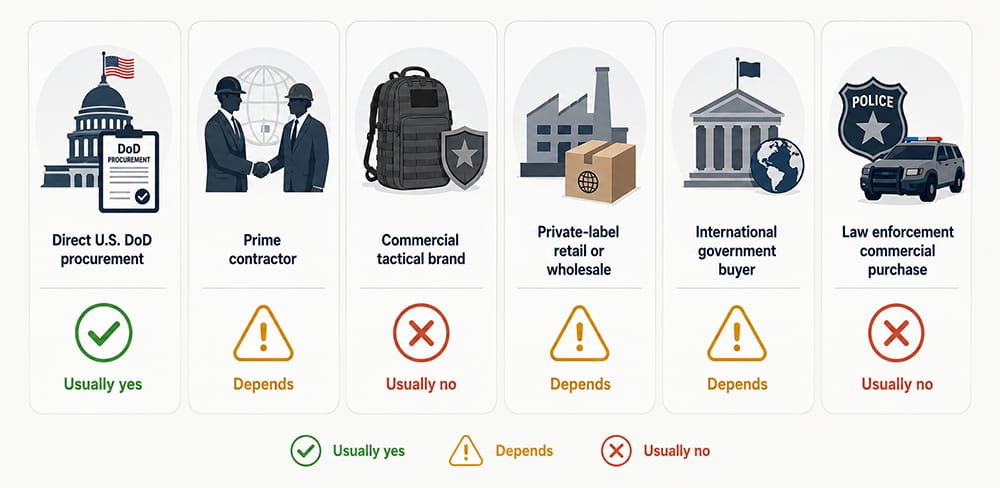
The table below gives buyers a practical starting point. It should not replace legal or contract review, but it can help teams understand when the Berry Amendment is likely to become a sourcing issue.
Buyer Scenario
Does Berry Usually Matter?
Suggested Sourcing Direction
Direct U.S. DoD textile or tactical gear procurement
Yes
Work with qualified U.S. Berry-compliant sources and verify full documentation.
Prime contractor supplying a DoD program
Usually yes
Confirm DFARS and Berry clauses before selecting any supplier.
Subcontractor supplying textile components into a DoD project
Usually yes
Review component origin, production records, and contract flow-down requirements.
U.S. law enforcement commercial purchase
Not always
Check agency rules; Berry may not apply unless contract language requires it.
Commercial tactical gear brand
Usually no
Global OEM/ODM manufacturing may be suitable if claims and labeling are accurate.
Hunting, outdoor, EDC, or tactical-style retail bag line
Usually no
Focus on materials, structure, testing, QC, branding, and market positioning.
International government buyer outside the U.S.
Depends
Follow local procurement rules and origin requirements.
Private-label tactical bag program for retail or wholesale
Usually no
International production can be practical when no Berry restriction exists.
This is the core decision point for global buyers: identify the procurement channel first, then choose the right sourcing path.
How DFARS Language Affects Sourcing
For DoD-related projects, buyers should pay close attention to the contract language. The relevant sourcing requirements are commonly implemented through DFARS 225.7002-1, which covers restrictions on certain foreign products and materials.
A tactical bag buyer should not guess whether Berry applies based only on the product name. The better approach is to check:
Does the contract mention Berry Amendment?
Does the contract include DFARS 225.7002 language?
Is the bag being purchased as clothing, individual equipment, a textile item, or a component of another system?
Are all textile materials required to be U.S.-origin?
Are components such as webbing, thread, zippers, hook-and-loop, and buckles included in the compliance requirement?
Are there any approved exceptions or domestic nonavailability determinations?
Is the project for direct DoD procurement, a prime contractor, or a commercial buyer?
The contract language should guide the sourcing decision. If the buyer is unsure, the project should be reviewed by a legal, compliance, or government procurement specialist before the supplier is selected.
Where Global Tactical Bag Manufacturing Still Makes Sense
The Berry Amendment is important, but it does not eliminate the need for global tactical bag manufacturing. Many tactical bag programs are not DoD Berry projects.
International OEM/ODM production can still be suitable for:
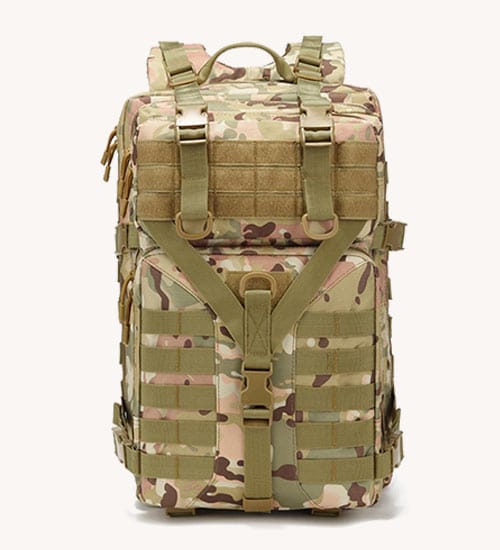
commercial tactical backpacks;
outdoor and survival gear bags;
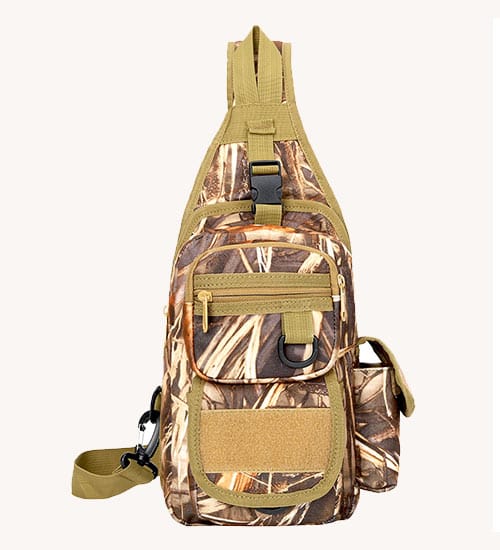
hunting backpacks and field bags;
range bags for civilian and retail markets;
tactical sling bags and EDC bags;
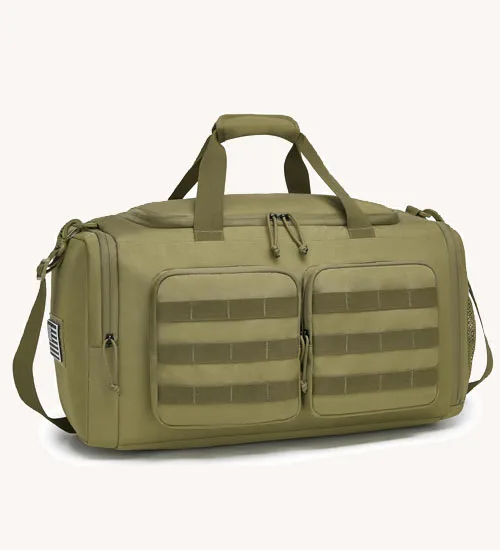
tactical duffel bags;
camera and equipment bags with tactical styling;
private-label tactical accessories;
non-U.S. government procurement programs;
international distributor and wholesale projects.
For these projects, buyers usually focus on product performance, material selection, construction strength, price positioning, MOQ, sample development, branding, packaging, and production consistency.
A global custom tactical bag manufacturer can support these needs through fabric sourcing, structure development, MOLLE layout planning, pocket engineering, logo customization, private-label packaging, sampling, and bulk production.
The key is transparency. If a buyer needs Berry Amendment compliance, an overseas factory should not be positioned as the solution. If the project is a commercial tactical bag program without Berry restrictions, international manufacturing may be a practical and cost-effective option.
Tactical Bag Components Buyers Should Review Early
Before starting a tactical bag OEM project, buyers should define the compliance level required. This should happen before sampling, not after the prototype is finished.
Here are the main areas to review.
Main Shell Fabric
The shell fabric affects durability, cost, appearance, and compliance risk. Common tactical bag fabrics include 600D polyester, 900D polyester, 1000D nylon, ripstop nylon, coated polyester, canvas, and Cordura-type materials.
For commercial projects, buyers may compare abrasion resistance, water-repellent coating, colorfastness, hand feel, and price. For Berry-related projects, the origin of the fabric, yarn, finishing, and coating process may need documentation.
MOLLE Webbing and Load-Bearing Straps
MOLLE webbing is central to many tactical backpacks, pouches, plate carrier accessories, and modular systems. Shoulder straps, compression straps, waist belts, and carry handles also rely heavily on webbing.
For commercial projects, buyers should test tensile strength, bartack reinforcement, spacing accuracy, and long-term deformation. For Berry-related projects, webbing origin and production traceability may also need review.
Thread and Stitching Construction
Thread is easy to overlook, but it can be a critical part of compliance and durability. Tactical bags often require heavy-duty stitching, bartack reinforcement, stress-point sewing, and reinforced seams.
For OEM development, buyers should specify thread type, stitch density, reinforcement method, and load testing standards. If the project has Berry requirements, thread sourcing may need to be verified as part of the full compliance chain.
Zippers, Buckles, and Hook-and-Loop
Tactical bags often use heavy-duty zippers, quick-release buckles, D-rings, ladder locks, hook-and-loop panels, pullers, and modular attachment hardware.
For commercial projects, buyers should evaluate function, corrosion resistance, pull strength, smoothness, field usability, and replacement availability. For regulated projects, the buyer should confirm whether each component is included in the sourcing requirement.
Labels, Packaging, and Product Claims
Compliance risk is not only about materials. It is also about how the product is described.
Buyers should avoid unclear claims such as:
“military compliant”;
“DoD approved”;
“Berry-style”;
“Made for government use”;
“Berry compliant” without documentation;
“Made in USA” when major components are imported.
For tactical bag brands, accurate labeling protects both the buyer and the supplier. If a product is made for commercial tactical use, say that clearly. If it is not Berry compliant, do not imply that it is.
Questions to Ask Before Starting an OEM Tactical Bag Project
A good tactical bag supplier discussion should begin with product use, target market, and compliance expectations. Before sampling, buyers should ask:
Is this tactical bag for commercial sale, government procurement, or DoD-related use?
Does the contract include Berry Amendment or DFARS requirements?
Is “Made in USA” required, or is full Berry compliance required?
Are all textile components required to be U.S.-origin?
Are zippers, buckles, hook-and-loop, thread, and webbing included in the sourcing requirement?
Does the buyer need component certificates or supplier declarations?
Can the supplier separate commercial materials from regulated sourcing requirements?
What claims can legally appear on the label, packaging, and product page?
What testing is required for load-bearing areas, seams, closures, and MOLLE panels?
What is the target market: retail tactical, outdoor, law enforcement, hunting, training, or government contract?
Mistake 1: Assuming All Tactical Gear Must Be Berry Compliant
Not every tactical bag is purchased by the DoD. Commercial tactical gear, outdoor bags, hunting bags, and private-label EDC products may have different requirements.
A buyer should define the sales channel first. If the product is not entering a Berry-restricted contract, the project may be evaluated mainly by performance, quality, price, and brand positioning.
Mistake 2: Treating Final Assembly as Full Compliance
Final assembly is only one part of the issue. For strict Berry projects, fabric, fibers, webbing, thread, and other covered components may also matter.
A bag sewn in one country using imported textile components may not meet the sourcing requirement if the contract demands full domestic origin.
Mistake 3: Using “Berry Compliant” as a Marketing Phrase
Berry compliance is not a casual marketing phrase. It should be supported by documentation and contract-specific review.
If a tactical bag is designed for commercial use, it is better to focus on accurate performance claims such as reinforced stitching, water-repellent fabric, abrasion resistance, MOLLE compatibility, padded compartments, or private-label customization.
Mistake 4: Ignoring Component-Level Traceability
For regulated projects, buyers may need more than a finished product invoice. They may need documentation for fabric, thread, webbing, zippers, hardware, and other components.
This is why compliance planning should begin before material sourcing and sample production.
Mistake 5: Assuming ISO 9001 or GSA Automatically Means Berry Compliance
ISO 9001 can support quality management, process control, documentation habits, and traceability systems. GSA can provide a government purchasing pathway. But neither one automatically proves that every specific tactical bag is Berry compliant.
Buyers still need to check the product, the contract, the materials, and the documentation.
Mistake 6: Choosing a Supplier Before Reviewing Contract Language
A supplier may be excellent for commercial tactical bag manufacturing but unsuitable for a Berry-restricted DoD program. The contract requirement should come first, followed by supplier selection.
How Buyers Can Build a Safer Sourcing Plan
A safer tactical bag sourcing plan starts with classification. Buyers should separate projects into at least three groups:
Project Type
Suitable Sourcing Direction
DoD Berry-restricted project
Work with qualified U.S. Berry-compliant manufacturers and verify full documentation.
U.S. commercial tactical project
Global OEM/ODM sourcing may be suitable if labeling and claims are accurate.
International tactical bag project
Global manufacturing may be practical, depending on local requirements, quality standards, and market positioning.
For commercial and international programs, buyers can focus on product development factors such as:
fabric selection based on target price and durability;
MOLLE spacing and modular layout;
load-bearing strap reinforcement;
pocket organization;
hydration compatibility;
padded protection zones;
color and camouflage options;
brand logo and packaging;
AQL inspection and shipment quality control.
A tactical gear supplier with OEM/ODM experience can support these commercial development needs, but buyers should still make sure the final product claims match the actual sourcing and manufacturing process.
What This Means for Vancharli Outdoor Buyers
Vancharli Outdoor supports OEM/ODM tactical bag development for brands, wholesalers, importers, and procurement teams working on commercial tactical, outdoor, hunting, EDC, and private-label bag programs.
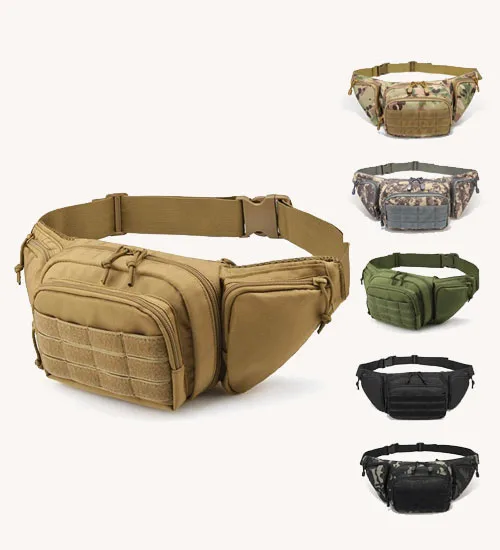
That includes product types such as tactical backpacks, tactical sling bags, tactical waist bags, tactical duffel bags, hunting bags, tactical camera bags, range bags, pouches, and related soft goods.
However, buyers should be clear about the compliance boundary. Vancharli Outdoor should not be treated as a Berry Amendment-compliant U.S. manufacturer for DoD-restricted procurement. If a project requires Berry compliance, the buyer should verify U.S. domestic sourcing requirements with legal or procurement specialists and work with qualified U.S.-based suppliers where required.
For non-Berry commercial tactical bag programs, Vancharli Outdoor can support material selection, structure development, sampling, logo customization, private-label packaging, quality control, and bulk production through China and Southeast Asia manufacturing resources.
This is the right positioning: clear, transparent, and useful for global buyers.
Final Thoughts
The Berry Amendment is important, but it should not be misunderstood.
For DoD procurement and certain defense-related contracts, Berry requirements can directly affect whether a tactical bag supplier is eligible. Buyers may need U.S.-origin materials, U.S. component manufacturing, U.S. assembly, and detailed documentation.
For commercial tactical bags, private-label outdoor gear, hunting bags, EDC packs, international wholesale programs, and non-Berry projects, global OEM/ODM manufacturing can still be a strong option.
The best sourcing decision starts with one question:
What compliance requirement does this project actually have?
Once that is clear, buyers can choose the right manufacturing path, avoid inaccurate claims, and develop tactical bags that match both the product purpose and the market requirement.
FAQ
1. Does the Berry Amendment apply to every tactical bag?
No. It mainly matters when the tactical bag is connected to U.S. Department of Defense procurement or a contract that includes Berry Amendment or DFARS requirements. Many commercial tactical bags are not Berry-restricted projects.
2. Can an overseas tactical bag factory make Berry-compliant bags?
For strict DoD Berry requirements, covered textile materials and production generally need to be domestic to the United States. Overseas manufacturing is usually not suitable for a Berry-restricted project unless a specific contract exception applies and is properly approved.
3. Is Made in USA the same as Berry compliant?
No. Made in USA and Berry compliant are different. Berry compliance is usually stricter for covered DoD procurement items and may require deeper traceability for materials, components, and production.
4. Is Berry compliance the same as better product quality?
No. Berry compliance is a sourcing and procurement requirement, not a performance rating. A tactical bag still needs strong material selection, reinforcement, stitching, testing, and quality control to perform well.
5. Does ISO 9001 prove Berry compliance?
No. ISO 9001 can support quality management and documentation control, but it does not prove that a tactical bag is Berry compliant. Buyers still need product-specific sourcing documentation.
6. Does GSA availability mean a tactical bag is Berry compliant?
Not automatically. GSA availability may support government purchasing, but buyers still need to confirm whether the exact product and contract require Berry compliance and whether the supplier can provide the required documentation.
7. What tactical bag components may affect Berry compliance?
Fabric, webbing, thread, zipper tape, hook-and-loop material, binding, reinforcement panels, and other textile components may need review. Depending on the contract, hardware and other components may also need documentation.
8. Do commercial tactical brands need Berry-compliant bags?
Usually not, unless they are selling into a DoD-related contract or a specific buyer requires it. Commercial tactical brands usually focus on performance, durability, pricing, branding, MOQ, and reliable production.
9. Can Vancharli Outdoor support Berry Amendment projects?
Vancharli Outdoor is not positioned as a Berry Amendment-compliant U.S. manufacturer. For Berry-restricted DoD projects, buyers should verify requirements with qualified specialists and work with appropriate U.S. domestic sources where required.
10. What projects are suitable for Vancharli Outdoor?
Vancharli Outdoor is suitable for non-Berry commercial tactical bag projects, private-label tactical gear programs, outdoor and hunting bag lines, EDC tactical bags, tactical backpacks, range bags, pouches, and OEM/ODM soft goods development.
11. What should buyers check before starting a tactical bag OEM project?
Buyers should confirm target market, compliance requirements, material specifications, MOLLE layout, structure, load-bearing areas, branding needs, packaging, MOQ, sampling timeline, testing requirements, and final product claims.








Comments are closed