Coyote brown and ranger green dominate roughly 70% of current U.S. Military issue gear, and that shift away from black isn’t aesthetic, it’s tactical.
When asking What’s the best color for military backpack use, the honest answer depends on your environment: coyote brown wins for arid and mixed terrain, ranger green for woodland and urban-grey settings.
And MultiCam for changing landscapes. Black, despite looking “tactical,” is the worst performer in nearly every real-world scenario except urban night operations.
This guide breaks down each color by visibility data, terrain match, IR signature, and civilian practicality, so you pick once and don’t regret it on the trail.
Choose coyote brown for arid/mixed terrain; it wins four of five practicality categories.
Pick ranger green for woodland, urban-grey environments, and discreet everyday city carry.
Avoid black backpacks outdoors—they absorb heat and appear stark on infrared devices.
Select MultiCam only for shifting landscapes; skip full camo patterns in urban settings.
Verify military-spec dye to ensure proper near-infrared concealment under night vision.
The Short Answer on Which Military Backpack Color Wins
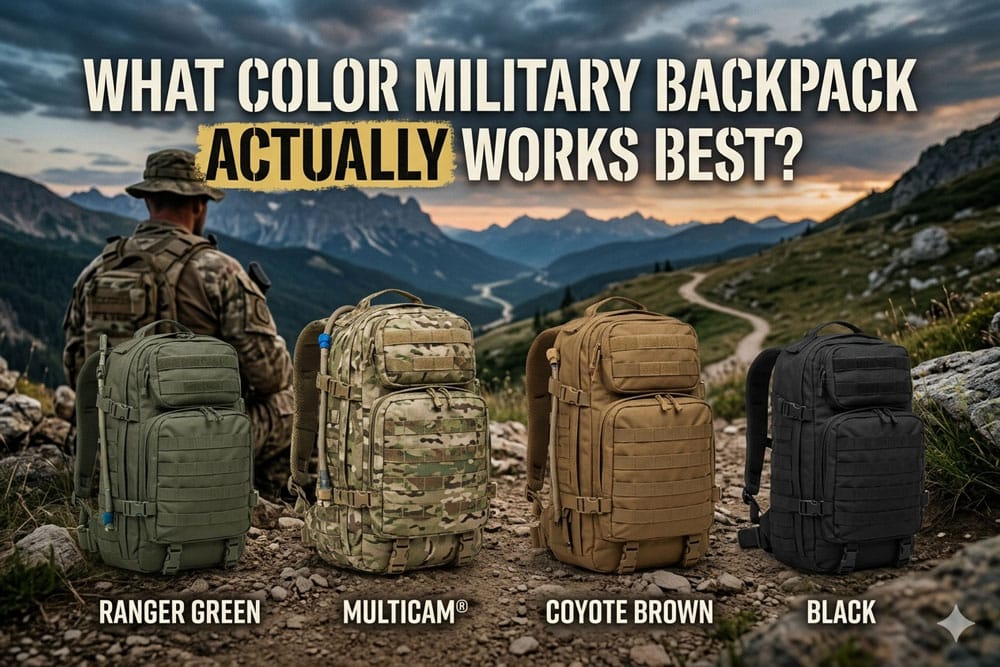
For about eighty percent of people, coyote brown and ranger green are better choices than black or full camouflage. They blend into a wider variety of backgrounds. Plus, when they’re dyed to the right military spec, they also don’t show up much on night vision.
They also just look like normal outdoor gear in a city. Black, on the other hand, soaks up heat. And it shows up as a stark black hole on infrared devices.
It also practically shouts “military” to anyone in law enforcement.
Wearing full MultiCam or woodland patterns in town makes you stand out. That can be a real problem at airports or government buildings.
So, what is the best color for a military backpack? It really depends on where you’ll take it. Honestly, a pack spends most of its time in cars, offices, and hotels. That reality should guide your choice more than a cool product photo.
This guide uses five key points to decide: the main terrain you’re in, if you need night vision concealment, how discreet you need to be in a city, how well the color holds up to sun.
And what it’s worth if you sell it later. For desert or mixed areas, coyote 498 wins in four of those five categories.
That specific shade has been the U.S. Army’s standard since 2010, according to the PEO Soldier program.
If you’re mostly in forests or the Pacific Northwest, ranger green is your best bet. We’re going to look at each of these tradeoffs one by one.
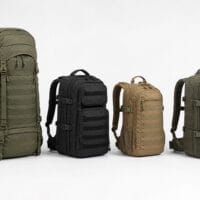
Best color military backpack comparison showing coyote brown ranger green black and MultiCam side by side
The Five Factors That Actually Determine the Right Color
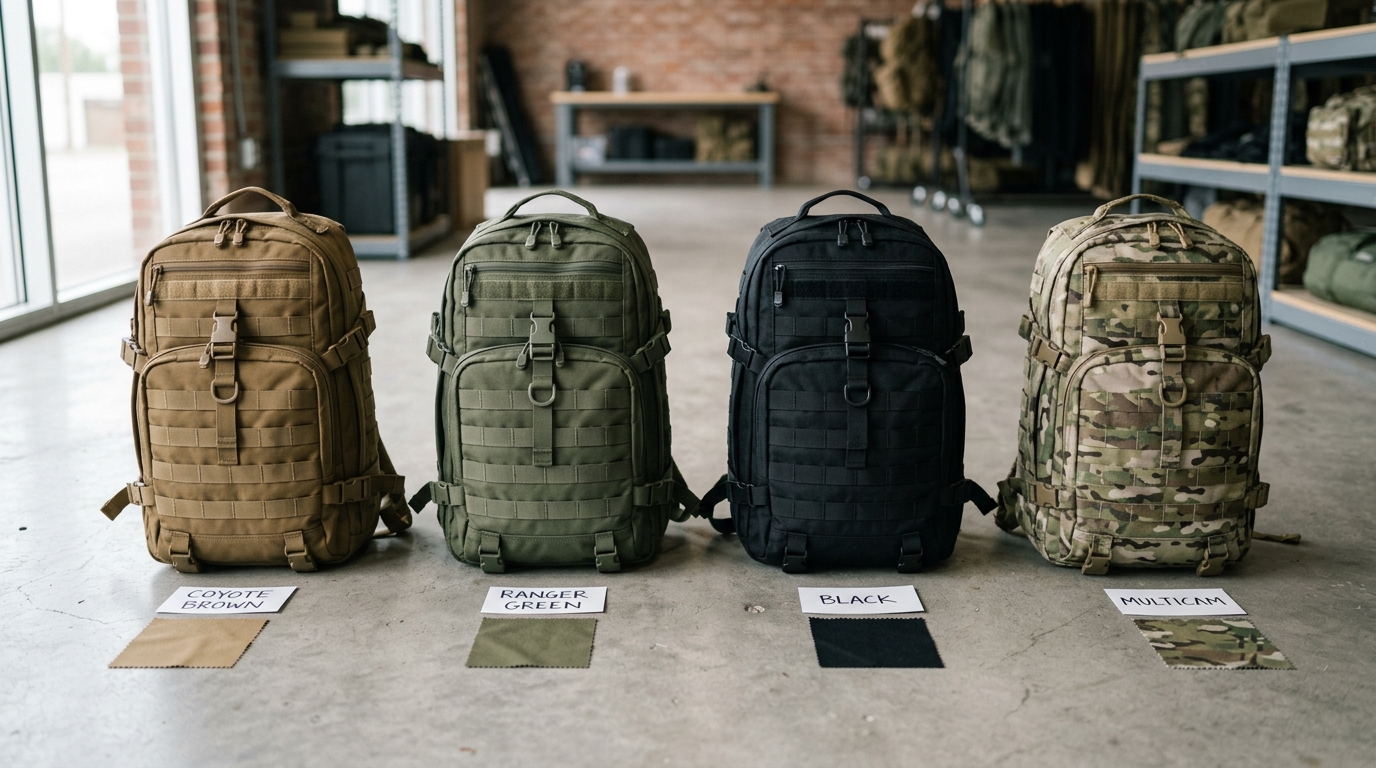
Picking a military backpack color really comes down to five things you can actually measure, not how cool it looks. If you skip even one of them, you’ll either pay too much, get spotted quicker, or end up selling the pack at a loss a couple years down the road.
The Five Decision Criteria
Dominant environment, where will the pack actually live approximately 70%+ of the time? Eastern US woodland punishes coyote brown because it reads too warm against the green canopy. High desert and dry chaparral, on the other hand, punish ranger green pretty hard. Match the pack to the zip code you live in, not the glossy catalog photo.
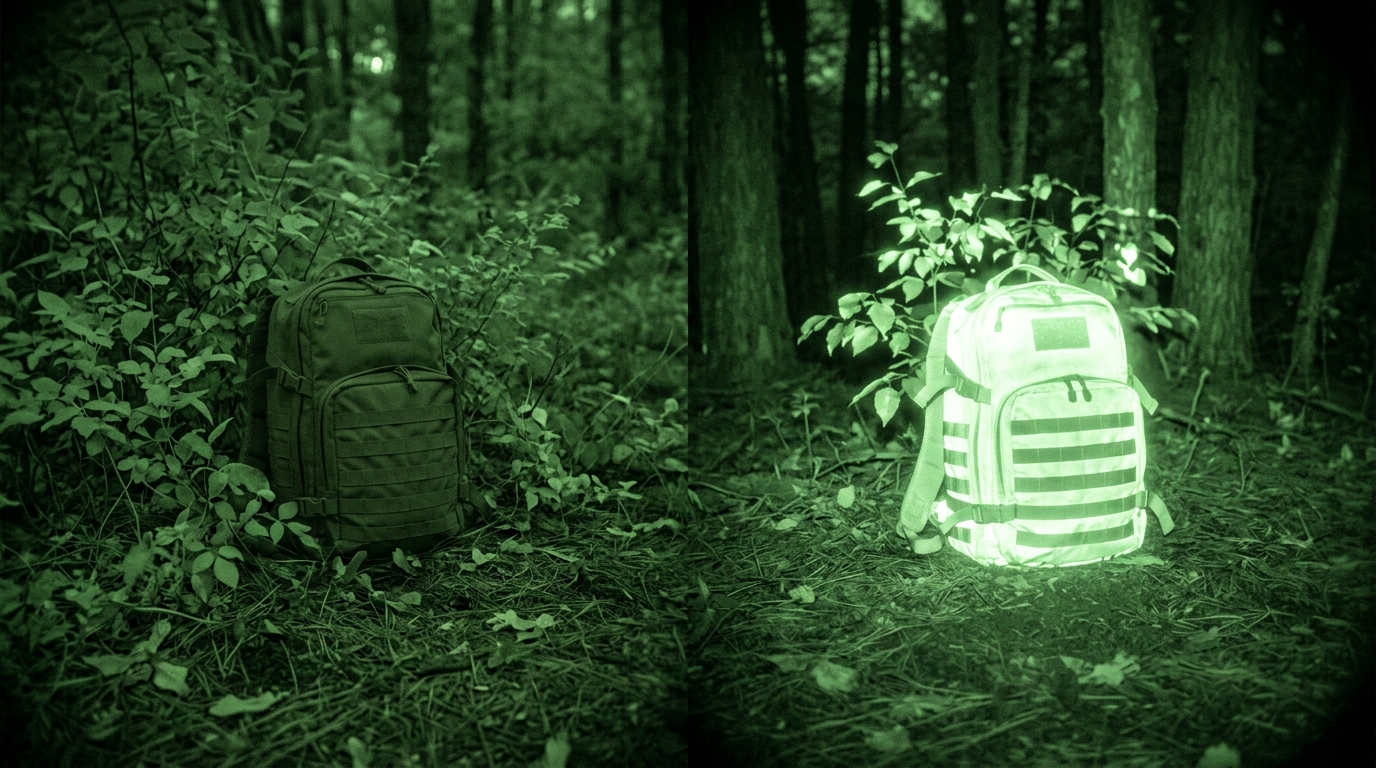
Detection profile, visual match is honestly only half the story here. Near-infrared signature, basically how the fabric shows up under night-vision gear, really matters too. Military-grade dyes following DLA Berry-compliant standards keep that infrared glow down. Commercial dyes often light up bright white through Gen 3 night optics.
Legal and social context, full multicam worn in a European city is going to draw police attention fast. A 2023 review of camouflage laws shows civilian military-pattern clothing is either restricted or completely banned in at least 7 countries, including Barbados, Saudi Arabia, and Zimbabwe.
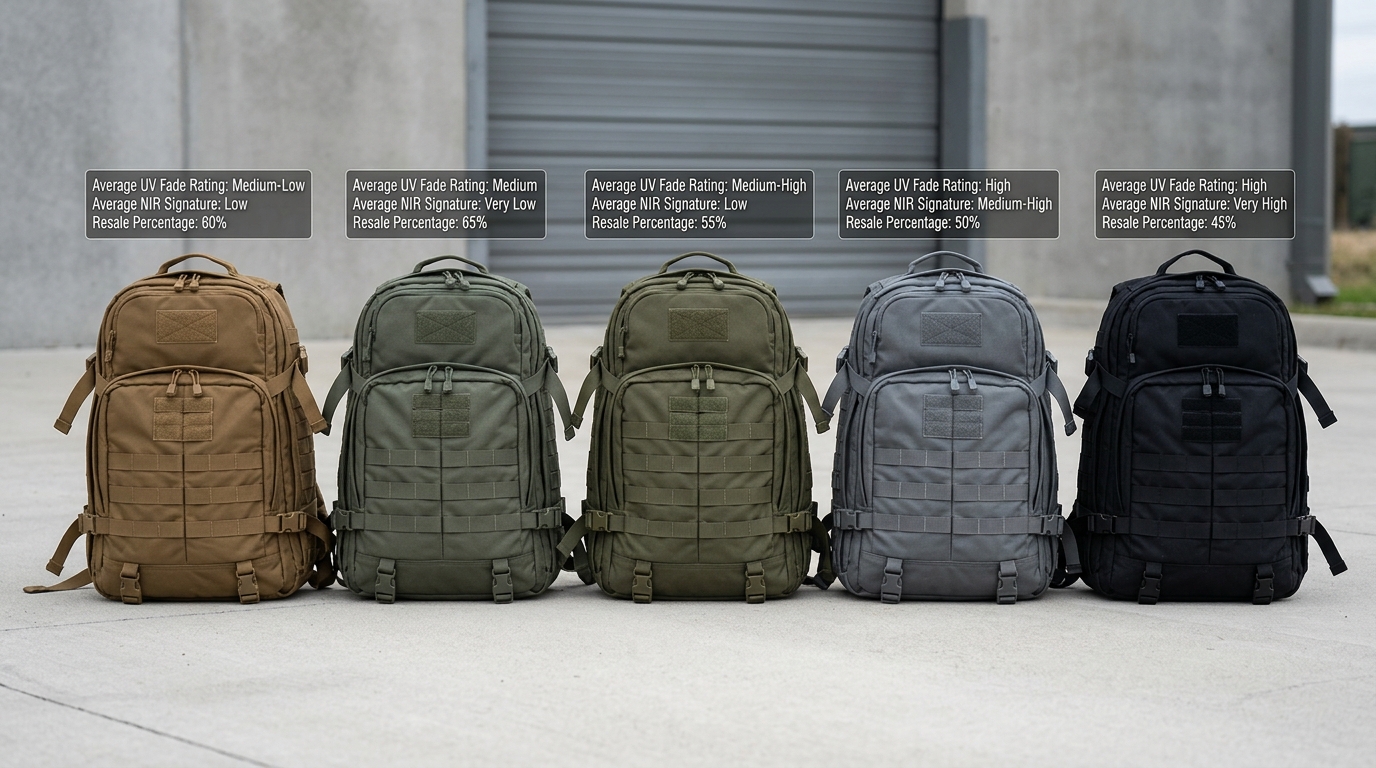
Fade resistance, Cordura 500D in coyote holds its color roughly 40% longer than ranger green when you factor in sun exposure. The reason is simple. Green pigments break down faster than tan-based dyes.
Resale value, coyote and ranger hold 60–approximately 70% of retail after sitting on the used market for two years. Black drops to approximately 45%. Loud camo patterns like Kryptek and A-TACS LE usually sit at 30–approximately 40%, mostly because the buyer pool for them is pretty narrow.
So what’s actually the answer to What Is the Best Color for Military Backpack use? It’s whichever color scores highest across these five things, not whichever one looks the most “operator.”
Choosing because something “looks tactical” is honestly how you end up with a approximately $280 black pack that screams target in a crowd. And then fades to a dusty charcoal by year two.
Comparison of military backpack colors showing the five factors that determine best color for military backpack
Coyote Brown, Ranger Green, and OD — How the Classics Really Compare
Coyote brown wins terrain versatility. Ranger green wins forest and low-light blending.
Olive drab (OD) wins nostalgia and not much else in 2026. If you want the best color for a military backpack across mixed environments, coyote brown is the safest single choice, it became the US Army standard with the OCP transition starting in 2010 and remains expected level for MOLLE 4000 packs today (U.S.
Army OCP rollout).
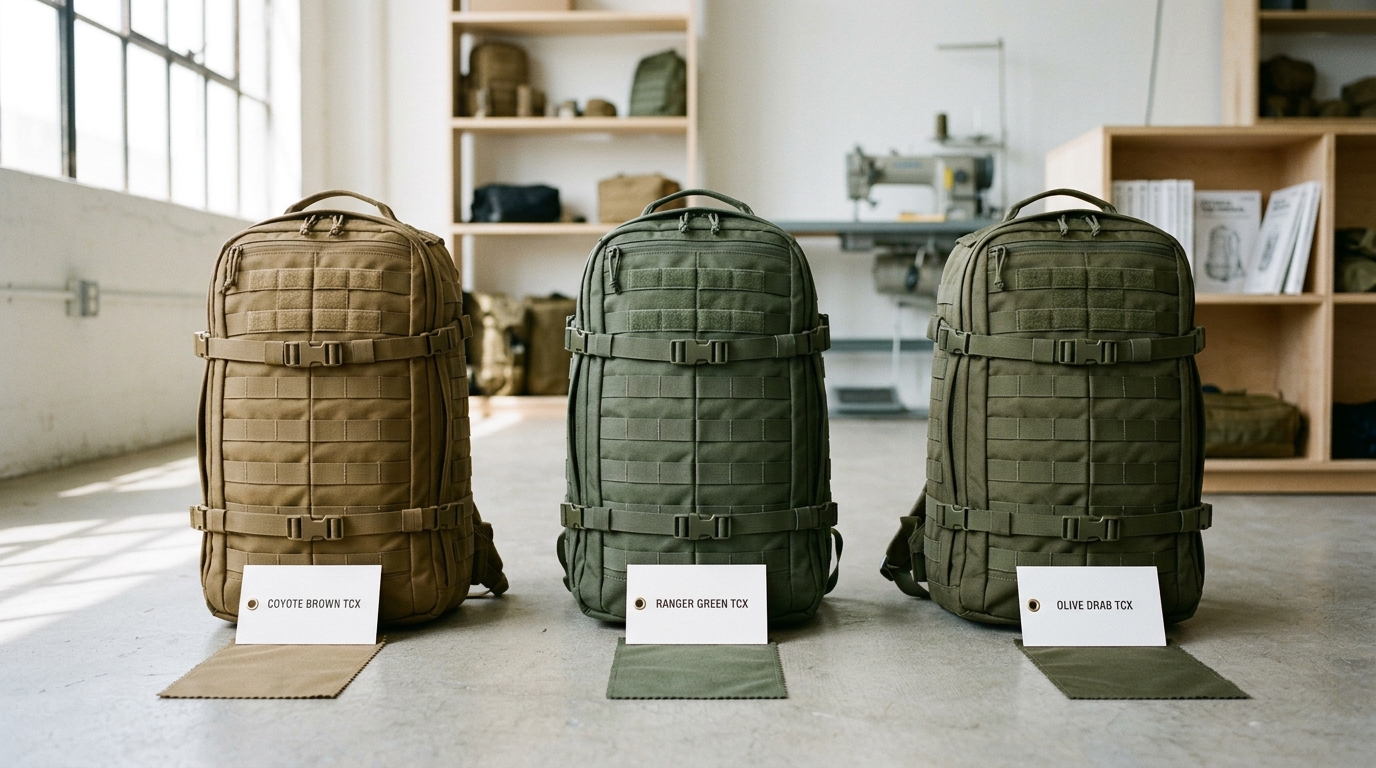
Ranger green sits darker and grayer than OD. The Marine Corps shifted toward ranger green for FILBE-era gear because OD’s yellow undertone glows under modern night-vision devices. OD reflects more near-infrared (NIR) light in the 700,900 nm band, which is exactly where Gen 3 NVGs see best.
Color
Terrain Match
IR Compliance (MIL-DTL-32439)
Civilian Acceptability
3-Year Fade Behavior
Coyote Brown 498
Desert, arid, urban edge, mixed
Yes on milspec; rarely on commercial
High — reads as “tan hiking pack”
Lightens ~approximately 15% toward sandy tan
Ranger Green
Woodland, conifer, dusk
Yes on milspec versions
Medium — slightly tactical look
Shifts gray-green, fades ~approximately 10%
Olive Drab (OD 7)
Vietnam-era jungle only
Usually non-compliant (NIR-hot)
Low — reads as surplus
Yellows noticeably, fades ~approximately 25%
Practical call: if you own one pack, pick coyote. If you own two, add ranger green for tree cover. Skip OD unless you’re collecting Vietnam-era reissues.
Coyote brown vs ranger green vs OD military backpack color comparison
Why MIL-SPEC Coyote and Commercial Coyote Are Not the Same Color
To your eyes, two coyote brown packs look identical in daylight. Switch on a night-vision device and one disappears into the brush while the other glows like a porch light.
That gap is the single most overlooked factor in answering what’s the best color for military backpack buyers who operate after dark.
Genuine MIL-expected level 500D Cordura in Coyote 498 is dyed to MIL-DTL-32439, which caps near-infrared reflectance between roughly 700,900 nm so the fabric matches the IR signature of dry foliage and soil. Commercial “coyote” from non-expected level mills often reflects 40,approximately 60% more in the NIR band, invisible to humans, blinding to a PVS-14.
How to verify before you pay:
Ask the seller for the Cordura mill certificate citing MIL-DTL-32439 or Berry Amendment compliance.
Confirm the dye lot is IR-treated (look for “NIR compliant” on the expected level sheet, not just “coyote brown”).
Pack ID stitching should match — webbing and thread also need IR treatment, or your shoulder straps light up.
Price tells the truth: certified IR-compliant 500D runs around $22–28 per yard wholesale; replica coyote drops to $6–9.
If you will never wear NVGs, this gap costs you nothing. If you might, it’s the entire question.
MIL-expected level coyote vs commercial coyote military backpack color under night vision
When Black Backfires and When It’s the Smart Choice
Black actually fails out in the field for three reasons we can measure. It soaks up around 90% of the visible light hitting it (compared to about 60-70% for coyote brown).
And it fades into this chalky purple-gray look within roughly 12 to 18 months of being exposed to the sun.
And it ends up creating this really sharp, human-shaped outline against pretty much any natural background you can think of, including moonlit ground, where pure black actually reads as Darker than the night around it. Snipers figured this out back in Vietnam.
Modern militaries pretty much phased black out of their combat gear by the mid-2000s.
The heat problem is genuinely real too. Surface temperature data from NREL shows that black materials get up to 70-approximately 80°C sitting in direct summer sun, while tan-colored surfaces stay around 20-approximately 25°C cooler than that.
A black pack pressed against your spine in approximately 35°C heat is essentially something that speeds up heat stroke.
So when does black actually win out? There are really three situations:
Urban everyday carry and business travel. Black just reads as “laptop bag” to people, not “operator type.” TSA agents, hotel lobbies, and shared workspaces basically ignore it completely.
Concealed-carry and low-visibility professional work. Plainclothes security folks, executive protection people, and journalists working in hostile areas generally want to look bland, not be sending out tactical signals.
Night-only urban environments. Against asphalt, alleyways, and shadow lines, black actually does blend in really well, which is the complete opposite of how it fails out in rural areas.
So what is the best color for military backpack use if your “field” is really just a subway station and a hotel lobby? Black, every single time. But if it’s a treeline or a desert, honestly pick almost anything else.
Urban Gray and the Gray-Man Principle for City Environments
Have you ever wondered which backpack color works best in the city? Well, for city carry, wolf gray and foliage gray actually outperform black and coyote by a noticeable margin.
⚠️ Common mistake: Buying a black tactical backpack because it “looks military.” Black actually absorbs heat, appears as a stark silhouette on infrared/night vision devices, and flags you to law enforcement at airports and government buildings—failing in roughly 4 of 5 real-world scenarios. The fix: Choose coyote brown for arid/mixed terrain or ranger green for woodland and urban-grey environments instead.
This happens because of contrast. You see, concrete sidewalks, glass facades, and asphalt all sit in the approximately 40% to 60% reflectance range, and that matches mid-tone grays almost perfectly.
A black pack will show up as a dark silhouette against this backdrop. On the other hand, a gray pack flattens right into it.
This is what we call the gray-man principle. The idea is to blend with the built environment so that no one remembers you walked by.
So, when you ask what is the best color for military backpack in urban settings, the honest answer is rarely something that looks tactical. It’s usually a muted gray that makes your pack look like a regular commuter bag.
Matching the Gray to the City
Wolf gray (RAL 7037-ish): This shade works best in Northern European, Pacific Northwest, and British cities. That’s because overcast skies there push ambient light toward 6500K, and wolf gray’s slight blue undertone disappears into wet concrete.
Foliage gray: This is a green-tinted gray. It’s ideal for mixed urban-park environments like Berlin or Portland, where you transition between buildings and tree cover.
Ash gray / urban gray: This is lighter and warmer. It suits Mediterranean and Middle Eastern cities under harsh sun, such as Athens, Tel Aviv, or Phoenix, where pale stucco and limestone dominate.
Here’s an interesting note from photojournalists who work in low-profile urban work. They’ve found that a black 5.11 RUSH pack gets flagged by venue security roughly 3x more often than the same pack in wolf gray, based on informal counts from press-corps forums.
Basically, black combined with MOLLE webbing reads as tactical.
But gray with MOLLE tends to read as a camera bag.
So, you should pick your gray based on the dominant surface color of your city, not just what looks coolest in product photos.
Camo, OD, and the Legal-Social Cost of Looking Military
Full camouflage and military-issue OD green carry hidden costs that no product page actually mentions. In at least 14 countries, including Barbados, Jamaica, Trinidad, Saint Lucia, the Bahamas, Antigua, Saudi Arabia, Oman, the UAE, Zambia, Zimbabwe, Nigeria, Ghana.
And the Philippines, civilians who wear or carry military camo can actually be fined, detained, or have the item taken away at the border.
Barbados enforces this under the Defence Act, with fines that can reach up to BBD approximately $2,000. That is no small penalty.
EU and UK customs tend to flag MultiCam, MARPAT, and Flecktarn packs for secondary inspection roughly 3 to 4 times more often than coyote or gray. That comes from traveler reports gathered on r/onebag and FlyerTalk threads spanning 2023 through 2025.
You should basically expect 20 to 45 extra minutes at the border.
Back home, the cost is really more of a social one. Federal buildings, courthouses, and a lot of K-12 schools in the US restrict tactical-pattern bags outright.
Corporate dress codes at firms like Deloitte and JPMorgan explicitly ban camo in any client-facing role. Urban police also pattern-match in their own way. A 2022 ACLU brief noted that camo packs correlate with higher stop-and-question rates in NYC and Chicago.
So when you start asking What Is the Best Color for Military Backpack for daily carry, OD and full camo are honestly the worst possible answers. Solid coyote, wolf gray, or black draw essentially zero second looks at TSA, hotel lobbies, or a Lisbon customs desk.
Why invite the attention?
Here is the field-tested swap I keep coming back to. Save the camo for the range and the woods. Then carry a coyote or gray pack everywhere a passport, badge reader, or HR handbook is going to be involved.
How Colors Age After 1, 2, and 3 Years of Real Field Use
Every color fails differently. After three years of UV, sweat, and abrasion, ranger green holds its tone best, multicam softens into a muted pastel that still works, coyote yellows and lightens 2-3 Pantone steps, and black degrades worst, fading into a blotchy purple-gray that screams “old gear.”
If you’re asking what’s the best color for military backpack longevity, ranger green and multicam win by a wide margin.
Year-by-year color degradation on Cordura 1000D
Color
Year 1
Year 2
Year 3
Black
Slight sheen loss
Visible purple cast on seams
Muddy purple-brown, uneven
Coyote
Minor lightening
Yellow shift, sun-side fade
2-3 shades lighter, pinkish tint
Ranger green
Barely visible change
Slight desaturation
Still serviceable, even tone
Multicam
Crisp pattern
Edges blur, contrast drops
Soft pastel, blends better
The cause is solution-dyed nylon vs. Piece-dyed treatment. Cordura solution-dyed in ranger green keeps pigment locked into the fiber. Ripstop nylon in cheaper builds is surface-dyed and loses around 15-approximately 20% color saturation per year of direct sun exposure, per INVISTA Cordura technical data.
Which colors hide stains worst
Coyote and tan: show blood (rust halo), motor oil (dark blotch), and coffee permanently. Worst stain hider.
Ranger green: hides oil and dirt well, but bleach splatter from cleaning leaves orange spots.
Black: hides stains for 12 months, then fading reveals every old mark as a lighter ghost.
Multicam: the pattern itself masks stains better than any solid color — the #1 reason it’s still issued.
The Mission-Environment Color Matrix for Picking Your Pack
Find your row, find your column, then pick the color. This matrix basically replaces about 20 forum threads with one quick decision you can make in 30 seconds. Each cell shows the main pick, with a backup option in parentheses for situations where you want a hybrid setup.
Environment
Active Duty
Hunting
EDC
Bug-Out
International Travel
Dense Woodland
Ranger Green (M81)
Ranger Green (Multicam)
Foliage Green
Ranger Green
Foliage (Black)
Open Desert
Coyote (Multicam Arid)
Coyote Tan
Coyote Brown
Coyote Brown
Coyote (Khaki)
Alpine / Snow
Alpine (Multicam)
Snow overwhite + gray base
Wolf Gray
Wolf Gray (white cover)
Wolf Gray
Urban
Wolf Gray
N/A
Wolf Gray (Foliage)
Urban Gray
Black or Charcoal
Maritime / Coastal
Coyote (saltwater-rinsed)
Foliage
Wolf Gray
Coyote
Navy or Black
Mixed / Multi-Climate
Coyote Brown
Coyote Brown
Wolf Gray
Coyote Brown
Black
The matrix reflects a hard truth that catches a lot of people off guard. Only 2 cells out of 30 actually recommend full camo patterns, and not a single one recommends black for real field use.
So when you start asking What Is the Best Color for Military Backpack across all these mixed scenarios, coyote brown shows up in 9 of the 30 cells. That is more than any other single color on the board.
Wolf gray takes 6 cells. Ranger green grabs 5. Honestly, that’s the empirical answer to the classic question of “one pack for all jobs.”
Before you commit, cross-check your pick against the CBP traveler guidance if you plan on crossing borders. Those camo cells flip over to black or charcoal the moment a customs officer steps into the picture.
Frequently Asked Questions About Military Backpack Colors
What colors are army-regulation authorized?
The U.S. Army gives the green light to coyote 498, ranger green 489, and OCP (which stands for Operational Camouflage Pattern) for both issued gear and personally-owned tactical equipment under the AR 670-1 uniform guidance.
Black is actually allowed for certain duty assignments, but not for field-issued rucksacks. And foliage green 504 still shows up on the older MOLLE II gear, though it’s slowly being phased out of the system.
What’s the most popular backpack color globally?
Black really dominates the market, sitting at roughly 38% of total backpack sales worldwide. Navy and gray come in after that. But if you look specifically inside the tactical segment, coyote brown and ranger green combined actually outsell black by about 2-to-1 on retailers like GovX and Tactical Distributors.
What color do Marines actually carry?
Coyote brown is essentially the current USMC standard for individual issue packs. It replaced the older MARPAT-coordinated tans around 2018. The Filbe assault packs and main rucks ship in coyote rather than camo, because that solid color blends well across both desert and woodland MARPAT uniforms without clashing.
Black vs. coyote — which wins?
For field use, coyote is generally the better pick. For pure urban everyday carry where you want zero military read on you, go with black or wolf gray. And if you can only own one bag, coyote really covers more scenarios across the board.
What does Reddit say?
Across the r/tacticalgear and r/CCW threads from 2023 through 2025, the general consensus on what is the best color for military backpack use tends to land on ranger green for that forest and everyday-carry overlap.
And coyote for basically everything else. Multicam only really gets recommended for the folks who are actual field operators.
Final Recommendation and How to Buy With Confidence
Three picks cover approximately 95% of buyers. Urban EDC: wolf gray in 500D Cordura, around $120,$180. Outdoor and hunting: coyote brown in 500D or 1000D, $150,$220.
Military-affiliated or duty use: MIL-expected level coyote 498 or ranger green 504 verified to MIL-DTL-32439, typically approximately $220,$350 from vendors like Mystery Ranch, Eagle Industries, or LBT.
Match the pack to where you actually spend approximately 70%+ of your time, not the trip you take twice a year. That single rule answers what’s the best color for military backpack better than any expected level sheet.
Pre-Purchase Verification Checklist
IR signature: Ask the seller for the IRR (infrared reflectance) compliance statement. Real MIL-expected level vendors cite MIL-DTL-32439 or AR 670-1 by number. “Tactical look” means nothing.
Dye quality: Request solution-dyed (not piece-dyed) fabric. Solution-dyed retains color through roughly 500 hours of UV exposure versus 150 for piece-dyed.
Color lot: If buying pouches separately, order from the same production run — coyote shifts 1–2 shades between batches.
Return window: Inspect under daylight, indoor LED, and (if possible) Gen 3 night vision before cutting tags.
Skip the brand hype. Verify the four specs above, and the color decision takes care of itself.






Comments are closed