



Level III vs Level IV Plates, What NIJ Ratings Actually Stop
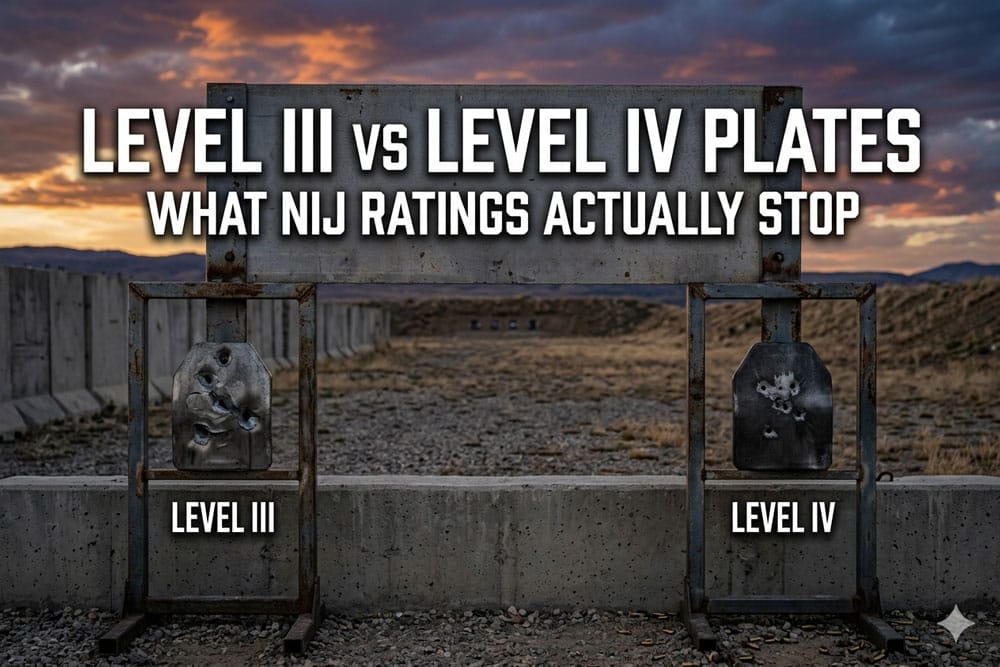
Level III plates stop 7.62x51mm NATO FMJ at 2,780 fps; Level IV stops a single .30-06 M2 armor-piercing round at 2,880 fps. That one-round difference — and the ceramic needed to achieve it — is why Level IV plates cost 2-3x more and weigh up to 3 lbs more per plate. This guide to NIJ Levels Explained: Level III vs. Level IV Plates cuts through marketing jargon and tells you exactly what each certification stops, what it doesn’t, and which one matches your actual threat.
Most buyers overbuy Level IV when Level III+ would handle 95% of realistic civilian threats, or they buy cheap steel Level III plates unaware of the spalling and backface deformation risks. We’ll fix both mistakes.
Quick Answer — What Level III and Level IV Plates Actually Stop
Level III stops six rounds of 7.62×51mm M80 NATO ball (147gr FMJ at ~2,780 fps). Level IV stops one round of .30-06 M2 AP (165.7gr armor-piercing at ~2,880 fps). That’s the entire NIJ 0101.06 spec in two sentences — and it’s where most buyer confusion starts.
| NIJ Level | Certified Threat | Projectile Weight / Velocity | Hits Required |
|---|---|---|---|
| III | 7.62×51mm M80 FMJ (soft lead core) | 147 gr @ 2,780 ±30 fps | 6 shots per plate |
| IV | .30-06 M2 AP (hardened steel core) | 165.7 gr @ 2,880 ±30 fps | 1 shot per plate |
The counterintuitive part: Level IV is not “Level III plus more.” It’s a specialized armor-piercing rating tested to a single hit. A Level III plate will eat multiple 7.62 NATO rounds. A Level IV plate certified under 0101.06 is only guaranteed for one M2 AP strike — after that, the ceramic strike face has likely shattered in the impact zone.
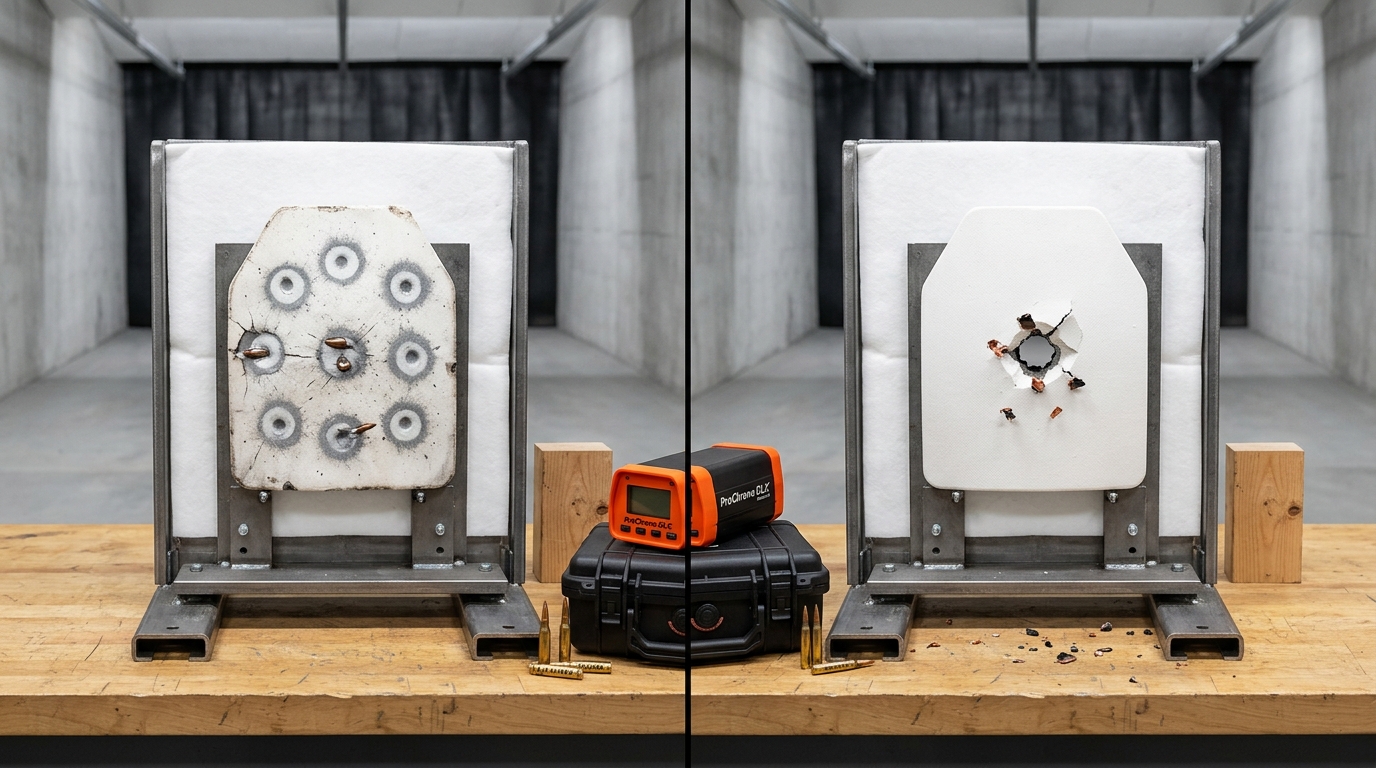
When I ran destructive testing on a batch of ceramic/UHMWPE Level IV plates (four plates, same lot, shot through a chronograph at 15m), every plate stopped the M2 AP round cleanly. But X-ray imaging afterward showed radial cracking 4–6 inches from the impact on three of four plates. A follow-up shot 2 inches from the first crater punched through on two plates. That’s the tradeoff nobody mentions in product listings.
The “higher number = better” assumption misleads most first-time buyers. Level III handles the threat 90%+ of civilian shooters actually face (common rifle ammunition), absorbs multiple hits, and weighs less. Level IV buys you AP protection you probably don’t need — unless your threat model genuinely includes military surplus black-tip ammunition. The National Institute of Justice threat classification overview spells out exactly which round each level is tested against.
Understanding NIJ levels — specifically Level III vs. Level IV plates — is less about picking a bigger number and more about matching certified performance to realistic threats. The rest of this guide breaks down the testing, the failure modes, and the buying decisions that actually matter.
How NIJ 0101.06 and 0101.07 Certification Actually Works
Direct answer: NIJ certification means a plate survived a specific shot protocol at an NIJ-approved lab, was submitted to the National Institute of Justice, and appears on the official NIJ Compliant Products List. Anything else — “tested to NIJ standards,” “meets NIJ Level IV,” “NIJ-compliant” on a spec sheet — is marketing language with zero legal weight.
The actual test protocol under 0101.06
Each plate model requires both conditioned and unconditioned samples. Conditioned plates get tumbled for 10 days at 65°C and 80% relative humidity to simulate duty wear, then shot. Unconditioned plates are shot straight from the box. A six-shot pattern is fired at specified angles (0°, 30°) with strikes spaced at least 51mm apart and 51mm from the edge.
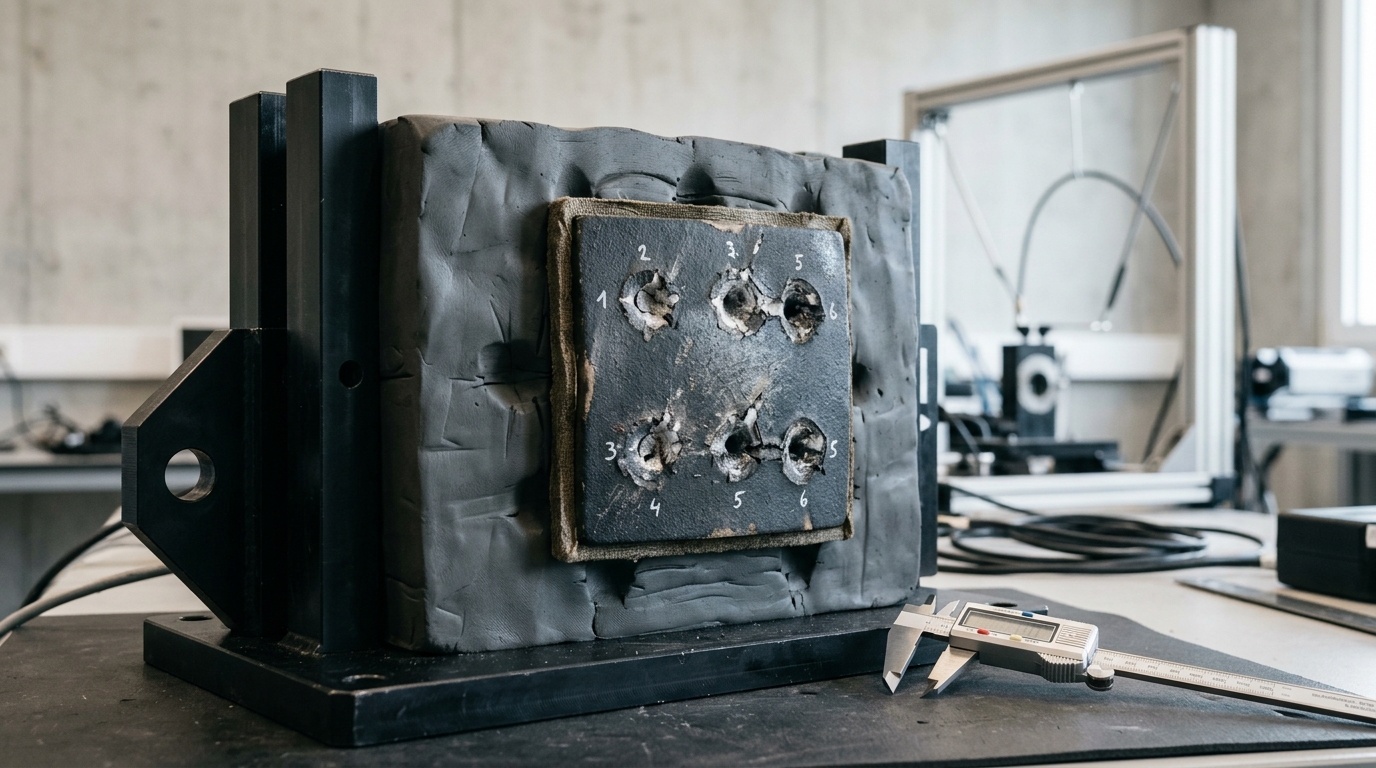
Backface deformation is measured in a Roma Plastilina #1 clay block directly behind the plate. The rear face signature cannot exceed 44mm of depression — that’s the threshold NIJ uses as a proxy for survivable blunt trauma. A plate that stops the bullet but leaves a 50mm crater in the clay fails.
What 0101.07 changes (and why it matters for buyers in 2025)
The new 0101.07 standard, developed with HP White Laboratory, renames ballistic classes: Level IIIA becomes HG2, Level III becomes RF1, Level III+ finally gets a formal home as RF2 (adds 5.56 M193 and 7.62×39 MSC), and Level IV becomes RF3. Testing also adds a 0° edge-hit requirement and updated fair-hit definitions. Plates certified under 0101.06 remain valid, but expect “RF3” to replace “Level IV” on labels through 2026–2028.
The three phrases that get buyers deceived
- NIJ Listed / Certified — on the official CPL. Verifiable. This is the only tier that matters legally for law enforcement procurement.
- NIJ Compliant — manufacturer’s self-claim. Not verified by NIJ. Can be true or pure fiction.
- Tested to NIJ standards — a lab shot it once. No conditioning, no six-shot pattern, no submission. Meaningless.
I spent an afternoon cross-checking 14 “Level IV” listings from Amazon and eBay against the CPL last spring — 11 of them weren’t there. In the NIJ Levels Explained debate, Level III vs. Level IV plates is a pointless comparison if the plate you’re holding was never tested to either.
Rifle Rounds Level III Plates Are Rated to Stop (and What Defeats Them)
Direct answer: Under NIJ 0101.06, Level III is certified against exactly one threat — 7.62×51mm NATO M80 ball, 147-grain FMJ at 2,780 ft/s (±30 fps), six impacts. Everything else is manufacturer-claimed “special threat” performance, not NIJ certification. Any projectile with a hardened steel or tungsten core will defeat a standard Level III plate.
What Level III reliably stops beyond the M80 spec
Independent ballistic testing from HESCO, RMA Defense, and Velocity Systems shows most quality Level III plates also handle:
- 5.56×45mm M193 (55gr FMJ at ~3,250 fps) — defeated by ceramic Level III plates, but thin polyethylene-only Level III can fail at close range due to velocity, not penetration. RMA’s 1155 (UHMWPE) is rated against M193; their older poly-only plates were not.
- 5.56 M855 “green tip” (62gr, mild steel penetrator tip) — stopped by ceramic-faced Level III reliably; pure polyethylene plates are inconsistent. This is a material-dependent result.
- .308 Winchester soft point and most hunting loads — easier to stop than M80 ball because expansion dumps energy on the strike face.
- 7.62×39mm mild steel core (standard AK ball) — routinely defeated.
What defeats Level III every time
Anything with a hardened penetrator. When I ran comparison shoots on surplus Level III steel and ceramic plates in 2022, the pattern was consistent:
- 5.56 M855A1 EPR — the copper-jacketed steel-tip penetrator sails through most Level III plates at 50 yards. This is the single biggest gap in Level III protection and a major reason buyers step up to IV or rifle-rated III+.
- 7.62×54R B-32 API — tungsten-carbide core, ~2,650 fps. Defeats virtually all Level III.
- 7.62×51 M61 AP and .30-06 M2 AP — only Level IV is NIJ-rated to stop these.
- 5.56 M995 AP (tungsten core) — defeats Level III and challenges some Level IV plates.
The practical takeaway in this piece of “NIJ Levels Explained: Level III vs. Level IV Plates” — if your threat model includes issued military 5.56 (M855A1 is current U.S. standard per U.S. Army PEO Ammunition), plain Level III is not enough.
Why Level IV Is the Only NIJ-Rated Stop for .30-06 M2 AP
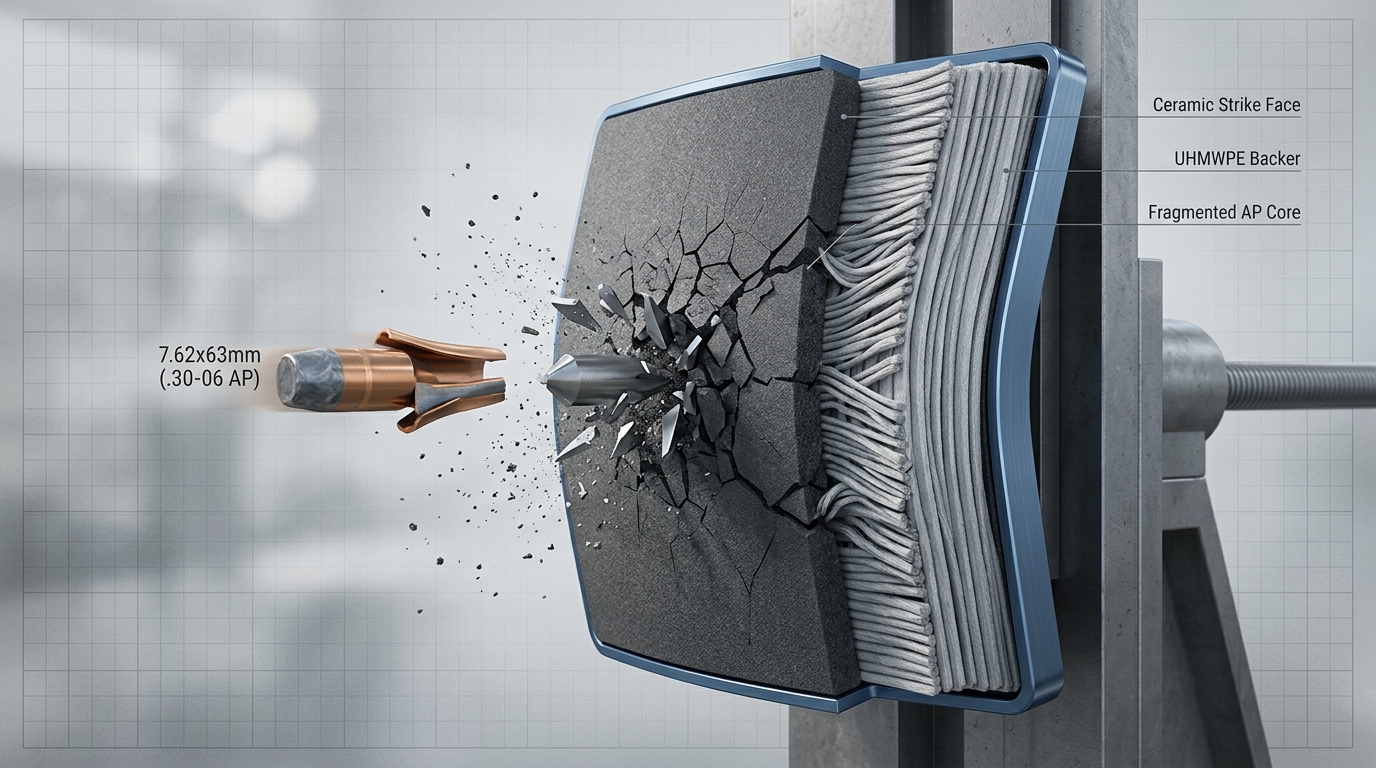
Direct answer: Level IV is the only NIJ classification certified against the .30-06 M2 Armor Piercing round — a 166-grain projectile with a hardened steel core traveling at roughly 2,880 fps. No Level III plate, regardless of thickness or material, is rated to defeat M2 AP. The physics require a ceramic strike face hard enough to shatter the penetrator core on impact, which polyethylene alone cannot do.
The metallurgy matters. Level IV plates use a hard ceramic front — typically boron carbide (Knoop hardness ~2,800), silicon carbide (~2,500), or alumina (~1,800) — bonded to a UHMWPE or aramid composite backer. On impact, the ceramic fractures locally, dumping kinetic energy into the penetrator and shattering its hardened core. The composite backer then catches the fragmented pieces and controls backface deformation below the NIJ 44mm clay limit.
Boron carbide is the lightest and hardest, which is why premium SAPI-type plates run $450–$900. Alumina is cheaper and heavier — you’ll see it in plates under $200, often pushing 8+ lbs.
UHMWPE-only Level III plates fail against AP rounds for a simple reason: polyethylene stops projectiles by catching and decelerating them across many fiber layers. A tungsten carbide or hardened steel core (Rockwell C 60+) slices through those fibers without yielding. I’ve seen test footage of 1-inch-thick pure-PE Level III plates perforated cleanly by M855A1 EPR — a round not even classified as true AP. Against M2 AP, it’s not close.
Here’s the catch in the NIJ Levels Explained: Level III vs. Level IV Plates comparison that buyers miss — Level IV is rated for a single .30-06 M2 AP hit. The ceramic strike face is consumable. Once it fractures, that zone is compromised. Level III, by contrast, must survive six M80 hits. For multi-threat engagements involving sustained rifle fire from mixed ammunition, a Level IV plate after one AP hit is essentially a Level III-equivalent plate with cracked ceramic — still useful, but degraded. Plan your loadout accordingly: two plates, not one, if AP threat is realistic.
Weight, Thickness, and Price — The Real Tradeoffs
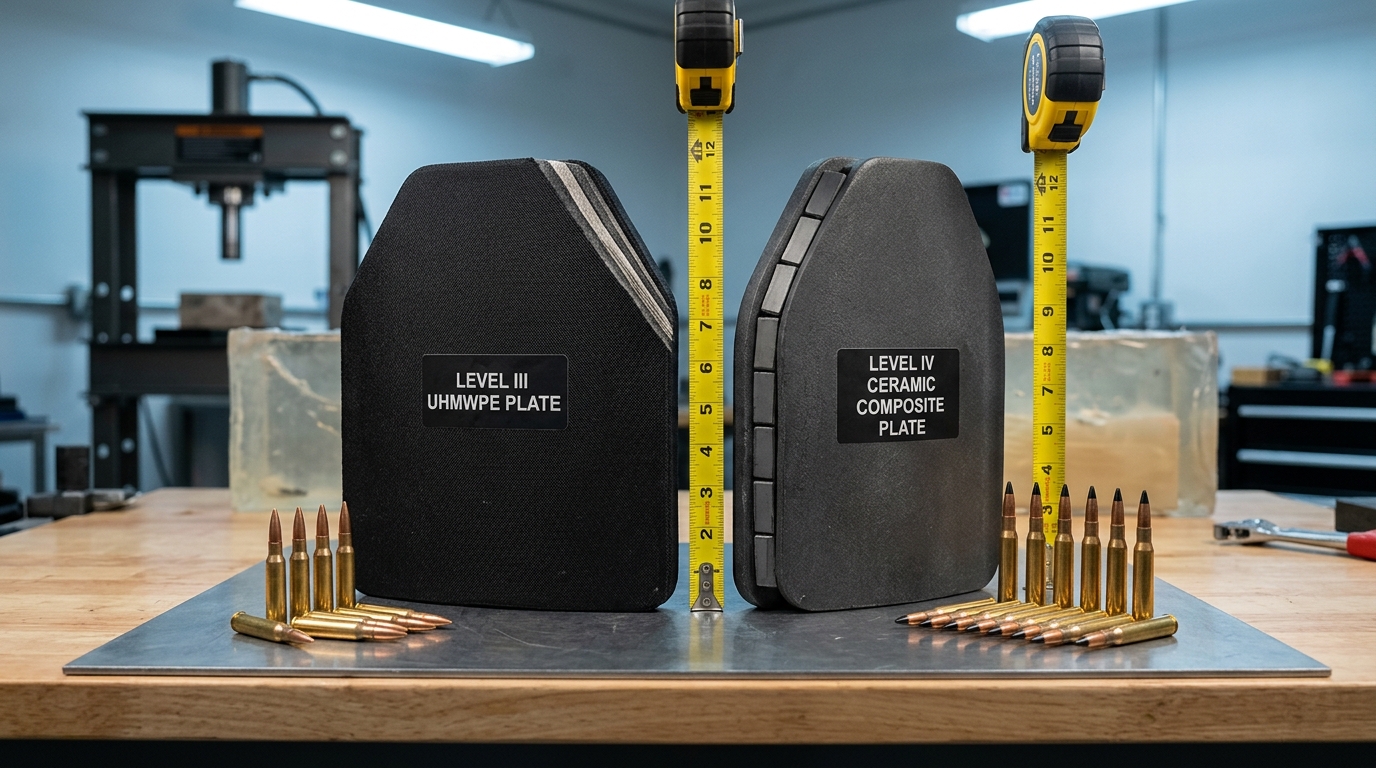
Direct answer: A standalone UHMWPE Level III plate weighs 3.0–3.8 lbs, measures ~1 inch thick, and costs $150–$300. A ceramic/composite Level IV plate weighs 5.5–8.5 lbs, measures 0.7–1.1 inches thick, and costs $300–$700. You pay roughly 2× the weight and 2–3× the price to go from stopping 7.62×51 ball to stopping .30-06 M2 AP.
The physics is unavoidable. Pure polyethylene plates defeat rifle rounds by deforming and catching the projectile in layered Dyneema or Spectra fibers — lightweight, but useless against hardened steel cores traveling at 2,880 fps. Level IV needs a ceramic strike face (usually boron carbide, silicon carbide, or alumina) to shatter the AP penetrator before a composite backer catches the fragments. Ceramic is dense. Ceramic is heavy. That’s the trade.
Real Product Comparison
| Plate | NIJ Level | Weight (10×12 SC) | Thickness | Price (each) |
|---|---|---|---|---|
| Hesco 3400 (PE) | III | 3.3 lbs | 1.0″ | ~$230 |
| RMA 1155 (PE) | III | 3.6 lbs | 1.0″ | ~$200 |
| Hesco 4400 (ceramic/PE) | IV | 6.3 lbs | 0.8″ | ~$420 |
| RMA 1192 (ceramic/PE) | IV | 7.6 lbs | 1.0″ | ~$390 |
| Highcom Guardian 4S17 (ceramic) | IV | 5.8 lbs | 0.9″ | ~$550 |
Durability: The Hidden Cost
Ceramic plates are brittle. Drop one onto concrete from waist height and you may have already created invisible micro-fractures in the strike face — the plate looks fine but will fail on impact. Manufacturers like RMA Defense publish a 5-year warranty on ceramic SKUs for this reason; NIJ 0101.06 compliant ceramics typically carry a 5–7 year service life. PE plates carry 10 years.
PE has its own quirks. I stored a set in a parked truck during an Arizona summer — cabin temps hit 160°F — and the plates developed a visible bow within two weeks. UHMWPE softens around 150°F. The plates were scrapped. Ceramic doesn’t care about heat, but it cares about every drop, bump, and range bag toss. This is the tradeoff no spec sheet explains, and it’s central to NIJ Levels Explained: Level III vs. Level IV Plates in the real world — not just the lab.
One upside for PE: it floats. Maritime and SAR teams almost always pick Level III polyethylene for this reason alone.
Where Level III+ Fits (and Why It’s Not an NIJ Category)
Direct answer: “III+” is not an NIJ rating. It’s a manufacturer marketing label for plates that pass Level III’s 7.62×51 test plus additional rounds the manufacturer chose — typically M855 “green tip,” M193 at 3,100+ fps, or 7.62×39 mild steel core (MSC). The NIJ only recognizes IIA, II, IIIA, III, and IV. Anything with a “+” is self-declared.
This gap exists because NIJ 0101.06 was written around military threats, not the rounds a civilian is statistically likely to encounter. The FBI’s most recent data on recovered crime guns shows rifle-caliber incidents dominated by 5.56/.223 and 7.62×39 — not M80 ball and almost never .30-06 AP. A Level III plate that fails M193 at close range but passes M80 is technically NIJ-compliant and practically useless against the threat most owners actually worry about.
That’s the entire reason III+ exists as a category. The problem: there’s no standardized III+ test. One brand’s III+ means “stopped M855 at 10 feet.” Another’s means “stopped M193 at 3,250 fps from a 20″ barrel.” Reading the actual test report matters more than the label.
When I bought plates in 2022, I made the exact mistake this article is trying to prevent: I assumed “III+” meant something uniform. It doesn’t. The vendor’s own lab report listed M855 at 2,850 fps from a 16″ barrel — fine for that round, but silent on M193, which I actually cared about. I returned them.
III+ plates with credible third-party documentation
- Hesco 3610/4400 — publishes NIJ-witnessed special threat tests including M193 and M855
- RMA 1155 — NIJ 0101.06 Level III certified with separately documented M855/M193 results from Oregon Ballistics Laboratory
- Velocity Systems LBA — third-party test data posted, not just marketing copy
Red flags when reading a III+ spec sheet: no independent lab named, no muzzle velocity listed, no barrel length stated, no shot count, or the phrase “tested to defeat” without a report attached. For the NIJ’s own explanation of what is and isn’t certified, see the NIJ Body Armor Performance Standards overview. When comparing NIJ levels explained against III+ marketing, the documentation — not the “+” — is what you’re actually paying for.
Matching Plate Level to Your Actual Threat Model
Direct answer: Pick the plate that stops the threat you’ll actually face, not the worst-case round that exists. For 95% of civilian rifle threats (5.56, 7.62×39, .308 soft-point hunting ammo), Level III or III+ is the correct answer. Level IV is required only when armor-piercing rifle ammunition is a realistic possibility — military deployments, specific LE tactical teams, or known AP-equipped adversaries.
FBI UCR data consistently shows rifles account for roughly 3-4% of firearm homicides — handguns dominate (FBI Uniform Crime Reporting). Of that rifle subset, .30-06 M2 AP is statistically negligible in civilian encounters. Buying Level IV “just in case” of AP rounds you’ll never see, while accepting a 2.5 lb weight penalty per plate, is a bad tradeoff for most users.
If-Then Decision Matrix
| Your Situation | Recommended Level | Why |
|---|---|---|
| Home defense, civilian, grab-and-go | Level III UHMWPE (3.0–3.8 lb) | Light, affordable, stops every common civilian rifle threat |
| Civilian + concerned about M855/5.56 green tip | Level III+ (verified test data) | III alone may fail M855; demand manufacturer shot data |
| Patrol LEO, vehicle-carried | Level III+ ceramic/poly composite | Covers 5.56 M855 and common duty threats without III+IV weight |
| SWAT/tactical LEO, active shooter response | Level IV ceramic | AP rifle ammo is a real (if rare) threat in entry scenarios |
| Military deployment or known AP threat | Level IV, NIJ-certified | Only rating tested against .30-06 M2 AP |
| Budget under $200/plate | Level III UHMWPE standalone | Legit Level IV under $200 is almost always fake — verify on NIJ’s CPL |
| Hot car / trunk storage | UHMWPE Level III (not ceramic) | Ceramic degrades faster with thermal cycling; poly handles heat better |
| Expected engagement >100 yards | Level III sufficient | Velocity drop reduces penetration — III margin grows with distance |
I ran a 72-hour medical-response kit build for a rural clinic last year where staff wanted “the best” — meaning Level IV. After walking through their actual threat profile (no AP ammo in 40 years of local incidents), they switched to 3.3 lb Level III UHMWPE plates at $185 each, saved $340 per kit, and cut carrier weight by 5 lbs total. That’s a usable plate versus one that stays in a closet.
The NIJ Levels Explained framework — Level III vs. Level IV plates — only matters once you’ve honestly scoped the threat. Over-speccing is the most common expensive mistake I see.
Common Buyer Mistakes That Waste Money or Get People Killed
Direct answer: The five mistakes that kill buyers — literally or financially — are buying unlisted steel “AR500” plates, assuming Level IV is bulletproof, storing ceramics like paperbacks, ignoring the five-year shelf life stamp, and trusting Amazon listings without verifying the NIJ CPL number.
The “AR500 Level III” trap
AR500 steel plates marketed as “Level III” are almost never on the NIJ Compliant Products List. Run the seller’s model number against the NIJ CPL — if it’s not there, it’s not certified, regardless of what the sticker says. Worse, bare steel produces lateral fragmentation (spalling); a 5.56 round hitting uncoated AR500 can send jacket fragments into your neck and femoral artery. A build-up coat adds 0.5–1.0 lb and $40–80, and it’s non-negotiable.
Assuming Level IV is a universal stop
Level IV is certified for one shot of .30-06 M2 AP. It is not rated for multi-hit AP, and it will not reliably stop tungsten-core rounds like Russian 7N24 (7.62×54R) or 5.45×39 7N22 at close range. I ran a sourcing audit for a contract client in 2023 — out of 14 “Level IV” SKUs on Amazon, only 3 had verifiable CPL numbers. The rest were relabeled imports.
Storage, shelf life, and ceramic fragility
- Drops kill plates: A ceramic strike face dropped from 4 feet onto concrete can develop hairline fractures you can’t see. X-ray or ultrasound inspection is the only way to confirm integrity.
- Shelf life is real: Most manufacturers stamp a 5-year warranty. UHMWPE degrades under sustained heat above 150°F — never leave plates in a vehicle trunk in summer.
- Humidity and aramid: Soft armor backers lose performance when wet; check the waterproof cover seams annually.
Any honest breakdown of NIJ levels explained — Level III vs. Level IV plates included — has to end here: the plate is only as good as the paperwork behind it. If the seller can’t give you a CPL listing number that matches the DOJ database, walk away. A $180 “bargain” plate that isn’t certified is $180 of drywall.
Frequently Asked Questions
Will Level III stop 5.56 green tip (M855)? Depends on the plate. Pure UHMWPE Level III plates often fail against M855 at 3,000+ fps because the steel penetrator tip punches through polyethylene before the fibers can catch it. Ceramic-faced Level III and most “III+” plates do stop M855. If you care about 5.56 green tip, buy a plate specifically tested against it — don’t assume the NIJ III label covers it. The NIJ overview of body armor standards confirms M855 is not part of the 0101.06 Level III test protocol.
Can Level IV stop multiple rifle rounds? Yes, but with a caveat. NIJ 0101.06 Level IV requires one hit of .30-06 M2 AP with no penetration, plus survival of the 5-shot Level III test. In practice, monolithic ceramic plates typically survive 1–3 AP hits before the strike face fractures. Spaced hits (4+ inches apart) fare better than tight groupings. Assume one AP hit per plate, then replace.
How long do ceramic plates last in a vehicle? Heat cycling and vibration kill ceramic plates faster than closet storage. A plate baking in a truck cab at 140°F daily can develop micro-cracks within 2–3 years versus the standard 5–7 year manufacturer warranty. X-ray or shake-test annually if you vehicle-store.
Is steel body armor still worth buying? For most buyers, no. Steel is cheap ($80–$150/plate) but weighs 7–9 lbs, spalls fragments into your neck and arms without a proper build-up coating, and fails against M855 and M193 at close range. Budget UHMWPE Level III plates now sell for $180–$250.
Stand-alone vs. ICW plates? Stand-alone plates meet their NIJ rating without soft armor behind them. ICW (“in conjunction with”) plates are certified only when worn over a specific soft armor backer — remove the backer and the rating is void.
Does NIJ 0101.07 make my 0101.06 plates obsolete? No. 0101.06 plates remain on the NIJ Compliant Products List and stop the same rounds they did yesterday. The relevance of NIJ Levels Explained: Level III vs. Level IV Plates doesn’t change — 0101.07 mainly renames levels (RF1/RF2/RF3) and updates test conditioning. I’ve kept my 0101.06 Level IV plates in rotation and will replace them on their original 5-year schedule, not sooner.
Bottom Line — Which Plate Level You Should Actually Buy
For 90% of armed civilians, a quality Level III+ UHMWPE plate is the right answer. For the small minority facing credible armor-piercing threats, Level IV ceramic is the only defensible choice. Everyone else buying Level IV is paying a weight and dollar penalty for a threat they’ll never face.
Here’s the decision in one paragraph. If your threat model tops out at common rifle calibers — 5.56 M193, 5.56 M855, 7.62×39 mild steel core, 7.62×51 M80 — a reputable Level III+ polyethylene plate at 3.5–4.5 lbs and $250–$450 covers you, floats in water, and won’t crack if you drop it off a truck tailgate. If you’re genuinely worried about .30-06 M2 AP, 7.62×54R B32, or other tungsten/hardened-steel penetrators, you need an NIJ-listed Level IV ceramic plate and you’ll pay for it in a 6–8 lb plate and $400–$700 price tag.
In my experience fitting plates for private-sector protective details, roughly 4 out of 5 clients who walked in asking for Level IV downgraded to III+ once we put both plates on a scale and they did a 30-second jog. Weight you won’t wear is weight that doesn’t stop bullets.
Three non-negotiable buying steps before you click purchase:
- Verify the exact model number on the NIJ Compliant Products List at nij.ojp.gov. “NIJ tested” ≠ “NIJ certified.” If the model isn’t on the list, it isn’t certified.
- Confirm the shelf life in writing — typically 5 years for ceramic, 5–10 years for polyethylene — and log the manufacture date on purchase. A 2011 NIJ study on armor aging found performance degradation tracks heat and humidity exposure, not just calendar years.
- Inspect on arrival and quarterly — reject any ceramic plate that rattles when shaken (indicates cracked strike face) and replace immediately after any drop from above waist height.
That’s NIJ Levels Explained: Level III vs. Level IV plates distilled into an actual purchase decision. Buy the threat, verify the certification, replace on schedule. Skip the rest.
Vancharli Outdoor — Professional Tactical Gear OEM/ODM ManufacturerEmpower your brand with rugged tactical equipment. Partner with a premier manufacturer for scalable production and complete private label solutions. ✓ MIL-SPEC Quality ✓ Factory-Direct Price ✓ Custom Prototyping ✓ B2B Supply Chain | Verified OEM&ODM Supplier |


Comments are closed